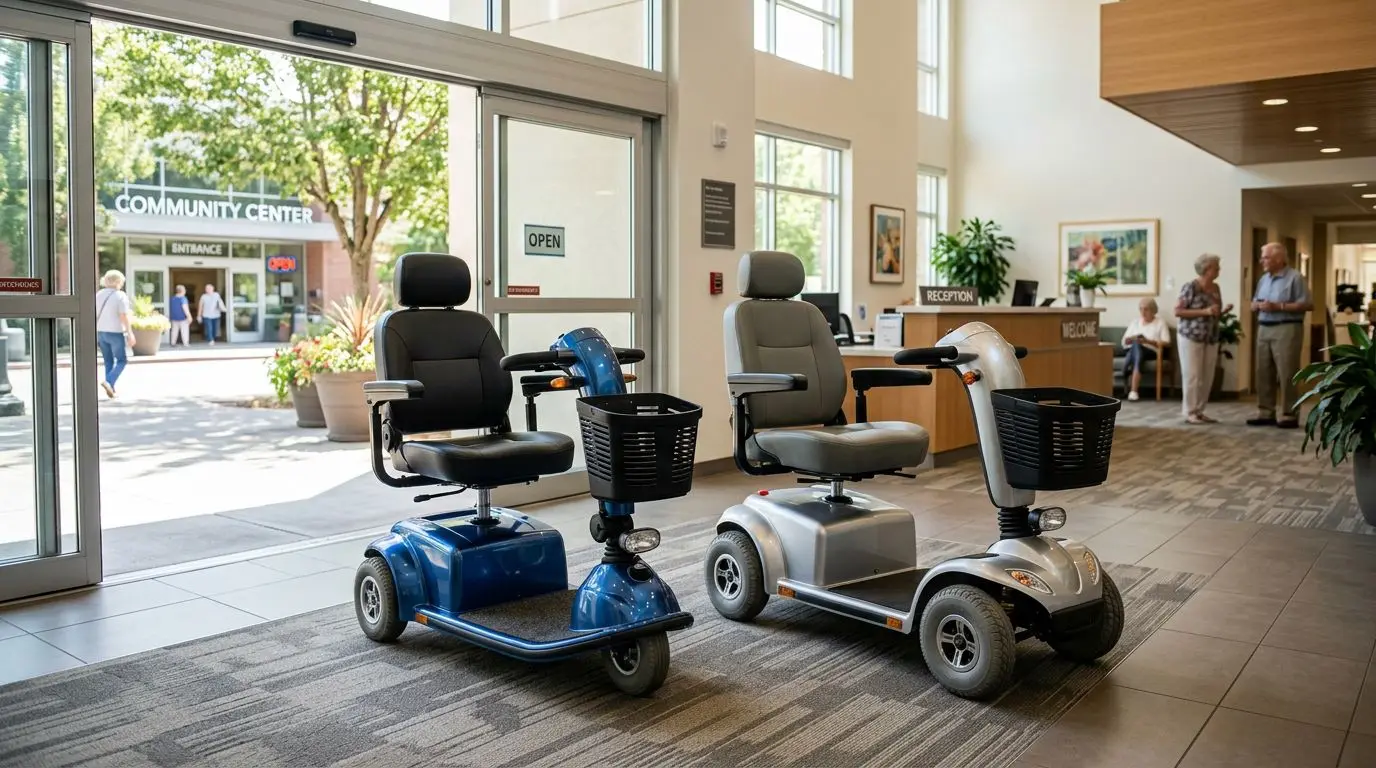
A 3-wheel mobility scooter is usually better for tight indoor spaces because it turns in a smaller circle, often around 31 to 45 inches. A 4-wheel mobility scooter is usually better for outdoor confidence and stability because the wider four-point base feels steadier on uneven pavement, curb cuts, and gentle slopes. The right choice depends on where you ride most, how much room you have to turn, and how secure you feel while steering.
If you mainly need a scooter for hallways, apartments, stores, and elevators, a 3-wheel design may be easier to handle. If your daily route includes sidewalks, parking lots, rougher paths, or a longer ride outside, a 4-wheel scooter is often the safer, more comfortable fit. Neither type is automatically best for everyone.
3-wheel vs. 4-wheel scooters at a glance: 31 to 60 inches of turning space can change everything
The biggest practical difference is turning radius. Many 3-wheel mobility scooters can turn in about 31 to 45 inches, while many 4-wheel scooters need closer to 44 to 60 inches or more, depending on size and tire layout. That matters in a kitchen, bedroom, hallway, medical office, or small retail aisle.
Stability is the other major difference. A 4-wheel scooter places the rider over four contact points, which generally creates a more planted feel on uneven ground or during gradual outdoor turns. A 3-wheel scooter has one front wheel, so it can steer sharply, but it may feel less secure during quick turns, on side slopes, or when one wheel crosses a raised edge.
| Factor | 3-wheel mobility scooter | 4-wheel mobility scooter |
|---|---|---|
| Typical turning radius | About 31 to 45 inches on many compact designs | About 44 to 60+ inches on many designs |
| Best common setting | Indoor use, tight turns, smaller homes | Outdoor routes, sidewalks, rougher surfaces |
| Stability feel | Good on flat surfaces, less planted on uneven ground | Generally steadier because of four-wheel contact |
| Legroom | Often more open space around the front column | May feel more boxed in, depending on frame design |
| Maneuverability | Excellent in narrow spaces | Good, but needs more room to turn |
| Rider confidence | Best for riders comfortable with sharper steering | Best for riders who want a steadier, more grounded feel |
Think of the choice this way: a 3-wheel scooter is often easier to point and pivot; a 4-wheel scooter is often easier to trust when the surface is not perfectly flat.
Stability and rider confidence: why 4 contact points usually feel steadier
Stability is not just a technical detail. It affects how relaxed you feel every time you cross a driveway, roll over a doorway threshold, or turn on a sidewalk. A 4-wheel scooter typically feels more stable because the weight is spread across two front wheels and two rear wheels. That can reduce the side-to-side tipping sensation some riders notice on 3-wheel scooters.
A 3-wheel scooter can still be safe when used as intended. On flat floors, level sidewalks, and smooth indoor surfaces, many people find them stable enough for daily use. The concern grows on uneven ground, sloped driveways, grass, gravel, or broken pavement. Even a 1-inch height change can feel significant if it catches a small front wheel at an angle.
Rider confidence also depends on speed and steering habits. Many everyday mobility scooters travel around 4 to 5 mph, though some are designed for higher speeds. At walking pace, both types may feel controlled. At faster speeds, sharp steering inputs on a 3-wheel scooter can feel more dramatic because the front end pivots more tightly.
Seat height and rider position matter too. A higher seat raises the rider center of gravity, which can increase the feeling of sway. A rider who weighs close to the scooter capacity limit, often 250 to 350 pounds on many standard scooters and higher on heavy-duty designs, should pay close attention to frame size, wheelbase, seat support, and manufacturer limits. Weight capacity is not just about whether the motor can move; it also affects handling, braking, and long-term durability.
- Choose 4 wheels if you are nervous about tipping or side slopes.
- Choose 3 wheels only if your routes are mostly smooth and flat.
- Slow down before turning, no matter which type you buy.
- Avoid crossing ramps or driveway aprons sideways when possible.
No scooter design removes all risk. Safe operation still depends on speed control, proper seating position, tire condition, and avoiding surfaces beyond the scooter rating.
Turning radius and indoor use: measure 32-inch doorways and 36-inch halls before choosing
Indoor use is where 3-wheel scooters often shine. The smaller turning radius helps in apartment hallways, senior living rooms, kitchens, bedrooms, and medical offices. A compact 3-wheel scooter may be able to turn where a larger 4-wheel scooter needs a three-point maneuver.
Start with your doors. A standard residential door is often called 32 inches wide, but the usable clear opening may be closer to 29 to 30 inches once the door and hinges are considered. Some bathroom doors are narrower. Scooter width varies by category, but many travel and standard scooters fall somewhere around 20 to 27 inches wide. That sounds like enough clearance, yet armrests, mirrors, baskets, and the rider’s hands can make tight doorways harder.
Hallway width matters as much as door width. A 36-inch hallway may be workable for many scooters, but turning from that hallway into a bedroom can be difficult if the scooter has a long wheelbase. A 3-wheel scooter’s tighter turning radius can help, especially if you need to turn around in a small room without backing up repeatedly.
Simple at-home turning test
Use painter’s tape or a measuring tape to mark a circle on the floor. If the scooter you are considering lists a 40-inch turning radius, create a 40-inch radius or an 80-inch diameter space to understand the full turn area. Some shoppers confuse radius with diameter. Radius is measured from the center of the turn to the outside path; diameter is the full width of the circle.
Also test the real path you use every day. Measure these areas:
- The narrowest doorway, including the clear opening with the door open.
- The hallway width at corners and near furniture.
- The space beside the bed, toilet, recliner, dining table, or desk.
- Elevator depth and width if you live in an apartment building.
- The turning area near your front door or garage entry.
If you need to make frequent tight turns in less than 5 feet of space, a 3-wheel scooter may be much easier to live with. If you have wide halls, open rooms, and most riding happens outdoors, the indoor advantage may matter less.
Outdoor use and terrain: 2-inch thresholds, curb cuts, and uneven pavement favor 4 wheels
Outdoor riding asks more from a scooter. Surfaces change quickly. You may move from a smooth garage floor to a driveway seam, a sidewalk crack, a curb cut, a parking lot, and a store entrance within a few minutes. These small changes are where 4-wheel scooters often feel more reassuring.
A 4-wheel scooter generally tracks straighter on sidewalks and gives the front end more support when one wheel meets a raised edge. It may also handle shallow dips and pavement seams with less steering wobble. Larger tires, suspension, and ground clearance make a major difference too, so do not judge outdoor ability by wheel count alone.
Thresholds deserve special attention. Many homes have doorway thresholds around 1/2 inch to 1 inch, and some exterior thresholds or uneven transitions can approach 2 inches. A scooter with small wheels and low ground clearance may scrape or stop abruptly. A 4-wheel scooter with larger tires may handle these transitions more comfortably, but only within the limits listed for that scooter type.
Grass and gravel are trickier. Mobility scooters are not all-terrain vehicles. Loose gravel can reduce traction, and wet grass can cause wheels to slip or sink. If you must cross a short packed-gravel driveway or a firm lawn path, a larger 4-wheel scooter with suitable tires will usually feel more stable than a compact 3-wheel travel scooter. Still, routine use on soft or uneven ground should be approached carefully.
| Outdoor condition | 3-wheel scooter | 4-wheel scooter | What to check |
|---|---|---|---|
| Smooth sidewalk | Usually fine at controlled speed | Usually fine and steadier | Tire size, braking, comfort |
| Cracked pavement | Can feel twitchier | Often more planted | Ground clearance and suspension |
| Curb cuts | Use straight-on and slowly | Generally more confidence | Approach angle and anti-tip design |
| Grass or loose gravel | Usually not ideal | Better only if designed for rougher surfaces | Tire tread, motor power, clearance |
| Sloped driveway | May feel less stable on side slopes | Usually preferred | Maximum incline rating and rider comfort |
When outdoor use is a daily need rather than an occasional extra, lean toward stability, larger wheels, and a frame that matches the terrain. Turning tightly is less important than feeling secure over the full route.
Comfort, legroom, and body fit: 250 to 350 lb capacities are common, but fit is personal
Body fit can change the answer. Some riders prefer 3-wheel scooters because the front section is more open, which can create extra knee and foot space. This can help taller riders, people with stiff knees, or anyone who needs to position their feet at a slight angle.
Many 4-wheel scooters have a wider front wheel assembly, so the foot platform may feel more structured. That is not always bad. Some riders like the defined foot space and steadier front end. Others may feel cramped. You cannot tell from wheel count alone; the deck length, tiller angle, seat height, armrest width, and swivel seat design all matter.
Weight capacity should be treated as a safety and performance number, not a goal. If a scooter lists a capacity of 300 pounds and the rider is near that number, it may have reduced range, slower hill climbing, and more strain on the frame and motor. A more generous capacity can provide a comfort margin, especially if the rider carries oxygen equipment, groceries, or a bag on the scooter.
Seat size matters as well. A seat that is too narrow can cause discomfort after 20 to 30 minutes, while a seat that is too wide can make armrests and controls harder to reach. If possible, sit on a scooter type before choosing. Your feet should rest securely, your knees should not press against the tiller, and your elbows should bend naturally when holding the controls.
- Check seat width and depth, not just scooter width.
- Look for adjustable armrests if transfers are difficult.
- Confirm the tiller can tilt or adjust to your reach.
- Make sure the swivel seat has room to rotate where you park.
- Consider how long you usually ride: 10 minutes indoors is different from 2 hours outside.
A scooter that fits your body well will feel safer because you will not need to twist, lean, or stretch to control it.
Portability and storage: travel scooters may break into 4 or 5 pieces
If you need to load a scooter into a car, portability may outweigh the 3-wheel versus 4-wheel question. Many travel scooters are designed to disassemble into 4 or 5 pieces, such as the seat, battery pack, front section, rear section, and basket. The heaviest piece can still be difficult to lift, often weighing several dozen pounds depending on design.
Three-wheel travel scooters are often slightly lighter and more compact, though this is not guaranteed. Four-wheel travel scooters can still disassemble, but the front section may be wider and the overall footprint may be longer. Before deciding, measure the trunk or cargo area of the vehicle you plan to use. Measure width, depth, hatch opening height, and the lift-over height from the ground.
Storage at home is just as important. A scooter may be parked in a hallway, entryway, garage, laundry room, or beside a bed. Leave room for the charger cord and safe walking space. A scooter that blocks a doorway or emergency exit is not a good fit, no matter how well it rides.
Charging usually requires a standard household outlet. Many batteries charge overnight, often in the range of 6 to 10 hours depending on battery type and level of discharge. Place the scooter where the cord will not create a trip hazard.
| Feature | Why it matters | Typical question to ask |
|---|---|---|
| Disassembly | Helps with car transport | Can I lift the heaviest piece safely? |
| Overall length | Affects elevators, closets, and trunks | Will it fit without removing the seat? |
| Battery access | Impacts charging and lifting | Can I remove or plug it in without bending too far? |
| Basket and accessories | Adds convenience but increases space needs | Will it catch on door frames? |
| Fold or take-apart design | Changes storage options | Is folding easier than disassembly for me? |
If lifting is difficult, ask a caregiver, therapist, or mobility equipment professional to help assess the transport routine. A scooter that is technically portable may still be impractical if one piece is too heavy.
Who it is best for: 3-wheel and 4-wheel choices by everyday situation
The best choice is the one that matches your real routine, not the one that looks best on paper. A person who rides 90 percent indoors has different needs than someone who rides to a mailbox, community center, bus stop, or grocery store several times a week.
A 3-wheel scooter is often best for people who:
- Ride mostly indoors on flat, smooth floors.
- Live in an apartment, condo, or smaller home with tight turns.
- Need to maneuver around furniture, bedroom corners, or narrow store aisles.
- Want a smaller turning radius, often under about 45 inches.
- Prefer a more open front area for knees and feet.
- Feel confident steering and slowing before turns.
A 4-wheel scooter is often best for people who:
- Ride outdoors daily or several times per week.
- Use sidewalks, curb cuts, driveways, or parking lots.
- Want the most stable-feeling layout for general use.
- Feel nervous about tipping or leaning in turns.
- Need a scooter that tracks steadily over longer distances.
- Have enough room at home for a wider turning radius, often 50 inches or more.
Some riders should strongly consider a 4-wheel design even if they like the maneuverability of 3 wheels. This includes riders who have poor trunk control, feel anxious on sloped surfaces, or often travel where pavement is uneven. That said, personal medical conditions should be discussed with a clinician or mobility specialist who can evaluate transfer ability, posture, vision, reaction time, and safe operation.
How to choose and measure: use a 10-minute home and route checklist
You can narrow the choice in about 10 minutes with a tape measure and a realistic look at your daily route. Do this before focusing on colors, accessories, or range numbers.
Step 1: Measure your tightest indoor spaces
Measure the clear width of your narrowest doorway, the width of your hallway, and the space where you must turn around. If your turning areas are less than 5 feet wide, a compact 3-wheel scooter deserves serious consideration. If your home has open rooms and wider paths, a 4-wheel scooter may work indoors without much trouble.
Step 2: Walk your outdoor route
Look for cracks, slopes, gravel, drainage dips, and curb cuts. Note any threshold or lip that looks close to 1 inch or higher. If the route is smooth and short, either type may work. If the route is uneven or includes slopes, a 4-wheel scooter with suitable ground clearance and tires is usually the better starting point.
Step 3: Check your turning confidence
Ask yourself how you feel on mobility equipment. Do you prefer quick, responsive steering, or do you want a slower, steadier feel? A 3-wheel scooter can feel nimble. A 4-wheel scooter can feel more grounded. Confidence is a real safety factor because nervous riders may overcorrect, brake suddenly, or avoid using the scooter altogether.
Step 4: Match capacity and range to real use
Do not buy based only on the maximum advertised range. Range can be affected by rider weight, terrain, speed, battery age, temperature, and stops. If your daily trip is 3 miles round trip, look for a comfortable margin rather than a scooter that barely meets that number under ideal conditions.
Step 5: Try before you commit when possible
If you can, test both types in a setting similar to your home or route. Practice a doorway, a hallway turn, a ramp, a curb cut, and a slow U-turn. Five minutes of real steering can reveal more than a page of specifications.
Common mistakes to avoid: a 1-inch obstacle can matter more than a long feature list
Many poor scooter choices happen because shoppers focus on the wrong number. Speed, range, and appearance are easy to compare, but they do not tell you whether the scooter will fit through your bathroom door or feel safe at the end of your driveway.
- Ignoring turning radius. A scooter that needs 60 inches to turn may be frustrating in a small apartment.
- Assuming 4 wheels means all-terrain. Four wheels improve stability, but tire size, clearance, suspension, and surface conditions still matter.
- Assuming 3 wheels are unsafe. A 3-wheel scooter can be a practical, safe choice on smooth indoor surfaces when used properly.
- Forgetting the rider plus cargo weight. Groceries, oxygen equipment, bags, and accessories add load.
- Overlooking transport weight. A take-apart scooter is only helpful if the heaviest piece can be lifted safely.
- Turning too fast. Most stability problems are worse when a rider turns sharply at speed.
One practical rule helps: choose the smallest scooter that safely handles your environment and the most stable scooter you can comfortably store and maneuver. That balance is different for every rider.
Final verdict: choose 3 wheels for tight indoor turns and 4 wheels for outdoor confidence
Choose a 3-wheel mobility scooter if your priority is maneuvering through tight indoor spaces, turning in small rooms, and keeping the front foot area more open. Choose a 4-wheel mobility scooter if your priority is stability, outdoor confidence, and a steadier ride over sidewalks, curb cuts, and uneven pavement.
If you are undecided, let your most demanding daily situation decide. A narrow hallway may push you toward 3 wheels. A sloped driveway or rough sidewalk may push you toward 4 wheels. The best scooter is not the one with the longest list of features; it is the one you will use safely, comfortably, and confidently every day.
FAQ: 5 practical answers before you decide
Are 4-wheel mobility scooters always safer than 3-wheel scooters?
No. Four-wheel scooters usually feel more stable, especially outdoors, but safety depends on the rider, terrain, speed, fit, maintenance, and correct use. A 3-wheel scooter used slowly on smooth indoor floors can be a very appropriate choice.
Can a 3-wheel scooter be used outside?
Yes, if the surface is smooth, level, and within the scooter’s limits. A 3-wheel scooter may work well on paved paths or short sidewalk trips, but it is usually less confidence-inspiring on cracked pavement, slopes, gravel, or uneven curb cuts.
What turning radius should I look for indoors?
For tight indoor use, many shoppers prefer a turning radius under about 45 inches. If your home has narrow hallways or small rooms, measure your actual turning spaces before deciding.
Do 4-wheel scooters fit through standard doorways?
Many do, but not all. A door described as 32 inches wide may have only 29 to 30 inches of clear opening. Check the scooter’s overall width and remember that armrests, mirrors, baskets, and hand position can affect clearance.
Which type is better for seniors who feel nervous riding?
A 4-wheel scooter often feels better for riders who are nervous because the base feels more planted. Still, the best choice should be tested at low speed in the places the rider will actually use it.
Frequently asked questions
Are 4-wheel mobility scooters always safer than 3-wheel scooters? +
No. Four-wheel scooters usually feel more stable, especially outdoors, but safety depends on the rider, terrain, speed, fit, maintenance, and correct use. A 3-wheel scooter used slowly on smooth indoor floors can be appropriate.
Can a 3-wheel scooter be used outside? +
Yes, if the surface is smooth, level, and within the scooter’s limits. A 3-wheel scooter may work for paved paths or short sidewalk trips, but it is usually less stable-feeling on cracked pavement, slopes, gravel, or uneven curb cuts.
What turning radius should I look for indoors? +
For tight indoor use, many shoppers prefer a turning radius under about 45 inches. Measure your actual hallways, doorways, and turning spaces before choosing.
Do 4-wheel scooters fit through standard doorways? +
Many do, but not all. A door described as 32 inches wide may have only 29 to 30 inches of clear opening, so check the scooter’s total width and account for armrests, baskets, mirrors, and hand position.
Which type is better for seniors who feel nervous riding? +
A 4-wheel scooter often feels better for nervous riders because the base is more planted. The best choice should still be tested at low speed in the spaces and outdoor areas where the rider will actually use it.
Related guides

Indoor vs. Outdoor Mobility Scooters: How to Match the Scooter Type to Where You’ll Use It
14 min read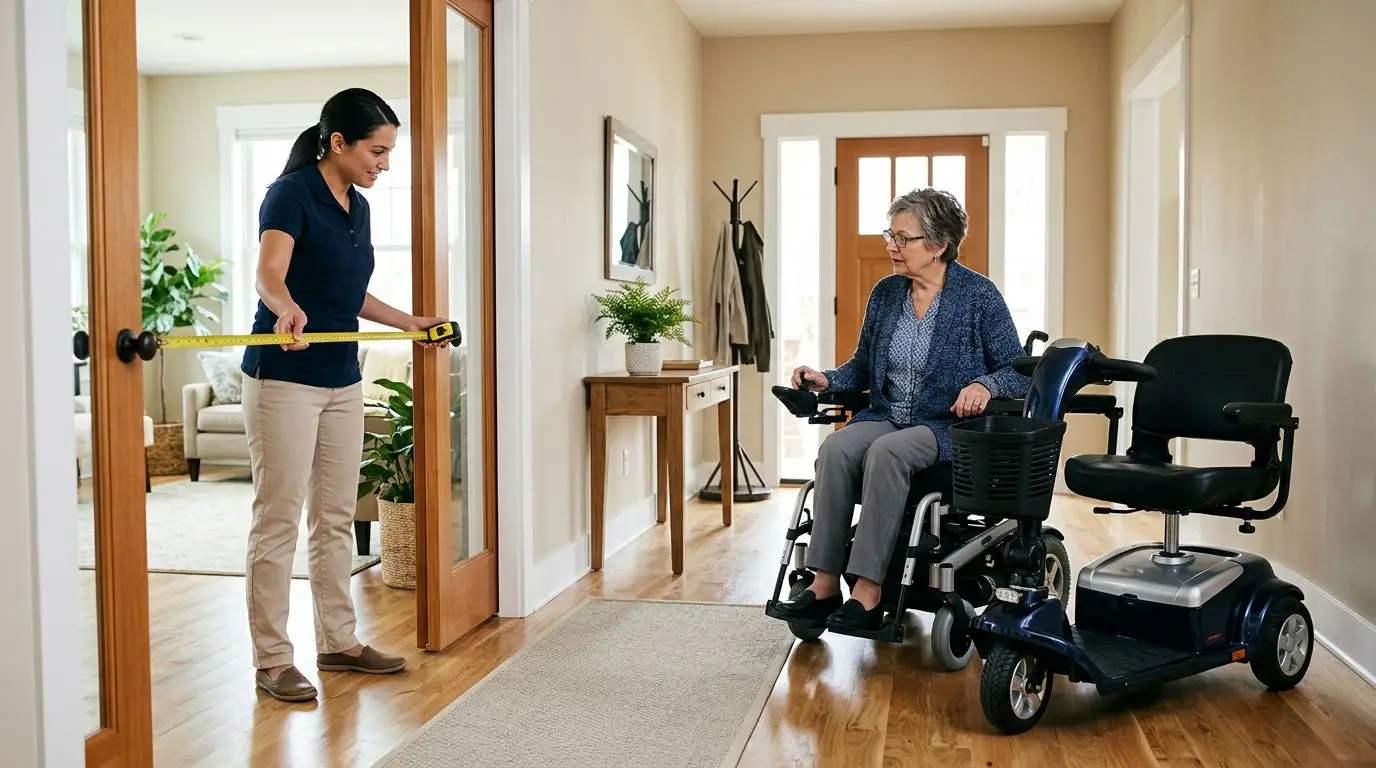
Mobility Scooter vs. Power Wheelchair: Which Mobility Device Is Right for You?
15 min read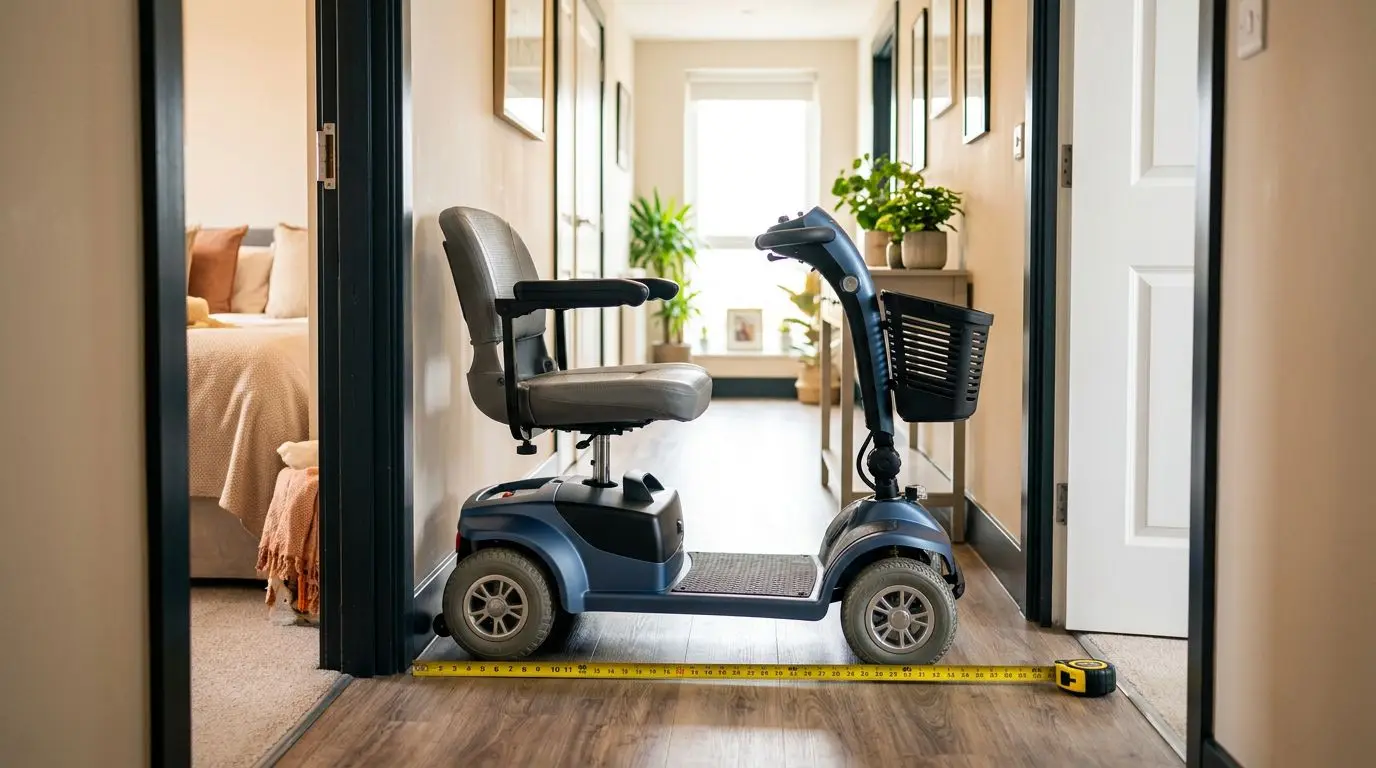
Compact Mobility Scooters for Apartments, Stores, and Tight Spaces: Dimensions That Matter
13 min read