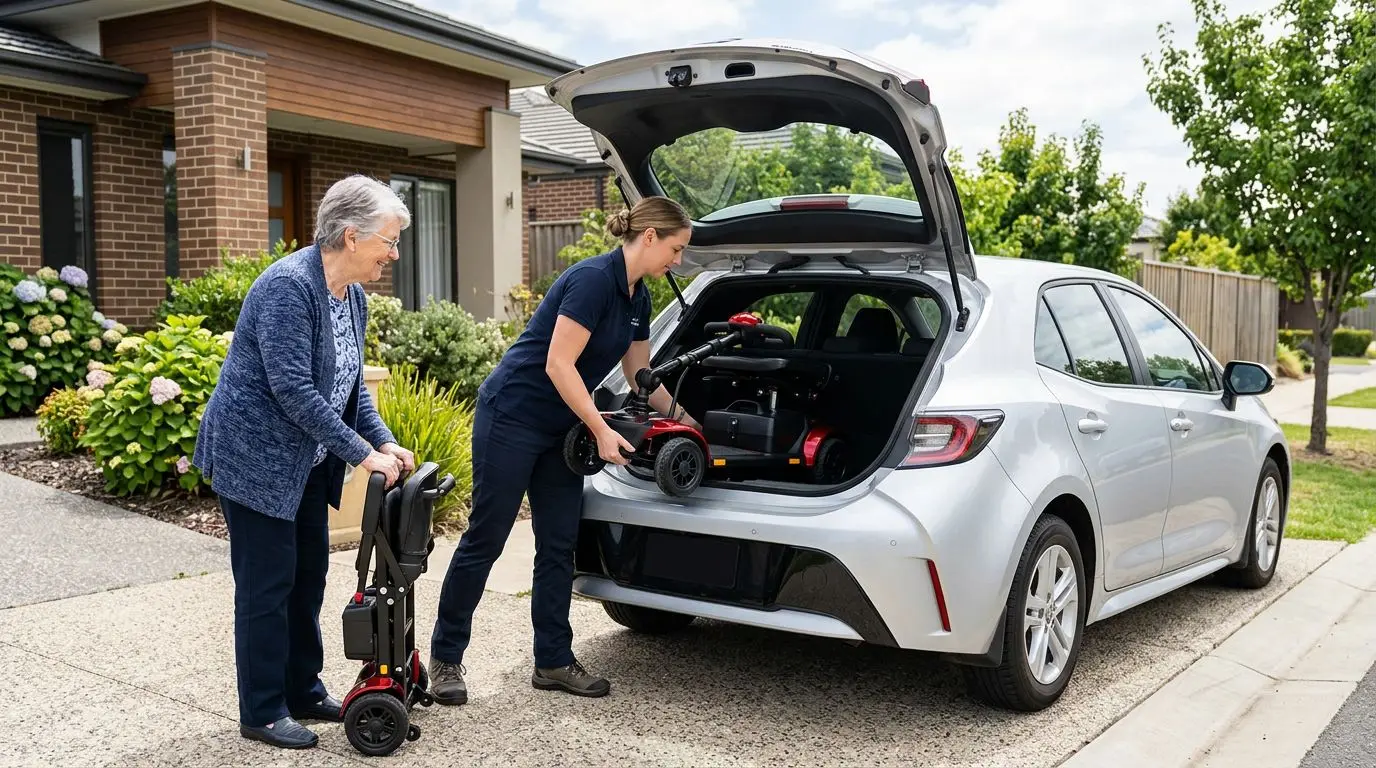
A travel, folding, or lightweight mobility scooter works best when it matches your real transportation routine: your car, your storage space, your lifting ability, and any airline rules you may need to follow. Before you buy, compare folded size, heaviest-piece weight, battery type, seat comfort, and ground clearance—not only total scooter weight. The right portable scooter should be easy enough to load on an ordinary day, not just in a showroom.
Portability always involves trade-offs. Smaller scooters usually store and travel better, but they often have less legroom, smaller wheels, lower weight capacity, shorter range, and a firmer ride than full-size models. This guide explains what to measure, which features matter, and who may be better served by another scooter type.
Travel Scooter Types: 3 Portable Designs Compared
Most portable mobility scooters fit into 3 broad categories: folding scooters, disassembling travel scooters, and ultra-light compact scooters. The names sometimes overlap, but the way each one loads into a car is different.
A folding scooter typically collapses into one unit. That can make storage simple, though the entire folded scooter may still need to be lifted at once. A disassembling travel scooter separates into several pieces, often including a front section, rear section, seat, battery, and basket. This reduces the heaviest-piece weight, but it adds setup time. Ultra-light compact scooters focus on minimal size and low weight, usually with smaller seats and wheels.
| Portable scooter type | Typical transport method | Common advantage | Common trade-off |
|---|---|---|---|
| Folding scooter | Folds into 1 main unit | Fast storage and simple handling | May require lifting the full scooter weight |
| Disassembling travel scooter | Separates into 4 to 5 pieces | Heaviest piece is often easier to lift | Assembly takes time and hand strength |
| Ultra-light compact scooter | Folds or breaks down into smaller parts | Best for tight trunks and small apartments | Usually less padding, range, and outdoor capability |
Do not judge portability by total weight alone. A 55 lb scooter that breaks into 5 manageable parts may be easier for many people than a 45 lb scooter that must be lifted as one awkward rectangle. Shape matters. Handles matter too.
Car Transport: Measure 4 Spaces Before You Buy
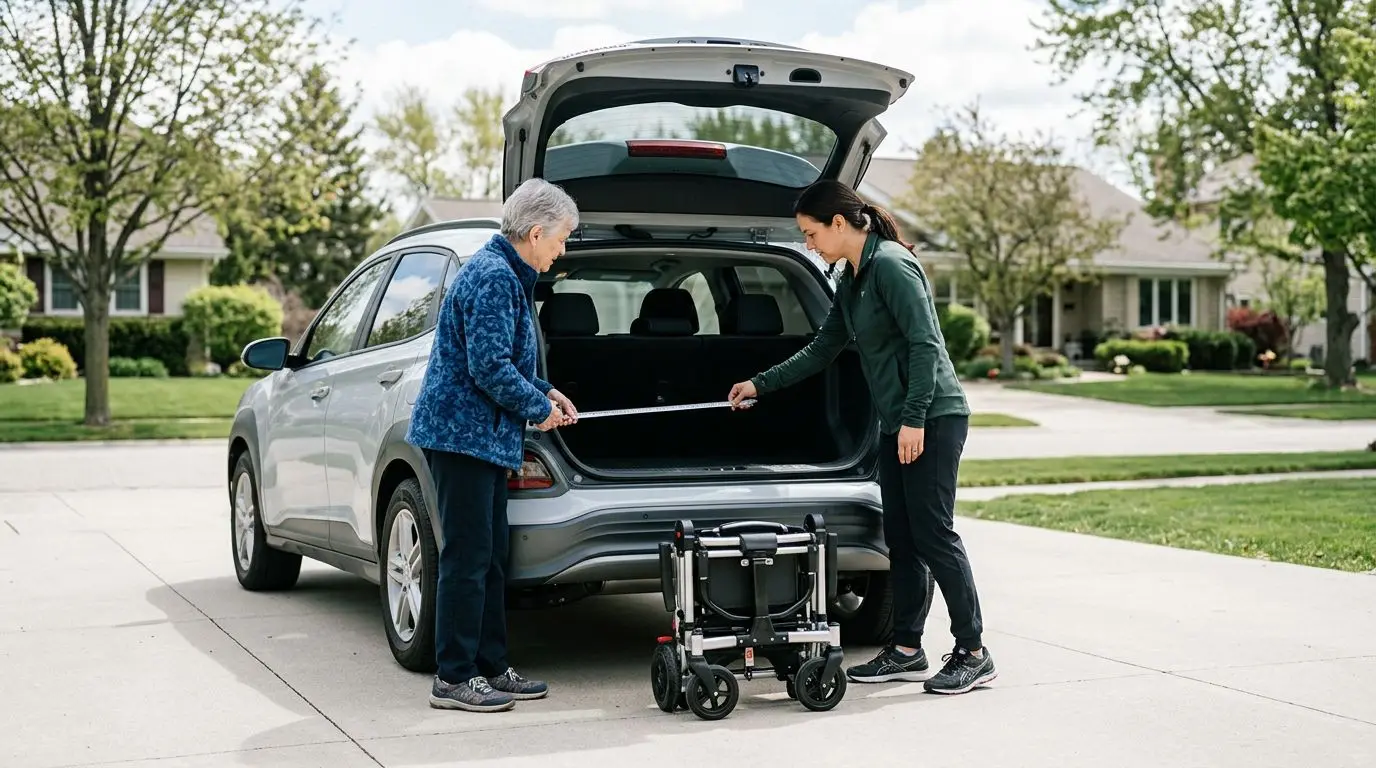
Before choosing a portable scooter, measure 4 areas: trunk opening width, trunk depth, trunk height, and lift-over height from the ground to the cargo floor. Write the numbers down in inches and compare them with the scooter’s folded or disassembled dimensions.
Start with the narrowest point. Many trunks look roomy inside but have a tighter opening. Measure the width between the smallest usable edges, not the widest interior wall. Then measure from the back of the trunk to the rear seat or hatch area. For height, check the vertical clearance at the opening and inside the cargo space.
Lift-over height is easy to overlook. A sedan trunk may require lifting the scooter 25 to 30 inches up and forward. A small SUV or crossover can require a higher lift, sometimes above 30 inches, even when the cargo space is larger. If you have shoulder, back, balance, or grip limitations, that extra height can matter more than the scooter’s published weight.
Simple measuring method
- Use a tape measure and record dimensions in inches.
- Measure the smallest trunk or hatch opening, not the largest interior space.
- Check whether the rear seats fold flat, and measure again if they do.
- Use a cardboard box or laundry basket to practice the lifting motion.
- Leave room for the battery, charger, cane, walker, groceries, or luggage.
If you regularly ride with another person, measure with their seat in its normal position. A scooter that only fits when the passenger seat is pushed all the way forward may not be practical.
Lifting Weight: Why 35 lb Feels Different at 50 Inches
The heaviest-piece weight is one of the most important numbers when shopping for a portable scooter. For many travel scooters, the heaviest section may fall somewhere around 30 to 50 lb, while total scooter weight may be higher once the seat, battery, and accessories are included.
Even a manageable weight can feel difficult when the piece is bulky, has no good handle, or must be lifted away from the body. A 35 lb rear section held close to your torso is not the same as a 35 lb folded scooter lifted from ground level into a tall cargo area. Balance and grip are part of the workload.
Ask yourself who will load the scooter on a normal weekday. If the answer is usually you, choose based on your own safe lifting ability, not on what a family member can do once in a while. If a caregiver will load it, include that person in the measuring and test-lifting process.
Questions that reveal the real lifting burden
- What is the heaviest single piece in pounds?
- Does that piece have a handle or natural grip point?
- Can the battery be removed before lifting?
- Can the seat be removed with one hand?
- Will you lift it into a trunk, SUV hatch, closet, or garage shelf?
- Do you need to load it more than 2 times per outing?
If lifting is the main obstacle, a disassembling scooter may be easier than a one-piece folding scooter. If storage speed is the main issue, a folding design may be better. The best choice depends on your routine.
Airline Travel: 2 Battery Rules to Check Before Flying
For airline travel, the 2 main battery details to confirm are battery chemistry and watt-hour rating. Many portable scooters use lithium-ion batteries, while some use sealed, non-spillable batteries. Airlines may require advance notice, terminal protection, and battery removal or documentation.
For lithium-ion mobility aid batteries, common airline and federal guidance focuses on watt-hours, often written as Wh on the battery label. A removable lithium-ion battery for a mobility device is commonly limited to 300 Wh, with spare battery limits often set at 1 spare up to 300 Wh or 2 spares up to 160 Wh each. Airline procedures can vary, so check directly with the carrier before your trip.
Do this at least 48 hours before departure. Ask what paperwork they need, whether the battery must be removed, how the terminals should be protected, and whether the scooter can be gate-checked. Keep the charger in your carry-on if possible, and take photos of the scooter before handing it over to airline staff.
Air travel checklist
- Find the battery label and note the watt-hours.
- Confirm whether the battery is lithium-ion or sealed non-spillable.
- Call the airline and ask about mobility device battery rules.
- Bring the user manual or battery specification sheet if available.
- Protect exposed battery terminals from short circuits.
- Remove loose accessories before gate-checking the scooter.
A portable scooter can make airports easier, but it should not be treated like ordinary luggage. Give yourself extra time at check-in and boarding.
Storage at Home: Plan for a 24-by-36-Inch Parking Spot
A compact scooter still needs a practical home base. As a starting point, plan for at least a 24-by-36-inch floor area for a folded or disassembled scooter, then adjust based on the actual folded dimensions. Some designs need more space because the tiller, rear wheels, or basket stick out.
Think about charging as well. The storage spot should be close to an outlet and dry, level, and out of the main walking path. A hallway corner may look convenient, but it can become a tripping hazard if the scooter blocks a walker, cane path, or doorway.
Apartment and senior-living residents should check building rules before buying. Some buildings restrict storage in hallways or shared spaces. If you plan to store the scooter in a closet, measure the door opening and the turning space in front of the closet. A folded scooter that fits inside the closet but cannot turn through the doorway is still a problem.
Good storage locations often have these traits
- A nearby standard electrical outlet for charging.
- Enough room to stand beside the scooter while folding it.
- A dry floor away from rain, sprinklers, or snow melt.
- No blocking of emergency exits or walking paths.
- Room for the charger cord without stretching it across a walkway.
Battery care is part of storage. Follow the manufacturer’s charging instructions, especially if the scooter will sit unused for several weeks.
Features Worth Comparing: 8 Details That Affect Daily Use
Portable scooters can look similar online, but 8 practical features can change how they feel: seat size, tiller adjustment, wheel diameter, ground clearance, turning radius, battery range, weight capacity, and braking style. These are not luxury details. They affect comfort, safety, and usefulness.
| Feature | Why it matters | What to check |
|---|---|---|
| Seat width and padding | Affects comfort on longer errands | Compare seat width in inches and whether armrests adjust |
| Tiller adjustment | Helps position hands and arms comfortably | Check angle range and whether controls are easy to reach |
| Wheel diameter | Larger wheels usually handle cracks better | Compare front and rear wheel size, often 6 to 9 inches on compact scooters |
| Ground clearance | Low clearance can scrape on thresholds | Look for clearance in inches and consider your sidewalks |
| Turning radius | Important in apartments and stores | Smaller numbers turn more tightly |
| Battery range | Determines how far you can travel per charge | Treat advertised range as an estimate, not a guarantee |
| Weight capacity | Affects performance and frame suitability | Choose capacity with a comfortable margin |
| Braking style | Affects stopping control and confidence | Understand automatic braking and freewheel mode |
Range deserves special caution. Published range is often measured under controlled conditions. Real-world range can drop with higher rider weight, hills, cold weather, rough pavement, frequent starts and stops, and older batteries. If your typical outing is 5 miles, it is wise to choose a scooter with more than a 5-mile advertised range.
Also check ground clearance. Many lightweight scooters are designed for smooth floors, paved paths, and short transitions. A 2-inch curb, steep driveway lip, gravel path, or broken sidewalk may be too much for some compact designs.
Who Lightweight Scooters Are Best For: 5 Common Shopper Profiles
Lightweight and folding mobility scooters are best for shoppers who value transport and storage over maximum outdoor power. They often work well for 5 types of users: frequent car travelers, apartment residents, cruise or airline travelers, part-time scooter users, and people who need help with longer walking distances in stores or public spaces.
They are especially useful when the main challenge is fatigue or limited walking endurance over longer distances, not the need to cross rough ground. A travel scooter may help someone move through a grocery store, museum, airport terminal, community event, or medical campus with less strain. It should be viewed as a mobility tool, not a medical treatment.
A portable scooter may be a good fit if you:
- Need it to fit in a trunk or small SUV.
- Have limited storage space at home.
- Use the scooter for errands, appointments, and travel days.
- Ride mostly on smooth pavement and indoor floors.
- Can safely transfer on and off a compact seat.
- Can load it yourself or have reliable help.
You may need a larger scooter if you:
- Ride daily for long distances outdoors.
- Need higher ground clearance for uneven areas.
- Require a wider, more supportive seat.
- Need a higher weight capacity than compact scooters commonly offer.
- Regularly travel over grass, gravel, steep ramps, or rough sidewalks.
If balance, vision, reaction time, or transfer safety is a concern, talk with a qualified health professional or mobility specialist before buying. A scooter should fit both the environment and the rider.
How to Choose: A 10-Step Portable Scooter Checklist
A good buying process starts with 10 practical checks. Work through them before comparing colors, accessories, or optional extras.
- Measure your vehicle. Record trunk width, depth, height, and lift-over height.
- Measure home storage. Include doorways, closet openings, and charging space.
- Check heaviest-piece weight. Do not rely only on total scooter weight.
- Confirm folded or disassembled dimensions. Compare them with your real spaces.
- Review rider weight capacity. Leave a reasonable margin for clothing, bags, and accessories.
- Consider seat comfort. Check width, back height, armrests, and transfer ease.
- Match wheels to surfaces. Smaller wheels are best for smooth indoor and paved areas.
- Check battery range and charging routine. Plan for real-world conditions.
- Ask about airline battery documentation. Get watt-hours and battery chemistry in writing.
- Review return and service options. Know what happens if it does not fit your car or body.
If possible, test the folding or disassembly process more than once. The first attempt may feel easy with a salesperson helping. The better test is whether you can repeat the process calmly, without rushing, and without pinching fingers or straining your back.
Pay attention to the tiller and controls. Some scooters use thumb levers; others use finger controls or a delta-style tiller that allows different hand positions. If you have arthritis, neuropathy, reduced grip strength, or hand pain, control layout can matter as much as weight.
Portability vs Comfort: 4 Trade-Offs to Expect
Every lightweight scooter involves at least 4 trade-offs: size, ride comfort, range, and stability. Smaller frames are easier to store, but they can feel less roomy. Smaller batteries reduce weight, but they may reduce travel distance. Smaller wheels help compactness, but they can make bumps more noticeable.
Stability is not only about the number of wheels. Many portable scooters come in 3-wheel or 4-wheel layouts. A 3-wheel design may turn more tightly in small rooms and store aisles. A 4-wheel design may feel more planted for some riders, especially outdoors, but it may need more turning space. Neither layout is automatically best for everyone.
Comfort also depends on body position. Check knee room, foot platform size, seat height, and whether the tiller can be adjusted without crowding your legs. If you are tall, have long legs, or use a cushion, verify that your knees do not hit the tiller during turns.
Think about the longest likely ride. A scooter that feels fine for 5 minutes may feel cramped after 45 minutes at an airport gate or outdoor event. If you need all-day comfort, a slightly heavier scooter may be the more practical choice.
FAQ: 5 Common Questions About Folding and Travel Scooters
Can a lightweight mobility scooter fit in a car trunk?
Many can, but only if the folded size or disassembled pieces match your trunk opening and cargo space. Measure in inches before buying, especially the narrowest opening and lift-over height.
Is a folding scooter always easier than a disassembling scooter?
No. A folding scooter may be faster to collapse, but it may need to be lifted as one piece. A disassembling scooter can take longer to set up, yet the heaviest piece may be easier to manage.
Can I take a travel mobility scooter on an airplane?
Often, yes, but the airline must confirm battery rules and handling procedures. Check battery chemistry, watt-hours, terminal protection, and whether the battery must be removed before gate-checking.
How much range do I need?
Choose more advertised range than your exact trip distance. Hills, rider weight, cold weather, rough surfaces, and frequent stopping can reduce real-world range.
Are lightweight scooters safe outdoors?
They can be appropriate on smooth sidewalks, paved paths, and level surfaces, but many are not built for gravel, grass, steep slopes, or high curbs. Check ground clearance, wheel size, and slope guidance.
Frequently asked questions
Can a lightweight mobility scooter fit in a car trunk? +
Many can, but only if the folded size or disassembled pieces match your trunk opening and cargo space. Measure the narrowest trunk opening, cargo depth, height, and lift-over height before buying.
Is a folding scooter always easier than a disassembling scooter? +
No. A folding scooter may be faster to collapse, but it may need to be lifted as one unit. A disassembling scooter takes more setup time, yet the heaviest piece may be easier to lift.
Can I take a travel mobility scooter on an airplane? +
Often, yes, but you must confirm the airline’s battery and handling rules. Check battery chemistry, watt-hours, terminal protection, and whether the battery must be removed.
How much scooter range do I need? +
Choose more advertised range than your exact trip distance. Hills, rider weight, cold weather, rough surfaces, and frequent starts and stops can reduce real-world range.
Are lightweight mobility scooters safe outdoors? +
They can be suitable on smooth sidewalks, paved paths, and level surfaces. Many compact scooters are not intended for gravel, grass, steep slopes, high curbs, or rough sidewalks.
Related guides
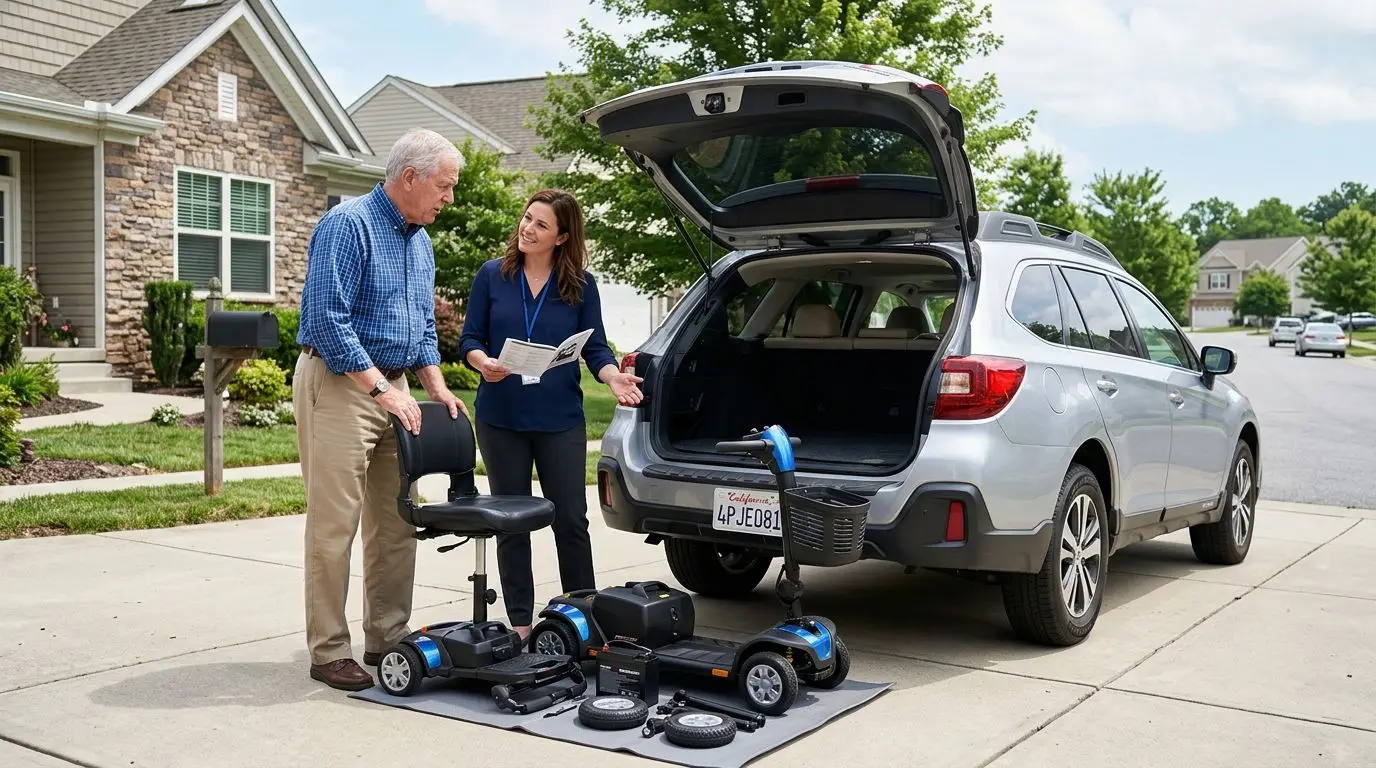
Portable Mobility Scooters for Cars: Folding, Disassembling, and Lift-Compatible Types Compared
12 min read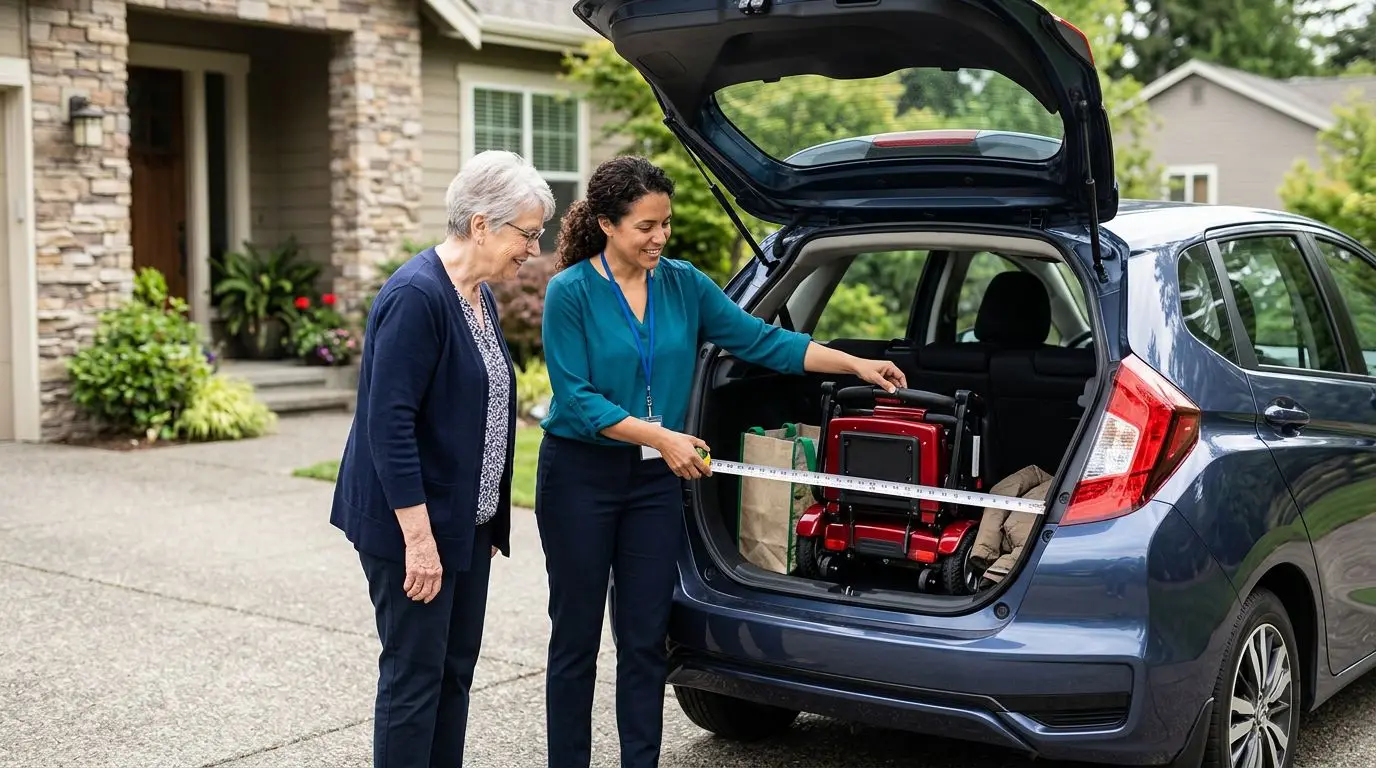
Foldable Lightweight Mobility Scooters: Manual Folding, Auto Folding, and Disassembly Options Explained
14 min read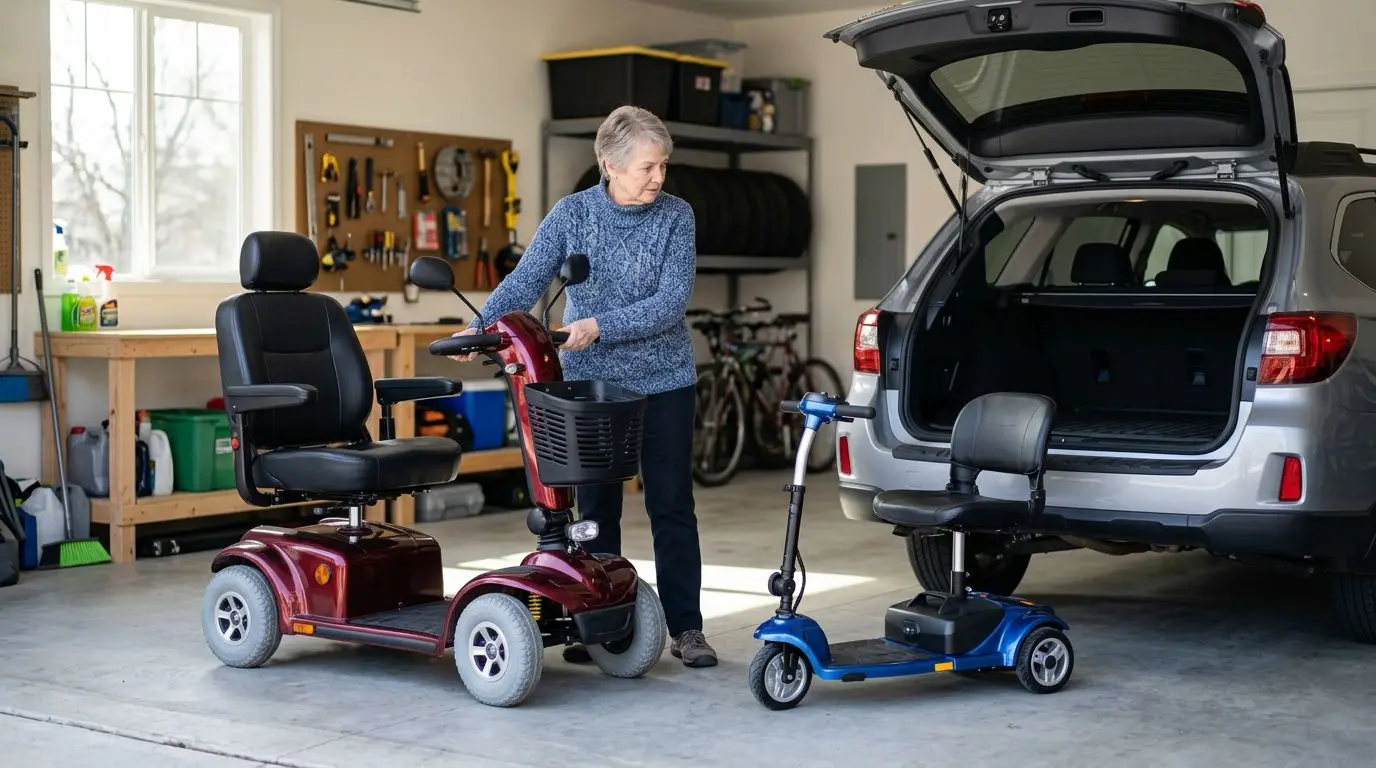
Travel vs. Full-Size Mobility Scooters: How to Choose Between Portability, Comfort, and Range
15 min read