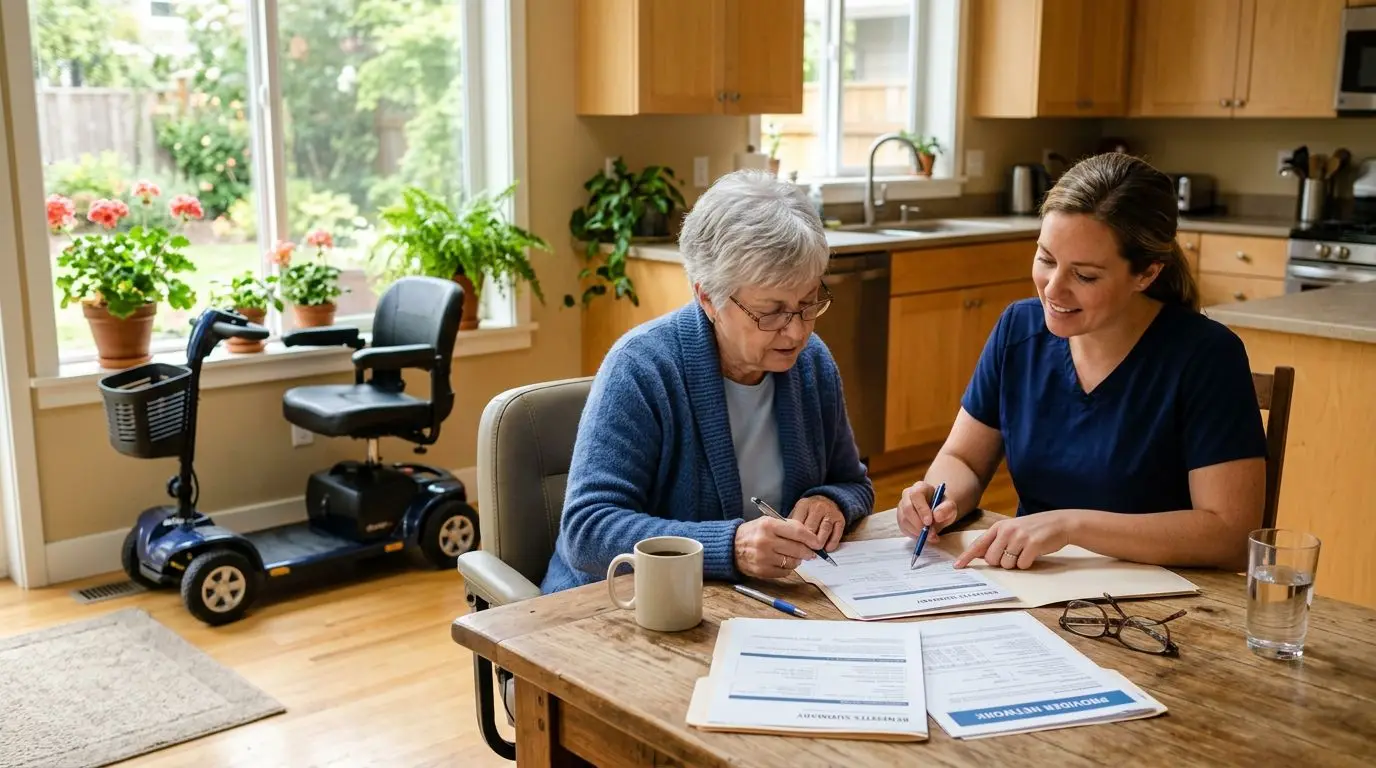
A mobility scooter prescription is usually not enough on its own for insurance approval. Most insurers, including Medicare Part B, look for detailed medical records showing that you have a mobility limitation affecting daily activities inside the home, that safer or less costly options are not sufficient, and that you can use a scooter safely.
Your doctor’s documentation should explain your diagnosis, walking limits, fall risk, strength, balance, pain or shortness of breath, and why a cane, walker, or manual wheelchair will not meet your needs. The stronger the medical necessity notes are, the less likely your claim is to be delayed because information is missing.
Why the prescription is only 1 part of approval
A written prescription may say something simple, such as “mobility scooter needed.” That can start the process, but it rarely proves medical necessity by itself. Insurance reviewers want to see the clinical reasoning behind the order, usually from a face-to-face visit and supporting medical records.
For Medicare, a mobility scooter is generally treated as durable medical equipment, often called DME. Private insurance and Medicaid plans may use similar language, though each plan can set its own forms, prior authorization steps, and review timelines. Some plans require approval before delivery. Others may deny payment if the required documentation is dated after the equipment was provided.
The key issue is not whether a scooter would be convenient outdoors. It is whether the scooter is medically necessary to help you perform mobility-related activities of daily living, often called MRADLs, in your home. These are basic tasks such as getting to the bathroom, moving to the kitchen to prepare a meal, or reaching the bedroom safely.
That distinction matters. Many people need help with long walks in parking lots or stores, but insurance coverage often focuses first on in-home mobility. If your records discuss only community outings, vacations, or shopping trips, the claim may be considered incomplete even when your need is real.
What doctors should document in the medical necessity note: 7 core items
A strong mobility scooter medical necessity note connects your medical condition to specific mobility problems. It should read like a clear explanation, not a one-line request.
Doctors commonly need to document these 7 areas:
- Diagnosis or condition: Examples may include arthritis, neurologic disease, cardiopulmonary disease, amputation, severe balance impairment, chronic pain, or another condition that affects walking. The note should connect the diagnosis to function.
- Walking distance and endurance: A useful note might say you can walk 20 feet with a walker before needing to sit, or that you become unsafe after 2 minutes of standing. Specific limits are stronger than “poor mobility.”
- Mobility-related daily activities: The doctor should describe which in-home tasks are difficult, such as toileting, bathing access, meal preparation, or moving between rooms.
- Why simpler aids are not enough: The record should explain why a cane, walker, crutches, or manual wheelchair does not meet your needs. This may involve upper-body weakness, pain, poor endurance, shortness of breath, unsafe gait, or repeated falls.
- Safety and ability to operate: A scooter has a tiller, seat, controls, and battery-powered movement. The doctor should document that you can transfer on and off, sit upright, steer, stop, and understand safe operation.
- Home fit: Reviewers may look for evidence that the scooter can be used inside the home. Doorways, hallway turns, thresholds, and floor surfaces can matter.
- Expected duration of need: Many insurers want to know whether the mobility limitation is long-term. A need expected to last 3 months may be viewed differently from a chronic or permanent limitation.
Specific measurements help. “Patient is limited to 10 to 15 feet due to knee pain and instability” is more useful than “patient cannot walk far.” Likewise, “has fallen 3 times in 6 months while walking to the bathroom” gives reviewers a clearer safety picture than a general statement about fall risk.
Mobility limitations insurers look for inside the home: 5 common examples
Insurance approval usually depends on whether your mobility limitation affects necessary daily tasks. The records should show what happens during normal home routines, not only during a doctor’s office exam.
| In-home task | What documentation should explain | Helpful detail |
|---|---|---|
| Getting to the bathroom | Distance, urgency, falls, need for assistance | “Bathroom is 25 feet from recliner; patient stops twice due to pain.” |
| Preparing meals | Standing tolerance, ability to reach kitchen safely | “Can stand 3 minutes before needing to sit.” |
| Moving bedroom to living area | Gait instability, fatigue, transfer ability | “Uses walker but knees buckle after short distances.” |
| Bathing access | Safe approach to bathroom and transfers | “Requires supervision after 2 recent near-falls.” |
| Answering door or moving between rooms | Speed, balance, and endurance limitations | “Unable to cross hallway safely without seated rest.” |
A note does not need dramatic language. It needs clear, practical detail. If the main issue is pain, the doctor should document pain severity, triggers, and how pain affects movement. If the main issue is shortness of breath, the note should describe what level of exertion brings it on and whether it improves with rest.
For people with fluctuating conditions, the record should describe the pattern. Someone who can walk 60 feet on a good morning but cannot safely reach the bathroom later in the day may still have a significant limitation. That pattern needs to be documented.
Why canes, walkers, and manual wheelchairs must be addressed before a scooter
Many insurance reviewers use a step-by-step logic. If a cane, walker, crutches, or manual wheelchair would safely meet your in-home mobility needs, they may not cover a powered scooter. That is why the doctor’s note should not skip over these options.
The goal is not to criticize simpler equipment. In many cases, a walker is the right tool. But if a walker is unsafe or insufficient, the medical record should explain why. Examples include severe shoulder pain, hand weakness, poor grip, unstable gait, oxygen desaturation with exertion, or fatigue after a few steps.
A manual wheelchair also has to be considered. If you cannot self-propel a manual wheelchair because of limited arm strength, shoulder disease, poor endurance, or cardiopulmonary limits, that should be written clearly. If a caregiver is not available to push the chair for daily needs, that may also be relevant, depending on the insurer’s policy.
| Mobility option | When it may be enough | When records may support a scooter instead |
|---|---|---|
| Cane | Mild balance support for short distances | Frequent falls, leg weakness, or need for 2-sided support |
| Walker | Moderate support with adequate endurance | Unsafe gait, severe fatigue, hand pain, or inability to walk room-to-room |
| Manual wheelchair | User can self-propel or has daily pushing help | Shoulder weakness, poor stamina, pain, or no available caregiver support |
| Mobility scooter | Can transfer, sit upright, steer, and use tiller controls | Powered mobility is needed for in-home MRADLs and home layout allows use |
This is one of the most common documentation gaps. A prescription may identify the scooter, but the chart note may not explain why lower-level aids are not medically sufficient. Reviewers often ask for that missing step.
Safety documentation: transfers, vision, cognition, and home layout within 36 inches
A mobility scooter must be safe for the user and the home environment. Insurance approval can be difficult if the record does not address safe operation.
The doctor may document whether you can transfer from a bed or chair onto the scooter seat. Transfers do not have to be perfect, but they should be safe enough for routine use, with any needed assistance or transfer technique noted. If you need a caregiver for transfers, the record should state that honestly.
Posture matters too. Scooters generally require the user to sit upright and maintain balance while turning, stopping, and crossing thresholds. The doctor should mention trunk control, dizziness, severe tremor, or other issues that could affect safe use.
Cognition and vision are also part of safety. A user needs to understand basic controls, judge distance, respond to obstacles, and stop when needed. Documentation should avoid vague labels and focus on function. For example: “Patient is alert, follows 2-step commands, and can demonstrate safe stop-and-go control” is more useful than “patient seems fine.”
Home layout is practical. Some interior doorways are around 28 to 32 inches wide, while many scooters require enough room for the device and the rider’s hands and knees. Turning space can be more important than doorway width. Narrow hallways, tight bathroom turns, thick rugs, and raised thresholds can all affect whether the scooter can be used for the tasks being claimed.
If your home has tight spaces, measure before the paperwork is finalized. A scooter that cannot reach the bathroom or bedroom may not satisfy the insurer’s in-home medical necessity standard.
How to prepare for the face-to-face visit in 30 minutes
A focused appointment can make the documentation stronger. Before the visit, spend 30 minutes writing down your mobility limits in everyday terms. Bring the list with you and give a copy to the clinician if possible.
Include concrete examples:
- How far you can walk inside before you must sit, such as 10 feet, 25 feet, or 1 room length.
- How many falls or near-falls you have had in the past 3, 6, or 12 months.
- Which daily tasks are unsafe or impossible without help.
- What assistive devices you have tried and what happened.
- Whether pain, weakness, breathing, balance, or fatigue is the main barrier.
- Whether symptoms change during the day.
Do not exaggerate. Accurate details help your doctor write a record that matches your condition. If you can walk short distances on some days, say that. Then explain what happens on bad days or after repeated trips to the bathroom or kitchen.
It is also helpful to bring medication lists, recent hospital or therapy notes, fall reports, and names of specialists involved in your care. Physical therapy or occupational therapy notes can be especially useful because they often include gait distance, transfer status, strength, balance testing, and home safety observations.
How to measure your home for scooter use: 6 spots to check
Insurance reviewers may not inspect your home, but your supplier or clinician may ask whether the scooter can be used indoors. You can reduce problems by checking 6 areas before ordering paperwork moves forward.
- Main entry path: Measure door width and note steps, ramps, or thresholds. A 1-inch raised threshold can still be a problem for some users.
- Hallways: Measure width at the narrowest point, especially where furniture narrows the path.
- Bathroom approach: Check whether a scooter can reach close enough for a safe transfer or whether the turn is too tight.
- Bedroom access: Look at the path from the bed to the door and where the scooter would park.
- Kitchen route: Confirm that cabinets, tables, and rugs do not block the turning path.
- Charging location: Identify an outlet where the scooter can be parked without creating a trip hazard. Many batteries are charged for several hours at a time, often overnight.
Write down measurements in inches. Photos can also help your clinician or equipment provider understand barriers. If the home cannot accommodate a scooter but may accommodate a different powered mobility device, discuss that before a claim is submitted.
Who a prescribed mobility scooter is best for: 4 practical fit factors
A prescribed mobility scooter is generally best for someone who has a significant walking limitation but still has enough upper-body control, sitting balance, vision, and judgment to operate tiller steering safely. It is not the right fit for every mobility impairment.
Good candidates often share 4 practical factors:
- They need powered mobility for basic in-home tasks. The need is tied to toileting, eating, bathing access, or moving room-to-room, not only long outdoor trips.
- They can transfer safely. This may be independent or with consistent assistance, depending on the situation and insurer rules.
- They can operate hand controls. Tiller steering requires reach, grip, coordination, and attention.
- The home can support use. The scooter can reach the areas connected to the documented mobility limitation.
A scooter may be a poor fit for someone who cannot sit upright, cannot safely steer, has severe cognitive impairment affecting operation, or needs complex seating support. In those cases, a clinician may consider other equipment. The right device should match the person, the home, and the medical need.
Common documentation gaps that lead to denials within 14 to 30 days
Many denials are not because the person has no mobility problem. They happen because the submitted record does not answer the insurer’s questions. Requests for more information may arrive within a few weeks, though timelines vary by plan.
| Documentation gap | Why it hurts the claim | How to strengthen the record |
|---|---|---|
| Prescription only | No clinical proof of medical necessity | Add face-to-face note with diagnosis, limits, and MRADLs |
| Outdoor need only | Many policies focus on in-home use | Describe bathroom, kitchen, bedroom, and transfer needs |
| No walking distance | Reviewer cannot judge severity | Document feet, minutes, rests, falls, or assistance needed |
| No discussion of walker or wheelchair | Insurer may view scooter as not the least costly adequate option | Explain why each simpler aid is unsafe or insufficient |
| No safety statement | Reviewer may question ability to operate | Document transfers, sitting balance, vision, cognition, and hand control |
| Home access not addressed | Scooter may not meet in-home need | Include doorway, hallway, and room access information when relevant |
If you receive a denial, read the reason carefully. It may ask for a missing exam note, clearer MRADL limitations, proof that a manual wheelchair is not suitable, or a corrected order. A denial is not always the end of the process. Many plans allow appeals, but deadlines can be short.
Medicare, Medicaid, and private insurance: 3 coverage paths to verify
Coverage rules vary. Medicare Part B, Medicaid, Medicare Advantage plans, and employer or marketplace health plans can all handle mobility scooter requests differently. Always verify the current requirements with your plan before assuming approval.
For Medicare Part B, the scooter generally must be medically necessary for use in the home, prescribed after a face-to-face evaluation, and supplied through an eligible DME supplier. Medicare Advantage plans must cover at least the same basic Medicare benefits, but they may use network rules, prior authorization, or specific documentation forms.
Medicaid coverage varies by state. Some Medicaid programs require prior authorization, therapy evaluations, or home assessments. Private insurers often require prior authorization and may request chart notes from the last 6 to 12 months, depending on the policy.
Ask these questions before submission:
- Is prior authorization required?
- Does the plan require a specific mobility evaluation form?
- How recent must the face-to-face visit be?
- Must the supplier be in network?
- Does the plan require a home assessment or therapy evaluation?
- What appeal deadline applies if the claim is denied?
Keep copies of every order, office note, therapy report, denial letter, and appeal submission. A simple folder can prevent delays when the insurer asks for the same information twice.
FAQ: 5 questions about mobility scooter prescription requirements
Can my doctor just write a prescription for a mobility scooter?
Your doctor can write a prescription, but insurance usually needs more than that. The medical record should document your diagnosis, walking limits, in-home daily activity problems, safety to operate the scooter, and why lower-level mobility aids are not enough.
Does insurance cover a scooter if I only need it outside?
Often, no. Many insurance policies, including Medicare’s standard medical necessity approach, focus on mobility needs inside the home. Outdoor-only convenience, shopping, or community travel may not meet the coverage standard.
What walking distance should be documented?
There is no single distance that guarantees approval. The record should state your real limit in feet or minutes and explain what happens, such as pain, shortness of breath, leg weakness, unsafe balance, or the need to sit.
Do I need a physical therapy evaluation?
Some plans require one, and others request it when the medical record is not clear. Therapy notes can help because they often include objective details such as gait distance, transfer ability, strength, balance, and home safety concerns.
What if my mobility scooter claim is denied?
Read the denial reason and deadline first. Many denials involve missing documentation, such as no face-to-face note, no in-home MRADL limitation, or no explanation of why a walker or manual wheelchair is not enough. Ask your doctor and supplier what records are needed for an appeal.
Frequently asked questions
Can my doctor just write a prescription for a mobility scooter? +
A prescription alone is usually not enough for insurance approval. The medical record should document your diagnosis, walking limits, in-home daily activity problems, safe operation, and why a cane, walker, or manual wheelchair will not meet your needs.
Does insurance cover a scooter if I only need it outside? +
Often, no. Many policies focus on whether the scooter is medically necessary for mobility-related daily activities inside the home, such as reaching the bathroom, bedroom, or kitchen.
What walking distance should my doctor document? +
There is no single distance that guarantees approval. Your doctor should document your real limit in feet or minutes and explain what happens when you exceed it, such as pain, fatigue, shortness of breath, weakness, or unsafe balance.
Do I need a physical therapy evaluation for a mobility scooter? +
Some insurance plans require one, and others may request it if the chart notes are not detailed enough. Therapy documentation can strengthen a claim by recording gait distance, transfer ability, strength, balance, and home safety issues.
What should I do if my mobility scooter claim is denied? +
Read the denial reason and appeal deadline first. Then ask your doctor and equipment supplier which records are missing, such as a face-to-face visit note, in-home mobility limitations, or an explanation of why simpler mobility aids are not sufficient.
Related guides

Mobility Scooter Claim Denied? Common Insurance Reasons and How to Start an Appeal
14 min read
Mobility Scooter Prior Authorization Checklist: What to Ask Your Doctor, Plan, and Supplier
12 min read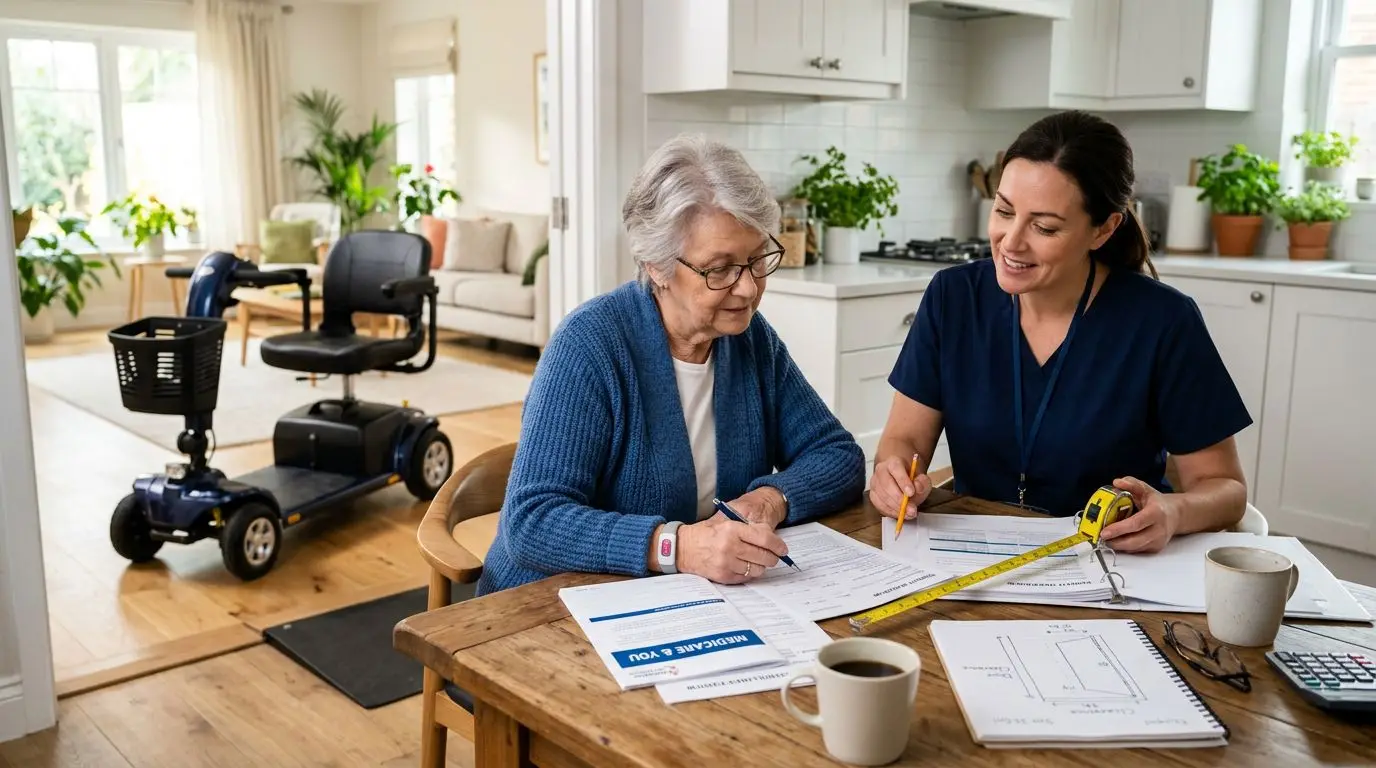
Does Medicare or Insurance Cover Mobility Scooters? A US Buyer’s Guide
12 min read