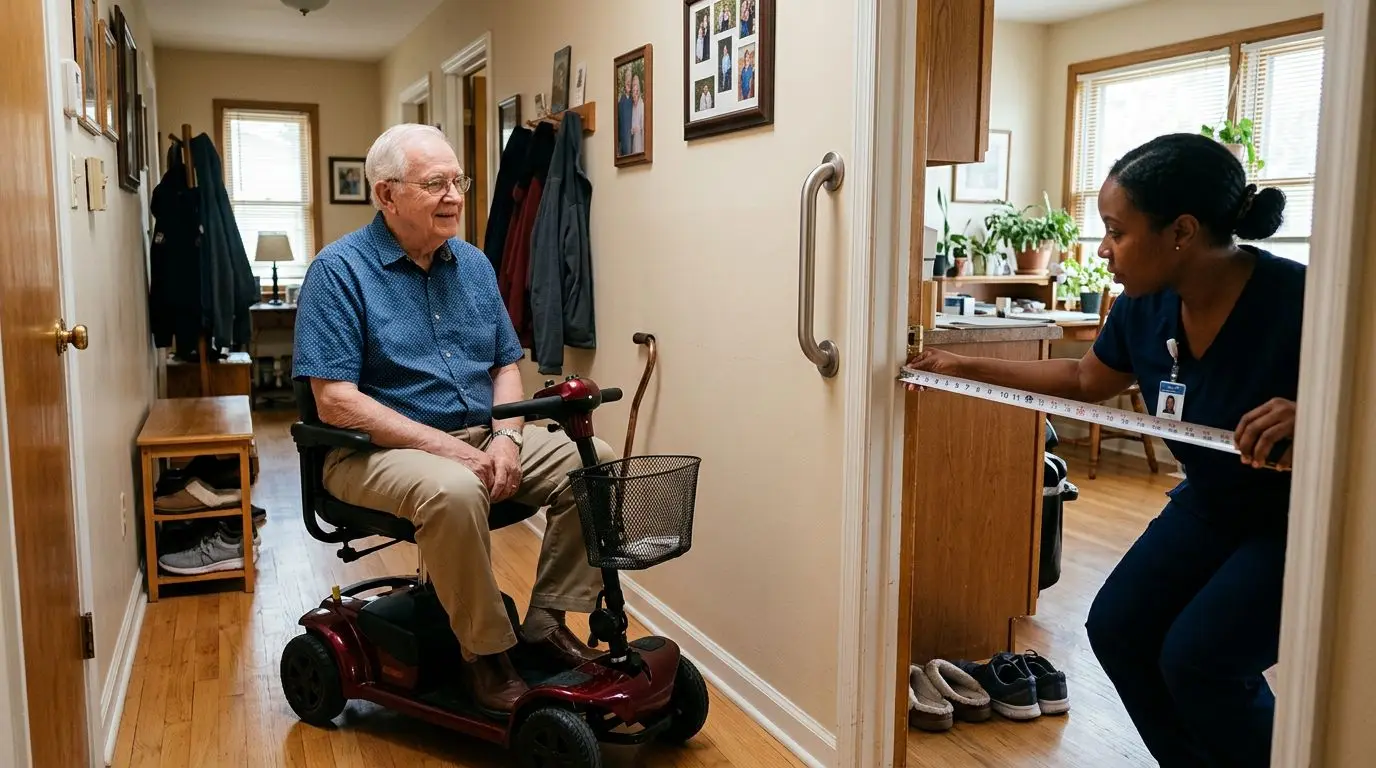
Insurance-covered mobility scooters generally must be medically necessary for use inside the home, not simply helpful for errands, shopping, travel, or outdoor convenience. In practical terms, the insurer wants to know whether the scooter helps you complete essential daily activities at home, such as getting to the bathroom, bedroom, kitchen, or a chair safely.
This is one of the most common approval barriers. A person may clearly struggle outdoors but still be denied if the documentation does not show a mobility need within the home.
The 1 core rule: coverage is usually based on in-home mobility
Most health insurance programs that cover durable medical equipment review mobility scooters through a medical-necessity lens. For many plans, including Medicare-style coverage rules, the central question is not, “Would a scooter make life easier?” It is closer to: “Is this device needed for basic mobility-related activities of daily living inside the home?”
That distinction matters. A scooter used mainly for walking the dog, visiting a store 2 miles away, crossing a large parking lot, or attending an outdoor event may be valuable. Still, outdoor usefulness alone usually does not meet the standard for insurance payment.
Insurers often consider a scooter only after asking whether a simpler mobility aid would work. That may include a cane, walker, manual wheelchair, or other assistive device. A scooter is more likely to be considered when those options are not safe or functional for the person’s in-home needs.
Coverage rules vary by plan, state, and benefit type, but the pattern is consistent: documentation must connect the device to safe movement inside the living space. A prescription by itself is often not enough. The medical record usually needs to explain functional limitations, the tasks affected, and why the scooter is appropriate for the home.
What “needed at home” means in a 20- to 36-inch doorway world
In-home need means the scooter helps with necessary movement inside the residence. Think about the daily routes that make a home livable: bed to bathroom, chair to kitchen, kitchen to dining area, bedroom to medication storage, and living room to the front door in case of an appointment or emergency.
Many US homes have interior doorways around 28 to 32 inches wide, though older homes and bathroom entries may be narrower. Hallways are often about 36 inches wide, but furniture, rugs, laundry baskets, and tight corners can shrink usable space. That is why insurers and clinicians may ask whether a scooter can actually operate inside the home, not just whether the person has difficulty walking.
Here are examples of in-home mobility concerns that are more relevant to coverage:
- Needing to reach the bathroom in time but being unable to walk the distance safely.
- Having a high fall risk when moving from the bedroom to the kitchen.
- Being unable to prepare a simple meal because standing and walking are too limited.
- Not being able to move between essential rooms even with a cane or walker.
- Requiring frequent seated rest after only a short distance, such as 10 to 20 feet.
By contrast, a person who walks safely inside but cannot tolerate a large grocery store may have a real access problem, yet the request may be considered outdoor or community mobility. That difference can decide approval.
In-home need vs outdoor convenience: 6 common examples
The same scooter can support both indoor and outdoor mobility, but the reason for coverage matters. Documentation that focuses only on outdoor distance, shopping fatigue, or travel plans may miss the insurer’s main requirement.
| Situation | How insurers may view it | Why it matters |
|---|---|---|
| Unable to get from bed to bathroom safely, even with a walker | Potential in-home medical need | Bathroom access is a basic daily activity |
| Needs help moving from living room to kitchen several times per day | Potential in-home medical need | Meal access and hydration are essential |
| Can walk indoors but cannot cross a large parking lot | Often outdoor/community convenience | Important, but not usually the core coverage test |
| Wants a scooter for amusement parks or vacations | Usually not covered | Travel use is typically outside medical necessity rules |
| Cannot propel a manual wheelchair inside due to arm weakness | May support power mobility need | Shows why a simpler device may not work |
| Needs a scooter only for shopping trips twice a week | Often not enough by itself | Errands alone may not establish in-home need |
This does not mean outdoor life is unimportant. Social connection, appointments, and errands matter. The point is narrower: when insurance is paying, the file usually has to prove the scooter is medically necessary in the home first.
How clinicians document the need in 4 practical steps
A strong request usually connects medical conditions to specific functional limits. It should avoid vague statements such as “patient would benefit from a scooter” and instead explain what the person cannot do safely at home without power mobility.
The process often includes 4 parts:
- Face-to-face evaluation. A qualified medical provider evaluates mobility limitations, diagnoses, strength, balance, endurance, pain, breathing tolerance, or other relevant factors.
- Functional description. The record describes what happens inside the home, such as inability to reach the bathroom without stopping, falling, or needing another person’s help.
- Consideration of alternatives. The documentation explains why a cane, walker, or manual wheelchair is not enough, unsafe, or not practical for the person’s condition.
- Home suitability. The request addresses whether the device can be used in the residence, including doorway width, turning space, flooring, and storage or charging access.
Some plans may require a supplier evaluation, occupational or physical therapy input, prior authorization, or specific forms. Private insurance, Medicaid programs, Medicare Advantage plans, and workers’ compensation rules may each handle the process differently. Always check the plan’s current requirements before ordering equipment.
One more point: the person must generally be able to operate the scooter safely, or have a realistic support plan if the policy allows caregiver-assisted use. Safe steering, braking, transfers, judgment, and vision can all matter.
How to measure your home: 7 numbers to write down
Home measurements can make or break the practical side of a scooter request. A scooter that cannot pass through the bathroom doorway or turn at the end of a hall may not solve the in-home problem, even when the medical need is real.
Before a mobility evaluation or supplier visit, write down these 7 measurements:
- Narrowest doorway width. Measure the clear opening, not the trim. Many bathroom doors are under 30 inches.
- Hallway width. Measure the tightest point, including handrails, furniture, or stored items.
- Turning space. Note areas where a scooter must turn 90 degrees, such as hallway-to-bedroom or hallway-to-bathroom turns.
- Floor transitions. Measure thresholds between rooms. Even a 1-inch rise can affect safe use.
- Ramp slope or entry step height. If the scooter must enter from outside, measure any step or ramp area.
- Storage area. Measure the space where the scooter would park without blocking exits.
- Outlet distance. Note whether charging can happen within about 6 feet of a safe parking spot, without creating a cord trip hazard.
Also take photos of tight turns, rugs, raised thresholds, and narrow bathroom entries. A simple sketch of the home can help the evaluator understand the daily route. Keep it factual. The goal is not to make the home look worse than it is; it is to show whether power mobility can realistically support essential daily movement.
Scooter features that affect in-home use: 3-wheel, 4-wheel, and compact designs
Insurance decisions should not be based on style or convenience features. Even so, the type of scooter matters because the device must fit the user and the home environment.
| Type or feature | Common in-home advantage | Possible limitation |
|---|---|---|
| 3-wheel scooter | Often has a tighter turning radius for indoor corners | May feel less stable than some 4-wheel designs for certain users |
| 4-wheel scooter | Often provides a more stable base | May need more room to turn in small homes |
| Compact travel-style scooter | May fit better through narrow spaces and store in less room | May have lower weight capacity or less seating support |
| Full-size scooter | May offer more seat support, range, or capacity | May be too large for bathrooms, halls, or tight turns |
| Adjustable tiller and seat | Helps position hands, knees, and hips safely | Still must allow safe transfers and steering clearance |
| Anti-tip wheels and lights | Can support safer operation in low light or uneven areas | Do not replace the need for proper fit and training |
Many mobility scooters have weight capacities somewhere between about 250 and 400 pounds, depending on category, but capacity alone is not the whole fit. Seat width, transfer height, legroom, tiller reach, turning radius, and overall scooter width all matter.
For insurance purposes, the best-fitting scooter is not necessarily the largest or most feature-rich. It is the least complex device that safely meets the documented in-home mobility need and fits the user’s residence.
Who insurance-covered scooters are best for: 5 typical situations
An insurance-covered scooter may be appropriate for someone who has significant difficulty moving inside the home and cannot meet that need safely with simpler equipment. It is not meant to replace walking for someone who can safely perform essential indoor activities without it.
It may be a stronger fit when 5 conditions are present:
- Indoor walking is unsafe or not functional. The person cannot reliably reach essential rooms without falls, severe fatigue, shortness of breath, or pain that limits function.
- A cane or walker is not enough. These devices have been tried or considered and do not solve the in-home mobility problem.
- A manual wheelchair is not practical. The person may lack the arm strength, endurance, coordination, or home setup needed to self-propel.
- The person can operate a scooter safely. Steering, braking, transfers, vision, and judgment are adequate for the home environment.
- The home can accommodate the device. Doorways, floors, turns, and storage space allow practical use.
It may be a weaker insurance fit when the main issue is community distance only. For example, if someone walks around the home independently but wants a scooter for flea markets, airport terminals, or weekend shopping, that may be a legitimate personal purchase consideration, but it may not meet insurance criteria.
There are gray areas. Some people can take a few steps indoors but cannot complete a full daily routine safely. Others have fluctuating conditions and are unsafe at certain times of day. In those cases, detailed medical notes and real examples are especially important.
How to prepare before requesting coverage: a 10-item checklist
Preparation can reduce delays. It also helps your clinician write documentation that matches what the insurer needs to review.
- List the rooms you cannot reach safely and how often the problem occurs each day.
- Write down recent falls, near-falls, or times you needed help moving at home.
- Describe how far you can walk indoors, such as 10 feet, 25 feet, or from bed to door.
- Note which devices you use now, including a cane, walker, rollator, or wheelchair.
- Explain why those devices do not work well enough inside the home.
- Measure narrow doorways, halls, thresholds, and turning spaces.
- Take photos of tight areas, especially bathrooms and bedroom entries.
- Ask whether a physical or occupational therapy mobility evaluation is needed.
- Confirm whether prior authorization is required before delivery.
- Use an in-network or approved equipment supplier when your plan requires it.
Be honest and specific. Saying “I cannot get from my bed to the bathroom at night without holding walls and stopping twice” is more useful than saying “I need a scooter to get around.”
If coverage is denied: watch the 30- to 60-day appeal window
Denials happen for several reasons. The most common are missing documentation, no clear in-home need, lack of proof that simpler devices are insufficient, or a home environment that does not appear suitable for scooter use.
Read the denial letter carefully. Many plans give a deadline for appeal, often around 30 to 60 days, though the exact timeframe varies. The letter should state why the request was denied and what information may be needed.
Useful appeal materials may include:
- Updated clinician notes that describe in-home mobility limitations.
- A therapy evaluation addressing balance, endurance, transfers, and safe operation.
- Home measurements showing the scooter can fit through required routes.
- Documentation of failed or unsafe use of a cane, walker, or manual wheelchair.
- A corrected prescription or prior authorization form, if the first one was incomplete.
Do not assume a denial means you can never qualify. Sometimes the issue is not medical need but the way the request was written. On the other hand, if the scooter is mainly for outdoor convenience, travel, or shopping, insurance may continue to deny it even after appeal.
FAQ: 5 answers about insurance and in-home scooter need
Will insurance cover a scooter if I only need it outside?
Usually not. Many insurers focus on whether the scooter is medically necessary for essential mobility inside the home. Outdoor errands, shopping, vacations, or long parking lots may not be enough by themselves.
Does Medicare ever cover mobility scooters?
Medicare Part B may cover a power-operated vehicle when specific medical-necessity requirements are met, including a documented need for use in the home. The provider and supplier must also follow Medicare rules. Medicare Advantage plans may have their own authorization steps.
What if my home is too small for a scooter?
If a scooter cannot fit through necessary doorways or make required turns, the insurer may question whether it solves the in-home problem. A different mobility device or home modification may need to be considered.
Is a doctor’s prescription enough for approval?
Often, no. A prescription is important, but insurers commonly require supporting medical records, functional details, and sometimes a mobility evaluation or prior authorization.
Can I mention outdoor needs in my request?
Yes, but outdoor needs should not be the main evidence if insurance coverage depends on in-home use. Make sure the documentation clearly explains the essential indoor tasks you cannot perform safely without the scooter.
The key takeaway is simple: insurance coverage is usually built around medical necessity at home. If a scooter is needed to safely reach the bathroom, kitchen, bedroom, or other essential areas, that should be documented clearly. If it is mainly for errands or outdoor convenience, it may still be useful, but insurance may not pay for it.
Frequently asked questions
Will insurance cover a scooter if I only need it outside? +
Usually not. Many insurers focus on whether the scooter is medically necessary for essential mobility inside the home. Outdoor errands, shopping, vacations, or long parking lots may not be enough by themselves.
Does Medicare ever cover mobility scooters? +
Medicare Part B may cover a power-operated vehicle when specific medical-necessity requirements are met, including a documented need for use in the home. The provider and supplier must also follow Medicare rules.
What if my home is too small for a scooter? +
If a scooter cannot fit through necessary doorways or make required turns, the insurer may question whether it solves the in-home problem. A different device or home modification may need to be considered.
Is a doctor’s prescription enough for approval? +
Often, no. A prescription is important, but insurers commonly require supporting medical records, functional details, and sometimes a mobility evaluation or prior authorization.
Can I mention outdoor needs in my request? +
Yes, but outdoor needs should not be the main evidence if insurance coverage depends on in-home use. The documentation should clearly explain the essential indoor tasks you cannot perform safely without the scooter.
Related guides
Power Wheelchair vs. Mobility Scooter Coverage: Why Insurance May Approve One and Not the Other
14 min read
Does Medicare or Insurance Cover Mobility Scooters? A US Buyer’s Guide
12 min read
Private Insurance Coverage for Mobility Scooters: Medical Necessity, Prior Approval, and What You May Pay
13 min read