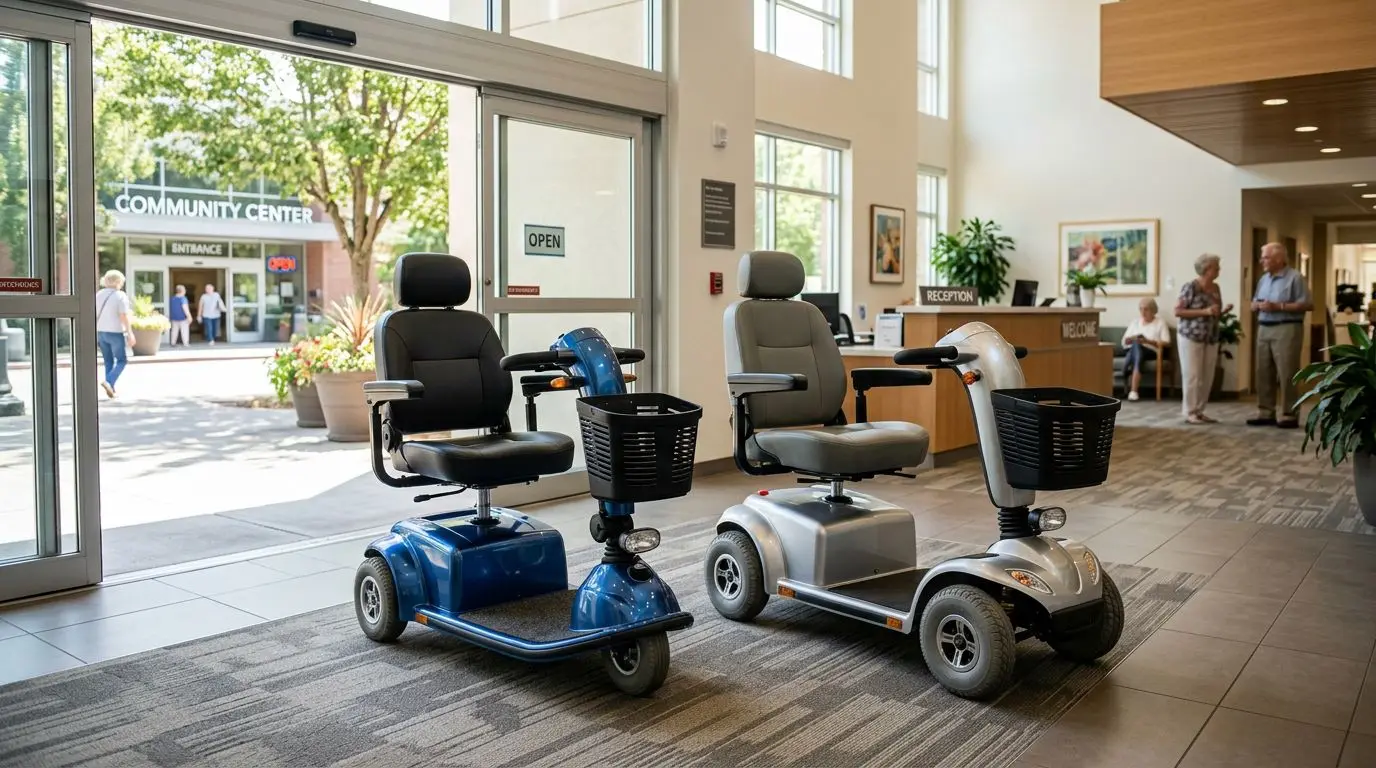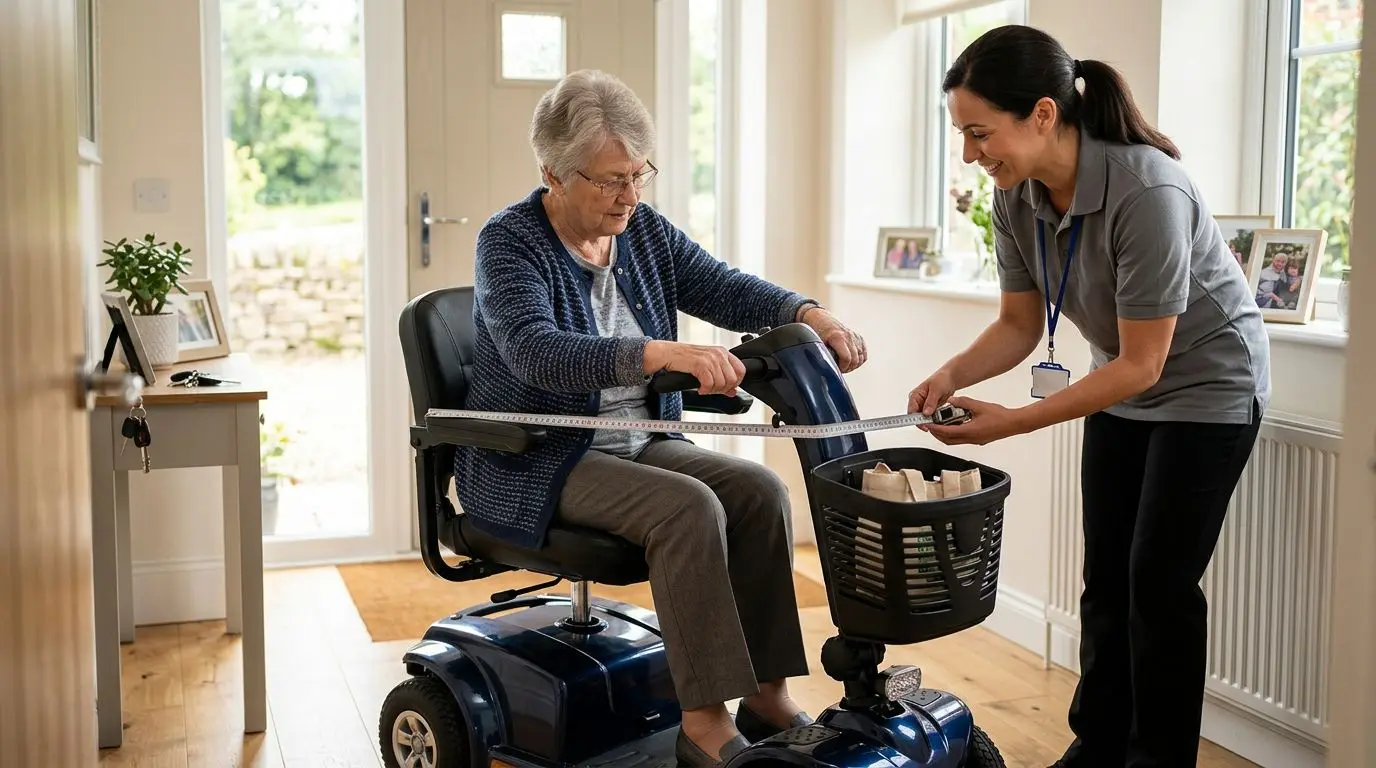
A better-fitting mobility scooter should let you sit upright, reach the controls without stretching, rest your feet flat, and get on and off safely. Before choosing a scooter, check seat height, seat width, swivel function, armrest adjustment, legroom, and tiller angle against your own body measurements instead of relying on the scooter’s overall size alone.
The right fit is about more than comfort. A scooter that matches your reach, hip width, knee bend, and transfer needs can reduce awkward movements and make everyday use easier, especially on trips that last 30 minutes or more.
What a better fit means: 6 points to check
A mobility scooter fits well when six contact points work together: hips, back, arms, hands, knees, and feet. If one point is off by even 1 or 2 inches, you may feel it as shoulder tension, cramped knees, sliding forward in the seat, or difficulty turning the tiller.
Begin with posture. Your hips should sit back against the seat, your back should feel supported, and your shoulders should stay relaxed. Your elbows should have a slight bend when you hold the tiller, not a locked-out reach. Your knees need enough room to bend naturally, and your feet should rest fully on the floorboard or foot area without hanging over the edge.
For many adults, a comfortable seated knee angle is roughly 90 to 110 degrees. That range is not a medical rule, but it is a helpful visual cue. If your knees sit much higher than your hips, the seat may be too low or the foot space too tight. If your toes barely reach the floorboard, the seat may be too high or too far back.
Think of fit as a system. A higher seat can make standing easier, but it may reduce knee clearance under the tiller. A wider armrest setting may feel better at the hips, but it can make the scooter harder to maneuver through a 30-inch doorway. A more upright tiller can bring the controls closer, but it may limit space during transfers on or off the scooter.
Seat height and seat depth: how to measure in 5 minutes
Seat height is one of the most important comfort measurements. Many scooter seats have a fixed height or a few height positions, often changing in increments of about 1 inch. Your goal is to sit with your feet supported, your knees comfortable, and your hips high enough that standing up does not require excessive effort.
To measure at home, sit on a firm dining chair while wearing your shoes. Measure from the floor to the top of the seat where your weight rests. That number gives you a useful comparison point when reading scooter specifications or trying a scooter in person. A common adult chair seat height is around 17 to 19 inches, though many people need something lower or higher based on leg length, strength, and transfer style.
Seat depth matters as well. Measure from the back of your hips to the back of your knee, then subtract about 1 to 2 inches. That space helps keep the front edge of the seat from pressing into the backs of your legs. If the seat is too deep, you may slide forward or lose back support. If it is too shallow, your thighs may not feel supported during longer rides.
Who it is best for
A higher seat is often easier for people who have trouble rising from low furniture, especially if their knees or hips feel stiff. A lower seat may suit shorter riders or anyone who needs both feet firmly supported. A seat with height adjustment is useful when two household members may use the scooter, although each person should still confirm that the controls and legroom work for them.
How to choose
- Measure your comfortable chair height in inches while wearing your usual shoes.
- Check whether the scooter seat height is fixed or adjustable.
- Look for at least 1 inch of clearance between the back of your knees and the seat edge.
- During a test sit, make sure your hips stay back against the seat without sliding.
Swivel seats and slide rails: easier transfers at 45 to 90 degrees
A swivel seat can make a noticeable difference if stepping over the scooter deck is difficult. Many swivel seats rotate in partial positions, commonly around 45 degrees or 90 degrees, so you can turn toward the side before standing. This can reduce the need to twist your knees or hips while getting on or off.
Control is the key. A swivel seat should lock securely in the forward-facing position before driving. If the seat rotates too freely or the release lever is hard to reach, it can become frustrating. Try operating the lever with your usual hand, and check whether you can hear or feel the seat lock into place.
Slide rails, sometimes called fore-aft seat adjustment, move the seat closer to or farther from the tiller. Even a 2-inch change can improve reach and legroom. Riders with shorter arms may need the seat forward, while taller riders may need it back to avoid cramped knees. If both swivel and slide are available, test them together because moving the seat forward can change transfer clearance.
Who it is best for
A swivel seat is especially useful for people who transfer from the side, use a cane, or prefer to sit first and then bring both legs onto the deck. It can also help in tight parking situations where stepping straight forward is not possible.
| Seat feature | What it does | Best fit situation | What to check |
|---|---|---|---|
| Swivel seat | Turns the seat side to side, often up to 90 degrees | Side transfers and limited twisting | Lock strength and lever reach |
| Slide rail | Moves the seat forward or back, often by several inches | Fine-tuning arm reach and legroom | Knee clearance after adjustment |
| Height adjustment | Raises or lowers the seating position | Standing ease or shorter leg length | Foot support and center of balance |
Armrests: width, height, and flip-up clearance in inches
Armrests affect transfers as well as comfort. If they are too narrow, they can press against your hips or outer thighs. If they are too wide, your arms may drift outward, which can lead to shoulder fatigue over a 20- to 30-minute ride.
Measure your seated hip width at the widest point, then add about 1 to 2 inches for comfort. Compare that number with the usable space between the armrests, not only the seat cushion width. A seat may be listed as 18 inches wide, but inward-facing armrests can reduce the practical space.
Armrest height should allow your shoulders to relax. When your forearms rest on the pads, your shoulders should not shrug upward. At the same time, the pads should not sit so low that you lean sideways to find support. Some scooters have angle-adjustable or height-adjustable armrests; others only flip up.
Flip-up armrests are valuable if you transfer from a chair, bed, vehicle seat, or doorway side. Check how much clearance you actually gain when the armrest is raised. Also check whether the armrest stays up or drops back down easily. That detail matters when you are balancing or holding a cane.
How to measure armrest fit
- Sit in a firm chair and measure your hip width at the widest point.
- Add 1 to 2 inches for clothing and comfortable movement.
- Measure from the chair seat to the bottom of your relaxed elbow to estimate armrest height.
- During a test sit, keep your shoulders relaxed for at least 2 minutes to see if tension builds.
Legroom and footboard space: use the 2-inch clearance rule
Legroom is easy to underestimate, especially on compact scooters. A scooter may look roomy from the outside but still place the tiller, front shroud, or wheel housing close to your knees. A practical rule is to look for about 2 inches of comfortable clearance between your knees and the tiller area when seated in your normal driving position.
Footboard shape matters as much as length. Some scooters have a flat floorboard, while others include raised sections, wheel arches, or a center column that reduces usable foot space. If you wear larger shoes, ankle braces, or heavier winter footwear, test with those items on. A size 12 shoe can change the feel of a floorboard significantly compared with a smaller shoe.
Taller riders should pay close attention to knee bend. If your knees are forced outward around the tiller, you may feel stable at first but uncomfortable after several errands. Shorter riders should check that moving the seat forward does not crowd the feet or place the knees too close to the front panel.
Who it is best for
Extra legroom is important for riders over about 6 feet tall, people with long thighs, and anyone with limited knee flexion. A more compact foot area may still work well for shorter riders, apartment use, elevators, or indoor travel where a small turning radius matters.
| Fit issue | What you may feel | Possible adjustment |
|---|---|---|
| Knees touch the tiller area | Cramped turns or pressure at the knees | Move seat back or adjust tiller angle |
| Feet hang off the floorboard | Less stable foot position | Choose a longer deck or flatter footboard |
| Hips slide forward | Poor back support after 10 minutes | Check seat depth and backrest angle |
| Shoulders tighten | Fatigue while steering | Bring tiller closer or adjust armrests |
Tiller angle and reach: aim for a 15 to 30 degree elbow bend
The tiller is the steering column that holds the controls. Its angle and reach determine whether you drive with relaxed arms or with your shoulders pulled forward. A comfortable setup usually keeps the elbows slightly bent, often around 15 to 30 degrees, while your back remains against the seat.
If the tiller is too far away, you may lean forward to steer. That can reduce back support and make small steering corrections tiring. If it is too close, it may interfere with your knees or make transfers harder. Adjustable tillers are helpful because they let you bring the controls closer or move them away based on your arm length and legroom.
Pay close attention to the control style. Some scooters use thumb levers, some use finger-style paddles, and some controls require more hand strength than others. The right tiller position should let you operate forward and reverse without stretching your thumb, sharply bending your wrist, or lifting your shoulder.
How to choose a tiller position
- Sit all the way back with your hips against the seat.
- Place both hands on the controls and check for a slight elbow bend.
- Turn the tiller left and right to confirm your knees do not block movement.
- Operate the speed dial, horn, lights, and reverse control without leaning forward.
- Hold the driving position for 3 minutes, not just 10 seconds.
Visibility matters too. Make sure the tiller does not block your view of the floor directly ahead, especially if you use the scooter indoors around thresholds, rugs, or narrow doorways.
Comparison table: fit features by 3 common scooter types
Different scooter types tend to offer different adjustment options. Exact dimensions vary, but comparing the three broad categories below can help you decide which style deserves a closer look before you test sit.
| Scooter type | Typical fit strengths | Common fit tradeoffs | Best for |
|---|---|---|---|
| Compact travel scooter | Lower weight, smaller frame, often easier to store | Less legroom and smaller seats, often around 16 to 18 inches wide | Short trips, indoor use, car transport |
| Mid-size scooter | More seat support, better deck space, often more tiller adjustment | Larger turning radius and heavier parts | Daily errands, mixed indoor and outdoor use |
| Heavy-duty style scooter | Wider seating, longer deck, higher weight capacity ranges | Needs more storage space and may be harder to transport | Taller or larger riders, longer outdoor rides |
Three-wheel and four-wheel layouts can also affect fit. Three-wheel scooters often provide more open foot space near the front, which may help long legs, while four-wheel scooters may feel more planted on uneven surfaces. Stability depends on design, speed, surface, rider position, and weight distribution, so avoid assuming wheel count alone tells the whole story.
Who it is best for
A compact scooter can be a good match for a smaller rider who values portability and drives mostly indoors. A mid-size scooter often suits someone who wants a balance of comfort and maneuverability. A larger scooter may be the better direction for someone who needs a wider seat, longer deck, or more supportive ride over sidewalks and parking lots.
Test ride checklist: spend 10 minutes before you decide
A short test sit is useful, but a 10-minute fit check is much better. Discomfort often appears after a few minutes, especially in the shoulders, knees, lower back, or hands. If you cannot test the exact scooter in person, use this checklist when speaking with a seller, therapist, or equipment provider.
- Sit for 3 minutes with your back against the seat and hands on the controls.
- Check that your feet rest fully on the floorboard with your usual shoes.
- Turn the tiller fully left and right to confirm knee clearance.
- Operate every control you expect to use, including speed adjustment and horn.
- Swivel the seat, if available, and confirm it locks before driving.
- Flip up the armrests and practice a safe side transfer motion.
- Drive slowly through a doorway or marked space about 30 to 36 inches wide if possible.
- Try a turn in both directions and note whether your upper body leans or twists.
- Stop, stand up, and sit back down to judge seat height.
- After 10 minutes, ask yourself where you feel pressure or strain.
If a scooter feels almost right, identify the exact problem before moving on. A tiller adjustment may solve reach strain. A seat slide may solve knee crowding. A different scooter type may be needed if the basic frame is too short, too narrow, or too tall for your body.
Common fit mistakes to avoid: 1 small measurement can matter
The most common mistake is choosing by overall scooter size instead of rider fit. A scooter that fits in the trunk is not automatically comfortable for a 45-minute outing. Another mistake is focusing only on seat width while overlooking armrests, tiller reach, and footboard space.
Do not assume the softest seat is the best seat. A very soft cushion may feel pleasant for the first minute but allow your hips to sink, changing your reach to the controls. Seat support, backrest position, and correct height are just as important as padding thickness.
Avoid testing in the wrong shoes, too. If you usually wear orthopedic shoes, boots, braces, or thick soles, measure and test with them. A difference of even half an inch in sole height can change how your knees, hips, and feet line up.
Finally, remember that comfort and safety are connected, but a scooter is not a medical treatment. If pain, weakness, balance issues, or transfer difficulty affect your choice, consider asking a qualified clinician, seating specialist, or mobility equipment professional to review your fit.
FAQ: 5 fit questions before choosing a scooter
How high should a mobility scooter seat be?
A good seat height lets your feet rest securely and helps you stand without excessive effort. As a starting point, compare the scooter seat height with a chair you find comfortable, often around 17 to 19 inches for many adults, then adjust for your leg length and transfer needs.
Is a swivel seat worth it?
A swivel seat is worth considering if stepping over the deck is difficult or if you prefer side transfers. Look for a seat that rotates smoothly, commonly up to 90 degrees, and locks firmly before driving.
How much room should I have between my knees and the tiller?
Aim for about 2 inches of comfortable clearance in your normal driving position. You should be able to turn the tiller without bumping your knees or forcing your legs outward.
Should armrests be tight or loose?
Armrests should be close enough to support relaxed arms but not press into your hips. Measuring your seated hip width and adding 1 to 2 inches is a practical starting point.
What if I am between two scooter sizes?
Choose based on the fit problem you cannot adjust away. Seat height, tiller angle, and armrest width may be adjustable, but a frame with too little deck length or too narrow a seating area usually cannot be fixed later.
Frequently asked questions
How high should a mobility scooter seat be? +
A good seat height lets your feet rest securely and helps you stand without excessive effort. Compare it with a chair you find comfortable, often around 17 to 19 inches for many adults, then adjust for your body size and transfer needs.
Is a swivel seat worth it on a mobility scooter? +
A swivel seat is useful if you have trouble stepping over the deck or prefer transferring from the side. Make sure it rotates smoothly and locks firmly in the forward-facing position before driving.
How much knee clearance do I need near the tiller? +
About 2 inches of comfortable clearance is a practical target. You should be able to steer left and right without your knees bumping the tiller or front panel.
How should mobility scooter armrests fit? +
Armrests should support your forearms while your shoulders stay relaxed. They should not press into your hips, and flip-up armrests should provide enough clearance for safe transfers.
What should I test before choosing a mobility scooter? +
Test seat height, seat depth, swivel function, armrest width, footboard space, tiller reach, control access, and transfers. Spend at least 10 minutes seated if possible because fit problems often appear after the first few minutes.
Related guides

Mobility Scooter Seat Size and Comfort: How to Choose Width, Cushioning, Armrests, and Back Support
15 min read
Mobility Scooter Controls and Tiller Fit: What to Check for Arthritis, Weak Grip, or Limited Reach
14 min read
Mobility Scooter vs. Power Wheelchair: Which Mobility Device Is Right for You?
15 min read