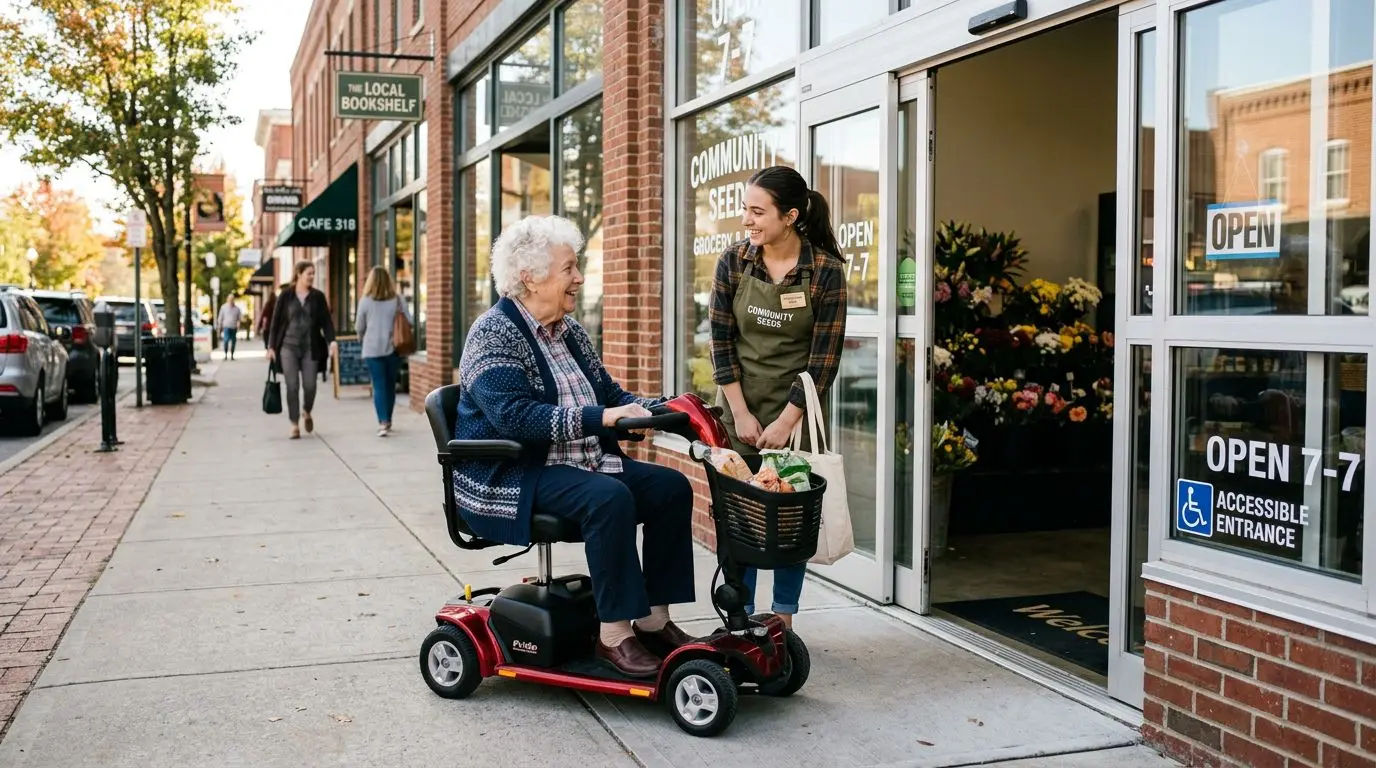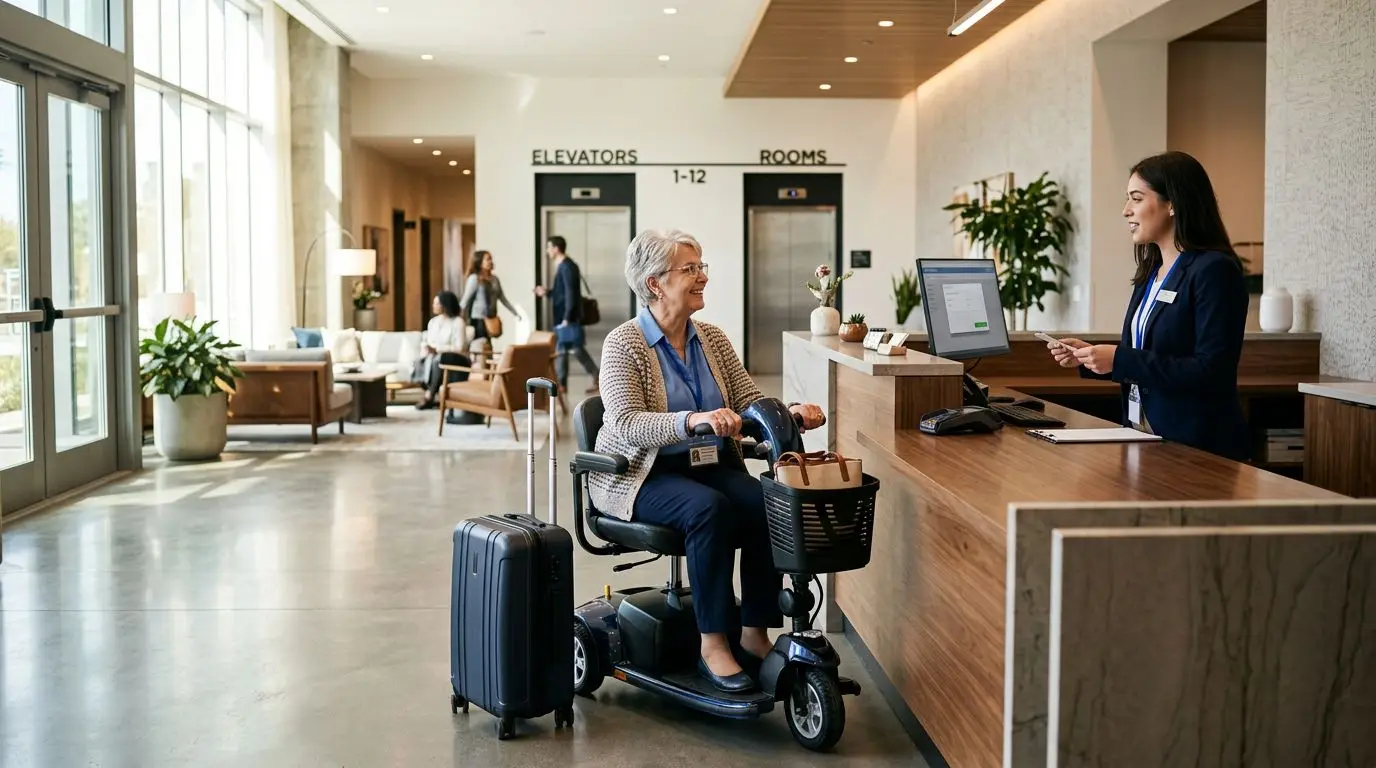
Most U.S. hotels must allow guests to use mobility scooters in public areas and accessible rooms when the scooter can move safely along the accessible route. Each property, however, may set reasonable rules for charging, storage, and hallway clearance. The safest approach is to request an accessible room, confirm key measurements, and get written answers about overnight parking or charging before you book.
A mobility scooter can make a hotel stay much easier, but hotel buildings vary widely. A newer property may have wide elevators and roll-in showers, while an older downtown hotel may have tight guest room entries, small elevators, or limited outlets near the bed. This guide explains what hotels usually can and cannot do, what to ask before booking, and how to avoid last-minute surprises at check-in.
1. What U.S. hotels generally must allow under the ADA
Hotels in the United States are usually considered places of public accommodation under the Americans with Disabilities Act, passed in 1990. In practical terms, guests with mobility disabilities must receive equal access to hotel services, including entrances, registration areas, restaurants, pools where accessible features exist, elevators, and guest rooms reserved as accessible rooms.
Mobility scooters designed for people with mobility disabilities are generally allowed anywhere guests using wheelchairs are allowed, unless the hotel can identify a legitimate safety issue. A hotel should not refuse a guest simply because they use a scooter. It also should not charge an extra fee just because the guest uses a mobility device.
That said, the ADA does not let guests park or charge a scooter anywhere they choose. Hotels can enforce reasonable safety rules, such as keeping exits clear, not blocking corridors, and preventing cords from crossing walking paths. Many accessible routes are built around common ADA dimensions, such as a 36-inch minimum route width and a 60-inch turning space in certain areas, but real-world hotels can feel tighter because of furniture, door swings, luggage carts, and housekeeping equipment.
Hotel staff should not ask for your diagnosis. They may ask practical questions tied to access and safety, such as whether the scooter can fit through the room door, whether it folds, or whether you need a ground-floor room if the elevator is out of service. If a staff member seems unsure, ask for the front desk manager or reservations manager and keep the conversation focused on logistics.
2. Who this hotel scooter guide is best for
This guide is for travelers who use a mobility scooter at least part of the day and want to know whether a hotel can reasonably accommodate it. That includes people who use a compact travel scooter, a mid-size 3-wheel scooter, a wider 4-wheel scooter, or a heavier full-size scooter that may be 50 inches or more in overall length.
It is especially useful if you are booking a hotel without seeing the property first. Photos help, but they rarely show the exact path from the parking lot to the room, the elevator depth, or the distance from the nearest outlet to a safe parking spot. A hotel website may say “accessible,” but that word can cover several features, from a grab bar near the toilet to a fully accessible room with a roll-in shower.
This advice also applies to caregivers, adult children booking for a parent, cruise passengers staying near a port, air travelers staying near an airport, and anyone attending a wedding, conference, or medical appointment. If your stay is only 1 night, a poor room fit is still frustrating. If your stay is 3 to 7 nights, charging and storage rules become even more important.
3. Room fit: measure 5 things before booking
The biggest hotel scooter problem is usually not the lobby. It is the guest room. A scooter that glides through a wide front entrance may become awkward at the room door, beside the bed, or in the bathroom area. Before booking, measure your scooter and compare those numbers with the hotel’s room layout.
Start with 5 measurements: overall scooter width, overall length, turning radius if you know it, handlebar or tiller height, and the space you need to transfer safely. Many travel scooters are roughly 20 to 22 inches wide, while larger scooters may be 24 to 27 inches wide or more. Length can vary from about 37 inches on compact scooters to 55 inches or more on larger ones. These are general ranges, so measure your own scooter instead of relying on category names.
Ask the hotel for the clear width of the guest room door, not just the size of the door slab. Under common ADA design standards, many accessible doors provide at least 32 inches of clear opening when the door is open 90 degrees. Older buildings, historic hotels, and rooms converted after construction may differ. If your scooter is 25 inches wide, a 32-inch clear opening sounds fine on paper, but a tight hallway turn into the room can still be difficult.
Inside the room, ask whether there is at least one open area where the scooter can park without blocking the bathroom door, the main room door, or the path to the bed. A 60-inch turning circle is a helpful reference point for maneuvering, though not every space in every room will provide it. If you need to drive the scooter into the bathroom, ask specifically about bathroom door width, threshold height, and whether the bathroom has a roll-in shower or a tub.
| Measurement or feature | What to ask the hotel | Why it matters |
|---|---|---|
| Scooter width | “What is the clear door opening in inches?” | A scooter may fit through a 32-inch opening but struggle with a tight angled turn. |
| Scooter length | “Is there an open parking area at least 4 to 5 feet long?” | Larger scooters can block doors or walkways if the room is crowded. |
| Turning space | “Is there a 60-inch turning area in the room or bathroom?” | Turning space helps with safe entry, exit, and transfers. |
| Bed clearance | “How much space is beside the bed?” | Some guests need side access for transfers, walkers, or caregiver help. |
| Bathroom access | “Is the shower roll-in, or is it a tub?” | A room can be accessible in one way but still not meet your bathing needs. |
4. Charging rules: ask about 1 grounded outlet and overnight access
Most hotel scooter charging issues come down to location. You need a safe, reachable outlet where the scooter can charge overnight without blocking a path. Ask for at least 1 grounded outlet near the scooter parking spot, ideally in the room rather than a public corridor.
Hotels may not allow charging in hallways, stairwells, elevator lobbies, or emergency exit paths. That is usually a fire and trip-hazard concern, not a disability access refusal. A charging cord stretched across a hallway can be dangerous for other guests and staff, especially at night. If you cannot charge inside the room, ask the manager where scooters are normally charged and whether staff can confirm that the area remains accessible 24 hours a day.
Use the charger supplied for your scooter and follow the battery instructions for your device. Do not use a damaged cord, a loose outlet, or an overloaded power strip. If you need an extension cord, ask the hotel first; some properties prohibit guest extension cords or require maintenance staff to approve the setup. Never run a cord under a door where it can be pinched, frayed, or heated.
If your scooter has a removable battery, ask whether you may bring the battery into the room for charging while storing the scooter elsewhere. This can help when the room is small, but the hotel may still have battery safety rules. If you are flying, battery rules are a separate issue handled by the airline and the airport, so confirm those before travel day.
5. Storage and parking: keep 36 inches of corridor clearance in mind
Overnight storage often causes confusion. A hotel may welcome your scooter but still say it cannot be parked in the hallway outside your room. That answer is usually tied to emergency access. Corridors are escape routes, and many accessibility and fire-safety practices focus on keeping a clear path, often using 36 inches as a key minimum route width.
The best storage option is usually inside your accessible guest room, if the scooter fits and can charge safely. The next best option may be a designated storage room, bell desk area, meeting room corner, or secured back-office space. If the scooter will not be in your room, ask who has access, whether the area is locked, and how you retrieve it at 6 a.m. or after midnight.
Do not assume the hotel has a scooter storage room. Many do not. Smaller hotels may have only a lobby and a housekeeping closet, neither of which is designed for guest mobility equipment. Larger conference hotels may have more space, but they may also have more foot traffic and stricter safety policies.
| Storage option | Best for | Questions to ask | Watch out for |
|---|---|---|---|
| Inside the guest room | Most travelers, especially 2- to 7-night stays | “Will it fit without blocking the door or bathroom?” | Tight furniture layout, poor outlet placement |
| Designated hotel storage area | Larger scooters or small rooms | “Is it locked, staffed, and available 24 hours?” | Limited access after front desk staffing changes |
| Bell desk or lobby corner | Short daytime storage | “Will it be supervised?” | Public access, accidental damage, blocked routes |
| Hallway outside the room | Rarely appropriate | “Does this comply with your safety policy?” | Fire-code concerns and blocked evacuation routes |
| Vehicle or parking garage | Backup only | “Is there step-free access from parking to lobby?” | Weather, theft risk, no charging access |
6. How to make an accessibility request in 10 minutes
You do not need a long speech to request hotel accessibility. A clear 10-minute call or message can prevent most problems. Contact the hotel directly, not only the central reservation line, because property staff are more likely to know the actual elevator, room, outlet, and storage layout.
Use simple, specific language. For example: “I use a mobility scooter that is 25 inches wide and 48 inches long. I need an accessible room with a step-free route from the entrance to the room, a door opening of at least 32 inches, and space to park and charge the scooter overnight. Can you confirm those details in writing?”
Ask the hotel to add the request to your reservation notes. Then ask for an email or message confirming the accessible room type and any charging or storage plan. Written confirmation is useful if you arrive during a busy shift and the person at the desk has not seen your request.
Here is a practical booking checklist:
- Ask for an accessible room that matches your needs, such as roll-in shower, tub with grab bars, or hearing-accessible features if needed.
- Confirm a step-free route from parking, rideshare drop-off, or shuttle stop to the front desk.
- Ask whether the elevator is large enough for your scooter and a companion, if you will not be on the ground floor.
- Confirm the clear room door width in inches.
- Ask where the scooter may be parked overnight.
- Ask where it may be charged and whether the outlet is grounded and reachable.
- Ask whether hallway parking is prohibited, so you are not surprised later.
- Request written confirmation in your reservation notes.
If the hotel cannot answer basic measurement questions, ask whether a manager or maintenance staff member can check the room. A tape measure takes 2 minutes. A vague answer like “it should be fine” is less useful than “the door clear opening is 33 inches, and there is open floor space next to the desk.”
7. Compare hotel features before choosing 1 room type
Accessible room labels are not all the same. A room with a lower peephole and grab bars may not have the same layout as a room with a roll-in shower and wider floor space. Before you choose 1 room type, compare the features that affect scooter use, not just the room name.
| Feature | Why it helps scooter users | Good question before booking |
|---|---|---|
| Step-free entrance | Prevents the need to lift the scooter over a curb or step | “Is the accessible entrance the main entrance or a separate entrance?” |
| Elevator access | Allows upper-floor rooms when ground floor is unavailable | “What is the elevator door width and approximate depth?” |
| Accessible room door | Supports entry with less scraping or tight turns | “What is the clear opening in inches?” |
| Roll-in shower | May help guests who cannot step over a tub wall | “Is it a true roll-in shower or a low tub?” |
| Open floor area | Gives space to turn, park, and transfer | “Can the scooter park without blocking the room door?” |
| Outlet near parking spot | Makes overnight charging safer and easier | “Is there an outlet within a few feet of the parking area?” |
| Accessible parking | Reduces distance from vehicle to lobby | “How many accessible spaces are near the entrance?” |
| Shuttle with lift or ramp | Matters for airport and medical district hotels | “Can the shuttle carry a mobility scooter, and do I need to reserve it?” |
If two hotels are similar in price and location, choose the one that gives clearer answers. A property that can describe its accessible route, room door width, and charging plan is usually easier to work with than one that only repeats “we are ADA compliant.” Compliance matters, but your trip depends on the actual fit.
8. Arrival checklist: the first 15 minutes at the hotel
Use the first 15 minutes after arrival to confirm that the plan matches what you were promised. It is easier to solve a room problem before you unpack, shower, or plug in the charger for the night.
At check-in, politely remind the front desk that your reservation includes a mobility scooter accessibility request. Ask them to confirm the room type and charging or storage plan. If the scooter will be stored outside the room, ask for the exact pickup process, including late-night and early-morning access.
Before settling in, test the route. Drive from the lobby to the elevator, from the elevator to the room, and through the guest room door. Check whether the scooter can turn around or back out safely. Look for raised thresholds, tight corners, loose rugs, narrow doorways, and furniture that staff could move.
Then inspect the charging spot. The outlet should be secure, the cord should not cross a walking path, and the scooter should not block the door. If something does not work, call the front desk right away and ask for a solution. Options may include moving a chair, relocating a small table, changing rooms, or using an approved storage and charging area.
Keep the tone calm and practical. Hotel employees handle many room issues every day, but they may not understand scooter clearance unless you explain it in inches and specific obstacles. A clear request such as “I need 4 feet of open space beside the desk so the scooter does not block the door” is easier to act on than “this room is not accessible.”
9. When a hotel says no: 3 reasonable next steps
Sometimes a hotel says it cannot meet your request. The important question is why. A blanket “no scooters allowed” is very different from “we cannot allow charging in a hallway because it blocks an emergency route.”
First, ask for the specific policy or safety concern. If the issue is hallway parking, ask whether the scooter can be parked in the room, a storage area, or another location that keeps a clear route. If the issue is charging, ask whether a safer outlet location is available.
Second, ask for a reasonable alternative. That could mean a different accessible room, a ground-floor room, furniture removal, a room closer to the elevator, or staff assistance identifying a safe charging spot. Hotels are not required to provide every possible arrangement, but they should consider practical access solutions when reasonable.
Third, document the conversation. Save emails, note names and times, and keep screenshots of room descriptions. If you believe you were denied access because of disability, you may choose to contact the hotel’s corporate office, a disability rights organization, or the appropriate civil rights agency. This article is general information, not legal advice, but documentation helps any follow-up.
FAQ: 5 common hotel mobility scooter questions
Can a hotel refuse my mobility scooter?
A U.S. hotel generally should not refuse a guest simply because they use a mobility scooter for a mobility disability. The hotel may set reasonable safety rules, such as keeping exits and hallways clear or limiting unsafe charging locations.
Do hotels have to provide scooter charging?
Hotels usually need to provide equal access to their services, but they may not have a special scooter charging station. Ask for a safe outlet in or near your room and confirm whether charging is allowed overnight.
Can I leave my scooter in the hallway outside my room?
Often, no. Hallways are emergency routes, and a parked scooter can reduce the clear path needed for guests, staff, and first responders. Ask for in-room parking or a designated storage location instead.
What room measurements should I ask for?
Ask for the clear guest room door width, bathroom door width, elevator access, open floor space for turning, and a safe parking area. A 32-inch clear doorway and a 60-inch turning space are useful reference points, but the full route matters.
Should I book an accessible room if I use a scooter?
In most cases, yes. An accessible room is more likely to have a wider route, better bathroom access, and more usable floor space. Still, confirm the exact features because accessible rooms differ.
Frequently asked questions
Can a hotel refuse my mobility scooter? +
A U.S. hotel generally should not refuse a guest simply because they use a mobility scooter for a mobility disability. The hotel may enforce reasonable safety rules, such as keeping exits, hallways, and charging cords clear.
Do hotels have to provide scooter charging? +
Hotels may not have dedicated scooter charging stations, but you can request a safe outlet and a place to park the scooter while it charges. Confirm the charging location before booking, especially for overnight stays.
Can I store my mobility scooter in the hallway outside my room? +
Many hotels do not allow hallway storage because corridors are emergency exit routes. Ask whether the scooter can fit inside your room or whether the hotel has a secure designated storage area.
What measurements should I confirm before booking? +
Confirm the clear room door width, bathroom door width, elevator access, open floor space, and parking space for the scooter. Common reference points include a 32-inch clear doorway and a 60-inch turning space.
Is an accessible hotel room always scooter-friendly? +
Not always. Accessible rooms vary by layout and features, so ask about the exact route, door widths, bathroom setup, furniture placement, and outlet location before you reserve.
Related guides
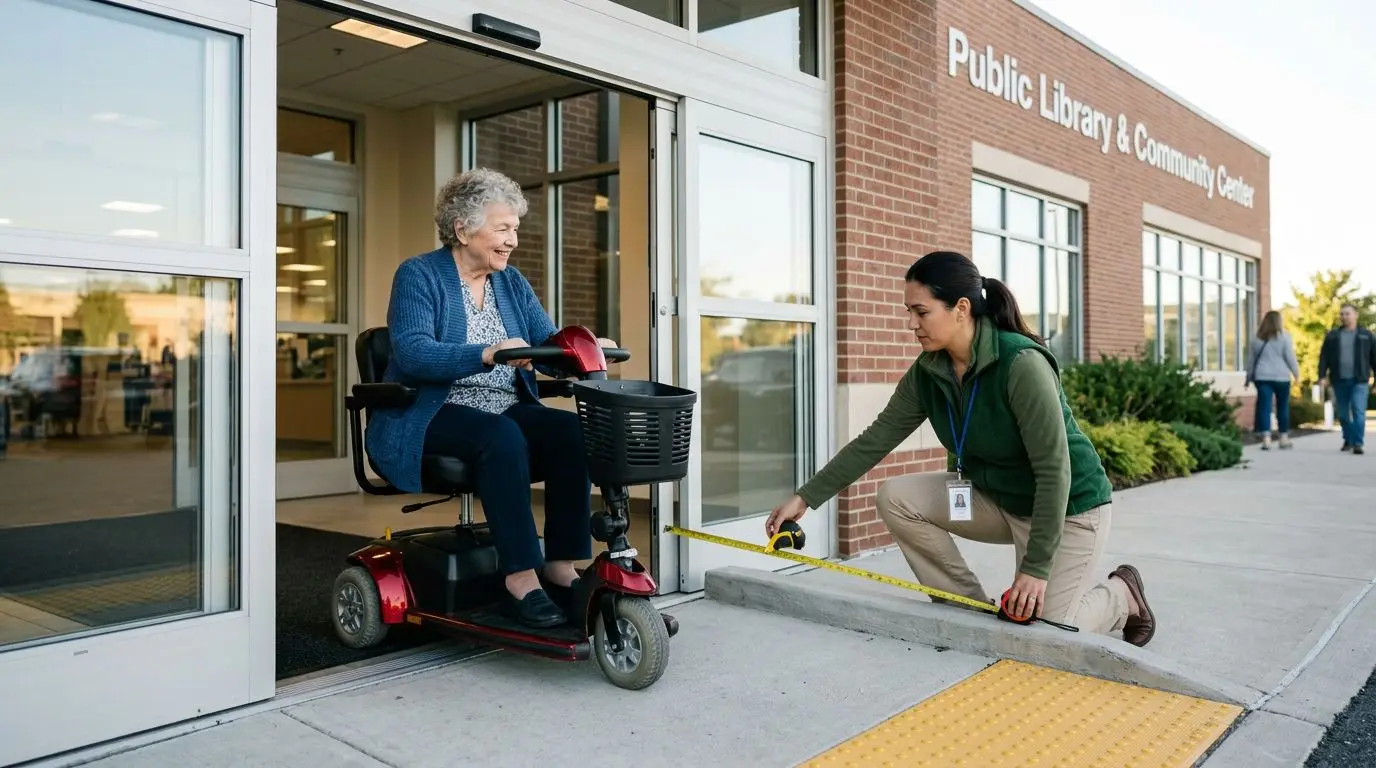
ADA-Accessible Routes for Mobility Scooters: Doorways, Ramps, Elevators, and Turning Space
12 min read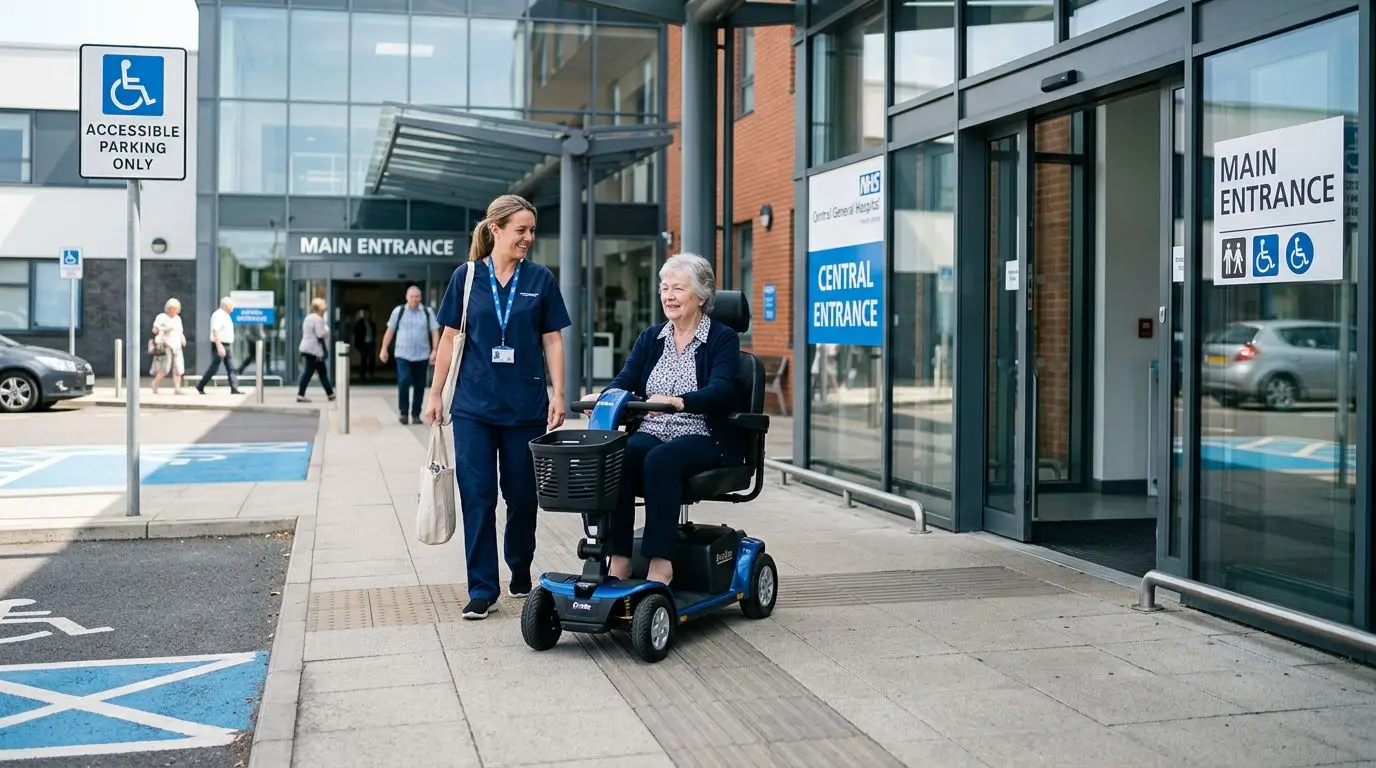
Mobility Scooter Access at Medical Offices, Hospitals, and Clinics
14 min read
Can You Bring a Mobility Scooter to Theme Parks, Stadiums, Museums, and Other Venues?
16 min read