Yes, you can use a mobility scooter on many cruises, but you need to plan cabin storage, battery charging, port access, and delivery details before you sail. The main rule is simple: the scooter must fit inside your stateroom, not in the hallway, and you should confirm your cruise line’s accessibility policies in writing.
A cruise can be a very scooter-friendly vacation because the ship keeps restaurants, entertainment, and your room in one contained place. Still, ships have narrow doorways, busy elevators, steep gangways, and port conditions that can change with tide or weather. A little measuring at home can prevent a stressful surprise at the terminal.
Start with cruise line rules 30 to 60 days before sailing
Contact the cruise line’s accessibility or special needs department at least 30 to 60 days before departure, and earlier if you need an accessible cabin. Ask about the policy on mobility scooters, battery types, charging, tender ports, and rental delivery. If you receive instructions by phone, request an email confirmation or save the policy page from the cruise line’s website.
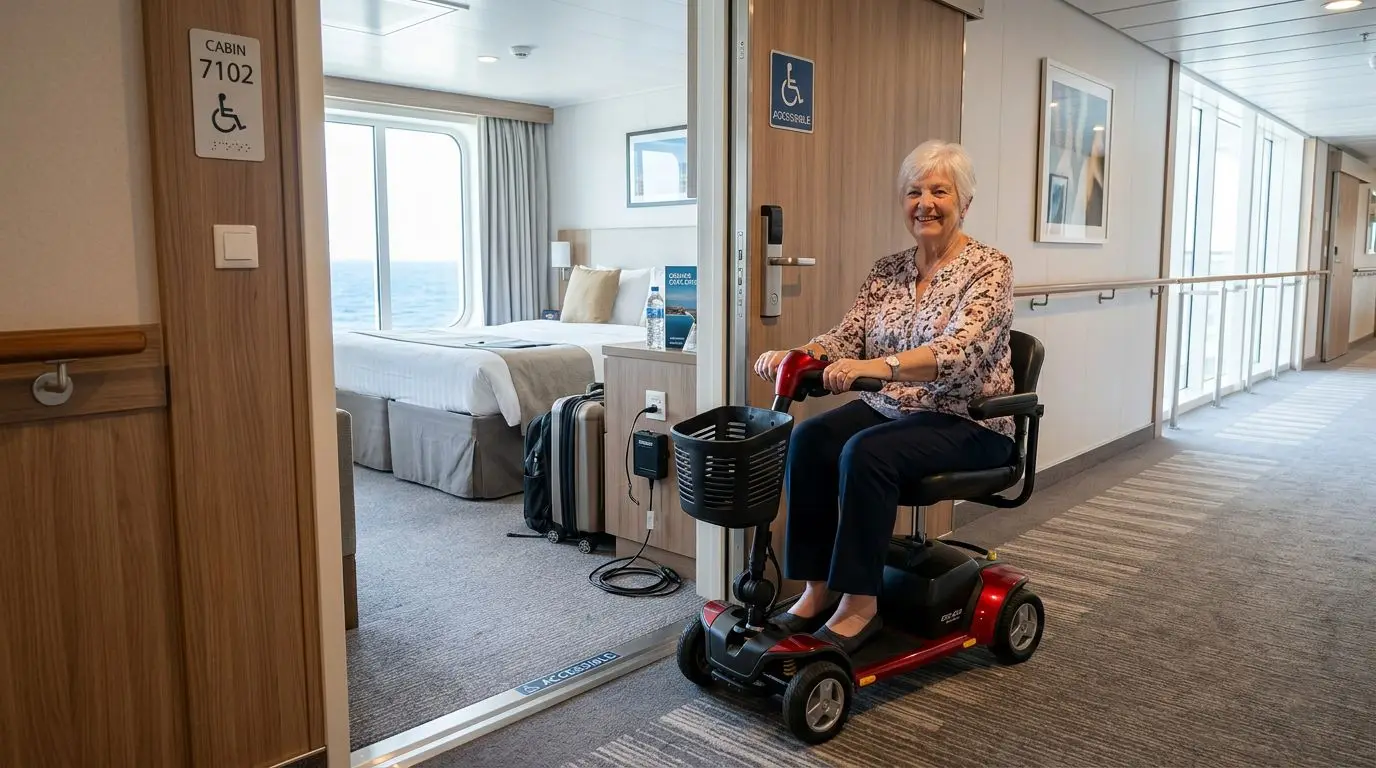
Most cruise lines require mobility devices to be stored inside your stateroom because corridors are emergency exit routes. A scooter parked in a hallway can block crew, passengers using wheelchairs, and evacuation paths. Even if a hallway looks wide enough for 1 night, do not count on being allowed to leave the scooter there.
Ask whether the ship needs advance notice of your scooter’s dimensions and battery information. Useful details include overall length, width, weight, turning radius if known, battery chemistry, and whether the scooter folds or disassembles. If renting, ask the rental company for a specification sheet you can forward to the cruise line.
One more point matters: cruise ships are not identical. A newer ship may have more accessible cabins and smoother public routes, while an older or smaller ship may have tighter thresholds and fewer elevators. Policies can also differ for embarkation ports outside the United States, so confirm the rules for your exact sailing rather than relying on general advice.
Cabin fit: measure doorways, turning space, and a 30-inch path
Cabin fit is the make-or-break detail. Many travel scooters are about 19 to 22 inches wide, while larger 4-wheel scooters may be closer to 24 to 28 inches wide. Standard stateroom doors can be too narrow for some scooters, while accessible staterooms usually offer wider doorways, more floor space, and bathrooms designed for roll-in access.
Measure the scooter at its widest point, not just the seat. Include armrests, rear wheels, baskets, mirrors, and any side-mounted accessories. Then compare that width with the cabin doorway. Leave at least 1 to 2 inches of practical clearance if possible, because doorway lips, carpet transitions, and angled entry paths can make a scooter feel wider than it is.
Next, think beyond the doorway. A scooter that gets through the door still needs a place to park without blocking the bathroom, balcony door, bed access, or cabin exit. A 30-inch clear path is a helpful planning target for walking around the scooter, though accessible cabins may provide more usable maneuvering space.
If you are booking a standard cabin, ask for the interior door width and layout. If you use a scooter daily or cannot stand and walk short distances, an accessible cabin is usually the safer choice. These cabins are limited and may be reserved for guests with mobility needs, so book early and provide any required accessibility forms honestly.
How to measure before you book
- Measure scooter width at the widest point, including armrests and accessories.
- Measure scooter length from front basket or tiller to the rear anti-tip wheels.
- Check the turning radius if listed, or test whether you can make a U-turn in a hallway at home.
- Ask the cruise line for cabin doorway width, bathroom threshold details, and whether the bed can be arranged for more open floor space.
- Confirm that the scooter can be charged where it is parked without stretching a cord across a walking path.
If your scooter comes apart, do a practice breakdown at home. Time it. If it takes 8 minutes and requires bending, lifting, or hand strength you do not have on a tiring travel day, do not assume it will be easy in a cabin.
Charging rules: batteries, outlets, and 6 to 10 hours overnight
Most mobility scooters charge overnight, often in the range of 6 to 10 hours depending on battery size, charger output, and how much you used the scooter that day. Plan to charge inside your cabin with the proper charger supplied for that scooter. Do not charge in a hallway, stair landing, dining area, or any place the crew has not approved.
Cruise cabins may have a limited number of outlets, often near the desk rather than near the bed or entry door. Ask whether the cabin has standard 110-volt outlets, 220-volt outlets, or both, and check that your charger is rated for the voltage you plan to use. Many modern chargers list an input range on the label, but you should verify rather than guess.
Avoid bringing unapproved extension cords, power strips, or surge protectors. Cruise lines commonly restrict these items because of fire safety concerns. If you need a cord for medical equipment or safe scooter charging, ask the cruise line in advance whether it can provide an approved solution.
Battery type matters, too. Mobility scooters commonly use sealed lead-acid, gel, AGM, or lithium-ion batteries. Cruise lines may ask for the battery type and capacity, especially with lithium batteries. Keep battery terminals covered, do not modify wiring, and never use a damaged charger, swollen battery, or cord that feels hot.
Charge where the scooter has ventilation and where the cord will not create a trip hazard. Keep the key removed while charging unless the manual says otherwise. If you rent, ask the provider to show you the charging port, indicator lights, and expected full-charge signal before you leave the terminal or cabin.
Port access: plan for ramps, tenders, tides, and 1 missed port possibility
Port access is less predictable than ship access. Even on an accessible ship, a port day can involve a long pier, a shuttle bus with steps, a steep gangway, cobblestones, broken pavement, or a tender boat. Tender ports are especially important because passengers may need to transfer from the ship to a small boat, and scooter boarding can depend on sea conditions and crew judgment.
Build your itinerary with the understanding that 1 port may not work out exactly as planned. Weather, tides, and local infrastructure can change access even after the ship arrives. This is not meant to discourage you; it is a practical reason to choose excursions and port plans with backup options.
Read shore excursion descriptions carefully. Terms like “panoramic,” “easy,” or “minimal walking” do not always mean scooter-accessible. Look for specific details: accessible vehicle, ramp or lift, step-free route, paved paths, restroom access, and maximum walking distance. If the excursion uses a bus, ask whether the bus has a lift and whether the scooter can be secured or stored.
Gangways can be another challenge. A gangway that feels manageable in the morning may become steeper later because of tide changes. Crew members can assist with guidance, but they may not be permitted to lift you while seated on a scooter. If you cannot stand, transfer, or walk a few steps, ask very specific questions before choosing a route with tenders or steep pier access.
Port-day access questions to ask
- Is this port docked or tendered?
- How far is it from the ship to transportation, in feet or minutes?
- Are shuttle buses step-free or lift-equipped?
- Are sidewalks paved, gravel, cobblestone, or uneven?
- Will my scooter be allowed on the excursion vehicle?
- Is there an accessible restroom at the main stop?
For independent exploring, use a conservative battery plan. If your scooter’s usable daily range is listed as 8 to 12 miles under ideal conditions, hills, weight, heat, and stop-and-go riding can reduce that. Return to the ship with extra battery, not with the gauge blinking on the pier.
Rental delivery: coordinate timing, paperwork, and a 15-minute inspection
Renting a scooter for a cruise can help if traveling with your own device is difficult, but delivery rules need careful coordination. Some rental companies deliver to the cruise terminal, some deliver directly to the stateroom when permitted, and some require pickup outside a designated area. The cruise line, terminal, and rental provider all need to be aligned.
Start by asking the cruise line whether outside rentals are allowed, where delivery can occur, and what information the provider must include on the order. Then ask the rental company for the delivery window, return procedure, emergency contact number, charger instructions, and what happens if your ship is delayed.
When the scooter arrives, take 15 minutes to inspect it before relying on it. Check that the charger is present, the key works, the battery gauge responds, the tires look sound, and the seat locks into position. Test forward, reverse, horn, speed control, brakes, and freewheel lever location. If anything seems wrong, call the rental provider immediately while you still have time to swap or repair the unit.
Ask for the scooter’s width and length before reserving. Do not rent a larger scooter just because it looks more comfortable if it will not fit through the cabin door. If you need a higher weight capacity or better outdoor stability, you may need an accessible cabin to match the scooter’s size.
Keep rental paperwork in your carry-on or phone. It should include your name, ship, sail date, cabin number if known, rental provider contact, and order number. If the scooter is delivered before cabins open, ask where it will be held and whether you can use it during boarding.
Which scooter type works best on a cruise? 3 common options
The best scooter for a cruise depends on cabin size, user weight, balance, walking ability, and port plans. A compact travel scooter may fit a standard cabin better, while a larger scooter may feel steadier on long piers and rougher pavement. There is no single right answer for every passenger.
| Scooter type | Typical strengths | Common cruise trade-offs | Who it is best for |
|---|---|---|---|
| Compact 3-wheel travel scooter | Narrow profile, tighter turning, often easier in elevators and cabins | May feel less stable on uneven port surfaces; smaller battery range | Passengers who can walk short distances and need help mainly onboard |
| Compact 4-wheel travel scooter | More stable feel than many 3-wheel designs; still relatively cabin-friendly | Turning radius can be wider; may be harder in tight stateroom entries | Passengers who want a balance of indoor use and light port exploring |
| Mid-size or full-size scooter | Higher comfort, larger seat, stronger outdoor performance, often longer range | Wider and longer; may require an accessible cabin and more elevator space | Passengers who rely on a scooter full time or need added support and capacity |
Three-wheel scooters often turn more sharply, which helps in buffet areas, theaters, and cabin entryways. Four-wheel scooters may feel more planted, especially outdoors, but they usually need more room to turn. Larger wheels can handle thresholds and pier surfaces better than very small wheels, though the added size can create storage problems.
Weight capacity should be treated as a safety limit, not a comfort estimate. Include the user’s weight plus a bag, oxygen holder, or personal items carried on the scooter. If you are close to the stated capacity, ask a mobility professional or rental provider about a better size class rather than pushing the limits.
Features worth comparing: 5 details that affect cruise days
Small features can make a big difference over a 7-night cruise. Compare scooter details based on how you will actually use the device: boarding, elevators, dining rooms, cabin charging, port pavement, and storage in a tight room.
| Feature | Why it matters on a cruise | What to check |
|---|---|---|
| Overall width | Determines cabin doorway and elevator ease | Measure the widest point in inches |
| Turning radius | Affects cabin entry, buffet lines, and theater seating areas | Smaller is easier indoors; test if possible |
| Battery range | Port days can involve long piers and delays | Plan for less than ideal-range estimates |
| Ground clearance | Helps with thresholds, ramps, and uneven pavement | Higher clearance helps outdoors but may raise seat height |
| Disassembly or folding | May help with taxis or storage, but only if manageable | Check heaviest piece weight and setup time |
Seat height also deserves attention. A tall seat may make transfers easier for some users but can feel less stable on slopes. Armrests can help with transfers, yet they add width. A front basket is convenient for a water bottle and small bag, but it can make the scooter longer when turning near cabin furniture.
If you use oxygen, a cane, or a walker along with the scooter, ask how these items will be carried safely. Do not hang heavy bags from the tiller. Extra weight on the front can affect steering, and swinging bags can catch on doorframes or chairs.
Onboard safety and etiquette: 8 checks for the first day
The first day is busy. Elevators are crowded, luggage is in the halls, and passengers are learning the ship layout. Use the first 8 checks below to make your scooter routine safer before the ship settles into its normal rhythm.
- Find your cabin route. Identify the least crowded elevator bank and the shortest step-free path.
- Practice parking. Park inside the cabin so the bathroom, bed, and exit remain usable.
- Set a low speed indoors. Dining rooms, shops, and photo areas can have sudden pedestrian traffic.
- Use elevators patiently. Enter straight, turn slowly, and give others room to exit first.
- Avoid wet decks. Pool areas and outdoor walkways can be slick, especially after cleaning or rain.
- Watch thresholds. Door tracks and deck transitions may catch small wheels.
- Charge at the same time nightly. A routine reduces the chance of starting a port day half charged.
- Keep the key secure. Bring a spare if provided, and do not leave the scooter powered on when parked.
Be courteous, but do not apologize for needing a mobility device. Drive at walking speed in crowded areas, use the horn sparingly, and give crew time to move chairs or open accessible routes. If a dining table or theater seat does not work, ask early; crew can often help when they have a few minutes to adjust the space.
For embarkation and disembarkation, keep medications, documents, charger, and essential supplies with you rather than in checked luggage. If your scooter battery runs low during boarding, you do not want the charger buried in a suitcase that arrives hours later.
FAQ: 5 cruise scooter questions travelers ask most
Can I keep my mobility scooter in the hallway outside my cabin?
Usually, no. Cruise lines generally require scooters to be stored inside the stateroom because hallways are emergency routes. Plan for in-cabin parking before you sail.
Do I need an accessible cabin if I use a scooter?
Not always, but many scooter users do better in one. If your scooter is wider than about 22 inches, if you cannot walk short distances, or if you need roll-in bathroom access, an accessible cabin is often the more practical choice.
Can I take my scooter on a tender boat?
Sometimes, but never assume. Tender access depends on the port, sea conditions, equipment, scooter size, and whether you can transfer safely. Ask about each tender port before booking excursions.
Is it safe to charge a scooter overnight in the cabin?
It is generally expected when done according to the scooter instructions and cruise line rules. Use the correct charger, keep the cord out of walking paths, avoid unapproved power strips, and stop using any equipment that overheats or looks damaged.
Should I bring my own scooter or rent one for the cruise?
Bring your own if it fits the cabin, you know its battery range, and transport to the port is manageable. Renting may be easier if you are flying, but confirm delivery rules, dimensions, charger instructions, and service support before reserving.
A mobility scooter can make a cruise more comfortable and manageable, especially on large ships where a single day may involve thousands of steps. The key is matching the scooter to the cabin, confirming charging and storage rules, and planning port days with honest access information. Measure first, ask specific questions, and keep written confirmations where you can find them.
Frequently asked questions
Can I keep my mobility scooter in the hallway outside my cabin? +
Usually, no. Cruise lines generally require scooters to be stored inside the stateroom because hallways are emergency routes. Confirm your cruise line’s policy before sailing.
Do I need an accessible cabin if I use a mobility scooter? +
Not always, but it is often the better choice if your scooter is wide, you cannot walk short distances, or you need a roll-in bathroom. Measure the scooter and ask for cabin doorway details before booking.
Can I take a mobility scooter on a cruise tender boat? +
Sometimes, but access depends on sea conditions, crew procedures, scooter size, and your ability to transfer safely. Ask about each tender port before choosing shore excursions.
How should I charge a mobility scooter on a cruise? +
Charge it inside your cabin with the correct charger, usually overnight. Keep cords out of walking paths, avoid unapproved power strips or surge protectors, and follow the cruise line’s electrical safety rules.
Is it better to bring my own scooter or rent one for a cruise? +
Bring your own if it fits the cabin and transportation to the port is practical. Rent if flying or transporting your scooter is difficult, but confirm delivery location, dimensions, charger instructions, and support contacts in advance.
Related guides

Renting a Mobility Scooter for Travel: When It Beats Bringing Your Own
13 min read
Can You Bring a Mobility Scooter to Theme Parks, Stadiums, Museums, and Other Venues?
16 min read
Mobility Scooter Rentals for US Theme Parks: On-Site vs. Off-Site Planning Guide
14 min read