The best way to transport a mobility scooter by car depends on 4 things: scooter weight, vehicle type, your lifting ability, and whether the scooter can ride outside the vehicle. Portable scooters work well when the heaviest piece is about 35 to 60 lb. Hitch carriers and lifts are better for heavier 3-wheel and 4-wheel scooters that may weigh 100 to 350 lb. Ramps can be practical for vans and some SUVs, but only when the ramp angle, cargo height, and interior space allow safe loading.
There is no single right setup for everyone. A sedan owner with a 45 lb foldable scooter has very different needs from a minivan owner transporting a full-size scooter every day. Use the guide below to compare the main options before you buy a scooter, ramp, carrier, or lift.
Start with 5 measurements before you buy anything
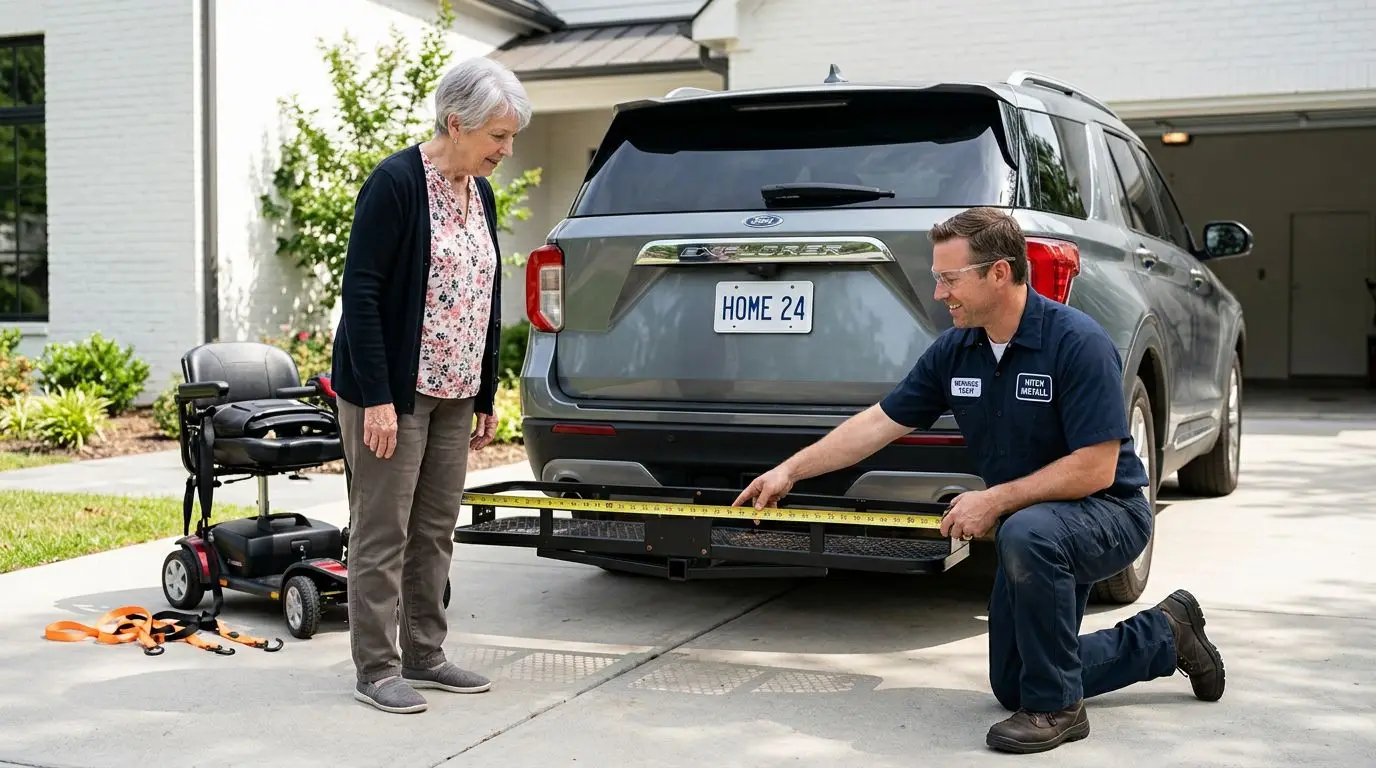
Before you compare transport equipment, measure both your scooter and your vehicle. A difference of just 2 inches can determine whether a scooter fits in a cargo area, clears a bumper, or loads at a safe ramp angle.
- Scooter total weight: Include the battery. Travel scooters may weigh under 100 lb total, while full-size scooters can exceed 250 lb.
- Heaviest individual piece: If the scooter disassembles into 4 or 5 pieces, the seat, battery pack, rear motor section, or front tiller section may each weigh different amounts. The heaviest piece is the number that matters for hand lifting.
- Scooter footprint: Measure overall length and width. Many compact scooters are roughly 38 to 45 inches long, while larger models may be 50 inches or more.
- Vehicle cargo opening: Measure width, height, and floor-to-ceiling space with the hatch or trunk open. Also check the narrowest point between wheel wells.
- Ground-to-cargo-floor height: A sedan trunk may be around 25 to 30 inches high, while an SUV or minivan cargo floor can be higher. This affects ramp length and lift choice.
Do not rely only on brochure dimensions. Basket brackets, armrests, headrests, mirrors, and the steering tiller can add practical bulk even when the listed scooter width looks acceptable.
Transport options at a glance: 4 common methods compared
Most car transport setups fall into 4 categories: portable scooters loaded by hand, ramps, hitch-mounted carriers, and powered lifts. Each method solves a different problem, and each has limits.
| Method | Best fit | Typical weight considerations | Main trade-off |
|---|---|---|---|
| Foldable or disassembling scooter | Sedans, hatchbacks, smaller SUVs | Heaviest piece often about 35 to 60 lb | Requires lifting and assembly |
| Portable ramp | Vans, minivans, some SUVs | Ramp must be rated above scooter plus rider if driving up | Needs safe angle and cargo space |
| Hitch carrier | SUVs, crossovers, vans, some trucks | Carrier and hitch must support scooter weight, often 150 to 350 lb or more | Scooter rides outside in weather and road spray |
| Powered vehicle lift | Frequent transport, heavier scooters | Lift capacity must exceed actual scooter weight with accessories | Higher cost and vehicle compatibility checks |
A good rule of thumb: if you cannot comfortably lift the heaviest scooter piece 10 times in a row, do not build your plan around lifting it after a long appointment or shopping trip. Fatigue matters.
Portable and foldable scooters: best when the heaviest piece is under 60 lb
A portable scooter is usually the simplest car solution because it avoids exterior carriers and permanent vehicle equipment. Some scooters fold as one unit, while others separate into several pieces, commonly the seat, battery pack, basket, front section, and rear drive section.
This route often works best for people using a sedan, hatchback, or small crossover. If the heaviest component is 35 to 60 lb and the user or caregiver can safely lift that weight to trunk height, a portable scooter can be loaded without a ramp or lift.
Who it is best for
- People who need occasional transport, such as 1 or 2 trips per week.
- Drivers with limited parking space who do not want a hitch carrier extending behind the car.
- Users who can manage small setup steps, including removing the seat and battery.
- Caregivers who prefer several lighter lifts instead of one heavy loading task.
What to watch for
Portable does not always mean easy. A 95 lb scooter that splits into 5 pieces may be manageable, but a 65 lb folding scooter that must be lifted as one unit can be difficult. Also check battery rules if you fly or use rideshare services; airline battery limits are separate from car transport, but they can influence which scooter you choose.
Try a realistic loading test when possible. Lift the heaviest piece from ground level to the height of your trunk or cargo floor, then set it down gently without twisting. If that movement strains your back, shoulders, or grip, consider a ramp, carrier, or lift instead.
Ramps: useful for vans and SUVs when the angle stays near 10 degrees or less
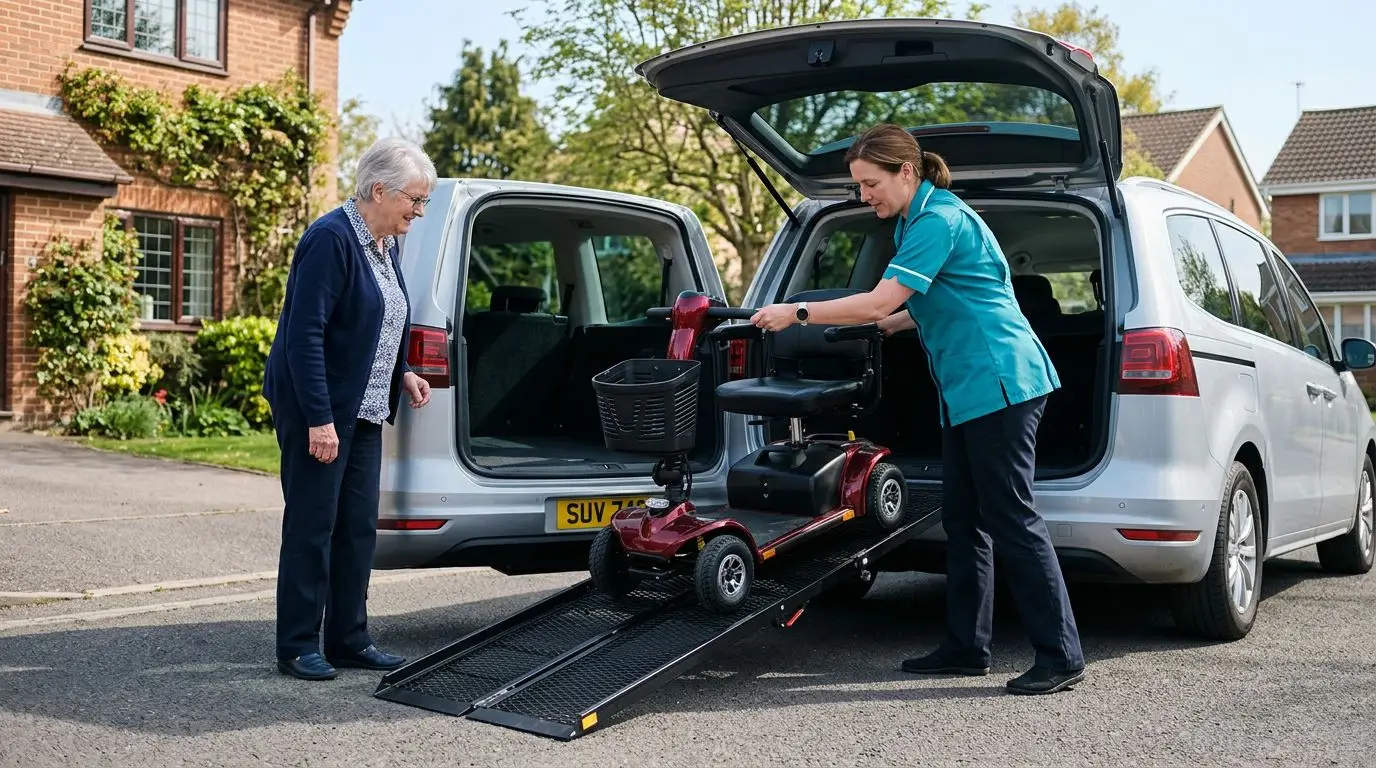
A ramp lets you roll a scooter into a vehicle instead of lifting it. It may be a folding ramp, telescoping track ramp, suitcase-style ramp, or wider platform ramp. Ramps are most practical when the vehicle has a low cargo floor and enough interior room for the scooter to sit securely.
Ramp angle is the key safety factor. Many users find loading easier when the ramp angle is about 10 degrees or less. A short ramp on a tall SUV can get steep quickly, increasing the risk of wheel spin, tipping, or loss of control.
How to estimate ramp length
Measure from the ground to the vehicle cargo floor. A common planning guideline is that every 1 inch of rise needs about 8 to 12 inches of ramp length for easier loading. For example, a 24 inch cargo height may call for a ramp roughly 8 to 12 feet long for a gentler approach, depending on the scooter, ramp design, and user control.
That length may be too long to store inside a small vehicle. This is why ramps often make more sense for minivans, full-size vans, and lower cargo openings than for tall SUVs.
| Ramp type | Typical use | Pros | Limits |
|---|---|---|---|
| Folding platform ramp | Loading into rear cargo area | Wide surface, easier wheel alignment | Can be heavy and bulky |
| Telescoping track ramps | Scooters with predictable wheel spacing | Compact storage, lighter sections | Requires careful wheel alignment |
| Suitcase-style ramp | Occasional loading and thresholds | Folds for storage, simple design | May not be long enough for vehicle loading |
| Built-in van ramp | Frequent use with adapted vehicle | Fast loading, stable platform | Requires compatible vehicle setup |
Always check the ramp weight rating. If a person rides the scooter up the ramp, the ramp must support the combined weight of rider plus scooter. If the scooter is pushed or powered up without the rider, the required capacity may be lower, but control and braking still matter.
Hitch carriers: a practical outside option for scooters around 150 to 350 lb
A hitch-mounted carrier attaches to the receiver hitch at the back of the vehicle. The scooter rides on an exterior platform, often with a fold-up ramp. This avoids lifting the scooter into the cargo area and keeps the vehicle interior free for passengers, luggage, or medical equipment.
Hitch carriers can work well for mid-size and full-size scooters, but only when the vehicle, hitch class, carrier capacity, and tongue weight rating all match the load. Tongue weight is the downward force on the hitch. It is not the same as the maximum trailer towing rating.
Who it is best for
- People who transport a scooter several times per week and want a faster loading routine.
- Owners of SUVs, vans, crossovers, or trucks with a compatible receiver hitch.
- Users whose scooter is too heavy to lift but not so heavy that it exceeds hitch limits.
- Drivers who can handle the extra rear length when backing up and parking.
Key checks before buying a hitch carrier
- Receiver size: Many carriers require a 2 inch receiver, but you must verify compatibility.
- Tongue weight rating: Add the scooter weight plus the carrier weight. A 250 lb scooter on a 75 lb carrier creates a 325 lb load before accessories.
- Ramp width and platform size: The deck must fit the scooter wheelbase and width with room for tie-downs.
- Ground clearance: The carrier may scrape on steep driveways or speed bumps, especially with a low vehicle.
- Lights and license plate visibility: A loaded scooter can block tail lights or plates. Local rules vary, so check your state requirements.
Weather exposure is the biggest downside. Rain, winter road salt, dust, and sun can affect upholstery, controls, and metal parts. A fitted cover can help during travel, but it must be secured so it does not flap into lights, exhaust, or moving parts.
Powered lifts: best for frequent loading or scooters over 100 lb
A powered lift uses an electric motor to raise, lower, or swing the scooter into position. There are 2 broad categories: interior lifts that load the scooter into a cargo area and exterior platform lifts that mount at the hitch. Some lifts use a boom arm, while others use a platform.
Powered lifts are often the most convenient choice when the scooter is used daily or when the user cannot safely lift 50 lb. They can also reduce caregiver strain over time. They still require careful vehicle fit checks and usually need professional installation or at least a knowledgeable installer.
Interior lifts
Interior lifts keep the scooter protected from weather and theft. They are often used in minivans, SUVs, and hatchbacks with enough cargo height. The trade-off is space: the scooter and lift may use much of the rear cargo area, and some setups require removing or folding the third-row seats.
Exterior platform lifts
Exterior lifts are similar to hitch carriers but use power to raise and lower the platform. They are useful when the scooter is too heavy to push up a ramp. Because the scooter rides outside, you still need to consider road spray, rear visibility, and hitch capacity.
| Lift style | Best for | Major advantage | Common limitation |
|---|---|---|---|
| Interior boom lift | Smaller scooters and larger cargo openings | Protects scooter inside vehicle | May require guiding the scooter carefully |
| Interior platform lift | Vans and SUVs with enough cargo space | Stable loading surface | Uses significant interior room |
| Exterior powered platform | Heavier scooters and frequent use | No ramp pushing or lifting | Scooter remains outside |
| Hybrid hoist or swing-away setup | Specific vehicle layouts | Can improve access to rear cargo door | Compatibility is more limited |
Check lift capacity with the real scooter weight, not just the advertised base weight. Add the battery, seat, basket, cane holder, oxygen holder, cover, and any other accessories. A 20 lb difference can matter when equipment is close to its rating.
How to choose by vehicle type: sedan, SUV, van, or truck
Your vehicle may narrow the choice before your scooter does. A sedan trunk might only accept a disassembled travel scooter, while a minivan with a low floor may handle a ramp or interior lift. Trucks add bed height and tailgate issues.
| Vehicle type | Usually easiest option | Why | Common caution |
|---|---|---|---|
| Sedan | Foldable or disassembling scooter | Limited trunk height and opening size | Check if the heaviest piece can clear the trunk lip |
| Hatchback | Portable scooter or small interior lift | Better opening than many trunks | Measure rear seat angle and cargo height |
| Small SUV | Portable scooter or hitch carrier | More cargo room, often hitch capable | Higher floor can make ramps steep |
| Minivan | Ramp or interior lift | Lower floor and wide rear opening | Third-row seating may need to fold or be removed |
| Pickup truck | Hitch lift or specialized loading system | Open bed space can fit larger scooters | Bed height may be 30 inches or more |
If you plan to change vehicles within 1 to 2 years, avoid an overly custom solution unless you know it can transfer. Some lifts and wiring kits are vehicle-specific, while many portable ramps and hitch carriers are easier to move to another compatible vehicle.
Safety checklist for every trip: 7 steps before driving
A scooter can shift, bounce, or tip if it is not secured correctly. Even a 100 lb scooter becomes a serious hazard during sudden braking. Build a repeatable loading routine and use it every time.
- Turn the scooter off: Remove the key if it has one, and make sure the throttle cannot be bumped.
- Secure the tiller: Fold or lock it if the scooter design allows. A loose tiller can swing during travel.
- Use tie-downs at solid points: Do not attach straps to plastic shrouds, baskets, or armrests.
- Check battery security: Battery packs should be latched and unable to slide.
- Confirm ramp or platform locks: A carrier ramp should be pinned or latched before driving.
- Recheck visibility: Make sure brake lights, turn signals, and the license plate are not blocked.
- Drive smoothly: Leave extra stopping distance, especially with an exterior carrier adding weight behind the rear axle.
For interior transport, avoid leaving the scooter loose in the back of a vehicle. Cargo straps, anchor points, or a properly designed lift platform can help prevent movement. For exterior transport, stop after the first 5 to 10 miles and recheck straps, pins, and the cover.
Cost and effort: compare the real daily workload
Prices vary widely by equipment type, installation needs, vehicle wiring, and local labor rates, so it is better to compare total effort than chase a single average price. Think in terms of minutes, lifting weight, storage space, and how often you travel.
A portable scooter may take 3 to 8 minutes to disassemble and load once you learn the routine. A hitch carrier may load faster, but you still need to lower the ramp, drive or push the scooter on, strap it down, and secure the ramp. A powered lift may reduce physical strain the most, though it adds electrical and fit requirements.
| Question | If you answer yes | Likely direction |
|---|---|---|
| Can you lift 40 to 60 lb safely? | Yes | Consider a portable scooter |
| Do you use the scooter daily? | Yes | Consider a powered lift or carrier |
| Do you drive in heavy rain, snow, or salt? | Yes | Interior transport may protect the scooter better |
| Is your cargo floor more than 24 inches high? | Yes | Be cautious with short ramps |
| Do you need all rear seats available? | Yes | Exterior carrier or lift may preserve cabin space |
The right choice should be safe on your hardest day, not just your best day. If pain, balance, grip strength, or stamina varies, choose a method that leaves a margin for fatigue.
Before you buy: a 10-minute decision process
Use this quick process before purchasing a scooter or transport accessory. It can prevent expensive mismatches.
- Write down the scooter total weight, heaviest piece, length, width, and height.
- Measure the vehicle cargo opening and floor height in inches.
- Check the vehicle owner manual for hitch and tongue weight limits if using an exterior carrier or lift.
- Decide whether the scooter must ride inside, especially if you drive in wet or snowy conditions.
- Estimate how many times per week you will load it. Daily use justifies more convenience.
- Test your lifting ability with a safe object close to the same weight, such as a packed suitcase.
- Confirm that tie-down points, ramp locks, and battery latches are easy for you to reach.
- Check where the ramp, lift, or carrier will be stored when not in use.
- Ask an installer or mobility equipment professional to review fit if wiring, drilling, or hitch loading is involved.
- Do a slow practice load at home before relying on the setup for an appointment.
If any step feels uncertain, pause before buying. A scooter that is easy to drive but difficult to transport may end up staying at home.
FAQ: common car transport questions
Can I put a mobility scooter in a regular car trunk?
Sometimes, but usually only with a compact scooter that folds or disassembles. Measure the trunk opening, not just the trunk floor. The heaviest piece should be within your safe lifting range, often under about 60 lb for many caregivers.
Is it safe to drive a scooter up a ramp into a vehicle?
It depends on the ramp rating, angle, surface, and scooter stability. Many users are safer walking beside the scooter or using power carefully without sitting on it, but that requires control and space. Follow the ramp and scooter instructions, and avoid steep or wet loading surfaces.
Do I need a hitch carrier or a powered lift?
A hitch carrier may be enough if you can safely load the scooter up a short carrier ramp and secure it. A powered lift is better when pushing, steering, or lifting is difficult, or when the scooter is heavy enough that manual loading feels unsafe.
Will a hitch carrier fit any SUV?
No. The SUV needs a compatible receiver hitch and enough tongue weight capacity for the scooter plus carrier. Rear clearance, exhaust location, lights, backup sensors, and license plate visibility also need to be checked.
Can I leave the scooter on an outside carrier overnight?
It is usually better to store the scooter indoors when possible. Outside storage exposes it to theft risk, rain, moisture, temperature swings, and road grime. If you must leave it outside briefly, secure it, cover it properly, and remove valuables or detachable accessories.
Frequently asked questions
Can I put a mobility scooter in a regular car trunk? +
Sometimes, but usually only if the scooter folds or disassembles into pieces that fit through the trunk opening. Measure the trunk opening and confirm the heaviest piece is within your safe lifting range.
Is a ramp or hitch carrier better for a mobility scooter? +
A ramp is best when the scooter can be loaded into a vehicle at a gentle angle and there is enough interior space. A hitch carrier is better when you want to keep the vehicle interior open and the vehicle has enough hitch and tongue weight capacity.
How do I know if my vehicle can carry a hitch-mounted scooter carrier? +
Check the receiver hitch size and tongue weight rating in the vehicle and hitch documentation. Add the scooter weight plus the carrier weight, then make sure the total stays within the rated limit.
Do I need a powered lift for my mobility scooter? +
You may need a powered lift if the scooter or its heaviest piece is too heavy to lift safely, if you transport it daily, or if pushing it up a ramp is difficult. A lift can reduce strain but must be matched to the scooter and vehicle.
Can a mobility scooter ride outside the vehicle in rain? +
A scooter can travel on an exterior carrier in light rain if it is secured and protected, but repeated exposure to water, road salt, and grime can affect components. Interior transport offers better protection when available.
Related guides
Mobility Scooter Carriers vs. Vehicle Lifts: Which Transport Option Makes Sense?
16 min read
How to Load and Secure a Mobility Scooter in a Vehicle Without Damage or Injury
13 min read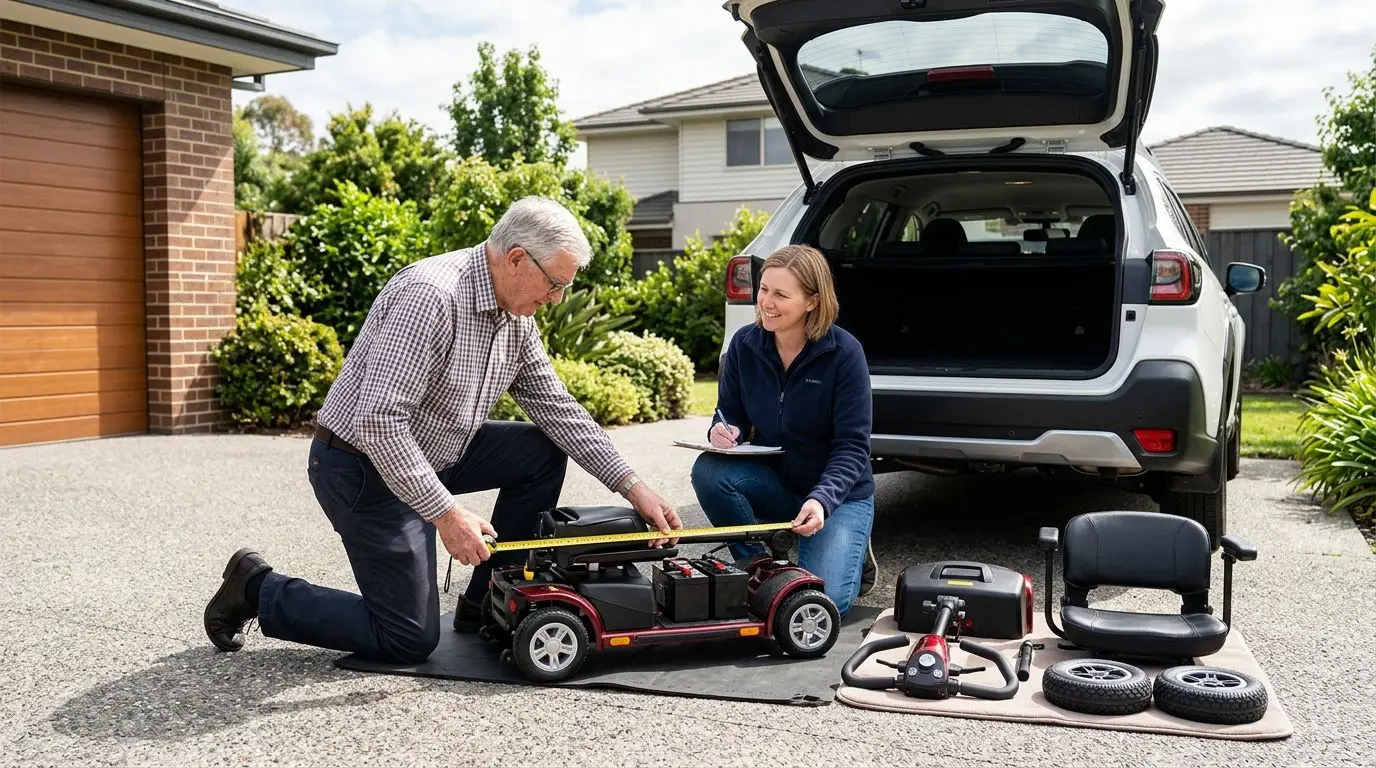
How to Transport a Mobility Scooter in a Car, SUV, or Van
14 min read