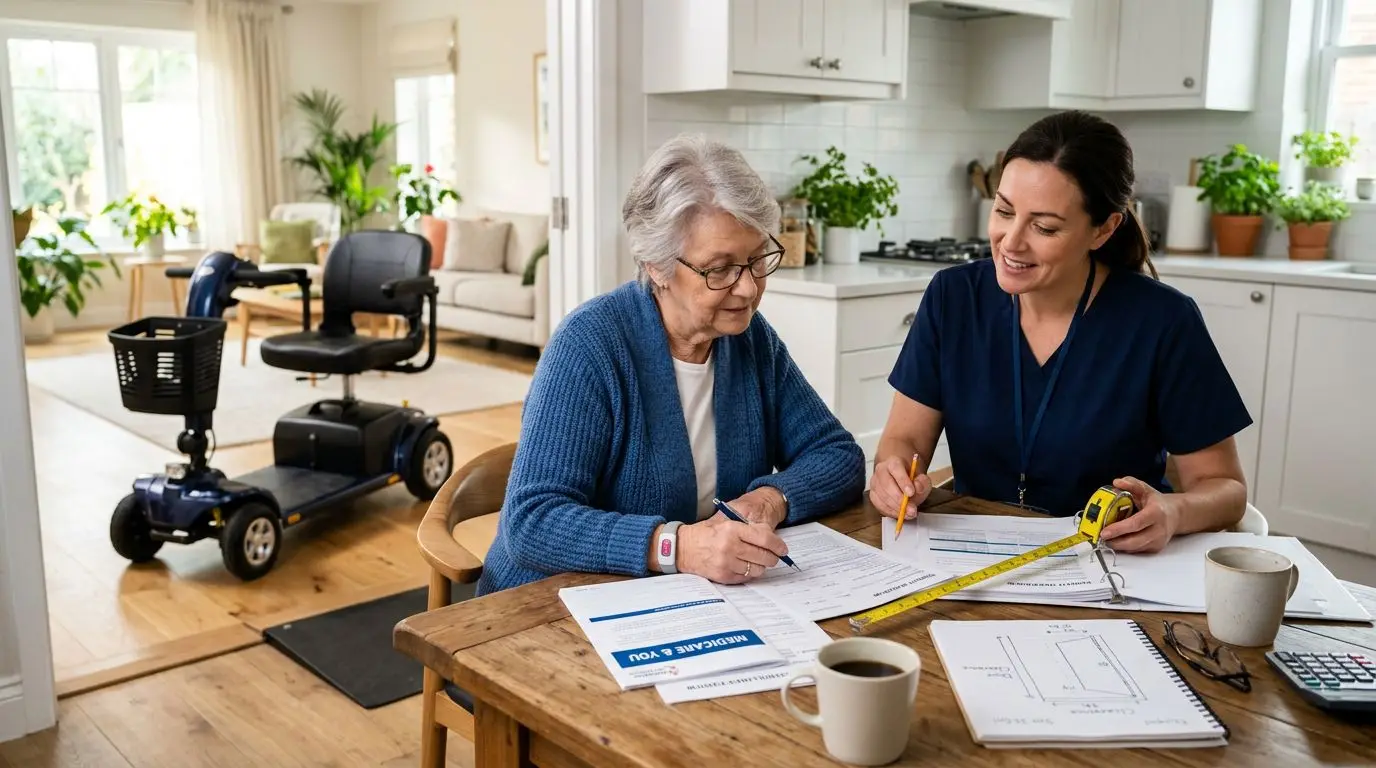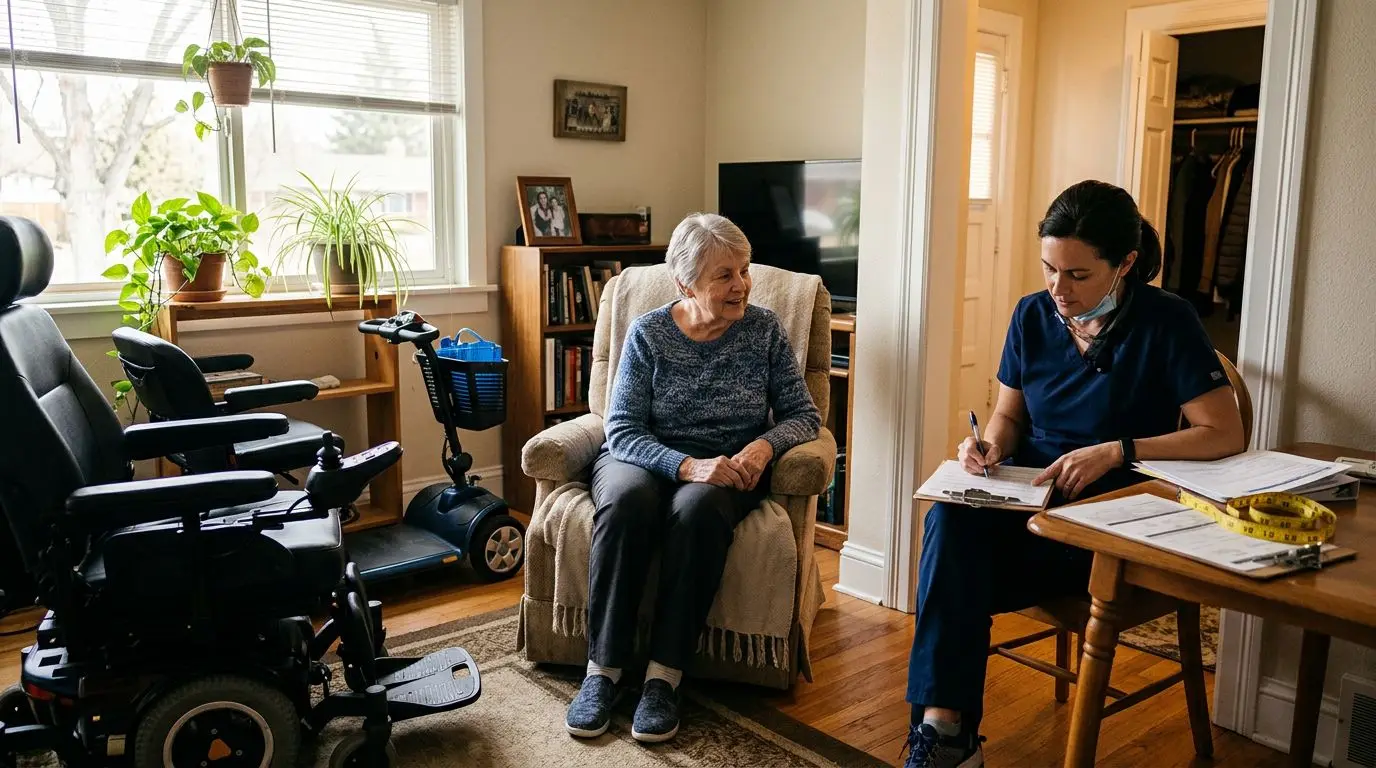
Insurance is more likely to approve the device that is medically necessary for mobility inside your home, not just the device you prefer for errands or outdoor travel. A power wheelchair may be approved when you cannot safely use a scooter. A mobility scooter may be approved when you can sit upright, transfer safely, and operate a tiller-style control.
The key question is not whether a scooter or power wheelchair would be helpful. It is whether your documentation shows that you need that specific type of powered mobility device to complete daily activities, such as getting to the bathroom, kitchen, bedroom, or living area.
Why insurers focus on in-home medical necessity, not convenience
Most U.S. insurance coverage decisions for powered mobility equipment begin with one practical standard: can you move safely and effectively inside your home to perform mobility-related activities of daily living? These activities are often abbreviated as MRADLs and include tasks such as toileting, bathing, dressing, and getting meals. For Medicare and many private plans, outdoor use alone is usually not enough.
This is where many denials happen. A person may truly need help shopping, visiting family, or traveling longer distances, but the insurer may say the device is not covered if the record does not show an in-home need. A 200-foot walk to the mailbox may feel impossible, yet coverage is typically based on whether you can reach the bathroom from your bed, move between rooms, and avoid unsafe falls during daily routines.
Insurers also compare lower-level options first. If a cane, walker, or manual wheelchair meets the in-home need safely, a powered device may not be approved. If a powered device is justified, the insurer then asks which one is appropriate: a scooter, sometimes called a power-operated vehicle, or a power wheelchair.
Power wheelchair vs. mobility scooter: the 5 coverage differences that matter
A mobility scooter and a power wheelchair may both be battery-powered, but insurers treat them differently because they require different physical abilities. A scooter usually has a tiller handlebar, a larger turning radius, and a seat that the user must transfer onto and off of. A power wheelchair usually uses a joystick or alternative drive control and is designed for people who need more seated support, tighter indoor maneuvering, or cannot safely operate a scooter.
| Coverage factor | Mobility scooter | Power wheelchair |
|---|---|---|
| Typical control | Tiller or handlebar-style steering | Joystick or other electronic drive control |
| Transfer need | User usually must transfer on and off safely | May be used by people with limited transfer ability, depending on setup |
| Postural support | Basic seat and back support | More seating and positioning options |
| Indoor maneuvering | Often needs wider turns and more open space | Often better for tighter spaces, including hallways and bedrooms |
| Why it may be denied | Unsafe transfers, poor trunk control, home too tight, outdoor-only need | May be denied if scooter or manual wheelchair can meet the need |
The turning radius matters in real homes. Many scooters need more space to turn than a power wheelchair, especially 4-wheel scooter designs. In a home with 30- to 36-inch doorways, a narrow hallway, and small bathrooms, the device that looks easy in a showroom may not work at home.
Insurance reviewers look for consistency. If your clinician says you need a scooter but also documents that you cannot transfer safely or cannot keep both hands on a tiller, the claim may conflict with itself. If your clinician recommends a power wheelchair but the notes show you can walk household distances safely with a walker, that may also trigger a denial.
When a mobility scooter is more likely to be approved: 4 common conditions of use
A mobility scooter is more likely to be approved when you need powered mobility inside the home and can physically use the scooter safely. Usually, that means you can sit upright, maintain balance on the seat, steer with a tiller, understand and control speed, and transfer to and from the scooter without unreasonable risk.
In practical terms, many scooter users can stand briefly, pivot, and sit down with or without help from stable surfaces. They also have enough shoulder, arm, hand, and trunk function to steer, accelerate, brake, and back up. The documentation should make this clear.
Who a covered scooter is best for
- Someone who cannot complete essential in-home walking distances but can safely operate a tiller.
- Someone with adequate sitting balance for a scooter seat, usually without advanced positioning support.
- Someone whose home has enough clear space to turn, park, and charge the device.
- Someone who can transfer on and off the scooter consistently, including during fatigue.
A scooter may be a poor coverage match if the main need is outdoor distance only, such as navigating a large store, park, or apartment complex courtyard. Those needs are important for quality of life, but they may not meet the insurer’s medical necessity rule unless they connect directly to covered in-home function.
When a power wheelchair is more likely to be approved: 6 signs in the medical record
A power wheelchair is more likely to be approved when a scooter is not safe or functional, and a manual wheelchair is not effective. The medical record often needs to explain why the person cannot walk safely enough, cannot self-propel a manual wheelchair for daily home tasks, and cannot use a scooter because of transfers, steering, posture, endurance, or home layout.
For example, a person may have enough hand control to use a joystick but not enough shoulder range or grip endurance to steer a tiller. Another person may be able to sit safely only with a more supportive wheelchair seat and back. In those situations, a power wheelchair can be the more medically appropriate device.
Who a covered power wheelchair is best for
- Someone who cannot safely operate a scooter tiller but can use a joystick or adapted control.
- Someone with limited standing, pivoting, or transfer ability.
- Someone who needs tighter indoor maneuverability in rooms, hallways, or near a bed.
- Someone who cannot self-propel a manual wheelchair enough to complete MRADLs.
- Someone who needs more seating support than a scooter provides.
- Someone whose fatigue, pain, weakness, or balance problems create unsafe walking inside the home.
That does not mean a power wheelchair is automatically easier to get covered. Reviewers still expect a step-by-step explanation. The record should show why lower-cost or less complex options are not adequate, and why the prescribed power wheelchair features are necessary rather than optional.
How to choose and measure before the claim: 10 checks to do at home
Before asking your clinician to prescribe powered mobility equipment, measure the home as if the device had to work there every day. A common problem is that the need is real, but the home cannot accommodate the requested device. Doorways, bathroom entries, bed placement, rug edges, and charging space all matter.
Start with a tape measure and write down actual numbers. Many interior doorways are around 30 to 32 inches wide, while older homes may have narrower openings. Hallways may be 36 inches wide but still difficult if there are sharp turns, furniture, or laundry baskets in the path.
Home measurement checklist
- Measure the narrowest doorway the device must pass through, in inches.
- Measure hallway width and note any 90-degree turns.
- Measure the clear floor space beside the bed for transfers.
- Measure bathroom doorway width and turning room near the toilet.
- Check whether thresholds are higher than about 1/2 inch, which can be difficult for some devices.
- Identify at least one safe charging location near a grounded outlet.
- Look for loose rugs, cords, pet bowls, or clutter along the route.
- Confirm whether the device can reach the kitchen, bathroom, bedroom, and main sitting area.
- Check ramp slope if there is an entry ramp; overly steep ramps can be unsafe.
- Ask whether the device must fit in an elevator, van, or apartment doorway.
Bring these measurements to the clinical visit and the equipment evaluation. A therapist or qualified equipment professional may identify issues you missed, such as turning clearance at the end of a hallway or whether a scooter seat height makes transfers harder.
What documentation insurers usually want: 7 items that reduce denials
Coverage rules vary by plan, but many insurers want the same basic evidence. The documentation should connect diagnosis, functional limitation, home need, safety, and device selection. A short prescription that says powered scooter needed is rarely enough by itself.
| Documentation item | Why it matters |
|---|---|
| Face-to-face mobility evaluation | Shows the clinician assessed your current mobility and daily needs |
| Functional limits inside the home | Explains what tasks you cannot complete safely, such as reaching the bathroom |
| Why cane, walker, or manual wheelchair is not enough | Shows lower-level options were considered |
| Ability to operate the requested device | Confirms steering, judgment, vision, transfers, and sitting balance |
| Home environment information | Shows the device can be used in the living space |
| Specific device type and needed features | Connects the prescription to medical necessity |
| Supplier paperwork and plan forms | Helps meet timing, authorization, and billing requirements |
Medicare Part B, when it applies, generally treats power wheelchairs and scooters as durable medical equipment and may cover medically necessary equipment after plan requirements are met. Many private Medicare Advantage and commercial plans use similar medical-necessity concepts, but prior authorization steps, network rules, and cost-sharing can differ.
Medicaid rules are state-specific. Some state programs may consider broader community needs, while others follow strict medical necessity standards. If you have both Medicare and Medicaid, coordination rules can affect what is reviewed first and what out-of-pocket costs remain.
Why a scooter may be denied while a power wheelchair is approved: 5 real-world scenarios
It can feel confusing when a less complex scooter is denied but a power wheelchair is approved. The reason is usually safety or function. The insurer is not always choosing the cheapest-looking option; it is choosing the device that the record supports as medically necessary and usable.
- Unsafe transfers: The person cannot reliably stand and pivot onto a scooter seat, especially during fatigue or pain flare-ups.
- Poor tiller control: The person lacks the grip, reach, shoulder motion, or endurance needed to steer a scooter.
- Postural support needs: The person cannot maintain safe sitting on a basic scooter seat for daily tasks.
- Tight home layout: The scooter cannot turn into the bathroom or bedroom, but a power wheelchair can maneuver in the available space.
- Manual wheelchair not effective: The person cannot self-propel due to weakness, pain, heart or lung endurance limits, or upper-body impairment documented by the clinician.
A scooter denial does not always mean powered mobility is denied. It may mean the requested device does not fit the medical facts. In that case, your clinician may need to clarify whether a power wheelchair is more appropriate.
Why a power wheelchair may be denied while a scooter is approved: 4 common reasons
The reverse can happen too. A power wheelchair may be denied if the insurer believes a scooter can meet the in-home need safely. Reviewers may also deny a power wheelchair if the extra features are not tied to a documented medical need.
- The person can transfer safely: If transfers are consistent and safe, a scooter may be considered adequate.
- Tiller operation is documented as safe: Good sitting balance, hand control, and judgment may support scooter use.
- No need for advanced seating: If standard seating is adequate, the insurer may not approve wheelchair seating features.
- Home layout allows scooter use: If the scooter can reach the key rooms, tighter power wheelchair maneuvering may not be considered necessary.
This is why the evaluation should not start with a preferred device. It should start with your functional limits, home layout, and safety requirements. The right paperwork follows the right clinical reasoning.
Appeals and next steps after a denial: act within the deadline on your notice
If coverage is denied, read the denial letter carefully. Many plans give a limited appeal window, often 60 days or 180 days depending on the insurer and type of plan. The letter should list the reason for denial, the appeal deadline, and where to send additional information.
Do not appeal with emotion alone, even if the denial feels unfair. Strong appeals address the exact reason for denial. If the plan says the device is for outdoor use, provide documentation of in-home MRADL limitations. If the plan says a manual wheelchair is sufficient, ask your clinician to document why self-propulsion is unsafe or ineffective.
Helpful appeal materials
- A revised clinician note that answers the denial reason directly.
- A therapy evaluation describing transfers, balance, endurance, and device trial results.
- Home measurements showing why one device type works and another does not.
- Fall history or safety incidents, when medically documented and relevant.
- A supplier letter explaining why the prescribed device and features match coverage criteria.
If your condition has changed since the first request, ask whether a new evaluation is needed instead of a simple appeal. A recent hospitalization, new diagnosis, worsening endurance, or new transfer limitation can change the medical necessity picture.
Questions to ask before choosing a covered device: 12 practical prompts
A good decision protects both safety and coverage. Use these questions with your clinician, therapist, and equipment supplier before the claim is submitted.
- What in-home tasks can I not complete safely without powered mobility?
- Can I use a cane, walker, or manual wheelchair safely for those tasks?
- Can I transfer on and off a scooter at least several times per day?
- Can I steer a tiller with both hands when tired?
- Do I need a joystick or alternative control instead?
- Can I sit upright without added positioning support?
- Will the device fit through my narrowest doorway?
- Can it turn into my bathroom and bedroom?
- Where will it charge for 6 to 8 hours, if overnight charging is recommended?
- Does my plan require prior authorization?
- Is the supplier in network or approved by my insurance?
- What appeal rights do I have if the first request is denied?
These questions also help prevent a mismatch. A device that is covered but difficult to use in your home is not a successful outcome. A device that is comfortable outdoors but unsupported by medical necessity rules may leave you paying out of pocket.
FAQ: 5 coverage questions about scooters and power wheelchairs
Does insurance cover a scooter for shopping or outdoor errands?
Usually not by itself. Many insurers focus on medically necessary mobility inside the home. Outdoor access may matter, but it is rarely enough unless the plan specifically includes broader community mobility benefits.
Is a power wheelchair always easier to get covered than a scooter?
No. A power wheelchair generally requires stronger documentation because it is more complex. It may be approved when a scooter is unsafe or not functional, but it can be denied if a scooter or manual wheelchair meets the in-home need.
Can I choose the device I like best and ask my doctor to prescribe it?
You can share preferences, but coverage depends on medical necessity. The prescription should match your functional limits, home layout, transfer ability, and safe operating skills.
What if my home is too small for a scooter?
Tell your clinician and supplier, and provide measurements. If a scooter cannot reach essential rooms but a power wheelchair can, that fact may support a different device recommendation.
Will Medicare or private insurance pay the full cost?
Not always. Coverage depends on eligibility, medical necessity, deductibles, coinsurance, network rules, and prior authorization. Medicare Part B commonly involves cost-sharing after requirements are met, and private plans vary.
The best coverage strategy is simple: document the problem first, then match the equipment to the problem. A mobility scooter can be the right covered choice for someone who can transfer, steer, and use it safely at home. A power wheelchair can be the right covered choice when a scooter is not safe or functional and the medical record clearly explains why.
Frequently asked questions
Does insurance cover a mobility scooter for shopping or outdoor errands? +
Usually not by itself. Many insurers focus on medically necessary mobility inside the home, such as reaching the bathroom, bedroom, or kitchen. Outdoor and community use may be helpful, but it often is not enough unless your plan includes broader benefits.
Why would insurance approve a power wheelchair but deny a scooter? +
A scooter may be denied if you cannot transfer safely, cannot operate a tiller, need more postural support, or cannot use the scooter in your home layout. If the record shows a power wheelchair is safer and more functional for in-home daily activities, it may be approved instead.
Why would insurance approve a scooter but deny a power wheelchair? +
A power wheelchair may be denied if a scooter can meet your in-home mobility needs safely. Insurers generally look for the least complex device that meets the documented medical need.
What documentation helps support coverage for powered mobility equipment? +
Helpful documentation includes a face-to-face mobility evaluation, details about in-home functional limits, why a cane, walker, or manual wheelchair is not enough, proof that you can operate the requested device safely, and home measurements showing the device can be used where you live.
Can I appeal if my scooter or power wheelchair is denied? +
Yes. Read the denial letter, note the appeal deadline, and respond to the specific reason for denial. Ask your clinician, therapist, or equipment supplier for updated notes that address the plan’s concerns directly.
Related guides

What to Do if Medicare Won’t Cover Your Mobility Scooter
13 min read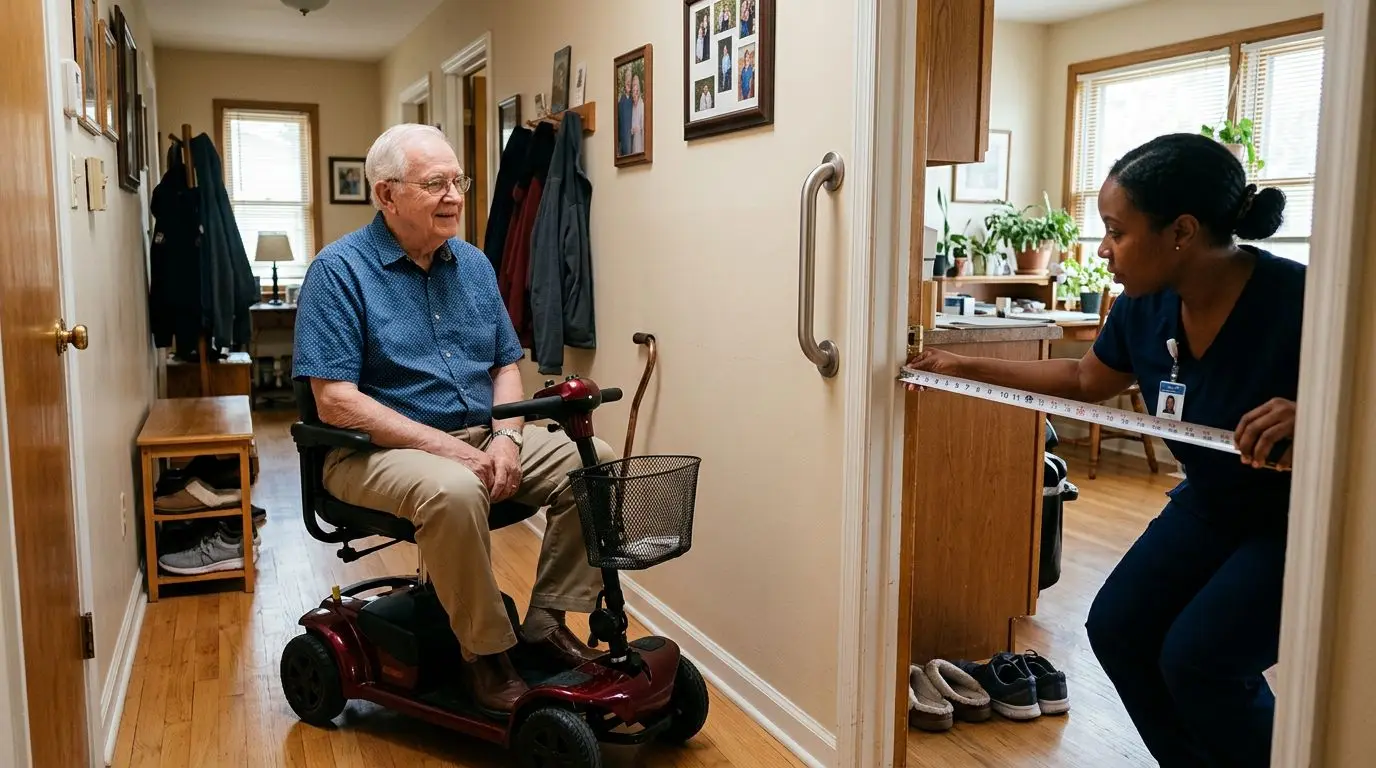
Why Insurance-Covered Mobility Scooters Must Be Needed at Home, Not Just Outdoors
12 min read
Mobility Scooter Prescription Requirements: What Doctors Must Document for Insurance Approval
14 min read