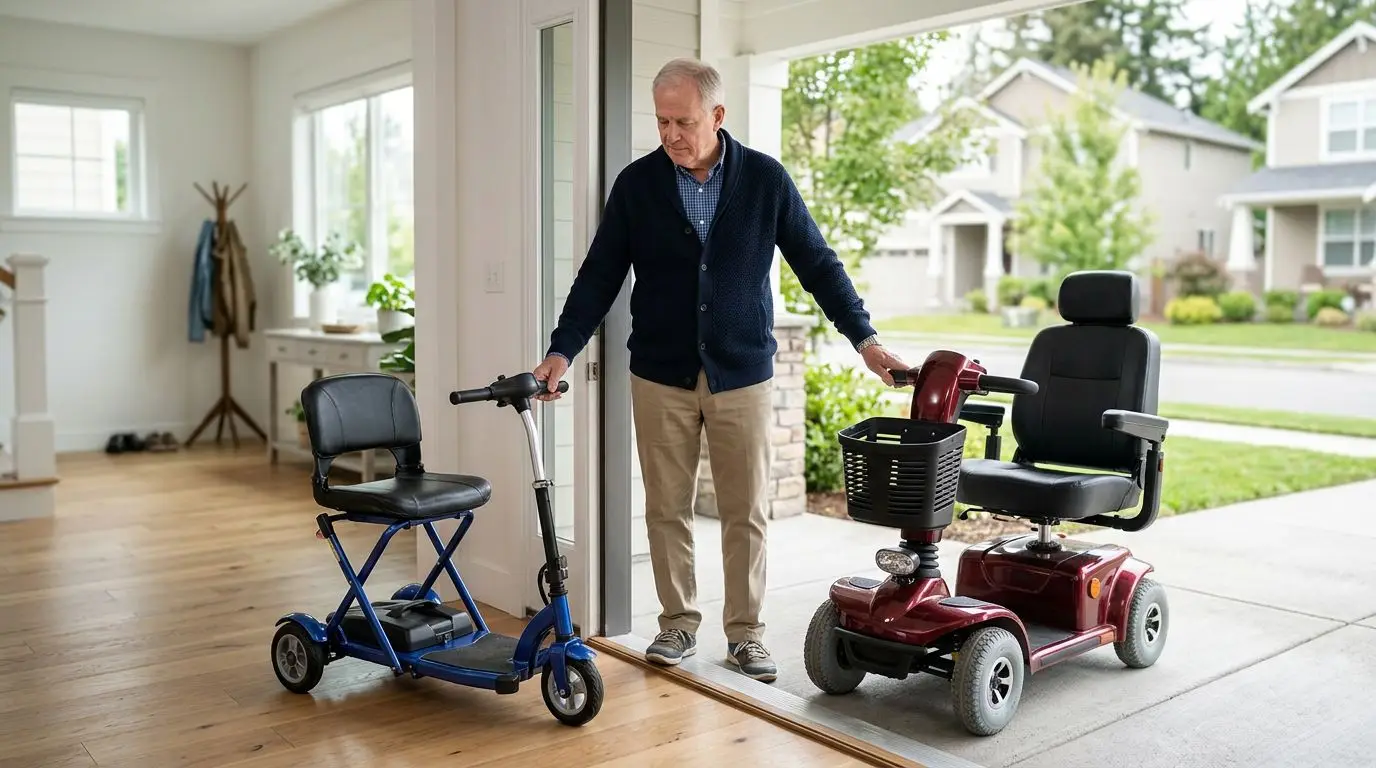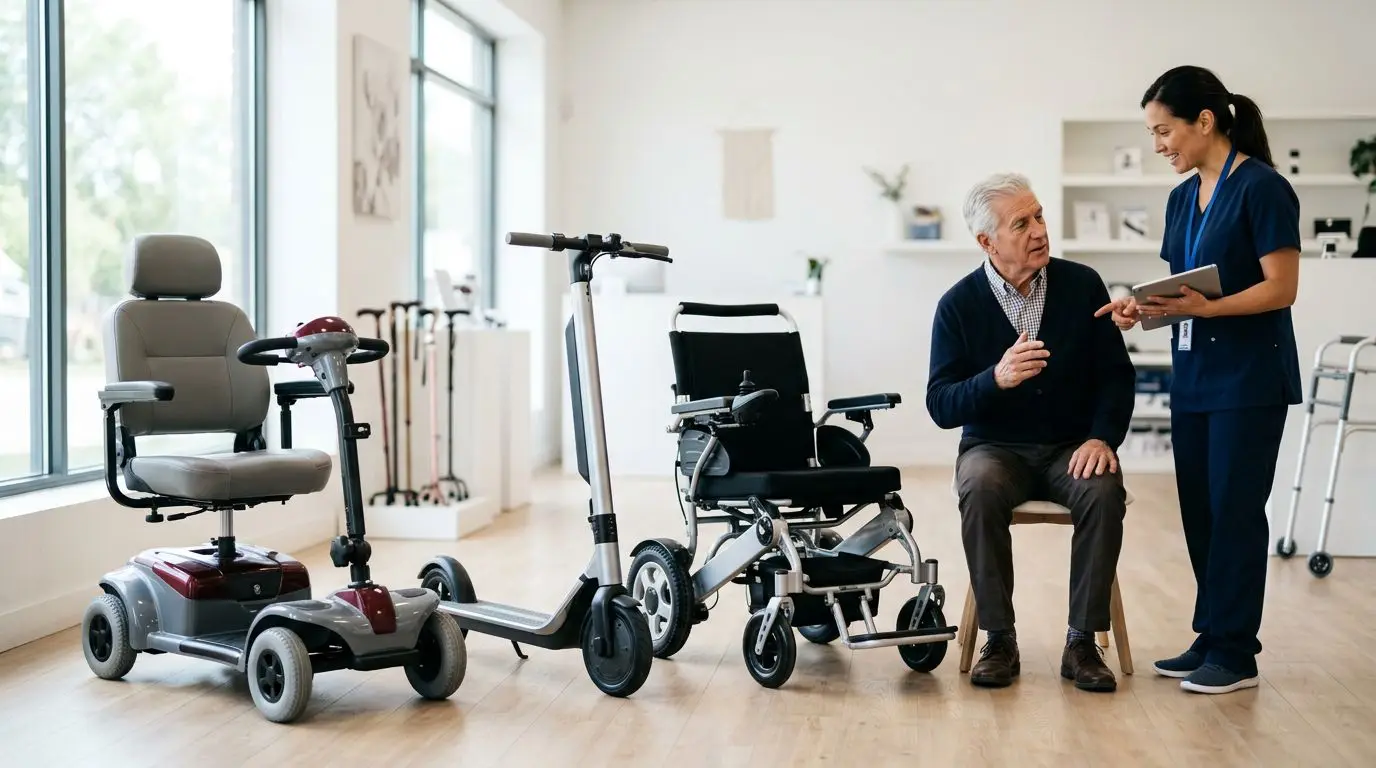
A medical mobility scooter is a seated mobility aid for people who can sit upright, steer with a tiller, and transfer on and off the seat. An electric scooter is usually a recreational or commuter device, often ridden standing on 2 wheels. A power wheelchair is a medical mobility device controlled by a joystick and designed for users who need more seating support and indoor maneuverability.
The easiest way to tell them apart is by the user, not the motor. Mobility scooters help with longer walking distances, electric scooters provide quick transportation for people with good balance, and power wheelchairs support people who rely on powered mobility as their main way to move through home and community spaces.
Quick comparison: 3 devices, 3 very different jobs
The names sound similar because all 3 can be battery powered, but their design goals differ. A seated medical mobility scooter may travel around 4 to 8 mph depending on type and setting. Many consumer electric scooters are built for faster street or bike-lane commuting where local law allows. Power wheelchairs are usually slower, often around walking speed, because precision, posture, and indoor control matter more than speed.
| Device type | Main purpose | Typical control | Best environment | Typical rider position |
|---|---|---|---|---|
| Medical mobility scooter | Seated mobility for people who have difficulty walking distances | Handlebar-style tiller with throttle | Sidewalks, stores, parks, large indoor areas | Seated upright |
| Electric scooter | Personal transportation or recreation for people with good balance | Handlebar throttle and brakes | Roadways, bike lanes, paved paths where legal | Usually standing |
| Power wheelchair | Primary powered mobility with seating and positioning support | Joystick or alternative drive control | Homes, apartments, clinics, tight indoor spaces | Seated with greater support |
If you are comparing these for yourself or a family member, start with safety and physical ability. Can the person stand steadily on a moving platform? Can they steer with both hands? Do they need trunk, head, or pressure relief support for several hours a day? Those answers matter more than the word electric.
Medical mobility scooters: built for seated travel at about 4 to 8 mph
A medical mobility scooter is a powered mobility device with a seat, deck, battery, motor, and front tiller. Most have 3 or 4 wheels. Three-wheel designs often turn more tightly, while four-wheel designs usually feel more stable outdoors on uneven pavement or curb-cut transitions.
These scooters are often used by people who can walk short distances but cannot comfortably get through a grocery store, medical campus, airport, senior community, or neighborhood path. The user usually needs enough upper body function to hold the tiller, control speed, and brake safely. Transfers matter too. The rider must be able to get on and off the seat, often with help from a swivel seat or armrests.
Scooter seating is supportive, but it is not the same as a custom wheelchair seating system. Many scooters have padded seats, armrests, and an adjustable tiller, but they are not designed for complex postural positioning. If someone leans heavily to one side, slides forward in the seat, needs pressure management, or cannot sit upright without help, a scooter may not provide enough support.
Mobility scooters come in travel, mid-size, heavy-duty, and all-terrain style categories. Travel scooters may break down into several pieces, with the heaviest piece commonly in the 30 to 60 lb range depending on design. Larger scooters can be more comfortable and stable, but they are harder to lift, store, or maneuver in tight rooms.
Who a medical mobility scooter is best for
- People who can walk a little but fatigue after 100 to 500 feet.
- Users who can sit upright without specialized positioning.
- Adults who can steer with both hands and react to pedestrians, curbs, and doors.
- People who want help with errands, appointments, community events, or long hallways.
- Users who have enough space at home or in a vehicle to store and charge it.
Electric scooters: 2 wheels, standing use, and short trips
An electric scooter is usually a personal transportation device, not a medical mobility aid. Most have 2 wheels, a narrow deck, a handlebar, and hand controls for speed and braking. Some have seats, but the overall design is still closer to commuter equipment than to a medical seating device.
The major difference is balance. A standing electric scooter requires the rider to step onto a small platform, stay balanced while accelerating and braking, handle bumps, and remain alert around cars, cyclists, pedestrians, and surface changes. Even a 1-inch pavement lip can matter when the wheels are small.
Electric scooters can be useful for adults with good balance, good reaction time, and no need for seating support. They are not a good substitute for a mobility scooter when the main issue is fall risk, leg weakness, severe fatigue, poor standing tolerance, or difficulty transferring safely after a trip.
Rules also vary. Some cities restrict electric scooters on sidewalks, roads, parks, transit platforms, or public buildings. Medical mobility devices generally have different access considerations than recreational or commuter scooters, although local rules and facility policies can still apply.
Who an electric scooter is best for
- People who can stand and balance for the full trip.
- Riders who need short-distance transportation, not medical support.
- Adults who can brake quickly and step down safely.
- Users who understand local traffic, helmet, sidewalk, and speed rules.
- People who can carry or store a compact device when needed.
Power wheelchairs: joystick control and tight indoor turning under 25 inches
A power wheelchair is a motorized wheelchair for people who need powered mobility and more seating support than a scooter can provide. Instead of a tiller, most use a joystick mounted near one armrest. Some can be configured with alternative controls for users who cannot operate a standard joystick, but those needs should be evaluated by qualified professionals.
The biggest practical advantage is indoor maneuverability. Many power wheelchairs have a much tighter turning radius than scooters, and some can rotate nearly within their own footprint. That matters in a 32-inch doorway, a small bathroom, a kitchen with a narrow turning space, or beside a bed.
Power wheelchairs also offer more options for posture and positioning. Depending on the chair type and clinical need, seating may include adjustable armrests, specialized cushions, lateral trunk supports, head support, elevating leg rests, tilt, recline, or power seat elevation. Not everyone needs those features, but when they are needed, a scooter is usually the wrong category.
They are not always easy to transport. Many power wheelchairs are heavy, and even compact versions may require a ramp, lift, or accessible vehicle. They can be excellent indoors and medically appropriate, but they are not automatically simpler than a scooter for car travel.
Who a power wheelchair is best for
- People who need powered mobility throughout the day, including inside the home.
- Users who cannot safely use a tiller because of arm, shoulder, hand, or trunk limitations.
- People who need seating, pressure relief, or positioning support beyond a scooter seat.
- Users who must turn in small rooms, narrow halls, or tight apartments.
- People whose clinician recommends powered wheelchair mobility based on functional need.
Who each device is best for: 6 common user situations
Real-life needs rarely fit a perfect chart, but these 6 situations make the decision clearer. Someone who can walk inside the home but struggles with a 20-minute shopping trip may need a very different device than someone who cannot move safely from bedroom to bathroom without powered assistance.
| Situation | Likely better fit | Why |
|---|---|---|
| Can walk around the house but not through large stores | Medical mobility scooter | Good for seated community mobility when transfers and tiller steering are safe |
| Needs powered mobility in the home every day | Power wheelchair | Better turning, joystick control, and seating options for indoor use |
| Has strong balance and wants a quick ride to transit | Electric scooter | Designed for transportation, not medical seating |
| Cannot sit upright without side support | Power wheelchair | Can offer more positioning and postural support |
| Needs a device that breaks into car-friendly pieces | Travel mobility scooter, if physically appropriate | Some designs disassemble, though lifting ability still matters |
| Has frequent falls when standing or stepping down | Medical evaluation needed; often not an electric scooter | Standing scooters can increase risk if balance is poor |
When in doubt, test the device in the hardest place you plan to use it. For many people, that is not the sidewalk. It is the bathroom doorway, car trunk, apartment elevator, or crowded pharmacy aisle.
How to choose: measure 5 things before you buy
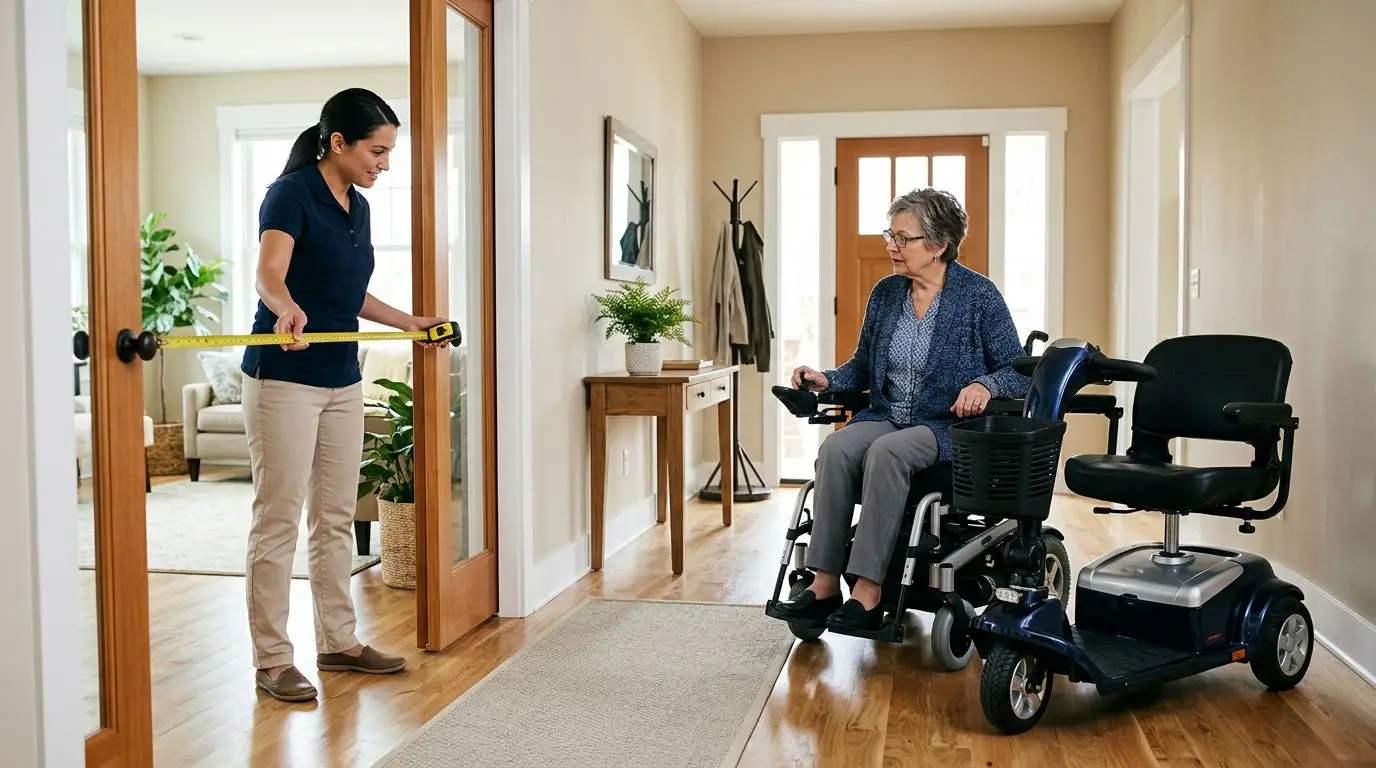
Good fit starts with measurements. Guessing can leave you with a device that is too wide for the hallway, too heavy for the caregiver, or too long for the vehicle lift. Before choosing between a mobility scooter, electric scooter, and power wheelchair, measure these 5 things.
- Doorway width: Many interior doorways are around 28 to 32 inches wide. Measure the narrowest usable opening, including trim and door swing.
- Turning space: Measure hall corners, bedroom approaches, bathroom access, and kitchen turns. Scooters need more room than many power wheelchairs.
- User dimensions: Seat width, hip width, leg length, and safe weight capacity matter. A seat that is too narrow or too high can make transfers unsafe.
- Vehicle space: Measure trunk opening height, cargo depth, and lift capacity. Do not rely only on total device weight; the heaviest piece matters.
- Daily distance: Estimate a realistic route, such as 1 mile of errands or 6 hours at a family event. Battery range varies by rider weight, terrain, temperature, and battery condition.
Think about controls as well. A tiller requires reaching forward and turning with both arms. A joystick requires fine hand control but usually less shoulder movement. A standing electric scooter requires balance from start to stop, plus the ability to step off quickly if something goes wrong.
Indoor use, portability, and transport: what changes in 30 seconds?
Portability is often misunderstood. Folding something in 30 seconds does not mean it is easy to lift, safe to load, or practical for daily use. A device can be compact and still too heavy for one person to manage.
Travel mobility scooters are often the most car-friendly medical option because some separate into multiple sections. That can help if the user or caregiver can lift the heaviest piece without strain. Larger scooters may need a vehicle lift, ramp, or trailer-style solution.
Electric scooters may fold quickly and fit in smaller spaces, but they do not solve seated mobility needs unless the rider can safely stand, balance, and manage curbs. Their small wheels can also be less forgiving on gravel, broken sidewalks, wet leaves, or driveway lips.
Power wheelchairs vary widely. Some compact power chairs fold or disassemble, while rehab-style power wheelchairs are typically heavier and intended for daily seating, not frequent lifting into a trunk. If indoor independence is the main goal, transport convenience should not override safe seating and maneuverability.
| Feature | Mobility scooter | Electric scooter | Power wheelchair |
|---|---|---|---|
| Indoor maneuvering | Fair to good, depending on size | Poor for medical indoor use | Usually best |
| Car transport | Good with travel types; harder with large types | Often easy to fold, but not medical seating | Varies; may need lift or ramp |
| Seating support | Basic to moderate | Minimal or none | Moderate to advanced |
| Balance required | Moderate for transfers and steering | High | Lower once seated, depending on needs |
| Best speed priority | Comfortable walking-area travel | Commuting where legal | Controlled indoor mobility |
Medical necessity and coverage: why documentation can take weeks
Medical necessity is about function, not convenience. A clinician or insurer may look at whether a person can safely perform mobility-related daily activities, especially inside the home, and whether a cane, walker, manual wheelchair, scooter, or power wheelchair is appropriate. The process can take weeks because it may involve medical visits, functional assessments, prescriptions, equipment evaluations, and paperwork.
A medical mobility scooter may be considered when a person cannot complete necessary activities by walking alone, but can still transfer, sit upright, and operate a tiller safely. A power wheelchair may be considered when the person needs powered mobility indoors and cannot safely use a scooter or manual wheelchair for essential tasks.
Electric scooters are generally treated differently because they are typically consumer transportation devices rather than prescribed durable medical equipment. That does not make them bad devices. It simply means they are usually not evaluated the same way for medical necessity.
If coverage, reimbursement, or clinical appropriateness matters, talk with a healthcare professional, occupational therapist, physical therapist, or qualified mobility equipment provider. Bring measurements, photos of home barriers, and a list of daily tasks that are difficult. Clear examples are better than broad statements.
Feature checklist: 10 details that matter more than labels
Labels can be confusing, so compare features directly. These 10 details often tell you more than the category name on the box or website.
- Control type: Tiller, handlebar throttle, joystick, or alternative control.
- Seat support: Basic padded seat, captain-style seat, adjustable cushion, or clinical seating.
- Turning radius: Critical for hallways, elevators, small kitchens, and bathrooms.
- Overall width: Compare with your narrowest doorway, not your widest one.
- Heaviest piece: More important than total weight if loading into a car.
- Ground clearance: A few inches can affect thresholds, ramps, and uneven sidewalks.
- Battery range: Treat published range as an estimate, not a guarantee.
- Braking system: Understand how it stops on slopes and during emergency use.
- Transfer setup: Armrests, seat height, swivel seat, footplate, and leg space all matter.
- Service and charging: Know where it will charge for 6 to 10 hours and who can maintain it.
A safe device should fit the person, the home, the vehicle, and the routine. The best choice is not always the fastest or smallest. It is the one the user can operate consistently, comfortably, and safely in the places that matter.
FAQs: 5 common questions
Is a mobility scooter the same as an electric scooter?
No. A mobility scooter is a seated mobility aid with a tiller, designed for people who have difficulty walking distances. An electric scooter is usually a standing transportation device for riders with good balance.
Which is better indoors, a mobility scooter or power wheelchair?
A power wheelchair is usually better indoors because it has tighter turning and joystick control. Some compact scooters work in larger rooms and wide halls, but they often struggle in small bathrooms or narrow apartments.
Can a power wheelchair replace a mobility scooter?
Sometimes, but the purpose is different. A power wheelchair is often chosen when the user needs more seating support, indoor maneuverability, or daily powered mobility; a scooter may be enough for outdoor errands and longer walking distances.
Are electric scooters safe for seniors?
They can be safe for some adults, but they require balance, quick reactions, and steady standing. Seniors with fall risk, leg weakness, dizziness, or poor standing tolerance should be cautious and consider a medical mobility device evaluation instead.
Do I need a prescription for a mobility scooter or power wheelchair?
You may not need a prescription to buy one privately, but documentation is usually needed if you are seeking insurance coverage or medical necessity approval. A clinician or mobility specialist can help determine the appropriate device type.
Frequently asked questions
Is a mobility scooter the same as an electric scooter? +
No. A mobility scooter is a seated mobility aid with a tiller, designed for people who have difficulty walking distances. An electric scooter is usually a standing transportation device for riders with good balance.
Which is better indoors, a mobility scooter or power wheelchair? +
A power wheelchair is usually better indoors because it has tighter turning and joystick control. Some compact scooters work in larger rooms and wide halls, but they often struggle in small bathrooms or narrow apartments.
Can a power wheelchair replace a mobility scooter? +
Sometimes, but the purpose is different. A power wheelchair is often chosen when the user needs more seating support, indoor maneuverability, or daily powered mobility; a scooter may be enough for outdoor errands and longer walking distances.
Are electric scooters safe for seniors? +
They can be safe for some adults, but they require balance, quick reactions, and steady standing. Seniors with fall risk, leg weakness, dizziness, or poor standing tolerance should be cautious and consider a medical mobility device evaluation instead.
Do I need a prescription for a mobility scooter or power wheelchair? +
You may not need a prescription to buy one privately, but documentation is usually needed if you are seeking insurance coverage or medical necessity approval. A clinician or mobility specialist can help determine the appropriate device type.
Related guides
Mobility Scooter vs. Power Wheelchair: Which Mobility Device Is Right for You?
15 min read
Mobility Scooters for Seniors: How to Pick the Right Scooter for Home, Errands, and Independence
14 min read
Mobility Scooters for Adults Under 65: Work, Errands, Fatigue, and Long-Term Mobility Needs
13 min read