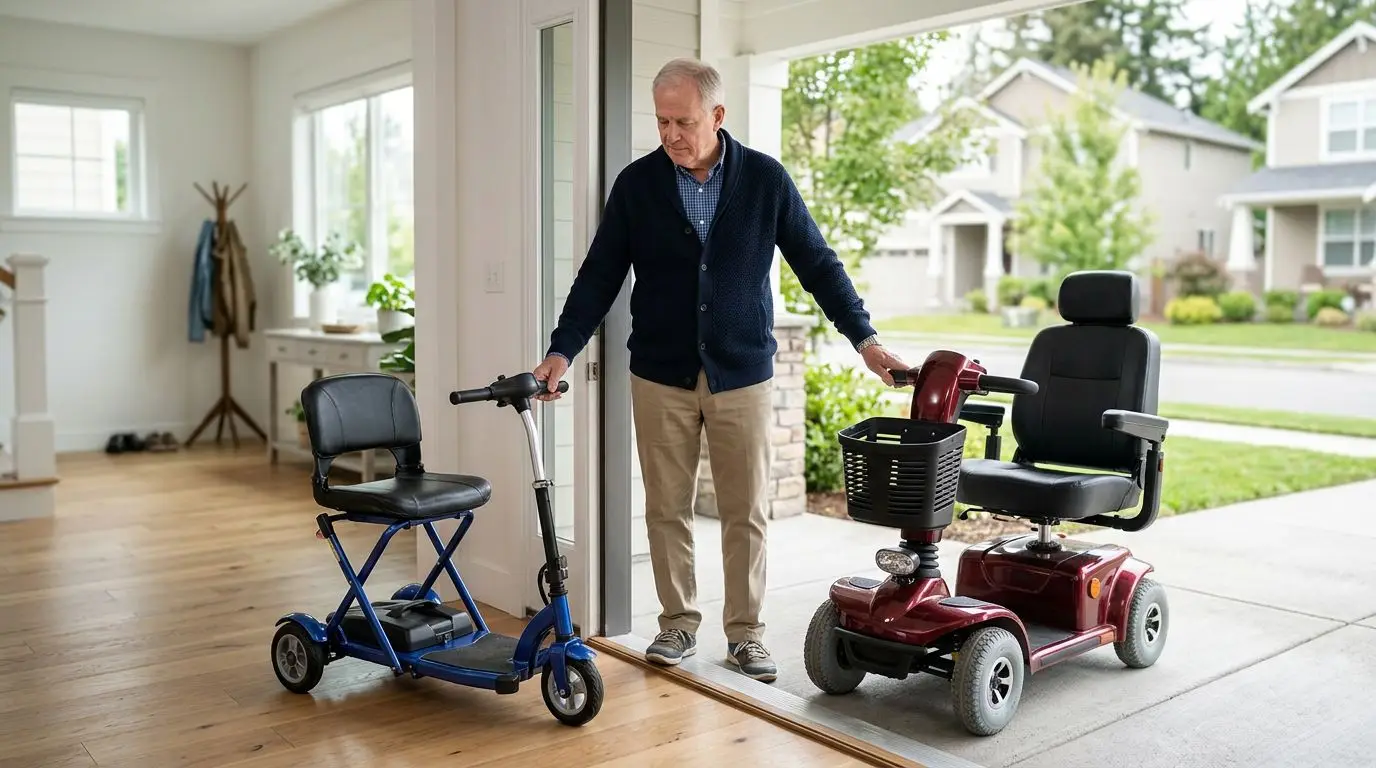
A mobility scooter is usually best if you can sit upright, get on and off safely, use both arms for tiller steering, and need a device mainly for errands, outdoor paths, or longer community outings. A power wheelchair is usually better if you need joystick control, tighter indoor maneuvering, more seating support, or a mobility device that serves as your primary chair throughout the day. The right choice depends less on speed or appearance and more on your home layout, body support needs, hand control, transfer ability, and how many hours a day you will use it.
Both devices can support independence when they are well matched to the user. They are not interchangeable, though. A scooter is closer to a powered personal vehicle with a seat, platform, and handlebar-style tiller. A power wheelchair is a powered seating and mobility system designed to move with the user in tighter spaces and, in many cases, accommodate more medical seating needs.
Quick comparison: scooter vs. power wheelchair in 8 everyday factors
The biggest difference is control and positioning. Most mobility scooters use a front tiller, so the user must reach forward and steer with the hands and arms. Most power wheelchairs use a joystick mounted near the armrest, often requiring less reaching and a smaller turning space. A compact power wheelchair may turn within roughly 20 to 30 inches depending on configuration, while many scooters need more room because the front tiller and wheelbase swing through a wider arc.
Here is a practical comparison, using general categories rather than brands or models.
| Factor | Mobility scooter | Power wheelchair |
|---|---|---|
| Primary control | Tiller steering with hand throttle | Joystick or alternative drive control |
| Typical turning feel | Wider, more like a small vehicle | Tighter, can pivot in place on some drive bases |
| Indoor fit | Better in open floor plans and wider hallways | Better for tight kitchens, bedrooms, and bathrooms |
| Transfers | User usually steps on/off or transfers to a scooter seat | Often used as the main seated position for hours |
| Seating support | Basic padded seat, limited positioning options | More options for back support, cushions, headrests, and positioning |
| Outdoor travel | Often comfortable for sidewalks, stores, parks, and campuses | Varies by base; some are indoor-focused, others handle outdoor terrain |
| Transport | Some disassemble into 3 to 5 pieces | Some fold, but many are heavier and require a lift or accessible vehicle |
| Best daily use pattern | Part-time mobility aid for outings | Full-time or near full-time mobility and seating support |
Use this as a starting point, not a rulebook. A person who walks short distances at home may love a scooter for shopping. Another person with limited trunk control, shoulder pain, or fatigue after 30 minutes of sitting may need the closer fit and support of a power wheelchair.
Who it is best for: 2 common user profiles
A mobility scooter is generally best for someone who can transfer independently or with light assistance, sit upright without specialized positioning, and manage a tiller for the length of a trip. Many scooter users can walk short distances, such as 20 to 100 feet, but need help conserving energy in larger spaces like grocery stores, medical centers, airports, senior communities, or outdoor events.
Scooters also fit people who want a device for use outside the home several times per week rather than all day. If you can safely get to the scooter, turn your shoulders, grip or press the controls, and maintain balance while crossing small thresholds, a scooter may feel natural. Three-wheel scooters typically feel more maneuverable than four-wheel scooters, while four-wheel scooters usually feel more stable on uneven outdoor surfaces.
A power wheelchair is generally best for someone who needs powered mobility inside the home, has trouble using a tiller, has reduced upper-body endurance, or needs better seating support. It may be the stronger choice if you spend 6 or more hours a day seated in the device, cannot safely step onto a scooter deck, or need controls positioned close to your body.
Power wheelchairs also become important when mobility needs are medical and daily, not just recreational or convenience-based. That does not mean every power wheelchair user has the same diagnosis. It means the device may need to support posture, pressure relief routines, fatigue management, transfers, and safe room-to-room mobility.
Choose a mobility scooter if you:
- Can sit upright on a standard seat for the length of your outing.
- Can reach forward to a tiller without shoulder, neck, or balance problems.
- Need help with longer distances more than tight indoor navigation.
- Have a place to park and charge a device that may be 40 to 55 inches long.
- Want a part-time mobility aid for shopping, appointments, and neighborhood travel.
Choose a power wheelchair if you:
- Need joystick control because tiller steering is difficult or unsafe.
- Use the device indoors daily, including bedrooms, kitchens, and bathrooms.
- Need more supportive seating than a basic scooter seat can provide.
- Have limited endurance, trunk control, arm reach, or transfer ability.
- May need professional fitting for cushion, backrest, armrest, or control placement.
Indoor maneuvering and controls: 30-inch doorways matter
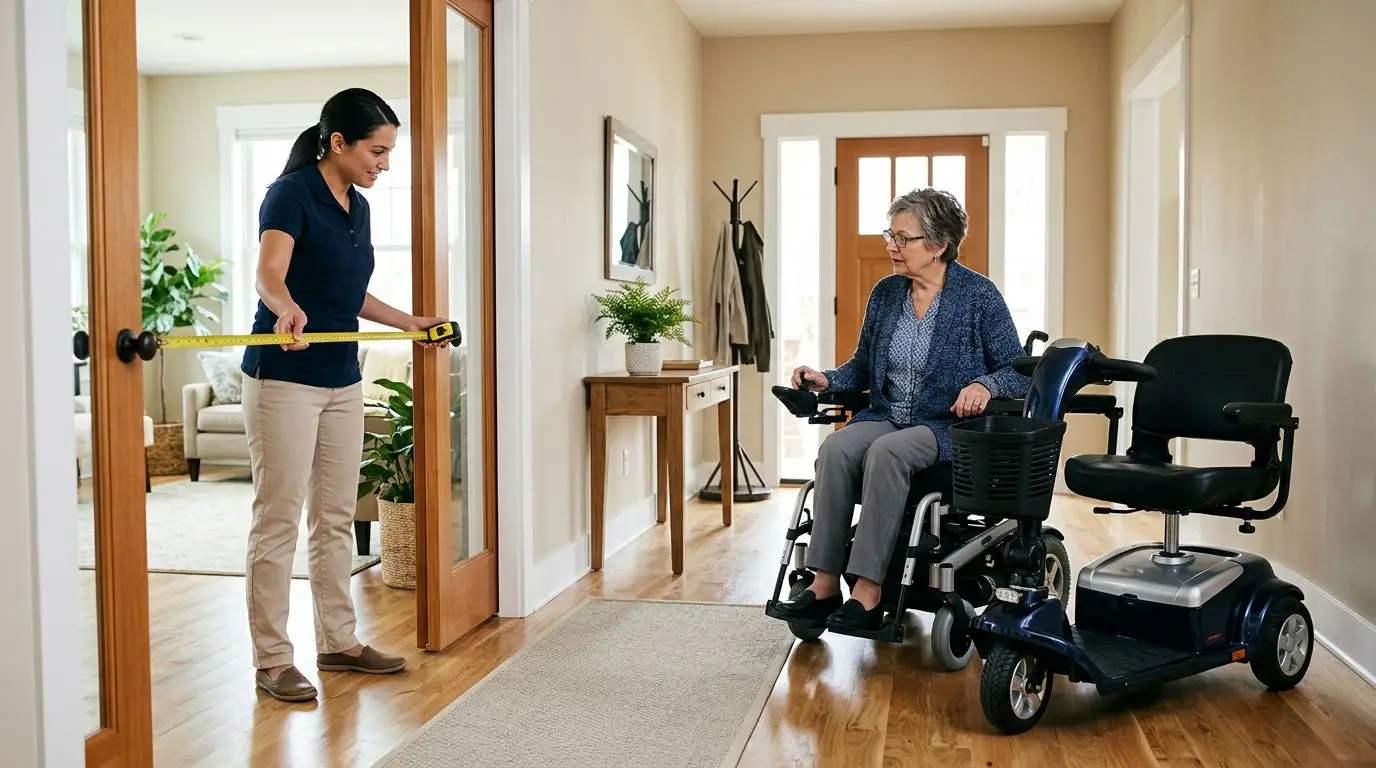
If tight indoor movement is your main concern, measure before you shop. Many US interior doorways are about 30 to 32 inches wide, while older homes may have bathroom or bedroom doors closer to 28 inches. A device that looks manageable in a showroom can feel very different when you turn from a narrow hall into a small bathroom.
Power wheelchairs often have the indoor advantage because the drive wheels can sit near the center or rear of the chair, and the joystick allows fine movements at low speed. Some power wheelchairs can turn in a very compact footprint, which helps near a kitchen island, bed corner, or hallway turn. The user also does not have to swing a front tiller around furniture.
Scooters need more forward and side clearance. The tiller, front wheel assembly, and deck length all matter. A 3-wheel scooter may turn tighter than a 4-wheel scooter, but it can still take planning in a small apartment. You may need room for a multi-point turn, especially if the hallway is less than 36 inches wide.
Controls matter just as much as dimensions. A scooter typically uses thumb levers, finger levers, or a twist-style control on the tiller. That works well for many users, but it may be difficult for people with arthritis, reduced grip, tremor, shoulder pain, or one-sided weakness. A power wheelchair joystick can often be positioned closer to the hand and may require only small movements. Some users also need alternative controls, though those should be discussed with a qualified seating or rehabilitation professional.
| Home feature to check | Why it matters | What to measure |
|---|---|---|
| Front door and interior doors | Determines whether the device can pass through straight | Clear opening width, not just the door size |
| Hallway turns | Shows whether the device can turn into rooms | Hallway width and distance from opposite wall |
| Bathroom layout | Often the tightest room in the home | Door width, turning space, toilet approach, sink clearance |
| Bedroom pathways | Affects daily independence | Space beside bed, dresser clearance, closet access |
| Charging location | Prevents tripping and blocked exits | Outlet location and floor space for overnight charging |
Seating support and medical mobility needs: 6 hours a day changes the decision
Seating is one of the clearest dividing lines. A scooter seat is usually designed for comfort during trips, not advanced postural support. It may swivel, slide, recline slightly, or have padded armrests, but it generally offers fewer adjustment and positioning options than a power wheelchair seating system.
If you will sit in the device for 1 to 3 hours at a time, a scooter seat may be adequate if it fits your body and you do not need special support. If you will sit in it for 6, 8, or more hours per day, seating becomes a health and safety issue that deserves professional guidance. Pressure management, pelvic positioning, back support, foot placement, and arm support all affect comfort and safe function.
Power wheelchairs can provide a more tailored seating setup. Depending on the chair category and user needs, options may include a supportive back, pressure-relieving cushion, adjustable armrests, elevating leg rests, head support, tilt, recline, or seat elevation. Not every user needs those features, and not every device includes them. The point is that power wheelchairs are more often built around the seated user, while scooters are more often built around travel convenience.
Weight capacity also needs attention. Many standard mobility devices fall around 250 to 300 pounds of capacity, while heavy-duty categories may support more. Capacity is not only about body weight; it affects motor strain, braking, seat width, frame strength, and stability. Seat width matters too. A seat that is too narrow can create pressure and pain, while a seat that is much too wide can reduce support and make reaching controls harder.
If you have a progressive condition, recent surgery, frequent falls, significant weakness, pressure injury risk, or complex medical needs, ask your clinician about an occupational therapy or physical therapy mobility evaluation. A properly chosen device can support daily activity, but it should not replace medical care, fall-risk assessment, or pressure-relief instruction.
Outdoor use, transport, and range: 4 mph to 8 mph is only part of the story
Many people compare speed first. That makes sense, but speed is rarely the deciding factor. A typical powered mobility device may travel in the general range of walking speed up to a brisk sidewalk pace, often around 4 to 8 mph depending on device type and settings. What matters more is whether it handles your real routes safely.
Scooters often feel well suited to outdoor errands. Larger wheels, longer frames, and straightforward steering can make them comfortable on sidewalks, paved paths, parking lots, and stores. Four-wheel scooters usually feel steadier on uneven ground than three-wheel designs, though they turn wider. Smaller travel scooters may be easier to load but less comfortable on rough pavement.
Power wheelchairs vary widely outdoors. Some compact chairs are excellent inside but are not intended for rough outdoor use. Other power wheelchairs have stronger bases, suspension, and drive configurations that handle ramps, sidewalks, and moderate outdoor surfaces better. If you need both indoor precision and outdoor dependability, pay close attention to ground clearance, wheel size, drive-wheel position, and manufacturer guidance on terrain.
Transport is another major difference. Some scooters break down into 3 to 5 pieces so they can fit into a vehicle trunk or cargo area, though the heaviest piece may still be difficult to lift. Folding scooters may reduce storage space but can still be heavy. Many power wheelchairs are heavier and may require a vehicle lift, ramp, or accessible van, especially if they have larger batteries or powered seating features.
Battery range should be treated as an estimate, not a promise. Published ranges are often measured under controlled conditions. Real-world range changes with user weight, hills, temperature, tire condition, floor surfaces, starts and stops, and battery age. If your regular outing is 6 miles round trip, do not choose a device that barely claims 6 miles of range. Build in a margin.
| Need | Feature to prioritize | Why it helps |
|---|---|---|
| Small apartment | Tight turning radius and joystick control | Improves access through narrow routes |
| Grocery shopping | Stable base, basket or storage, comfortable seat | Supports longer aisles and carrying essentials |
| Daily outdoor sidewalks | Wheel size, suspension, ground clearance | Reduces jolts and scraping on small obstacles |
| Car transport | Disassembly weight or folding size | Determines whether lifting is realistic |
| All-day sitting | Adjustable seating and pressure management | Supports posture and comfort over time |
How to choose and measure in 7 practical steps
Start with your day, not the device. Write down where you need powered mobility: bedroom to bathroom, kitchen to living room, apartment hallway, driveway, mailbox, medical appointments, grocery store, church, senior center, or outdoor path. A device that solves only one setting may not solve your real mobility problem.
- Measure doorways. Measure the clear opening with the door open, from the door face to the opposite jamb. Do not rely on the labeled door size. A 30-inch door may provide less clear space.
- Measure turning areas. Check hallway width, bathroom floor space, the route around the bed, and the spot where you would turn near the kitchen or entry. Mark tight corners with painter's tape if helpful.
- Check transfer height. Compare seat height with your bed, favorite chair, toilet, and vehicle seat. Even a 2-inch height difference can affect transfer safety.
- Assess hand and arm use. Ask whether you can reach forward, steer a tiller, squeeze or press a throttle, and hold your arm there for 10 to 20 minutes without pain or fatigue.
- Estimate sitting time. If you need the device for brief outings, basic seating may work. If you will sit for most of the day, get seating guidance.
- Plan charging and storage. Identify an outlet where the device can charge overnight without blocking a hallway, exit, or bathroom door.
- Try the device in a realistic setting. A 5-minute test in a wide store aisle is not the same as turning into your bathroom or approaching your bed.
If possible, involve a family member, caregiver, occupational therapist, physical therapist, or mobility equipment professional. They may notice details you miss, such as foot position, shoulder strain, or whether the device leaves enough room for a caregiver to assist safely.
Cost, coverage, and professional guidance: 1 written evaluation can prevent a poor fit
Costs and coverage vary, and this article should not be read as insurance advice. In the US, some medically necessary powered mobility devices may be considered for coverage when specific criteria are met, especially when the device is needed for mobility-related activities inside the home. The process commonly involves a medical evaluation, documentation of functional need, and a written order from a qualified clinician.
Coverage rules often treat scooters and power wheelchairs differently because they serve different levels of need. A person who can safely operate a scooter and transfer on and off may not meet the same criteria as someone who needs a power wheelchair for daily in-home mobility and positioning. Private insurance, Medicare, Medicaid programs, veterans' benefits, and workers' compensation can each have different rules.
Even if you plan to pay out of pocket, a professional evaluation can save money and frustration. A device that is too wide for a bathroom, too heavy to transport, or too poorly supported for all-day sitting may go unused. One home measurement visit or clinical mobility assessment can show whether joystick control, seating support, a different drive base, or a simpler scooter is the safer path.
Ask practical questions before buying or ordering: Who services the device? How long are batteries expected to last under typical use? Can the seating be adjusted later? What is the return policy? How heavy is the heaviest piece if it disassembles? Can it be repaired locally? Those details can matter as much as top speed.
Bottom line: match the device to your body, home, and daily routine
A mobility scooter is often the right choice for part-time community mobility when the user can transfer safely, sit upright, and steer with a tiller. A power wheelchair is often the better choice for daily indoor mobility, joystick control, tight turning, and more supportive seating. If you are deciding between the two, measure at least 3 critical places: your narrowest doorway, your tightest turn, and your main transfer location.
Do not choose based only on appearance. Choose based on whether the device fits your home, your hands, your posture, your transportation plan, and your real schedule. When medical needs, fall risk, pressure risk, or all-day use are involved, bring in a clinician or qualified mobility professional before making the final decision.
FAQ: 5 common questions about scooters and power wheelchairs
Is a power wheelchair always better indoors than a scooter?
Not always, but it often has an advantage in tight spaces. A compact power wheelchair may handle 30- to 32-inch doorways and narrow turns more easily because it uses joystick control and a shorter turning footprint. In an open home with wide halls, a small scooter may also work well.
Can I use a mobility scooter if I have trouble walking?
Many scooter users can walk short distances but need help with longer trips. The key question is whether you can transfer on and off safely, sit upright, and steer the tiller without fatigue or pain. If walking difficulty comes with frequent falls or poor trunk control, get a professional assessment.
Which device is better for arthritis in the hands?
It depends on your grip, pain, and range of motion. Some people manage scooter controls comfortably, while others find a joystick easier because it requires smaller hand movements. Try both for at least 10 minutes if possible, including starts, stops, turns, and backing up.
Do power wheelchairs fit in a car trunk?
Some lightweight or folding power wheelchairs may fit in certain vehicles, but many power wheelchairs are too heavy or bulky for trunk lifting. Scooters may disassemble into 3 to 5 pieces, yet the heaviest piece can still be challenging. Always check weight and dimensions before assuming transport will work.
Should I choose a 3-wheel or 4-wheel scooter instead of a power wheelchair?
A 3-wheel scooter usually turns tighter than a 4-wheel scooter, while a 4-wheel scooter often feels more stable outdoors. Neither automatically replaces a power wheelchair if you need joystick control, indoor precision, or specialized seating. Compare the device to your home measurements and support needs.
Frequently asked questions
Is a power wheelchair always better indoors than a scooter? +
Not always, but it often works better in tight spaces because joystick control and a compact turning footprint can help with narrow halls, bedrooms, and bathrooms.
Can I use a mobility scooter if I have trouble walking? +
Yes, if you can transfer safely, sit upright, and operate the tiller controls. If you have frequent falls, poor trunk control, or major fatigue, consider a professional mobility evaluation.
Which device is better for arthritis in the hands? +
It depends on your hand strength and pain. Some users manage scooter throttles well, while others find a joystick easier because it uses smaller movements.
Do power wheelchairs fit in a car trunk? +
Some folding power wheelchairs may fit certain vehicles, but many are too heavy or large for trunk loading. Check total weight, folded size, and whether a lift is needed.
Should I choose a 3-wheel or 4-wheel scooter instead of a power wheelchair? +
A 3-wheel scooter usually turns tighter, and a 4-wheel scooter often feels steadier outdoors. Choose a power wheelchair if you need joystick control, tighter indoor use, or more seating support.
Related guides

Medical Mobility Scooter vs. Electric Scooter vs. Power Wheelchair: What’s the Difference?
13 min read
3-Wheel vs. 4-Wheel Mobility Scooters: Which Type Is Right for You?
16 min read
Mobility Scooters for Seniors: How to Pick the Right Scooter for Home, Errands, and Independence
14 min read