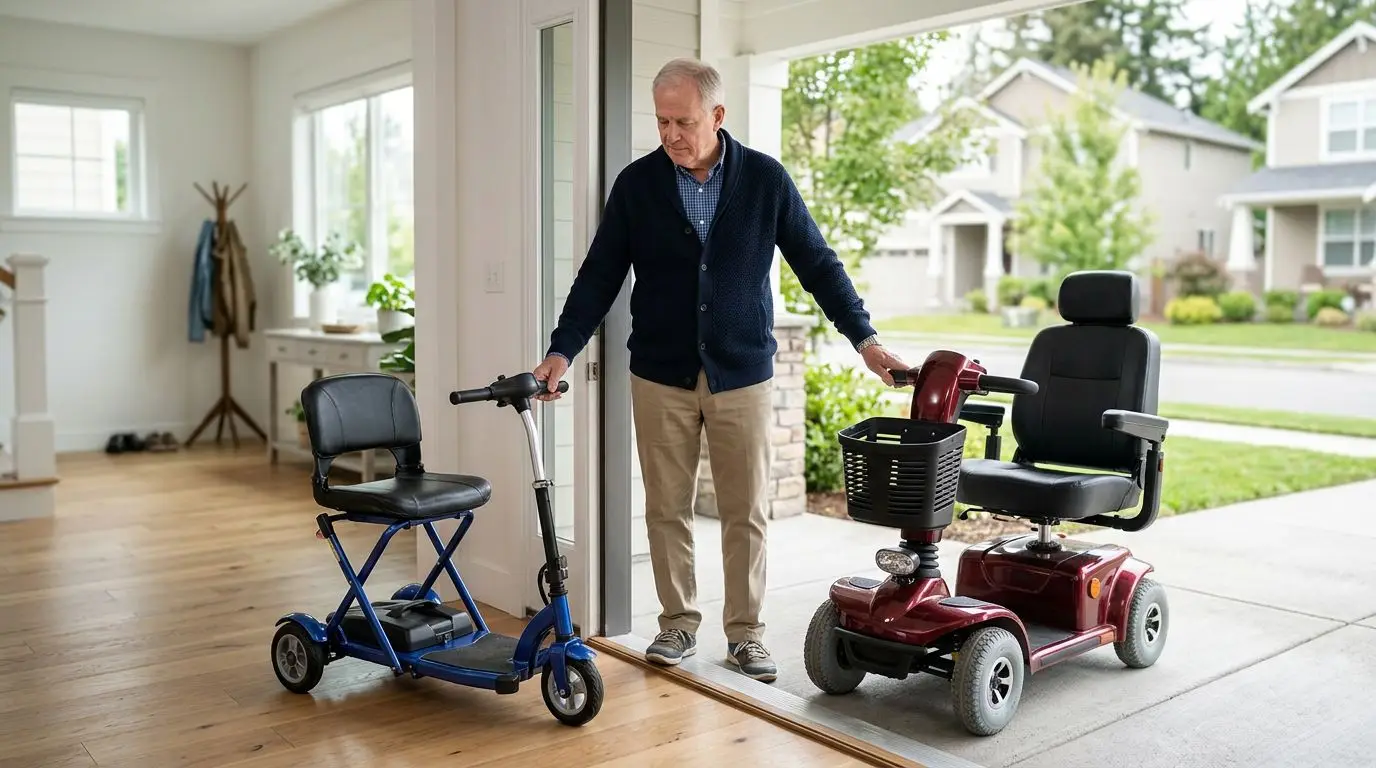
The best mobility scooter for you depends on where you will use it most: inside tight rooms, on smooth sidewalks, or across rougher outdoor surfaces. Indoor scooters emphasize a small turning radius and narrow width, sidewalk-friendly scooters balance maneuverability with comfort, and outdoor scooters add larger wheels, more ground clearance, and stronger suspension for longer trips.
If at least 70% of your scooter time will be inside the home, start with a compact model. If you will use it for errands, senior community paths, or neighborhood sidewalks, look for a mid-size scooter with stable handling. If your routes include grass, gravel, cracked pavement, hills, or long distances, an outdoor-capable setup is usually the safer and more comfortable fit.
The 3-zone decision: home, sidewalk, or outdoor routes
Start by dividing your daily travel into 3 zones: indoor rooms, paved public routes, and uneven outdoor surfaces. Most shoppers get stuck because they compare scooters by size or speed before asking the simpler question: where will the scooter spend most of its time?
A compact scooter that feels perfect in a kitchen may be tiring on a half-mile sidewalk trip. A larger outdoor scooter that feels confident over a bumpy driveway may be frustrating near a bathroom doorway. The right choice is not the biggest scooter you can afford or the smallest one that fits in a car. It is the scooter that fits your normal route with the least compromise.
| Scooter use area | Typical priority | Useful specs to compare | Common tradeoff |
|---|---|---|---|
| Mostly indoors | Tight maneuvering | Width, turning radius, overall length | Less comfort on rough pavement |
| Sidewalks and errands | Balanced handling | Wheel size, seat comfort, battery range | May be harder to turn in small rooms |
| Outdoor and uneven ground | Stability and ride quality | Ground clearance, suspension, tires, hill rating | Heavier and harder to transport |
Think about your worst routine surface, not your best one. A scooter that handles a smooth hallway does not automatically handle a sloped driveway. A single 1-inch doorway threshold, a patch of gravel near the mailbox, or a steep curb cut can change the best category.
Indoor mobility scooters: best when turns are under about 40 inches
Indoor mobility scooters are designed for short-distance movement in apartments, single-story homes, assisted living communities, medical offices, and stores with smooth floors. Their main advantage is maneuverability. Many compact designs have a turning radius roughly in the 30- to 45-inch range, though exact numbers vary by scooter type and setup.
That matters in real rooms. A small bathroom, galley kitchen, bedroom corner, or laundry area may not allow a wide U-turn. Narrow overall width also helps around furniture and door frames. Many interior doorways are around 28 to 32 inches wide, while older homes may have tighter openings. Always measure the actual clear opening with the door open, not the advertised door size.
Who indoor scooters are best for
- People who mainly need help moving around inside a home, apartment, or facility.
- Users who travel short distances on smooth, level surfaces.
- Anyone who needs to turn in hallways, kitchens, bedrooms, or elevators.
- People who plan to transport the scooter occasionally and need a lighter, simpler setup.
Indoor scooter strengths
Compact scooters are easier to park near a bed or table. Some disassemble into smaller pieces for vehicle loading, which can help with appointments or family visits. Three-wheel designs often turn more sharply than four-wheel designs, although four-wheel compact scooters can feel more planted for some riders.
The limitations matter just as much. Smaller wheels can catch on rough edges more easily. Lower ground clearance can scrape on thresholds, driveway lips, or uneven sidewalk slabs. A short wheelbase can also feel choppier outside. Indoors, that is not a problem. Outdoors, it can become uncomfortable quickly.
Sidewalk-friendly scooters: the middle ground for 1 to 3 mile errands
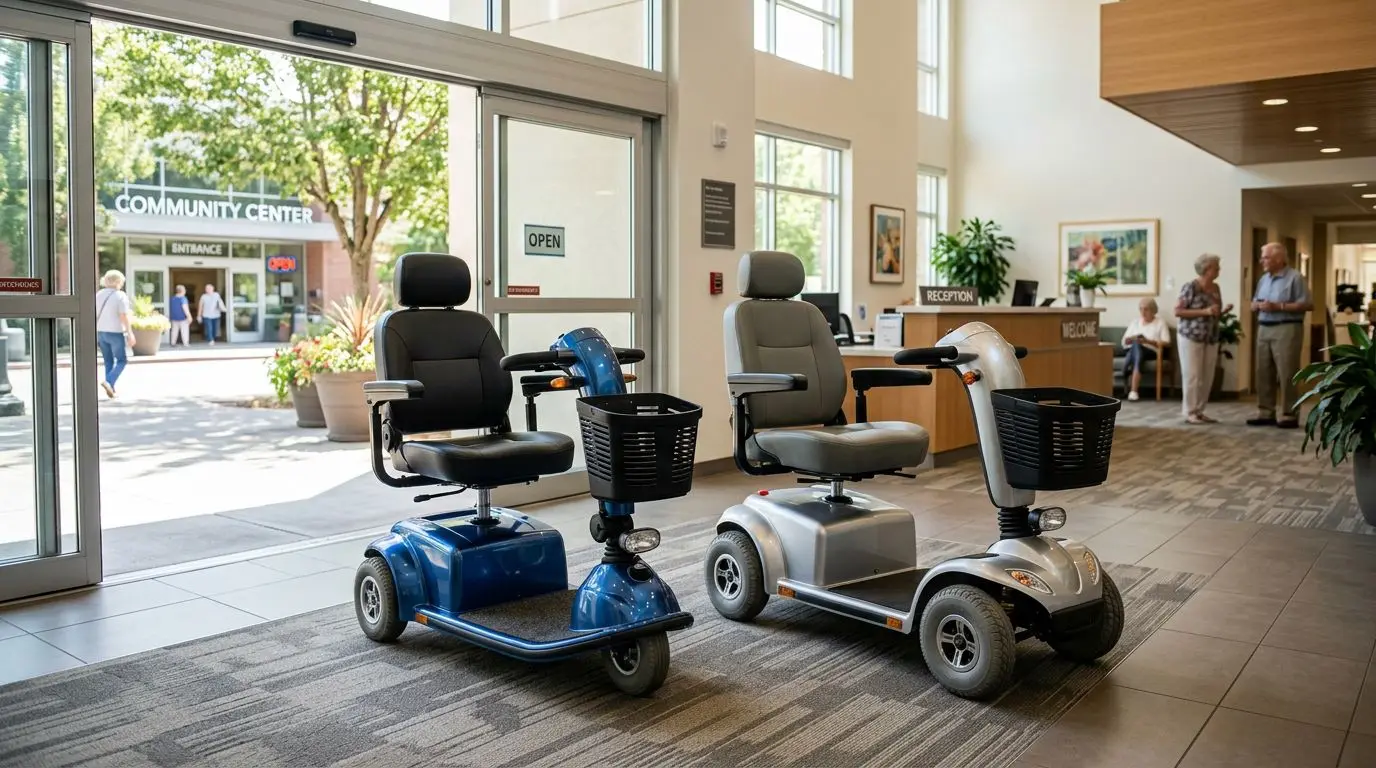
A sidewalk-friendly scooter is usually a mid-size option for people who split time between indoor spaces and paved outdoor routes. It should be easy enough to bring into a grocery store or community room, but more comfortable than a very compact scooter for a trip around the block or to a nearby pharmacy. For many riders, this is the most practical category.
These scooters often have larger wheels than compact indoor models, a more supportive seat, and a battery range suited to routine errands. A typical outing might be 1 to 3 miles total, including stops. Range ratings vary widely and are affected by rider weight, temperature, hills, tire type, surface condition, and battery age, so keep a margin instead of planning to use every mile on the spec sheet.
Who sidewalk-friendly scooters are best for
- People who use sidewalks, paved paths, stores, and community centers.
- Riders who need moderate comfort but still want manageable size.
- Users with routes that are mostly smooth, with occasional small cracks or curb cuts.
- Anyone who wants one scooter for both home entry and neighborhood use.
Look closely at where the sidewalk meets the street. Curb ramps can be uneven, sloped, or broken. A scooter with modest ground clearance and better tires may handle these spots more confidently than an indoor-only scooter. Still, a sidewalk-friendly model is not meant for deep gravel, wet grass, steep hills, or rutted trails.
Outdoor-capable scooters: choose when surfaces change by 2 inches or more
Outdoor-capable mobility scooters are built for longer trips and more varied terrain. They usually have larger wheels, higher ground clearance, stronger frames, more supportive seating, and suspension that helps reduce jarring on rough pavement. If your normal route includes uneven driveway sections, packed gravel, grass edges, potholes, or slab height changes approaching 2 inches, this category deserves serious attention.
Outdoor scooters are not off-road vehicles in the recreational sense. They are mobility devices meant to improve access over practical outdoor surfaces. Even a capable scooter has limits on slope, traction, water exposure, and obstacle height. Wet leaves, loose gravel, and steep ramps can be hazardous for any scooter.
Who outdoor-capable scooters are best for
- People who travel longer distances outdoors, such as across large senior communities or campuses.
- Riders who encounter cracked pavement, gravel, grass, or uneven curb cuts.
- Users who need a more cushioned ride due to comfort concerns, without assuming any medical treatment effect.
- Anyone who values stability and ride quality more than compact storage.
The tradeoff is size and weight. Outdoor scooters can be harder to turn indoors and may not fit well in small apartments. They are also less convenient to lift into a car. Some require a vehicle lift, ramp, or dedicated storage area. Before choosing one, measure your storage space and confirm your home entry route can handle the scooter width and turning needs.
3-wheel vs. 4-wheel scooters: turning radius versus stability
The 3-wheel versus 4-wheel decision is one of the most common scooter comparisons. In general, 3-wheel scooters tend to turn tighter, while 4-wheel scooters tend to feel more stable, especially outdoors. The difference can be noticeable in a hallway or elevator, where just 5 to 10 inches of turning radius may decide whether you can turn comfortably.
| Type | Best use | Main advantage | Watch for |
|---|---|---|---|
| 3-wheel compact | Indoor rooms and tight store aisles | Sharper turns and easier maneuvering | May feel less stable on uneven ground |
| 4-wheel compact | Indoor plus smooth outdoor surfaces | More planted feel than many 3-wheel designs | Usually needs more room to turn |
| Mid-size 4-wheel | Sidewalks, errands, paved paths | Good balance of comfort and stability | May be too large for small bathrooms |
| Heavy-duty outdoor | Longer outdoor routes and rougher pavement | Larger tires, clearance, and suspension | Heavy, bulky, and less transport-friendly |
Do not treat wheel count as the only safety factor. Seat height, center of gravity, tire design, speed control, suspension, user posture, and route conditions all matter. A careful rider on a properly matched 3-wheel scooter may be safer than an overconfident rider on a large 4-wheel scooter used in the wrong environment.
How to measure your space in 15 minutes
A tape measure can prevent an expensive mismatch. Set aside 15 minutes and measure the route you will actually use, from the charging location to the door, mailbox, vehicle, elevator, or sidewalk. Write the numbers down before comparing scooter specifications.
Measure these 8 areas
- Doorway clear width: Measure the open space from the door edge to the opposite frame. Many users need at least a few inches of clearance beyond scooter width.
- Hallway width: Note narrow points caused by furniture, trim, baskets, or wall-mounted items.
- Turning spaces: Measure kitchens, bedrooms, elevators, and bathroom entries where you need to turn around.
- Threshold height: Check entry lips, sliding door tracks, and room transitions. Even 0.5 to 1 inch can matter on a low scooter.
- Ramp slope: If you use a ramp, confirm it matches safe use guidance and the scooter’s stated capability.
- Sidewalk condition: Note cracked slabs, curb cuts, drainage dips, and cross-slopes.
- Storage footprint: Measure where the scooter will park, including room to transfer on and off.
- Vehicle loading height: If transporting, measure trunk, hatch, or lift height and compare it with scooter weight and disassembly needs.
When in doubt, make a simple cardboard footprint using the scooter’s approximate width and length from the specification sheet. Place it in your hallway or storage area. It is a low-tech test, but it quickly shows whether the scooter will block a doorway or require awkward backing up.
Features that matter outdoors after 4 mph
Many mobility scooters travel around walking speed, often in the range of 4 to 8 mph depending on type and local rules. Speed is not the main measure of outdoor usefulness. As surfaces change, comfort, braking control, traction, and stability become more important.
| Feature | Why it matters | Indoor priority | Outdoor priority |
|---|---|---|---|
| Wheel size | Larger wheels roll over small cracks more easily | Medium | High |
| Ground clearance | Helps avoid scraping on thresholds and uneven pavement | Low to medium | High |
| Suspension | Reduces jolts from rough surfaces | Low | High |
| Seat support | Affects comfort on longer rides | Medium | High |
| Battery range | Determines practical trip distance with a safety margin | Low to medium | High |
| Lighting and reflectors | Improves visibility in dim conditions | Low | Medium to high |
| Disassembly or folding | Helps with car transport and storage | High | Varies |
Outdoor use also makes tires more important. Solid tires reduce flat concerns, while air-filled tires can offer a more cushioned feel but require pressure checks and maintenance. Some scooters use foam-filled or other flat-resistant approaches. There is no one perfect tire; choose based on your route and your willingness to maintain it.
Battery range and rider weight: keep a 25% reserve
Battery range estimates are best treated as ideal-condition numbers. A scooter may be rated for a certain distance, but real-world range can drop with hills, cold weather, frequent starts and stops, heavier loads, rough surfaces, or aging batteries. A practical rule is to keep at least a 25% range reserve for normal outings.
For example, if your regular errand loop is 6 miles, avoid choosing a scooter that barely claims 6 miles of range under ideal conditions. Look for enough margin so you are not returning home on the last bar. Battery gauges can be approximate, especially under load or on hills.
Weight capacity matters too, and it is not just about whether the scooter can move. Higher loads can affect acceleration, braking distance, hill performance, and battery use. Include the rider, oxygen equipment if used, bags, groceries, weather gear, and accessories when thinking about total load. Staying within the stated capacity is a safety and durability issue, not a suggestion to ignore.
Transport and storage: check the heaviest piece over 30 lb
If you plan to put the scooter in a car, do not look only at total weight. Check the heaviest individual piece after disassembly. A scooter that separates into 4 or 5 parts may still have one section that weighs over 30 lb, which can be too much for some users or caregivers to lift safely.
Compact scooters are usually the easiest to transport. Mid-size scooters may disassemble, but the pieces are often bulkier. Outdoor-capable scooters may require a ramp, hitch-mounted carrier, or vehicle lift. That adds cost, storage needs, and another step to every trip.
At home, the scooter needs a dry, accessible charging location. Avoid blocking emergency paths, bedroom exits, or narrow hallways. Many batteries should be charged according to the manufacturer’s instructions, and chargers need ventilation and a standard outlet location that does not create a tripping hazard.
Safety and comfort checklist: test at least 5 real tasks
A scooter can look right on paper and still feel wrong during daily use. If possible, test or simulate at least 5 real tasks: entering your home, turning in your tightest room, approaching a table, riding over a threshold, and stopping on a slight slope. These tasks reveal more than a showroom circle on a smooth floor.
- Transfers: Can you sit down and stand up without twisting or overreaching?
- Tiller reach: Are the controls comfortable with shoulders relaxed?
- Speed control: Can you move slowly and predictably indoors?
- Braking: Does the scooter stop smoothly without startling you?
- Visibility: Can others see you in parking lots, shaded paths, or dusk conditions?
- Noise and alerts: Are horn and backup sounds useful without being confusing?
Match the scooter to your abilities, not just your destination. If you have changing vision, balance, reaction time, or strength, ask a qualified clinician, mobility specialist, or occupational therapist for guidance. A scooter can support independence, but it should be used with realistic expectations and safe route planning.
Best choice by user situation: 6 common examples
Here are 6 practical scenarios that show how the decision changes by environment. These are not medical recommendations, but they can help you narrow the category before comparing specifications.
| Situation | Likely best fit | Why |
|---|---|---|
| Small apartment, narrow hallway, elevator use | Compact indoor or compact 3-wheel | Tight turning and narrow width matter most |
| Single-story home plus occasional store trips | Compact 4-wheel or light mid-size | Balances indoor access with smoother paved use |
| Senior community with paved paths | Sidewalk-friendly mid-size | Comfort and range matter for daily outdoor travel |
| Neighborhood errands up to a few miles | Mid-size 4-wheel | Better stability, seating, and battery margin |
| Gravel driveway, grass edges, rough pavement | Outdoor-capable 4-wheel | Needs clearance, tires, and suspension |
| Frequent car transport by one caregiver | Disassembling compact scooter | Heaviest piece and loading height are decisive |
If two categories seem close, choose based on the hardest part of your week. A scooter used daily in a narrow home should not be too large just because you take one outdoor trip on Sundays. A scooter used every day on cracked sidewalks should not be chosen only because it fits neatly in a closet.
FAQ: 5 common indoor and outdoor scooter questions
Can I use an indoor mobility scooter outside?
Yes, but only on smooth, level surfaces and for short distances if the scooter is designed for that kind of light use. Avoid rough sidewalks, gravel, wet grass, steep curb cuts, and high thresholds unless the scooter specifications clearly support them.
Is a 4-wheel scooter always better outdoors?
Often, but not always. A 4-wheel scooter generally feels more stable on uneven surfaces, yet tire size, suspension, ground clearance, speed control, and rider habits also matter. For tight indoor spaces, some 3-wheel scooters may be easier to handle.
How much ground clearance do I need?
For indoor use, low clearance may be acceptable if thresholds are minimal. For outdoor routes with driveway lips, cracked pavement, or uneven curb ramps, more clearance is helpful. Measure your tallest routine obstacle, then compare it with the scooter’s stated clearance while leaving a safety margin.
Should I choose a folding scooter or a full-size scooter?
Choose folding or disassembling designs if transport and storage are top priorities. Choose a larger full-size setup if your main needs are outdoor comfort, stability, range, and rougher surfaces. The best choice depends on whether lifting and storage matter more than ride capability.
What if I need one scooter for both indoors and outdoors?
Look for a balanced mid-size scooter, then confirm it fits your narrowest doorway, tightest turn, and regular outdoor route. If your home is very tight or your outdoor terrain is very rough, one scooter may involve compromises, and a professional assessment can help.
Bottom line: Choose an indoor scooter for tight rooms and short smooth trips, a sidewalk-friendly scooter for paved errands and community routes, and an outdoor-capable scooter for rougher surfaces, longer distances, and better ride comfort. Measure first, compare the route honestly, and leave safety margins for range, clearance, and turning space.
Frequently asked questions
Can I use an indoor mobility scooter outside? +
Yes, but only on smooth, level surfaces and for short distances if the scooter is designed for light outdoor use. Avoid rough sidewalks, gravel, wet grass, steep curb cuts, and high thresholds unless the scooter specifications support them.
Is a 4-wheel scooter always better outdoors? +
A 4-wheel scooter often feels more stable outdoors, but it is not automatically better for every rider. Tire size, suspension, ground clearance, speed control, and the condition of your route all affect safety and comfort.
How do I measure for an indoor mobility scooter? +
Measure doorway clear width, hallway width, tight turning areas, threshold height, storage space, and the path from your charging spot to the door. Compare those measurements with the scooter’s width, length, and turning radius.
How much battery range should I allow for outdoor errands? +
Keep at least a 25% reserve beyond your normal trip distance. Hills, rider weight, cold weather, rough pavement, frequent stops, and battery age can all reduce real-world range.
What if I need one scooter for indoors and outdoors? +
A mid-size, sidewalk-friendly scooter is often the best compromise. Confirm that it fits your narrowest doorway and tightest turn while still offering enough wheel size, clearance, comfort, and range for your outdoor route.
Related guides
3-Wheel vs. 4-Wheel Mobility Scooters: Which Type Is Right for You?
16 min read
How to Choose a Mobility Scooter for Everyday Errands, Stores, and Medical Appointments
15 min read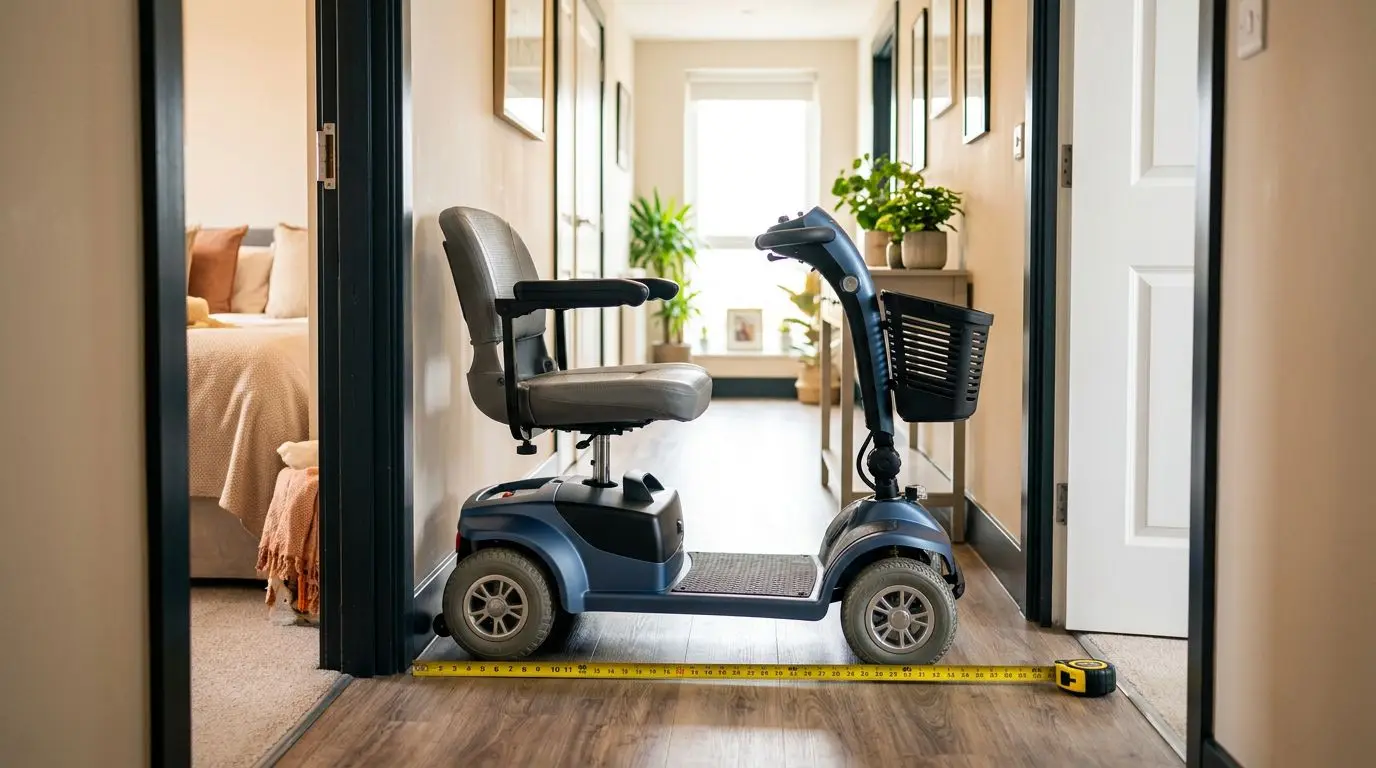
Compact Mobility Scooters for Apartments, Stores, and Tight Spaces: Dimensions That Matter
13 min read