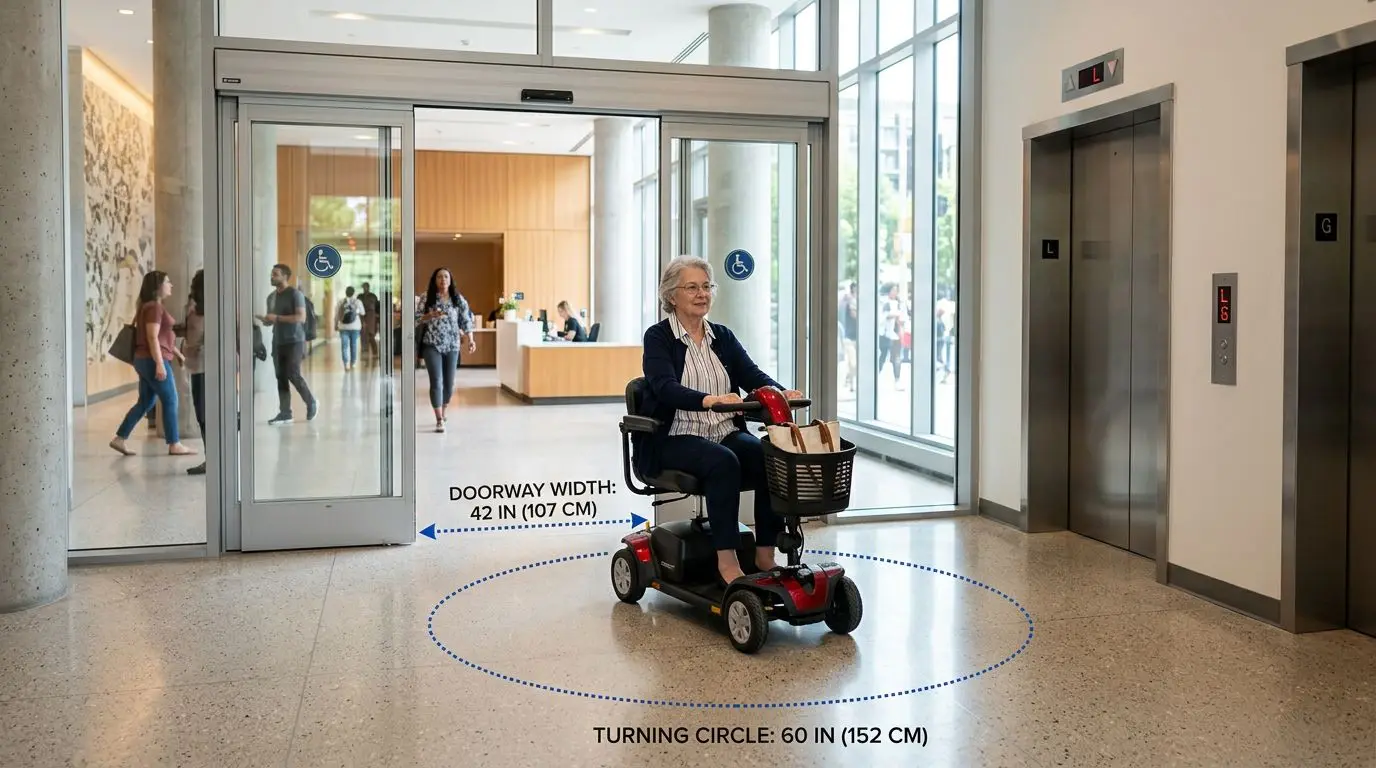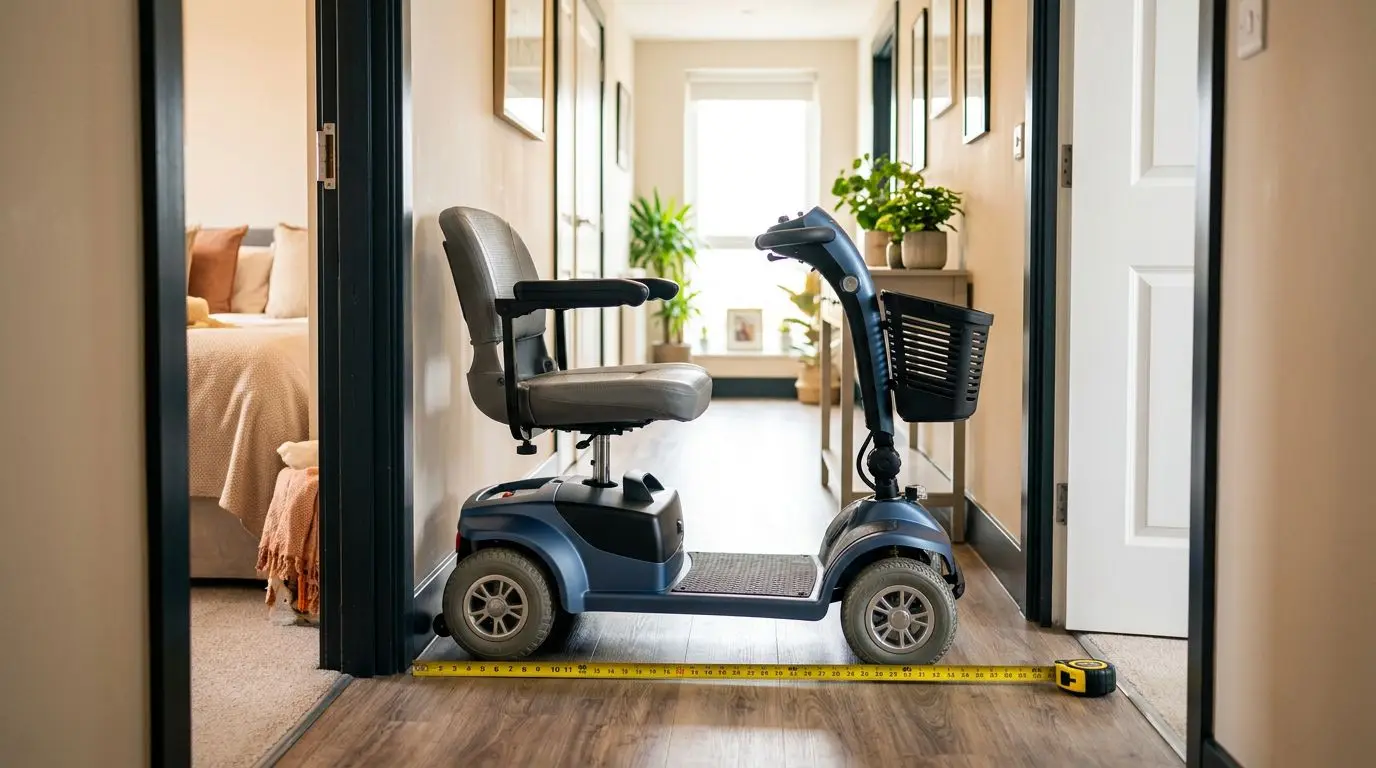
For apartments, stores, elevators, and narrow hallways, the compact mobility scooter dimensions that matter most are overall width, turning radius, overall length, and storage size. A practical indoor-friendly scooter is often about 19 to 23 inches wide, 37 to 45 inches long, and able to turn in roughly 35 to 55 inches, depending on whether it has 3 or 4 wheels. Always measure your actual doorways, elevator, storage spot, and tightest turn before choosing, because a scooter that fits on paper can still feel awkward in a 30-inch doorway or small kitchen.
Compact scooters are made to support daily movement, not to replace every mobility aid or solve every access issue. The right fit depends on your body size, balance, home layout, storage needs, and whether you plan to use the scooter mostly indoors, outdoors, or both.
The 5 dimensions that matter most in a 30-inch doorway
A doorway labeled 30 inches wide often has less than 30 inches of usable clearance once you account for door thickness, hinges, trim, and how far the door opens. That makes overall scooter width the first number to check, but it should not be the only one.
For tight spaces, consider these five measurements together:
- Overall width: The widest point of the scooter, often around the rear wheels, armrests, or front shroud. Compact scooters commonly fall around 19 to 23 inches wide.
- Overall length: The front-to-back footprint. Many compact travel-style scooters are roughly 37 to 45 inches long, while larger indoor-outdoor scooters can be longer.
- Turning radius: The smallest circle the scooter can turn within. A tighter radius, such as 35 to 45 inches, is usually easier in apartments than 55 inches or more.
- Seat and armrest width: The seat may fit the rider, but raised or wide armrests can affect doorway clearance and table access.
- Folded or disassembled size: Important if the scooter needs to sit in a closet, beside a bed, under a counter, or in a vehicle cargo area.
Do not rely only on marketing terms like compact or travel. Two scooters can both be called compact and still differ by 4 inches in width or 10 inches in turning radius. In a hallway, those inches matter.
Turning radius: why 35 to 55 inches changes how a scooter feels indoors
Turning radius is one of the most overlooked scooter specifications. It tells you how much open space the scooter needs to make a complete turn. In a studio apartment, small store aisle, or bathroom entry, a 40-inch turning radius can feel very different from a 55-inch turning radius.
In general, 3-wheel scooters tend to have a tighter turning radius because the front wheel assembly can pivot more sharply. Four-wheel scooters usually feel more stable on uneven outdoor surfaces, but they often need more room to turn. This is not true for every design, but it is a useful starting point.
| Scooter type | Typical turning behavior | Best fit | Common tradeoff |
|---|---|---|---|
| 3-wheel compact scooter | Often about 35 to 45 inches | Apartments, stores, narrow turns, elevators | May feel less planted on rough outdoor surfaces |
| 4-wheel compact scooter | Often about 45 to 55 inches | Mixed indoor and smooth outdoor use | Needs more turning room in hallways |
| Folding travel scooter | Varies widely, often tight enough for indoor paths | Storage, car trunks, occasional errands | Seat comfort and battery range may be more limited |
| Mid-size scooter | Often 55 inches or more | Longer outdoor trips and larger homes | Can be difficult in small apartments |
One useful check is the U-turn spot. Measure the width of the hallway or room where you would need to turn around. If the open space is only 48 inches wide, a scooter with a 52-inch turning radius may require repeated back-and-forth adjustments. That can be tiring, frustrating, and less safe near furniture or walls.
Width and doorways: allow 2 to 4 inches of clearance when possible
Most interior residential doorways in the United States are commonly around 28 to 32 inches wide, while many exterior doors are around 32 to 36 inches wide. The clear opening can be smaller than the door slab size, so measure the actual pass-through space with the door fully open.
For daily use, try to allow at least 2 inches of total clearance; 4 inches is more comfortable. For example, a 22-inch-wide scooter through a 30-inch clear doorway leaves 8 inches total, or about 4 inches on each side if centered. That is manageable for many riders. A 25-inch-wide scooter through a 28-inch clear opening leaves only 3 inches total, which can feel stressful and may scrape trim or armrests.
Pay attention to the true widest point. On some scooters, the rear wheels are widest. On others, the armrests, basket, or tiller position may be the issue. If armrests flip up or adjust inward, that can help at desks and dining tables, but it does not always reduce the widest base measurement.
Also check threshold height. Many compact scooters have modest ground clearance, often around 2 to 4 inches. A raised doorway threshold, thick rug edge, or uneven patio transition can stop the scooter or cause a jolt. Indoors, low-profile thresholds and firm flooring are easier than plush carpet or loose mats.
Elevators, aisles, and kitchens: plan for 36 to 48 inches of working space
A scooter may fit through a door and still be awkward once inside an elevator, kitchen, or store aisle. The issue is not only entry width; it is the space needed to enter, turn, stop, and exit without bumping walls or people.
Many public spaces are designed around accessibility standards, but real-world layouts vary. Displays, carts, trash cans, and seasonal merchandise can reduce an aisle that started at 36 inches. In a small apartment kitchen, the distance between counters may be 36 to 42 inches, leaving little room to turn a scooter that is over 40 inches long.
Use these practical examples:
- Small elevator: A car around 36 by 48 inches may fit a compact scooter, but turning inside may be limited. You may need to back in or back out.
- Grocery aisle: A clear path of 36 inches can work for many compact scooters, but stopping beside another cart may block traffic.
- Galley kitchen: If the aisle between counters is 40 inches, a 43-inch-long scooter may enter but not turn around easily.
- Bathroom approach: A 30-inch doorway plus a tight 90-degree turn from a hallway can be more limiting than the doorway itself.
If you use elevators often, practice slow entry and exit with the tiller adjusted close enough for control but not so close that it crowds your knees. A scooter that accelerates gently at low speed is easier in shared buildings than one that feels jumpy indoors.
Storage and transport: compare folded size, heaviest piece, and 24-inch closet depth
Storage matters in an apartment. A scooter that fits through the hallway but blocks the front door, bedroom path, or emergency exit is not a good fit. Many apartment closets are about 24 inches deep, and that depth is often too shallow for a fully assembled scooter, though it may work for a folded or disassembled one.
There are three common storage approaches:
| Storage style | What to measure | Why it matters | Best for |
|---|---|---|---|
| Fully assembled | Full length and width, plus handlebar position | Fast daily use, but needs floor space | Riders who use the scooter every day at home |
| Folded | Folded length, height, width, and whether it stands upright | Saves space if the folded shape is stable | Small apartments and shared entry areas |
| Disassembled | Heaviest piece weight and number of pieces | Easier vehicle loading if each piece is manageable | Errands, rides with family, occasional travel |
For transport, do not just ask whether it comes apart. Ask how heavy the heaviest piece is. Some compact scooters separate into several pieces, but the base may still weigh 30 to 45 pounds or more. That may be reasonable for one caregiver and too much for another. If lifting is involved, consider the vehicle trunk height, cargo opening width, and whether the person lifting can do so safely without twisting.
Charging location is part of storage, too. If the battery can be removed, you may be able to park the scooter in one place and charge the battery in another. If charging requires the full scooter near an outlet, measure the cord path and avoid creating a trip hazard.
Who compact scooters are best for: riders within about 250 to 300 pounds and short daily routes
Many compact scooters are designed for riders who need help covering distance in apartments, senior communities, stores, medical buildings, and smooth outdoor areas. Common weight capacities for compact models are often around 250 to 300 pounds, though capacities vary by design. The rider, clothing, bags, oxygen holder if used, and personal items all count toward the load.
A compact scooter may be a good match if you:
- Need help with walking longer distances but can transfer on and off the seat safely.
- Live in an apartment, condo, assisted living setting, or smaller home with limited turning space.
- Shop in stores with aisles, elevators, and checkout lanes where a large scooter would be cumbersome.
- Need a scooter that can be stored in a corner, utility area, or vehicle.
- Mostly travel on level indoor floors, sidewalks, or smooth pavement.
A compact scooter may not be the best choice if you need a very high weight capacity, a large captain-style seat, high ground clearance, or regular travel over gravel, steep ramps, grass, or broken sidewalks. A larger scooter may offer more comfort and outdoor capability, but it will usually require more space. If balance, transfers, cognition, or vision are concerns, consider asking a qualified clinician, occupational therapist, or mobility professional to review your setup.
How to measure your home in 15 minutes before choosing
You can avoid many fit problems with a tape measure, painter’s tape, and 15 minutes. Write down the narrowest and tightest areas, not just the average ones. A single pinch point can determine whether a scooter works.
Use this simple measuring checklist:
- Door clear openings: Measure from the inside face of the open door to the opposite frame. Do this for entry doors, bedroom doors, bathroom doors, and storage areas.
- Hallway width: Measure the narrowest section, especially where furniture, radiators, laundry baskets, or shoe racks reduce clearance.
- 90-degree turns: Measure both the hallway width and the doorway width at turns into bedrooms, bathrooms, and kitchens.
- Elevator interior: Measure door opening, inside width, and inside depth. Note whether you can turn around or must back out.
- Storage footprint: Mark the scooter’s expected length and width on the floor with painter’s tape, such as 22 by 42 inches, and see what it blocks.
- Thresholds and rugs: Measure raised edges. Even a 1-inch lip can feel significant on a small-wheel scooter.
When comparing your numbers to scooter dimensions, add a comfort buffer. If your narrowest doorway is 29 inches, a scooter listed at 28 inches wide is technically close but practically unforgiving. A narrower scooter will be easier to steer, especially if hand strength, reaction time, or vision is limited.
Feature tradeoffs in scooters under 45 inches long
Keeping a scooter under about 45 inches long can make it easier to store, turn, and use in elevators, but compact dimensions often come with tradeoffs. The goal is not to find the smallest scooter at any cost. The goal is to find the smallest scooter that still supports the rider comfortably and safely.
| Feature | Compact advantage | Possible limitation | What to check |
|---|---|---|---|
| Small wheels | Lower step-over height and compact frame | Less comfortable over bumps and thresholds | Ground clearance and intended surfaces |
| Narrow base | Better doorway and aisle clearance | May feel less stable during sharp turns | Low-speed control and seat height |
| Short frame | Easier elevator and apartment storage | Less legroom for taller riders | Knee clearance at the tiller |
| Lightweight parts | Easier lifting and transport | May have lower capacity or fewer comfort features | Heaviest piece and weight rating |
| Smaller battery | Lighter and easier to remove | Shorter range between charges | Realistic daily distance, not just maximum range |
Seat comfort deserves close attention. A narrow seat may help with overall width, but it must support the rider for the length of typical use. If errands take 45 minutes, the seat should remain comfortable for that long, not just for a quick test. Adjustable tiller angle, swivel seat, flip-up armrests, and a simple speed dial can make a compact scooter easier to live with.
Speed is rarely the priority indoors. A scooter that can crawl smoothly at low speed is more useful in a store than one focused on maximum speed. Look for predictable braking, easy-to-reach controls, and a horn or alert that is polite but noticeable.
Safety checks for tight spaces: keep 36 inches clear near exits
In small homes, scooter parking can accidentally create a safety problem. Try to keep at least 36 inches of clear path near main exits, hallways, and areas used at night. Do not park a scooter where it blocks a door swing, heater, stair landing, or emergency route.
Use the lowest practical speed setting indoors, especially around pets, children, blind corners, and checkout lines. Slow turns reduce tipping risk and make it easier to avoid clipping walls with rear wheels. If the scooter has anti-tip wheels, they are a helpful safety feature, but they do not make sharp turns at speed safe.
Lighting helps, even indoors. A front light can make the scooter easier for others to notice in dim apartment hallways or parking garages. Reflective details, a rear light, or a small flag may be useful in shared buildings, but avoid add-ons that make the scooter wider unless you have measured for them.
Routine checks are simple: keep tires properly maintained, make sure the seat locks into position, confirm the tiller adjustment is secure, and charge the battery as directed. If the scooter begins pulling to one side, braking unevenly, or making unusual noises, stop using it until it is inspected.
FAQ: 5 compact scooter dimension questions
What is a good width for an apartment mobility scooter?
A width around 19 to 23 inches is often practical for apartments, but your actual doorway measurements matter more than the average. Measure the clear opening of each doorway and aim for at least 2 to 4 inches of extra clearance when possible.
Is a 3-wheel scooter better for tight spaces than a 4-wheel scooter?
Often, yes. A 3-wheel scooter usually has a tighter turning radius, sometimes around 35 to 45 inches, which helps in hallways, elevators, and stores. A 4-wheel scooter may feel more stable outdoors but commonly needs more room to turn.
Can a mobility scooter fit in a small elevator?
Many compact scooters can fit in a small elevator, but turning inside may not be possible. Measure the elevator door opening, inside width, and inside depth. If the car is about 36 by 48 inches, you may need to enter carefully and back out.
How much turning radius do I need for a store?
For stores and pharmacies, a turning radius under about 45 inches is easier to manage than 55 inches or more. Aisles may be partly blocked by carts or displays, so tighter turning and smooth low-speed control are valuable.
Should I choose the smallest scooter available?
Not automatically. The scooter still needs enough seat width, legroom, weight capacity, battery range, and stability for your daily use. Choose the smallest scooter that fits both your space and your body comfortably.
Frequently asked questions
What is a good width for an apartment mobility scooter? +
A width around 19 to 23 inches is often practical for apartments, but measure your real doorways first. Aim for at least 2 to 4 inches of extra clearance when possible.
Is a 3-wheel scooter better for tight spaces than a 4-wheel scooter? +
Often, yes. A 3-wheel scooter usually has a tighter turning radius, often around 35 to 45 inches, while many 4-wheel scooters need more room but may feel more stable outdoors.
Can a mobility scooter fit in a small elevator? +
Many compact scooters can fit in small elevators, but turning inside may be limited. Measure the door opening, inside width, and inside depth before choosing.
How much turning radius do I need for a store? +
For stores, pharmacies, and tight aisles, a turning radius under about 45 inches is easier to manage than 55 inches or more, especially when displays or carts reduce aisle space.
Should I choose the smallest mobility scooter available? +
Not automatically. Choose the smallest scooter that still gives you enough seat comfort, legroom, stability, weight capacity, and range for your normal daily use.
Related guides
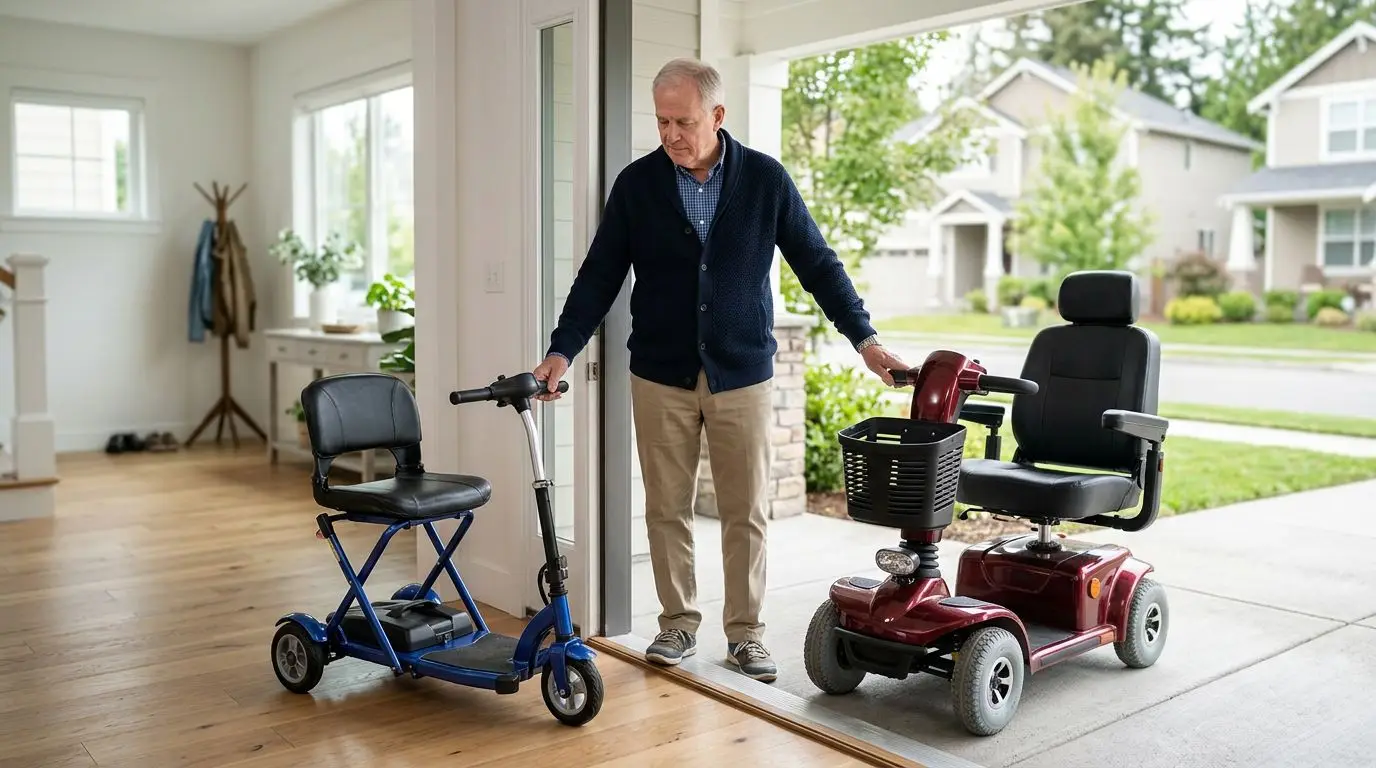
Indoor vs. Outdoor Mobility Scooters: How to Match the Scooter Type to Where You’ll Use It
14 min read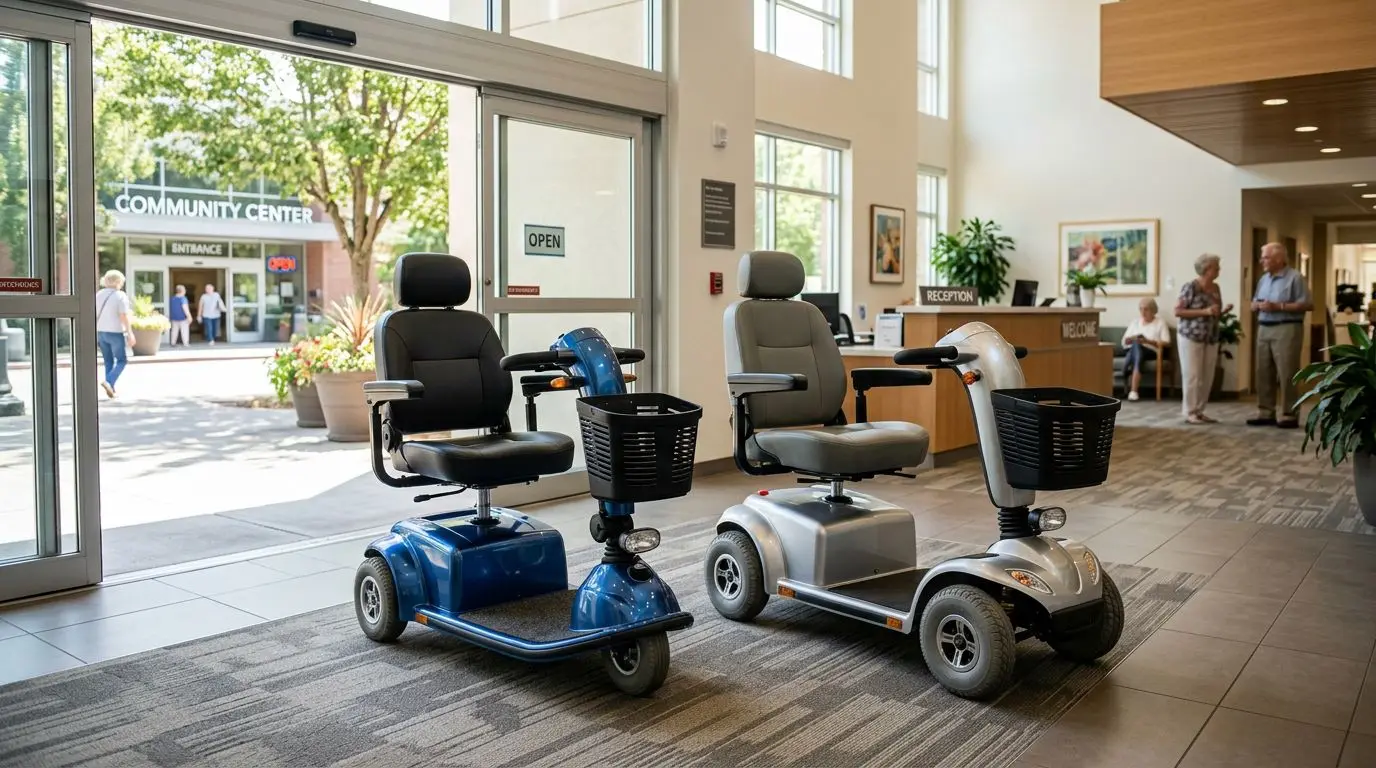
3-Wheel vs. 4-Wheel Mobility Scooters: Which Type Is Right for You?
16 min read
How to Choose a Mobility Scooter for Everyday Errands, Stores, and Medical Appointments
15 min read