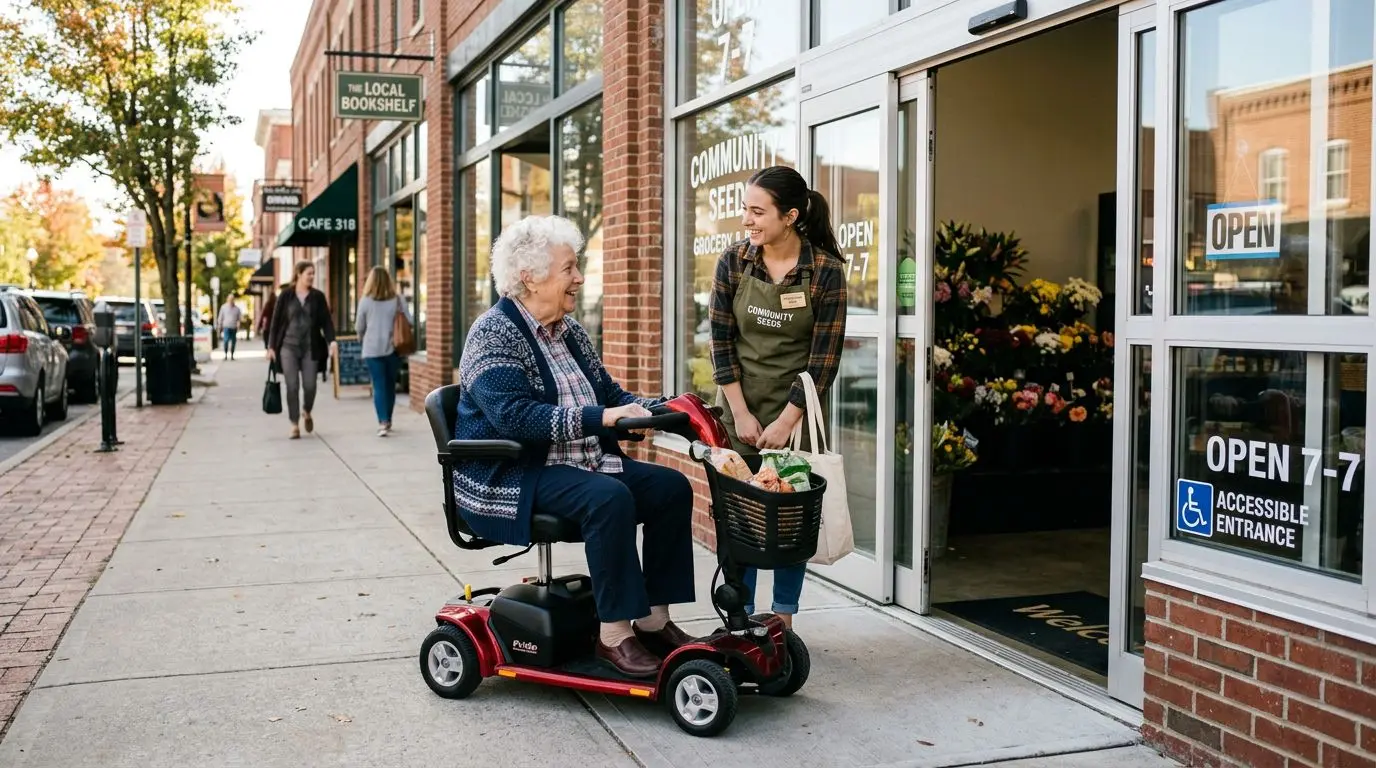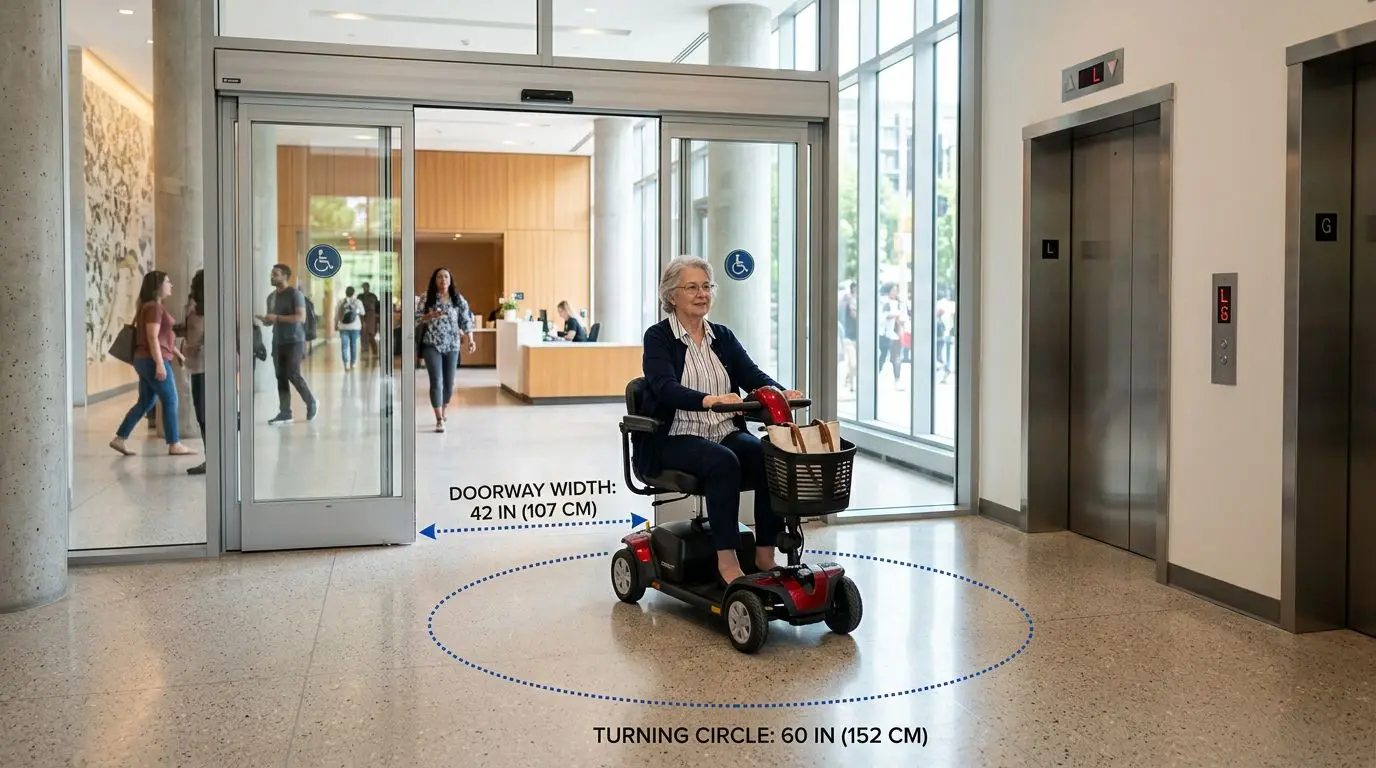
Most ADA-designed public spaces can accommodate many mobility scooters, but the fit depends on the scooter’s width, length, turning radius, and the space available. Key ADA reference dimensions include a 32-inch minimum clear doorway opening, a 36-inch minimum accessible route, a 60-inch turning circle, and ramp slopes no steeper than 1:12 in most new construction. A scooter that is compact, easy to steer, and measured with baskets, armrests, and mirrors included is usually easier to use in stores, medical offices, restaurants, and transit areas.
ADA standards were written around accessible routes and wheelchair clearances, not one standard scooter size. So the practical question is not simply “Is this scooter ADA compliant?” It is: “Can this scooter safely fit and turn within common ADA accessibility dimensions?”
Why a 32-inch doorway and a 36-inch route matter for scooter access
The ADA minimum clear opening for most accessible doorways is 32 inches when the door is open 90 degrees. Accessible routes are generally at least 36 inches wide, though short narrow sections may be allowed in limited conditions. For mobility scooter users, these two numbers are the starting point for understanding public access.
A scooter may be listed as 24 inches wide, but that number does not always tell the whole story. Armrests, mirrors, rear baskets, cup holders, oxygen tank carriers, and the rider’s hand position can add usable width. A scooter that technically fits through a 32-inch doorway may still feel tight if the doorway has a heavy closer, a threshold, a tight turn immediately inside, or a line of people nearby.
Length matters too. A 48-inch-long scooter may pass through a door easily but struggle if the door opens into a small vestibule or a restroom entry with a quick 90-degree turn. Turning radius is often the measurement people overlook until they are already inside a building.
| ADA or access dimension | Common reference number | Why it matters for scooters |
|---|---|---|
| Clear doorway opening | 32 inches minimum | Determines whether the scooter can pass through without scraping or angling sharply |
| Accessible route width | 36 inches minimum in many areas | Affects hallways, store aisles, corridors, and paths between furniture |
| Wheelchair clear floor space | 30 by 48 inches | Helpful reference for parking beside counters, tables, and service areas |
| Turning space | 60-inch diameter circle or T-shaped turn | Shows whether a user can turn around without backing up repeatedly |
| Passing space on narrow routes | 60 by 60 inches at intervals up to 200 feet | Allows two mobility device users or pedestrians to pass on longer routes |
Typical mobility scooter dimensions: 20 to 32 inches wide is a big difference
Mobility scooters vary widely. A compact travel scooter may be around 19 to 22 inches wide and 37 to 43 inches long. A full-size scooter may be closer to 23 to 27 inches wide and 45 to 55 inches long. Larger outdoor or heavy-duty scooters can approach 27 to 32 inches wide and 55 to 65 inches long, sometimes with a turning radius over 60 inches.
Those few inches change how a scooter behaves in public places. A scooter that is 21 inches wide has about 11 inches of total clearance in a 32-inch doorway, before accounting for hands, mirrors, and steering angle. A scooter that is 29 inches wide leaves only about 3 inches of total clearance. That is tight, especially for a user with limited hand strength, low vision, or difficulty making small steering corrections.
Turning radius can be just as important as width. Some smaller scooters can turn in roughly 32 to 45 inches. Many mid-size scooters need about 45 to 60 inches. Larger scooters may need 60 to 82 inches or more, depending on design. Three-wheel scooters often turn more tightly than four-wheel scooters of similar length, while four-wheel scooters may feel steadier outdoors. Neither style is automatically better for every user.
| Scooter type | Typical width | Typical length | Typical turning radius | Public access notes |
|---|---|---|---|---|
| Compact travel scooter | 19 to 22 inches | 37 to 43 inches | 32 to 45 inches | Often easiest for doorways, elevators, clinics, and small shops |
| Mid-size everyday scooter | 23 to 27 inches | 45 to 55 inches | 45 to 60 inches | Works in many ADA-designed spaces but may need careful turning |
| Large outdoor scooter | 27 to 32 inches | 55 to 65 inches | 60 to 82 inches or more | Better suited to open areas; can be challenging in restrooms, restaurants, and older buildings |
| Three-wheel configuration | Varies | Varies | Often tighter than similar four-wheel designs | Useful where indoor turning is a priority |
| Four-wheel configuration | Varies | Varies | Often wider turning path | Often preferred for outdoor stability and uneven surfaces |
Doorways, thresholds, and vestibules: plan beyond the 32-inch opening
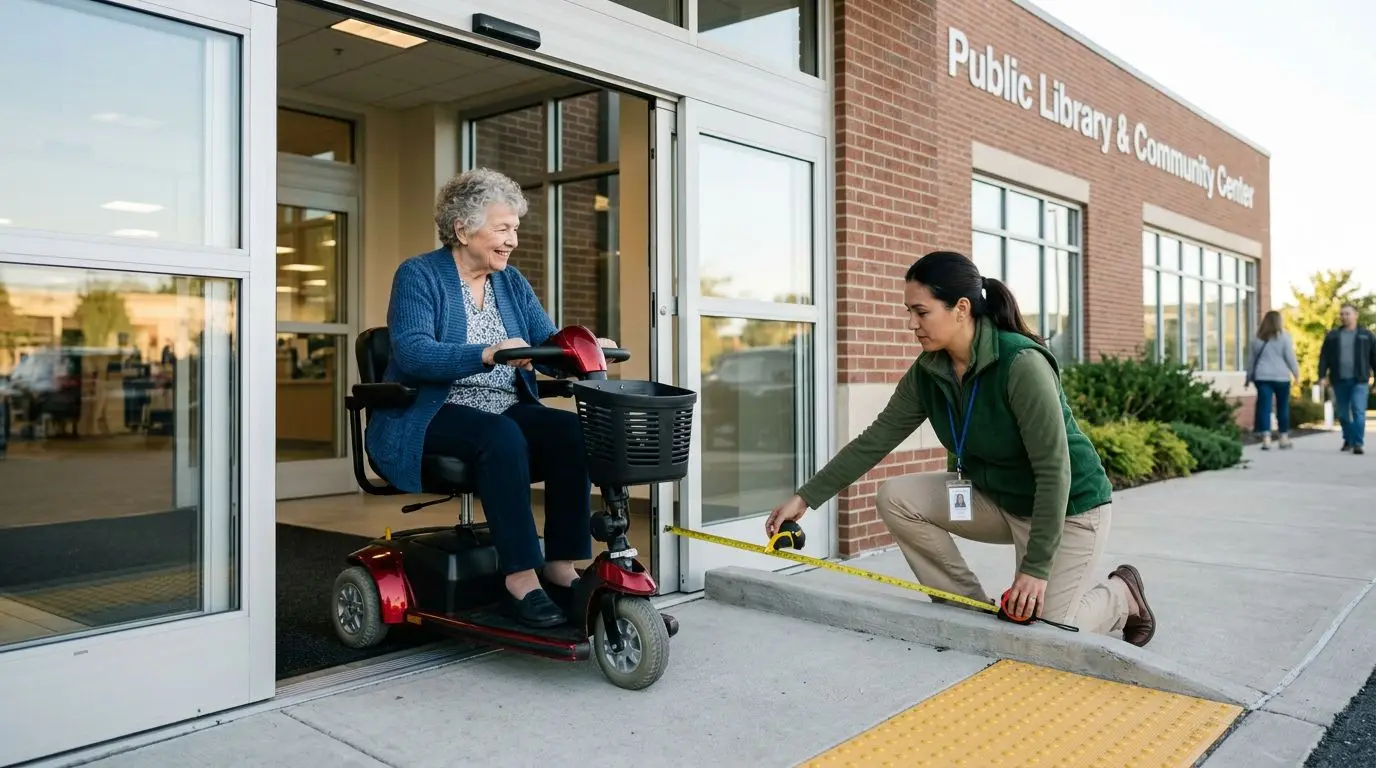
A 32-inch clear door opening is the ADA minimum, but scooter users should think in three parts: approach, opening, and space after the door. A straight-on entry is much easier than a doorway that requires a sharp turn from a narrow hallway. A 1/2-inch threshold can also feel very different depending on wheel size, speed control, and user confidence.
In public places, the hardest doors are often not the widest ones. They are heavy restroom doors, double doors where only one leaf is unlocked, entries with floor mats, and doors that swing toward the user in a tight space. Automatic doors can make a major difference, but not every accessible entrance has them.
When judging a doorway, consider the scooter’s widest fixed point and the rider’s usable space. If armrests are 25 inches wide and the door is 32 inches clear, there are 7 inches total to work with. That sounds generous until the scooter approaches at a slight angle. A rear basket can also clip the door frame after the front wheels have already cleared it.
- Measure the scooter at its widest point, not just the seat base.
- Check whether mirrors fold inward before entering tight doorways.
- Watch rear accessories when turning through a doorway.
- Approach slowly and as straight as possible.
- If a door is heavy, ask staff for assistance rather than forcing a risky maneuver.
Ramps: 1:12 slope, 36-inch width, and 60-inch landings
Under ADA standards, an accessible ramp in new construction generally has a maximum running slope of 1:12. That means 1 inch of rise for every 12 inches of ramp run. A ramp that rises 6 inches would typically need at least 72 inches, or 6 feet, of run. The clear width between handrails is generally at least 36 inches, and landings are commonly 60 inches long at the top and bottom.
These numbers matter because scooters are powered, wheeled devices with weight, momentum, and a turning path. A ramp that is too steep can reduce control on descent and strain the scooter on ascent. A ramp that is wide enough on paper may still feel narrow if it has high edges, handrails close to the driving line, or pedestrians coming the other way.
Landings are easy to underestimate. A 60-inch landing gives a user room to stop, align the scooter, and operate a door or turn onto the next section. If a scooter is 55 inches long, that landing does not leave much extra room for positioning, especially with a rear basket or foot platform extending forward.
| Ramp feature | Common ADA reference | Scooter user consideration |
|---|---|---|
| Running slope | 1:12 maximum in many new construction settings | Steeper ramps may feel unsafe or strain the scooter |
| Clear width | 36 inches minimum | Large scooters may fit but have little side clearance |
| Maximum rise per ramp run | 30 inches | Longer rises need intermediate landings |
| Top and bottom landings | 60 inches long | Important for stopping, turning, and opening doors |
| Cross slope | Generally no more than 1:48 | Side tilt can make steering harder and less comfortable |
Elevators: a 36-inch door and car depth can make or break the trip
ADA elevator doors commonly require at least a 36-inch clear opening, but elevator car size varies by elevator type and door location. Some ADA-compliant elevator configurations use car dimensions around 51 inches deep by 68 inches wide, while others may be deeper or wider depending on whether the door is centered or side-opening. For scooter users, the critical question is whether the scooter can enter, turn or back out safely, and reach the controls.
Elevators can be stressful because there is a time limit, other people are waiting, and the space is enclosed. A short scooter may drive straight in and back out without trouble. A longer scooter may require careful alignment or may need the user to reverse out, which is harder if the hallway outside is crowded.
Controls are another factor. ADA standards generally place many operable parts within accessible reach ranges, often no higher than 48 inches for forward or side reach in common situations. Still, a scooter user may have trouble reaching a panel that is behind the shoulder, too close to a corner, or blocked by other passengers.
- Enter slowly and centered, especially with a front basket.
- If the elevator is small, decide before entering whether you will back out or turn around.
- Use mirrors carefully, but also look over your shoulder if you can do so safely.
- Ask others to hold the door if you need extra time.
- Avoid rushing. A second elevator is safer than a rushed turn.
Turning space: why 60 inches is the key indoor number
The ADA turning space standard often uses a 60-inch diameter circle or an approved T-shaped turning space. That 5-foot circle is one of the most useful numbers for scooter users because it shows whether a mobility device can reverse direction in one controlled movement. Many compact scooters can manage a 60-inch turning area, while larger scooters may need more space or a multi-point turn.
Turning radius is not the same as scooter length. A 48-inch scooter might have a 54-inch turning radius, depending on wheelbase, steering angle, and front wheel layout. Add a rider’s knees, a basket, or a cane holder, and the practical turning space grows.
Public spaces often meet the rule in one area but not where the user actually needs it. A restroom may have the required turning space on paper, yet a trash can, wet floor sign, decorative table, or poorly placed chair may block the circle. In a restaurant, the route to a table may be 36 inches wide, but the space to turn at the table may be far less than 60 inches once chairs are occupied.
| Space | Useful number | What to check |
|---|---|---|
| Restroom turning area | 60-inch circle | Look for trash cans, open doors, and tight stall approaches |
| Retail aisle | 36-inch accessible route | Watch displays, baskets, and people standing in the aisle |
| Reception area | 30 by 48-inch clear floor space | Check whether you can park without blocking the route |
| Dining table approach | 36-inch route plus knee/parking space | Ask for an end table or extra chair removal when needed |
Who is best served by a compact scooter under about 22 inches wide?
A compact scooter is often best for people who regularly visit medical offices, grocery stores, apartment buildings, senior centers, museums, and restaurants where doorways, elevators, and restroom approaches can be tight. A width under about 22 inches and a turning radius under about 45 inches can make daily indoor access noticeably easier.
This does not mean everyone should choose the smallest scooter. A user who travels long outdoor distances, carries supplies, needs a higher weight capacity, or often crosses uneven pavement may need a larger frame, bigger wheels, or stronger suspension. The right scooter balances body support, outdoor performance, transport needs, and the spaces the user visits most.
Compact scooters are usually best for:
- Indoor-heavy routines with frequent doorways and elevators.
- Users who need the scooter transported in a vehicle.
- Buildings with older layouts and smaller restrooms.
- People who can manage a smaller seat and lighter frame comfortably.
Larger scooters may be better for:
- Longer outdoor trips on sidewalks or campuses.
- Users who need a higher weight capacity or wider seating.
- Rougher surfaces, curb cuts, and longer distances between charging.
- People who prioritize ride comfort over tight indoor turning.
How to measure your scooter in 10 minutes before visiting a public place
You can measure the key scooter dimensions in about 10 minutes with a tape measure, painter’s tape, and a clear floor area. Write the numbers on a card or in your phone so you can compare them with doorways, ramps, elevators, and restroom layouts when planning trips.
Start with overall width. Measure the widest point with the scooter set up the way you actually use it. Include armrests, mirrors, baskets, cane holders, oxygen carriers, and any accessory that stays attached in public. If mirrors fold, record both the open and folded width.
Next, measure total length from the front-most point to the rear-most point. Include the basket, foot platform, anti-tip wheels, and rear storage. Then check turning space by using tape to mark a 60-inch circle or a 60-by-60-inch square on a driveway, garage floor, or community room floor. Practice turning within that space at the slowest speed.
- Width: Measure side to side at the widest fixed point.
- Length: Measure front accessory to rear accessory.
- Turning radius: Use the manufacturer’s general specification if available, then test it in a 60-inch marked area.
- Ground clearance: Note the lowest point under the scooter, especially if you cross thresholds.
- Weight with batteries: Important for lifts, transport, and some facility safety policies.
If you are unsure about a destination, call ahead with specific questions. Ask, “Is the accessible entrance a 32-inch clear opening or wider?” “Does the elevator fit a scooter about 50 inches long?” “Is there a 60-inch turning space in the restroom?” Specific numbers get better answers than asking whether a place is “scooter friendly.”
ADA rules and mobility scooters: what public places generally consider
Under the ADA, public accommodations must provide accessible routes and features according to applicable standards, but the law does not certify a personal scooter as “ADA approved.” The ADA also recognizes mobility devices used by people with disabilities, including wheelchairs and other power-driven mobility devices in many public settings. Facilities may consider legitimate safety requirements, but broad assumptions about scooters are not enough.
In practical terms, most public places focus on whether the mobility device can be operated safely in that environment. For example, a compact scooter in a wide museum corridor is different from a very large outdoor scooter in a crowded historic building with narrow routes. Staff may also need to keep fire exits, aisles, and service counters clear.
Rules can differ in transportation systems, stadiums, amusement venues, hospitals, and federal facilities. If access is important for a scheduled appointment or ticketed event, call ahead and ask about the specific route from entrance to destination. Document names, times, and instructions if the trip is essential.
Real-world access checks: 5 public places to think through
Before choosing or using a scooter in public, picture the actual trip in segments. A building may have a 36-inch accessible route at the entrance but a crowded waiting room, a small elevator, or a tight restroom turn deeper inside.
| Public place | Key dimension to think about | Practical tip |
|---|---|---|
| Medical office | 32-inch doors and 60-inch turns | Ask whether exam rooms have space for the scooter or a transfer chair |
| Grocery store | 36-inch aisles or wider clear routes | Watch end-cap displays and temporary stocking carts |
| Restaurant | 36-inch route to table | Request an end table and ask staff to remove an extra chair |
| Parking garage | Ramp slope and elevator size | Confirm the accessible route does not require a steep vehicle ramp |
| Hotel | Door width, elevator depth, bed clearance | Ask for exact room doorway and bathroom measurements before booking |
A good habit is to identify the narrowest point of the trip. It may not be the front door. It might be the restroom vestibule, the elevator lobby, the hallway outside a clinic suite, or the route between dining tables.
FAQ: ADA dimensions and mobility scooters
Is there an ADA-approved mobility scooter size?
No. The ADA does not create one approved scooter size. It sets accessibility requirements for public spaces, such as 32-inch clear door openings, 36-inch accessible routes, and 60-inch turning spaces. Scooter users should compare their scooter’s actual width, length, and turning radius with those dimensions.
Will a 30-inch-wide scooter fit through an ADA doorway?
It may fit through a 32-inch clear opening, but it will be very tight. A 30-inch scooter leaves only about 2 inches of total clearance, not counting hands, mirrors, steering angle, or doorway trim. A wider entrance or automatic door will be much easier.
What scooter size works best in elevators?
For elevators, length and turning radius matter as much as width. A compact scooter under about 22 inches wide and under about 45 inches long is usually easier to position, but elevator car sizes vary. If you use a longer scooter, be prepared to enter straight and back out slowly when turning is not possible.
Are public places allowed to ban mobility scooters?
Public places generally must allow mobility devices used by people with disabilities, but facilities can apply legitimate safety requirements based on the actual setting. Policies should not be based on stereotypes or convenience alone. For a specific dispute, contact an ADA information resource or a qualified legal professional.
What is the most important measurement before buying a scooter for public access?
Width is the first measurement to check because of 32-inch doors and 36-inch routes, but turning radius is just as important indoors. A scooter that is narrow but long may still be difficult in restrooms, elevators, restaurants, and small offices.
Frequently asked questions
Is there an ADA-approved mobility scooter size? +
No. The ADA does not define one approved mobility scooter size. It sets accessibility requirements for public spaces, such as 32-inch clear door openings, 36-inch accessible routes, and 60-inch turning spaces.
Will a 30-inch-wide scooter fit through an ADA doorway? +
It may fit through a 32-inch clear doorway, but it will be tight. A 30-inch scooter leaves only about 2 inches of total clearance before considering hands, mirrors, steering angle, or accessories.
What mobility scooter dimensions are best for public places? +
For frequent indoor public use, a scooter under about 22 inches wide with a tighter turning radius is often easier to manage. Larger scooters may be better outdoors but can be harder in elevators, restrooms, and restaurants.
What ADA ramp slope should scooter users know? +
A common ADA maximum ramp slope in new construction is 1:12, meaning 1 inch of rise for every 12 inches of ramp run. Ramps also commonly need at least 36 inches of clear width and 60-inch landings.
Are public places allowed to ban mobility scooters? +
Public places generally must allow mobility devices used by people with disabilities, though they may apply legitimate safety requirements based on the actual setting. Broad assumptions about scooters are not enough.
Related guides
ADA-Accessible Routes for Mobility Scooters: Doorways, Ramps, Elevators, and Turning Space
12 min read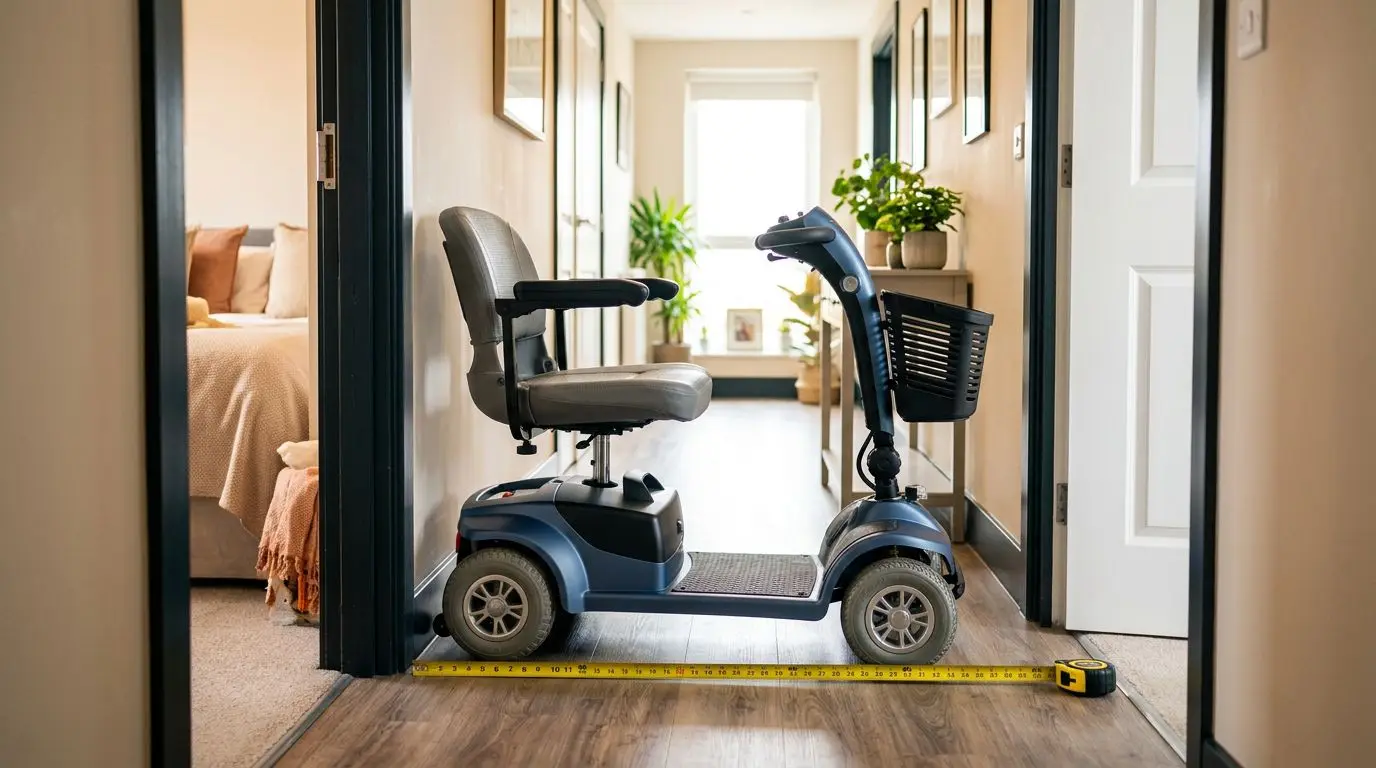
Compact Mobility Scooters for Apartments, Stores, and Tight Spaces: Dimensions That Matter
13 min read
Using a Mobility Scooter Safely in Stores, Elevators, Hallways, and Crowded Public Places
14 min read