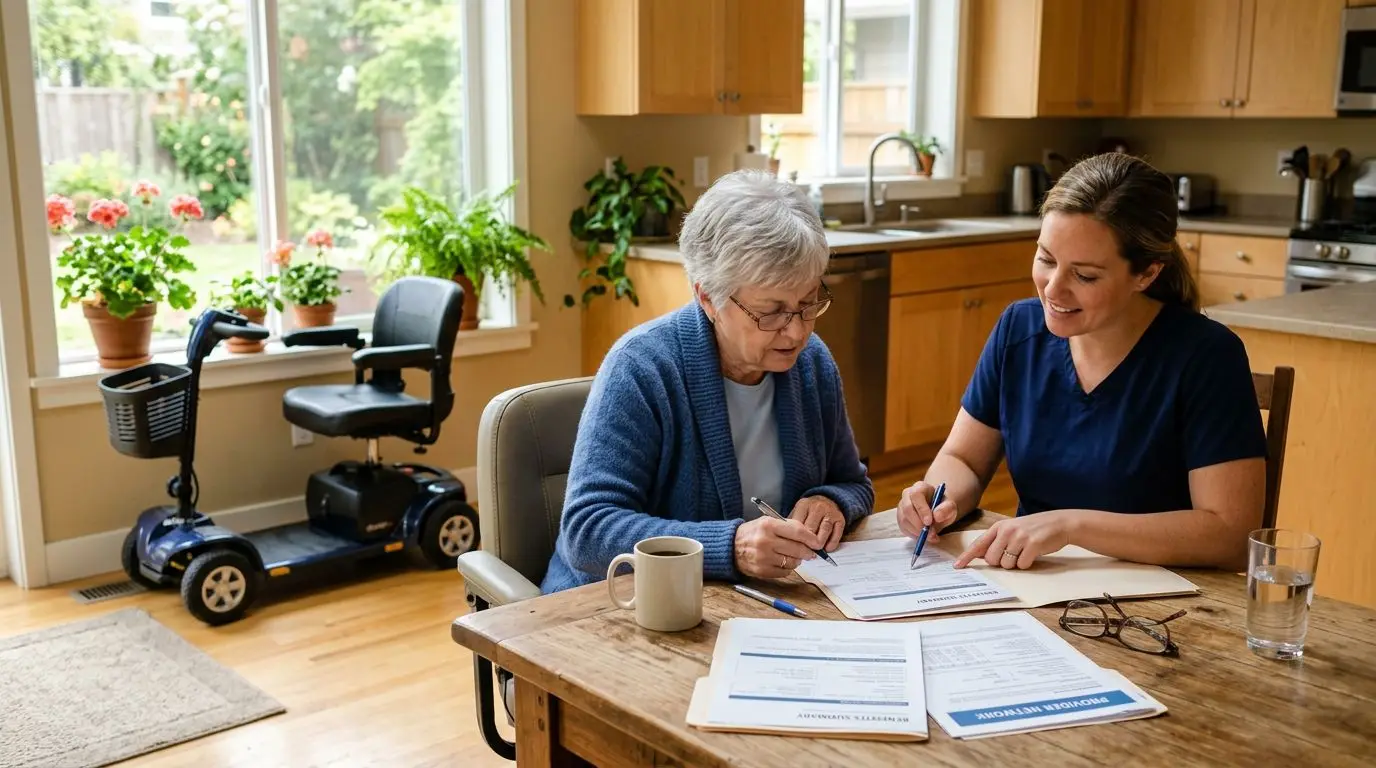
Free mobility scooters are available in the US, but they usually come through medical coverage, local donation programs, veterans benefits, state assistive technology programs, or nonprofit assistance, not one national free-scooter program. The best approach is to start locally, gather your medical and financial documents, and apply to 2 or 3 funding sources at the same time. If you qualify, help may cover a new scooter, a refurbished scooter, a long-term loan, repairs, or part of your out-of-pocket cost.
The key is matching the scooter to your medical need and your living situation. A scooter that cannot turn in your hallway, fit through a 32-inch doorway, or support your body weight is not a safe bargain, even if it is free.
Start with these 6 funding paths
Most people find scooter help through one of 6 routes: health insurance, Medicaid, veterans benefits, state assistive technology programs, nonprofit or faith-based aid, and used equipment donations. Each route has its own paperwork and wait times, so keep a simple folder with your ID, insurance cards, proof of income, medical notes, and a short written explanation of why you need a scooter.
| Funding path | What it may help with | Best first step |
|---|---|---|
| Medicare Part B | May cover a power-operated vehicle, including a scooter, when it is medically necessary for use inside the home. If approved, Medicare commonly pays 80% of the Medicare-approved amount after the Part B deductible, leaving 20% coinsurance unless other coverage applies. | Ask your doctor for a mobility evaluation and use a Medicare-enrolled equipment supplier. |
| Medicaid | May cover a scooter, repairs, batteries, or related durable medical equipment. Rules vary by state and by Medicaid plan. | Call the number on your Medicaid card and ask for durable medical equipment authorization rules. |
| VA benefits | May assist eligible veterans with medically necessary mobility equipment through VA health care or related benefit channels. | Contact your VA care team or a county veterans service officer. |
| State assistive technology programs | May offer device demonstrations, reuse programs, low-interest loans, short-term loans, or referrals to local funding. | Search for your state assistive technology program or call a local disability resource center. |
| Nonprofits and faith-based groups | May provide small grants, donated equipment, repairs, ramps, or emergency assistance. | Call 211, your Area Agency on Aging, or a local Center for Independent Living. |
| Medical equipment loan closets | May loan or give refurbished scooters when available. Inventory changes often, sometimes weekly. | Ask hospitals, senior centers, rehabilitation clinics, and community groups about loan closets. |
No single option works for everyone. Someone with a Medicare Advantage plan may need prior authorization, while someone with Medicaid may need state-specific documentation. A veteran may have a separate pathway. A person who does not meet insurance rules may still find help through a local reuse program.
Who is most likely to qualify for no-cost or low-cost help
Programs usually look at 2 things: medical need and financial need. Medical need means a scooter is necessary for daily mobility, often inside the home, not just for occasional shopping trips. Financial need means the scooter cost would be difficult or impossible to pay without assistance, based on income, assets, insurance status, or a recent hardship.
Medicare is a good example of why wording matters. A scooter may be considered only when a cane, walker, or manual wheelchair is not enough for daily activities in the home, and the person can safely operate the scooter or has help available. Coverage is not usually based on wanting a scooter for outdoor errands alone. That distinction matters.
Nonprofit and donation programs may be more flexible, but they still often ask for proof. Common requests include a photo ID, a doctor or therapist note, proof of address, proof of monthly income, a denial letter from insurance, or a short statement describing your mobility limits. Some local groups can decide quickly; others meet once a month to review requests.
You may have the strongest case if one or more of these applies:
- You have difficulty walking room to room, getting to the bathroom, or reaching the kitchen safely.
- You have a documented disability, chronic condition, injury, or age-related mobility limitation.
- You live on a fixed income and cannot afford the remaining 20% coinsurance, repairs, or a replacement battery.
- You recently left a hospital, rehabilitation facility, or skilled nursing facility and need equipment to stay at home.
- You are a veteran receiving care through VA channels.
- You need a scooter to keep a job, attend training, or travel around a campus, in which case vocational rehabilitation may be worth contacting.
Do not overstate your condition. Be clear, specific, and honest. Instead of saying you simply need independence, explain that you cannot stand long enough to prepare a meal, cannot walk 30 feet to the mailbox without resting, or have fallen while trying to move through the home.
How to apply in 5 practical steps
A scooter request often takes more than 1 phone call. For insurance-based funding, 30 to 60 days is not unusual, and delays happen when paperwork is incomplete. Donation programs can move faster, but availability depends on what has been returned or donated.
1. Get a mobility evaluation
Start with your primary care doctor, specialist, physical therapist, occupational therapist, or rehabilitation clinic. Ask for a written assessment that explains your mobility limits, your ability to operate a scooter, and why simpler aids are not enough. If the scooter must be used inside the home, the note should say so clearly.
2. Call your insurance before choosing equipment
Ask whether scooters are covered as durable medical equipment, whether prior authorization is required, and whether you must use an in-network supplier. If you have both Medicare and Medicaid, ask how the 20% Medicare coinsurance is handled in your state or plan.
3. Contact local aging and disability offices
Call your Area Agency on Aging, Aging and Disability Resource Center, Center for Independent Living, or 211. Say you are looking for mobility scooter funding, donated durable medical equipment, or a medical equipment loan closet. Ask for at least 3 referrals because inventory and grant money change often.
4. Apply to more than one source
It is reasonable to apply to insurance, a state assistive technology program, and a local nonprofit at the same time. Tell each program if you are waiting on another decision. Some charities prefer to pay a remaining balance after insurance, while others may help only after you show a denial.
5. Keep notes from every call
Write down the date, phone number, person you spoke with, required documents, and next step. A 1-page call log can prevent missed deadlines and repeated explanations. If a program says no, ask whether they know another resource that serves your county.
How to measure your home and your body before accepting a scooter
A free scooter still needs to fit. Many US interior doorways are about 30 to 36 inches wide, and older homes may have tighter bathroom doors, narrow halls, or sharp turns. Measure before you accept a donated scooter or start paperwork for a covered one.
Use a tape measure and write down these numbers:
- Narrowest doorway: Measure the clear opening with the door open, not the frame-to-frame width with the door partly closed.
- Hallway width: Note any turns, furniture, rugs, or thresholds higher than about 1/2 inch.
- Turning space: Check whether you can turn around in the bedroom, bathroom area, and kitchen. Scooters often need more turning room than power wheelchairs.
- User weight: Compare your current weight, clothing, oxygen tank, bags, and accessories with the scooter weight capacity. Common capacities may be around 250 to 300 pounds for lighter scooters, while larger scooters may support more.
- Seat fit: Measure hip width while seated and allow space for comfort. A seat that is too narrow can create unsafe posture and pressure.
- Storage and charging: Confirm there is a dry indoor space near a standard outlet. Most scooter batteries should not be left in extreme heat, freezing conditions, or rain.
If possible, ask an occupational therapist, physical therapist, or experienced durable medical equipment provider to review your home layout. A scooter that works well in a grocery store may be awkward in a small apartment.
Compare scooter types before you accept a donation
Mobility scooters are not all designed for the same setting. A compact scooter may break down into 3 or 4 pieces for transport, while a full-size scooter may offer more stability and battery range but require more storage space. Choose based on your daily route, not just appearance.
| Scooter type | Typical strengths | Watch-outs | Best for |
|---|---|---|---|
| 3-wheel scooter | Often has a tighter turning radius and easier maneuvering in small rooms. | May feel less stable than a 4-wheel scooter on uneven ground. | Indoor use, apartments, smoother surfaces. |
| 4-wheel scooter | Usually offers better stability over outdoor surfaces and straight paths. | May need more room to turn in hallways or tight kitchens. | Mixed indoor and outdoor use where space allows. |
| Travel or portable scooter | May disassemble for car transport; individual pieces can still weigh 30 pounds or more. | Shorter range, smaller seat, and lower weight capacity are common tradeoffs. | Occasional trips, appointments, and users with a helper for lifting. |
| Full-size scooter | More seating comfort, higher capacity, and longer range than many portable options. | Harder to transport and may not fit tight interiors. | Daily use in homes with adequate space and outdoor paths. |
| Heavy-duty scooter | Higher weight capacity, wider seat options, stronger frame, and larger tires. | Requires more turning room, storage, and often a vehicle lift for transport. | Larger users or rougher outdoor routes, when home access is suitable. |
Ask for the basic specifications before accepting any used scooter: overall width, weight capacity, battery type, charger availability, seat width, and whether the scooter can be serviced locally. If the donor cannot provide them, measure what you can and have a qualified repair shop inspect it.
Low-cost and donated scooters: 10 inspection checks
A donated scooter can be a major help, but it should be checked carefully. Set aside at least 15 to 20 minutes for a test, and never accept a scooter without its correct charger unless a repair shop confirms a safe replacement.
- Battery performance: Ask how old the batteries are. Weak batteries are one of the most common used-scooter expenses.
- Charger condition: Inspect the cord, plug, and charging port. Do not use frayed cords.
- Brake response: Test stopping on a flat surface at low speed.
- Tires and wheels: Look for cracks, flat spots, missing tread, or wobbling.
- Seat and armrests: Check for tears, loose bolts, and safe transfers.
- Tiller adjustment: Make sure you can reach the controls without leaning forward.
- Lights and horn: If included, confirm they work, especially for sidewalks, parking lots, and building entrances.
- Frame condition: Look for rust, bent parts, or signs of water damage.
- Speed control: Confirm the low-speed setting works smoothly and does not surge.
- Serviceability: Ask whether local repair shops can work on generic components, batteries, tires, and seating hardware.
Be cautious with online giveaways that require shipping fees, wire transfers, gift cards, or personal banking information. Local pickup through a known community group, medical equipment exchange, senior center, or nonprofit is usually safer than sending money to a stranger.
What to say when you call for local help
A clear 60-second explanation can make calls easier and more productive. Many offices receive a high volume of requests, so be brief, polite, and specific about your county, insurance, medical need, and budget.
Try this script: I live in this county and need help getting a mobility scooter. I have limited income and difficulty walking safely in my home and community. I have a doctor or therapist who can provide documentation. Do you know of any durable medical equipment grants, loan closets, refurbished scooter programs, or local charities that can help?
If the first person cannot help, ask 3 follow-up questions:
- Do you know who handles donated medical equipment in this county?
- Is there an assistive technology reuse program or equipment loan closet nearby?
- Can you refer me to a social worker, disability resource center, or aging services office?
Hospital discharge planners, rehabilitation clinics, senior centers, county veterans offices, and community health clinics may also know who has equipment available. If you belong to a faith community, ask whether they have a benevolence fund or volunteers who help with medical equipment searches.
FAQ: free mobility scooter help in the US
Can I really get a mobility scooter for free?
Yes, some people do, but free scooters are usually tied to eligibility. You may qualify through Medicaid, VA benefits, a local donation program, a medical equipment loan closet, or a nonprofit grant. Medicare may reduce the cost if you meet medical necessity rules, but it does not automatically make every scooter free.
Will Medicare pay for a scooter?
Medicare Part B may cover a scooter as durable medical equipment when it is medically necessary for use inside your home, your doctor documents the need, and the supplier is Medicare-enrolled. If approved, Medicare generally pays 80% of the approved amount after the deductible, and you may owe the remaining 20% unless other coverage helps.
What if I only need a scooter outside the home?
Insurance coverage is harder when the need is only for outdoor errands, shopping, or recreation. You should still ask about Medicaid waivers, state assistive technology programs, local grants, and donated equipment, because some community programs consider broader independence and access needs.
Where can I find donated mobility scooters near me?
Start with 211, your Area Agency on Aging, Aging and Disability Resource Center, Center for Independent Living, hospital social work department, senior center, and local medical equipment loan closets. Ask specifically for refurbished scooters, durable medical equipment reuse, and long-term loans.
Is a used scooter safe?
A used scooter can be safe if it fits the user, holds a charge, brakes properly, includes the correct charger, and has no major frame, tire, or wiring problems. Test it for 15 to 20 minutes and have a repair professional inspect it when possible.
Can a nonprofit pay my remaining balance after insurance?
Sometimes. Some charities and local assistance funds will help with coinsurance, deductibles, batteries, repairs, ramps, or delivery fees. They may ask for an insurance approval or denial letter, a written estimate, and proof of income before deciding.
Frequently asked questions
Can I really get a mobility scooter for free? +
Yes, but free scooters are usually tied to eligibility. Help may come through Medicaid, VA benefits, a local donation program, a medical equipment loan closet, or a nonprofit grant.
Will Medicare pay for a scooter? +
Medicare Part B may cover a scooter when it is medically necessary for use inside the home, documented by a doctor, and provided by a Medicare-enrolled supplier. If approved, Medicare generally pays 80% of the approved amount after the deductible.
What if I only need a scooter outside the home? +
Insurance coverage is harder when the need is only outside the home. Check Medicaid waivers, state assistive technology programs, local grants, and donated equipment programs.
Where can I find donated mobility scooters near me? +
Call 211, your Area Agency on Aging, Aging and Disability Resource Center, Center for Independent Living, hospital social work department, senior center, and local medical equipment loan closets.
Is a used scooter safe? +
It can be, if it fits the user, holds a charge, brakes properly, has the correct charger, and has no major frame or wiring damage. Test it and consider a repair inspection.
Can a nonprofit pay my remaining balance after insurance? +
Sometimes. Some local funds help with coinsurance, deductibles, batteries, repairs, ramps, or delivery fees if you provide an estimate and proof of need.
Related guides
Does Medicare or Insurance Cover Mobility Scooters? A US Buyer’s Guide
12 min read
Does Medicaid Cover Mobility Scooters? State Rules, Waivers, and Medical Necessity Explained
13 min read
How to Finance a Mobility Scooter: Payment Plans, Medical Financing, and Credit Options
13 min read