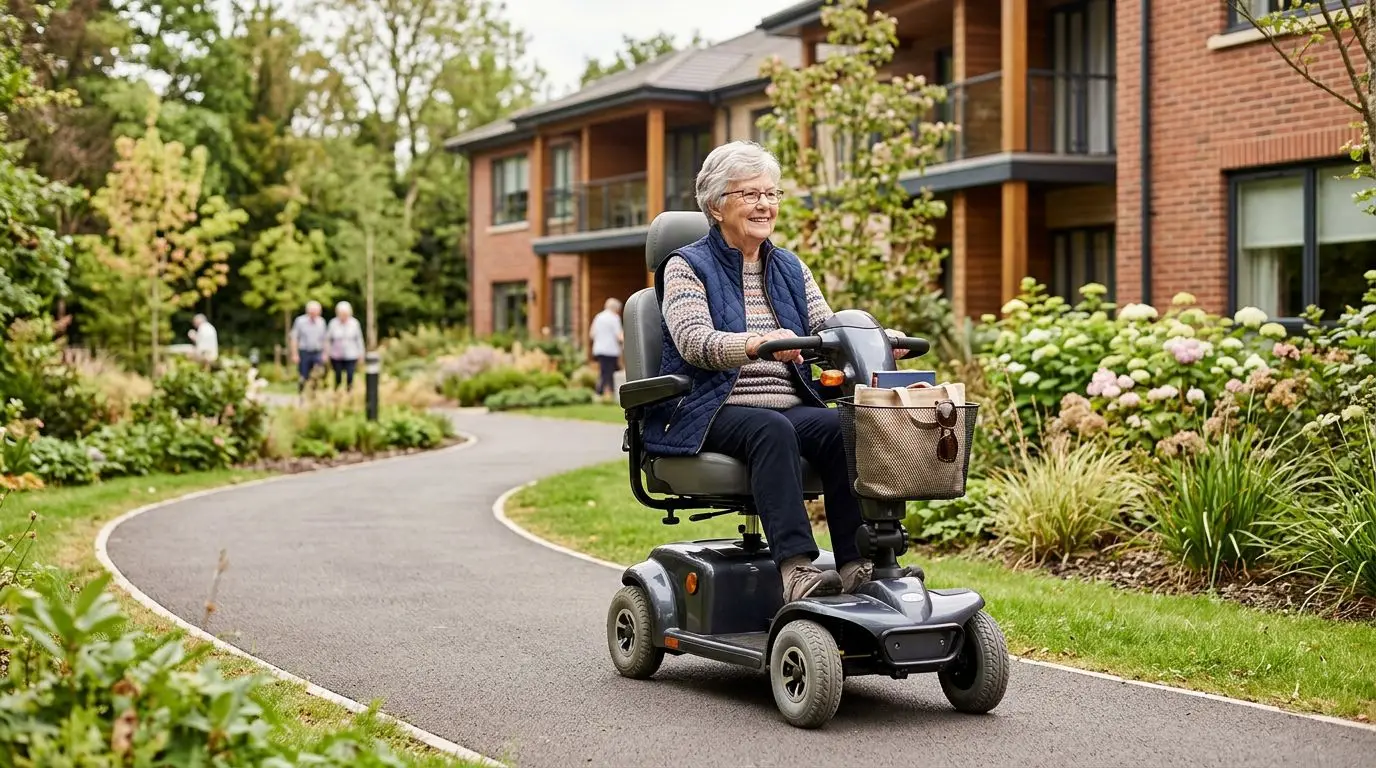
A heavy-duty mobility scooter is usually the right category to consider when the rider, clothing, accessories, and carried items may exceed the limits of a standard scooter. Before buying, check the scooter’s rated weight capacity, usable seat width, frame design, real-world range, stability features, and whether you can store or transport it safely.
The best choice is not simply the scooter with the highest number on the brochure. A safer, more comfortable purchase comes from matching the scooter to the rider’s actual measurements, daily routes, doorways, ramps, vehicle setup, and charging routine.
What “heavy-duty” usually means: 300 to 600 lb capacity
In mobility scooters, “heavy-duty” generally means scooters rated above the common standard range of about 250 to 300 lb. Many higher-capacity scooters are rated around 350, 400, 450, 500, or even 600 lb, though exact limits vary by design. Treat that published number as a maximum operating limit, not a comfort target.
A practical rule is to leave a cushion of at least 10% to 20% below the maximum capacity when possible. For example, a 400 lb rider who regularly carries a 10 lb bag and wears heavier winter clothing may be better served by a scooter rated well above 400 lb rather than one that barely meets the total load.
That extra margin matters because weight affects acceleration, braking distance, hill climbing, battery drain, tire wear, and motor strain. A scooter may technically move at its rated limit, yet still feel sluggish on a driveway slope, in thick carpet, or over sidewalk seams. Capacity also does not tell you whether the seat is wide enough or the deck has enough foot room.
| Capacity category | Typical use case | What to double-check |
|---|---|---|
| Up to 300 lb | Standard daily errands on smooth surfaces | May not offer enough seat width or structural margin for heavier adults |
| 350 to 450 lb | Many higher-weight riders who need more seat and frame support | Seat dimensions, motor performance on ramps, total scooter weight |
| 500 to 600 lb | Riders needing the strongest frame and wider seating options | Doorway clearance, turning radius, vehicle lift rating, storage space |
Who heavy-duty scooters are best for: riders needing more than a 300 lb limit
Heavy-duty scooters are best for adults who need a higher weight rating, a wider seat, a more planted ride, or stronger performance across uneven outdoor surfaces. They can also make sense for someone under the maximum capacity who carries oxygen equipment, groceries, tools, a pet carrier, or other items that add 10 to 40 lb during a typical outing.
They are not automatically the best choice for every larger rider. A heavy-duty scooter can be wider, longer, and much heavier than a compact travel scooter. Some units may measure roughly 24 to 30 inches wide and can be difficult to maneuver through narrow interior spaces. If your home has tight hallways, a small elevator, or a bathroom doorway under 28 inches, overall scooter size matters as much as capacity.
Consider a heavy-duty scooter if you:
- Need a rated capacity above 300 lb including clothing and carried items.
- Prefer a seat wider than about 18 inches.
- Use the scooter outdoors on sidewalks, parking lots, or mild slopes.
- Want a more stable 4-wheel platform rather than a small travel scooter.
- Do not need to lift the scooter into a trunk by hand.
You may want to consider other mobility options if you need very tight indoor maneuvering, full-time seating support, or assistance with posture and pressure management. For those concerns, a medical professional or mobility seating specialist can help identify needs that a basic scooter specification sheet will not cover.
How to check true weight capacity: include 20 lb of everyday carry items
Start by calculating the real operating load. Add the rider’s current weight, clothing, shoes, purse or backpack, oxygen tank if used, groceries, and any basket contents. Everyday extras commonly add 10 to 20 lb without much thought.
Use this simple formula:
Rider weight + clothing/shoes + carried items + mounted accessories = minimum required load support.
If that total is 365 lb, a scooter rated for 375 lb leaves almost no margin. A model rated around 450 lb or higher may provide a more reasonable buffer, assuming the seat and frame dimensions also fit. Do not assume a rear basket, cane holder, or oxygen holder is weight-neutral. Anything attached to the scooter still contributes to the total load the motor, frame, tires, and brakes must manage.
Ask how the rating was determined, too. A listed maximum may be based on level ground, properly inflated tires, a fully charged battery, and normal operating conditions. The same scooter may feel very different on a 6-degree driveway incline, rough pavement, or grass. If your daily route includes slopes, curb cuts, or long outdoor trips, build in more capacity than the bare minimum.
Seat size and comfort: measure hips and add 1 to 2 inches
Seat fit is one of the most overlooked parts of buying a heavy-duty mobility scooter. Weight capacity tells you what the frame is rated to carry; it does not guarantee the seat will feel comfortable for a larger body. Many scooter seats fall somewhere around 17 to 22 inches wide, while some heavy-duty designs may offer wider seating in the 22 to 24 inch range.
To measure seat width, sit on a firm chair and measure the widest point across your hips or thighs. Add 1 to 2 inches so you are not wedged between the armrests. If the measurement is 21 inches, a 22 or 23 inch usable seat width may be more realistic than an 18 inch seat, even if the scooter’s weight rating looks adequate.
Pay attention to these seat details:
- Usable width: Armrests reduce space, so check the distance between the arms, not just the cushion size.
- Seat depth: A depth around 17 to 19 inches may suit many adults, but taller riders may need more thigh support.
- Seat height: The rider’s feet should rest securely on the deck without straining the knees or hips.
- Armrest adjustment: Width-adjustable or flip-up arms can make transfers easier.
- Swivel function: A rotating seat can reduce twisting when getting on and off.
Comfort is not just softness. A very plush seat may feel good for 5 minutes but provide poor support after an hour. If you have skin sensitivity, pain, swelling, or pressure concerns, ask a qualified clinician about seating needs before relying on a scooter seat alone.
Frame strength, wheelbase, and tires: look beyond a 4-wheel label
Most heavy-duty scooters use a 4-wheel design because it offers a broader stance than a 3-wheel scooter. That helps with straight-line stability, especially outdoors. Still, not all 4-wheel scooters feel the same. Wheelbase length, tire size, deck design, suspension, and center of gravity all influence how steady the scooter feels.
Larger scooters may use tires around 10 to 14 inches in diameter, while smaller travel scooters may use smaller wheels. Bigger tires can roll more easily over sidewalk cracks, shallow gravel, and uneven parking lots, though they do not turn a scooter into an off-road vehicle. Pneumatic tires may ride softer but require air pressure checks. Solid tires reduce flat risk but can feel firmer.
| Design feature | Why it matters for higher-weight riders | Useful check |
|---|---|---|
| Longer wheelbase | Can improve straight-line stability | Compare overall length and turning radius before buying |
| Wider stance | May feel more planted on outdoor surfaces | Measure doorway and hallway clearance |
| Suspension | Helps reduce vibration over rough pavement | Test on a sidewalk seam or parking lot if possible |
| Large tires | Can handle small bumps better than tiny wheels | Check tire diameter and maintenance needs |
| Reinforced frame | Supports higher rated loads | Verify the total capacity includes rider plus cargo |
Anti-tip wheels, effective brakes, and a low step-through deck are also worth checking. Stability is a system, not a single feature. A wide scooter with a high seat and heavy rear load can still feel less secure than expected.
Range and battery performance: expect less than the advertised maximum
Advertised range is usually based on favorable conditions, such as level ground, moderate rider weight, new batteries, and steady speeds. In real use, a higher rider weight, frequent starts, hills, cold weather, soft surfaces, and underinflated tires can reduce range. A scooter listed for 20 miles under ideal testing may provide noticeably less on a hilly neighborhood route.
If your most important trip is 3 miles to a store and 3 miles back, do not shop as if you only need 6 miles of range. Add a buffer for detours, battery aging, headwinds, ramps, and the fact that many riders do not want to run the battery near empty. A practical target is often 1.5 to 2 times your longest regular round trip.
Battery size, motor efficiency, tire pressure, terrain, and rider load all interact. Heavier-duty scooters often use larger batteries than compact scooters, but they also move more total mass. Ask about charging time as well. Many scooter batteries take roughly 6 to 10 hours to recharge fully, so overnight charging is common.
Battery placement affects handling and transport, too. Larger batteries can add substantial weight, and removing them may not make the scooter easy to lift. If you live in an apartment, confirm where charging will happen and whether the charging cord can reach safely without becoming a trip hazard.
Stability on ramps and uneven ground: check inclines before you buy
Ramps are a major test for any heavy-duty scooter. A common accessibility guideline for permanent ramps is a 1:12 slope, meaning 1 inch of rise for every 12 inches of ramp length. Many private ramps, portable ramps, and driveway transitions are steeper than that, and a heavier loaded scooter will work harder climbing them.
Look for the scooter’s maximum incline rating, but treat it as a controlled-condition number. A wet ramp, loose gravel, worn tires, or a sharp turn at the top can change the situation quickly. If your home has a 4 inch threshold ramp, a steep garage entry, or a sloped driveway, measure it and compare it with the scooter’s specifications before purchasing.
Ground clearance matters as well. Many scooters offer roughly 2 to 5 inches of clearance, depending on size and design. More clearance can help over thresholds and uneven pavement, but a higher ride height can affect center of gravity. Balance is key.
For outdoor use, check these points:
- Can the scooter climb your actual driveway with the rider seated?
- Does it stop smoothly while going downhill?
- Are the controls easy to feather at low speed?
- Does the scooter remain steady when turning onto a ramp?
- Is there enough lighting for evening visibility?
A test drive on level showroom flooring is useful, but it does not tell the whole story. If possible, test conditions similar to your real route.
Indoor fit and turning radius: measure every 30-inch doorway
A higher-capacity scooter that fits your body still has to fit your environment. Many interior doorways in older homes can be about 28 to 30 inches wide, while exterior doors are often wider. Heavy-duty scooters may be too wide or long for tight bathrooms, narrow hallways, or crowded kitchens.
Measure the actual clear opening of each doorway, not the nominal door size. Door trim, hinges, and the open door itself can reduce usable space. If a scooter is 27 inches wide and the doorway opening is 28 inches, you have only 1 inch total clearance. That is tight for daily use, especially when turning.
Turning radius is another key number. A compact scooter may turn in a tighter circle than a heavy-duty 4-wheel scooter. Larger units may require more than 50 inches of turning space, and some need much more. If you must make a 90-degree turn from a hallway into a bedroom, measure the hallway width and door opening together.
| Area to measure | Minimum practical question | Example data point |
|---|---|---|
| Doorways | Will the scooter pass through with room to correct? | A 30-inch clear opening is easier than a 28-inch opening |
| Hallways | Can you turn without scraping walls? | Many halls are 36 inches wide, but furniture reduces space |
| Storage spot | Can the scooter park and charge safely? | Allow several extra inches around the scooter |
| Elevator | Will the full length fit with the door closed? | Measure inside depth and turning space |
Do not forget weight on floors and lifts. Most homes can handle a scooter like other heavy furniture when used normally, but portable ramps, vehicle lifts, and platform lifts have their own ratings that must exceed the combined scooter and rider load where applicable.
Transport and storage: a heavy-duty scooter may weigh 200 to 350 lb
Many heavy-duty scooters are not designed to be lifted into a car trunk by one person. Total scooter weight can be in the 200 to 350 lb range, sometimes more, depending on batteries, seat size, frame, and accessories. Even if the seat and batteries come off, the heaviest remaining section may still be too heavy for safe manual lifting.
If you plan to travel by vehicle, check three ratings: the scooter’s total weight, the vehicle lift or carrier capacity, and the vehicle’s tongue weight or hitch rating. A carrier that can hold a scooter is not enough if the vehicle itself is not rated for that load. Include the carrier’s own weight in the calculation.
Storage also deserves planning. A heavy-duty scooter needs a dry, secure place with access to power. Outdoor storage can expose the scooter to moisture, temperature swings, and theft risk unless properly protected. If you store it in a garage, make sure there is enough room to get on and off without squeezing between a car and a wall.
Ask yourself:
- Will I transport this scooter weekly, monthly, or almost never?
- Can I use a ramp, lift, or accessible vehicle instead of lifting?
- Where will the scooter charge for 6 to 10 hours?
- Can I reach the charger port without bending awkwardly?
- Will the scooter block exits or walking paths while parked?
Controls, braking, and safety features: test at 2 mph first
Controls should feel predictable at very low speed. Before focusing on top speed, test how smoothly the scooter starts, turns, and stops around 2 mph. Jerky acceleration can make transfers, indoor driving, and crowded areas more stressful.
Most scooters use a tiller with thumb or finger controls. Check whether you can reach the controls comfortably without leaning forward. The tiller should adjust enough to allow a relaxed shoulder position, and the seat should let you see clearly over the front basket or tiller.
Safety-related features to compare include:
- Automatic braking: The scooter should stop when the throttle is released.
- Manual freewheel lever: Useful for pushing the scooter, but it must be easy to re-engage before riding.
- Lights and reflectors: Important for parking lots and dusk use.
- Horn: Helps alert pedestrians in shared spaces.
- Mirrors: Helpful outdoors, especially near driveways and paths.
- Speed control: A low-speed setting is valuable indoors.
No feature replaces careful operation. Mobility scooters are meant for pedestrian environments, not traffic lanes. Use extra caution around curb cuts, wet leaves, crowded store aisles, and uneven pavement.
How to choose: use a 7-step measuring checklist
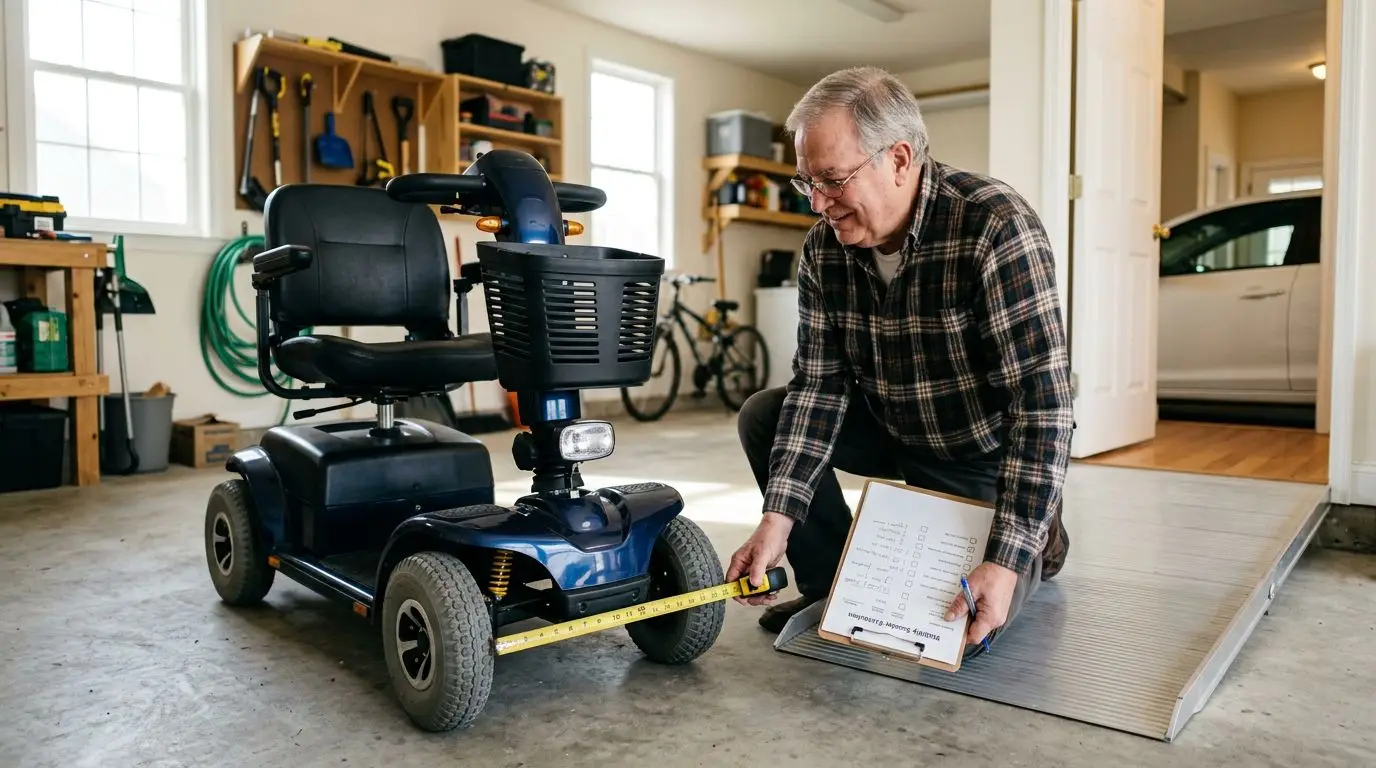
A good heavy-duty scooter purchase starts with measurements, not guesswork. Set aside 30 minutes with a tape measure, a notepad, and your most common travel route in mind.
- Calculate total load. Add rider weight, clothing, accessories, and a realistic 10 to 20 lb for carried items.
- Measure seated hip width. Add 1 to 2 inches for comfort and armrest clearance.
- Measure leg position. Confirm foot deck length and knee space, especially for taller riders.
- Measure doorways. Use the clear opening, including trim and door swing.
- Measure turning spaces. Check hallways, bedrooms, elevators, and storage areas.
- Map your route. Note hills, curb cuts, gravel, rough sidewalks, and trip distance in miles.
- Check transport ratings. Compare scooter weight with lift, ramp, carrier, and vehicle limits.
When comparing specifications, prioritize fit and safety before convenience extras. A cup holder is nice. A seat that is 3 inches too narrow is a daily problem.
| Feature | Why it matters | Better question to ask |
|---|---|---|
| Weight capacity | Protects frame, motor, tires, and brakes from overload | Does the rating exceed my real total load by a useful margin? |
| Seat width | Affects comfort and transfers | What is the usable width between armrests? |
| Range | Determines practical trip distance | Will it cover 1.5 to 2 times my normal round trip? |
| Turning radius | Controls indoor maneuverability | Can it turn in my narrowest space? |
| Total weight | Affects transport and storage | Can my lift, carrier, or ramp handle the scooter safely? |
Common buying mistakes: a 500 lb rating is not enough by itself
The biggest mistake is buying by capacity alone. A 500 lb rating may sound reassuring, but it does not tell you the seat width, turning radius, ramp performance, or whether the scooter fits through your front door. Specifications work together.
Another mistake is assuming advertised range is guaranteed. Range can drop with rider weight, slopes, cold weather, frequent stops, and aging batteries. If you regularly travel 8 miles, shopping for a scooter advertised at only 8 to 10 miles of range leaves little room for real life.
Buyers also underestimate transport challenges. A scooter that weighs 280 lb is not a simple errand companion unless you have the right vehicle setup. If you need something that breaks down for frequent lifting, a full-size heavy-duty scooter may conflict with that goal.
Finally, do not ignore the return policy, warranty terms, service access, and parts availability. Even a well-chosen scooter may need adjustments, batteries, tires, or brake service over time. Know who will help if something goes wrong after delivery.
FAQ: heavy-duty scooter questions answered in 5 quick checks
What weight capacity should I choose if I am near the limit?
Choose a scooter with a comfortable margin above your real total load. Add your body weight, clothing, shoes, and carried items, then look for a rating that is at least 10% to 20% higher when possible.
Are 3-wheel heavy-duty scooters stable enough?
Some 3-wheel scooters offer higher capacities and tighter turning, but 4-wheel scooters usually feel more stable outdoors. If stability is a top concern, test turns, ramps, and uneven pavement before choosing.
How wide should the seat be?
Measure your seated hip width and add 1 to 2 inches. Also check the usable space between armrests, because armrests can make a seat feel narrower than the cushion measurement suggests.
Will a heavy-duty scooter fit in my home?
Only if its width, length, and turning radius match your space. Measure every key doorway, hallway, elevator, and storage area. A 30-inch doorway is much easier than a tight 28-inch opening.
Does a higher weight capacity mean longer range?
No. Higher-capacity scooters may have larger batteries, but they also weigh more and often carry heavier loads. Range depends on battery size, terrain, rider load, tire condition, speed, and temperature.
Can I transport a heavy-duty scooter on a vehicle carrier?
Possibly, but you must verify the scooter weight, carrier rating, hitch rating, and vehicle limits. Include the carrier’s weight and any accessories in the total load calculation.
Frequently asked questions
What weight capacity should I choose if I am close to the scooter’s limit? +
Add your body weight, clothing, shoes, accessories, and typical carried items, then choose a scooter with a practical buffer above that total. A 10% to 20% margin is helpful when available.
How do I know if the seat will be wide enough? +
Sit on a firm chair, measure across the widest point of your hips or thighs, and add 1 to 2 inches. Check the usable width between the armrests, not just the cushion width.
Are heavy-duty mobility scooters good indoors? +
Some can be used indoors, but many are wider and longer than compact scooters. Measure doorways, hallways, turning spaces, elevators, and the charging area before buying.
Why is real-world range often lower than advertised range? +
Range can drop because of higher rider weight, hills, cold weather, frequent stops, rough surfaces, tire condition, and battery age. Plan for more range than your exact round-trip mileage.
Is a 4-wheel scooter always better for higher-weight riders? +
A 4-wheel scooter often feels more stable outdoors, but it may have a wider turning radius. The best choice depends on your route, indoor space, seat fit, and stability needs.
Can one person lift a heavy-duty scooter into a car? +
Usually not safely. Many heavy-duty scooters weigh around 200 to 350 lb, and even removable parts can be heavy. Check ramps, lifts, carriers, and vehicle ratings instead of assuming manual lifting will work.
Related guides
Heavy-Capacity Mobility Scooters: What Higher Weight Ratings Mean for Comfort, Range, and Transport
13 min read
How to Choose a Mobility Scooter: A Practical Buying Guide for Seniors and Adults
13 min read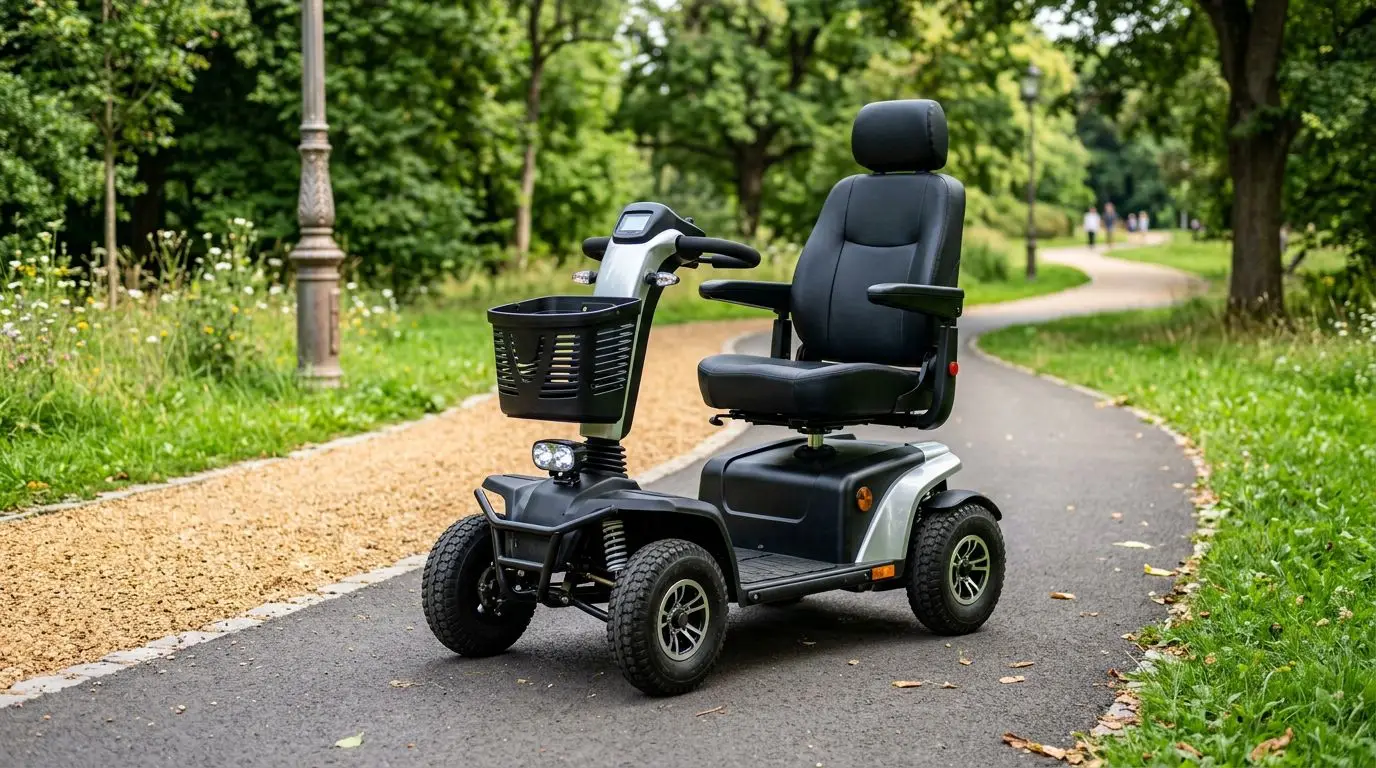
Heavy-Duty and All-Terrain Mobility Scooters: Weight Capacity, Comfort, and Outdoor Performance
15 min read