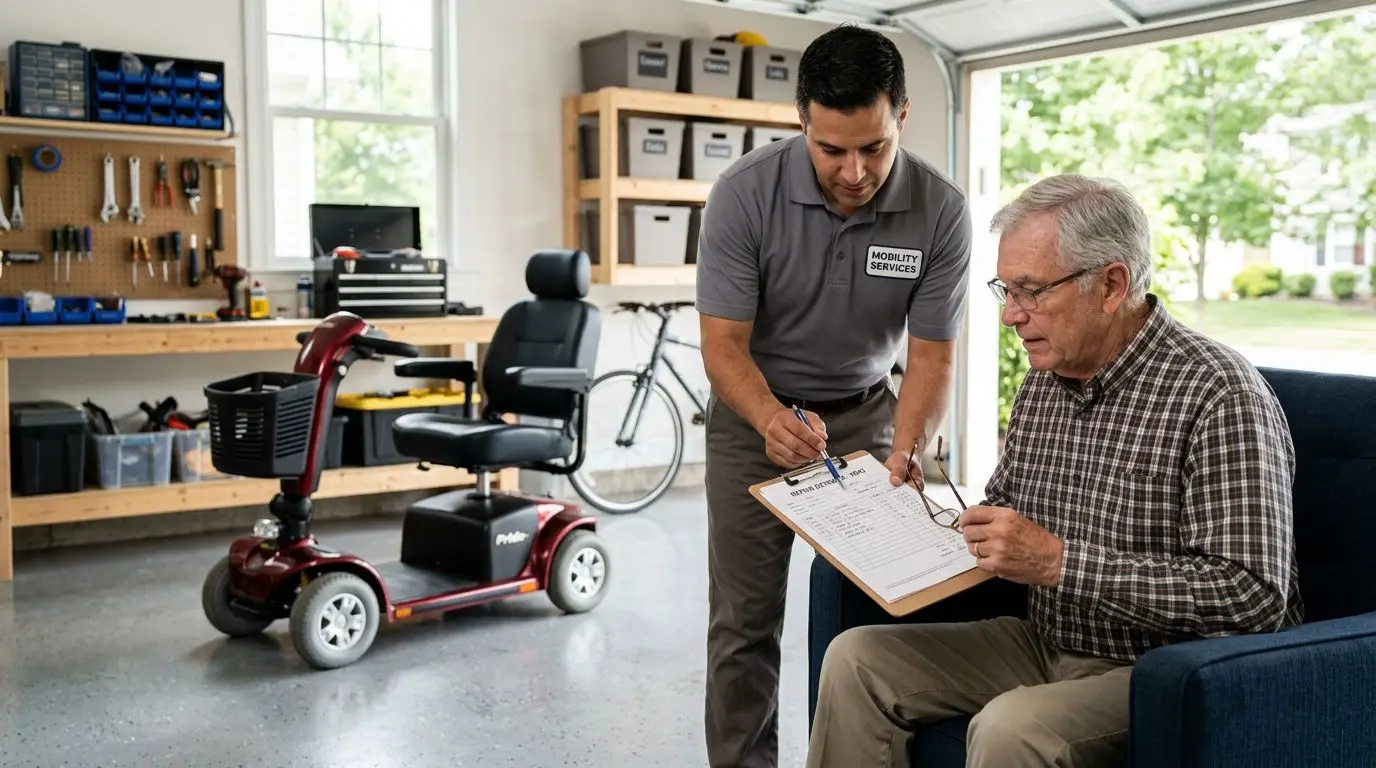
Mobility scooter repair is usually worth it when the fix costs less than about 40% to 50% of a comparable replacement and the scooter is otherwise safe, comfortable, and reliable. In the U.S., many common repairs fall between $100 and $600. Major electrical or drive-system work can climb past $900 once parts, labor, and service-call fees are included. If the scooter is older, needs several repairs, or no longer fits your daily needs, putting the money toward a replacement may be the better long-term choice.
The right decision depends on more than the repair estimate. Battery age, tire condition, frame condition, parts availability, and how much you rely on the scooter each week all matter. This guide walks through common U.S. service-cost scenarios so you can approve repairs with confidence—or know when to step back.
Typical U.S. Mobility Scooter Repair Costs: $75 to $150 Just to Diagnose
Most scooter repair bills begin with a diagnostic fee. In many U.S. areas, an in-shop diagnostic commonly runs about $75 to $150, while a mobile technician visit may add a trip charge of roughly $75 to $200 before repair work begins. Labor is often billed hourly, commonly in the $90 to $160 per hour range, depending on the market and type of service provider.
These are general planning ranges, not guaranteed prices. Urban areas with higher labor costs may be more expensive. Rural areas may have fewer technicians, which can increase travel charges. A simple battery test might be handled quickly, while intermittent electrical problems can take longer because the technician has to reproduce and trace the issue.
A basic estimate usually has four parts: the diagnostic fee, labor, parts, and any trip or pickup fee. Ask whether the diagnostic fee is applied toward the repair if you approve the work. Some shops credit it back; others do not.
| Cost item | Typical U.S. range | What it covers |
|---|---|---|
| Diagnostic fee | $75–$150 | Testing batteries, charger, wiring, controls, brakes, or drive components |
| Shop labor | $90–$160 per hour | Hands-on repair time after diagnosis |
| Mobile service call | $75–$200 | Travel to your home, often separate from labor |
| Pickup and delivery | $50–$200+ | Transporting the scooter to and from a repair location |
Before authorizing work, request a written estimate that separates parts from labor. That one step makes it much easier to compare repair with replacement.
Common Fixes and Price Ranges: Batteries, Tires, Chargers, and Motors
The most common mobility scooter repairs involve batteries, chargers, tires, brakes, controls, and the drive system. Battery replacement might cost around $150 to $600 or more, depending on battery type and size. A major motor or transaxle repair can reach $300 to $900 or higher before labor in some cases.
Batteries are often the first suspect when a scooter loses range, slows down under load, or dies after a short trip. Many scooters use two 12-volt batteries wired together for a 24-volt system, though capacity can vary widely. Smaller travel scooters may use compact batteries, while larger scooters often need higher-capacity units that cost more.
Tire repairs vary as well. Pneumatic tires may need tubes, valve stems, or tire replacement. Solid tires avoid flats but can be more labor-intensive to install because they are stiff and must be pressed or worked onto the wheel. If a scooter pulls to one side, feels rough, or shows uneven tread wear, the tires and wheel assemblies deserve a close look.
| Repair type | Typical parts and labor scenario | Repair decision note |
|---|---|---|
| Battery replacement | $150–$600+ | Often worth it if the scooter is otherwise reliable and batteries are 2–4 years old |
| Charger replacement | $60–$200+ | Worth checking before replacing batteries; a weak charger can mimic bad batteries |
| Tire or tube repair | $40–$200 per wheel | Usually worth it unless wheel, rim, or suspension damage is also present |
| Brake adjustment or repair | $100–$350 | Safety-related; do not delay if stopping distance has increased |
| Throttle, tiller, or wiring issue | $120–$500+ | Depends heavily on diagnostic time and parts availability |
| Controller or control module | $200–$700+ | Compare carefully if the scooter is older or has multiple electrical issues |
| Motor or transaxle | $300–$900+ | Often a borderline repair on older scooters |
Do not assume the most expensive part has failed. A scooter that will not move could have a loose freewheel lever, dead batteries, corroded terminals, a blown fuse, a failed charger, a throttle fault, or a controller issue. A good diagnostic process helps prevent unnecessary parts replacement.
Service Fees: In-Shop, Mobile Repair, and Pickup Can Differ by $200 or More
Where the scooter is repaired can change the final bill by $200 or more. In-shop service may have a lower diagnostic fee, but you may need transportation. Mobile repair is convenient, especially for a scooter that will not move, though the trip fee can make a small repair feel expensive.
In-shop repair works best when the scooter can be transported safely in a vehicle or by a local medical equipment service provider. It gives the technician access to lifts, tools, chargers, test equipment, and parts storage. That can reduce labor time on complicated repairs.
Mobile repair is useful when the scooter is your primary way to move around at home or in the community. The technician comes to you, tests the scooter, and may be able to complete common fixes on-site. The limitation is parts availability. If a special tire, controller, harness, or motor is needed, a second visit may be required.
- Ask about minimum labor. Some providers bill a 1-hour minimum even if the repair takes 20 minutes.
- Ask whether travel is charged one way or round trip. That matters if you live 30 miles from the technician.
- Ask about return visits. If a part must be ordered, confirm whether you will pay a second trip charge.
- Ask for warranty terms. A 30- to 90-day labor warranty is common for many local repairs, but policies vary.
If you are comparing two estimates, make sure both include the same service method. A $180 in-shop repair may not be cheaper than a $260 mobile repair if you must pay separately to transport the scooter.
When Repair Is Worth It: Use the 40% to 50% Rule
A practical rule is to consider repair when the total bill is less than 40% to 50% of the cost of a similar replacement scooter. For example, if a comparable replacement would cost about $1,600, a $300 battery repair is usually reasonable, while a $900 motor-and-controller repair deserves closer review.
This rule is not perfect, but it keeps emotion from driving the decision. Many owners like their current scooter because it fits the doorway, loads into the vehicle, or feels familiar. That has value. Still, repeated repairs can quietly exceed replacement cost within a year.
Repair is more likely worth it when the scooter is structurally sound, has no frame damage, has batteries that are the only major problem, and still meets your daily range and comfort needs. It is less attractive when the scooter has corrosion, multiple electrical faults, worn tires, weak brakes, and seating that no longer supports you comfortably.
| Scenario | Repair usually makes sense? | Why |
|---|---|---|
| 2-year-old scooter needs batteries | Often yes | Batteries are a normal wear item, and the rest of the scooter may have years left |
| 6-year-old scooter needs batteries and tires | Maybe | Compare the combined cost with range, comfort, and parts availability |
| Older scooter needs controller and motor work | Often questionable | High parts cost plus labor can approach replacement value |
| Scooter has frame damage after a crash | Often no | Safety and alignment concerns may remain after repair |
| Scooter no longer fits your health or home needs | Often no | A repaired scooter still may not solve the real problem |
Also consider downtime. If parts take 2 to 4 weeks to arrive and the scooter is essential for appointments or daily errands, replacement or a temporary rental may be more practical.
How to Choose: 7 Checks Before You Approve a Repair
Before approving any repair over about $250, take 10 minutes to gather details. A clear estimate protects you from surprise charges and helps you decide whether the scooter is still a good match.
1. Check the scooter’s age and repair history
If this is the first meaningful repair in several years, fixing it may be sensible. If you have paid for 3 repairs in 12 months, step back and total the spending. Frequent small bills can point to broader wear.
2. Confirm battery age
Many scooter batteries last about 2 to 4 years, depending on use, storage, charging habits, temperature, and battery chemistry. If the batteries are old, replacement may be normal maintenance. If new batteries keep failing, the charger or electrical system needs attention.
3. Ask whether parts are readily available
A repair that takes 3 days is very different from one that takes 3 weeks. If parts are no longer easy to source, future repairs may be harder and more expensive.
4. Measure the real replacement requirement
If you are considering replacement, measure what the scooter must do. Note your tightest doorway in inches, the space in your vehicle, your typical daily travel distance, the steepest ramp you use, and the seat width that feels safe and comfortable. A repair may be cheap, but replacement may be justified if your current scooter barely fits your life.
5. Get the estimate in writing
The estimate should list diagnostic fees, hourly labor, parts, taxes, trip charges, pickup fees, and warranty terms. If the technician cannot guarantee the diagnosis, ask what happens if the first repair does not solve the problem.
6. Prioritize safety items
Brakes, tires, steering, throttle response, and seating stability are not optional. A scooter that hesitates, surges, or takes longer to stop should be inspected before regular use.
7. Consider your backup plan
If you depend on the scooter every day, a 1-week delay may be unacceptable. Ask whether the shop offers loaners, rentals, or staged repairs so you are not left without mobility support.
Who Repair Is Best For: 3 Owner Situations
Repair is not automatically the budget choice, but it is often the right move for 3 types of owners: those with newer scooters, those facing normal wear-item replacement, and those whose current scooter fits their home and vehicle especially well.
Owners of newer scooters. If the scooter is only a few years old and has one clear problem, repair often preserves value. Batteries, tires, armrest pads, and chargers are wear items. Replacing them does not mean the scooter is worn out.
Owners with a good fit. Sometimes the best scooter is the one that already works in your home. If it clears a 30-inch doorway, turns well in your kitchen, fits on your lift, and supports your usual errands, repairing it may be more practical than starting over.
Owners with predictable needs. If your routine is stable—short trips, familiar surfaces, moderate use—a straightforward repair can be enough. You may not need a different scooter type unless your range, terrain, transport, or comfort needs have changed.
Replacement may be better for owners whose needs have changed significantly. If you now need more seat support, a higher weight capacity, better outdoor stability, longer range, or easier transport, paying to repair a poor-fit scooter may only delay the necessary decision.
Repair vs. Replacement: A 2-Year Cost View
Looking only at today’s invoice can be misleading. A 2-year view gives a better picture, especially if your repair estimate is $500 or more. The goal is not to buy new every time something breaks; it is to avoid spending heavily on a scooter that is likely to keep needing work.
| Decision factor | Repair favors this | Replacement favors this |
|---|---|---|
| Current estimate | Under 40% of replacement cost | Over 50% of replacement cost |
| Age | Newer or lightly used | Older with repeated failures |
| Battery condition | Only batteries are worn | Batteries plus controller, motor, or wiring issues |
| Comfort and fit | Seat, controls, and size still work well | Pain, poor posture, tight fit, or difficult transfers |
| Parts availability | Parts available within days | Parts delayed weeks or hard to source |
| Use level | Occasional or moderate use | Daily essential transportation with no backup |
Here is a simple example. Suppose a scooter needs $425 in batteries and labor, and it has had no other issues. Repair is likely reasonable. Now suppose the same scooter also needs two tires, a brake repair, and intermittent controller diagnosis, bringing the likely total near $1,100. At that point, replacement deserves serious consideration, especially if the scooter is older or parts are slow to obtain.
Do not forget accessories and setup. If replacement would require a new vehicle lift, ramp, basket, weather cover, or home storage change, the true replacement cost may be higher than the scooter alone.
How to Reduce Repair Costs: 30-Day Habits That Help
A few simple habits can reduce service calls and extend component life. Spend 5 minutes each week and about 30 minutes once a month checking the basics: charging, tires, fasteners, and cleanliness.
- Charge consistently. Follow the battery and charger instructions. Avoid leaving batteries deeply discharged for long periods.
- Store the scooter dry. Moisture can corrode terminals, connectors, and metal hardware. A dry indoor location is best when available.
- Check tire pressure if you have pneumatic tires. Low pressure reduces range and can damage tubes or sidewalls.
- Keep the battery terminals clean. Corrosion can cause weak performance and charging problems.
- Listen for changes. Grinding, clicking, squeaking, or sudden vibration should be checked early.
- Do not exceed the rated weight capacity. Extra load strains batteries, motors, brakes, tires, and frames.
- Use ramps within safe limits. Steep slopes increase heat and stress on the drive system.
Keep a small maintenance note in a drawer or on your phone. Record battery dates, tire repairs, service calls, and charger issues. When a problem appears, that history helps the technician diagnose faster, which can save labor time.
Frequently Asked Questions: 5 Repair Cost Questions
How much does it cost to replace mobility scooter batteries?
A typical battery replacement can range from about $150 to $600 or more, depending on battery size, chemistry, access, and labor. Larger scooters usually use larger battery packs, which cost more. Always confirm that the charger has been tested before replacing batteries.
Is mobile scooter repair more expensive than shop repair?
Often, yes. Mobile repair may add a travel fee of roughly $75 to $200, but it can still be worthwhile if transporting the scooter is difficult or unsafe. Ask whether a second trip fee applies if parts must be ordered.
When should I replace my scooter instead of repairing it?
Consider replacement when the repair estimate is over 50% of the cost of a comparable scooter, when parts are hard to get, when the frame is damaged, or when the scooter no longer fits your daily needs. Multiple repairs within 12 months are another warning sign.
Why does my scooter lose power even after charging?
Common causes include aging batteries, a weak charger, loose or corroded battery connections, underinflated tires, heavy loads, cold temperatures, or an electrical fault. A technician can load-test the batteries and check the charging system.
Are brakes and tires worth repairing?
Usually, yes. Brakes and tires are safety-related and are often less expensive than major electrical or motor repairs. If brake or tire problems are combined with frame damage or several other failures, compare the total repair cost with replacement.
Repair decisions are easier when you look at the whole picture: today’s estimate, the scooter’s age, your daily needs, and the likelihood of more repairs soon. A fair repair can keep a well-fitting scooter useful for years. A high repair bill on an older, unreliable, or poor-fit scooter may be a sign to put the money toward something that better supports safe everyday mobility.
Frequently asked questions
How much does it cost to replace mobility scooter batteries? +
A typical battery replacement can range from about $150 to $600 or more, depending on battery size, chemistry, access, and labor. Have the charger tested too, because a weak charger can mimic bad batteries.
Is mobile mobility scooter repair more expensive than in-shop repair? +
Mobile repair often costs more because it may include a travel fee of roughly $75 to $200 in addition to labor and parts. It can still be practical if the scooter cannot be safely transported.
When is a mobility scooter not worth repairing? +
Replacement is worth considering when the repair is over 50% of the cost of a comparable scooter, parts are hard to get, the frame is damaged, or the scooter no longer fits your needs.
What are the most common mobility scooter repairs? +
Common repairs include battery replacement, charger replacement, tire or tube repair, brake service, throttle or tiller wiring fixes, controller replacement, and motor or transaxle work.
Why does my scooter lose power after a full charge? +
Possible causes include aging batteries, a faulty charger, corroded terminals, loose connections, low tire pressure, heavy loads, cold weather, or an electrical fault. A load test can help identify the issue.
Related guides
Where to Get Mobility Scooter Repairs Near You: Local Shops, In-Home Service, and What to Ask
14 min read
The Total Cost of Owning a Mobility Scooter: Batteries, Repairs, Accessories, Transport, and Maintenance
15 min read
Mobility Scooter Motor Problems: Warning Signs, Common Causes, and Repair vs. Replacement Decisions
17 min read