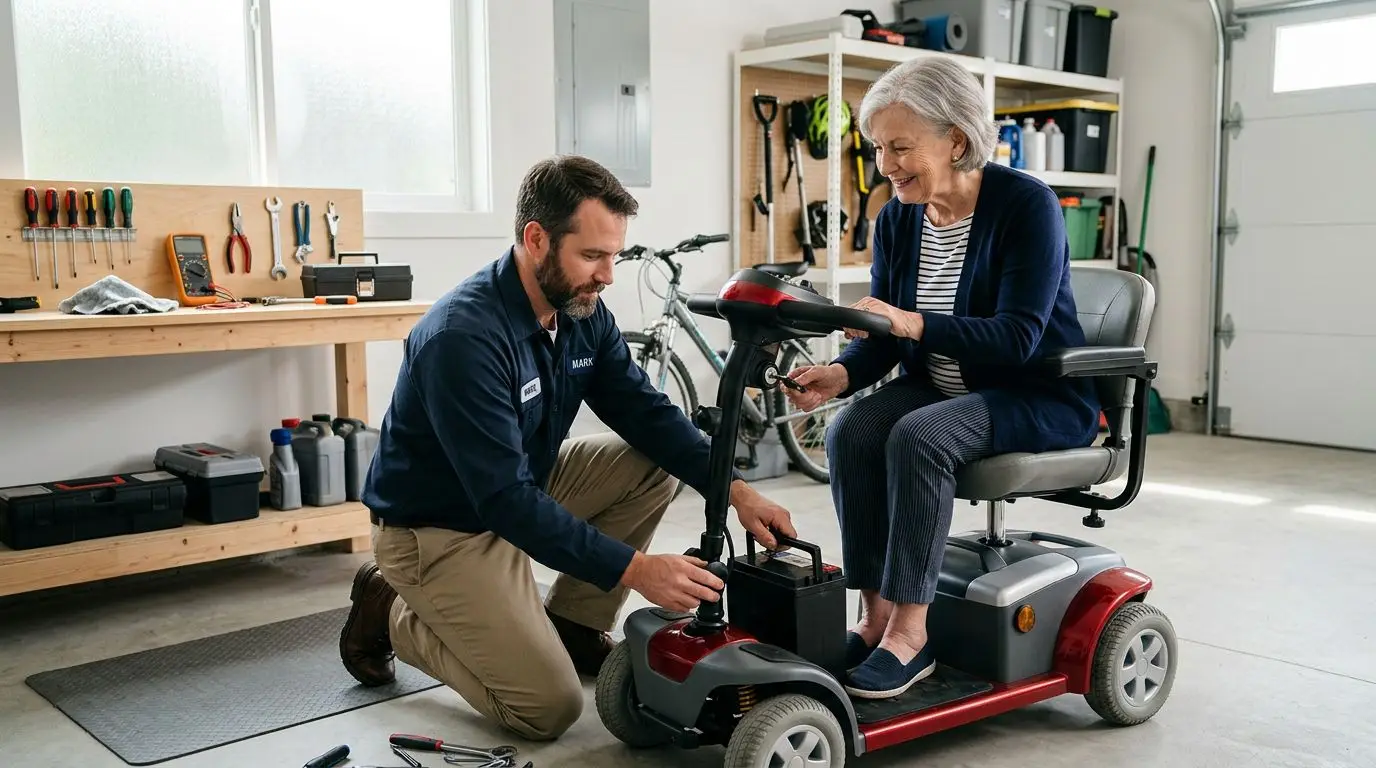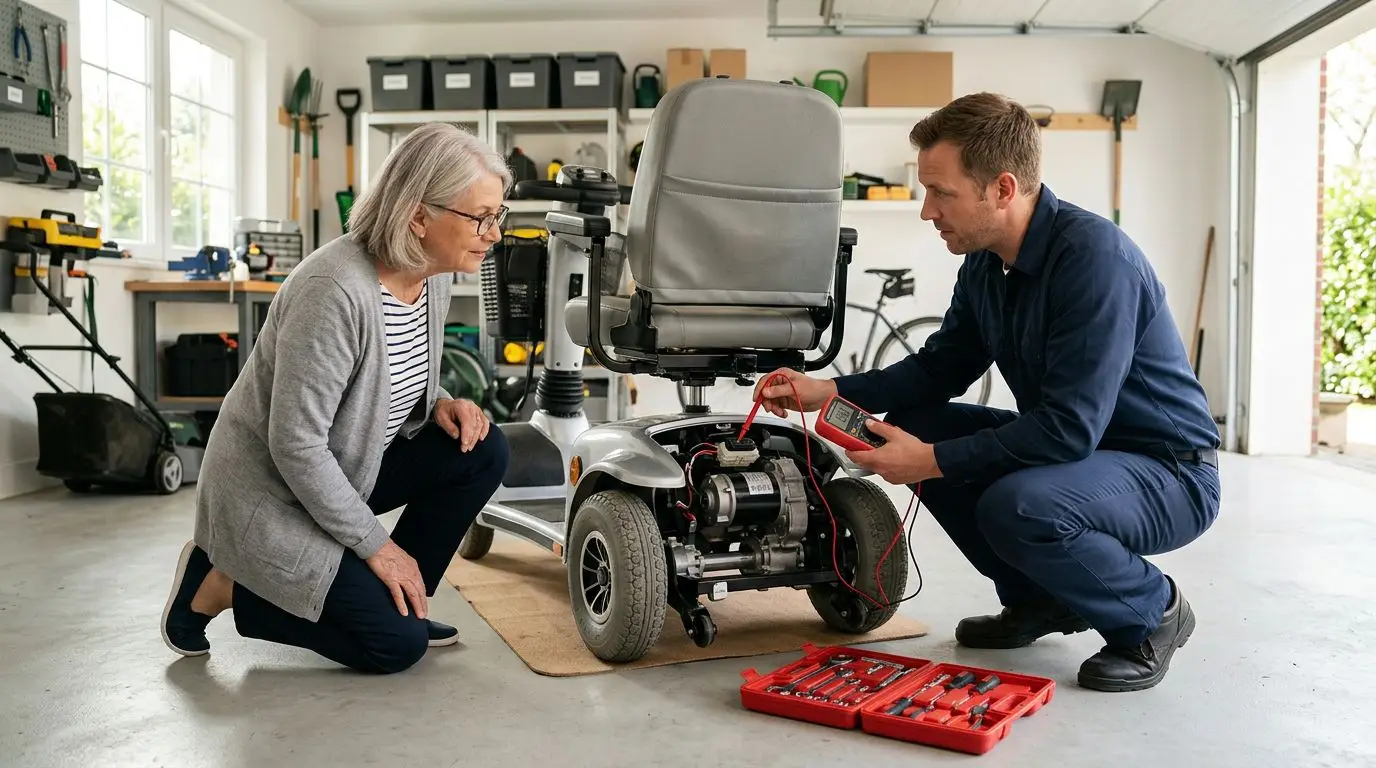
Mobility scooter motor problems often appear as loss of power, unusual noises, burning smells, jerky movement, overheating, or a scooter that will not move even with a charged battery. The safest next step is to stop riding, check simple items such as the freewheel lever, battery connections, and visible wiring, then have a qualified technician test the motor, controller, and brake before replacing parts.
Not every scooter that feels weak has a bad motor. Battery voltage, worn tires, loose connectors, brake drag, overloaded weight, steep hills, and controller faults can all imitate motor failure. This guide covers the warning signs, common causes, basic checks you can do safely, and how to choose between repair, motor replacement, or replacing the scooter.
6 warning signs your mobility scooter motor needs attention
A healthy scooter motor should accelerate smoothly, hold a steady speed, and sound consistent during normal use. If your scooter’s behavior changes over 1 or 2 rides, take it seriously. Motor and electrical problems usually get worse when they are ignored.
Watch for these common warning signs:
- Slow acceleration: The scooter hesitates, crawls, or takes several seconds longer than usual to reach speed.
- Loss of power on small inclines: A slope you handled last week now causes bogging down or stopping.
- Jerky movement: The scooter surges, cuts out, or pulses when you press the throttle.
- Grinding, clicking, or whining: New mechanical sounds can point to motor bearings, gears, brake parts, or drivetrain wear.
- Burning smell or excessive heat: A hot motor, melted-plastic odor, or smoke means stop using the scooter right away.
- No movement: The lights may turn on, but the scooter does not drive when the throttle is engaged.
One brief hesitation can come from a bump, a loose plug, or a low battery. Repeated symptoms are different. If the same issue happens 3 or more times in a short period, park the scooter until you can check it or arrange service.
Pay attention to error beeps or flashing lights too. Many scooters use a sequence of beeps or flashes to indicate a fault, such as a brake issue, throttle fault, low battery voltage, controller problem, or motor connection problem. The exact meaning varies by scooter, so check the owner’s manual if you have it.
Motor problem or battery problem? 5 clues that help separate them
Many riders assume a weak scooter has a bad motor, but batteries are often the first suspect. A motor needs stable voltage and current. If the battery pack sags under load, the scooter may feel as if the motor is failing even when the motor itself is fine.
| Symptom | More likely battery-related | More likely motor or drivetrain-related |
|---|---|---|
| Power fades during the ride | Yes, especially after 10–20 minutes of use | Possible if heat builds up in the motor |
| Scooter will not move but lights work | Possible if voltage drops under load | Possible motor, brake, controller, or wiring fault |
| Grinding or scraping noise | Unlikely | More likely motor, gearbox, brake, bearing, or wheel issue |
| Range has slowly dropped over months | Common with aging batteries | Less likely unless there is drag or overheating |
| Burning smell near rear axle or motor | Possible wiring issue | Urgent motor, controller, brake, or wiring concern |
For example, if a scooter drives normally for the first mile and then slows dramatically on a gentle ramp, the battery pack may be sagging. If it makes a harsh grinding noise from the first few feet of movement, the motor, brake, gearbox, or wheel assembly needs closer attention.
Battery age matters. Many sealed lead-acid mobility scooter batteries lose useful capacity after about 18–36 months, depending on use, charging habits, storage temperature, and depth of discharge. Lithium packs may last longer in many applications, but they still require proper charging and protection circuitry. A technician can load-test the battery pack instead of guessing.
8 common causes of mobility scooter motor problems
Motor trouble usually comes from heat, electrical resistance, moisture, wear, overloading, or a fault in a related component. The motor is part of a system. Replacing it without checking that system can waste money.
- Loose or corroded connections: A connector that is only partly seated can cause intermittent cutting out, arcing, heat, or reduced power.
- Weak batteries: Low voltage under load forces the electrical system to work harder and may trigger controller shutoff.
- Controller faults: The controller regulates power to the motor. If it fails, the motor may not receive the right signal.
- Electromagnetic brake problems: Many scooters use a brake mounted near the motor. If it does not release fully, the scooter may feel weak or may overheat.
- Worn brushes in brushed motors: Some scooter motors use carbon brushes that wear over time, creating poor contact and inconsistent power.
- Worn bearings or gearbox parts: Increased friction can make the motor noisier and less efficient.
- Water exposure: Riding through standing water, heavy rain, or wet grass can allow moisture into connectors, brakes, or motor housings.
- Overloading and steep grades: Carrying weight beyond the scooter’s rating or climbing long hills can overheat the drivetrain.
Weight capacity is not a suggestion. If a scooter is rated for 300 lb, that rating includes the rider and carried items, and it assumes the scooter is used within its intended conditions. A basket loaded with groceries, oxygen equipment, or tools can add 10–30 lb without much thought.
Tire condition also affects the motor. Underinflated pneumatic tires create extra rolling resistance, while damaged solid tires can create vibration. If your scooter uses air-filled tires, check the sidewall pressure recommendation and keep both drive tires even. A difference of just a few PSI can make the scooter pull or work harder.
7 safe checks you can do before calling for repair
You can perform a few basic checks without opening the motor, bypassing safety devices, or handling high-current wiring. These steps take about 10–15 minutes and may reveal a simple issue.
- Turn the scooter off and remove the key: Do this before touching wiring, wheels, or the freewheel lever.
- Confirm the freewheel lever is in drive mode: If the scooter is in manual push mode, many scooters will beep or refuse to drive.
- Charge fully: Use the correct charger and let the pack reach a full charge before testing performance.
- Inspect visible wiring: Look for loose plugs, pinched wires, corrosion, melted insulation, or moisture under the shroud.
- Check for wheel obstruction: Remove string, plastic, carpet fibers, or debris wrapped near the axle or drive wheels.
- Listen during a short, level test: On a flat surface, move forward and backward at low speed for 10–20 feet while listening for grinding or clicking.
- Note the error pattern: Count beeps or flashes before turning the scooter off, then compare with the manual if available.
Stop immediately if you smell burning, see smoke, notice melted plastic, or feel the motor housing becoming unusually hot after a short test. Heat is one of the clearest signs that a scooter should not be ridden until it is inspected.
Do not lift the scooter and run the drive wheels at high speed unless the manual specifically gives that procedure and you can do it safely. A spinning drive wheel can catch clothing or fingers. It can also make a scooter unstable if it is not properly supported.
4 diagnostics a qualified technician may perform
A trained mobility equipment technician can test the scooter as a whole system instead of guessing by symptom alone. That matters because the motor, controller, battery, brake, throttle, wiring harness, and charger all affect drive performance.
| Diagnostic check | What it can reveal | Why it matters |
|---|---|---|
| Battery load test | Voltage drop under real demand | Identifies weak batteries that still show charged at rest |
| Motor resistance and continuity check | Open circuits, shorts, or abnormal readings | Helps confirm whether the motor windings are healthy |
| Brake release test | Brake drag or failure to disengage | A dragging brake can mimic a weak motor and create heat |
| Controller output test | Power delivery and fault codes | Prevents replacing a good motor when the controller is the issue |
Testing may also include inspecting the throttle pot or wig-wag lever, checking charger output, looking for water intrusion, and measuring current draw while the scooter is under load. These are not difficult tasks for a trained person with the right meter and service information, but they are easy to misread without experience.
If your scooter is still under warranty, avoid opening sealed components or cutting wires. Unauthorized work can make a warranty claim harder. Keep notes: date of the problem, battery charge level, surface type, rider weight range, error code, and whether the issue happened going forward, reverse, uphill, or after a certain ride time.
Repair vs. replacement: 6 decision factors that matter
The right decision depends on scooter age, overall condition, parts availability, total repair cost, safety, and whether the scooter still fits your daily mobility needs. A motor replacement can make sense on a well-kept scooter, but it may not be wise on a heavily worn unit with several aging systems.
| Decision factor | Repair may make sense when... | Replacement may make sense when... |
|---|---|---|
| Scooter age | The scooter is only a few years old and otherwise reliable | The scooter has many years of heavy use and repeated failures |
| Battery condition | Batteries test strong under load | Batteries, charger, and motor-related parts all need work |
| Frame and drivetrain | No cracks, corrosion, bent forks, or axle damage | There is structural damage or severe rust |
| Parts availability | Compatible parts are available through proper service channels | Critical electrical parts are discontinued or uncertain |
| Use pattern | Your routes are level and within the scooter’s rating | You now need more range, stability, or weight capacity |
| Safety confidence | A technician can verify the repair and test drive it | The scooter still cuts out, overheats, or brakes inconsistently |
A practical rule: if one isolated part failed and the scooter otherwise fits you, repair is worth considering. If the motor problem is one item in a longer list — worn batteries, damaged seat post, unreliable brakes, cracked tires, loose tiller, and electrical faults — replacing the scooter may be safer and more dependable.
Do not base the decision only on whether the lights turn on. Drive safety depends on controlled acceleration, predictable braking, stable steering, and enough reserve power to get home. A scooter that runs for 5 minutes in the driveway but cuts out at a curb ramp is not reliable transportation.
3 motor types and what they mean for maintenance
Mobility scooters commonly use electric drive motors paired with gear reduction and an electromagnetic brake. The exact design varies, but understanding the broad motor type helps you ask better repair questions.
| Motor or drive type | Typical maintenance concern | What users may notice |
|---|---|---|
| Brushed DC motor | Brush wear, commutator wear, dust buildup, bearing wear | Intermittent power, reduced torque, sparking smell, uneven running |
| Brushless motor | Sensor, controller, wiring, or bearing issues | Fault codes, no movement, pulsing, or sudden cutout |
| Geared transaxle drive | Gear wear, brake drag, bearing noise, seal issues | Grinding, whining, heat, or loss of hill-climbing ability |
Some compact travel scooters have smaller motors designed for short trips, indoor use, sidewalks, and level surfaces. Larger outdoor scooters may use heavier-duty drive systems intended for longer rides and rougher surfaces. Bigger is not automatically better; the right match depends on your environment, storage space, transport needs, and the scooter’s rated capacity.
Ask the technician what failed and why. If a motor burned out because a brake was dragging, replacing only the motor may lead to the same problem again. If water damaged a connector, the repair should include finding the entry point and protecting the connection, not just clearing the fault code.
5 situations where you should not modify the motor
Motor upgrades can be tempting when a scooter feels slow, but modifying speed, controller output, voltage, gearing, or wiring can create serious safety and reliability problems. Mobility scooters are designed as complete systems, not just as a motor on wheels.
- To go faster than the original design: Brakes, tires, steering geometry, and stability may not be rated for higher speeds.
- To exceed weight capacity: More motor power does not strengthen the frame, seat post, suspension, wheel bearings, or brakes.
- To climb steeper hills than rated: Extra power can create overheating, brake stress, and rollback risk.
- To mix unknown batteries and controllers: Incorrect voltage or current handling can damage electronics or create a fire risk.
- To bypass safety features: Disabling freewheel sensors, brake circuits, or speed limits can make the scooter unsafe.
Many mobility scooters are built around common system voltages such as 24 volts, but that does not mean components are interchangeable. Connectors, brake timing, controller programming, current limits, wiring gauge, and thermal protection must all match. A part that physically plugs in may still be electrically wrong.
If you need more hill-climbing ability, more range, or better outdoor stability, the safer path is usually choosing a scooter type designed for that use. That may mean a higher weight rating, larger tires, better suspension, a longer wheelbase, or a drive system intended for outdoor routes. It should not mean bypassing the protections on a scooter that was never built for that workload.
Who motor repair is best for: 4 user scenarios
Repair is often the right choice when the scooter has one clear fault and still matches your body size, home layout, vehicle transport method, and daily routes. It is less appealing when your needs have changed.
- Best for a newer scooter with one problem: If the scooter is otherwise clean, stable, and reliable, diagnosing and repairing the motor system may restore normal use.
- Best for users with consistent routes: If you mainly ride indoors, in a retirement community, or on level sidewalks, repairing the current scooter may be practical.
- Best when batteries test good: A motor or brake repair makes more sense when the battery pack, charger, tires, and frame are in good condition.
- Best when service records are clear: If you know how the scooter has been stored and maintained, decisions are easier.
Replacement is worth considering if you now travel farther, encounter steeper ramps, carry more items, or feel less stable than you used to. A scooter that was perfect for 1 building may not be the right fit for a neighborhood route with curb cuts, rough pavement, and longer distances.
Safety comes first. If you do not feel confident that the scooter will start, stop, and steer predictably, do not keep riding it while hoping the problem clears up.
How to measure your needs before replacing a motor or scooter: 10 numbers to record
Before approving a motor replacement or shopping for a different scooter type, write down the numbers that describe your real use. Good measurements help prevent overbuying, underbuying, and unsafe modifications.
- Your combined load: Rider weight plus regular cargo, bags, baskets, and accessories.
- Longest daily trip: Estimate miles or minutes between charges.
- Typical slope: Note ramps, driveways, and hills that cause trouble.
- Doorway width: Many interior doors are about 30–36 inches wide, but measure your actual narrowest point.
- Turning space: Measure hallways, kitchens, elevators, and bathroom approaches.
- Storage area: Record length, width, and available charging outlet location.
- Transport limit: If lifting into a vehicle, know the heaviest piece you or a caregiver can safely lift.
- Surface type: Carpet, tile, sidewalks, gravel, grass, curb cuts, and ramps all affect motor load.
- Battery charging time: Note whether the scooter sits on the charger overnight or only for short periods.
- Service access: Consider whether local repair help is available within a reasonable distance.
For example, a scooter used for 20 minutes inside a senior apartment has very different motor demands than one used for 3 miles outdoors with groceries. Both uses are valid. They simply call for different priorities.
If you are repairing, share these numbers with the technician. If the motor failed because the scooter was consistently used near or beyond its limits, a replacement motor alone may not solve the underlying mismatch.
Preventing motor problems with a 15-minute monthly routine
Most motor problems cannot be prevented forever, but regular checks can reduce avoidable failures. A short monthly routine is enough for many users, with extra checks after rain, storage, travel, or rough outdoor use.
- Charge correctly: Use the correct charger and avoid leaving batteries deeply discharged for long periods.
- Inspect cables: Look for loose, crushed, corroded, or wet connectors.
- Check tires: Keep pneumatic tires at the recommended pressure and inspect solid tires for chunks or flat spots.
- Clean around wheels: Remove hair, string, leaves, and debris from axles and wheel areas.
- Listen during the first minute: New noises often appear before complete failure.
- Avoid standing water: Do not drive through puddles deep enough to reach the motor, brake, or wiring.
- Respect rest time: If the scooter smells hot after a hill or long ride, let it cool and investigate why.
Storage matters too. A dry, moderate-temperature location is better for electrical parts and batteries than a damp shed or a very hot garage. If the scooter will sit unused for several weeks, follow the battery storage instructions in the manual.
Keep a small log. Write down battery age, repairs, unusual noises, and when symptoms started. A 30-second note can save hours of guessing later.
When to stop riding immediately: 7 safety red flags
Some symptoms are not wait-and-see issues. Stop using the scooter and arrange service if you notice any of these red flags:
- Burning smell, smoke, or melted plastic
- Motor or brake area too hot to touch after a short ride
- Scooter moves without predictable throttle control
- Scooter fails to stop normally
- Repeated sudden cutouts in traffic areas, crosswalks, or ramps
- Grinding with vibration from the drive wheel or rear axle
- Visible damaged wiring, sparks, or battery leakage
If the scooter stops away from home, put it in a safe location, turn it off, and use assistance rather than trying to force it to drive. Many scooters have a freewheel mode for pushing, but the scooter should not be pushed downhill without control because the brake may be disengaged.
Do not ignore brake-related symptoms. The motor gets the scooter moving, but the brake system helps keep it controlled. Both must work correctly for safe use.
FAQ: 5 common questions about mobility scooter motor problems
How do I know if my mobility scooter motor is bad?
Common signs include loss of power, jerky acceleration, grinding or whining noises, overheating, burning smells, and no movement even when the battery is charged. A technician should test the battery, brake, controller, wiring, and motor before confirming the motor is bad.
Can weak batteries make the motor seem bad?
Yes. Weak batteries can show a charge at rest but drop voltage when the motor needs power. That can cause slow acceleration, short range, cutouts, or poor hill performance.
Is it safe to keep riding if the scooter motor makes noise?
A minor sound change should be checked soon, and grinding, scraping, clicking with vibration, heat, or burning smell means stop riding. Noise can come from the motor, gearbox, brake, bearing, or wheel area.
Can I upgrade my mobility scooter motor for more speed?
It is usually not recommended. Higher speed can exceed the scooter’s brake, tire, controller, stability, and frame design limits. If you need different performance, choose a scooter type designed for that use rather than modifying safety-critical systems.
When is motor replacement worth it?
Motor replacement may be worth it when the scooter is otherwise in good condition, parts are compatible and available, batteries test well, and the scooter still fits your daily needs. If multiple major systems are worn or the scooter no longer matches your routes, replacement may be safer.
Frequently asked questions
How do I know if my mobility scooter motor is bad? +
Common signs include loss of power, jerky acceleration, grinding or whining noises, overheating, burning smells, and no movement even when the battery is charged. A technician should test the battery, brake, controller, wiring, and motor before confirming the motor is bad.
Can weak batteries make the motor seem bad? +
Yes. Weak batteries can show a charge at rest but drop voltage when the motor needs power. That can cause slow acceleration, short range, cutouts, or poor hill performance.
Is it safe to keep riding if the scooter motor makes noise? +
A minor sound change should be checked soon. Grinding, scraping, clicking with vibration, heat, or a burning smell means stop riding and arrange service.
Can I upgrade my mobility scooter motor for more speed? +
It is usually not recommended. Higher speed can exceed the scooter’s brake, tire, controller, stability, and frame design limits. If you need different performance, choose a scooter type designed for that use.
When is motor replacement worth it? +
Motor replacement may be worth it when the scooter is otherwise in good condition, compatible parts are available, batteries test well, and the scooter still fits your daily needs. If several major systems are worn, replacing the scooter may be safer.
Related guides
Can You Upgrade a Mobility Scooter Motor? Speed, Torque, Controller Compatibility, and Safety Risks
14 min read
Where to Get Mobility Scooter Repairs Near You: Local Shops, In-Home Service, and What to Ask
14 min read
Mobility Scooter Repair Costs: Common Fixes, Service Fees, and When Repair Is Worth It
13 min read