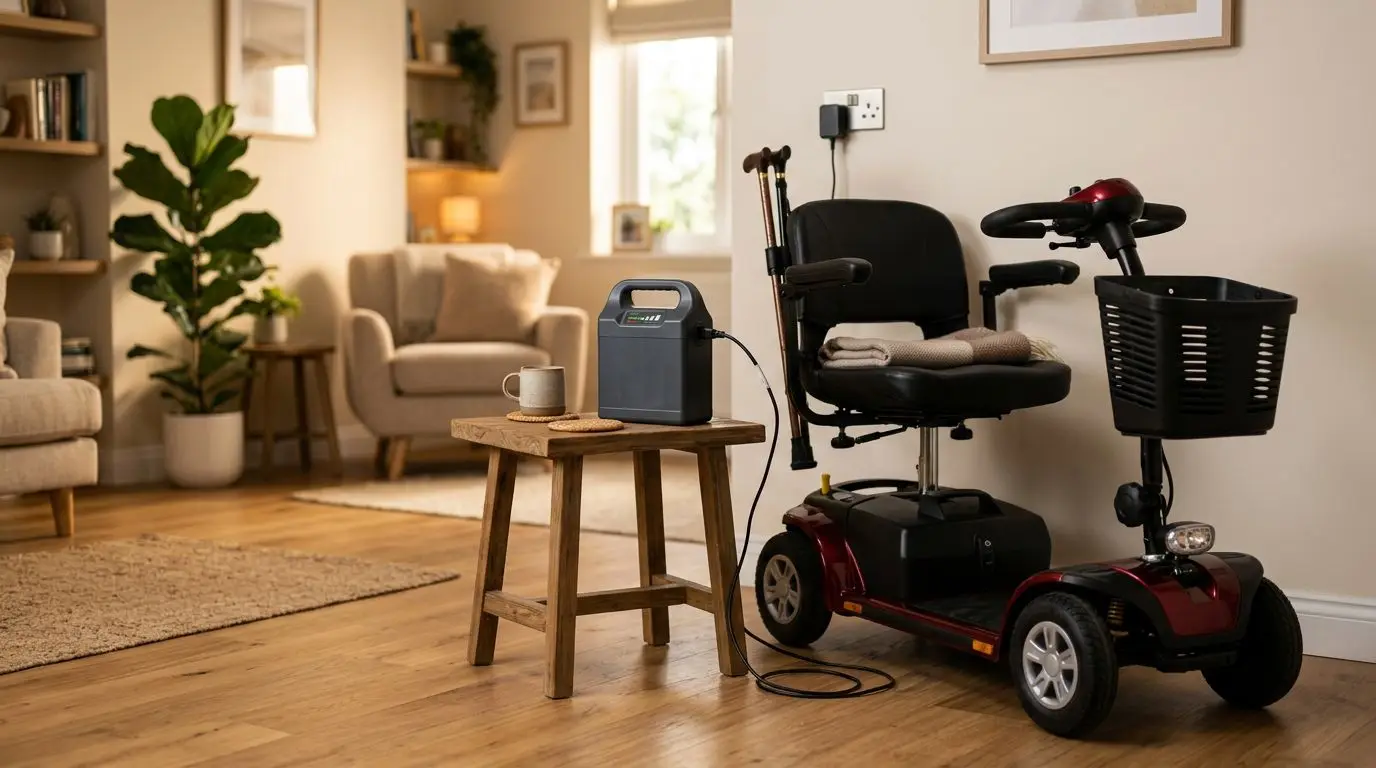
Mobility scooter batteries determine how far you can ride, how often you need to charge, and what you may spend later on replacement. Most scooters use either sealed lead-acid or lithium-ion battery packs, with real-world range often falling between about 6 and 25 miles depending on scooter size, rider weight, terrain, battery age, and speed. The best choice is the battery system that comfortably covers your daily miles, fits your charging routine, and comes with a replacement cost you can plan for.
Battery shopping can feel technical at first. It becomes much easier when you focus on a few practical numbers: voltage, amp-hours, watt-hours, charger amperage, and the distance you actually ride in a normal day.
Battery basics: 12V, 24V, amp-hours, and watt-hours
Most mobility scooters run on a 24-volt electrical system, often made from two 12V batteries wired together or one integrated 24V lithium pack. The label may show amp-hours, written as Ah, such as 12Ah, 18Ah, 35Ah, or 50Ah. A higher Ah rating usually means more stored energy, although scooter efficiency and battery chemistry still matter.
Watt-hours, written as Wh, are often the clearest way to compare battery capacity. The formula is simple: volts multiplied by amp-hours equals watt-hours. A 24V 12Ah pack stores about 288Wh, while a 24V 35Ah system stores about 840Wh. That does not mean the larger pack will go exactly three times farther, but it does give you a useful comparison point.
The main buying idea is this: do not judge range by battery size alone. A compact travel scooter with small wheels may use less energy on smooth indoor floors, while a heavier outdoor scooter with larger motors may need more battery to cover the same distance.
| Battery term | What it means | Why buyers should care |
|---|---|---|
| Voltage, such as 24V | The electrical system level | The charger and replacement batteries must match it |
| Amp-hours, such as 18Ah | Stored charge capacity | Higher Ah generally supports longer range |
| Watt-hours, such as 432Wh | Total stored energy | Best number for comparing different packs |
| Charger output, such as 2A or 5A | How quickly the charger sends current | Affects charging time and must be compatible |
Expected range: why a 15-mile rating may not mean 15 miles
A scooter advertised with a 15-mile range is usually tested under controlled conditions, often with a moderate rider weight, a smooth surface, a fully charged newer battery, and limited stops. Real use is less tidy. Hills, carpet, cold weather, stop-and-go riding, underinflated tires, and a rider plus cargo near the scooter weight limit can all reduce range.
A smart planning rule is to keep a 20% to 30% reserve rather than using the full rated range. If your round trip to a nearby store is 8 miles, a scooter rated for 10 miles is cutting it close. A scooter rated around 12 to 15 miles gives you more practical breathing room, especially as batteries age.
Range also changes over the life of the battery. Sealed lead-acid batteries commonly lose noticeable capacity after heavy use or poor storage, while lithium batteries often hold capacity longer when treated properly. No battery stays new forever.
| Real-world factor | Common effect on range | Example |
|---|---|---|
| Rider and cargo weight | Higher weight uses more energy | A 250 lb rider plus groceries drains faster than a 160 lb rider |
| Terrain | Hills and ramps reduce range | A 6-degree ramp needs more power than a flat sidewalk |
| Surface | Soft or rough surfaces increase resistance | Thick carpet, grass, and cracked pavement shorten range |
| Temperature | Cold weather reduces usable capacity | A battery may feel weaker at 35°F than at 70°F |
| Battery age | Older batteries hold less charge | A 3-year-old pack may not match its original range |
Battery types compared: SLA, AGM, gel, and lithium-ion
Mobility scooters most often use sealed lead-acid batteries, including AGM or gel types, or lithium-ion battery packs. Traditional sealed lead-acid batteries are widely available and usually cost less upfront. They are heavier, charge more slowly, and are more sensitive to being left discharged.
AGM stands for absorbed glass mat. Gel batteries use a thickened electrolyte. Both are sealed lead-acid designs, and both are common in mobility equipment because they do not require adding water. They still need correct charging and storage.
Lithium-ion batteries are usually lighter and may offer longer cycle life, but replacement cost is often higher. Many travel scooters use removable lithium packs because they are easier to lift, sometimes weighing under 10 lb, while a pair of larger lead-acid batteries may weigh 40 to 70 lb combined. If you need to load the scooter into a vehicle, that weight difference can matter every week.
| Battery type | Common strengths | Common trade-offs | Who it is best for |
|---|---|---|---|
| Sealed lead-acid, including AGM | Lower upfront replacement cost, widely available | Heavier, shorter useful life if poorly maintained | Budget-focused riders with a simple daily routine |
| Gel sealed lead-acid | Stable sealed design, often used in mobility equipment | Needs a compatible charger profile | Riders replacing like-for-like gel batteries |
| Lithium-ion | Lighter weight, often faster charging, strong energy density | Higher replacement cost, charger must match exactly | Frequent travelers and people lifting battery packs |
| Airline-compliant lithium packs | Designed around travel rules when properly rated | Capacity limits and airline approval steps apply | Riders who fly several times per year |
Charging time and charger size: what 2A, 3A, and 5A mean
Charger output is usually listed in amps. A 2A charger sends power more slowly than a 5A charger, but bigger is not automatically better. The charger must match the scooter voltage, battery chemistry, connector, and recommended charge rate.
Many compact scooters use small chargers in the 2A to 3A range. Larger batteries may use 4A to 8A chargers, depending on the system. A small 12Ah battery pack may recharge overnight, while a larger 50Ah lead-acid battery set can take much longer after deep use. Charging time also depends on how far the battery was discharged before you plugged it in.
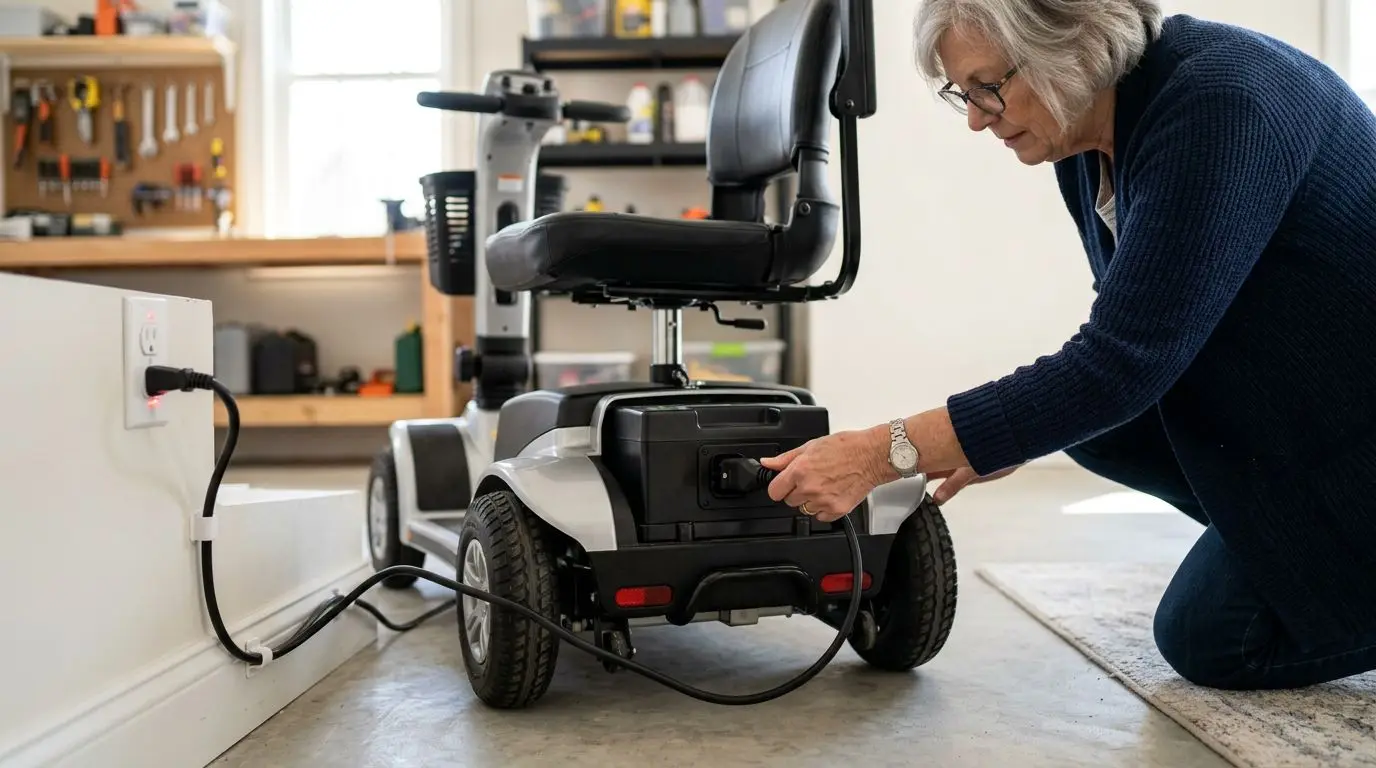
Use the charger designed for the scooter or a compatible replacement with the correct specifications. A charger meant for lithium should not be used on lead-acid unless it is specifically designed for both chemistries, and the reverse is also true. Incorrect charging can shorten battery life and may create a safety risk.
- Check that the charger voltage matches the scooter, commonly 24V.
- Match the charger to the battery chemistry: lead-acid, gel, AGM, or lithium.
- Confirm the plug shape and pin layout before buying a replacement charger.
- Avoid damaged cords, loose connectors, or chargers that become unusually hot.
- Charge in a dry, ventilated area away from direct heat.
Replacement cost: plan for $80 to $900 depending on battery type
Battery replacement cost varies widely by size, chemistry, source, and whether labor is included. As a broad US planning range, a small pair of sealed lead-acid scooter batteries may cost about $80 to $200, while larger lead-acid sets often run closer to $150 to $350. Lithium replacement packs commonly cost more, often several hundred dollars and sometimes roughly $300 to $900 for larger or travel-focused packs.
Those ranges are not a quote. Local repair shops, online battery suppliers, medical equipment dealers, shipping fees, recycling fees, and installation labor can all change the final bill. If the battery is built into a proprietary housing or includes electronics, the cost may be higher than replacing two standard-looking batteries.
Before buying any used scooter, ask when the batteries were last replaced. A scooter that looks clean but needs a new battery pack soon may not be the bargain it seems. If replacement is due within 6 months, include that cost in your decision.
| Replacement situation | Typical planning range | Cost notes |
|---|---|---|
| Small sealed lead-acid pair | $80 to $200 | Often used in compact scooters |
| Mid-size or larger lead-acid set | $150 to $350 | Heavier batteries may raise shipping cost |
| Lithium battery pack | $300 to $900 | Integrated electronics and housings can add cost |
| Professional installation | Varies by shop | Ask about labor, testing, and recycling fees |
Battery lifespan: what to expect after 12 to 36 months
Battery lifespan depends more on care than many buyers realize. With regular use and proper charging, sealed lead-acid scooter batteries often last around 1 to 3 years. Lithium packs may last longer in many cases, but they still age with time, heat, deep discharge, and charge cycles.
A cycle means using and recharging part or all of the battery capacity. A rider who uses a scooter for 2 miles a day on smooth floors may get more calendar life than someone who rides 10 miles daily over hills. Storage matters too. Leaving a lead-acid battery discharged for several weeks can permanently reduce its capacity.
Signs of battery decline are usually easy to spot. The scooter may show a full charge at first, then drop quickly after a short ride. It may slow on ramps that were once manageable. It may also take longer to charge or stop reaching full charge. These symptoms can point to battery wear, though tires, brakes, motor issues, or a faulty charger can cause similar problems.
How to choose and measure: calculate your daily miles with a 30% reserve
Start with your real routine, not the largest number printed in a brochure. Write down your longest normal day: mailbox, lobby, grocery aisle, pharmacy, park path, or medical appointment. If you can, use a phone map, car odometer for neighborhood routes, or a simple walking-distance estimate. A grocery store loop can easily add 1 mile or more inside the building.
Once you know the distance, add a reserve. If your longest normal day is 7 miles, shop as if you need at least 10 miles of reliable range. If your route includes hills, rough sidewalks, or cold weather, add more cushion. This is especially important if you cannot easily call for a ride or charge at your destination.
Measure your charging setup as well. A scooter parked 15 feet from the nearest outlet may need a safer parking location, not a long extension cord across a walkway. If you live in an apartment, check whether you can charge in your unit, a storage room, or a designated mobility area. Some buildings have rules about lithium batteries, hallways, and electrical cords.
Quick measuring checklist
- Longest normal round trip: write the miles down.
- Reserve: add 20% to 30% beyond that distance.
- Rider plus cargo weight: include bags, oxygen equipment, or baskets.
- Charging outlet distance: keep cords out of walkways.
- Battery lifting weight: check whether a 10 lb or 35 lb pack is realistic for you.
- Storage temperature: avoid long storage in freezing or very hot spaces.
Who each battery setup is best for: 3 common rider profiles
A short-range battery setup can be perfectly adequate for the right person. If you mostly ride indoors or around a senior community, a compact scooter with a smaller battery may be easier to store, easier to transport, and less expensive to maintain. Range only becomes a problem when your normal trips exceed the battery cushion.
A mid-range battery setup suits many everyday users. This rider may visit stores, use sidewalks, attend appointments, and charge every night. A practical range in the 10 to 18 mile class, depending on conditions, can cover many local routines without creating a huge scooter.
A longer-range setup is best for riders who spend several hours away from home, live in spread-out neighborhoods, or face hills and rough pavement. These scooters may use larger batteries, weigh more, and require more storage space. In return, you get more confidence between charges.
| Rider profile | Typical daily use | Battery priority |
|---|---|---|
| Indoor and short errands | 1 to 5 miles per day | Easy charging, low weight, modest cost |
| Neighborhood and shopping | 5 to 12 miles per day | Reliable reserve and overnight charging |
| Longer outdoor days | 12 miles or more per day | Higher capacity, durable charger, service access |
Care tips that can add months to battery life
Good battery care is simple, but it has to be consistent. Charge after use, especially with lead-acid batteries. Do not park a scooter for weeks with a depleted battery. If you store the scooter, follow the battery instructions and recharge on the recommended schedule, often about once every 30 days for lead-acid systems.
Temperature control helps. Batteries do best in moderate conditions, roughly room temperature. Avoid leaving a scooter in a hot garage for weeks in summer or in a freezing shed in winter. If the battery is removable and safe to bring indoors, storing the battery inside can help protect performance.
Keep the charging port clean and dry. Look for corrosion, bent pins, frayed charger cords, or cracked battery cases. If you smell a rotten-egg odor from a lead-acid battery, see swelling, or notice heat that seems abnormal, stop using the battery and have it checked by a qualified technician.
- Charge after each day of use rather than waiting for the battery to go flat.
- Unplug according to the charger instructions after charging is complete.
- Use the correct charger, not a random charger with a similar-looking plug.
- Keep tires properly inflated if the scooter uses pneumatic tires.
- Do not pressure-wash the scooter or soak the battery compartment.
- Recycle old batteries through an appropriate battery recycler or service provider.
Charging safety at home: keep a 3-foot clear area
Most scooter charging is routine, but the setup still deserves care. Charge on a stable surface with airflow around the charger. Keep paper, blankets, and other flammable items at least 3 feet away from the charger and battery area. Do not run cords under rugs, through doorways, or across common walkways where someone could trip.
If you use a power strip, it should be properly rated and in good condition, but a wall outlet is often the safer choice. Avoid daisy-chaining extension cords. If you must use an extension cord temporarily, use a properly rated cord and remove it after charging. Ask an electrician or building manager if outlets are loose, warm, or frequently trip breakers.
Travel adds another safety layer. For air travel, lithium batteries may be subject to watt-hour limits and airline approval. Many airlines require advance notice and documentation. Call the airline before your trip, and do not assume that every scooter battery can fly.
When poor range is not just the battery: test 4 other causes
A weak battery is common, but it is not the only reason a scooter loses range. Before replacing batteries, check the basics. Low tire pressure can make a scooter work harder. A dragging brake can drain power quickly. Dirty or loose battery connections can limit performance. A failing charger may never fully charge the pack.
If the scooter is more than 2 years old and the batteries have never been replaced, testing the batteries is reasonable. Many mobility service providers can load-test lead-acid batteries and check charger output. For lithium systems, diagnosis may require equipment that can read the battery management system.
Do not keep riding a scooter that suddenly loses power in unsafe locations. A sudden range drop can leave you stranded in a parking lot, at a curb cut, or far from an outlet. If range changes sharply from one week to the next, schedule service before relying on the scooter for a long trip.
FAQ: 5 battery and charger questions buyers ask most
How often should I charge a mobility scooter battery?
For regular use, charge after each day of riding, even if you only used part of the battery. This habit is especially helpful for sealed lead-acid batteries, which do not like being stored in a discharged state.
Can I leave my mobility scooter plugged in overnight?
Many modern scooter chargers are designed to taper or stop charging when the battery is full, and overnight charging is common. Still, follow the scooter and charger instructions, use the correct charger, and avoid leaving damaged or questionable equipment plugged in unattended.
Can I upgrade to a bigger battery for more range?
Sometimes, but not always. The battery must physically fit, match the scooter voltage and chemistry requirements, and stay within the scooter design limits. A heavier battery can affect handling, braking, lifting, and warranty coverage, so check with a qualified mobility technician before changing battery size.
Why does my battery gauge drop quickly after showing full?
This often happens when batteries are aging or have lost capacity. It can also be caused by a weak charger, loose connections, cold weather, low tire pressure, or heavy loads. A battery and charger test can help confirm the cause.
How should I dispose of old scooter batteries?
Do not put scooter batteries in household trash. Sealed lead-acid and lithium batteries should be recycled through a battery recycler, mobility equipment provider, municipal hazardous waste program, or participating retailer.
Frequently asked questions
How often should I charge a mobility scooter battery? +
For regular use, charge after each day of riding, even if the battery is not empty. This is especially important for sealed lead-acid batteries, which can lose capacity when stored discharged.
Can I leave my mobility scooter plugged in overnight? +
Overnight charging is common when using the correct charger in good condition, and many chargers taper when the battery is full. Always follow the scooter and charger instructions and avoid using damaged cords or loose outlets.
How much does it cost to replace mobility scooter batteries? +
As a broad US planning range, small sealed lead-acid battery pairs may cost about $80 to $200, larger lead-acid sets about $150 to $350, and lithium packs roughly $300 to $900. Labor, shipping, recycling, and battery housing design can change the final cost.
Can I use a higher-capacity battery to get more range? +
Only if the battery fits, matches the scooter voltage and chemistry requirements, and stays within the scooter design limits. A qualified mobility technician should confirm compatibility before you change battery size.
Why is my scooter range getting shorter? +
Shorter range is often caused by aging batteries, but low tire pressure, hills, cold weather, heavy loads, loose connections, a dragging brake, or a weak charger can also reduce range.
Related guides
Mobility Scooter Battery Prices in the US: What Affects Cost and When Replacement Is Worth It
12 min read
Mobility Scooter Batteries Explained: Types, Voltage, Amp-Hours, and Compatibility
15 min read
How to Charge a Mobility Scooter Battery the Right Way: Daily Use, Overcharging Myths, and Battery-Life Tips
16 min read