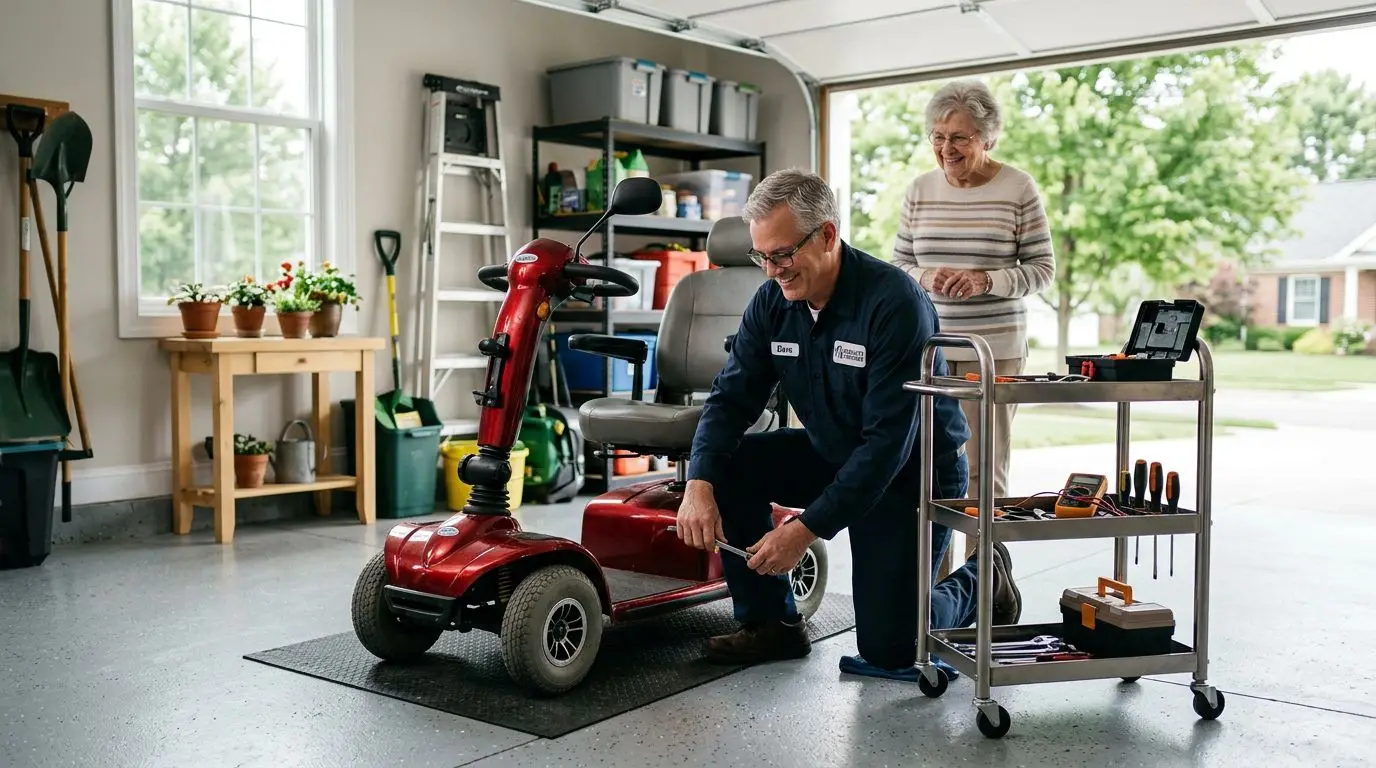
To find mobility scooter repairs near you, start with local mobility equipment repair shops, medical equipment service companies, and in-home technicians who cover your ZIP code. Ask whether they service your scooter type, work on batteries, tires, brakes, wiring, and controls, and provide a written estimate before any work begins. If the scooter has brake trouble, steering problems, exposed wiring, or sudden power loss, stop riding it until it has been inspected.
Most mobility scooter repairs fall into a few practical categories: battery and charger issues, flat or worn tires, loose seats or tillers, brake adjustments, motor or controller problems, and general tune-ups. The right service option depends on whether the scooter is safe to move, whether you have transportation, and whether the repair needs a workshop bench, diagnostic tools, or only a house-call visit.
Start your repair search within 10 to 25 miles
A good first search radius is 10 to 25 miles from your home, since many repair providers work locally and may limit house calls by ZIP code. Search terms that usually work better than broad phrases include mobility scooter repair, power mobility repair, medical equipment repair, scooter battery replacement, and in-home mobility scooter service.
Do not limit your search to stores that sell scooters. In many US communities, repairs may be handled by independent mobility technicians, durable medical equipment service departments, wheelchair repair providers, or small engine and electronics repair shops with experience in low-voltage mobility equipment. Call before you visit. A scooter can weigh 80 to more than 250 pounds, and bringing it in without confirming service can create a difficult loading problem.
When you call, describe the symptom in plain language. For example: the scooter turns on but does not move, the charger light never changes, the scooter slows after 10 minutes, the tiller wobbles, or one rear tire will not hold air. Clear symptoms help the shop decide whether the likely issue is a battery, charger, fuse, brake lever, wiring connection, controller, motor, or mechanical part.
- Check local mobility equipment shops first.
- Ask senior centers, rehab clinics, and independent living centers for repair referrals.
- Search for in-home service if the scooter is unsafe to drive or hard to transport.
- Look for providers who clearly explain diagnostics, parts ordering, and turnaround time.
- Confirm whether the technician works on 3-wheel, 4-wheel, travel, heavy-duty, or all-terrain scooters.
Compare 3 repair options: shop visit, in-home service, and pickup
The 3 most common repair routes are taking the scooter to a local shop, scheduling an in-home service call, or arranging pickup and return. Each can be the right choice. The safest option depends on the scooter weight, the repair type, and whether the scooter still moves under its own power.
| Repair option | Best for | Typical limitations | Questions to ask |
|---|---|---|---|
| Local repair shop | Repairs needing bench tools, lift access, wiring checks, tire work, or deeper diagnostics | You may need a vehicle ramp, lift, or helper; many scooters weigh 80 to 250+ pounds | Do you require an appointment? Can you test batteries, charger, brakes, and controller? |
| In-home technician | Battery swaps, charger checks, minor adjustments, basic troubleshooting, and scooters that are hard to transport | Some motor, frame, or wiring jobs may still need a shop | Do you cover my ZIP code? What can you repair during a first visit? |
| Pickup and return | Non-running scooters, heavy scooters, or homes without a ramp or suitable vehicle | Turnaround may depend on driver routes and parts availability | How is the scooter secured during transport? Will I get a written intake note? |
If the scooter is a lightweight folding or travel type, shop service may be simple because some models break down into 4 or 5 pieces. A heavy-duty scooter is different. Some are too large for a car trunk, and even removable battery packs can weigh enough to make lifting difficult.
In-home repair is often the most senior-friendly first step, especially when the problem appears electrical or battery-related. A technician may still need a clean, level work area with a standard outlet nearby. If you live in an apartment or senior living community, ask where the technician should park and whether the building requires visitor check-in.
Common repairs technicians see in the first 30 minutes
Many mobility scooter problems can be narrowed down during the first 30 minutes of inspection, even when the full repair takes longer. A technician may test battery voltage, inspect the charger, check freewheel levers, look for loose connectors, examine tires, test the brake release, and listen for motor or transaxle noise.
Battery trouble is the most common call. Many mobility scooters use 2 sealed batteries wired together, often in a 24-volt system, though designs vary. Weak batteries can cause short range, slow hill climbing, sudden shutdown under load, or a charger that never seems to complete a normal cycle. A proper battery test should check condition under load, not just a quick surface reading.
Tires are another frequent issue. Small scooter tires commonly fall in the 8 to 13 inch range, depending on the scooter type. Pneumatic tires can go flat or lose air over time, while solid tires can wear unevenly, crack, or reduce ride comfort. If your scooter pulls to one side, feels rough, or leaves black marks, the wheels and tires deserve a close look.
| Symptom | Possible causes | What to tell the repair provider |
|---|---|---|
| Scooter powers on but will not move | Freewheel lever engaged, brake issue, throttle fault, controller fault, loose wiring | Mention lights, beeps, display codes, and whether it rolls freely |
| Range dropped sharply | Aging batteries, charger problem, heavy load, hills, cold weather, tire drag | Estimate how many minutes or miles it runs before slowing |
| Charger light acts unusual | Charger failure, battery failure, outlet issue, charging port problem | Describe the charger light color and whether it changes after several hours |
| Grinding or clicking noise | Wheel bearing, brake, motor, transaxle, loose hardware | Say whether the noise happens turning, accelerating, or coasting |
| Tiller or seat feels loose | Worn adjustment hardware, loose bolts, damaged latch, frame stress | Do not keep riding if the steering feels unstable |
Not every symptom points to a major repair. A scooter in freewheel mode may turn on but refuse to drive. A loose charger plug can mimic a bad battery. A key switch or reset button can also cause confusion. That is why careful diagnosis matters.
How to choose a reliable repair provider: 10 questions to ask
Before you schedule service, ask direct questions. A reliable provider should be comfortable explaining what they can inspect, what they cannot promise before diagnosis, and how they handle parts. You do not need technical language. You need clear answers.
- Do you repair mobility scooters, not just sell or rent them? Some businesses sell equipment but send repairs elsewhere.
- Do you service my scooter type? Mention whether it is 3-wheel, 4-wheel, folding, travel, full-size, heavy-duty, or outdoor-oriented.
- Can you test batteries and chargers under load? A simple voltage check may miss weak batteries.
- Do you provide in-home service in my ZIP code? Ask about scheduling windows and access needs.
- Can you pick up a non-running scooter? This matters if the scooter weighs more than 100 pounds or cannot be safely rolled.
- Will I receive a written estimate before repair? The estimate should separate diagnosis, labor, parts, and transport if applicable.
- What happens if parts need to be ordered? Ask about compatibility, expected wait time, and whether the scooter can be used safely while waiting.
- Do you warranty your repair labor? Ask how long the labor warranty lasts and what it covers.
- Are replacement parts new, compatible, and appropriate for medical mobility use? Avoid vague answers about whatever fits.
- What safety checks are included before return? Brakes, steering, tires, battery connections, and throttle response should be checked.
Listen for specifics. A good technician may say they will test the charger output, inspect both batteries, check the freewheel lever, verify tire condition, and road-test the scooter in a safe area. Be cautious if someone promises a fix without seeing the scooter or hearing the symptoms.
Licensing rules for repair businesses vary by state and city, so there is no single national credential that applies to every mobility scooter technician. Even so, you can look for signs of professionalism: a real business name, reachable phone number, clear service area, written paperwork, insurance information if they enter your home, and a policy for parts and labor.
How to measure and prepare before you call: 7 details to collect
Gathering 7 basic details before you call can save time and help prevent a wasted appointment. You do not need to disassemble the scooter. You only need enough information for the provider to understand what equipment they are dealing with.
- Scooter type: 3-wheel, 4-wheel, folding, travel, full-size, heavy-duty, or outdoor style.
- Approximate weight: If you do not know, say whether one person can lift it, whether it breaks apart, or whether it needs a ramp.
- Overall width: Many scooters are roughly 20 to 30 inches wide, but heavy-duty types may be wider. Measure the widest point.
- Battery information: Look for battery labels if they are easy to see, such as 12V and amp-hour markings. Do not open sealed compartments if you are unsure.
- Charger behavior: Note whether the charger gets warm, whether lights change, and how many hours it has been plugged in.
- Error clues: Count beeps, note flashing lights, or take a photo of any display message.
- Recent events: Mention rain exposure, curb impact, storage for several months, a fall, or a sudden stop.
Photos help. Take 4 quick pictures: the full scooter from the side, the control panel, the charging port, and the tire or part that seems damaged. If there is a label with serial or specification information, photograph it too. Do not share personal medical information unless it is relevant to safe service access, such as needing the technician to call before arriving because you need extra time to answer the door.
Prepare the scooter area before an in-home visit. Clear at least 3 feet of space around the scooter if possible, remove loose rugs or cords, and make sure an outlet is accessible. If the scooter is stored in a garage, note the temperature; very cold or very hot storage can affect battery testing and charging behavior.
Who in-home repair is best for after 1 failed ride
In-home mobility scooter repair is best for people who cannot safely transport the scooter, have a scooter that stopped after 1 short ride, live alone, or use a heavier model that does not fit in a car. It is also helpful when the first likely problem is a battery, charger, loose connection, control issue, or adjustment.
A house call can reduce strain for caregivers. It can also prevent the unsafe practice of driving a scooter with weak brakes, failing batteries, or a loose tiller just to get it to a repair shop. If the scooter is your main way to move around the home, ask whether the provider can prioritize mobility-critical repairs, but stay realistic about parts delays.
In-home repair is not always enough. If the scooter has frame damage, water intrusion, major wiring damage, motor replacement needs, or repeated faults that require extended testing, the technician may recommend shop service. That is not a failure. Some work is safer and more accurate on a bench or lift.
When a local shop is better for scooters over 150 pounds
A local repair shop is often better for scooters over 150 pounds when the repair involves tires, suspension, steering hardware, motor access, transaxle noise, or deeper electrical diagnostics. Larger scooters can be difficult to maneuver in a living room, and some jobs require tools that are not practical to bring into a home.
Shop service also makes sense for repeat problems. If a scooter has gone through multiple battery sets quickly, keeps tripping a breaker, or shuts down on hills, the issue may involve charging habits, wiring resistance, brake drag, controller behavior, or motor load. A controlled shop inspection can test more than one component at a time.
Ask the shop how they store scooters awaiting parts. The scooter should be kept dry, identified with your name or ticket number, and protected from accidental damage. Before leaving it, remove personal items from baskets, under-seat pouches, cup holders, and phone mounts.
What to do if no repair provider is within 50 miles
If you live in a rural area and no repair provider is within 50 miles, widen your search to regional medical equipment service companies, wheelchair repair services, independent technicians, and mobile repair providers that schedule route days. Some technicians serve multiple counties but travel to certain towns only 1 or 2 days per month.
Ask nearby clinics, senior centers, veterans groups, aging services offices, and independent living organizations for names of technicians who serve rural customers. Local recommendations can be more useful than online listings that have not been updated. If you bought the scooter secondhand, you can still seek general repair service; just be honest that you may not have original paperwork.
Remote troubleshooting may help identify simple issues, but it has limits. A provider may walk you through checking whether the freewheel lever is engaged, whether the charger is fully plugged in, whether the reset button has tripped, or whether the key switch is loose. Do not bypass fuses, tape down controls, open sealed batteries, or modify wiring based on online guesses. Mobility scooters are low-voltage compared with household wiring, but they can still short, spark, overheat, or fail unsafely if repaired incorrectly.
Safety red flags to take seriously within 24 hours
Some scooter problems should be addressed within 24 hours or before the next ride, whichever comes first. Stop using the scooter if you notice burning smells, melted plastic, exposed wires, brakes that do not hold, sudden acceleration, steering wobble, severe pulling to one side, or a battery case that is swollen, cracked, leaking, or unusually hot.
Battery and charger issues deserve care. Use the charger intended for the scooter type and battery chemistry, and charge in a dry, ventilated area away from bedding, paper, or clutter. If a charger plug sparks repeatedly, the cord is damaged, or the charging port feels loose, discontinue charging and schedule service.
Water exposure is another red flag. Many scooters can handle ordinary outdoor use, but they are not meant to be pressure-washed or driven through deep standing water. If the scooter was caught in heavy rain, submerged, or stored where water reached the floorboard, let a technician inspect it before use. Electrical corrosion may not show up immediately.
FAQ: 5 repair-near-me questions answered
Can a regular scooter or bicycle shop repair a mobility scooter?
Sometimes, but ask first. A bicycle shop may help with certain tire or tube issues, and a general repair shop may understand mechanical hardware, but mobility scooters include batteries, controllers, brakes, and safety systems that require specific experience. For electrical, braking, or drive problems, choose a provider familiar with mobility equipment.
How long does mobility scooter repair usually take?
Simple checks may take 30 to 60 minutes, while repairs that need ordered parts can take several days or longer depending on availability. Ask for an expected timeline after diagnosis, not before. A careful provider should explain whether the delay is labor scheduling, parts ordering, transport, or testing.
Should I replace both batteries at the same time?
In many 24-volt scooter systems that use 2 matched batteries, technicians commonly replace both at the same time so the pair charges and discharges evenly. The right answer depends on the scooter design and battery condition. Ask for a load test and a clear explanation before approving battery replacement.
Is it safe to keep riding if the scooter still moves?
Not always. If the problem involves brakes, steering, sudden stopping, overheating, unusual smells, exposed wires, or loose structural parts, stop riding until it is inspected. A scooter that still moves can still be unsafe.
What should I ask before letting a technician into my home?
Confirm the business name, technician name if available, arrival window, service area, paperwork process, and whether there is a written estimate before repair. Clear the work area, secure pets, and ask whether a caregiver or building staff member should be present if that makes you more comfortable.
Frequently asked questions
Can a regular scooter or bicycle shop repair a mobility scooter? +
Sometimes, but ask first. A bicycle shop may help with certain tire or tube issues, and a general repair shop may understand mechanical hardware, but mobility scooters include batteries, controllers, brakes, and safety systems that require specific experience. For electrical, braking, or drive problems, choose a provider familiar with mobility equipment.
How long does mobility scooter repair usually take? +
Simple checks may take 30 to 60 minutes, while repairs that need ordered parts can take several days or longer depending on availability. Ask for an expected timeline after diagnosis, not before. A careful provider should explain whether the delay is labor scheduling, parts ordering, transport, or testing.
Should I replace both batteries at the same time? +
In many 24-volt scooter systems that use 2 matched batteries, technicians commonly replace both at the same time so the pair charges and discharges evenly. The right answer depends on the scooter design and battery condition. Ask for a load test and a clear explanation before approving battery replacement.
Is it safe to keep riding if the scooter still moves? +
Not always. If the problem involves brakes, steering, sudden stopping, overheating, unusual smells, exposed wires, or loose structural parts, stop riding until it is inspected. A scooter that still moves can still be unsafe.
What should I ask before letting a technician into my home? +
Confirm the business name, technician name if available, arrival window, service area, paperwork process, and whether there is a written estimate before repair. Clear the work area, secure pets, and ask whether a caregiver or building staff member should be present if that makes you more comfortable.
Related guides

What to Do If Your Mobility Scooter Breaks Down Away From Home
14 min read
Mobility Scooter Maintenance Schedule: Weekly, Monthly, and Trip Checks
16 min read
Mobility Scooter Won’t Turn On: Battery, Key Switch, Fuse, Brake, and Freewheel Checks
15 min read