
Renting a mobility scooter for travel usually makes more sense than bringing your own when the trip is short, the destination is difficult to navigate, or transporting your scooter would mean extra lifting, airline paperwork, or vehicle space. It is especially practical for vacations, medical recovery, conventions, theme parks, cruises, weddings, and multi-day events where you need dependable mobility for a few hours to a few weeks.
Bringing your own scooter can still be the better choice if you depend on custom seating, specialized controls, or a familiar setup every day. The right decision comes down to 5 things: trip length, transport effort, scooter fit, terrain, and how much risk you are willing to take with delays or damage in transit.
When renting beats bringing your own scooter
Renting is often easier when your personal scooter would have to be disassembled, checked with an airline, loaded into a rental car, or stored in a small hotel room. Many travel scooters break into 4 or 5 pieces, but the heaviest piece can still weigh 30 to 70 pounds, which is a lot to handle after a flight or during a busy vacation day.
A rental can be delivered where you need it. Depending on the provider and destination rules, that may mean delivery to a hotel lobby, vacation rental, cruise terminal, convention center, medical facility, or event entrance. Always confirm the exact handoff location in writing, since some properties do not allow equipment to be left unattended.
Renting also helps when your home scooter is not ideal for the trip. A larger scooter may feel comfortable at home but awkward in a crowded museum, narrow restaurant, or shuttle bus aisle. A compact rental may fit elevators and hotel hallways more easily, while a more rugged rental may suit outdoor fairgrounds better than a lightweight scooter designed for smooth indoor floors.
| Situation | Why renting may win | What to ask for |
|---|---|---|
| Weekend city trip | A 2 or 3 day rental avoids airline or car transport stress | Compact scooter with tight turning radius |
| Cruise vacation | Delivery to port or hotel may be simpler than flying with your own | Overall width that fits the cabin doorway |
| Theme park or zoo | Long walking distances can exceed 5 miles in one day | All-day battery range and comfortable seat |
| Convention or trade show | Exhibit halls often involve hours on concrete floors | Stable 4-wheel scooter with basket or storage |
| Medical recovery | Short-term need may last 1 to 8 weeks | Easy controls, good leg room, delivery to home or hotel |
Who it is best for: trips from 1 day to 4 weeks
Mobility scooter rental is best for people who need temporary support, predictable access, and less handling on travel days. A 1-day event rental may solve one specific problem, while a 2 to 4 week rental can bridge the gap during recovery, family visits, or a seasonal stay away from home.
It is a strong fit for travelers who can walk short distances but not full vacation distances. For example, someone who can comfortably walk from a hotel bed to the bathroom may still struggle with a large airport terminal, a boardwalk, or a museum day that involves 3 to 6 hours of standing and slow walking.
It can also help caregivers. If a spouse or adult child would otherwise need to push a manual wheelchair for hours, a scooter may reduce fatigue for both people, as long as the rider can steer, brake, transfer safely, and follow venue rules. That is a mobility and convenience benefit, not a medical treatment.
Renting is especially useful for these travelers
- Vacationers who do not use a scooter every day but need help with long distances.
- People recovering from surgery or injury who have a short-term mobility limit and medical clearance to use powered mobility.
- Older adults visiting family who want to join outings without relying on a borrowed wheelchair.
- Event attendees going to festivals, fairs, conventions, graduations, or weddings with limited seating.
- Cruise passengers who need assistance on long decks, port terminals, or shore excursions.
Renting is not ideal for everyone. If you need complex postural support, oxygen tank mounting, left-hand controls, elevating leg rests, or other individualized features, a generic rental may not be enough. In that case, speak with your clinician or equipment specialist before you travel.
Renting vs bringing your own: a practical comparison
The biggest tradeoff is control versus convenience. Bringing your own scooter gives you the familiar seat height, throttle feel, and turning behavior you already know. Renting reduces transport work, but you will need to adapt to equipment that may feel slightly different for the first 10 to 20 minutes.
Air travel is a common deciding point. Airlines generally allow mobility devices, but you may need to provide battery information, protect removable parts, arrive early, and wait for the scooter after landing. Damage and delay are not everyday events, but they are real risks. If your whole trip depends on the scooter being ready when you arrive, a local rental waiting at the destination can be the calmer plan.
| Decision factor | Rent at destination | Bring your own |
|---|---|---|
| Trip length | Often best for 1 day to 4 weeks | Often better for long stays or daily dependence |
| Fit and familiarity | May require adjustment | Already customized to you |
| Transport work | Minimal if delivered | May require lifting, disassembly, or airline handling |
| Risk of transit damage | Lower for your personal scooter | Your scooter is exposed to handling during travel |
| Terrain match | You can choose a type for the destination | You are limited to the scooter you own |
| Cost structure | Rental fee plus possible delivery or deposit | Possible airline, vehicle, repair, or accessory costs |
For road trips, the math changes. If you already own a vehicle lift or have a ramp van, bringing your own may be easy. If you drive a small car with limited cargo space, renting at the destination may spare you from wrestling with a scooter that does not fit through the trunk opening or requires lifting a 50-pound section.
How to choose the right rental scooter: 6 measurements to take
Do not choose a rental scooter by appearance alone. Before reserving, write down 6 measurements: rider weight, rider height, doorway width, elevator or cabin width, expected daily distance, and the steepest ramp or driveway you expect to use. These numbers help the rental provider match you with a scooter that is safe and practical.
Most rental categories fall into compact travel scooters, standard scooters, heavy-duty scooters, and sometimes all-terrain or outdoor-focused scooters. Exact capacities vary, so never assume. Ask for the published weight capacity, and choose equipment that gives a reasonable safety margin above the rider’s weight plus carried items such as a bag, water bottle, or small medical accessory.
| Scooter type | Common strengths | Common limits | Best travel use |
|---|---|---|---|
| Compact 3-wheel | Tight turning, lighter feel, easier in hotel rooms | Less stable on uneven ground than many 4-wheel designs | Indoor attractions, airports, restaurants |
| Compact 4-wheel | Better straight-line stability, still travel-friendly | May need more turning space | Museums, cruises, smooth sidewalks |
| Standard 4-wheel | More comfort and often longer range | Heavier and wider | Theme parks, convention centers, full-day outings |
| Heavy-duty | Higher weight capacity and roomier seating | Harder in tight interiors and small vehicles | Outdoor venues, larger riders, longer seated use |
| Outdoor or all-terrain | Larger tires, better for grass or packed gravel | May not be allowed everywhere; larger turning radius | Fairgrounds, parks, uneven paths |
Key measurements to confirm
- Overall width: Many scooters are roughly 21 to 28 inches wide, but heavy-duty designs can be wider. Compare this with cabin doors, bathroom doors, elevators, and ramps.
- Turning radius: Compact scooters may turn in roughly 32 to 45 inches, while larger scooters may need 50 inches or more. This matters in hotel rooms and restaurants.
- Seat height and leg room: A tall rider may feel cramped on a compact scooter. A shorter rider may need a lower seat for safer transfers.
- Battery range: Common ranges may run from about 8 to 20 miles per charge depending on scooter size, rider weight, terrain, speed, and battery condition.
- Weight capacity: Ask for the stated limit and do not exceed it. Overloading affects braking, stability, motor strain, and battery performance.
- Ground clearance: Low scooters can scrape on steep curb cuts or thresholds. Ask about clearance if your route includes uneven pavement.
If you are cruising, measure the stateroom doorway before booking a scooter. Some accessible cabins have wider doors and turning space, while standard cabins may be much tighter. A scooter that cannot enter the room may create a safety and policy problem in the hallway.
Travel, delivery, and pickup details to confirm 48 hours ahead
Confirm every rental detail at least 48 hours before your trip or event. That gives you time to correct the delivery address, update the arrival window, ask about battery charging, and make sure the scooter type still matches your plans.
Start with the delivery location. A hotel may accept equipment at the front desk, but a vacation rental may require you to meet the driver in person. Event venues may direct rentals to a specific gate or accessibility desk. Cruise ports may have strict rules about where outside providers can hand off equipment.
Then ask what is included. A charger should come with any multi-day rental, and you should know whether the scooter arrives fully charged. If you plan to use it all day, ask how long a full recharge typically takes. Many scooter batteries need several hours to recharge, and overnight charging is the usual routine.
Questions to ask before you reserve
- What scooter category will I receive, and what is its weight capacity?
- What are the overall width, length, and approximate turning radius?
- Will it fit through a 24-inch, 26-inch, or 30-inch doorway?
- How far can it typically travel on one charge under normal use?
- Where exactly will delivery and pickup happen?
- What happens if the scooter does not fit or has a mechanical issue?
- Is there an after-hours phone number for urgent problems?
- Are damage waiver, deposit, cancellation, or late pickup policies in writing?
For air travel, check airport logistics too. If you rent at your destination, you still need to get from your home to your departure gate and from the arrival gate to the rental handoff location. Some travelers use airport wheelchair assistance for the terminals, then switch to the rental scooter at the hotel or cruise port.
Safety and comfort checks for your first 10 minutes
Spend the first 10 minutes testing the scooter before heading into a crowd. Check the brakes, horn, speed control, battery indicator, seat swivel, armrests, and tiller adjustment. If anything feels loose, noisy, delayed, or unsafe, call the rental provider before you leave the delivery area.
Start at the lowest speed setting. Practice starting, stopping, backing up, and making a full turn in an open area. Many rental scooters use thumb or finger controls, and the throttle response may not feel like your own scooter. A slow test helps prevent surprises at elevator doors, curb cuts, or crosswalks.
Comfort matters too. Adjust the tiller so your shoulders are relaxed and your elbows are slightly bent. Set the seat so you can transfer safely and keep both feet supported. If the scooter has a swivel seat, make sure it locks firmly before driving.
| Check | What to do | Why it matters |
|---|---|---|
| Battery | Confirm full or adequate charge before departure | A low battery can shorten the day |
| Brakes | Stop from slow speed on level ground | Verifies control before crowds or slopes |
| Horn or bell | Test once in a safe area | Helps alert pedestrians when needed |
| Seat lock | Swivel and relock the seat | Reduces transfer and driving risk |
| Tiller | Adjust angle and tighten | Improves steering comfort |
| Charger | Plug in and confirm indicator lights | A missing or faulty charger can ruin day 2 |
Use common-sense driving habits. Avoid steep wet ramps, loose gravel, deep sand, and crowded downhill paths when possible. Keep speed low indoors. Do not hang heavy bags from the tiller, because that can affect steering. If you are unsure whether a route is scooter-friendly, ask staff for the accessible entrance or elevator instead of improvising.
When bringing your own scooter still makes more sense
Bringing your own scooter may be smarter for trips longer than 4 weeks, for daily users who depend on a precise fit, or for anyone who cannot safely adapt to unfamiliar controls. Familiar equipment can reduce stress, especially when transfers, posture, or hand strength are major concerns.
Your own scooter is also preferable if you use custom accessories that are not easy to replicate. Examples include a special seat cushion, cane holder, oxygen holder, rear basket, mirror, phone mount, or modified control setup. Some accessories can be moved to a rental, but not all will fit securely.
Availability can be another issue. In busy destinations, scooters can sell out during holidays, large conferences, spring break, winter travel season, or major sporting events. If you wait until the week of travel, the exact size or capacity you need may not be available.
Bring your own if these apply
- You need the scooter every day, not just for long outings.
- You require custom seating, controls, or medical accessory mounting.
- You already have an accessible vehicle or lift that makes transport easy.
- Your destination has limited rental availability or unreliable delivery access.
- You are staying long enough that rental logistics become less convenient.
If you do bring your own scooter on a flight, label removable parts, carry battery information, photograph the scooter before handoff, and arrive early. Many travelers also remove baskets, cushions, or loose accessories before the scooter is handled. For lithium batteries, ask your airline about its current mobility device battery rules before departure, because requirements can depend on whether the battery is removable and its watt-hour rating.
Frequently asked questions about renting a travel mobility scooter
Is it better to rent a mobility scooter at my destination or bring mine on the plane?
Renting is often better for short trips, cruises, events, and vacations where delivery is available and you do not need a custom setup. Bringing your own is usually better if you rely on it daily, need specialized seating or controls, or cannot safely adjust to unfamiliar equipment.
How far in advance should I reserve a rental scooter?
For ordinary trips, try to reserve at least 1 to 2 weeks ahead. For holidays, cruises, conventions, and major events, earlier is better because popular scooter sizes and higher weight capacities may be limited.
Can I rent a scooter for medical recovery?
Yes, many people rent scooters during short-term recovery periods such as several days or several weeks, but you should follow your clinician’s mobility and weight-bearing instructions. A scooter can help with distance, but it is not a substitute for medical care or prescribed rehabilitation.
Will a rental scooter fit in a hotel room or cruise cabin?
It depends on the scooter width, turning radius, doorway width, and room layout. Measure doors and tight spaces before booking. A scooter around 22 inches wide may fit many more spaces than a larger unit, but the exact doorway and turning area matter.
What if the scooter battery runs out during the day?
Ask about expected range before you rent, charge overnight, and plan breaks if you will be out for many hours. Battery life depends on rider weight, hills, speed, surface, temperature, and battery condition. If the battery drains unusually fast, contact the rental provider.
Are mobility scooters allowed at events and attractions?
Many public attractions and events allow mobility scooters, but policies vary. Some venues restrict certain sizes, outdoor routes, charging locations, or storage areas. Check the accessibility page or call the venue before you go.
Frequently asked questions
Is it better to rent a mobility scooter at my destination or bring mine on the plane? +
Renting is often better for short trips, cruises, events, and vacations where delivery is available and you do not need a custom setup. Bringing your own is usually better if you rely on it daily, need specialized seating or controls, or cannot safely adjust to unfamiliar equipment.
How far in advance should I reserve a rental scooter? +
For ordinary trips, try to reserve at least 1 to 2 weeks ahead. For holidays, cruises, conventions, and major events, earlier is better because popular scooter sizes and higher weight capacities may be limited.
Can I rent a scooter for medical recovery? +
Yes, many people rent scooters during short-term recovery periods such as several days or several weeks, but you should follow your clinician’s mobility and weight-bearing instructions. A scooter can help with distance, but it is not a substitute for medical care or prescribed rehabilitation.
Will a rental scooter fit in a hotel room or cruise cabin? +
It depends on the scooter width, turning radius, doorway width, and room layout. Measure doors and tight spaces before booking. A scooter around 22 inches wide may fit many more spaces than a larger unit, but the exact doorway and turning area matter.
What if the scooter battery runs out during the day? +
Ask about expected range before you rent, charge overnight, and plan breaks if you will be out for many hours. Battery life depends on rider weight, hills, speed, surface, temperature, and battery condition. If the battery drains unusually fast, contact the rental provider.
Are mobility scooters allowed at events and attractions? +
Many public attractions and events allow mobility scooters, but policies vary. Some venues restrict certain sizes, outdoor routes, charging locations, or storage areas. Check the accessibility page or call the venue before you go.
Related guides

Where to Rent a Mobility Scooter Near You in the US: Local Shops, Delivery Options, and What to Ask Before Booking
14 min read
What to Ask Before You Rent a Mobility Scooter Near You
14 min read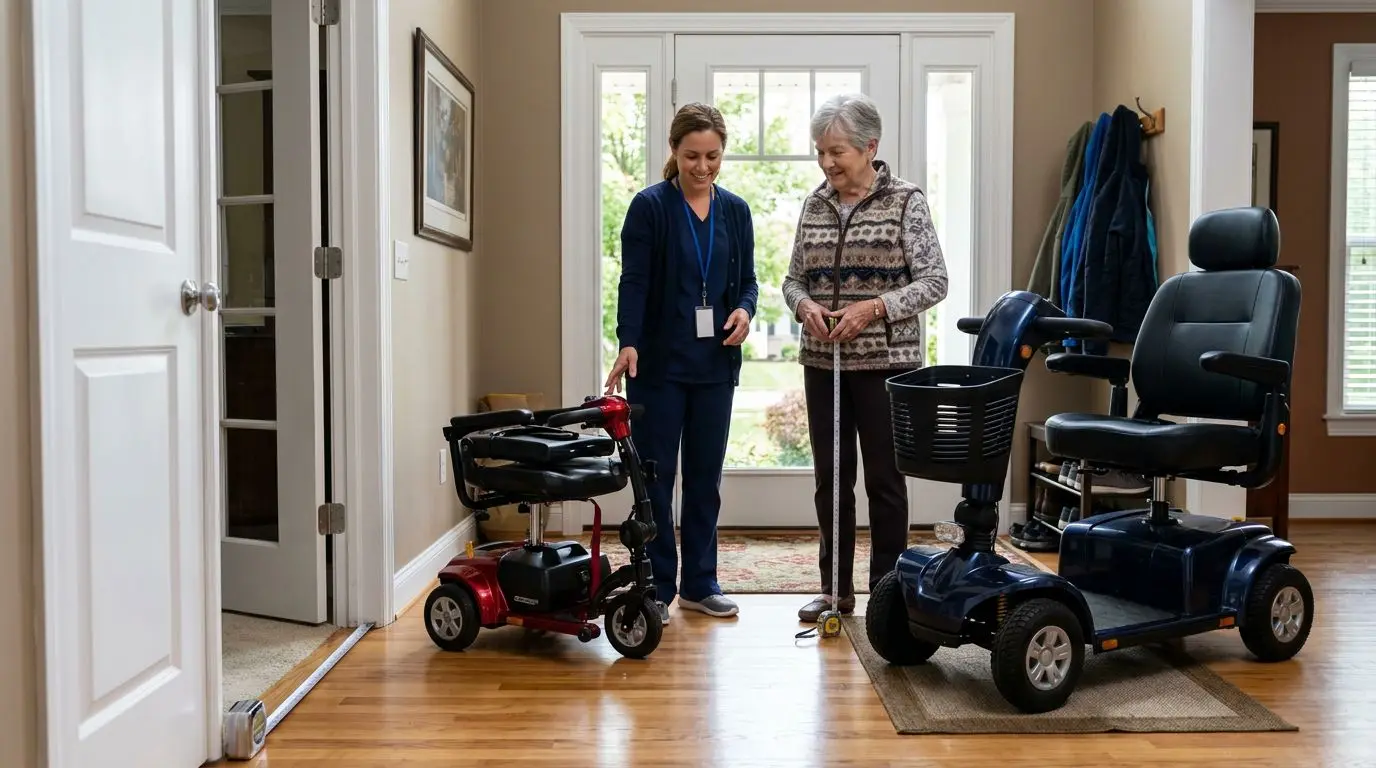
Renting vs. Buying a Mobility Scooter: Which Option Makes Sense?
13 min read