Renting a mobility scooter often makes sense for short-term needs, travel, recovery, or trying a scooter before you commit. Buying usually makes more sense if you expect to use a scooter several days a week for 6 months or longer, need a consistent fit, or want control over features, maintenance, and accessories.
The right choice depends on how long you need it, where you will use it, how much storage space you have, how you plan to transport it, and how much help you need with delivery, setup, and repairs. A rental can solve a temporary problem quickly, while ownership is often better for daily independence and a scooter that fits your body, home, and routine.
Renting vs. buying at a glance: 1 day to 5+ years
Start by estimating how long you will need the scooter. A 3-day event, a 2-week vacation, and a 12-month daily mobility need are very different situations. Rental providers commonly offer daily, weekly, and monthly terms, while ownership is built around repeated use over many months or years.
| Situation | Renting often makes sense when... | Buying often makes sense when... |
|---|---|---|
| Short trip or event | You need a scooter for 1 to 14 days at an airport, theme park, cruise, convention, or family visit. | You travel often and want the same scooter every time. |
| Recovery | You expect limited mobility for a few weeks or a few months after an injury, surgery, or medical treatment. | Your mobility need is ongoing or unpredictable beyond 6 months. |
| Trial period | You want to test a 3-wheel or 4-wheel style before buying. | You already know the size, comfort, and controls you prefer. |
| Daily home use | You need temporary help around a specific event or home project. | You will use the scooter most days for errands, appointments, or household mobility. |
| Feature needs | Basic portability and short-range use are enough. | You need a higher weight capacity, better suspension, a specific seat size, or longer range. |
Do not decide by cost alone. A low-friction rental may be safer when your need is temporary, but a poorly fitted scooter can become frustrating if you depend on it every day.
When renting a mobility scooter makes sense: trips, recovery, and 30-day needs
Renting works best for a defined window of use: 1 weekend, 10 vacation days, or a 30-day recovery period. You get mobility support without taking on long-term storage, battery upkeep, or resale concerns.
Who it is best for
- Travelers who need help covering long distances at airports, resorts, museums, theme parks, or cruise terminals.
- People recovering from a short-term condition and expecting mobility to improve.
- Caregivers who need a temporary solution for visiting family, events, or medical appointments.
- First-time users who want to try scooter driving before buying.
- Anyone who does not have a safe, dry place to store a scooter at home.
Renting can also lighten the planning load. Many rental services deliver to hotels, private homes, event venues, or senior living communities. You still need to confirm the details: delivery window, pickup time, battery charger, weight capacity, insurance or damage policy, and what happens if the scooter stops working after hours.
A rental is not always a perfect fit. Inventory may be limited, especially during holidays or large events. Seat width, tiller adjustment, battery range, and turning radius may not match your home or body as well as a scooter chosen for ownership.
When buying a mobility scooter makes sense: 6 months, weekly use, and daily routines
Buying is usually the stronger choice when the scooter will become part of normal life. If you expect to use it several days each week for 6 months or more, ownership lets you choose the right type, seat, controls, battery range, and transport setup.
Who it is best for
- People with long-term mobility limitations who want consistent support for errands, appointments, and social activities.
- Users who need a specific weight capacity, often listed in the 250 to 500 lb range depending on scooter type.
- People whose home requires a tighter turning radius, narrow overall width, or a certain ground clearance.
- Users who want accessories such as baskets, cane holders, lights, mirrors, oxygen tank holders, or weather covers.
- Anyone who wants to practice on the same controls and braking behavior every time.
Ownership can feel more comfortable, too. A scooter selected for your height, leg length, hand strength, and home layout is easier to live with than whatever happens to be available for rent. You can add accessories, set the tiller angle, and get used to a regular charging routine.
The tradeoff is responsibility. You need a charging location near a standard outlet, a dry storage area, and a plan for service. Batteries need regular charging, tires and brakes should be inspected, and the scooter must be protected from heavy rain when it is not rated for that environment.
How to choose: measure your body, home, vehicle, and routes in 4 steps
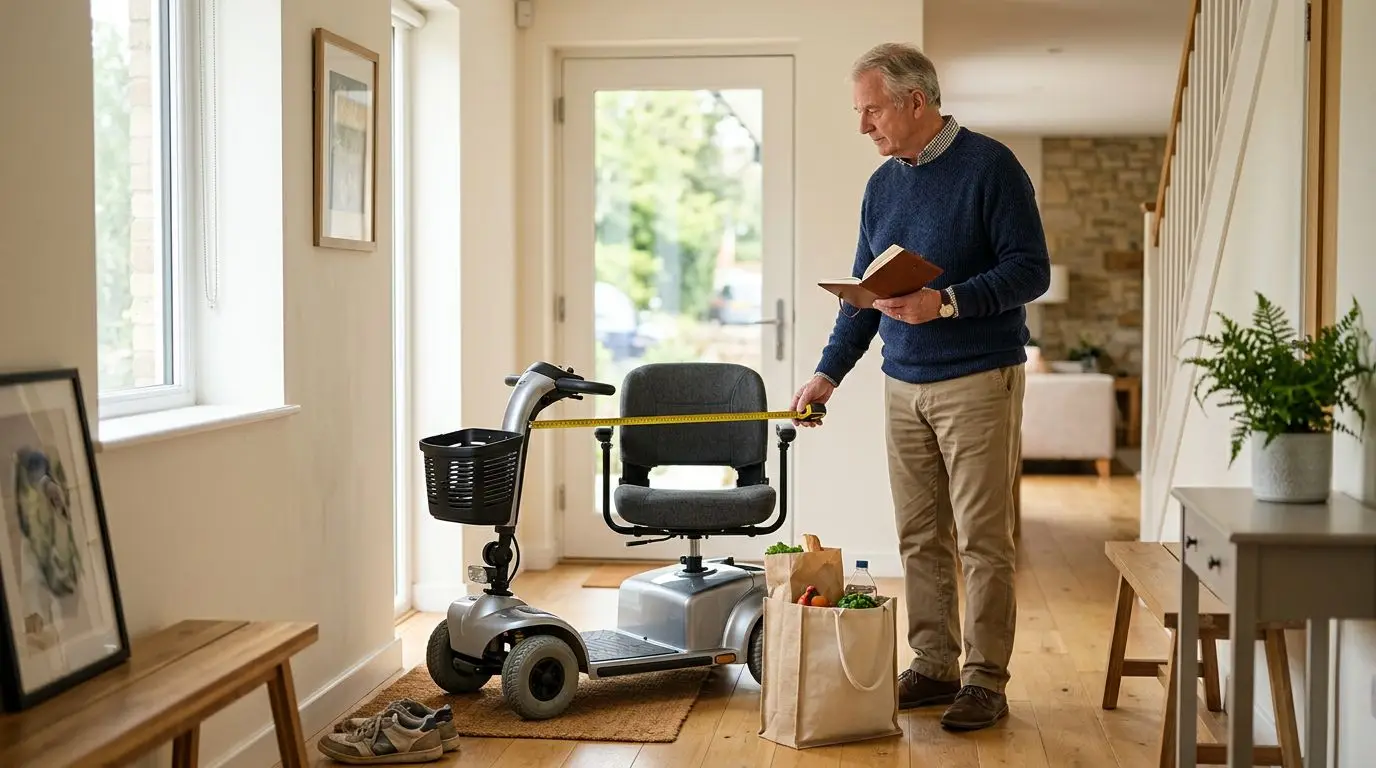
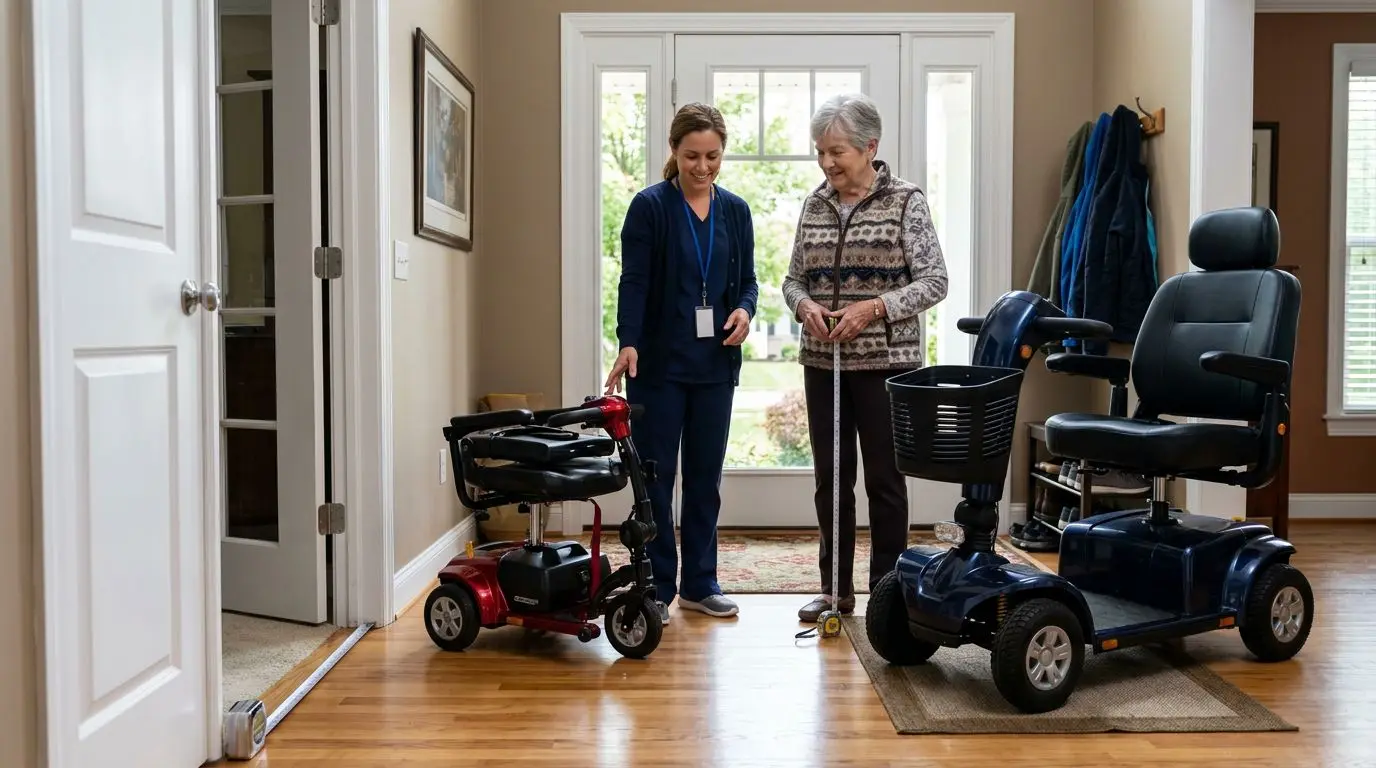
A good rent-or-buy decision starts with measurements, not guesswork. Keep a tape measure handy and write down 4 numbers: doorway width, vehicle cargo space, user weight, and the longest typical outing distance.
Step 1: Measure doorways and turning space
Many interior doors are about 28 to 36 inches wide, but older homes and bathroom entries can be tighter. Measure the narrowest doorway, hallway, elevator door, and ramp you expect to use. If a scooter is too wide or has a long turning radius, it may work outdoors but fail in the places where you need it most.
Step 2: Check user fit and weight capacity
Match the scooter to the user, including body weight, seat width, legroom, and comfort during turns. Do not choose a scooter at the edge of its listed capacity. A practical safety margin helps performance, especially on inclines, uneven pavement, or longer outings.
Step 3: Estimate range honestly
Battery range is often listed under ideal conditions. Real-world range can drop with hills, heavier loads, frequent stops, cold weather, rough surfaces, or older batteries. If your normal errand loop is 6 miles, do not choose a setup that only barely covers 6 miles under perfect conditions.
Step 4: Decide how it will travel
If you plan to put the scooter in a car, measure the trunk or cargo opening, not just the flat cargo floor. Portable scooters may disassemble into several pieces, but the heaviest piece can still be 30 to 60 lb or more. If lifting is unsafe for you or your caregiver, consider delivery, a vehicle lift, or a different scooter type.
Compare scooter types before you rent or buy: 3-wheel, 4-wheel, travel, and heavy-duty
Scooter type matters as much as the rent-or-buy decision. A compact travel scooter may be easy to load, while a larger outdoor scooter may be more stable and comfortable on longer routes. Common top speeds are often in the walking-to-brisk range, roughly 4 to 8 mph depending on type and setting.
| Scooter type | Common strengths | Possible limits | Best fit |
|---|---|---|---|
| 3-wheel | Tighter turning radius, easier indoor maneuvering, more legroom in some designs. | May feel less stable than 4-wheel designs on uneven ground. | Apartments, stores, indoor routes, smoother surfaces. |
| 4-wheel | More stable feel, better straight-line tracking, good for mixed indoor/outdoor use. | Usually needs more turning room. | Sidewalks, senior communities, errands, general daily use. |
| Travel or folding | Designed for transport, may fold or break down into sections. | Often smaller seats, lower ground clearance, and shorter range. | Trips, occasional use, car transport. |
| Full-size | More comfort features, stronger batteries, larger seats, better outdoor capability. | Heavier, harder to lift, needs more storage space. | Frequent use at home and in the community. |
| Heavy-duty | Higher weight capacity, wider seating, stronger frame, improved outdoor confidence. | Larger turning radius, heavier, may not fit narrow entries. | Users needing more capacity, comfort, or stability. |
If you are renting for a trip, ask which type will be delivered and whether substitutions are allowed. If you are buying, test the scooter in the tightest real environment you can, such as a hallway turn, ramp, sidewalk seam, or elevator.
Rental details to verify before you reserve: delivery, battery range, and 24-hour support
A rental agreement should be clear before the scooter arrives. Confirm at least 7 details: delivery location, pickup time, scooter type, user weight capacity, charger included, damage policy, and emergency support. Get it in writing when possible.
- Delivery and pickup: Ask whether the scooter will be left with hotel bell services, delivered to a room, or handed directly to you.
- Battery and charger: Confirm that the charger is included and ask how many hours a full charge typically takes.
- Range: Explain your expected use, such as a full day at a convention center or several miles of outdoor paths.
- Fit: Share user weight, approximate height, and any need for a swivel seat, adjustable armrests, or extra legroom.
- Terrain: Describe steep ramps, gravel, grass, cobblestones, cruise ship thresholds, or long hotel corridors.
- Breakdown plan: Ask who to call if the scooter fails on a weekend or after normal business hours.
- Travel rules: For airlines and cruises, check battery documentation and scooter size limits directly with the carrier.
Never assume every scooter is allowed everywhere. Some venues limit scooter access in certain areas, and transportation providers may have battery or size requirements. A quick call can prevent a difficult arrival day.
Buying details to verify before ownership: storage, service, and a 3-year plan
Before buying, think beyond the first ride. A scooter can serve you for years, but only if it fits your home, charging routine, transportation plan, and service options. A 3-year ownership plan should include storage, maintenance, battery replacement planning, and safe transport.
| Feature or decision | Why it matters | Questions to ask |
|---|---|---|
| Battery type and range | Affects daily distance, charging time, and long-term replacement needs. | How far do I usually go in one outing? Where will I charge? |
| Seat and armrests | Comfort affects how often you actually use the scooter. | Is the seat wide enough? Do the armrests adjust for transfers? |
| Turning radius | Determines whether the scooter works indoors. | Can it turn in my hallway, kitchen, bedroom, and elevator? |
| Ground clearance | Important for thresholds, sidewalk cracks, and curb cuts. | Will it clear my door threshold or driveway transition? |
| Transport weight | Controls whether you can load it into a vehicle safely. | What is the heaviest piece, and can someone lift it repeatedly? |
| Service access | Repairs and parts support matter after purchase. | Who services it locally, and what is covered by the seller? |
Used scooters can be an option, but inspect them carefully. Check battery age, charger condition, tires, brakes, seat wear, loose wiring, and whether replacement parts are available. If possible, have a knowledgeable technician evaluate the scooter before money changes hands.
Short-term recovery and medical situations: plan in 2-week checkpoints
For recovery after surgery, injury, or a temporary health setback, renting often gives you flexibility. Set 2-week checkpoints to reassess whether you still need the scooter, whether your walking tolerance is changing, and whether a different mobility aid is more appropriate.
Always follow guidance from your licensed health professional. A scooter can reduce how much walking is required, but it is not a treatment and should not replace prescribed therapy, exercise, weight-bearing instructions, or fall-prevention advice. The goal is practical access while you recover or manage limitations safely.
If your expected recovery timeline keeps extending, compare the cost and convenience of continued rental with ownership. Also ask whether your needs have changed. Someone who starts with a compact scooter for indoor use may later need a more stable 4-wheel design for outdoor appointments.
Travel decisions: rent at the destination or bring your own for a 7-day trip?
For a 7-day trip, renting at the destination is often easier if you do not use a scooter daily at home. Bringing your own may be better if you already own one, rely on an exact fit, or need special controls, seating, or capacity.
Air travel adds steps. Airlines have procedures for mobility devices, but you should contact the carrier before departure to confirm battery information, dimensions, and check-in timing. Cruise lines, hotels, resorts, and theme parks may also have size limits, storage rules, or designated charging areas.
Destination rental can reduce airport handling concerns and vehicle transport problems. The risk is fit and availability. Reserve early for holidays, spring break, major conferences, or popular travel seasons, and confirm the delivery address line by line.
Cost thinking without guesswork: compare total use over 12 months
Prices vary widely by location, scooter type, rental term, delivery, insurance, and service. Instead of relying on a single advertised number, compare total use over 12 months. Count how many days you expect to use the scooter and what convenience is worth to you.
For rentals, include delivery fees, pickup fees, deposits, damage waivers, extended-day charges, and possible cancellation rules. For ownership, include accessories, batteries over time, maintenance, repairs, storage solutions, and transport equipment if needed.
A simple break-even worksheet helps:
- Estimated rental days per year.
- Rental cost per day, week, or month including delivery.
- Expected ownership cost including accessories and service.
- How often you need the scooter available without reservation.
- Whether a consistent fit improves safety, comfort, or confidence.
If the scooter is needed only once or twice a year, renting may remain practical. If it becomes part of weekly life, ownership usually deserves a serious look.
FAQ: 5 common questions about renting or buying a mobility scooter
Is it better to rent or buy a mobility scooter for a vacation?
For a one-time vacation, renting at the destination is often the easiest option. If you already use a scooter every day and need a specific fit or controls, bringing your own may be more dependable.
How long should I rent before deciding to buy?
A trial of several days to a few weeks can teach you a lot about comfort, turning space, battery range, and transport. If you still need a scooter after 1 to 3 months and expect ongoing use, start comparing ownership options.
Can I rent a scooter after surgery?
Yes, many people rent scooters for short-term recovery, but ask your clinician whether a scooter is appropriate for your situation. Follow any instructions about walking, weight bearing, therapy, and safe transfers.
What measurements do I need before renting or buying?
Measure the narrowest doorway, hallway turns, vehicle cargo opening, user weight, seat needs, and typical outing distance. Doorway width, often around 28 to 36 inches, is especially important for indoor use.
Should I buy a used mobility scooter?
A used scooter can work if it is in good condition and parts are available. Check battery age, charger, tires, brakes, controls, frame condition, and service history before purchase.
Bottom line: match the scooter decision to your real timeline and daily environment
Rent if your need is temporary, travel-based, uncertain, or tied to a specific recovery window. Buy if you expect regular use for 6 months or more, need a precise fit, or want dependable access without reservations and delivery schedules.
The best decision is the one that fits your body, home, routes, and support system. Measure first, ask detailed questions, and choose the option that gives you safe, practical mobility without adding unnecessary complexity.
Frequently asked questions
Is it better to rent or buy a mobility scooter for a vacation? +
For a one-time vacation, renting at the destination is often easiest. If you already use a scooter daily and need a specific fit, controls, or accessories, bringing your own may be more dependable.
How long should I rent before deciding to buy? +
A trial of several days to a few weeks can help you evaluate comfort, turning space, battery range, and transport. If you still need a scooter after 1 to 3 months and expect ongoing use, compare ownership options.
Can I rent a mobility scooter after surgery? +
Yes, many people rent scooters for short-term recovery, but ask your licensed clinician whether a scooter is appropriate for your condition. Follow all instructions about walking, therapy, weight bearing, and safe transfers.
What should I measure before renting or buying? +
Measure the narrowest doorway, hallway turns, vehicle cargo opening, user weight, needed seat width, and typical outing distance. These numbers help determine whether a scooter will actually work in your home and routine.
Is buying a used mobility scooter a good idea? +
It can be, if the scooter is in good condition and service support is available. Check battery age, charger, tires, brakes, controls, frame condition, seat wear, and replacement part availability before buying.
Related guides

Renting vs. Buying a Mobility Scooter: Cost Break-Even for Recovery, Travel, and Everyday Use
13 min read
How Much Does It Cost to Rent a Mobility Scooter? Daily, Weekly, Monthly, and Travel Rental Pricing
12 min read
Renting a Mobility Scooter for Travel: When It Beats Bringing Your Own
13 min read