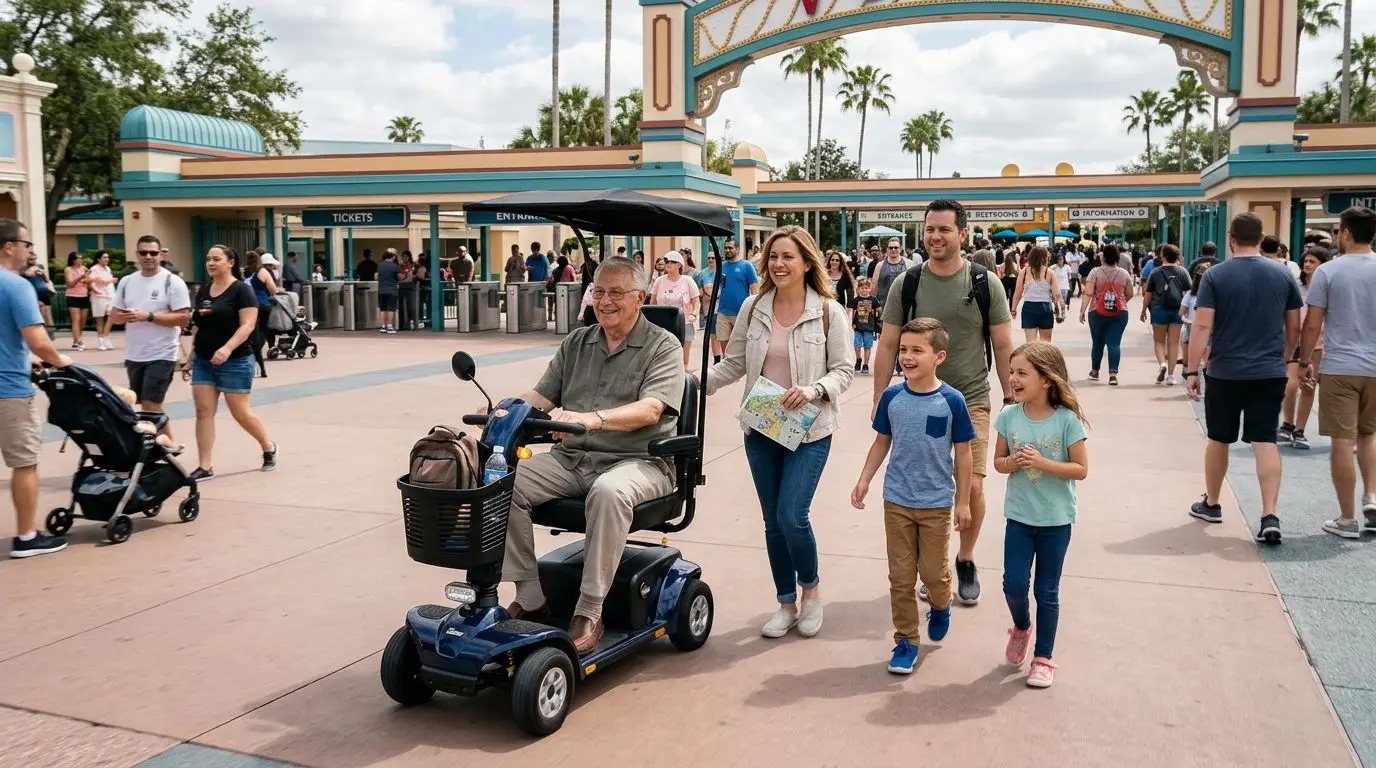
For US theme parks, an off-site mobility scooter rental is usually the better choice if you need the scooter at your hotel, in parking areas, or across multiple park days. An on-site rental is simpler for a single day inside one park, but supply may be limited and the scooter typically cannot leave the park. Reserve early, confirm battery range for an 8- to 12-hour day, and choose comfort features that fit your body size and walking limits.
Theme park days are long. Many guests cover 5 to 10 miles between parking, security, attractions, dining, parades, and transportation hubs. A mobility scooter can make the day more manageable, but only when the rental plan fits the trip. The right choice depends on where you need the scooter, how many days you will use it, how comfortable the seat is, and whether the battery can handle a full day without stress.
On-site vs. off-site rentals: 1 day inside the gate or 3 days door to door
Most US theme park guests choose between two rental paths: renting directly at the park or arranging delivery from an off-site rental company. The main difference is access. On-site rentals are usually picked up after you enter the park, while off-site rentals can often be delivered to a hotel, vacation rental, or designated meeting point before your park day starts.
If your walking difficulty begins at the parking lot, hotel corridor, shuttle stop, or ticket gate, that difference matters. A park entrance can be several hundred yards from rides and restaurants, and large resort transportation areas may add more walking before you reach the rental counter. On-site scooters help once you have them. Off-site scooters help before you get there.
| Rental option | Best use | Main advantage | Main tradeoff |
|---|---|---|---|
| On-site scooter rental | Single park day, limited walking only inside the park | Simple pickup and return at the park | May be first-come, limited supply, usually cannot leave the park |
| Off-site scooter rental | Multi-day trips, hotel-to-park mobility, long resort days | Use from hotel room to transportation and back | Requires reservation, delivery coordination, and storage/charging space |
| Manual wheelchair rental | Short-distance support with a companion to push | No battery to charge | Requires upper-body effort or caregiver assistance |
| Personal scooter brought from home | Frequent travelers who know their equipment | Familiar controls and fit | Airline, vehicle, and transport planning required |
On-site rentals can be convenient when you are comfortable walking from the car or bus to the entrance. They also remove the need to transport or charge equipment overnight. The catch is availability. Busy weekends, holidays, and school breaks can increase demand, and parks may not guarantee same-day scooter availability.
Off-site rentals require more planning but give you more control. Depending on what the provider offers, you can often choose among compact, standard, and higher-capacity scooters. You can also keep the scooter for the entire rental period, which helps with resort dining, evening events, and the trip back to your room when everyone is tired.
Who it is best for: 1 park day, 2-plus days, or a full resort stay
An on-site rental is best for someone who can comfortably walk at least 10 to 20 minutes at a time but wants seated mobility during the heaviest part of the day. It can also work for a visitor who is unsure whether they will need a scooter and wants a same-day option, as long as they accept the risk that units may run out.
An off-site rental is best for guests who need mobility support before the park entrance or after leaving at night. It is also the stronger choice for 2 or more park days, especially when the trip includes hotel lobbies, transportation stations, shopping areas, or long waits after fireworks and closing time.
Traveling with a senior parent? Plan around the weakest part of the day, not the strongest. Many people feel fine at 9 a.m. and struggle by 4 p.m. Heat, standing in lines, uneven pavement, and repeated transfers from scooter to seat can add up quickly.
- Choose on-site rental if: the guest can walk from parking or transportation to the rental location, needs a scooter only inside the park, and is visiting for 1 day.
- Choose off-site rental if: the guest needs help at the hotel, uses accessible transportation, visits for 2 or more days, or wants a better chance of reserving a specific scooter type.
- Consider bringing your own scooter if: the guest already relies on one daily and is comfortable arranging vehicle, airline, or lift logistics.
For a family group, pace matters too. A scooter user should not feel rushed through crowds or left behind after shows. Plan meeting points and rest stops every 60 to 90 minutes, even when the scooter has plenty of battery.
Reservations and pickup: book 2 to 4 weeks ahead for busy dates
For off-site rentals, reserving 2 to 4 weeks ahead is a practical target for ordinary travel dates. For major holidays, spring break, long weekends, or peak summer travel, earlier is safer. On-site park rentals may not always accept reservations, so check the current guest services policy before assuming availability.
When booking off-site, ask exactly where and how the scooter will be delivered. Some hotels allow approved vendors to leave mobility equipment with bell services, while others require the guest to meet the driver in person. Vacation rentals may have gate codes, elevator limits, or delivery windows that affect timing.
Confirm these details before travel:
- Delivery address, building number, and room or lobby procedure
- Pickup date, time window, and after-hours instructions
- Whether the scooter arrives fully charged
- Battery charger location and charging instructions
- What to do if the scooter has a flat tire, dead battery, or control problem
- Cancellation policy if weather, illness, or flight delays change the trip
Build in a buffer. If your first park reservation or ticketed event starts at 8 a.m., a delivery window that ends at 7:30 a.m. may be too tight. When possible, it is better to receive the scooter the evening before, charge it overnight, and learn the controls in a quiet hallway or parking area.
For on-site rental, arrive early on high-demand days. Bring a payment method, photo ID if required, and any documentation the park requests for deposits or agreements. Do not assume a scooter can be transferred from one park to another without checking the rule; many on-site rentals are tied to a specific location or same-day system.
Battery range for an 8- to 12-hour theme park day
A typical rental mobility scooter may advertise roughly 8 to 15 miles of range, while some larger scooters may advertise more. Real-world range can be lower because theme parks involve stop-and-go driving, ramps, heavy crowds, heat, rider weight, and frequent starts from a full stop. For planning, think in terms of a full 8- to 12-hour day rather than the most optimistic mileage number.
Battery range is not only about distance. A scooter can use extra power on inclines, textured pavement, long transportation ramps, and repeated acceleration after shows let out. Hot weather can also be hard on both the rider and the equipment. If the battery gauge drops faster than expected by midday, slow down, reduce unnecessary backtracking, and find a charging option before the evening rush.
| Day style | Typical scooter demand | Planning tip |
|---|---|---|
| Short visit, 4 to 6 hours | Lower demand if staying in one area | A standard full charge may be enough, but still start at 100 percent |
| Full day, 8 to 12 hours | Moderate to high demand with meals, shows, and repeated crossings | Ask about real-world range and carry the charger if allowed |
| Open-to-close day, 12-plus hours | High demand, especially in heat or crowds | Plan a midday charging break and reduce long backtracking |
| Multi-park or resort day | Higher demand due to transportation hubs and extra walking areas | Consider an off-site rental with a larger battery option if suitable |
Ask the rental provider how the battery gauge works. Some gauges drop gradually; others appear full for hours and then fall quickly. That can surprise first-time users. A simple rule is to treat half battery by midafternoon as a warning, not a comfort zone, if you plan to stay into the evening.
Charging is another detail to verify. Some scooters need several hours for a meaningful recharge, and a full overnight charge can take 6 to 8 hours depending on battery type and condition. Ask where the charging port is located and whether the charger is light enough for you or a companion to carry.
Comfort and sizing: seat width, weight capacity, and 6-hour fatigue
Comfort matters because a theme park rental may become your seat for 6 or more hours, even if you transfer to ride vehicles, benches, or restaurants. Seat width, back support, armrests, legroom, and suspension can make the difference between a useful aid and a miserable day.
Start with weight capacity. Never choose a scooter at or below the rider's weight. A safer planning approach is to leave a margin because bags, water bottles, medical supplies, and souvenirs add weight. If a rider weighs 250 lb, for example, a scooter rated exactly at 250 lb is not the right fit; ask for a higher-capacity category.
Seat width is personal, but many mobility scooter seats fall somewhere around 17 to 20 inches wide, with wider seats available on some larger rentals. If the rider uses a cushion, has hip discomfort, or needs room to shift position, ask about seat dimensions before booking. Armrests that flip up can also make transfers easier.
| Feature | Why it matters during a park day | What to ask |
|---|---|---|
| Seat width | Prevents hip pressure and cramped posture | What is the seat width in inches? |
| Weight capacity | Affects safety, range, and motor strain | What capacity category fits the rider plus bags? |
| Adjustable tiller | Helps wrist, shoulder, and reach comfort | Can the steering column be adjusted? |
| Armrests | Support posture and transfers | Do they lift up or adjust outward? |
| Basket or storage | Holds small items without hanging bags on controls | How much storage is included? |
| Lights or reflectors | Improve visibility in evening crowds | Are lights included and working? |
Do not overlook foot space. A rider with knee stiffness may need more legroom than a compact scooter provides. A rider with smaller hands may need easy-to-reach throttle controls. If the person has limited grip strength, ask how the controls work, but avoid assuming any scooter will solve a medical limitation.
Bring practical comfort items: a breathable seat cover or small cushion if permitted, a hat, sunscreen, and a lightweight rain cover for the rider. Avoid covering the scooter controls or battery area unless the rental provider says it is safe.
How to measure and choose: 3 widths, 1 weight number, and your longest route
Before reserving, gather 3 measurements and 1 number: the rider's weight, the rider's comfortable seat width, the narrowest doorway or storage space you must pass through, and the longest expected route of the day. This takes about 10 minutes at home and can prevent a poor rental match.
First, measure seating needs. Use a firm chair and measure the space that feels comfortable across the hips, then add a little room for clothing and movement. If the rider uses a cushion, measure with the cushion in place. Second, check doorways and elevators at your lodging when possible. Many interior doors are around 30 to 32 inches wide, while accessible routes are often wider, but older properties vary.
Third, map your day. You do not need exact mileage, but you should know whether you plan to move from one side of the park to the other 4 or 5 times, leave for a hotel break, or stay in one themed area. Repeated cross-park travel drains both battery and patience.
Questions to ask before you pay
- What scooter category fits the rider's height, weight, and legroom needs?
- What is the expected range for a full day in crowded, stop-and-go conditions?
- Is the scooter approved for the transportation options you plan to use?
- Can the scooter be disassembled or folded, or is it too heavy for a car trunk?
- What happens if the scooter stops working inside or outside the park?
- Are there extra rules for rain, overnight storage, or charging?
If you will use buses, vans, monorails, boats, trams, or rideshare vehicles, ask about dimensions and loading. Some scooters are compact and travel-friendly; others are sturdier but heavier and harder to transport. A scooter that is comfortable all day may not fit easily into every vehicle.
Crowd-friendly use: 3 mph speed, safe spacing, and show exits
In dense theme park crowds, a mobility scooter should move at walking speed, often around 2 to 3 mph. The goal is not to keep up with the fastest person in your group; it is to move predictably, protect pedestrians, and avoid sudden stops.
First-time users should practice before entering a busy walkway. Learn how the throttle responds, how sharply the scooter turns, and how long it takes to stop. Practice backing up only in open space. In crowds, backing can surprise people who cannot see the reverse movement.
Use a few simple habits:
- Leave several feet of space before stopping behind a stroller, child, or wheelchair.
- Cross pedestrian traffic slowly and at right angles when possible.
- Do not weave through tight gaps to keep up with companions.
- Pull to the side before checking a map or phone.
- Use lights after dark if the scooter has them.
- Let crowds clear for 5 to 10 minutes after fireworks, parades, or major shows.
Theme parks have their own accessibility rules for queues, ride transfers, scooter parking, and viewing areas. A scooter may be allowed in some lines but not others. Some ride vehicles require a transfer from the scooter to a seat, sometimes with a step down or sideways movement. Ask a staff member at each attraction rather than assuming the process is the same across the park.
Rain is another safety issue. Wet pavement increases stopping distance, and ponchos can hang near wheels if they are too long. Keep the control area dry, follow the rental provider's weather instructions, and avoid driving through standing water. A short delay under cover is better than damaging equipment or risking a slide.
24-hour checklist before your theme park scooter rental
The day before your visit, spend 15 minutes confirming the basics. A small checklist can prevent the most common rental problems: late delivery, no charger, poor fit, and a battery that starts the day below full.
- Confirm delivery or pickup time and location.
- Test the key, throttle, brakes, horn, and speed control.
- Check that the charger is present and matches the scooter.
- Charge overnight, ideally 6 to 8 hours or as instructed.
- Adjust the seat, armrests, and tiller before leaving.
- Photograph the scooter condition at delivery if appropriate.
- Pack the rental phone number, charger, water, and any medical essentials.
- Review park rules for accessibility entrances, scooter parking, and transportation.
Also make a family plan. Decide who walks with the scooter user, where you will meet if separated, and when to take breaks. A scooter supports mobility, but it does not remove the need for shade, hydration, meals, and pacing. If the rider has medical concerns about heat, endurance, or transfers, ask a qualified health professional before the trip.
The best rental choice is the one that reduces friction from morning to night. For many theme park guests, that means an off-site scooter delivered before the first park day. For others, an on-site rental is enough. Match the equipment to the route, not just the ticket.
FAQ: 5 common questions about theme park scooter rentals
Is on-site or off-site scooter rental cheaper?
Rates vary by park, location, season, rental length, scooter type, deposit rules, and delivery policy. Do not compare only the daily rate. For a 3-day trip, off-site rental may be more practical because it covers hotel and transportation areas, while on-site rental may be simpler for 1 day inside one park.
Can I take a rented mobility scooter on theme park transportation?
Often yes, but rules depend on the transportation system, scooter size, securement space, and staff procedures. Check current park transportation policies before travel, especially if you plan to use buses, boats, trams, or rail-style systems.
Will a scooter battery last all day at a theme park?
It can, but do not rely only on advertised maximum range. A full 8- to 12-hour day with heat, ramps, crowds, and stop-and-go use can drain a battery faster. Start fully charged, ask about real-world range, and plan a charging break for long days.
Do I need medical paperwork to rent a mobility scooter?
Most rental situations do not require medical paperwork, but policies vary by provider and park. You may need identification, a rental agreement, payment method, or deposit. Accessibility services for attractions may have separate procedures.
Can a first-time user safely drive a scooter in a crowded park?
Many first-time users do fine when they practice first and keep speeds low. Learn the controls in an open area, drive at walking pace, avoid tight weaving, and let heavy crowds clear after shows. If the rider has vision, reaction time, or hand-control concerns, get professional advice before relying on a scooter.
Frequently asked questions
Is on-site or off-site scooter rental better for a theme park trip? +
On-site rental is usually best for 1 day inside one park if you can walk to the entrance. Off-site rental is usually better for multi-day trips or when you need the scooter at the hotel, parking area, or transportation stops.
How early should I reserve an off-site mobility scooter rental? +
For typical travel dates, reserving 2 to 4 weeks ahead is a practical target. For holidays, spring break, summer peaks, or long weekends, book earlier because demand and delivery windows can fill up.
How much battery range do I need for a full theme park day? +
Plan for an 8- to 12-hour day, not just the advertised mileage. Ask the rental provider about real-world range in crowds, heat, ramps, and stop-and-go use, and consider a midday charging break for open-to-close visits.
What scooter features matter most for comfort? +
The most important comfort factors are proper weight capacity, seat width, legroom, adjustable armrests, tiller reach, and enough storage for small essentials. A scooter that fits poorly can become uncomfortable after several hours.
Can I use a mobility scooter in theme park ride lines? +
Sometimes, but it depends on the attraction and the park's current accessibility procedures. Some queues allow scooters, while others require parking the scooter or transferring to a wheelchair or ride seat. Ask staff at each attraction.
Related guides
Mobility Scooters for Theme Parks, Shopping, and Long Days Out: What Type Should You Choose?
14 min read
Can You Bring a Mobility Scooter to Theme Parks, Stadiums, Museums, and Other Venues?
16 min read
Renting a Mobility Scooter for Travel: When It Beats Bringing Your Own
13 min read