Veterans may be able to receive a mobility scooter through VA health care when it is medically necessary for safe, functional mobility—not simply because a scooter would be convenient. The usual path includes enrollment in VA health care, a clinical evaluation, and approval through VA prosthetics or a related mobility equipment process. Start with your VA primary care team and ask for a mobility evaluation.
This guide explains how the process usually works in the United States, what the VA looks for, and how to prepare before your appointment. It is brand-neutral and focused on coverage through VA health care, not retail shopping.
How VA scooter coverage works in 2026: 1 medical-necessity decision
For VA purposes, a mobility scooter is a type of durable medical equipment that may be furnished when a veteran has a documented medical need. The key point is this: the VA generally does not treat scooters as consumer convenience items. A scooter must help address a functional mobility limitation that affects daily activities, safety, or access to care.
The decision is usually clinical. Your provider may consider your diagnosis, walking distance, balance, fall risk, endurance, pain, vision, cognition, ability to transfer, and whether you can operate a scooter safely. The VA may also consider whether a cane, walker, manual wheelchair, power wheelchair, or scooter is the most appropriate option.
In many cases, a scooter request passes through several VA roles. A primary care provider may start the referral. Physical therapy, occupational therapy, rehabilitation medicine, or a wheelchair and seating clinic may perform the evaluation. The prosthetics department or another equipment office may handle authorization, ordering, delivery, fitting, and repairs.
Coverage can vary based on clinical facts and local VA workflow. Two veterans with the same diagnosis may receive different recommendations if one can safely walk 200 feet with a walker and the other cannot cross a parking lot without stopping. Documentation matters.
Who it is best for: 3 common eligibility factors
A VA-provided mobility scooter is generally best for a veteran who has a mobility limitation, can safely use a scooter, and needs powered mobility for activities that matter in daily life. It is not automatically tied to age or a particular disability rating.
Three factors commonly shape the decision:
- VA health care enrollment. Most veterans begin by enrolling in VA health care. If you are not enrolled, you can apply using VA Form 10-10EZ, online through VA resources, by phone, by mail, or in person at a VA medical center.
- Documented medical need. The VA needs clinical evidence that your condition limits mobility. Examples can include neurologic conditions, cardiopulmonary limitations, severe arthritis, limb loss, chronic pain conditions, or other impairments that affect safe walking.
- Safe and appropriate use. A scooter user typically needs enough vision, judgment, upper-body function, sitting balance, and reaction time to steer, stop, transfer, and manage the device in real settings.
Service connection can matter for some VA benefits, but a veteran does not always need a 100% disability rating to be considered for medical equipment through VA health care. The central question is whether the device is clinically appropriate and medically necessary under VA care.
A scooter may not be the best fit for every veteran. If you cannot safely transfer on and off the seat, need complex seating support, cannot operate a tiller-style steering system, or need powered mobility inside very tight rooms, a different mobility device may be recommended.
Medical evaluation: what to expect in a 30- to 90-minute visit
A mobility evaluation often takes about 30 to 90 minutes, depending on the clinic, the complexity of your condition, and whether measurements or trial equipment are available that day. Some veterans need more than 1 appointment, especially when the home environment, transportation, or seating needs are complicated.
The clinician may ask how far you can walk, what happens when you walk too long, how often you fall or nearly fall, and which daily tasks are limited. Be specific. Saying “I have trouble walking” is less useful than saying “I can walk about 50 feet with a cane before I need to sit for 5 minutes.”
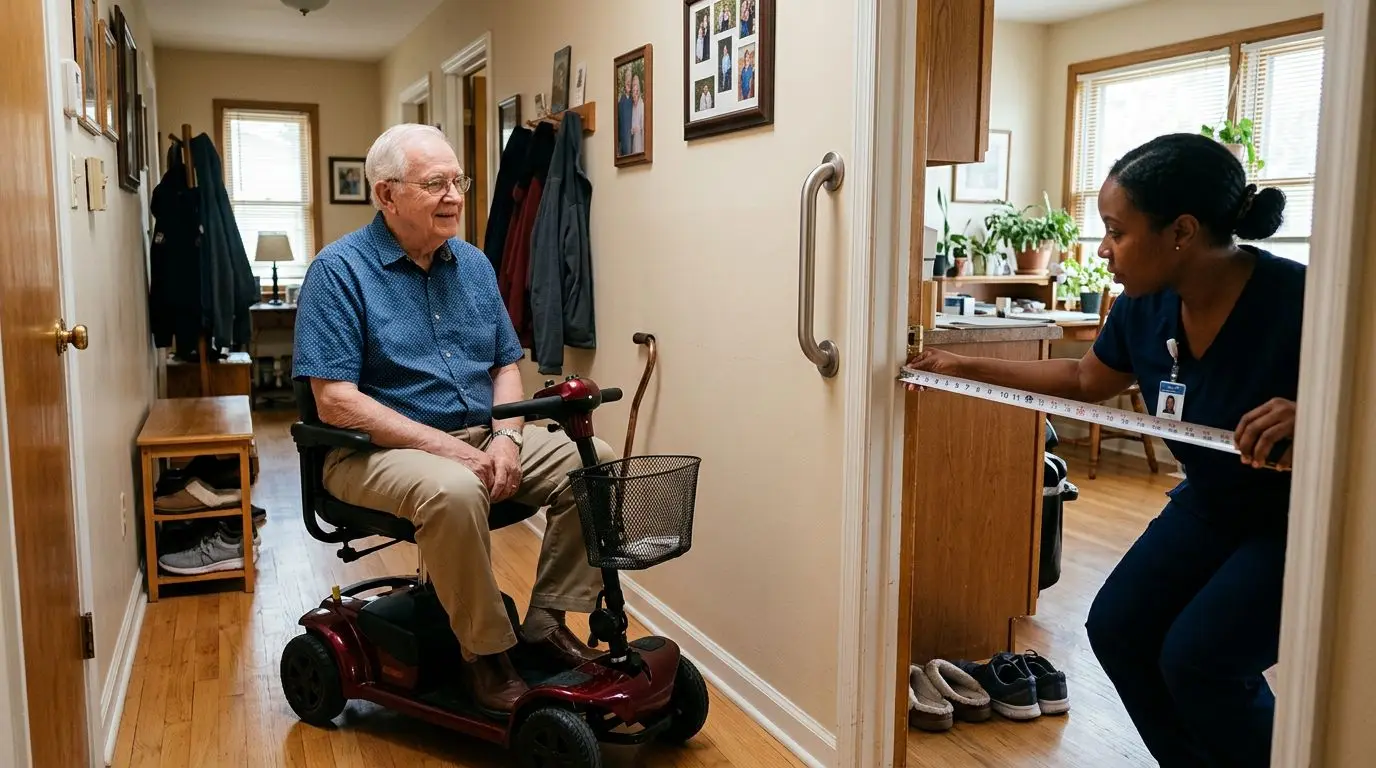
Expect to discuss your home, including doorways, floors, ramps, elevators, bathroom access, and where the scooter would be stored and charged. Scooters need room to turn and a safe charging location. If your apartment has a narrow hallway or several steps at the entrance, the VA may need to consider whether the equipment will actually work for you.
The evaluation may include:
- Walking distance and gait observation
- Strength, balance, endurance, and transfer ability
- Vision, cognition, and reaction time related to safe operation
- Pain, fatigue, shortness of breath, or other symptoms during activity
- Review of current devices, such as a cane, walker, brace, or wheelchair
- Discussion of home access and transportation
| Mobility option | Often considered when | Important limitation |
|---|---|---|
| Manual wheelchair | The veteran can self-propel or has reliable caregiver assistance for shorter distances. | May be difficult with shoulder pain, low endurance, or steep outdoor routes. |
| Mobility scooter | The veteran can sit upright, transfer safely, steer with a tiller, and needs powered help for longer distances. | Usually needs more turning space and may be less suitable for tight indoor layouts. |
| Power wheelchair | The veteran needs powered mobility with tighter maneuvering, specialized seating, or joystick control. | May require more detailed fitting and transportation planning. |
How veterans can start the process in 5 steps
The most practical starting point is your VA primary care team. You do not need to walk into a retail store first, and buying a scooter on your own before evaluation may not lead to reimbursement. Ask the VA directly before making a private purchase.
- Confirm VA health care enrollment. If you are not enrolled, apply first. Veterans can use VA Form 10-10EZ or contact VA health benefits support. Enrollment must usually be in place before VA medical equipment is furnished.
- Send a clear message to your care team. Tell your primary care provider that you are having mobility problems and would like an evaluation for powered mobility. Include specific examples, such as falls, distance limits, or missed appointments.
- Ask for the right referral. Depending on your VA facility, this may be to physical therapy, occupational therapy, rehabilitation medicine, prosthetics, or a wheelchair/seating clinic.
- Prepare for the evaluation. Bring your current cane, walker, brace, oxygen equipment, or wheelchair if you use one. Bring a medication list and be ready to describe your home layout.
- Follow up in writing. After the visit, ask what was recommended, which department handles the next step, and when you should expect an update. A secure message can create a helpful record.
If you receive care outside the VA, bring relevant records. A community physician’s note can support the discussion, but the VA will usually still need its own evaluation and approval process.
How to measure your home and daily routes: 6 numbers to bring
Good measurements can prevent delays. A scooter that cannot enter your home, turn in your hallway, fit in your vehicle, or reach a safe charging spot may not be appropriate. Before your appointment, write down at least 6 practical measurements.
| Measurement | How to measure it | Why it matters |
|---|---|---|
| Narrowest doorway width | Measure the clear opening in inches, not the door slab. | Many scooters need enough width for the base, hands, and safe entry. |
| Hallway width | Measure the tightest hallway or turn, especially near bedrooms and bathrooms. | Tight halls can make scooter use unsafe or impractical indoors. |
| Step height at entry | Measure each step from ground to top surface. | A scooter cannot climb standard steps; ramps or alternate access may be needed. |
| Ramp length and slope | Note ramp length, rise, surface, and handrails if present. | Steep ramps may exceed safe scooter use, especially in wet weather. |
| Distance to mailbox, parking, or clinic entrance | Estimate in feet or blocks; use a phone map if helpful. | This helps document real-world mobility needs beyond the living room. |
| Vehicle cargo space or lift setup | Measure trunk opening, cargo floor, or hitch capacity if you already use a carrier. | Transport affects whether a scooter can be used for appointments and community access. |
Photos can help. Take 4 to 8 pictures of your entrance, hallway turns, storage area, and outdoor route. Do not risk a fall to get measurements; ask a family member, caregiver, neighbor, or building manager if needed.
Scooter types and features: 3 categories the VA may consider
The VA does not choose a scooter the way a retail buyer compares colors or accessories. Clinicians look at function, safety, fit, and the environment. Still, it helps to understand the broad categories that may come up during the evaluation.
| Type or feature | Best suited for | Questions to ask |
|---|---|---|
| Compact travel-style scooter | Shorter community trips, easier storage, and situations where disassembly may be needed. | Can you safely assemble, lift, or manage the parts, or will you always have help? |
| Standard 3-wheel scooter | Veterans who need a tighter turning radius and use mostly smooth surfaces. | Is stability adequate for your balance, weight, speed control, and outdoor terrain? |
| Standard 4-wheel scooter | Veterans who need more stability outdoors and have enough room to turn. | Will it fit through your doors and turn where you need it to turn? |
| Adjustable seat and armrests | Veterans who need safer transfers and better seated posture. | Can you get on and off without twisting, sliding, or losing balance? |
| Battery range | Veterans who need to reach parking lots, clinics, dining areas, or community locations. | Does the expected route fit within the battery range with a safety margin? |
| Lighting, horn, and reflectors | Veterans who travel in parking lots, hallways, campuses, or low-light areas. | Will other pedestrians and drivers be able to see and hear you? |
Scooters commonly have weight capacities listed in pounds, and seat dimensions are usually measured in inches. Be honest about body weight, leg position, swelling, posture, and pain. Accurate measurements help the VA match the equipment to you safely and respectfully.
Costs, repairs, and timelines: 2 responsibilities to understand
When a scooter is approved as medically necessary through VA health care, the VA may furnish the equipment rather than asking the veteran to buy from a retailer. Benefits, copays, repairs, replacement rules, and local procedures can depend on your enrollment status, priority group, service connection, and the specific VA process.
Do not assume a private purchase will be reimbursed. If you buy a scooter first, the VA may not repay you unless the purchase was authorized under the correct rules. Ask before spending money.
Two responsibilities are especially important:
- Use the scooter as prescribed. Follow training, speed, charging, and safety instructions. Avoid passengers, unsafe slopes, wet surfaces, and roadways where scooters are not appropriate.
- Report problems promptly. If the battery fails, brakes feel weak, tires wear down, or the scooter no longer fits your needs, contact the VA department that manages your equipment. Do not attempt major repairs that could create safety problems.
Timelines vary. A straightforward evaluation and approval may move faster than a complex case involving home access, special seating, or transportation issues. It is reasonable to ask for an expected timeline in weeks, the name of the department handling the request, and how you will be notified.
If your scooter request is denied: 3 practical next steps
A denial or recommendation for a different device does not necessarily mean the VA is ignoring your mobility needs. It may mean the clinical team believes another option is safer, more medically appropriate, or more realistic for your home.
If you disagree, take these 3 steps:
- Ask for the reason in plain language. Was the concern safety, home access, lack of documentation, ability to walk a certain distance, or a recommendation for a different device?
- Request reconsideration with better information. Provide fall history, walking-distance limits, photos, outside medical records, or updated symptoms. If your condition has changed, say so clearly.
- Contact the Patient Advocate if communication breaks down. Every VA medical center has a Patient Advocate office that can help you understand the process, identify the right department, and address concerns about delays or communication.
For formal disputes about VA health care decisions, ask your facility about the local clinical appeals process. This is different from filing a disability compensation claim. Keep copies of secure messages, appointment notes, and any written decisions you receive.
FAQ: 5 common questions about VA mobility scooter benefits
Does the VA pay for mobility scooters for veterans?
The VA may provide a mobility scooter when it is medically necessary and approved through the VA health care process. Approval usually requires enrollment, a clinical evaluation, and documentation that a scooter is safe and appropriate for your functional needs.
Do I need a VA disability rating to get a scooter?
Not always. A disability rating may be relevant in some situations, but VA medical equipment decisions are typically based on clinical need and health care eligibility. Ask your VA care team to evaluate your mobility even if your rating is low or you do not have one.
Can my private doctor prescribe a scooter and have the VA cover it?
A private doctor’s note can be helpful, but the VA usually requires its own review or evaluation before furnishing equipment. Bring outside records to your VA appointment and ask that they be added to your chart.
Will the VA cover a scooter for outdoor use only?
Possibly, but it depends on your medical need, safety, and functional goals. Be ready to explain specific outdoor tasks, such as reaching a parking area, clinic entrance, mailbox, dining hall, or community location, and why a cane, walker, or manual wheelchair is not enough.
What if my home has steps or narrow doorways?
Tell the VA before equipment is ordered. Steps, narrow doorways, steep ramps, and tight turns can affect whether a scooter is safe or usable. Measurements and photos can help the team decide whether a scooter, power wheelchair, ramp solution, or another option should be considered.
Frequently asked questions
Does the VA pay for mobility scooters for veterans? +
The VA may provide a mobility scooter when it is medically necessary and approved through the VA health care process. Veterans usually need VA health care enrollment, a clinical evaluation, and documentation that the scooter is safe and appropriate.
Do I need a VA disability rating to get a mobility scooter? +
Not always. A VA disability rating may matter for some benefits, but medical equipment through VA health care is generally based on clinical need, eligibility, and safety.
How do I start a VA mobility scooter request? +
Contact your VA primary care team and ask for a mobility evaluation for powered mobility. Your provider may refer you to physical therapy, occupational therapy, rehabilitation medicine, prosthetics, or a wheelchair and seating clinic.
Can I buy a scooter first and ask the VA to reimburse me? +
Do not assume reimbursement will be approved. The VA usually needs to authorize equipment through the proper process before purchase, so ask your VA care team before spending money privately.
What should I bring to a VA scooter evaluation? +
Bring your current mobility aids, medication list, outside medical records if available, and notes about walking distance, falls, pain, fatigue, and home measurements such as doorway width, steps, and ramp access.
Related guides

Mobility Scooter Evaluation for Medicare: What to Expect From the Medical Exam and Home-Use Review
15 min read
Mobility Scooters for Adults Under 65: Work, Errands, Fatigue, and Long-Term Mobility Needs
13 min read
Does Medicare or Insurance Cover Mobility Scooters? A US Buyer’s Guide
12 min read