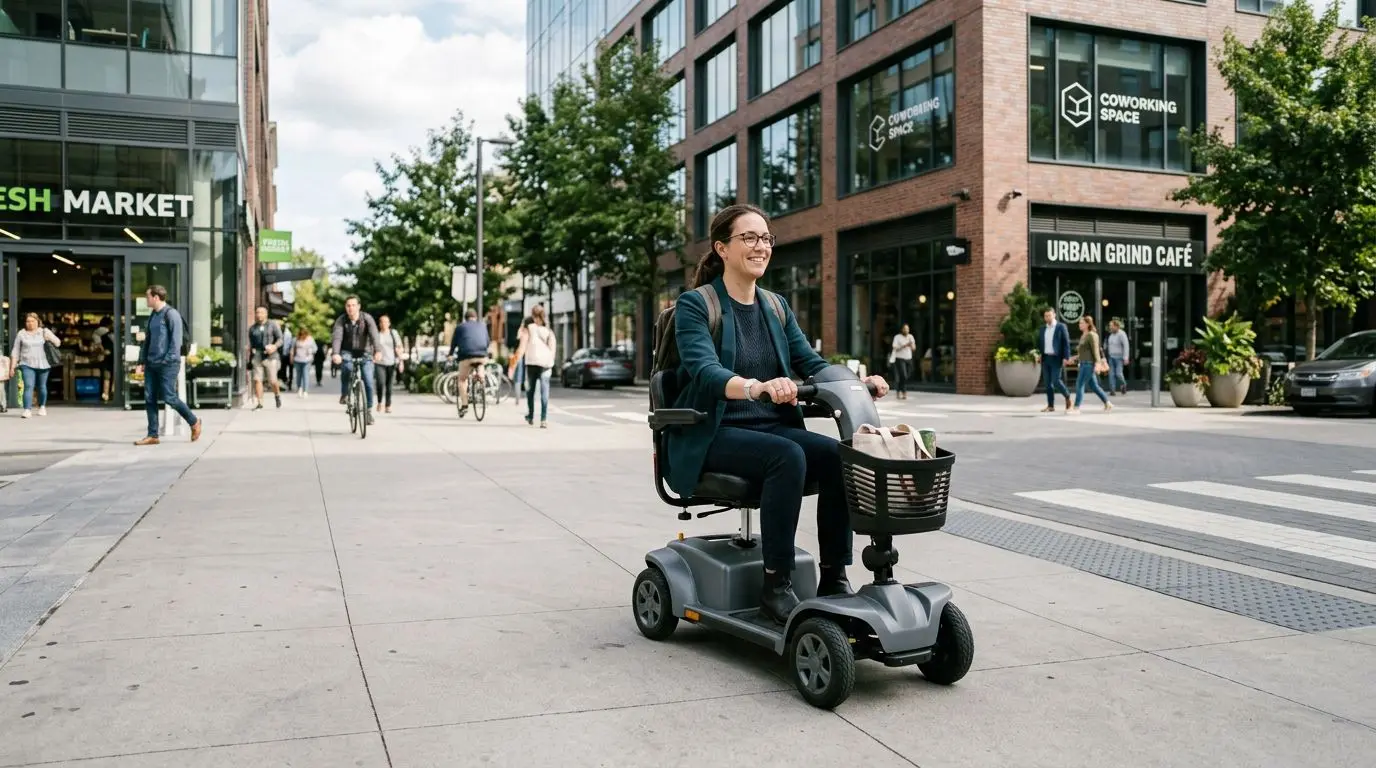
Mobility scooters can be a practical option for adults under 65 who can walk some distance but struggle with fatigue, pain, balance, stamina, or long days away from home. The right scooter can make work, errands, appointments, and social plans easier to manage, as long as it fits your body, transportation needs, home layout, and daily routes.
For non-senior adults, the decision is less about age and more about function. If walking 5 to 10 minutes leaves you unable to get through the rest of your day, a mobility scooter may help you conserve energy while staying active in the places that matter to you.
Is a mobility scooter reasonable before 65? Start with a 10-minute reality check
Yes. Adults in their 20s, 30s, 40s, 50s, and early 60s use mobility scooters for many reasons, including chronic fatigue, joint pain, neurological conditions, injury recovery, cardiopulmonary limitations, autoimmune flares, balance concerns, or long-term disability. A scooter is not a sign that you have stopped trying. It is a tool that may help you do more with the energy and mobility you have.
A useful starting point is the 10-minute test: if standing or walking for about 10 minutes regularly affects your ability to work, shop, cook, care for family, attend school, or participate socially, it is reasonable to explore mobility equipment. That does not mean a scooter is the only answer. Some adults do better with a cane, rollator, manual wheelchair, power chair, or a combination of tools.
Who it is best for
- Adults who can sit upright and safely operate hand controls.
- People who can transfer on and off the scooter independently or with planned help.
- Workers, students, caregivers, or active adults who need to conserve energy across a full day.
- People who walk short distances at home but need help for stores, campuses, airports, parking lots, or job sites.
- Adults whose symptoms fluctuate and who need backup mobility on bad days.
Who may need a different device
- Someone who cannot safely steer, brake, or react to obstacles.
- A person who needs full-time seated mobility indoors in tight rooms; a power chair may maneuver better.
- Anyone who cannot transfer safely and has no transfer support.
- People who need significant postural support beyond a standard scooter seat.
If your mobility changes are new, worsening, or unexplained, talk with a qualified clinician. A scooter can support independence, but it should not replace medical evaluation when symptoms need attention.
Types of adult mobility scooters compared: 3 wheels, 4 wheels, folding, full-size, and heavy-duty
Most adult scooters fall into a few broad categories. The best type depends on where you use it most: inside an apartment, across a workplace, through grocery aisles, on sidewalks, in a car trunk, or over uneven outdoor ground. Many adult scooters travel roughly 4 to 8 mph, though speed varies by design and setting.
| Type | Typical strengths | Common tradeoffs | Best fit |
|---|---|---|---|
| 3-wheel travel scooter | Tighter turning, often easier indoors, commonly disassembles | Less lateral stability than many 4-wheel designs | Apartments, offices, stores, short errands |
| 4-wheel travel scooter | More stable feel, still portable in many cases | Wider turning radius than 3-wheel options | Mixed indoor and outdoor daily use |
| Folding scooter | Compact storage, useful for rideshares or small homes | May have smaller wheels and limited suspension | Adults who prioritize portability over ruggedness |
| Full-size scooter | Larger seat, better range, more comfort features | Harder to lift, store, or fit in a small car | Long workdays, frequent errands, outdoor routes |
| Heavy-duty or all-terrain style | Higher weight capacity, larger tires, stronger frame | Heavier, larger, less convenient indoors | Rough sidewalks, longer outdoor routes, larger users |
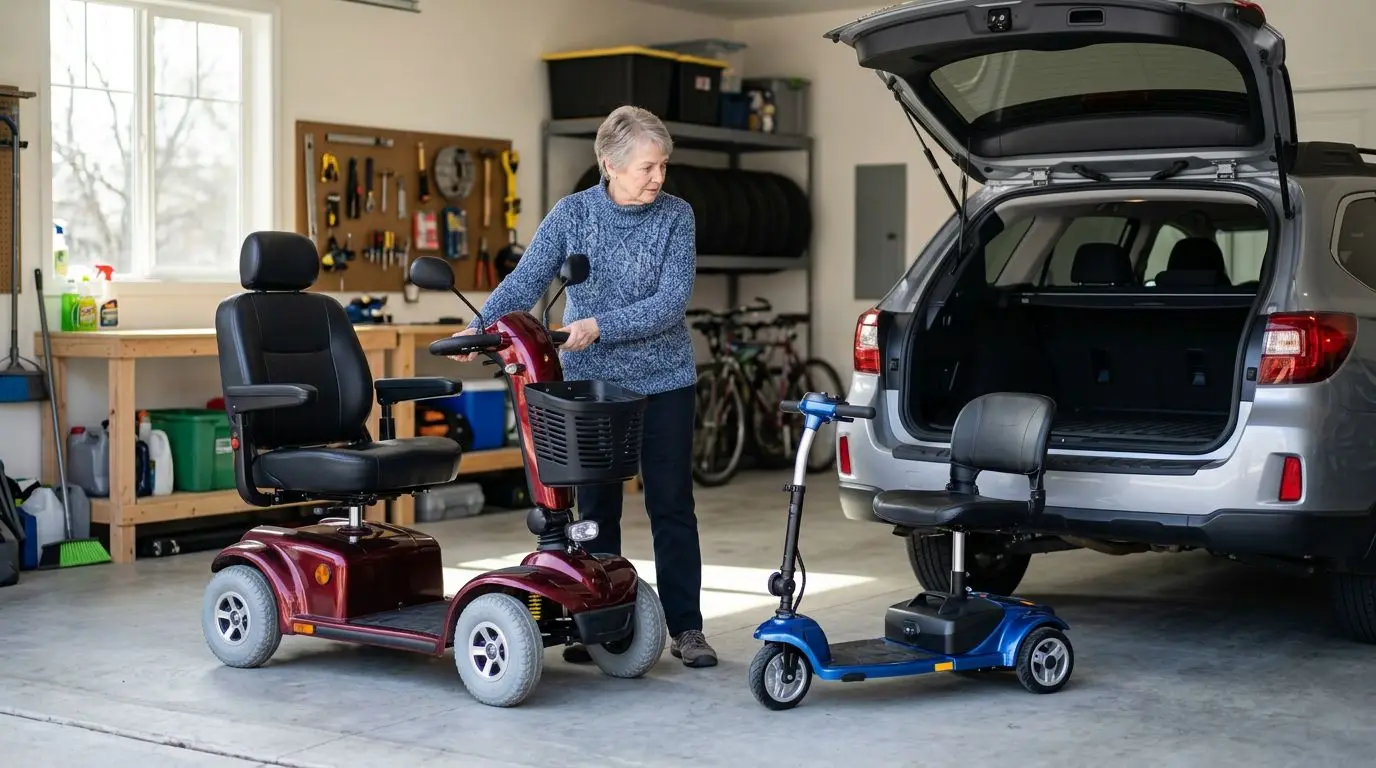
For portability, pay close attention to the heaviest single piece after disassembly. Some travel scooters break into pieces, with the heaviest section often in the 35 to 60 lb range. That may sound manageable until you lift it into a trunk at the end of a painful or exhausting day. If you cannot lift that weight safely 2 or 3 times in a row, plan for a vehicle lift, a lighter device, or a different transportation setup.
Weight capacity matters just as much. Many standard adult scooters are designed around common user weight ranges, while heavy-duty designs may support higher capacities. Choose based on your fully dressed weight plus anything you carry, such as a backpack, oxygen equipment, laptop bag, or groceries. Do not treat the published capacity as a performance target; a little margin helps with comfort and wear.
Using a scooter for work, school, or commuting during an 8-hour day
Work use is one of the biggest reasons adults under 65 consider a scooter. A full workday can include the parking lot, security desk, elevator, long hallways, bathroom trips, lunch, meetings, and the return trip home. Even if each walk is only 200 feet, the total can become a barrier.
Start by mapping a real day. Count the distance from parking or transit to your desk, the number of doorways, elevator rides, restroom access, and where the scooter will sit while you work. A scooter that feels fine in a medical office hallway may be awkward in a crowded break room or beside a narrow cubicle aisle.
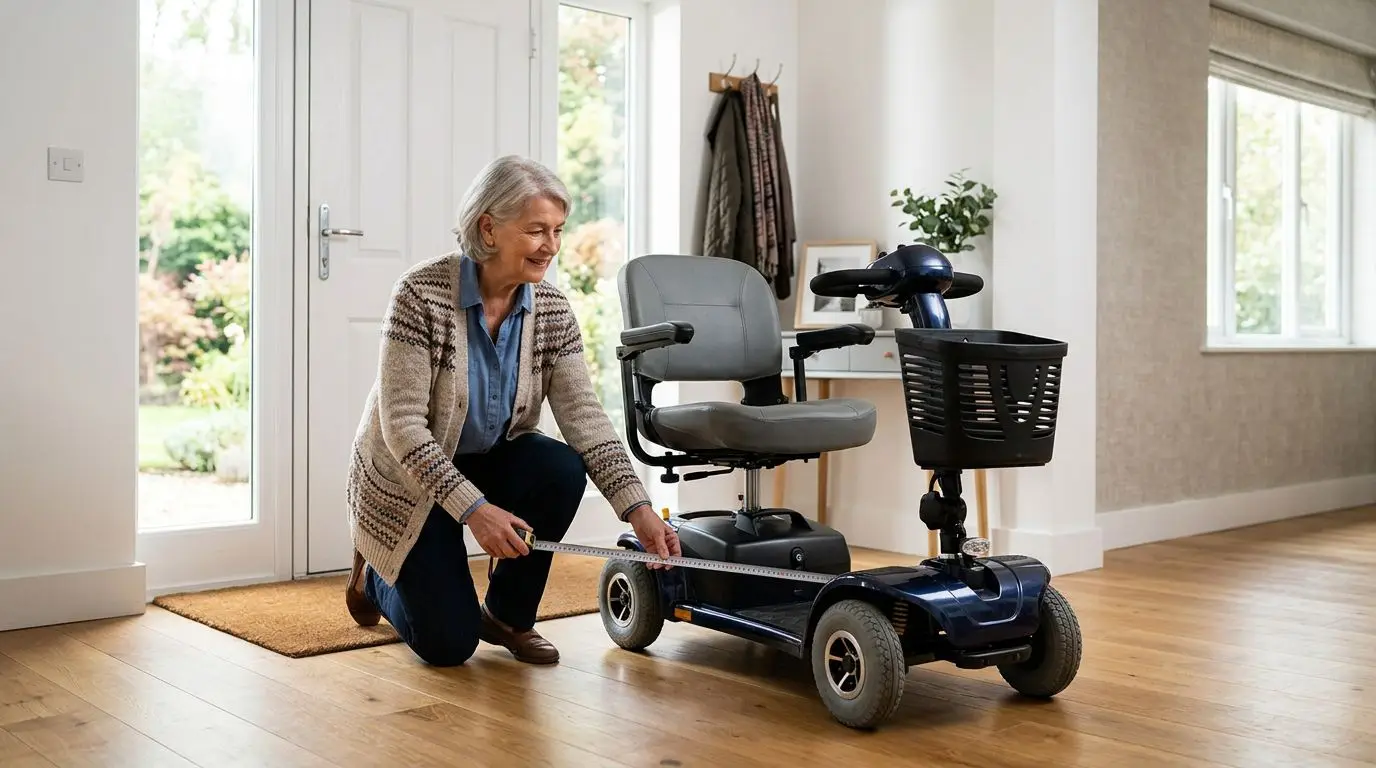
Important workplace details include doorway width, turning space, flooring, and charging access. Many accessible doorways are about 32 inches of clear opening, and accessible routes are often planned around 36 inches of clear width, but older buildings may vary. Measure your actual workplace route instead of assuming it will fit.
- Desk fit: Check whether the tiller and front basket clear your desk or whether you will transfer to a chair.
- Charging: Ask if plugging in during the day is allowed. Some batteries may take several hours to recharge fully.
- Storage: Identify a safe parking spot that does not block exits, fire lanes, or walkways.
- Meetings: Test conference rooms, training rooms, and shared tables before a high-pressure day.
- Weather: Plan for wet pavement and entrances. Most scooters are not meant to be left in heavy rain.
For commuting, think beyond the scooter itself. If you use a bus, paratransit, train, rideshare, or carpool, confirm size and securement rules ahead of time. Public transportation systems often accommodate mobility devices, but space, ramps, lifts, and tie-down procedures differ.
Errands and everyday independence: groceries, appointments, and trips under 3 miles
Errands are where a scooter can change daily life quickly. A pharmacy run, grocery trip, bank visit, or school pickup may be only 1 to 3 miles from home, but that distance can be too much when fatigue, pain, or balance problems build during the day.
For grocery shopping, consider basket size and carrying limits. A front basket may handle small items, but a gallon of milk weighs about 8.6 lb, and a modest grocery bag can easily reach 10 to 15 lb. Hanging heavy bags from the tiller is unsafe because it can affect steering and balance. Use approved storage points only, and keep weight low and centered.
Sidewalk quality matters. Small wheels are fine for smooth store floors, but cracked sidewalks, curb cuts, gravel patches, and driveway lips can be frustrating. If your normal routes include 1-inch bumps, uneven curb ramps, or frequent rough pavement, look for larger wheels, better ground clearance, and suspension rather than focusing only on portability.
Inside stores, smaller scooters are easier to manage around displays and checkout lanes. Outside, larger scooters often feel more stable and comfortable. That is the central compromise: the scooter that fits best in a compact car may not be the one you prefer for a long outdoor errand route.
| Errand need | Helpful feature | Why it matters |
|---|---|---|
| Quick pharmacy trip | Compact frame and tight turning | Easier in narrow aisles and small waiting areas |
| Weekly groceries | Stable 4-wheel base and approved storage | Better control with light to moderate carried items |
| Medical appointments | Comfortable seat and reliable range | Waiting rooms and long hallways can add time |
| Neighborhood travel | Lights, reflectors, larger tires | Improves visibility and comfort on sidewalks |
| Car-based errands | Disassembly or folding design | Makes loading and unloading realistic |
Fatigue, pain, and fluctuating symptoms: plan for the worst 20 percent of days
Many adults under 65 do not need a scooter every minute. They need it when symptoms flare, when the day is long, or when walking would use energy they need for work, parenting, school, or basic self-care. This is common with fluctuating conditions.
A practical way to choose is to plan for your hardest 20 percent of days, not your best day in the showroom. On a good day, almost any scooter may feel acceptable. On a bad day, the seat height, throttle pressure, tiller angle, armrest support, and ease of loading matter much more.
Treat comfort as a functional need, not a luxury. A seat that is too narrow, too low, or too firm can increase fatigue during a long errand or work shift. Armrests may help with posture and transfers. A swivel seat can reduce twisting when getting on and off. Suspension can reduce jarring over sidewalk seams, though it does not turn a scooter into an off-road vehicle.
Social comfort matters too. Younger adults may feel self-conscious using mobility equipment, especially if they can sometimes walk. That feeling is real. Still, an invisible condition is still valid, and needing mobility support part-time does not mean you are using it incorrectly.
- Use the scooter before you are fully exhausted, not only after symptoms peak.
- Build in rest breaks during long outings.
- Keep walking ability if advised by your clinician, but do not force painful overexertion to prove need.
- Have a backup plan for dead batteries, severe weather, or inaccessible entrances.
How to choose and measure: 7 numbers to write down before buying
A scooter that looks perfect online can fail in real life because of 1 inch at a doorway, 5 lb at the trunk, or 2 miles of missing range. Before comparing features, gather these 7 numbers.
| Measurement | How to check it | Why it matters |
|---|---|---|
| User weight plus carried items | Add body weight, clothing, bags, and regular equipment | Helps choose capacity with a safety margin |
| Seat width needed | Measure hip width while seated, then add comfort space | Prevents pressure and cramped posture |
| Doorway clear width | Measure the open space, not the door frame | Confirms home, work, and bathroom access |
| Hallway turning space | Measure narrow turns, elevator entries, and apartment corners | Determines whether 3-wheel or compact designs are needed |
| Vehicle cargo opening | Measure trunk width, depth, and lift-over height | Shows whether loading is realistic |
| Heaviest scooter piece | Check the weight of the largest section after disassembly | Protects your back and shoulders during loading |
| Daily travel distance | Add all trips, then include a buffer | Helps estimate battery range needs |
Range estimates can be tricky. Published range is usually based on controlled conditions, while real-world range is affected by user weight, hills, stop-and-go travel, tire condition, temperature, and battery age. If your normal day is 6 miles, a scooter rated just above that may leave too little margin. Many adults feel better with at least 25 to 30 percent extra range for unexpected detours.
Test the controls if possible. Some scooters use thumb levers, some use paddles, and some require more hand strength than expected. If you have arthritis, weakness, tremor, numbness, or one-sided limitations, control layout is not a minor detail.
Check ground clearance as well. A low scooter may be convenient indoors but scrape on thresholds or curb cuts. If your front door has a 1-inch threshold, test it with a ramp or threshold solution rather than forcing the scooter over it.
Safety, access, and transportation rules: know the 4 mph indoor mindset
Mobility scooters are not toys, and they are not bicycles. Indoors, a walking-speed mindset is safest. Many people move at roughly 3 to 4 mph when walking briskly, and that is a useful reference point in stores, offices, clinics, and crowded sidewalks.
Use slower speeds around pedestrians, doorways, pets, children, and blind corners. Keep both feet on the deck, avoid sudden turns on slopes, and do not carry passengers unless the device is specifically designed for that purpose. A scooter with a 300 lb capacity is not intended to carry two people whose combined weight happens to fit under that number.
Ramps need special attention. A common accessibility guideline is a 1:12 slope, meaning 1 inch of rise for every 12 inches of ramp run. Steeper portable ramps can feel unstable and may exceed what a scooter can handle safely. Always follow the scooter and ramp manufacturer limits.
Air travel and transit require planning. Airlines often transport mobility devices, but battery type, size, labeling, and advance notice matter. Lithium batteries, sealed lead-acid batteries, and other battery types may be handled differently. Contact the airline before travel and arrive early enough for inspection and loading procedures.
For car transport, secure every component. A loose battery, seat, or scooter base can become dangerous in a sudden stop. If using an exterior carrier or lift, confirm that the vehicle, hitch, lift, and scooter weight are compatible.
Long-term mobility planning: think 1 to 5 years ahead
Adults under 65 often need to think differently than someone buying a scooter for occasional retirement travel. You may be using the device around a job, growing family, changing health condition, future housing, or years of daily transportation. A scooter that works for one vacation may not be the right long-term mobility tool.
Think about the next 1 to 5 years. Could your condition improve, stay stable, or progress? Might you move to a different apartment, change jobs, return to school, or stop driving? The more uncertain your needs are, the more valuable adjustability, repairability, and service access become.
Maintenance is part of independence. Tires, brakes, armrests, batteries, chargers, upholstery, and electrical connections can wear out. Battery life varies widely by chemistry, charging habits, storage, and use, but many scooter batteries eventually need replacement after regular use. Store the scooter in a dry place, charge according to instructions, and do not ignore new noises, reduced range, or braking changes.
Funding can be complicated. Health insurance, workplace accommodations, vocational rehabilitation, disability programs, health savings funds, community grants, or private purchase may be options depending on your situation. Coverage often depends on medical necessity, where the device will be used, and documentation. Get written requirements before assuming any scooter will be reimbursed.
Finally, include the people who help you. If a partner, coworker, friend, or family member will load the scooter, store it, charge it, or travel with you, their physical limits and routines matter too. A mobility plan works best when it fits the whole day, not just the first 10 minutes of use.
FAQ: 5 common questions from adults under 65
Can I use a mobility scooter if I can still walk?
Yes. Many scooter users can walk short distances but cannot walk far enough, long enough, or often enough to complete daily tasks. Part-time use is valid when it helps you function safely and conserve energy.
Is a scooter better than a power wheelchair?
It depends. Scooters are often good for people who can transfer, sit upright, and use tiller steering. Power wheelchairs usually offer tighter indoor maneuvering and more seating support, which may suit people who need full-time seated mobility.
Will I be allowed to use a scooter at work?
Many workplaces must consider reasonable accommodations, but the exact process depends on the job, building, safety requirements, and applicable law. Document your needs, measure the route, and speak with human resources or an accommodation coordinator.
How much range do I need?
Add up your real daily distance, then include a buffer of about 25 to 30 percent for detours, hills, cold weather, battery aging, and heavier loads. Do not rely only on ideal-condition range estimates.
Can I take a mobility scooter on an airplane?
Often, yes, but you must check with the airline before travel. Battery type and size, removable parts, labeling, and handling procedures can affect how the scooter is transported.
Frequently asked questions
Can I use a mobility scooter if I can still walk? +
Yes. Many adults use scooters part-time because they can walk short distances but cannot walk far enough, long enough, or repeatedly enough to manage work, errands, or daily responsibilities.
What type of mobility scooter is best for adults under 65? +
It depends on your daily routine. Travel scooters are easier to transport, 3-wheel scooters turn more tightly indoors, 4-wheel scooters often feel more stable, and full-size or heavy-duty scooters may be better for long outdoor routes.
How do I know if a scooter will fit my car? +
Measure your cargo opening, trunk depth, lift-over height, and the heaviest scooter piece after disassembly. If you cannot safely lift that piece several times, consider a different scooter style or a vehicle lift.
Can I use a mobility scooter at work? +
Often, yes, but access depends on the building layout, job duties, safety rules, and accommodation process. Measure doorways, desk space, restrooms, elevators, and storage areas before relying on a scooter at work.
How much battery range should I choose? +
Add your real daily travel distance and include a 25 to 30 percent buffer. Hills, user weight, cold weather, battery age, and stop-and-go travel can reduce real-world range.
Related guides
How to Choose a Mobility Scooter: A Practical Buying Guide for Seniors and Adults
13 min read
Mobility Scooters for Seniors: How to Pick the Right Scooter for Home, Errands, and Independence
14 min read
How to Choose a Mobility Scooter for Everyday Errands, Stores, and Medical Appointments
15 min read