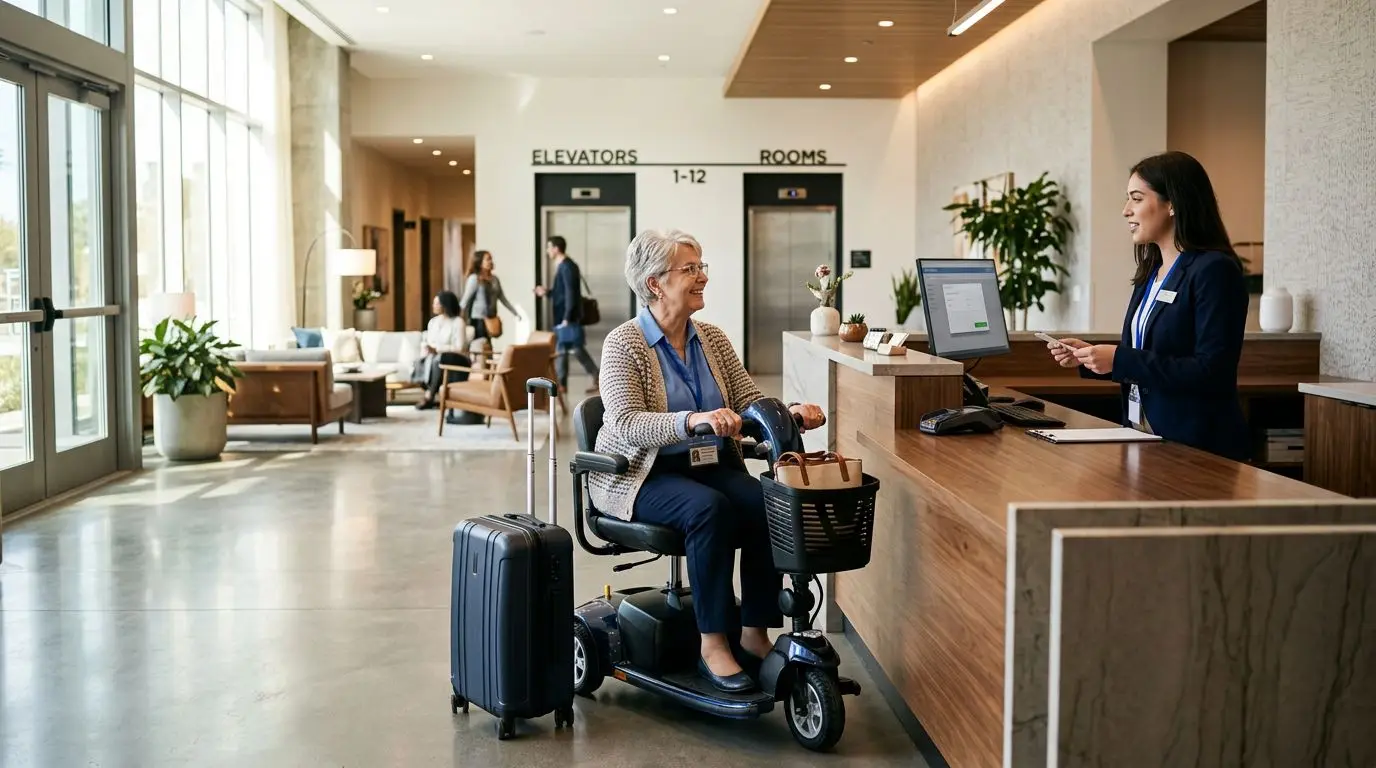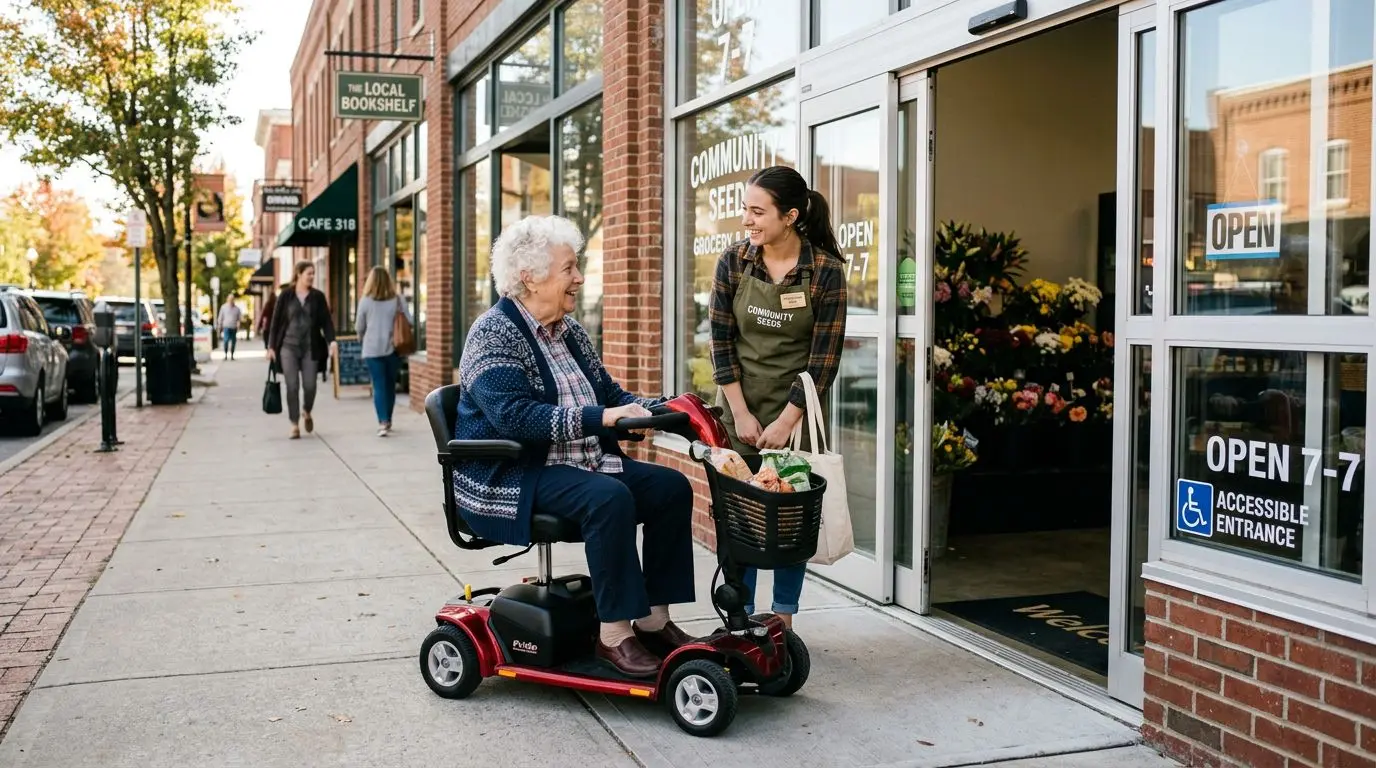
In most U.S. public businesses, a customer cannot be refused service simply because they use a mobility scooter for a mobility disability. Under the ADA, mobility scooters are generally mobility devices that must be allowed in areas open to pedestrians, unless the business has a specific, legitimate safety reason or the device physically cannot be accommodated. If you are challenged, stay calm, ask what the exact safety concern is, and request a reasonable way to receive the same goods or services.
This guide explains the practical side of ADA access for scooter users: what businesses usually must do, when safety exceptions may apply, and how to respond without turning a stressful moment into a confrontation. It is general information, not legal advice, but it can help you prepare before you leave home.
What the ADA generally requires: 2 core rules for public businesses
The Americans with Disabilities Act, often called the ADA, applies to many places that serve the public. Under Title III, this includes common businesses such as restaurants, retail stores, hotels, theaters, museums, medical offices, pharmacies, gyms, transportation depots, and many recreation facilities. The basic rule is straightforward: if customers are allowed in an area, a person using a mobility device because of a disability generally must be allowed there too.
There are 2 core ideas to know. First, a business may not exclude someone based on disability, assumptions, or inconvenience. Second, a business must make reasonable policy changes when needed for access, unless doing so would fundamentally change the business or create a legitimate safety problem.
Mobility scooters commonly used by people with mobility disabilities are typically treated as mobility devices for ADA access purposes. The ADA also recognizes other power-driven mobility devices, sometimes shortened to OPDMDs, which can include devices not originally designed only for disability use. For standard scooters used because of a mobility limitation, the access conversation should usually focus on whether the route, space, and operation are safe, not on prying into your medical history.
A business should not charge an extra fee because you use a scooter. It also should not require you to transfer out of your scooter simply because staff prefer it, although some activities or equipment may have their own safety rules. Staff generally should not ask for your diagnosis, medical records, or details about your condition. Your privacy matters.
One important limit: the ADA does not make every private place public. Truly private clubs and religious organizations have different rules, and private homes are not public accommodations just because a guest is invited. State and local laws may add protections, so the exact answer can vary by location.
When a business may limit a scooter: 5 safety factors
A business can set legitimate safety requirements, but the standard is not whether a scooter is unusual, inconvenient, or disliked by other customers. The ADA expects safety decisions to be based on actual risks. For other power-driven mobility devices, federal guidance points to 5 practical factors: the device type, size, weight, dimensions, and speed; the facility’s pedestrian traffic; the facility’s design; whether the device creates a substantial risk of serious harm; and whether that risk can be reduced with reasonable steps.
That means a blanket rule such as no scooters allowed is often a problem in a store, restaurant, or lobby open to the public. A narrower rule may be lawful if it is tied to a real hazard. For example, a high-speed device in a crowded exhibit room may be treated differently from a standard scooter moving at walking speed in a wide grocery aisle.
| Situation | Likely ADA concern | Practical alternative |
|---|---|---|
| Store posts no electric scooters at the entrance | A blanket ban can deny equal access | Ask whether scooters used for disability access are allowed and whether speed limits apply |
| Scooter is moving faster than walking pace in a crowded aisle | Business may address actual collision risk | Operate at low speed, use the widest route, or wait for crowding to ease |
| Small restaurant has tight tables and blocked paths | Access route may be limited by layout | Request an accessible table, movable chair removal, or a safer path |
| Historic site has fragile flooring or narrow elevated paths | Facility design and damage risk may matter | Ask about an alternate route, staff-guided access, or equivalent viewing options |
| Business refuses because scooters look dangerous | Stereotypes are not enough | Ask staff to identify the specific safety issue and how it can be reduced |
Safety cuts both ways. Businesses need to protect other customers and staff, but they also need to avoid policies that unnecessarily isolate scooter users. A good solution may be as simple as using a side entrance, moving one chair, slowing to a posted indoor speed, or waiting 2 minutes for a congested doorway to clear.
Where access gets complicated: 32-inch doors, 36-inch routes, and crowded spaces
Many conflicts happen not because a business openly wants to exclude someone, but because the building is cramped. ADA design standards often use concrete measurements, such as 32 inches of clear door opening and 36 inches of accessible route width in many situations. Turning spaces are commonly based on a 60-inch circle or an approved T-shaped space. These numbers are useful, but older buildings and small businesses may not match them perfectly.
If your scooter is wider than a doorway or cannot turn safely between tables, the business may not be able to change the physical space immediately. Still, staff should look for reasonable options when possible. That might include opening a second door leaf, moving a display rack, offering curbside or table service, seating you at a more accessible table, or using a different checkout lane.
Restaurants are a common example. A host may worry that a scooter blocks a server path or emergency exit. That concern can be legitimate if the scooter is left in a narrow aisle, but it does not justify automatically denying service. A better approach is to identify a table where the scooter can fit without blocking the route, or to discuss whether the rider wants to remain seated on the scooter or transfer to a chair.
Entertainment and recreation spaces can be trickier. A theater may need to keep aisles clear for fire safety. A boat tour may have a boarding ramp with a slope or weight limit. A ride at an amusement venue may have transfer rules tied to the equipment. These settings are not automatic denials, but they may involve a more specific safety review than a grocery store or pharmacy.
Air travel has its own federal rules separate from the ADA, and transit systems have additional requirements. If your concern involves an airplane, bus, train, or paratransit service, check the rules for that mode of transportation before your trip.
What to do if you are challenged: a 7-step script
Being stopped at a doorway is embarrassing. It can also feel personal. A calm, short script often works better than a long legal debate, especially when the first employee you meet has had little training.
- 1. Pause and lower the temperature. Try: I use this scooter because of a mobility disability, and I am here to shop or be served.
- 2. Ask for the specific rule. Say: Can you tell me the exact policy or safety concern?
- 3. Ask for a manager. Front-line staff may be repeating a mistaken rule. A manager may know the accessibility policy.
- 4. Offer safe operating choices. For example: I can drive at walking speed, use the wider aisle, or wait until the entrance is clear.
- 5. Request equal service. Say: If this route is not safe, what accessible route or service option can you provide?
- 6. Do not block exits or argue in a hazardous spot. Move to the side if you can do so safely.
- 7. Document what happened. Note the date, time, location, employee names, what was said, and any witnesses.
If the business asks whether the device is required because of a disability, answer simply if you are comfortable: yes, I use it for mobility access. For unusual power-driven devices, a business may be allowed to ask for credible assurance that the device is used because of a disability, such as a state disability parking placard or a verbal statement that is not contradicted by obvious facts. Staff should not ask you to explain your diagnosis.
Keep your phone handy. A quick photo of a posted no scooters sign, a blocked accessible entrance, or a narrow route can be useful later. Do not secretly record audio unless you know your state’s recording law. Written notes made right after the event are often safer and just as helpful.
How to prepare before you go: measure 4 numbers on your scooter
Knowing your scooter’s size gives you confidence and helps staff solve problems. Measure 4 numbers and save them in your phone: overall width, overall length, turning radius, and approximate loaded weight if available. Many everyday scooters are roughly 21 to 28 inches wide, but larger outdoor models can be wider and longer. Your exact scooter matters more than the category name.
| Measurement | Why it matters in public places | How to use it |
|---|---|---|
| Overall width | Helps compare your scooter to a 32-inch clear doorway | Measure the widest point, often armrests or rear wheels |
| Overall length | Affects elevators, small stores, and restaurant seating | Measure from front basket or tiller to the rear edge |
| Turning radius | Matters in restrooms, checkout lanes, and tight aisles | Check the manual or measure in an open driveway |
| Total weight | Can matter for lifts, ramps, boats, and older flooring | Include rider and carried items when a limit is posted |
Call ahead for unfamiliar places, especially if you are attending a timed event or traveling more than 30 minutes. Ask practical questions: Is there an accessible entrance? Are there steps? Is there an elevator? Is there a place to sit on or park a scooter without blocking an aisle? If you need to charge, ask whether outlets are available, but do not assume a business must provide charging access in every location.
Bring a small access kit. Useful items include a phone charger, a compact flashlight, your scooter dimensions, an emergency contact card, and any documents you already carry, such as a disability parking placard. You do not need to carry medical proof for routine shopping, but having basic information can make a difficult conversation shorter.
Who it is best for: compact scooters, full-size scooters, and outdoor scooters in public access
No single scooter type is best for every public place. A compact scooter may be easier in a 36-inch route, while a larger scooter may feel more stable outdoors or provide more seating support. Choosing for access means thinking about the places you visit most often, not just the smoothest ride in a showroom.
| Scooter type | Typical access strengths | Common tradeoffs | Best for |
|---|---|---|---|
| Compact or travel scooter | Narrower profile, often easier in elevators, stores, and apartments | May have smaller wheels, shorter range, and less seating support | Frequent indoor errands, medical appointments, and tight public spaces |
| Mid-size everyday scooter | Balance of comfort, battery range, and maneuverability | May still be tight in small restaurants or older buildings | Mixed indoor and outdoor use, shopping centers, and community events |
| Larger outdoor scooter | More ground clearance, larger tires, and stronger outdoor performance | Wider turning radius and harder indoor navigation | Parks, sidewalks, long outdoor routes, and users needing a larger seat |
| Heavy-duty scooter | Higher weight capacity and larger frame | Can exceed space or lift limits in some public settings | Users who need higher capacity and mostly use wider routes |
If you regularly visit older downtown shops, restaurants with tight table layouts, or medical buildings with small elevators, a smaller turning radius may be more useful than extra top speed. If your daily route includes uneven sidewalks or longer outdoor distances, wheel size, ground clearance, and battery range may matter more. Access is a real-world fit question.
For many riders, the best choice is the scooter that lets them operate predictably at walking speed indoors, stop smoothly, and fit through common doorways without scraping walls or displays. Safe operation helps protect your rights because it removes easy objections.
If you believe access was wrongly denied: 3 formal options
If a business refuses entry and does not offer a reasonable alternative, you have options after you leave. Start with documentation while details are fresh. Within 24 hours, write down the date, time, location, names or descriptions of staff, the exact words used, and whether you offered safe alternatives. Save receipts, appointment notices, photos, emails, or reservation confirmations.
Option 1 is to contact the business in writing. A short, factual message often works. Explain that you use a mobility scooter because of a disability, describe what happened, and ask the business to clarify its accessibility policy and staff training. Written communication creates a record and gives the business a chance to fix the problem.
Option 2 is to escalate through a corporate office, property manager, event organizer, or ADA coordinator if there is one. Larger organizations may have accessibility staff who understand the rules better than the person at the door. Ask for a written response.
Option 3 is to file a complaint with an enforcement agency or speak with a disability rights attorney. ADA complaints involving public accommodations can be submitted to the U.S. Department of Justice. State civil rights offices, local human rights commissions, or disability advocacy organizations may also help, depending on where you live. Deadlines can apply under state or local laws, so do not wait months if the denial caused a serious problem.
Not every unpleasant interaction becomes a legal case. Still, reporting patterns matters. If multiple scooter users are turned away by the same business, documentation can push the business toward better training, clearer policies, and safer access for everyone.
FAQ: 5 common mobility scooter access questions
Can a restaurant make me leave my scooter outside?
Usually not as a blanket rule. If the scooter can be used or parked without blocking aisles, exits, or server paths, the restaurant should look for an accessible seating option. If a particular table layout is unsafe, ask for another table or a reasonable service alternative.
Can a store ask what disability I have?
Staff should not ask for your diagnosis or medical details. In some situations involving less common power-driven mobility devices, a business may ask whether the device is required because of a disability and may request credible assurance. Keep your answer brief and focused on access.
Can a business deny my scooter because it is electric?
Not just because it is electric. Many mobility scooters are electric, and that alone is not a valid reason to refuse access. The business would need a specific safety concern, such as speed, size, weight, crowding, or a route that cannot safely accommodate the device.
What if my scooter cannot fit through the door?
If the device physically cannot fit, the business should still consider reasonable alternatives when possible. That could mean using another entrance, opening a second door, moving an obstacle, providing curbside service, or bringing goods or paperwork to an accessible location.
Do ADA rules apply to small businesses?
Yes, many small businesses open to the public are covered by ADA Title III. The size and resources of the business can affect what barrier removal is readily achievable, but a small business does not get a general exemption from serving customers with disabilities.
Frequently asked questions
Can a restaurant make me leave my scooter outside? +
Usually not as a blanket rule. If the scooter can be used or parked without blocking aisles, exits, or server paths, the restaurant should look for an accessible seating option. If a specific layout is unsafe, ask for another table or a reasonable service alternative.
Can a store ask what disability I have? +
Staff should not ask for your diagnosis or medical details. In some situations involving less common power-driven mobility devices, a business may ask whether the device is required because of a disability and may request credible assurance.
Can a business deny my scooter because it is electric? +
Not just because it is electric. Many mobility scooters are electric. A business would need a specific safety concern, such as size, speed, weight, crowding, or a route that cannot safely accommodate the device.
What if my scooter cannot fit through the door? +
If the scooter physically cannot fit, the business should still consider reasonable alternatives when possible, such as another entrance, opening a second door, moving an obstacle, or providing service at an accessible location.
Do ADA rules apply to small businesses? +
Yes, many small businesses open to the public are covered by ADA Title III. Business size may affect what barrier removal is readily achievable, but it does not create a general exemption from serving customers with disabilities.
Related guides
What to Do If a Business Says Your Mobility Scooter Is Not Allowed
16 min read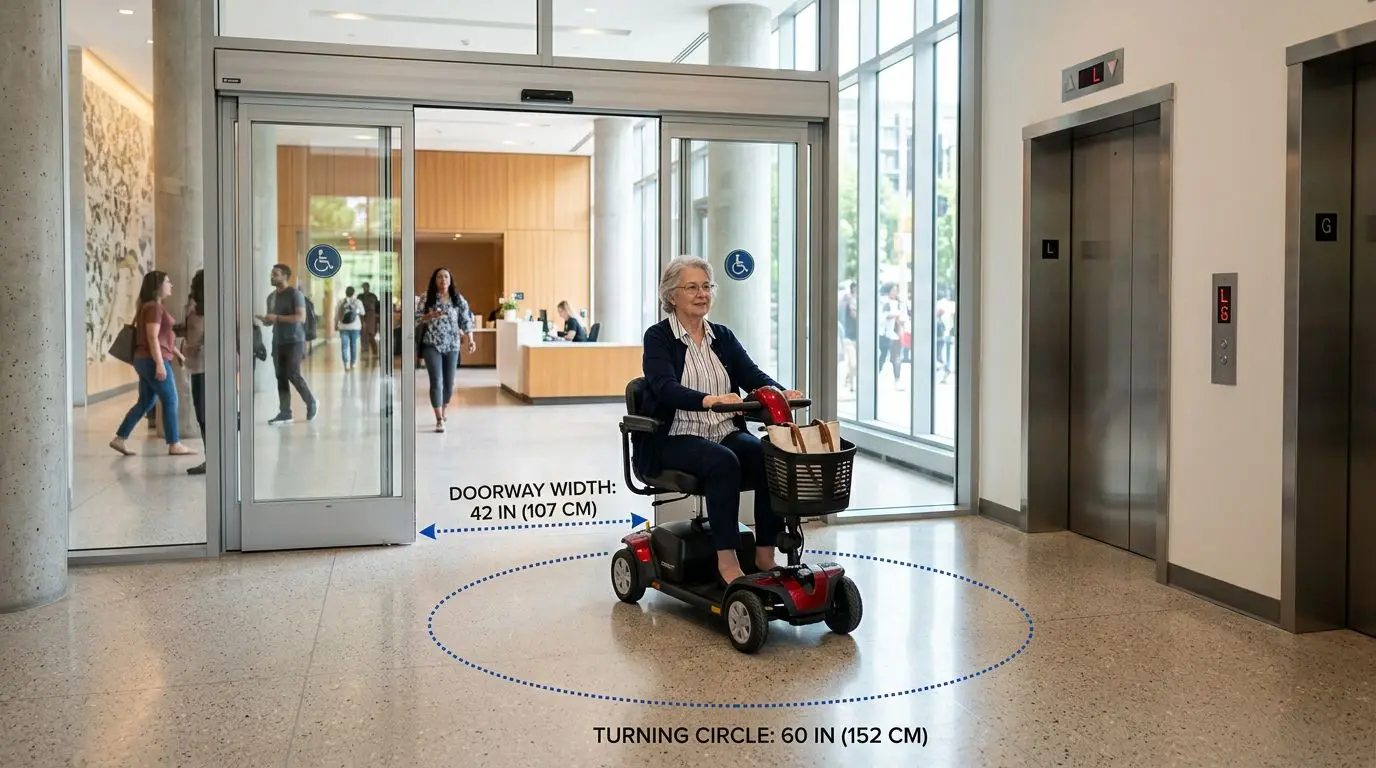
ADA Accessibility Dimensions for Mobility Scooters: Doorways, Ramps, Elevators, and Turning Space
14 min read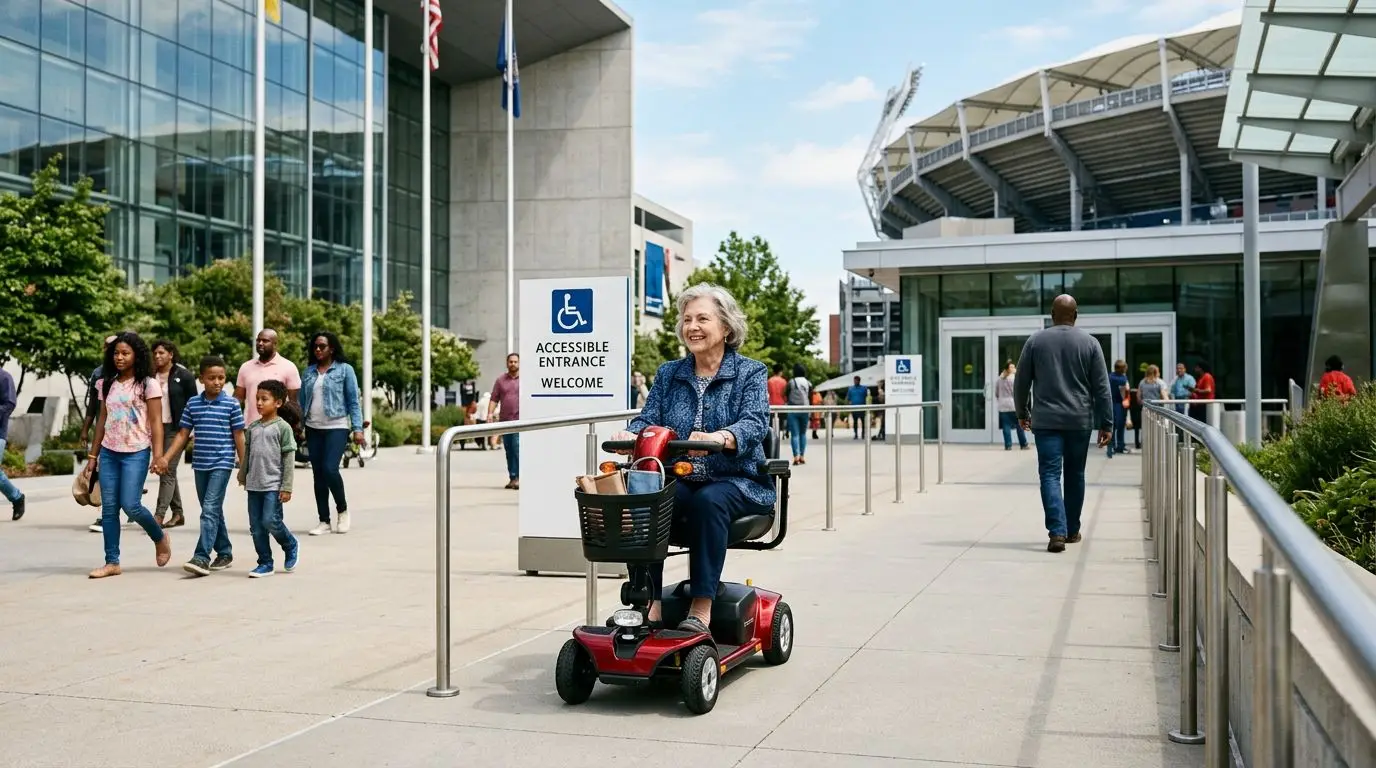
Can You Bring a Mobility Scooter to Theme Parks, Stadiums, Museums, and Other Venues?
16 min read