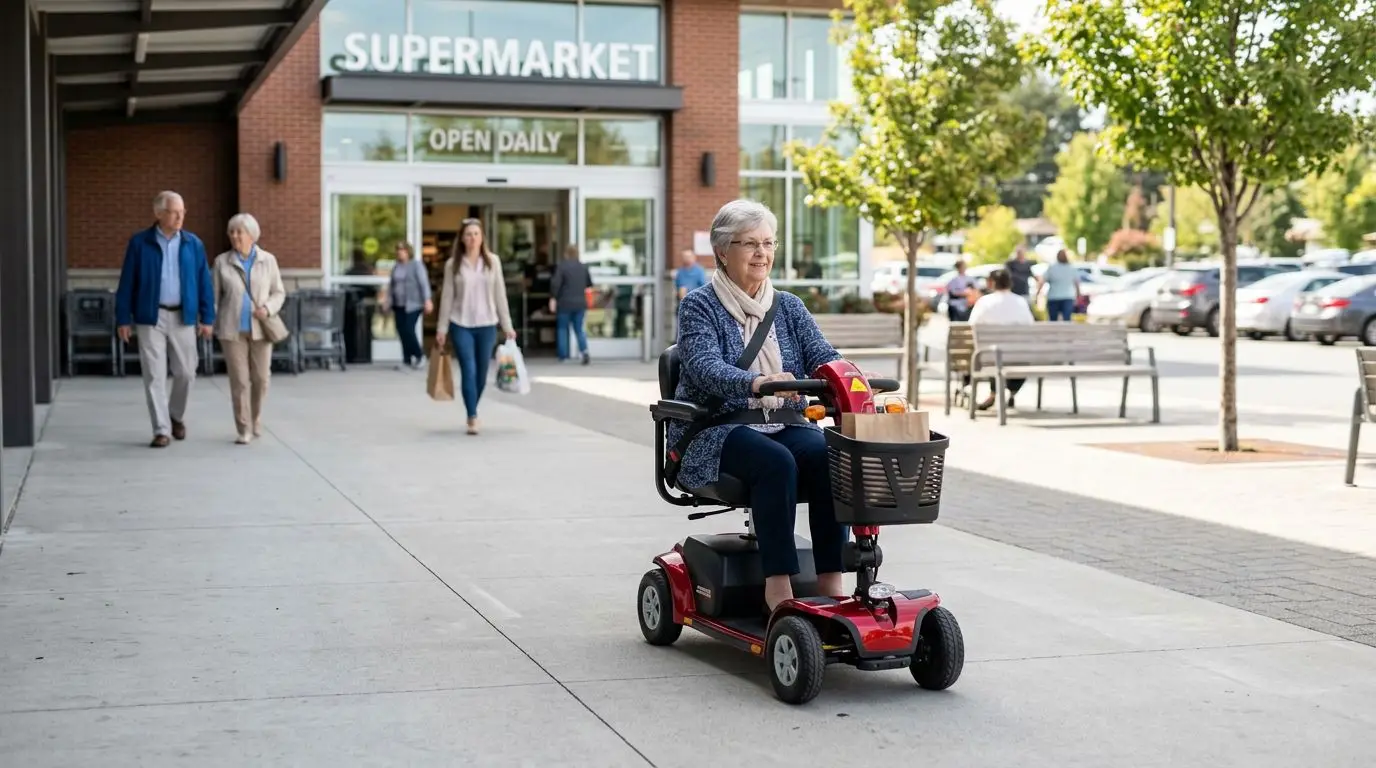
To use a mobility scooter safely in public places, slow down before you need to, keep both hands on the controls, and give pedestrians as much room as the space allows. In tight areas such as elevators, checkout lanes, store aisles, and hallways, move at walking speed, make wide turns, and stop before the scooter gets too close to people, shelves, doors, or walls.
Public use is different from riding at home or outdoors. You are sharing narrow spaces with people who may step backward, stop suddenly, push carts, open doors, or look at their phones instead of watching where they are going. A few simple habits can make those moments safer and less stressful.
Use a 3-foot safety mindset in tight public spaces
A good everyday goal is to keep about 3 feet of clearance whenever possible. That much space is not always available in a store aisle or elevator, but thinking in terms of 3 feet helps you slow down before the area becomes too tight.
Most mobility scooters are wider and longer than people expect. A compact scooter may be around 20 to 22 inches wide, while larger scooters can be 24 to 27 inches wide or more. Add your elbows, shopping bags, baskets, armrests, and turning arc, and a scooter needs more room than its frame suggests.
The most common public-use safety problems are not high-speed crashes. They are low-speed bumps: clipping a display, touching an elevator wall, nudging a cart, catching a doorway with a rear wheel, or surprising a pedestrian from behind. Slower entry, earlier stopping, and smaller steering corrections usually prevent these incidents.
Think of your scooter like a seated vehicle, not a powered chair that can squeeze anywhere. If a space looks narrow, stop first. Check the floor, side clearance, and exit path. Then decide whether to continue, ask for help, or choose another route.
Do a 5-minute scooter and route check before you go
A 5-minute check before leaving home can prevent many problems later. Public places often require repeated starts, stops, turns, and elevator rides, so small equipment issues can become frustrating quickly.
- Battery: Start with enough charge for the full outing plus a margin. If your indicator has 5 bars, avoid beginning a long shopping trip on the last bar.
- Tires or wheels: Look for low air pressure on pneumatic tires, flat spots, debris, or anything that could reduce traction.
- Brakes: Test the scooter at very low speed before entering a public space. It should stop smoothly when you release the throttle.
- Horn or bell: Use it politely when needed, especially near blind corners, but do not rely on it as your main safety tool.
- Seat and tiller: Make sure the seat is locked and the steering column is secure before you enter a store or elevator.
Plan the route, too. If a building has both stairs and an elevator, know where the accessible entrance is before you arrive. If you are going to a busy store, consider visiting during quieter hours, often mid-morning or early afternoon on weekdays. A trip that takes 30 minutes in an uncrowded store may take twice as long when aisles are full.
Carry only what you can secure. Loose bags on the floorboard can slide under your feet or interfere with steering. If you use a basket, keep heavier items low and do not hang several bags from the tiller. Hanging weight on the controls can affect steering and may make the scooter less stable during turns.
Store aisles and checkout lanes: handle 36-inch passages with care
Many accessible routes are designed around a minimum clear width near 36 inches, but real stores often feel tighter because of displays, carts, boxes, sale racks, and other shoppers. A 36-inch passage can be usable, yet it leaves little room for steering errors if your scooter is more than 24 inches wide.
Enter an aisle only when you can see a clear path or a safe stopping point. If another shopper is coming toward you with a cart, stop early and let them pass instead of trying to thread through at the midpoint. Waiting at the end of an aisle is usually easier than backing up once you are surrounded by shelves.
Checkout lanes call for extra patience. They may include narrow belt areas, posts, bagging stands, candy racks, and people turning around with carts. If the regular lane looks tight, ask whether there is a wider lane or accessible checkout. Staff can often guide you to a better option, but they cannot help if they do not know you need space.
| Store situation | Safer scooter habit | Why it helps |
|---|---|---|
| Narrow aisle near 36 inches | Go straight, slow, and avoid sudden turns | Reduces shelf and display bumps |
| End-cap displays | Turn wide and watch the rear wheels | The back of the scooter may cut closer than the front |
| Checkout lane | Stop before the belt, then move forward in short steps | Prevents nudging people, carts, or posts |
| Busy produce or pharmacy area | Pause at the edge and scan for movement | People often step backward without looking |
Use reverse carefully in stores. Many scooters beep when backing up, but sound does not guarantee that people will move. Look over both shoulders if you can, back up only a short distance, and stop if anyone walks behind you. If you cannot see clearly, ask for help or reposition by moving forward instead.
Elevators: use a 4-step boarding and exiting routine
Elevators are one of the tightest public spaces scooter users face. A simple 4-step routine can help: wait to the side, let people exit, enter straight, and turn only if there is enough room.
First, wait beside the elevator doors rather than directly in front of them. This gives people inside a clear path to exit. Second, let everyone who wants to leave come out before you move. Third, enter slowly and as straight as possible. Fourth, decide whether to turn around inside or back out when you arrive.
Many elevator cabs have limited turning space, especially in older buildings. If your scooter has a large turning radius, trying to spin inside the cab may lead to wall bumps or awkward multi-point turns. It may be safer to enter, remain facing forward, and back out carefully at your floor if the exit area is clear.
- Approach the elevator at the lowest practical speed.
- Keep your fingers, elbows, bags, and clothing away from the door edges.
- Stop with enough space so the doors do not touch the scooter.
- Ask another rider to press the floor button if you cannot reach it safely.
- If the elevator is crowded, wait for the next one.
When exiting, watch the threshold. Some elevators have a small gap or slight height difference between the cab and the floor. Cross it straight, not at a sharp angle. If your scooter hesitates or catches, stop and ask for assistance rather than forcing the scooter forward.
Hallways, doors, and ramps: respect 30-inch openings and tight turns
Doorways can be challenging because the clear opening may be around 30 to 32 inches in older buildings, even when the door itself looks wider. A scooter that fits through the opening still needs room for mirrors, armrests, hands, and the rear wheels to track through the turn.
Approach doors straight whenever possible. If the door swings toward you, stop far enough back to open it without pulling it into the scooter. If it swings away, move slowly and avoid pushing the door with the scooter unless it is clearly safe and lightweight. Heavy doors can swing back and catch a wheel, basket, or armrest.
Automatic doors help, but they are not perfect. Sensors may not detect every angle, and some doors close faster than expected. Do not race a closing door. Stop, let the door reopen, and continue when the path is clear.
Ramps deserve the same respect as doors. Go straight up and straight down when you can. Avoid stopping sideways on a ramp, and avoid sharp turns on sloped surfaces. Wet tile, polished concrete, and painted curb ramps can reduce traction, especially during rain or snow.
| Area | What to measure or notice | Practical target |
|---|---|---|
| Doorway | Clear width with the door open | At least a few inches wider than the scooter |
| Hallway turn | Space needed to swing the front and rear | Enough room for a slow, wide turn |
| Ramp | Slope, surface, and landing space | Dry, clear, and approached straight |
| Threshold | Small lip at entrance or elevator | Cross squarely at low speed |
If you regularly visit a building with tight doors, measure your scooter at its widest point. Include armrests, mirrors, and any basket or accessory that sticks out. Knowing the real width can help you decide whether to fold mirrors, remove a bag, or use a different entrance.
Crowds and pedestrians: slow down within 6 feet
In crowds, the safest rule is to slow down whenever someone is within about 6 feet of the scooter. Six feet gives you a small reaction buffer if a person stops, turns, drops something, or steps sideways without warning.
People in public places do unpredictable things. Children dart across aisles. Adults step backward to read signs. Someone may stop at the top of a ramp or in front of an elevator. Your job is not to predict every movement; it is to leave enough time and space to respond.
Use your voice early and politely. A calm, friendly phrase often works better than a horn in close situations. Try, Excuse me, coming through on your left, or Could I pass when you have a moment? Keep your tone patient. People may not realize they are blocking the accessible route.
When traveling with a companion, ask them not to walk directly in front of the scooter in tight spaces. It is often better for them to walk slightly ahead and to the side, opening doors or clearing a path only when needed. They should avoid pulling the scooter, standing on the floorboard, or trying to steer from the side.
- Do not tailgate pedestrians, even at low speed.
- Stop before blind corners and listen for carts or footsteps.
- Pass on the side with the most space, not necessarily the fastest side.
- Keep bags, canes, umbrellas, and oxygen tubing secured and away from wheels.
- Avoid phone use while moving.
If the crowd becomes too dense, stop in a safe place. Look for a wall edge, seating area, or wider lobby where you are not blocking traffic. Waiting 2 minutes for a crowd to thin is safer than forcing your way through.
How to choose and measure a scooter for public use: 3 key dimensions
If you often use stores, elevators, medical buildings, apartment hallways, or public transit areas, focus on 3 dimensions: overall width, overall length, and turning radius. These numbers matter more in tight spaces than top speed.
Overall width determines whether you can pass through doors and checkout lanes with room to spare. Overall length affects elevator positioning and hallway turns. Turning radius tells you how much space the scooter needs to make a full turn. A shorter turning radius generally helps indoors, but stability, comfort, weight capacity, and outdoor needs still matter.
| Scooter type | Typical public-space advantage | Tradeoff to consider |
|---|---|---|
| 3-wheel scooter | Often has a tighter turning radius for aisles and hallways | May feel less steady on uneven outdoor surfaces for some users |
| 4-wheel scooter | Often feels more stable in straight travel | May need more room to turn in elevators or tight checkout lanes |
| Travel or compact scooter | Smaller width and easier handling in buildings | May have less legroom, smaller batteries, or lower ground clearance |
| Full-size scooter | More comfort and support for longer outings | Can be harder to maneuver in narrow public interiors |
To measure your needs, start at home. Use a tape measure to check your narrowest doorway, hallway turn, and storage area. Then compare those numbers with the scooter width and length. If you already own a scooter, practice slow turns using cones, boxes, or tape on the floor to create a 36-inch path. This helps you learn where the front and rear wheels travel.
Controls matter, too. A comfortable throttle, easy speed adjustment, responsive braking, and clear battery indicator can make public use less tiring. Lighting and reflectors are helpful in parking garages or dim hallways, but they do not replace slow speed and eye contact.
Who this safety approach is best for on trips under 2 hours
This guide is especially useful for seniors and adults who use a mobility scooter for everyday errands, appointments, apartment living, shopping centers, libraries, community events, and medical buildings. It is also helpful for newer scooter users who can drive comfortably at home but feel uncertain in public spaces.
It may be a good fit if your typical outing is under 2 hours and includes several indoor transitions: car to sidewalk, entrance door, lobby, hallway, elevator, waiting room, store aisle, or checkout lane. These short trips involve many tight maneuvers, even when the total distance is not very far.
People with changes in vision, hearing, reaction time, hand strength, balance, or neck movement may need additional support or training. That does not mean a scooter is unsafe for them. It means the setup and habits should match the person. A healthcare professional, occupational therapist, mobility specialist, or qualified equipment provider may be able to help with fit, training, and safe use.
This guide is not meant to replace local rules or medical advice. Some buildings, transit systems, senior communities, and event venues have their own scooter policies. Follow posted instructions, staff guidance, and any safety rules that apply.
What to do after a bump, blockage, or unsafe moment: a 60-second reset
If you bump a shelf, block a doorway, or feel overwhelmed, take a 60-second reset. Stop the scooter, release the throttle, breathe, and look around before moving again. Rushing after a mistake often leads to another mistake.
If you touched another person, ask if they are okay and apologize calmly. If store property was damaged, notify staff. Most low-speed incidents are minor, but honesty and courtesy matter. If anyone appears injured, follow the location's emergency procedures and call for help.
If the scooter feels stuck, do not force the throttle. Check whether a wheel is against a display, door frame, curb, or elevator threshold. A small repositioning by hand or a short reverse may solve the problem, but only back up if the area behind you is clear. If you are unsure, ask for assistance.
After the incident, identify one change for next time. Maybe you need to slow down before checkout lanes, avoid a certain entrance, remove a wide accessory, or practice backing up in an empty hallway. One practical adjustment is more useful than blaming yourself.
FAQ: 5 public scooter safety questions
How fast should I drive a mobility scooter inside a store?
Use the slowest setting that lets you move smoothly. Indoors, that usually means walking speed or slower, especially within 6 feet of pedestrians, displays, doors, or checkout lanes.
Should I use the horn in crowded places?
Use the horn only when it is helpful, such as near a blind corner or when someone may not hear your voice. In close spaces, a polite verbal warning is often less startling and more effective.
Is it safer to back into an elevator or drive in forward?
It depends on the elevator size, scooter length, and your ability to see behind you. Many users enter forward and either turn inside if there is enough room or back out slowly at their floor after checking that the exit is clear.
What if a store aisle is too narrow for my scooter?
Do not force it. Stop at the aisle entrance, ask staff for help reaching an item, use a wider route, or visit during a less crowded time. Forcing a tight aisle increases the chance of hitting shelves or people.
Can I hang shopping bags from the tiller?
It is better not to hang heavy bags from the tiller. Extra weight on the steering area can interfere with control. Use a secure basket or ask for help carrying larger items.
Frequently asked questions
How fast should I drive a mobility scooter inside a store? +
Use the slowest setting that lets you move smoothly. Indoors, that usually means walking speed or slower, especially near pedestrians, displays, doors, and checkout lanes.
Should I use the horn in crowded places? +
Use the horn only when it is helpful, such as near a blind corner or when someone may not hear your voice. In close spaces, a polite verbal warning is often less startling.
Is it safer to back into an elevator or drive in forward? +
It depends on the elevator size, scooter length, and your visibility. Many users enter forward, then either turn inside if there is room or back out slowly when the exit is clear.
What if a store aisle is too narrow for my scooter? +
Do not force the scooter through. Stop, ask staff for help reaching an item, use a wider route, or shop during a quieter time when aisles are less crowded.
Can I hang shopping bags from the tiller? +
It is better not to hang heavy bags from the tiller because they can interfere with steering and control. Use a secure basket or ask for help carrying larger items.
Related guides

How to Drive a Mobility Scooter Safely in Stores, Malls, and Grocery Aisles
13 min read
Mobility Scooter Safety in Crowds: Theme Parks, Events, Airports, and Busy Sidewalks
15 min read
Mobility Scooter Safety Guide for Seniors: How to Ride, Turn, Stop, and Park With Confidence
15 min read