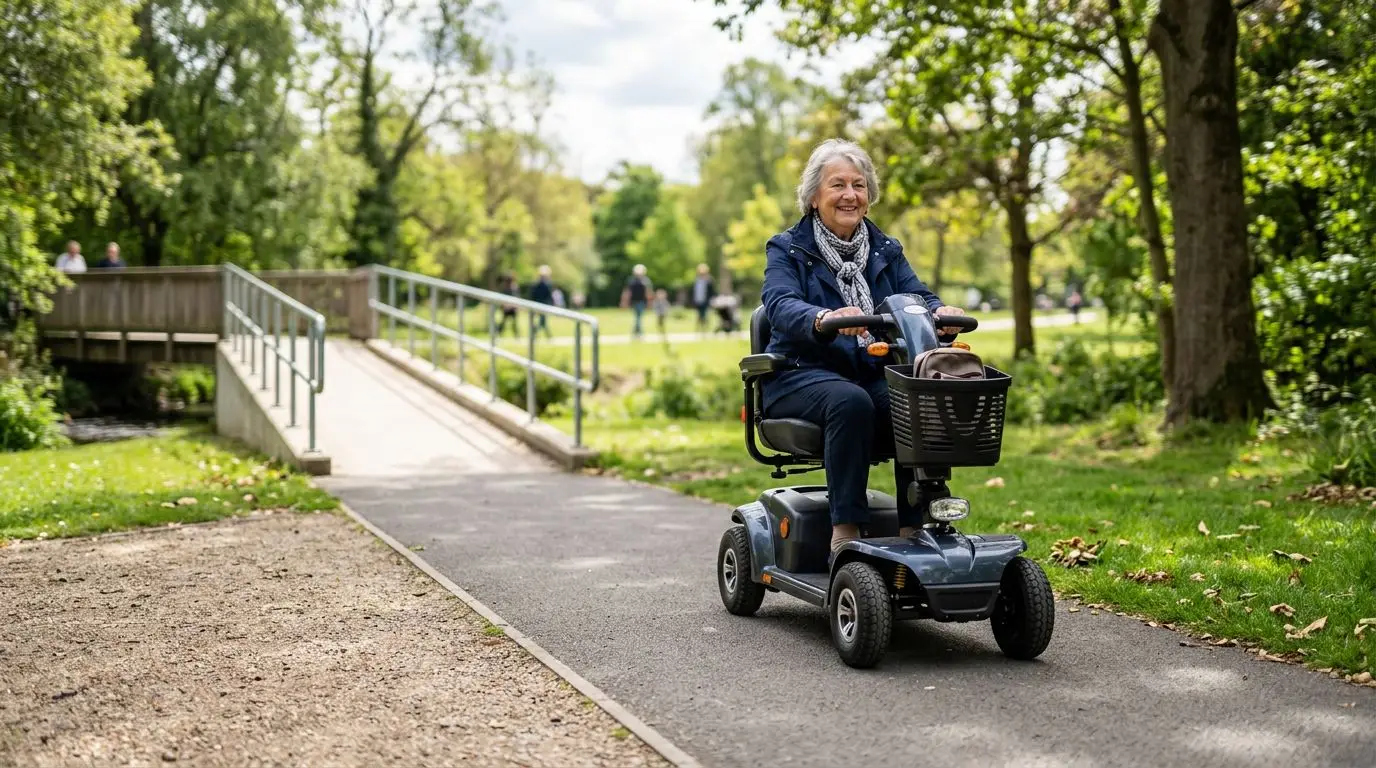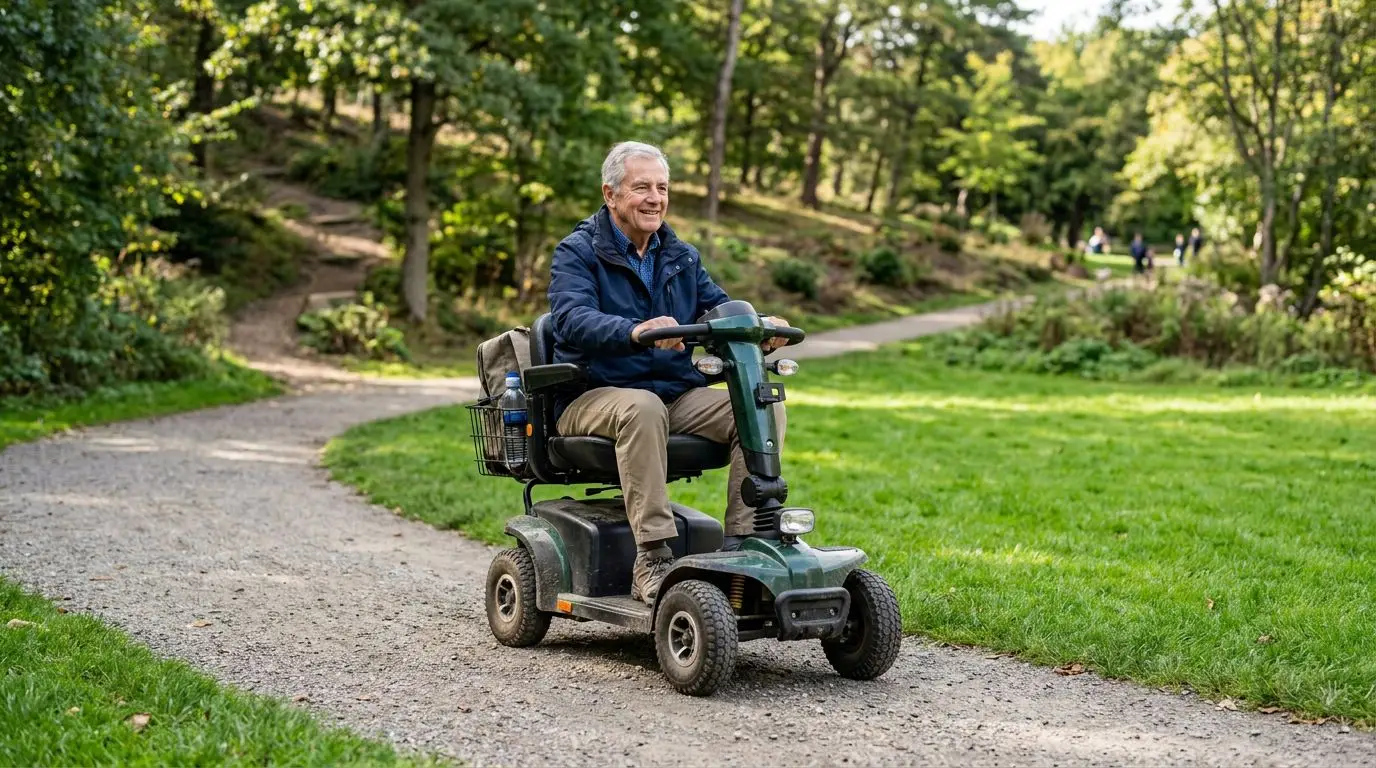
An all-terrain mobility scooter is best for riders who regularly travel over grass, gravel, uneven sidewalks, packed dirt, or moderate hills—not just smooth indoor floors. The key buying factors are tire type and size, suspension, ground clearance, stability, braking, battery capacity, and the scooter’s rated incline. Even a rugged scooter has limits, so the right choice starts with measuring your real routes before you buy.
Think of “all-terrain” as a practical range, not a promise that a scooter can go anywhere. A scooter that handles a firm lawn and a cracked driveway may still be unsafe on loose sand, deep mud, steep slopes, or wet grass. The goal is to match the scooter’s features to the surfaces you actually use.
What “all-terrain” means on surfaces like grass, gravel, and rough pavement
Most standard mobility scooters are designed for smooth, predictable surfaces such as indoor floors, sidewalks, stores, and paved paths. All-terrain scooters are built for more outdoor tolerance, with larger tires, stronger frames, higher ground clearance, and often front and rear suspension. Many outdoor-focused scooters use tires in the 10- to 14-inch range, while smaller travel scooters may use wheels closer to 6 to 8 inches.
That difference matters. A larger tire rolls over small stones, sidewalk seams, and shallow ruts more easily because it does not drop as sharply into every dip. A scooter with 4 inches of ground clearance is also less likely to scrape on a driveway lip than one with 2 inches of clearance.
Still, “all-terrain” does not mean off-road vehicle. Mobility scooters are personal mobility devices, not farm equipment, ATVs, or medical devices meant to prevent falls. Their job is to improve access and independence within reasonable conditions. Good judgment matters on every trip.
Who all-terrain scooters are best for: yards, long driveways, parks, and uneven sidewalks
An all-terrain scooter makes the most sense if at least 20% to 30% of your normal travel is outdoors on imperfect surfaces. It may be a good fit if you cross a lawn to reach a garden, travel a 200-foot gravel driveway, visit parks with packed stone paths, or deal with older sidewalks that have lifted slabs and rough curb cuts.
It may also help riders who need a more stable outdoor ride than a compact scooter can provide. Four-wheel outdoor scooters, in particular, often feel steadier on uneven ground because they have a wider base and more tire contact. Stability is not automatic, though. Seat height, rider position, speed, slope angle, and turning habits all affect safety.
Best for
- Riders who use paved and unpaved paths in the same trip.
- Homes with gravel, brick, uneven concrete, or mild lawn crossings.
- Outdoor community spaces, campgrounds, parks, and large properties.
- People who want a smoother ride over cracks and bumps than a compact scooter provides.
Not ideal for
- Deep mud, soft sand, wet slopes, and loose gravel deeper than about 1 inch.
- Steep hills beyond the scooter’s rated incline.
- Very tight indoor spaces, narrow hallways, or small elevators.
- Frequent car transport if the scooter is heavy and does not disassemble easily.
Compare the main all-terrain scooter types by wheel count and drive style
All-terrain mobility scooters generally fall into a few practical categories. A compact outdoor-capable scooter might weigh under 150 lb, while a heavy-duty outdoor scooter can weigh several hundred pounds with batteries installed. That weight affects comfort, durability, transport, and where you can store it.
| Type | Typical strengths | Trade-offs | Best use case |
|---|---|---|---|
| 3-wheel outdoor-capable scooter | Tighter turning, easier steering in some spaces | Usually less stable on side slopes and uneven ground | Mostly paved routes with occasional rough spots |
| 4-wheel all-terrain scooter | Better stability, more outdoor confidence | Larger turning radius and heavier frame | Grass edges, gravel paths, cracked pavement, parks |
| Heavy-duty outdoor scooter | Higher weight capacity, larger tires, stronger suspension | Harder to transport and store; may need a ramp or lift | Long outdoor routes, larger riders, rougher daily conditions |
| Track-style mobility device | Can spread weight across a larger contact area | Less common, bulkier, and often less practical for sidewalks or stores | Specialized outdoor access where wheels are not enough |
For most buyers, a 4-wheel all-terrain scooter is the practical starting point. It balances outdoor stability with familiar controls and a layout that still works on paved paths. Track-style devices can help in specialized settings, but they are not the typical choice for someone who also wants to visit stores, use sidewalks, or travel in a vehicle.
Tires and wheels: why 10 to 14 inches can change the ride
Tires are the first feature to study. On rough pavement, grass, and gravel, the tire determines how much vibration reaches the rider and how easily the scooter rolls over small obstacles. A 12-inch tire will generally handle a 1-inch sidewalk lip more comfortably than an 8-inch tire, assuming the scooter has enough power and ground clearance.
There are 3 common tire setups: solid, foam-filled, and pneumatic. Solid tires resist flats, a major advantage if you ride over thorns, sharp gravel, or debris. The downside is a firmer ride. Pneumatic tires, which are air-filled, usually ride softer and grip better on uneven surfaces, but they can lose air or puncture. Foam-filled tires sit between the two: no air pressure to maintain, with more cushioning than many solid tires.
| Tire type | Comfort | Flat resistance | Outdoor traction | What to watch |
|---|---|---|---|---|
| Solid | Firm | Excellent | Moderate | Can feel harsh on cracked pavement |
| Foam-filled | Medium | Excellent | Moderate to good | Heavier than basic solid tires |
| Pneumatic | Softer | Lower | Good | Requires pressure checks and puncture awareness |
Tread pattern matters too. A slightly knobby tread can help on packed dirt and grass, while a smoother tread may be quieter on pavement. Do not assume the most aggressive-looking tire is best. Deep lugs can feel bumpy on sidewalks and may not help much if the scooter lacks ground clearance or torque.
Suspension, ground clearance, and frame strength: look for at least 3 inches of clearance
Ground clearance is the distance between the lowest part of the scooter and the ground. For outdoor use, 3 inches is a practical minimum to look for, while 4 to 5 inches can be helpful for rougher driveways, packed gravel, and uneven path transitions. Low clearance is one reason some scooters get hung up on thresholds, roots, and broken pavement.
Suspension affects comfort and control. Front suspension helps when the scooter hits bumps head-on. Rear suspension reduces jolts under the seat and can make longer rides less tiring. Full suspension is especially useful if you ride 30 minutes or more at a time over rough pavement or gravel.
Frame strength matters as well, but do not judge it only by appearance. A heavy scooter is not automatically better. Check the stated weight capacity, overall scooter weight, wheelbase, ground clearance, and whether the tiller and seat feel solid when adjusted. If a scooter flexes, rattles, or feels top-heavy during a test ride, pay attention.
Hills, motors, brakes, and batteries: rated incline is often 6 to 10 degrees
Hill performance is one of the easiest areas to overestimate. Many mobility scooters list a maximum incline rating, often somewhere around 6 to 10 degrees depending on the design. That rating is not a guarantee that the scooter will climb every driveway safely in real weather with a full basket, rider, and low battery.
Hills demand more power, reduce range, and change stability. Climbing a hill shifts weight backward; descending shifts it forward. A side slope is even trickier because it can make the scooter feel like it wants to lean. For outdoor use, electromagnetic braking is common, but riders should also look for controlled downhill behavior and a speed setting that can be reduced before descending.
Battery range changes outdoors, too. A scooter advertised with a long range may be tested under smooth, controlled conditions. Grass, hills, cold weather, heavier rider weight, and frequent stops can reduce real-world range by 30% or more. If your regular outing is 6 miles round trip, shopping only for a stated 6-mile range leaves too little margin. A buffer is not a luxury. It is practical planning.
How to measure your route before buying: a 30-minute home audit
Before comparing features, measure where the scooter will actually go. A simple 30-minute route audit can prevent buying a scooter that is too large, too low, or not strong enough for your property. Bring a tape measure, a notepad, and if possible, a helper for checking slopes and tight turns.
- Measure the narrowest passage. Check gates, shed doors, porch entries, and hallways. Add at least 2 inches of clearance beyond the scooter’s width for easier steering.
- Check turning space. Measure patios, garage corners, and indoor entry areas where you need to turn around. Larger outdoor scooters may need a turning radius of several feet.
- Measure thresholds and lips. Note door thresholds, driveway edges, and sidewalk seams. A 1-inch lip can be manageable for some scooters but frustrating for others.
- Estimate slope. For a basic check, measure rise over run. If a ramp rises 10 inches over 120 inches, that is about an 8.3% grade. Compare that with the scooter’s specifications.
- Walk the roughest section. Look for loose gravel, roots, holes, drainage ruts, wet leaves, or areas that stay soft after rain.
- Confirm storage and charging. Measure the parking spot and make sure a standard electrical outlet is close enough for charging without creating a trip hazard.
Write down your top 3 obstacles. For many buyers, these might be a gravel driveway, a 2-inch garage threshold, and a sloped yard. Those details are more useful than a vague wish for the “most rugged” scooter.
Features worth prioritizing: 8 practical details that affect daily use
Once the basics are right, compare the features that make the scooter safer and easier to live with. A bright headlight may matter if you ride at dusk. A swivel seat may matter if hip or knee movement is limited. A higher weight capacity may be important, but it should include the rider plus cargo, oxygen equipment, groceries, or a pet carrier if those are part of real use.
| Feature | Why it matters | Practical target |
|---|---|---|
| Weight capacity | Affects performance, stability, and motor strain | Choose capacity above rider plus cargo weight |
| Seat width and padding | Controls comfort on 30- to 60-minute rides | Enough width without forcing arms outward |
| Adjustable tiller | Helps posture and steering control | Wrists relaxed, elbows slightly bent |
| Lighting and reflectors | Improves visibility near driveways and paths | Front light, rear reflectors, side visibility |
| Speed control | Lets you slow down for crowds, turns, and hills | Easy low-speed setting around walking pace |
| Battery access | Affects charging and service | Reachable without heavy lifting when possible |
| Transport compatibility | Determines whether you need a lift, ramp, or trailer | Know total weight and heaviest removable piece |
| Weather protection | Outdoor scooters still need dry storage | Covered storage and controls protected from rain |
Do not ignore service access. Outdoor use is harder on tires, bearings, brakes, suspension parts, and batteries. If the scooter will be used several times a week, ask how tires are replaced, how batteries are tested, and whether common wear parts can be serviced locally.
Realistic limits and safety checks for rides over 4 mph
Many outdoor mobility scooters can travel faster than a slow indoor scooter, with common top speeds often falling around 4 to 8 mph depending on the class and design. Speed feels very different on gravel than it does on a smooth sidewalk. The safest speed is the one that lets you stop, turn, and react without tipping or sliding.
Use extra care on wet grass, painted curb cuts, pine needles, loose gravel, and leaves. These surfaces can reduce traction quickly. Avoid turning sharply on slopes, and approach bumps straight on rather than at an angle when possible. If a hill feels uncomfortable during a test ride, do not assume you will “get used to it.” Your route may be asking too much of that scooter.
- Keep both feet inside the scooter platform while moving.
- Slow down before turns, ramps, curb cuts, and uneven seams.
- Do not exceed the weight capacity, including baskets and accessories.
- Charge before longer outdoor trips and avoid starting with a low battery.
- Store the scooter in a dry, secure place when not in use.
- Review any new mobility limitations with a qualified clinician or therapist if balance, vision, reaction time, or transfers are concerns.
A test ride is valuable if you can arrange one. Try a doorway, a turn, a mild slope, rough pavement, and a stop from low speed. Ten minutes on a realistic surface can tell you more than a long list of specifications.
FAQ: 5 common questions about all-terrain mobility scooters
Can an all-terrain mobility scooter go on grass?
Yes, many can cross short, firm grass, especially with larger tires and adequate ground clearance. Wet, tall, soft, or rutted grass is much harder and can cause loss of traction or get the scooter stuck.
Are 3-wheel or 4-wheel scooters better for gravel?
For gravel, a 4-wheel scooter is usually the better choice because it offers a more stable base. A 3-wheel scooter may turn more tightly, but it can feel less secure on uneven or sloped surfaces.
How much ground clearance do I need for rough pavement?
For outdoor routes, look for at least 3 inches of ground clearance. If your route includes raised sidewalk slabs, driveway lips, packed gravel, or small roots, 4 inches or more may be more comfortable.
Will a larger battery make the scooter better off-road?
A larger battery may improve range, but it does not automatically improve traction, stability, or hill climbing. Tires, motor design, gearing, ground clearance, suspension, rider weight, and slope all matter.
Can I use an all-terrain scooter in stores and indoors?
Sometimes, but larger outdoor scooters may be difficult in tight aisles, small bathrooms, elevators, and narrow hallways. Measure indoor turning areas and doorways before choosing a wide or heavy scooter.
The best all-terrain mobility scooter is not the biggest one you can find. It is the one that fits your body, your storage space, your transportation plan, and the roughest 10% of your real route while still feeling controlled at low speed. Measure first, compare features second, and be honest about terrain limits.
Frequently asked questions
Can an all-terrain mobility scooter go on grass? +
Yes, many all-terrain mobility scooters can cross short, firm grass when they have larger tires and enough ground clearance. Wet, tall, soft, or rutted grass is much harder and can reduce traction or cause the scooter to get stuck.
Are 3-wheel or 4-wheel scooters better for gravel? +
A 4-wheel scooter is usually better for gravel because it provides a more stable base on uneven surfaces. A 3-wheel scooter may turn more tightly, but it can feel less secure on rough or sloped ground.
How much ground clearance do I need for rough pavement? +
For outdoor use, at least 3 inches of ground clearance is a practical minimum. Routes with raised sidewalk slabs, driveway lips, packed gravel, or small roots may be easier with 4 inches or more.
Will a larger battery make a scooter better off-road? +
A larger battery can help with range, but it does not automatically improve off-road performance. Traction, tire size, suspension, motor design, gearing, rider weight, slope, and ground clearance all affect how well the scooter handles rough terrain.
Can I use an all-terrain scooter indoors or in stores? +
Sometimes, but larger outdoor scooters can be difficult in tight aisles, narrow hallways, small bathrooms, and elevators. Measure doorways and turning spaces before choosing a wide or heavy all-terrain scooter.
Related guides
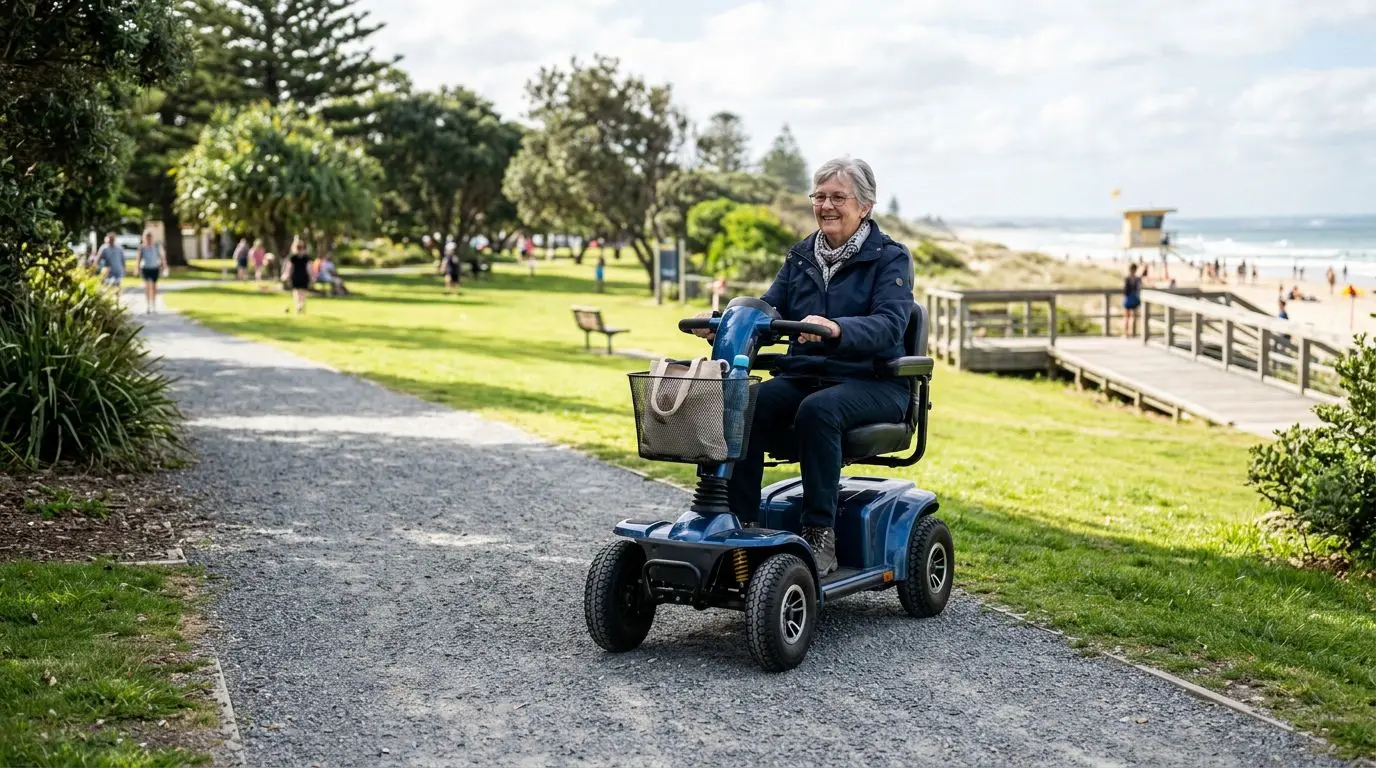
Beach, Grass, and Gravel Mobility Scooters: What Type Works on Loose or Uneven Surfaces?
15 min read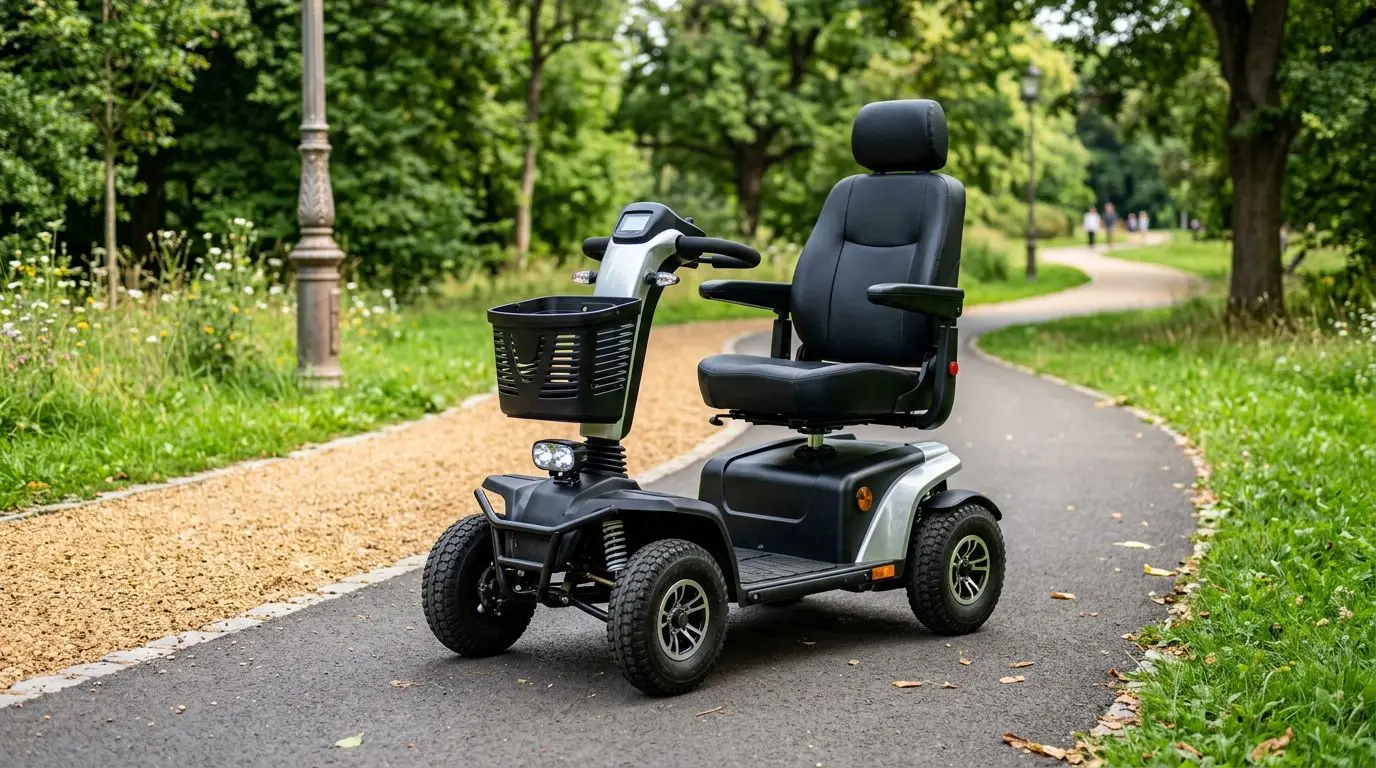
Heavy-Duty and All-Terrain Mobility Scooters: Weight Capacity, Comfort, and Outdoor Performance
15 min read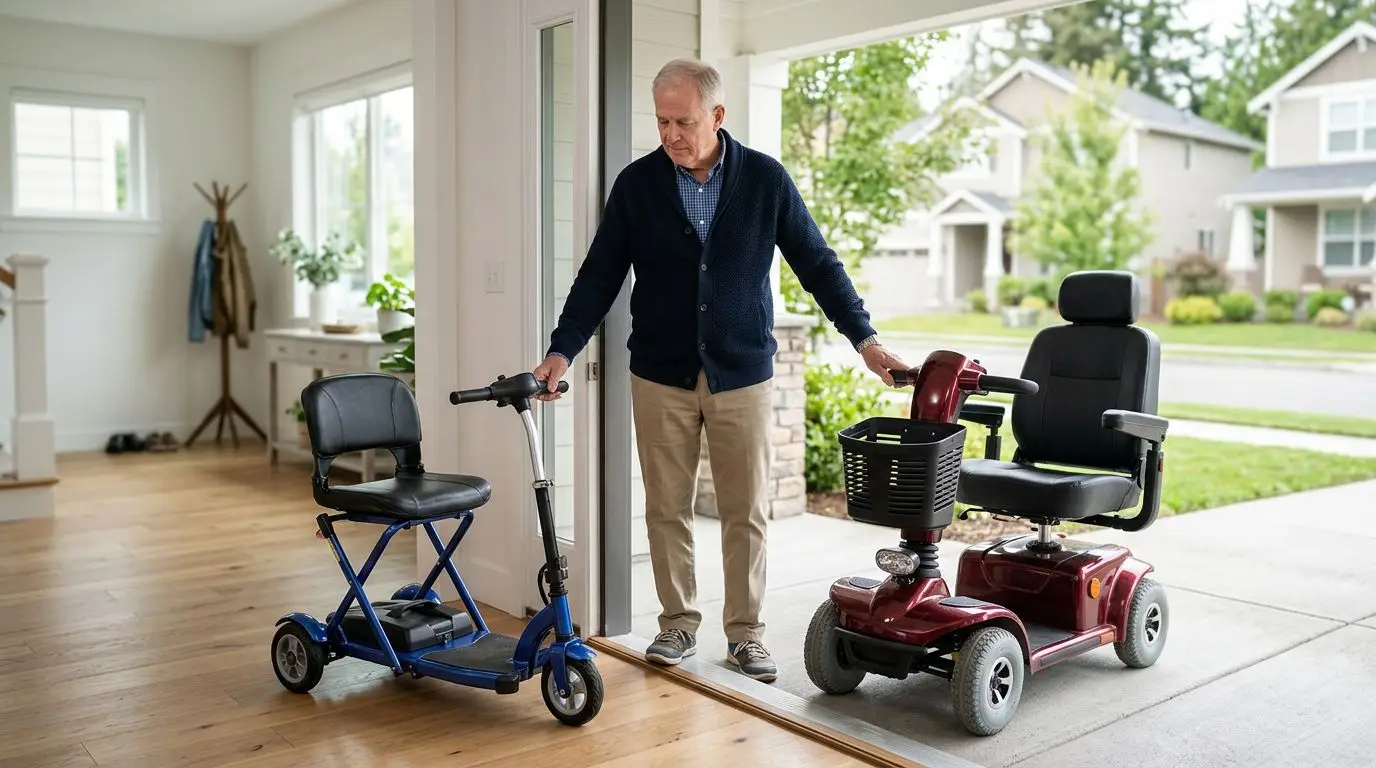
Indoor vs. Outdoor Mobility Scooters: How to Match the Scooter Type to Where You’ll Use It
14 min read