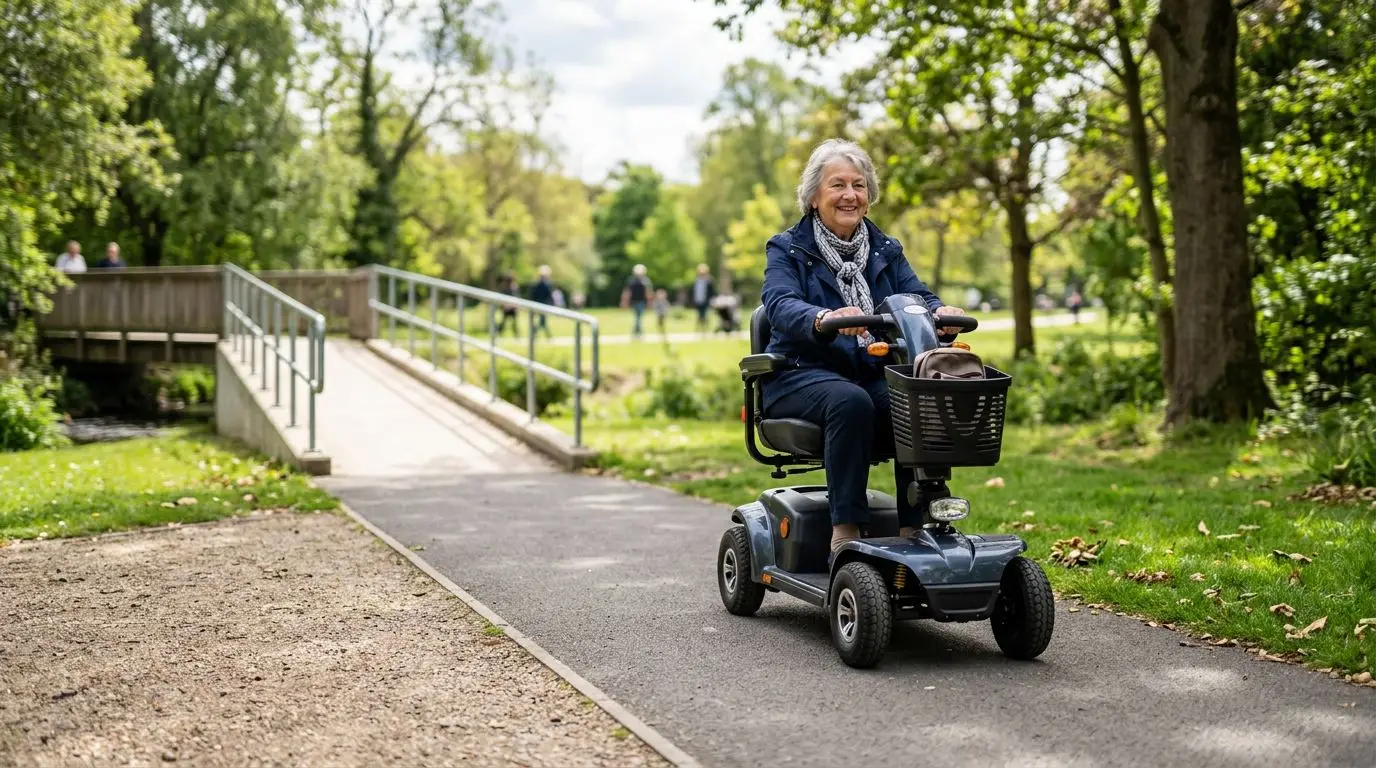
A mobility scooter can be used on some ramps, short grass, compacted gravel, and mildly uneven ground when the slope, surface, and scooter are within its limits. The safest approach is to follow the scooter’s stated limits, stick to dry, firm surfaces, and avoid loose, wet, rutted, or side-sloped areas. If you are unsure, slow down, approach straight, and take a flatter route.
Outdoor scooter use is not just about motor power. Stability, traction, braking distance, ground clearance, tire size, rider weight, battery charge, and surface conditions all matter. A path that feels easy in dry weather can become risky after 20 minutes of rain or when grass hides a dip you cannot see from the seat.
Safety basics: 6 degrees, 3 wheels vs 4 wheels, and why surface matters
Most mobility scooters are made for paved paths, sidewalks, indoor floors, and gentle outdoor surfaces. Many scooters list a maximum climbing angle of about 6 to 10 degrees, but that number does not guarantee every ramp or hill is safe in real life. It is usually based on controlled testing with a certain user weight, battery condition, and surface.
Think of outdoor use first as a stability issue and then as a traction issue. A scooter can tip if the center of gravity shifts too far to one side, the front, or the rear. It can also slide, spin, or get stuck if the tires cannot grip. Loose gravel, wet grass, mud, sand, and frost all reduce traction. Side slopes are especially risky because they tilt the scooter sideways, the direction where most riders have the least protection.
Three-wheel scooters often turn tightly, sometimes in a circle of roughly 32 to 45 inches, but they are usually less stable on uneven outdoor ground than similar four-wheel scooters. Four-wheel scooters often feel steadier on rough paths because the base is wider and the contact pattern is more balanced. That does not make them all-terrain vehicles. It simply gives them a better margin on mild irregularities.
Before taking any scooter outdoors, read the owner’s manual for the maximum incline, weight capacity, recommended tire pressure if it has air-filled tires, and warnings about water exposure. A 300 lb weight capacity, for example, includes the rider and anything carried. Bags, oxygen holders, groceries, and rear baskets all add weight and can affect balance.
Surface-by-surface guide: ramps, grass, gravel, and uneven ground compared
Different surfaces create different risks. A 20-foot paved ramp with handrails is very different from a 20-foot stretch of grass with a hidden sprinkler head. Use the table below as a practical safety screen, not as a substitute for your scooter’s manual.
| Surface | Usually safer when | Higher risk when | Best practice |
|---|---|---|---|
| Ramp | Dry, firm, straight, gentle slope, non-slip surface | Steeper than the scooter’s limit, wet, narrow, or side-sloped | Approach straight and keep speed low |
| Short grass | Dry, level, cut below about 3 inches, firm soil underneath | Wet, muddy, thick, sloped, or hiding holes | Test a small area first and avoid turning sharply |
| Compacted gravel | Hard-packed, shallow, level, with small stone | Deep, loose, freshly spread, rutted, or on a hill | Use steady speed and avoid sudden stops |
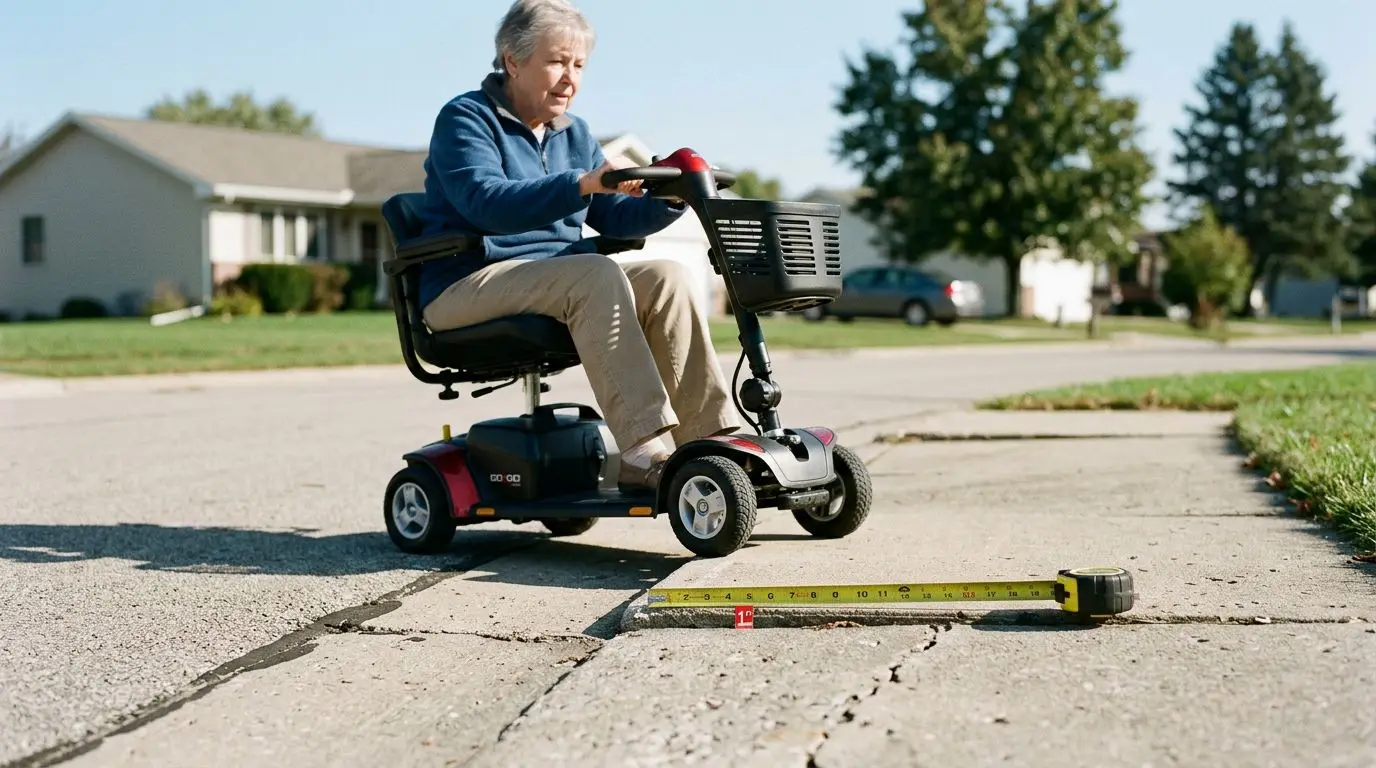
| Uneven pavement | Cracks are small, transitions are gradual, curb cuts are smooth | Edges exceed ground clearance or cause one wheel to lift | Cross seams squarely, not at a sharp angle |
| Dirt paths | Dry, packed, wide, and mostly flat | Roots, washouts, rocks, mud, or narrow drop-offs | Scout the path before committing |
The safest surfaces are dry, firm, and predictable. Problems begin when the ground changes under one tire but not the others. A front wheel dropping into a 2-inch hole may be manageable at walking speed, but the same hole can jolt the scooter hard enough to cause loss of control if you approach too fast.
Ramps: how steep is too steep for a mobility scooter?
For public access, the ADA design guideline often uses a 1:12 slope for many ramps, meaning 1 inch of rise for every 12 inches of ramp run. That equals about 4.8 degrees. Many mobility scooters can handle that type of ramp when it is dry, wide enough, and in good condition, but individual scooter limits still come first.
Portable scooter ramps are different. A short ramp can feel much steeper than it looks. For example, a 12-inch rise with a 4-foot ramp is a 1:4 slope, or about 14 degrees, which is too steep for many scooters and can cause the scooter to rear back, scrape, stall, or tip. A longer ramp reduces the angle. That is why ramp length matters as much as ramp height.
When using a ramp, line up straight before the front wheels touch it. Do not begin turning on the ramp. Keep both hands on the tiller, sit fully back in the seat, and use the slowest setting that still gives smooth forward movement. If the scooter has a speed dial, a low setting is usually safer than a quick throttle response.
Going down a ramp needs just as much care as going up. Descend straight, slowly, and without leaning forward. Avoid stopping halfway unless you must, because restarting on a slope can make the scooter jerk or roll. If the ramp is wet, icy, covered in leaves, or has a raised edge that could catch a wheel, wait or choose another route.
Grass and lawns: when 3 inches of grass can be too much
Short, dry grass over firm, level ground may be manageable for some four-wheel or outdoor-capable scooters. Tall, thick, wet, or soft grass is far less predictable. Grass can hide holes, tree roots, sprinkler heads, stones, and sudden soft patches, and a seated rider may not see them until the front wheels reach them.
A useful rule is to treat grass over about 3 inches high as a caution zone unless you know the lawn well. Even shorter grass can be unsafe when the soil is damp. Tires may sink, drive wheels may spin, and the scooter may stop with one side lower than the other. That side tilt can be more dangerous than simply getting stuck.
Do not cut diagonally across a sloped lawn. If you must travel on grass, choose the flattest path, go straight, and avoid sharp turns. Turning on grass raises the chance that a wheel will dig in. If the scooter starts to slow, bog down, or spin, stop before you dig a deeper rut. Back out gently if the path behind you is clear, or ask for assistance.
After riding on grass, check the underside and wheels. Long grass can wrap around axles, and wet clippings can collect near moving parts. A quick 2-minute inspection can prevent drag, noise, or a later problem.
Gravel, dirt, and uneven ground: tire grip and ground clearance matter
Compacted gravel is usually more scooter-friendly than loose gravel. A thin, hard-packed layer can behave almost like pavement, while 2 inches of loose stone can make steering wander and drive wheels spin. Freshly spread gravel is often the worst because the stones have not settled into a firm base.
Ground clearance is an important outdoor number. Many travel-style scooters have low clearance, sometimes around 2 to 3 inches, while larger outdoor-oriented scooters may offer more. Low clearance can cause the scooter to scrape on high spots, driveway lips, roots, or stones. Scraping is more than inconvenient; it can lift weight off a drive wheel and reduce traction.
Tire size also affects comfort and control. Larger wheels roll over small obstacles more easily than small wheels. Pneumatic, or air-filled, tires can cushion bumps and improve grip, but they require pressure checks and can puncture. Solid tires avoid flats but can transmit more vibration and may bounce on rough ground. Neither tire type makes deep gravel, mud, or rough trails automatically safe.
On dirt paths, look for width and escape options. A path that is only 30 inches wide with a drop-off on one side leaves little room to recover from a rut. Avoid routes with exposed roots, drainage channels, large rocks, soft shoulders, or blind turns where walkers, bicycles, or pets may appear quickly.
Which scooter type fits outdoor surfaces? 4 common categories compared
No scooter type is safe on every surface. Still, the general category says a lot about realistic limits. The table below compares common scooter types without naming brands or models.
| Scooter type | Typical strengths | Outdoor limits | Best use case |
|---|---|---|---|
| Compact travel scooter | Lightweight, easy to disassemble, tight turning | Lower ground clearance, smaller tires, less stability on rough ground | Indoor areas, smooth sidewalks, short paved trips |
| Standard 4-wheel scooter | Better stability than many 3-wheel designs, practical outdoor comfort | Still limited by slope, tire size, and wet conditions | Sidewalks, paved parks, gentle ramps, firm paths |
| Heavy-duty outdoor scooter | Higher weight capacity, larger tires, stronger suspension on some designs | Heavier to transport, needs more turning space, not safe on all terrain | Longer outdoor routes on firm, maintained surfaces |
| 3-wheel scooter | Nimble steering, easier maneuvering in tight spaces | Reduced side-to-side stability on uneven ground | Indoor use, smooth paved areas, tight turns |
Track-style mobility devices and specialty off-road mobility equipment exist, but they are not the same as everyday mobility scooters. They may handle soft or uneven ground better, yet they are heavier, more complex, and often come with different transport, storage, and safety considerations. For a typical mobility scooter user, the safer planning assumption is simple: stay on firm, dry, maintained routes.
How to choose and measure: 7 checks before riding outdoors
A safe outdoor decision starts before the trip. Use these 7 checks to compare the route with the scooter and the rider’s abilities.
- Check the maximum incline. Find the scooter’s rated slope or climbing angle in the manual. Do not rely on appearance alone.
- Measure ramp rise and run. Rise is vertical height; run is ramp length. A 6-inch rise with a 72-inch ramp is a 1:12 slope.
- Look at ground clearance. If a path has 3-inch rocks and the scooter has about 2.5 inches of clearance, scraping or stopping is likely.
- Confirm the loaded weight. Add rider weight plus bags, oxygen equipment, cane holders, groceries, or rear accessories.
- Inspect tires. For pneumatic tires, check pressure. For solid tires, check worn tread or cracks.
- Check battery charge. Hills, grass, and gravel use more power than level pavement. Start with a strong charge, especially for a trip longer than 30 minutes.
- Walk or visually scan the route. Look for puddles, loose stone, broken pavement, curb lips, leaves, ice, and construction plates.
You can estimate slope with a smartphone level app, a small inclinometer, or simple measurements. If a ramp rises 10 inches over 10 feet, that is 10 inches of rise over 120 inches of run, or a 1:12 ratio. If it rises 10 inches over 40 inches, that is 1:4 and much steeper. The shorter ramp may look convenient, but it can be unsafe for scooter loading and daily use.
Who it’s best for: outdoor scooter use within 1 to 2 miles of maintained routes
Using a mobility scooter outdoors works best for people who need help covering distance on predictable surfaces, such as sidewalks, paved paths, parking lots, building ramps, and maintained park trails. A common example is a rider traveling 1 to 2 miles for errands or social visits where curb cuts, crosswalks, and rest areas are available.
It is less suitable for riders who must cross soft lawns, steep driveways, rough rural paths, unpaved slopes, or areas without safe turnaround space. Outdoor scooter use also requires judgment: slowing before hazards, avoiding risky shortcuts, and deciding not to continue when conditions change.
Some users may benefit from professional guidance. An occupational therapist, physical therapist, mobility equipment specialist, or driver rehabilitation professional can help assess seating, transfers, vision, reaction time, route needs, and safe operation. That type of guidance does not guarantee safety, but it can reduce avoidable risks.
If balance, posture, hand control, or vision changes over time, reassess outdoor riding. A scooter that felt stable 2 years ago may no longer fit current needs, especially on ramps or uneven surfaces.
What to avoid: 10 high-risk situations
Some conditions are not worth testing. Avoid these 10 situations unless a qualified professional has confirmed the equipment and route are appropriate.
- Ramps steeper than the scooter’s stated limit.
- Wet wood ramps, metal plates, ice, snow, or algae-covered concrete.
- Side slopes where one side of the scooter rides higher than the other.
- Deep gravel, sand, mud, mulch, or beach surfaces.
- Grass that is wet, thick, sloped, or hiding holes.
- Curbs without curb cuts, even if the curb looks only a few inches high.
- Paths with exposed roots, loose rocks, washouts, or drop-offs.
- Fast turns on any uneven surface.
- Carrying heavy bags on the tiller, which can interfere with steering.
- Riding in traffic lanes where drivers do not expect slow mobility equipment.
Also avoid letting passengers ride on a single-user scooter. The added weight and movement change the center of gravity and can exceed the design limits. Children and pets should not ride on the foot platform.
Practical riding tips: a 5-minute pre-ride routine
A short routine can prevent many outdoor problems. Spend 5 minutes before each trip checking the scooter and the route. Make sure the seat is locked, armrests are secure, the battery indicator shows enough charge, the horn works, and the freewheel lever is in drive mode. If your scooter has lights or reflectors, check them before evening travel.
Start slowly. Practice on a flat paved area before trying ramps or firm gravel. Learn how the scooter responds when accelerating, braking, and turning at low speed. On uneven ground, small steering corrections are safer than sudden movements.
Approach bumps, seams, and driveway transitions as squarely as possible, with both front wheels reaching the obstacle at nearly the same time. Angled approaches can twist the scooter and lift a wheel. Keep feet fully on the platform and avoid reaching far to one side while moving.
Plan an exit. Before entering a grassy area or gravel path, ask yourself where you will turn around if it becomes unsafe. A 48-inch-wide path may not provide enough turning room for a larger scooter, especially if the edges are soft.
FAQ: 5 common outdoor mobility scooter questions
Can a mobility scooter go up a ramp?
Yes, if the ramp is within the scooter’s rated incline, wide enough, dry, firm, and approached straight. A 1:12 ramp, or 1 inch of rise for every 12 inches of run, is much gentler than many short portable ramps.
Is it safe to drive a mobility scooter on grass?
Sometimes, but only on short, dry, firm, and level grass. Grass over about 3 inches, wet lawns, slopes, and hidden holes increase the chance of slipping, sinking, or tipping.
Can mobility scooters handle gravel?
They can handle some compacted gravel, but deep or loose gravel is risky. If the stones shift under the tires or the path is more than about 1 to 2 inches loose on top, choose another route.
Are 4-wheel scooters safer on uneven ground than 3-wheel scooters?
Often, yes. Four-wheel scooters generally provide better side-to-side stability, while 3-wheel scooters usually turn more tightly. Stability still depends on slope, speed, tire size, ground clearance, and rider weight.
What should I do if my scooter gets stuck?
Stop applying power if the wheels spin. Turn the scooter off, stay seated if standing is unsafe, and ask for help. If you can safely exit, remove extra weight and move the scooter back to firm ground without pulling on fragile parts.
Frequently asked questions
Can a mobility scooter go up a ramp? +
Yes, if the ramp is dry, firm, wide enough, and within the scooter’s rated incline. Approach straight, use low speed, and avoid wet or steep ramps.
Is it safe to use a mobility scooter on grass? +
It can be safe on short, dry, level, firm grass, but wet, thick, sloped, or uneven grass can cause slipping, sinking, or tipping.
Can mobility scooters drive on gravel? +
Some can manage compacted gravel, but deep, loose, freshly spread, or sloped gravel is risky because tires can wander, spin, or sink.
Are four-wheel scooters better for uneven ground? +
Four-wheel scooters usually offer better stability than three-wheel scooters on mild uneven ground, but they still have limits for slope, traction, and clearance.
What is the safest way to go down a ramp on a scooter? +
Go straight down slowly, stay seated back, keep both hands on the tiller, and avoid turning or stopping suddenly on the ramp.
Related guides
Using a Mobility Scooter on Ramps, Slopes, Curbs, and Uneven Pavement Safely
13 min read
How to Prevent Mobility Scooter Tip-Overs: Slopes, Turns, Curbs, and Weight Balance Explained
14 min read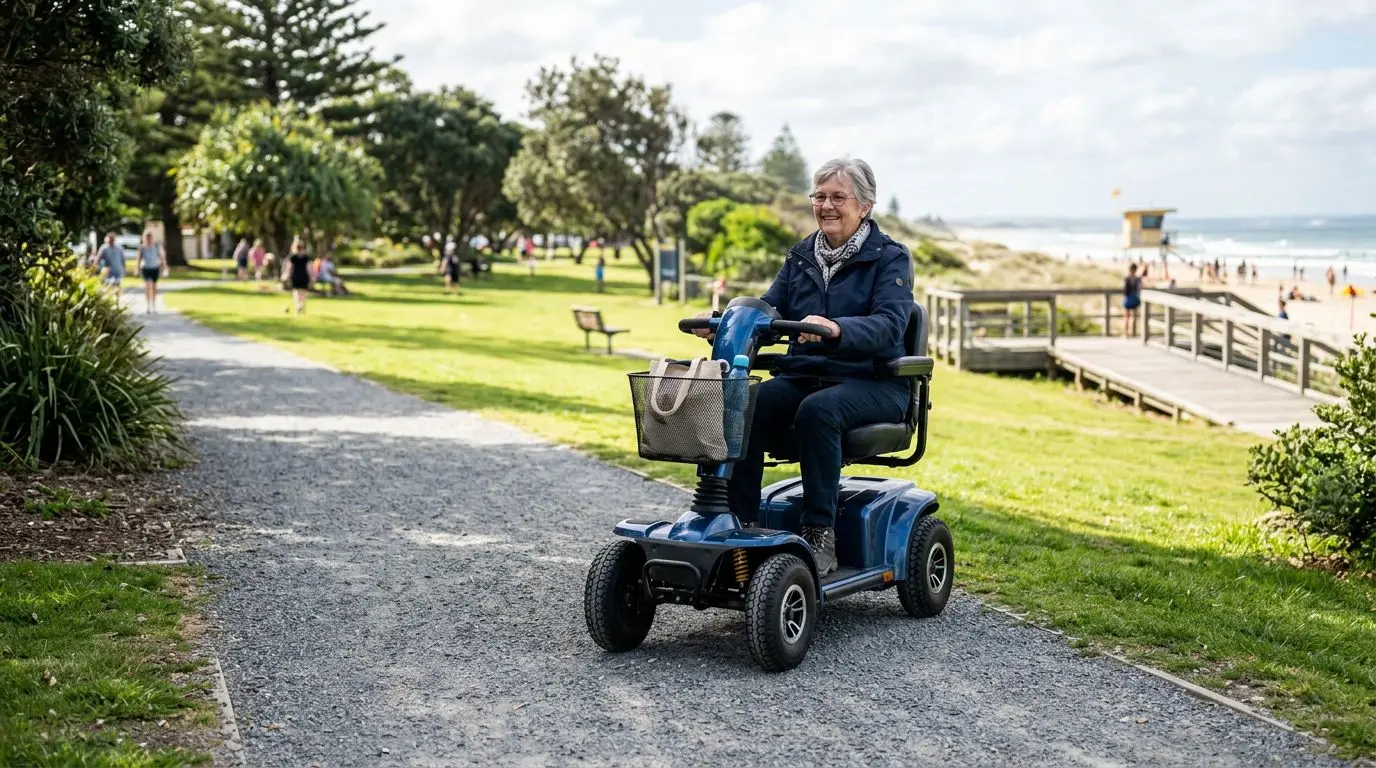
Beach, Grass, and Gravel Mobility Scooters: What Type Works on Loose or Uneven Surfaces?
15 min read