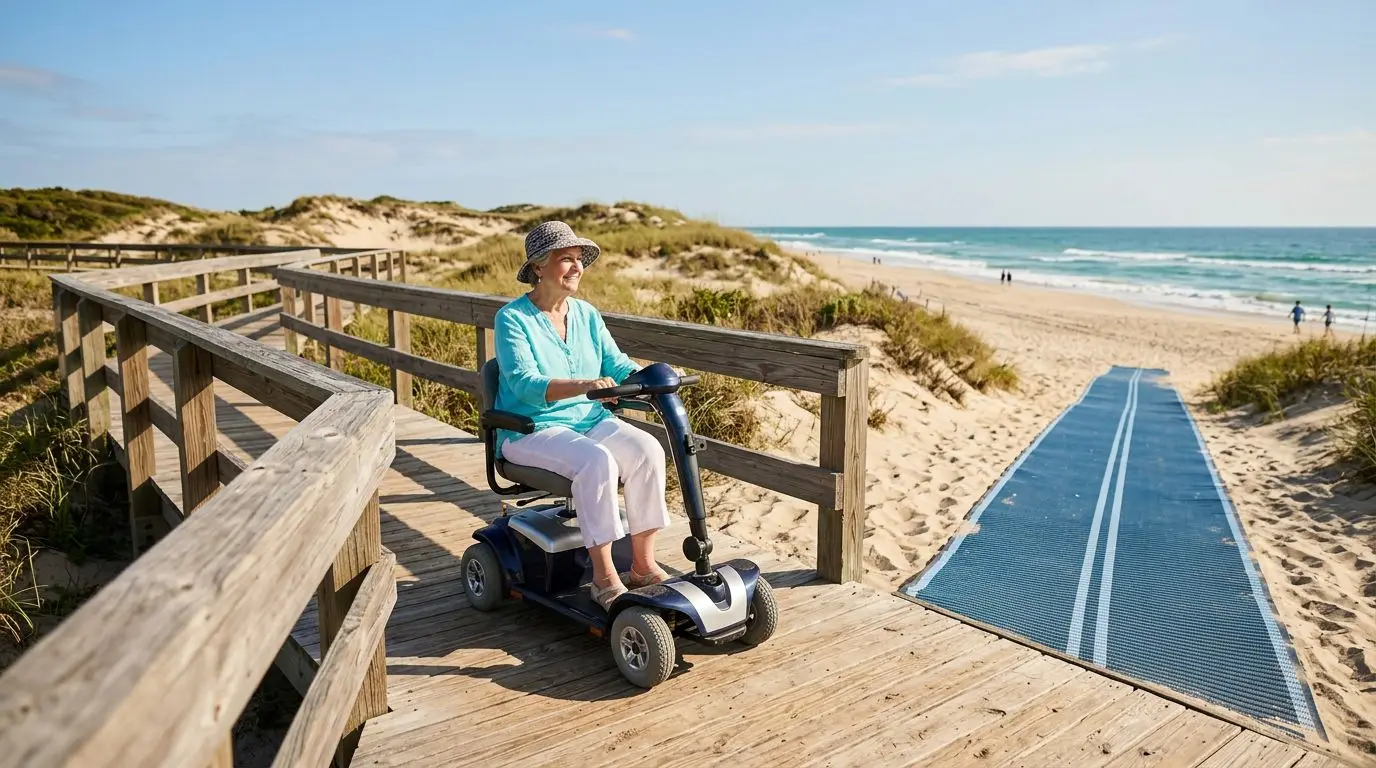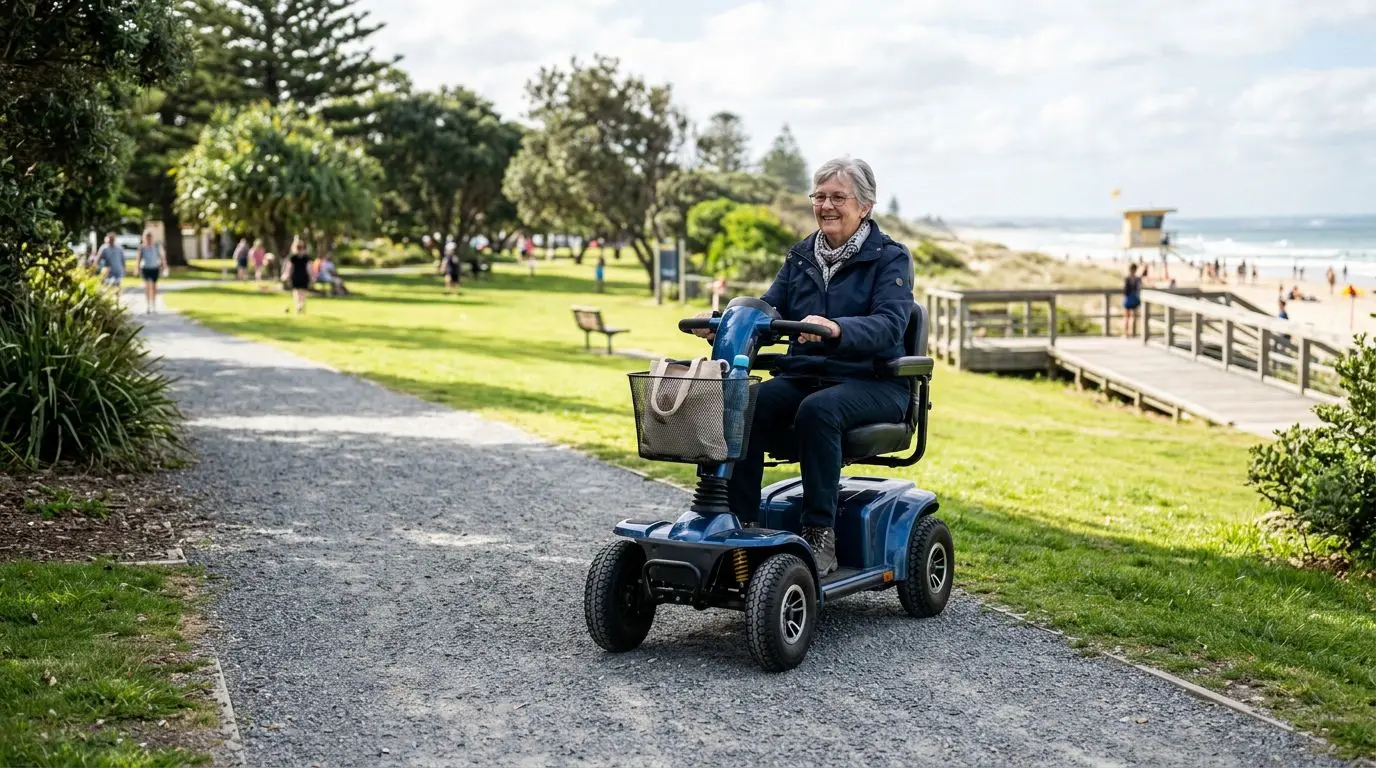
The best mobility scooter for beach, grass, or gravel is usually a stable 4-wheel outdoor scooter with large pneumatic or foam-filled tires, higher ground clearance, and a wider wheelbase. For soft dry sand, a standard scooter is rarely enough; you typically need a specialized beach-style setup with very wide tires, track-assisted drive, or another device built specifically for sand.
Loose and uneven surfaces are harder than sidewalks because the wheels can sink, spin, or catch on ruts. To choose safely, focus on traction, tire width, ground clearance, weight distribution, and the terrain you actually use most—not just the word “outdoor” in a product description.
Quick answer: 4-wheel outdoor scooters work best on most loose surfaces
For packed gravel paths, firm lawns, and park trails, a 4-wheel outdoor mobility scooter is usually the most practical choice. Look for larger tires in the 10- to 14-inch range, ground clearance around 4 inches or more, and a stable base that feels planted when turning slowly.
Three-wheel scooters can be easier to turn in tight indoor spaces, but they are generally less stable on uneven ground. On a bumpy gravel driveway or sloped yard, the extra front contact point of a 4-wheel scooter matters. It helps the scooter track straighter and reduces the rocking feeling that can happen when one wheel drops into a small dip.
Beach sand is the exception. Firm, damp sand near the waterline may be manageable for some heavy-duty outdoor scooters if the surface is flat and access is safe. Dry loose sand, however, can stop even a powerful scooter within a few feet. The wheels dig in, the motor works harder, and the scooter may become difficult to recover without help.
Comparison table: scooter types for 3 common outdoor surfaces
The table below compares broad scooter categories, not brands or models. Real performance depends on rider weight, battery condition, slope, tire pressure, surface depth, and how slowly the scooter is driven.
| Scooter type | Best surface match | Typical tire setup | Strengths | Realistic limits |
|---|---|---|---|---|
| Compact travel scooter | Smooth pavement, short firm grass | Small solid tires, often under 9 inches | Easy transport, tight turning | Low clearance, limited traction, not ideal for gravel or sand |
| Full-size 4-wheel outdoor scooter | Firm grass, packed gravel, uneven sidewalks | 10- to 12-inch tires, solid or pneumatic | Good stability and comfort for daily outdoor use | May struggle in loose gravel, mud, or dry sand |
| Heavy-duty all-terrain scooter | Rougher lawns, compact trails, coarser gravel | Large pneumatic or foam-filled tires, often 12 inches or more | Higher clearance, stronger traction, more stable frame | Heavier, wider, harder to transport, still not a true sand machine |
| Beach-style wide-tire scooter or chair | Soft sand and beach access routes | Extra-wide balloon-style tires or sand-specific wheels | Spreads weight over sand to reduce sinking | Usually less practical indoors and may require special transport |
| Track-assisted mobility device | Very loose ground, some sand, snow-like surfaces | Continuous rubber tracks instead of standard wheels | Large contact patch and strong flotation | Slower, heavier, specialized, and not suitable for every public area |
If you only cross a 20-foot strip of lawn to reach a patio, you may not need the same machine as someone who regularly travels across a gravel farm lane. Match the scooter to your hardest regular surface, not the easiest one.
Why loose terrain is harder: traction, sinking, and 2-inch obstacles
Loose terrain creates two problems at once. First, the tire needs enough grip to move forward without spinning. Second, the scooter needs enough surface area under the wheels to avoid sinking into sand, gravel, or soft soil.
A small solid tire can work well on a grocery store floor because the surface is flat, clean, and predictable. Put that same tire on pea gravel and it may push stones forward instead of rolling over them. On a lawn, it can sink into damp soil. On dry sand, it may dig a trench almost immediately.
Uneven ground also makes small obstacles feel bigger. A 2-inch lip at the edge of a walkway may be manageable for some outdoor scooters when approached straight and slowly. That same 2-inch height hidden in grass can jar the rider or stop the front wheels. Ruts, roots, and drainage dips are more difficult because they arrive at odd angles.
That is why speed is not the main answer. A scooter that can travel 5 or 6 mph on pavement should still be driven much more slowly on gravel, grass, or sand. Slow driving gives the tires time to climb, keeps steering inputs gentle, and reduces the chance of sliding sideways on a slope.
Tire style matters: 10-inch tires, wide tread, and air-filled comfort
Tires are one of the biggest differences between a pavement scooter and a terrain-capable scooter. Larger diameter tires roll over bumps more easily. As a general rule, a 12-inch tire handles rough ground better than an 8-inch tire because it does not fall as deeply into gaps between stones or roots.
Pneumatic tires, meaning air-filled tires, usually provide better cushioning and ground contact than small hard solid tires. They can flex slightly over gravel and grass, which helps comfort and traction. The tradeoff is maintenance: air pressure must be checked, and punctures are possible. Foam-filled tires reduce flat risk while still offering more give than very hard solid tires, but they can be heavier and may not ride quite as softly as air-filled versions.
Tread pattern matters too. A smooth tire is fine for sidewalks, but outdoor use benefits from deeper grooves that can bite into grass or compacted gravel. The goal is controlled grip, not aggressive tearing of the ground. Very knobby tires may add vibration on pavement and can still clog in mud.
Width is especially important for sand and soft soil. A wider tire spreads weight over a larger patch, which reduces sinking. Beach-style balloon tires use this idea to an extreme. They are not about speed; they are about flotation. If dry sand is a primary surface, narrow tires are usually the wrong tool.
Ground clearance and stability: aim for about 4 inches or more outdoors
Ground clearance is the space between the lowest point of the scooter and the ground. Many compact scooters sit low, sometimes around 2 to 3 inches, which is fine for indoor floors and smooth sidewalks. For outdoor uneven surfaces, about 4 inches or more is a more useful starting point.
Clearance helps prevent the underside from scraping on gravel crowns, driveway transitions, roots, and grass clumps. It does not make a scooter tip-proof, though. A scooter with high clearance but a narrow base can still feel unsettled on side slopes or rutted paths.
Stability comes from several factors working together: 4 wheels, a wider stance, a lower seated center of gravity, slower speed, and good weight distribution. Seat height also matters. A higher seat may improve visibility and comfort for transfers, but it can raise the rider’s center of gravity. On uneven ground, that can make leaning and turning feel more dramatic.
Suspension is another comfort and control feature. Front and rear suspension can reduce harsh jolts over gravel, especially during a 10- or 15-minute ride on a rough path. Suspension does not replace careful driving. It simply helps keep the tires and rider more settled.
Beach use: dry sand often requires sand-specific tires or tracks
Beach terrain changes every few feet. Firm boardwalk access, packed damp sand, loose dry sand, shells, and small slopes can all appear on the same trip. A scooter that works on the access mat may fail once it leaves the mat by just 6 feet.
For the beach, the key is flotation. Standard scooter tires concentrate weight into narrow contact patches. In dry sand, those tires dig down until the frame or motor housing is close to the surface. Once stuck, spinning the wheels usually makes the hole deeper.
Beach-capable designs usually use very wide low-pressure tires, oversized wheels, or track-style drive systems. Tracks spread weight across a long contact area, similar to how a snow vehicle spreads weight over soft snow. That can improve movement over loose surfaces, but tracked devices are often heavier, slower, and more specialized than everyday scooters.
Access is just as important as the scooter. Many beaches provide firm access mats, ramps, or loaner beach mobility equipment during certain hours or seasons. Before a trip, check the beach’s accessibility page or call the local parks office. Ask about mat length, slope, parking distance, and whether the route crosses soft sand.
Grass use: firmness, slope, and moisture change everything within 24 hours
Grass can be easy or difficult depending on what is underneath it. A firm, dry lawn is very different from wet soil after rain. The same yard may be passable on Friday afternoon and too soft on Saturday morning after a storm.
For lawns, choose a scooter with enough tire size and tread to roll over small bumps without digging in. Four-wheel stability is helpful, especially when crossing slight side slopes. Try to avoid wet grass, steep yard angles, and hidden holes. Even a shallow rut can turn the front wheels or cause a sudden tilt.
Moisture is the biggest warning sign. Wet grass reduces traction, and soft soil increases sinking. If the tires leave deep marks, the scooter is working too hard and may lose traction. Repeatedly driving the same route can also create ruts over time, so a firm path, pavers, or compacted walkway may be safer for regular use.
For homes, a practical test is to measure the route from the door to the outdoor seating area. If the grass section is only 12 to 20 feet, adding a firm pathway may be more reliable than buying the most aggressive scooter possible. The safest terrain is often the terrain you improve.
Gravel use: packed stone is manageable, loose 3-inch gravel is not ideal
Gravel varies more than many shoppers expect. Fine, well-compacted gravel can feel almost like a rough sidewalk. Deep loose gravel, especially rounded stones, can make steering wander and tires sink.
For gravel driveways and paths, larger tires and higher clearance help. Pneumatic or foam-filled tires are usually more comfortable than hard solid tires because they absorb chatter from the stones. A scooter with good low-speed control is also important. You want steady movement, not a jumpy start that spins the wheels.
Depth matters. A thin packed layer may be manageable, while 3 inches of loose decorative stone can be difficult. Rounded pea gravel is often harder than crushed gravel because the stones roll under the tires. Crushed gravel compacts and interlocks better, giving the tires a firmer surface.
If gravel is part of your daily route, inspect the worst areas: driveway crowns, washouts, dips near gutters, and transitions to concrete. A small ramp or packed repair may solve more problems than extra motor power. Motor strength helps, but it cannot fully overcome a loose surface that shifts under every wheel.
How to choose and measure: check 6 items before you buy
Start with your real route, not a brochure category. Walk or have someone inspect the exact surfaces you plan to use: doorway threshold, sidewalk cracks, grass length, gravel depth, ramp slope, and turning space. Take measurements with a tape measure when possible.
- Measure ground clearance needs. Note the tallest routine obstacle, such as a 1.5-inch threshold or 2-inch driveway lip. Choose clearance that gives margin, not just a match.
- Check tire diameter and width. For outdoor terrain, larger tires around 10 to 14 inches are generally more capable than small travel tires.
- Look at the wheelbase and overall width. A wider 4-wheel scooter may feel safer outdoors but may not fit through a 32-inch doorway or narrow gate.
- Confirm weight capacity with margin. Include rider weight plus oxygen equipment, bags, or groceries. Staying below the maximum rating helps performance and braking.
- Review slope ratings carefully. Many scooters list a maximum incline, but real-world traction on grass or gravel is lower than on dry pavement.
- Plan transport and storage. Heavy-duty terrain scooters can be difficult to lift and may require a vehicle lift, garage space, or ramped storage area.
If possible, test a similar scooter on a surface like yours. A 5-minute test on smooth showroom flooring does not tell you how it will behave on a sloped gravel path.
Feature comparison: what helps most on uneven ground
Not every outdoor feature matters equally. The most useful features for loose terrain are the ones that keep the scooter moving slowly, levelly, and predictably.
| Feature | Why it helps | What to watch for |
|---|---|---|
| 4-wheel base | Improves stability and straight tracking on uneven paths | Larger turning radius indoors |
| Large pneumatic tires | Better cushioning and traction over grass and gravel | Need air checks and can puncture |
| Foam-filled tires | Lower flat risk with more comfort than hard solid tires | Can add weight and may feel firmer |
| Higher ground clearance | Reduces scraping over roots, stones, and thresholds | Does not automatically mean better stability |
| Front and rear suspension | Reduces jolts during longer rides over rough surfaces | Adds complexity and may increase maintenance |
| Slow-speed control | Helps prevent wheel spin and sudden steering corrections | Test responsiveness before relying on it outdoors |
| Bright lights and reflectors | Improves visibility during dusk or shaded trail use | Does not replace safe route planning |
Battery range also deserves attention. Rough ground, grass, hills, and higher rider load can reduce real-world range compared with smooth indoor or sidewalk use. If a trip is 2 miles round trip, choose a scooter with comfortable range reserve rather than planning to use the full battery.
Who it’s best for: match the scooter to the hardest 10 percent of your route
An outdoor 4-wheel scooter is best for someone who mostly travels on pavement but regularly crosses firm grass, packed gravel, park paths, or uneven sidewalks. It is also a good fit for users who value stability over tight indoor turning.
A heavy-duty all-terrain scooter may be better for rural homes, large yards, long gravel driveways, or outdoor events where surfaces are unpredictable. These scooters are usually heavier and wider, so they are not the easiest choice for small apartments, frequent car loading, or narrow hallways.
A beach-specific scooter or track-assisted device is best for people whose main goal is sand access. It is usually not the most convenient daily scooter for shopping, medical appointments, or indoor use. Some people use one everyday scooter and rent or reserve beach mobility equipment only when needed.
A compact travel scooter is best for smooth surfaces, cruise terminals, airports, shopping centers, and short paved outings. It can handle a little firm grass in some cases, but it should not be expected to perform like a terrain scooter. If more than 10 percent of your regular route is loose or uneven, a compact scooter may be frustrating.
Safety and maintenance: inspect tires after every rough outdoor ride
Outdoor terrain adds risk, so keep expectations realistic. Mobility scooters can increase access and independence for many people, but they are not off-road vehicles. Avoid steep slopes, mud, standing water, soft shoulders, and sidehill travel whenever possible.
After riding on gravel, grass, or sand, check the scooter before storing it. Look for stones lodged in tread, grass wrapped near axles, low tire pressure, loose mirrors, and debris around the motor area. Sand and salt air can be especially harsh, so wipe exposed surfaces and follow the owner’s manual for cleaning. Do not hose down electrical parts unless the manual specifically allows it.
Use the lowest practical speed on uneven surfaces. Keep both hands on the controls, sit centered in the seat, and avoid sharp turns. If the scooter begins to sink or spin, stop and reassess rather than applying more throttle. Getting help early can prevent a minor stuck situation from becoming a damaged scooter or a fall risk.
Before changing tires, adding accessories, or modifying clearance, check the manual or ask a qualified mobility equipment professional. Changes can affect braking, stability, warranty coverage, and safe operation.
FAQ: 5 common questions about scooters for sand, grass, and gravel
Can a mobility scooter go on the beach?
Some can travel on firm beach access mats or very compact damp sand, but standard mobility scooters usually struggle in dry loose sand. For regular beach use, look for sand-specific wide tires, oversized flotation wheels, or track-style equipment, and confirm local beach access conditions before you go.
Are 3-wheel scooters safe on grass?
A 3-wheel scooter may cross short, flat, firm grass slowly, but it is generally not the best choice for uneven lawns. A 4-wheel scooter offers better stability when the ground has ruts, dips, or side slopes.
What tire type is best for gravel?
Larger pneumatic or foam-filled tires with outdoor tread usually work best on packed gravel. Small solid tires can chatter, sink, or wander more easily, especially in deep or rounded gravel.
How much ground clearance do I need outdoors?
For uneven outdoor use, about 4 inches or more is a practical starting point. More clearance can help over roots and gravel crowns, but stability, tire size, and driving technique matter just as much.
Will a more powerful motor solve loose terrain problems?
Not by itself. Power helps on hills and heavier loads, but loose terrain also requires traction and flotation. Narrow tires on soft sand may dig in even if the motor is strong.
Frequently asked questions
Can a mobility scooter go on the beach? +
Some mobility scooters can handle firm access mats or compact damp sand, but standard scooters usually struggle in dry loose sand. Regular beach use typically requires wide sand-specific tires, oversized flotation wheels, or track-style mobility equipment.
What type of mobility scooter is best for grass? +
A 4-wheel outdoor scooter with larger tires, outdoor tread, and about 4 inches or more of ground clearance is usually best for firm grass. Wet grass, soft soil, ruts, and side slopes can still be unsafe.
Are pneumatic tires better for gravel? +
Pneumatic tires often provide better cushioning and traction on packed gravel than small hard solid tires. Foam-filled tires are another option when you want some cushioning with less flat-tire risk.
How much ground clearance should an outdoor scooter have? +
For loose or uneven outdoor surfaces, about 4 inches or more is a useful starting point. Clearance should be considered along with tire size, wheelbase, stability, and the height of obstacles on your route.
Can a compact travel scooter handle gravel or grass? +
A compact travel scooter may manage very short stretches of firm grass or smooth packed gravel, but it is not designed for regular loose terrain. Small tires and low clearance are the main limitations.
Related guides
All-Terrain Mobility Scooters: What to Know Before Buying
12 min read
Using a Mobility Scooter on Ramps, Grass, Gravel, and Uneven Ground: What’s Safe and What to Avoid
13 min read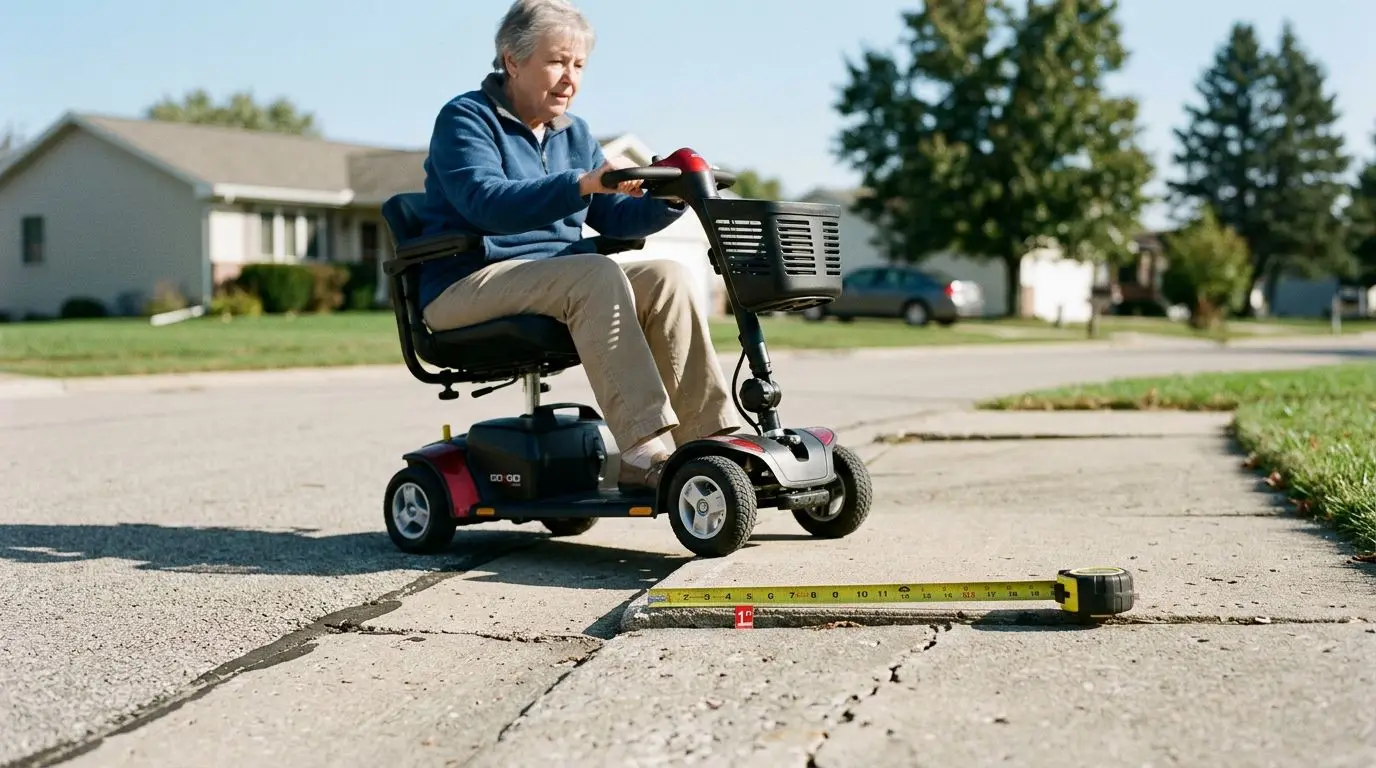
Mobility Scooter Tires, Suspension, and Ground Clearance: Matching Features to Sidewalks, Thresholds, and Rough Pavement
14 min read