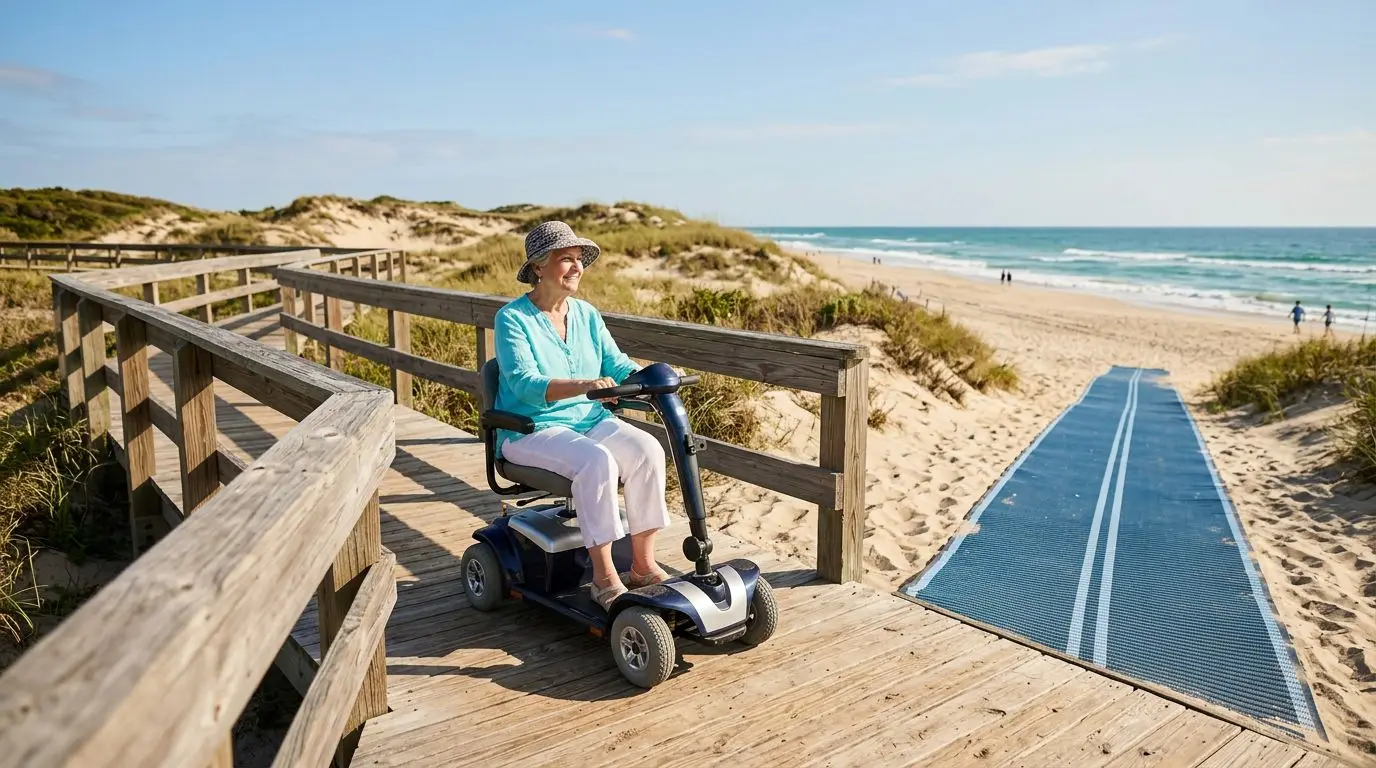
A standard mobility scooter usually works well in paved beach parking lots, on boardwalks, and over firm access mats, but it is not designed for loose, dry sand. For sand, better choices include wide-tire all-terrain scooters, tracked mobility devices, or beach wheelchairs with oversized balloon tires, depending on how far you need to travel and whether you can transfer safely.
The key is matching the device to the surface. A scooter that feels steady on a 6-foot-wide boardwalk may bog down within 10 feet of soft sand. At the same time, a sand-capable device may be too wide, heavy, or slow for a restaurant ramp or hotel elevator.
Beach terrain reality check: 4 surfaces, 4 different scooter demands
“Beach mobility scooter” can mean a few different things. Some people mean a regular scooter used during a beach vacation. Others mean a purpose-built machine for sand. Those are not the same, and the distinction matters.
Most everyday mobility scooters are made for hard, predictable surfaces: sidewalks, indoor floors, parking lots, compacted gravel, and smooth paths. Sand behaves differently. Wheels sink, the motor works harder, and steering becomes less predictable. Even a powerful scooter can get stuck if the tires are narrow or the ground is loose.
Use the table below to set realistic expectations before you reserve a rental or plan a beach day.
| Surface | Typical condition | What usually works | What to watch |
|---|---|---|---|
| Paved parking lot | Asphalt or concrete, sometimes sloped | Most 3-wheel and 4-wheel scooters | Curbs, potholes, and hot pavement above 100°F |
| Boardwalk | Wood, composite, or concrete, often 4 to 8 feet wide | Standard, travel, and full-size scooters | Gaps, wet boards, crowds, and tight turns |
| Beach access mat | Temporary or permanent mat over sand | Many full-size scooters if mat is firm and wide | Raised edges, soft spots, and abrupt ends |
| Loose dry sand | Deep, shifting, high rolling resistance | Wide-tire, tracked, or beach wheelchair options | Getting stuck, battery drain, tipping risk |
A useful rule of thumb: if your scooter has small tires under about 9 inches in diameter and low ground clearance, assume it is meant for hard surfaces only. That does not make it a poor scooter. It simply means the beach calls for different equipment.
What works on sand: wide tires, tracks, and beach wheelchairs
Loose sand is the hardest beach surface for powered mobility. A scooter needs flotation, traction, and enough ground clearance to keep the frame from dragging. Flotation means spreading weight over a larger contact area, which is why sand devices often use very wide tires or continuous tracks.
There are three common approaches, and each comes with trade-offs.
| Sand option | Best use | Strengths | Limitations |
|---|---|---|---|
| Wide-tire all-terrain scooter | Firm sand, packed sand, beach approaches, grass, rough paths | Powered mobility, familiar scooter controls, better flotation than narrow tires | May still struggle in deep dry sand; often heavier and wider than standard scooters |
| Tracked mobility device | Soft sand, uneven beach access, short sand crossings | Excellent traction and weight distribution; can handle surfaces that stop wheels | Usually slower, larger, and less convenient indoors; transport can be difficult |
| Beach wheelchair with balloon tires | Beach seating, waterline access with caregiver assistance, rental programs | Very good flotation; common at public beaches and resorts | Often not self-propelled; user may need transfer help and a companion |
Wide tires are the most scooter-like option. They can work well for people who want to ride from a paved area onto firmer beach terrain without transferring to a chair. Look for tires that are visibly broad, deeper tread than an indoor scooter, and ground clearance that keeps the underside from scraping. Even so, loose dune sand can still be too much.
Tracks are more specialized. They spread weight across a long footprint instead of relying on round wheels. That can be a major advantage on soft sand, but tracked devices are not always comfortable for long boardwalk rides or crowded shopping areas. They may also require a trailer, lift, or accessible delivery because they can be bulky.
Beach wheelchairs are worth considering even if you normally use a scooter. Many public beaches, state parks, and vacation areas keep balloon-tire chairs for visitors. Some are free with a reservation or available through local beach services. The trade-off is independence: many beach wheelchairs are pushed by another person, and some users need help transferring from a scooter seat.
Boardwalks, ramps, and parking lots: the 1:12 slope detail matters
For many beach trips, the most important terrain is not the sand. It is the route from the accessible parking space to the boardwalk, restroom, food stand, shade area, or rental office. A standard scooter may handle this very well if the route is continuous and reasonably smooth.
Accessible ramp design often uses a 1:12 slope guideline, meaning 1 inch of rise for every 12 inches of ramp run. In practice, older boardwalk entrances and private vacation properties may be steeper. A steep ramp can cause the scooter to lose traction, scrape at the bottom, or feel unstable near the top transition.
Boardwalk gaps are another issue people often miss. Small caster-style front wheels can catch on uneven boards or raised seams. A gap of 1/2 inch may not sound like much, but at low speed it can create a jolt. Larger wheels and slower driving help, but the safest choice is a route with smooth transitions.
Parking lots add their own challenges. Beach lots often have sand drift, puddles, wheel stops, and curb cuts that are partly blocked by vehicles. Before unloading a scooter, look for a continuous path that does not require dropping off a curb. If you use a vehicle lift or ramp, leave enough room behind the vehicle; many ramps need several feet of clear space to deploy safely.
On paved surfaces, 3-wheel scooters often turn tighter, which helps near ticket windows or restroom entrances. Four-wheel scooters generally feel more stable on uneven pavement and sloped approaches. Neither design automatically makes a scooter sand-ready.
Who beach mobility scooters are best for: trips under 3 miles and planned routes
A beach-capable mobility setup is best for someone who can plan the route, understand the equipment’s limits, and avoid pushing into unsafe terrain. It is not a magic solution for every shoreline. The right match depends on your balance, transfer ability, stamina, and how much help you will have nearby.
A standard scooter is often enough if your vacation goal is to enjoy the ocean view from a boardwalk, pier, paved promenade, or accessible deck. Many beach towns have long paved waterfront paths where a scooter can be extremely useful. If you expect to travel 1 to 3 miles during the day between parking, restaurants, restrooms, and viewpoints, a full battery and a hard-surface route may be the main requirements.
A wide-tire or tracked option makes more sense if the plan includes crossing sand to reach a beach chair area, fishing spot, or family gathering. It is especially helpful when access mats end before the area you want to use. If the sand crossing is more than 50 to 100 yards, ask very specific questions about battery capacity, heat, and whether the device has been used successfully on that beach.
A beach wheelchair may be better when the main goal is sitting with family on the sand rather than driving independently around town. It may also be safer if the user has limited trunk control, fatigue, or difficulty reacting to bumps. The trade-off is that a companion or beach staff member may need to push.
- Best for standard scooters: boardwalk sightseeing, paved paths, accessible piers, parking lots, restaurants, and hotel grounds.
- Best for wide-tire scooters: mixed hard surfaces, firm sand, grass, and short sand crossings.
- Best for tracked devices: soft sand access where wheeled devices are likely to sink.
- Best for beach wheelchairs: relaxing on the sand with assistance and minimizing the risk of a powered device getting stuck.
How to choose and measure before you rent or buy: 7 numbers to confirm
Beach access problems are often measurement problems. A scooter may be powerful enough for your needs but too wide for the rental house doorway, too heavy for the vehicle lift, or too long for the elevator. Before you commit, write down these 7 numbers.
| Measurement | Why it matters | Practical target or question |
|---|---|---|
| Overall width | Determines doorway, ramp, and boardwalk clearance | Compare to doors, gates, and mats; many interior doors are about 30 to 36 inches wide |
| User weight rating | Affects safety, braking, and performance | Do not exceed the stated capacity, including carried items |
| Ground clearance | Helps avoid scraping on ramp transitions and packed sand ridges | Ask about clearance at the lowest point, not just the frame |
| Tire diameter and width | Small narrow tires sink and catch more easily | For sand, wider tires or tracks matter more than motor size alone |
| Turning radius | Important in condos, elevators, shops, and restrooms | Measure the tightest turn on your route, not just open areas |
| Battery range | Sand, heat, hills, and user weight reduce real-world range | Plan a safety margin rather than using the full advertised range |
| Transport weight | Determines whether it can be lifted, ramped, or delivered | Ask for the heaviest piece if it disassembles |
Do not rely on photos alone. A scooter can look rugged while still having low clearance or tires that are not suited to deep sand. Ask the rental provider what surfaces the device is intended for and what surfaces are prohibited. That answer is more useful than a generic “all terrain” description.
Measure your vacation rental as well. Check the narrowest doorway, bed height if transfers are needed, elevator size, and the path from the entrance to the charging location. A scooter that cannot get into the unit cannot be charged securely overnight. Most mobility scooter batteries should be charged in a dry, ventilated area away from direct rain or salt spray.
Vacation rentals and beach towns: ask these questions 48 hours before arrival
Beach vacations have many moving parts: lodging, parking, tides, weather, rental delivery, and local rules. Calling 48 hours ahead gives you time to change plans if a beach access point is closed or the only available device is not suitable.
Start with the beach or parks office if you are visiting a public beach. Ask whether they have beach access mats, how far the mats extend, and whether beach wheelchairs are available by reservation. Some locations offer chairs only during staffed hours, such as 9 a.m. to 5 p.m., and may require an ID or sign-out form.
Then contact your lodging host or hotel. Confirm the route from parking to the room with measurements, not just “accessible” language. Ask about step-free entry, elevator availability, door width, and where the scooter can charge. If the property has a wooden ramp, ask whether it is solid, non-slip, and wide enough for the scooter.
If you are renting a scooter locally, be direct about your plans. Say, “I need to use it on paved areas only,” or “I need to cross soft sand for about 75 yards.” A responsible rental provider should tell you if a standard scooter is not appropriate. Also ask what happens if the scooter gets stuck or damaged from sand exposure, because some rental agreements restrict beach use.
- Is the device allowed on sand, or only on pavement and boardwalks?
- What is the total width, total length, and weight capacity?
- Can it be delivered to the hotel, rental house, or beach access point?
- How long does a full charge take, and is the charger included?
- Who do I call if there is a battery, tire, or control problem?
- Are there cleaning fees or restrictions for saltwater, wet sand, or ocean spray?
One practical tip: schedule delivery before you actually need to leave for the beach. A 30-minute delay may feel minor at home, but it can disrupt a family outing when heat, parking, and tides are involved.
Safety near water, heat, and crowds: keep at least 10 feet from the surf
Powered mobility devices and saltwater do not mix well. Even if a scooter can travel on firm wet sand, avoid driving through water, tidal pools, or heavy seaweed. Saltwater can damage electrical components, bearings, brakes, and connectors. A conservative rule is to stay at least 10 feet from the active surf line, and farther away when waves are unpredictable.
Heat is another serious factor. Dark pavement, direct sun, and slow travel can make a scooter seat, armrests, and foot platform uncomfortably hot. Bring water, take shade breaks, and avoid leaving the scooter baking in direct sun for long periods. Batteries also perform best when kept within the operating conditions recommended by the manufacturer or rental provider.
Drive slower than you would indoors. Beaches create distractions: children running, dogs on leashes, bicycles, coolers, carts, and people stopping suddenly for photos. On a crowded boardwalk, a walking-speed pace is usually the safest and most courteous choice.
Do not test limits alone. If you are trying sand for the first time, have another adult nearby and stay close to the access point. Turn around before the scooter starts straining, digging in, or leaning. Getting stuck 15 feet from the mat is inconvenient; getting stuck 150 feet away in hot sun is a much bigger problem.
FAQ: 5 practical answers for beach scooter planning
Can a regular mobility scooter drive on sand?
Usually not on loose, dry sand. A regular scooter may handle paved paths, boardwalks, and firm access mats, but narrow tires and low clearance can cause it to sink or drag in soft sand.
Are 3-wheel or 4-wheel scooters better for the beach?
For paved beach areas, 3-wheel scooters often turn more tightly, while 4-wheel scooters often feel steadier on uneven pavement. For sand, wheel count matters less than tire width, ground clearance, traction, and whether the device is designed for that surface.
Can I rent a scooter for a beach vacation?
In many beach towns, yes. Confirm at least 48 hours ahead, and ask whether the rental is approved for sand or only for hard surfaces. Many standard vacation scooters are pavement-only.
What is the best option if I want to sit on the sand with family?
A beach wheelchair with balloon tires may be the simplest choice, especially if you have a companion who can push and you can transfer safely. If you need powered independence on sand, ask about wide-tire or tracked devices.
Will beach access mats work with any scooter?
Not always. Mats vary in firmness, width, and condition. A scooter with small wheels may struggle at the edge, on a raised seam, or where the mat ends and soft sand begins.
The best beach mobility plan is honest about terrain. Use a standard scooter for hard surfaces, choose sand-specific equipment for soft sand, and confirm the route before you arrive. That practical planning protects your safety, your independence, and your vacation time.
Frequently asked questions
Can a regular mobility scooter drive on sand? +
Usually not on loose, dry sand. A regular scooter may work on pavement, boardwalks, and firm beach access mats, but narrow tires and low ground clearance can cause it to sink or get stuck.
Are 3-wheel or 4-wheel scooters better for beach areas? +
For paved beach areas, 3-wheel scooters often turn tighter, while 4-wheel scooters usually feel steadier on uneven pavement. For sand, tire width, ground clearance, traction, and sand-rated design matter more than wheel count.
What works best on soft beach sand? +
Soft sand usually requires wide-tire all-terrain scooters, tracked mobility devices, or beach wheelchairs with oversized balloon tires. Standard travel scooters are generally not suitable for loose sand.
Can I rent a mobility scooter for a beach vacation? +
Often, yes. Ask at least 48 hours ahead whether the rental is allowed on sand or only on hard surfaces, and confirm delivery, charging, width, weight capacity, and support if there is a problem.
Do beach access mats work for all mobility scooters? +
No. Mats vary in width, firmness, seams, and condition. Many scooters can handle a firm mat, but small wheels may struggle at raised edges, soft spots, or where the mat ends.
Related guides
Beach, Grass, and Gravel Mobility Scooters: What Type Works on Loose or Uneven Surfaces?
15 min read
Mobility Scooter Rules in Parks, Trails, and Outdoor Public Spaces
13 min read
What to Ask Before You Rent a Mobility Scooter Near You
14 min read