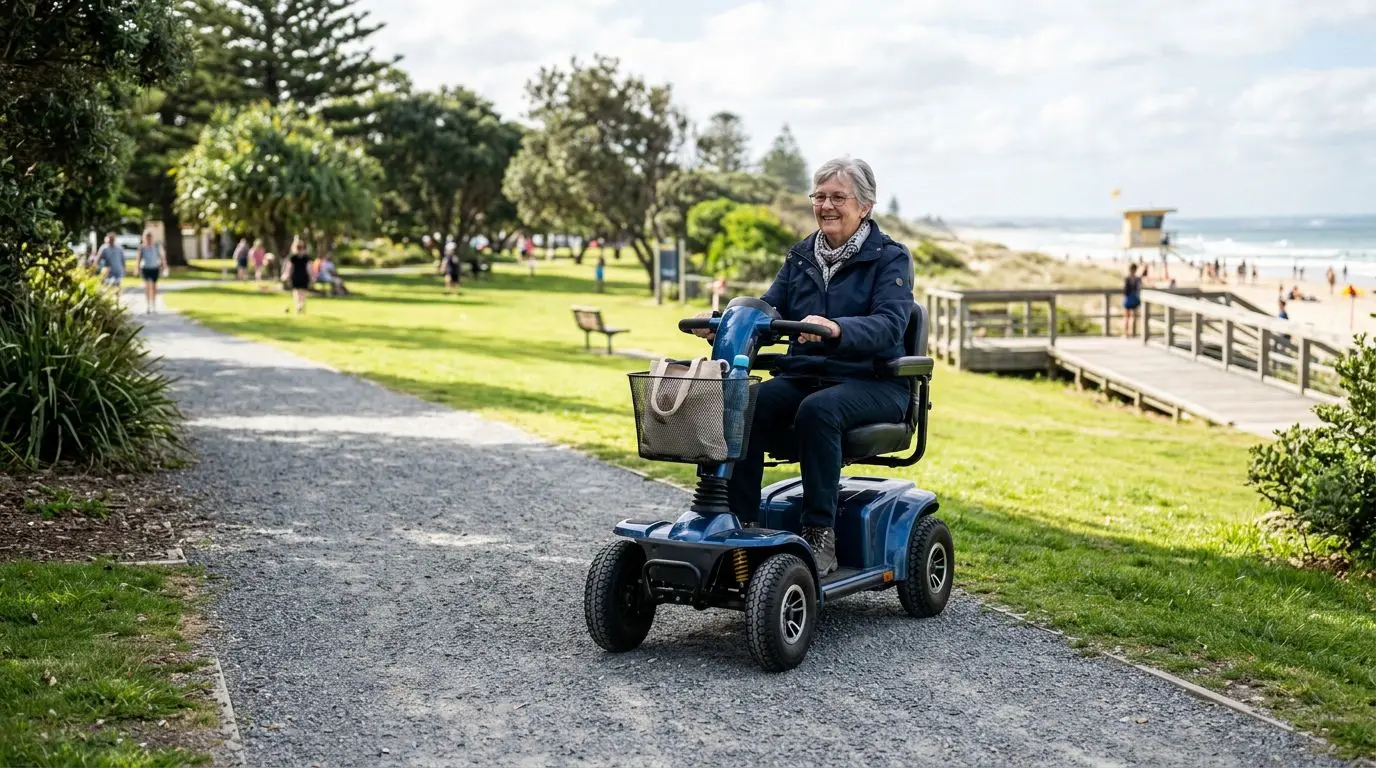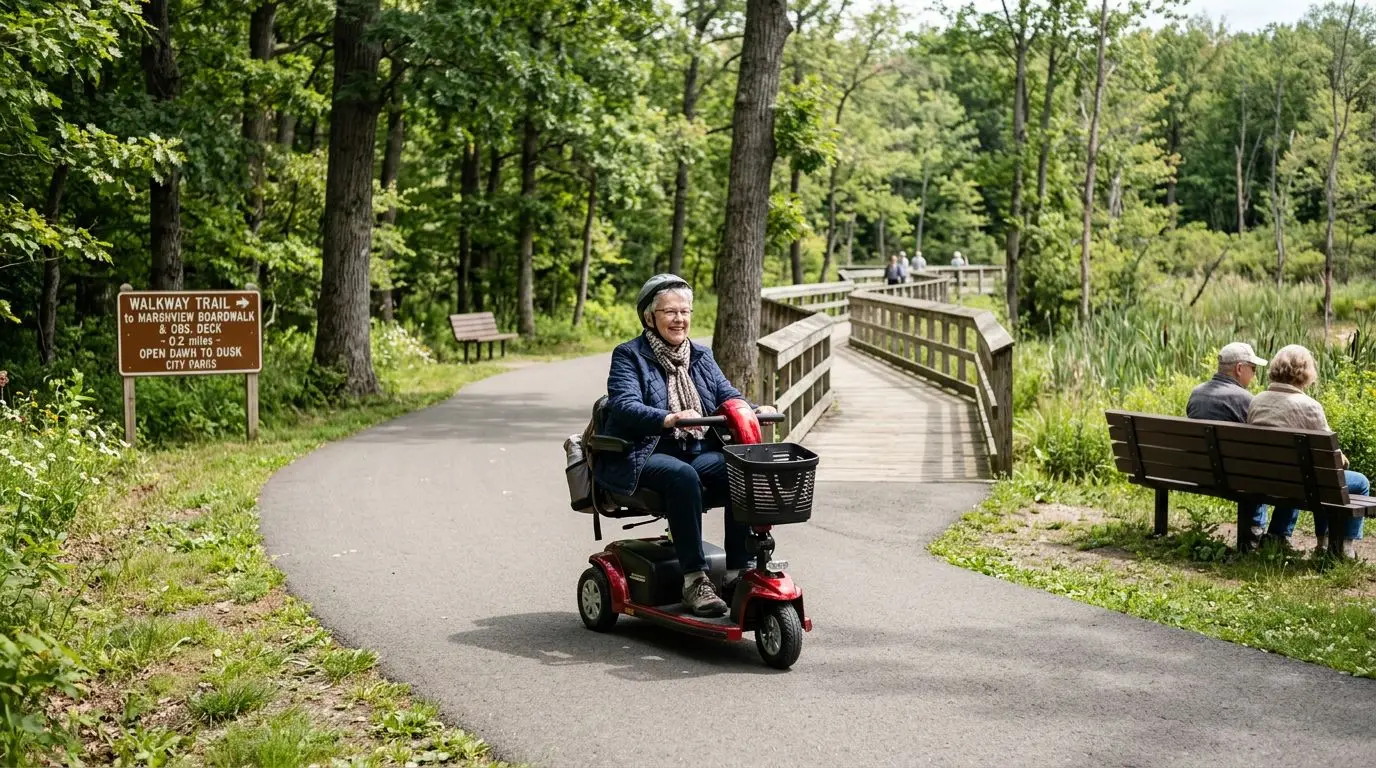
Mobility scooters are generally allowed in outdoor public spaces open to pedestrians, including many paved park paths, sidewalks, plazas, and public recreation areas. Limits may apply when a scooter creates a legitimate safety risk, cannot manage the terrain, could damage a sensitive natural area, or is restricted by clearly posted rules that comply with disability access laws.
The practical answer is straightforward: paved public routes are usually the easiest yes, while narrow nature trails, dunes, beaches, steep grades, and crowded event areas call for more checking. Before you go, confirm the site’s mobility device policy, match your scooter to the surface, and have a polite plan in case staff ask why you are using it.
Rules in 3 layers: federal access, local policy, and the actual trail
Outdoor scooter access in the United States is usually shaped by 3 layers at once: federal disability access rules, state or local park policies, and the physical conditions on the ground. A path may be legally open but still unsafe for a 3-wheel scooter with small tires if it has loose gravel, a 10% grade, or a narrow bridge.
Under the Americans with Disabilities Act, public entities and many places open to the public must generally allow wheelchairs and similar mobility devices in areas where pedestrians are allowed. Many mobility scooters used by people with mobility disabilities fit that practical category, especially when they are designed for personal locomotion rather than recreation.
For larger or less typical powered devices, the ADA uses the term other power-driven mobility devices, often shortened to OPDMDs. A park, trail operator, or public venue must consider whether that type of device can be used safely in that setting. They may look at factors such as device size, weight, speed, pedestrian traffic, environmental impact, and whether the area was designed for that kind of use.
That does not mean every outdoor surface is open to every scooter. A 30-inch-wide scooter may be reasonable on an 8-foot paved greenway and unreasonable on a 24-inch single-track dirt trail with steep drop-offs. Access is not only about permission. It is also about control, stability, turning space, and the ability to return safely.
Where scooters are usually allowed: 5 common outdoor settings
Most outdoor scooter users have the best results in places built for pedestrians, bicycles, strollers, or maintenance carts. Width matters. A typical mobility scooter may be about 22 to 30 inches wide, while many accessible routes are designed around a minimum clear width of 36 inches, with wider areas needed for passing and turning.
| Outdoor setting | Access outlook | Common limits | Practical tip |
|---|---|---|---|
| Paved park paths | Usually allowed when open to pedestrians | Crowds, events, maintenance closures | Use walking speed, often about 2 to 3 mph in busy areas |
| Sidewalks and plazas | Usually allowed | Curb cuts, uneven pavement, construction detours | Look for curb ramps before committing to a route |
| Boardwalks | Often allowed if boards are firm and gaps are manageable | Narrow sections, wet wood, sand buildup | Avoid sharp turns on wet boards |
| Multi-use greenways | Often allowed, but shared with bikes and runners | Speed differences, blind curves, bridges | Keep right and signal before stopping |
| Public gardens or outdoor museums | Often allowed on designated accessible routes | Historic surfaces, narrow gates, restricted lawns | Ask for the accessible map at entry |
Paved does not always mean smooth. Tree roots can lift asphalt by 1 inch or more, and small front wheels may catch where a person walking would barely notice the change. After rain, painted surfaces, metal plates, and wooden bridges can also become slick.
In city and county parks, scooter users are commonly expected to follow pedestrian rules rather than bicycle rules, unless signs say otherwise. That means yielding, keeping speeds low near families and pets, and staying out of areas marked for staff vehicles only.
When limits can apply: 6 safety and terrain reasons
Access limits should not be based on assumptions about disability. They are usually tied to real conditions, and there are at least 6 common reasons an outdoor site may restrict where a scooter can go: slope, width, surface firmness, drop-offs, crowding, and environmental protection.
- Steep grades: Many scooters feel less stable on long grades above about 5%, and ramp guidance often uses 1:12 as a maximum slope for short accessible ramps. Natural trails can be much steeper.
- Narrow clear width: If the route narrows below 36 inches, passing, steering correction, and turning become harder, especially with railings or rocks on both sides.
- Loose or soft surfaces: Deep sand, mud, pea gravel, wet leaves, and unpacked soil can reduce traction and increase the chance of getting stuck.
- Edge hazards: Trails with drop-offs, drainage ditches, or water on one side leave little room for error.
- Heavy pedestrian traffic: A scooter may be allowed in a plaza at 10 a.m. but restricted during a packed concert or fireworks event.
- Resource protection: Dunes, wetlands, archaeological areas, and restoration zones may have strict rules because one set of tire tracks can damage sensitive ground.
These limits should be specific, not vague. A sign that says motorized vehicles prohibited may be aimed at recreational vehicles, not mobility devices. A more useful policy explains where mobility devices are allowed, which routes are accessible, and which areas are closed because of measurable safety or environmental concerns.
If you are unsure, ask a focused question: Is a personal mobility scooter allowed on the paved loop trail from the visitor center to the lake overlook? You are more likely to get a useful answer than if you ask generally whether scooters are allowed in the park.
Public parks vs. nature trails: 4 access differences that matter
Public parks and nature trails are often managed differently, even when they sit side by side. A city park may have a 1-mile paved loop, restrooms, benches every few hundred feet, and accessible parking near the entrance. A nature preserve may have a 1.8-mile dirt trail, roots, seasonal mud, and no turnaround for a scooter once the path narrows.
| Factor | Paved public park route | Natural-surface trail |
|---|---|---|
| Surface | Asphalt, concrete, compacted stone | Dirt, grass, roots, rocks, boardwalk segments |
| Typical width | Often 36 inches or wider on accessible routes | May narrow to 18 to 30 inches in older areas |
| Grade | More likely to have gentle slopes and curb ramps | May have short, steep climbs or drainage dips |
| Help nearby | Staff, restrooms, parking, other visitors | Limited cell service and fewer exit points |
Federally designated wilderness areas have special rules. Wheelchairs, including some power-driven wheelchairs used by people with mobility disabilities, are generally permitted, but agencies are not required to alter wilderness conditions or build new accessible infrastructure. That distinction matters: allowed does not always mean graded, widened, or maintained for scooter travel.
Nature trail managers may also close routes seasonally. A trail that is firm in July can be impassable after 2 inches of rain or during spring thaw. If a website lists trail conditions, read the most recent update rather than relying only on the general accessibility symbol.
Beaches, boardwalks, and soft surfaces: 3 access scenarios
Beach access is one of the most confusing outdoor scooter topics because the route can change within 50 feet. You may have accessible parking, a firm boardwalk, and then loose sand that a standard scooter cannot cross safely.
1. Boardwalk to viewpoint
This is usually the simplest beach outing for a scooter user. A boardwalk or concrete path may lead from parking to a beach overlook, pier, restroom, or picnic area. Watch for sand drifts, wet boards, and gaps between planks; even a 1-inch lip can be uncomfortable on smaller wheels.
2. Mat over sand
Some beaches install portable access mats from the boardwalk toward the water. These mats can make travel easier, but they may be narrow, uneven, or partially buried after wind. If the mat is 60 inches wide, passing is much easier than on a 36-inch mat, though stopping to let others pass may still be necessary.
3. Open sand
Most standard mobility scooters are not built for deep dry sand. The drive wheels may spin, the motor may strain, and the scooter can become stuck far from firm ground. Some public beaches offer specialized beach mobility equipment through the park office or lifeguard station, often on a first-come or reservation basis, but availability varies widely.
Salt air and sand are also hard on mechanical and electrical parts. After a beach visit, wipe down exposed surfaces, avoid spraying water directly into controls, and check that sand has not packed around wheels or brakes.
How to choose and measure before you go: 7 checks
A good outdoor plan starts with measurements. Bring or save 7 basic details: scooter width, length, turning radius, ground clearance, battery range, total weight with rider and gear, and the type of tires or wheels. These numbers help you compare your scooter with a path before you are already committed.
- Measure width: Add at least 2 inches to your scooter’s widest point when judging gates, bollards, and bridge openings. If your scooter is 26 inches wide, treat 28 inches as your practical minimum.
- Know your turning space: Tight overlooks and dead-end boardwalks can be difficult if your scooter needs a wide turn. A 60-inch by 60-inch space is a useful reference for many accessible turn areas.
- Check ground clearance: Low clearance can catch on roots, curbs, and broken pavement. Even 2 inches can matter on a rutted trail.
- Plan battery conservatively: Outdoor range drops with hills, cold weather, rider weight, and rough surfaces. For an out-and-back route, consider turning around before the battery indicator reaches half.
- Look at tire type: Small solid tires work well on smooth pavement but may ride harshly on gravel. Larger tires can help on uneven ground, but they do not make every trail safe.
- Check the weather: Wet leaves, snow, ice, and soft mud can change a safe route in less than 30 minutes.
- Identify exits: On a 2-mile loop, ask whether there are shortcuts back to parking if fatigue, weather, or battery concerns arise.
| Feature | Best for paved parks | Best for rougher outdoor routes | Limit to remember |
|---|---|---|---|
| 3-wheel layout | Maneuvering around benches and tight turns | Less ideal on uneven ground | Can feel less stable on side slopes |
| 4-wheel layout | Stable on paths and greenways | Often preferred for uneven surfaces | May need more room to turn |
| Small solid tires | Smooth sidewalks and indoor-outdoor trips | Poor fit for gravel or roots | More vibration on rough pavement |
| Larger pneumatic-style tires | Comfort on longer paved routes | Better grip on firm dirt or compacted stone | Still vulnerable to soft sand and mud |
| Higher ground clearance | Helpful at curb cuts and cracks | Helpful on ruts and shallow roots | Higher does not replace careful driving |
Do not rely only on online photos. A path that looks smooth in a 5-year-old visitor photo may now have root heaves, washed-out gravel, or temporary construction fencing. Calling the visitor center is often faster than guessing.
Who it is best for: 4 outdoor user situations
Outdoor scooter access planning is especially helpful for 4 groups: people who can walk short distances but not a full park loop, visitors who need seated mobility for fatigue or pain, caregivers planning a family outing, and travelers visiting unfamiliar public spaces. It is also useful for anyone who can manage a sidewalk but is unsure about gravel, slopes, or crowded events.
A mobility scooter can support independence, comfort, and participation, but it does not remove every outdoor risk. It works best on routes where the surface is firm, the grade is manageable, and the user can steer, brake, and respond to pedestrians confidently.
Consider another option when the route includes deep sand, steep unprotected slopes, stairs, narrow bridges, or long remote sections without help nearby. In those situations, a different mobility aid, an accessible shuttle, a shorter route, or a viewpoint-based outing may be safer and more enjoyable.
Caregivers should avoid pushing a powered scooter unless the device is specifically designed to be pushed in freewheel mode and the path is safe. Many scooters are heavy, and controlling one downhill without power assist can be difficult. If a route has a 6% to 8% downhill grade, think carefully about the return trip and braking demands.
What to do if access is questioned: a 4-step approach
Most access questions are solved calmly in less than 5 minutes when you ask for the right person and keep the conversation specific. Staff may be trying to enforce a no motor vehicles rule without realizing that mobility devices are treated differently from recreational motorized equipment.
- Step 1: State the purpose clearly. Say that the scooter is your mobility device and that you are using it because of a mobility disability. You do not need to explain your diagnosis.
- Step 2: Ask about the route, not the entire property. For example: Which paved paths are open to mobility scooters today?
- Step 3: Request the policy basis. If access is denied, ask whether the limit is due to width, slope, crowding, resource protection, or another specific safety concern.
- Step 4: Ask for an accessible alternative. A staff member may know a different entrance, a service road used for accessible transport, an overlook route, or a shuttle option.
Under ADA guidance for OPDMDs, staff generally may ask whether the device is needed because of a disability and may seek credible assurance, such as a disability parking placard or a person’s statement that is not contradicted by observable facts. They should not ask for detailed medical records or require you to disclose the nature of your disability.
If you believe you were denied access improperly, document the date, location, names if available, signs, and the exact reason given. Then contact the park office, city accessibility coordinator, or agency civil rights office. Keep the tone factual. You are more likely to get a policy review when you identify the specific route and decision.
FAQ: 5 outdoor scooter access questions
Are mobility scooters allowed on trails marked no motorized vehicles?
Often, yes, if the scooter is being used as a mobility device by a person with a mobility disability and the trail is otherwise open to pedestrians. The sign may be intended to prohibit recreational motor vehicles. Still, the manager may restrict certain trails for safety, width, terrain, or environmental reasons.
Can a park require proof that I need a scooter?
For less typical power-driven devices, staff may ask whether the device is needed because of a disability and may ask for credible assurance. They should not ask about your diagnosis or detailed medical history. Policies vary by setting, so check the site’s posted accessibility information when possible.
Is a paved trail always safe for a scooter?
No. Paved trails can have steep hills, broken asphalt, sharp cross-slopes, puddles, or crowded blind curves. Before a long route, ask about grade, surface condition, distance, and whether there are turnaround points.
Can I take a standard scooter onto the beach?
Usually not on deep dry sand. A standard scooter may get stuck or lose traction. Look for boardwalks, beach access mats, or specialized beach mobility equipment offered by the beach authority.
What speed should I use in parks?
Use pedestrian speed in crowded areas, often around 2 to 3 mph. Slow down near children, pets, benches, narrow bridges, and curves. On shared greenways, keep right and make your stops predictable.
Frequently asked questions
Are mobility scooters allowed on trails marked no motorized vehicles? +
Often, yes, when the scooter is being used as a mobility device by a person with a mobility disability and the route is open to pedestrians. A trail manager can still limit access for specific safety, terrain, width, or environmental reasons.
Can a park require proof that I need a scooter? +
For some power-driven mobility devices, staff may ask whether the device is needed because of a disability and may seek credible assurance. They should not ask for your diagnosis or detailed medical records.
Are paved park paths always safe for mobility scooters? +
No. Paved paths can still have steep grades, broken asphalt, wet leaves, sharp cross-slopes, or heavy crowds. Check distance, grade, surface condition, and turnaround points before committing to a route.
Can I use a standard mobility scooter on sand? +
Standard scooters usually do poorly in deep dry sand and may get stuck. Look for firm boardwalks, beach access mats, or beach mobility equipment provided by the local beach authority.
What should I do if staff say scooters are not allowed? +
Calmly explain that the scooter is your mobility device, ask which accessible routes are open, and request the specific safety or policy reason for any denial. If needed, follow up with the park office or accessibility coordinator.
Related guides
Can You Ride a Mobility Scooter on the Sidewalk or Road? US Rules, Right-of-Way, and Safety Tips
15 min read
Using a Mobility Scooter on Ramps, Grass, Gravel, and Uneven Ground: What’s Safe and What to Avoid
13 min read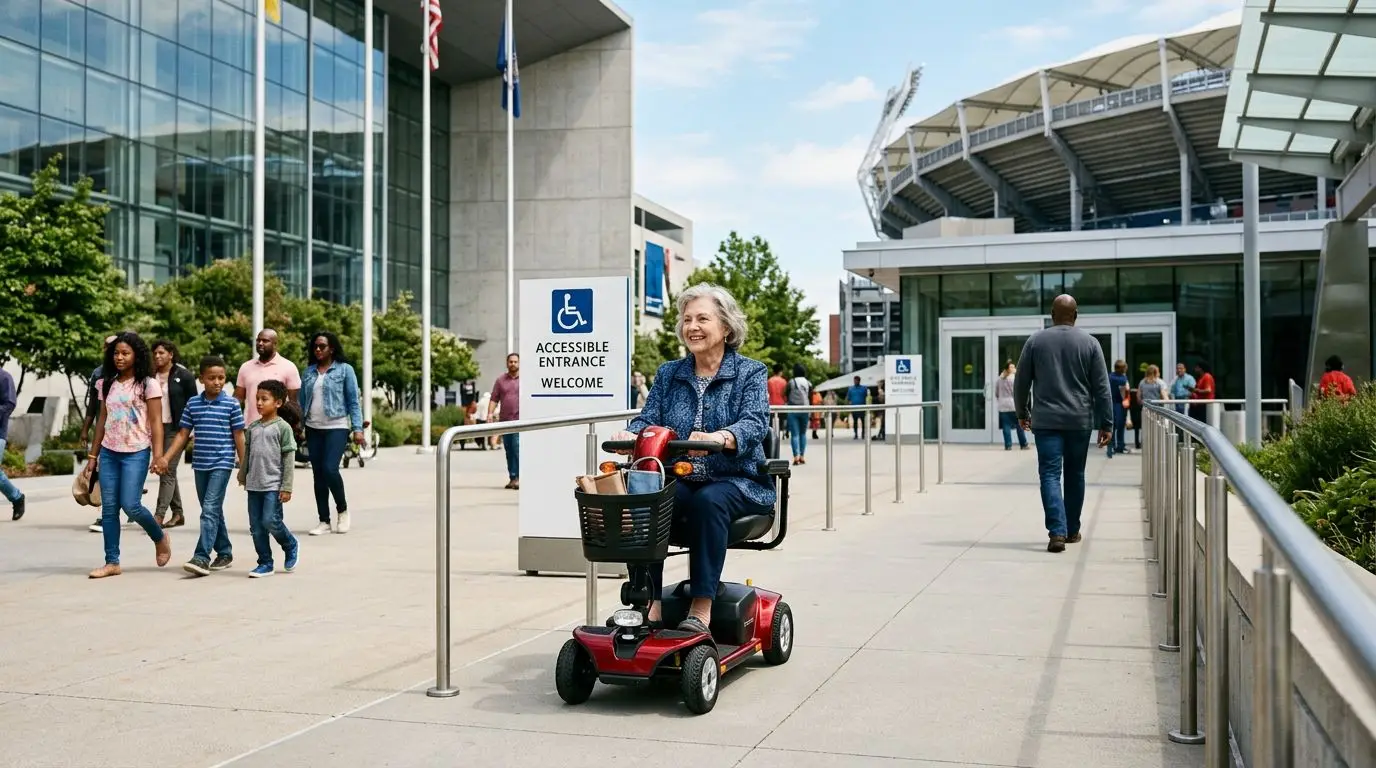
Can You Bring a Mobility Scooter to Theme Parks, Stadiums, Museums, and Other Venues?
16 min read