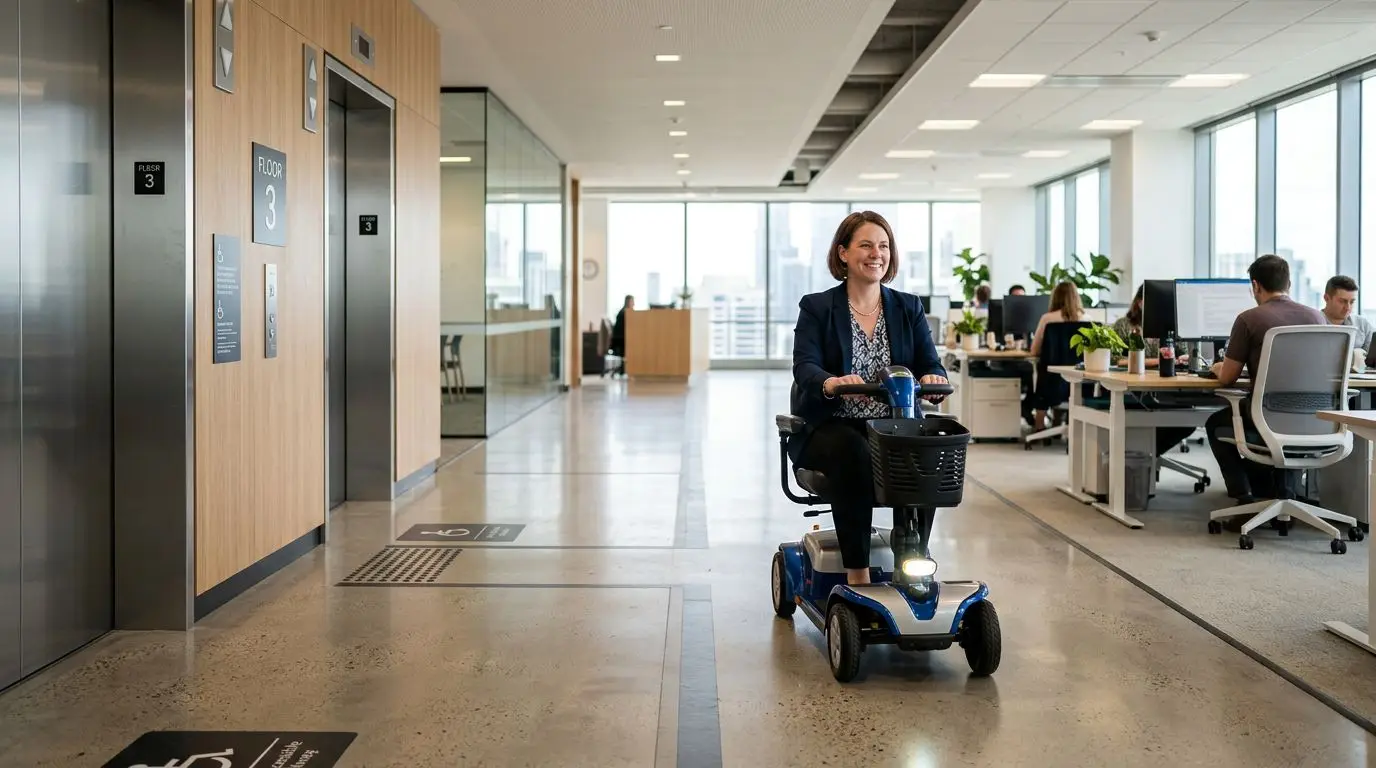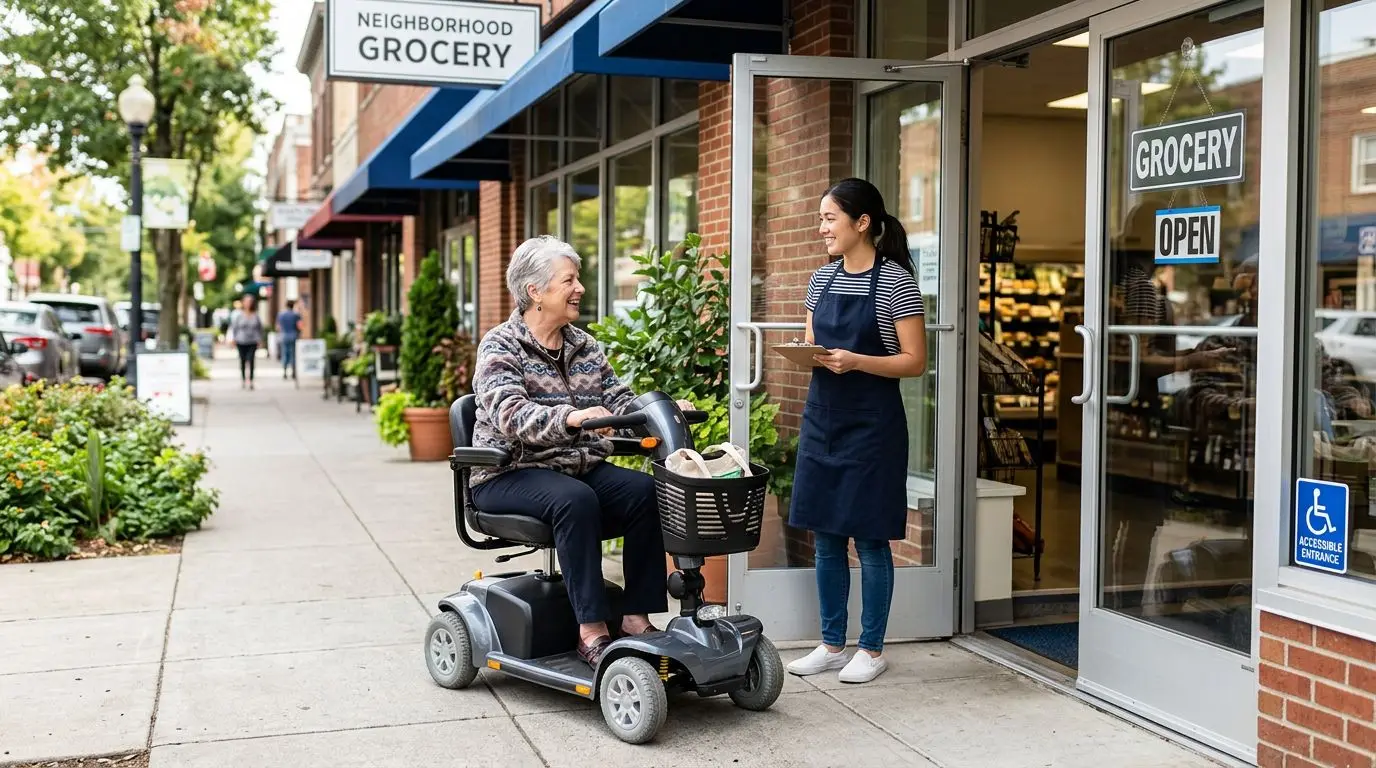
If a business says your mobility scooter is not allowed, stay calm, ask for the specific reason, and explain that you use the scooter because of a mobility disability. In most US public businesses, mobility scooters designed for people with disabilities are generally allowed anywhere customers can go, unless the business can show a legitimate safety or access reason under the Americans with Disabilities Act. If the denial continues, write down what happened, keep receipts or photos, and consider escalating to a manager, property owner, corporate office, local ADA coordinator, or the US Department of Justice.
This guide is not legal advice, but it can help you respond clearly in the moment and protect your options later. The goal is simple: get access when possible, avoid unnecessary conflict, and create a useful record if the business gets it wrong.
1. Know the basic rule before you respond
Under the ADA, businesses open to the public are called places of public accommodation. That includes many everyday locations: restaurants, grocery stores, pharmacies, hotels, theaters, banks, retail shops, medical offices, museums, and fitness centers. If customers are normally allowed in an area, a person using a mobility scooter because of a disability is generally allowed there too.
The ADA treats many mobility scooters as wheelchairs when they are designed primarily for use by people with mobility disabilities. A typical scooter has 3 or 4 wheels, a seat, a tiller or steering column, and a battery-powered drive system. It may be used indoors, outdoors, or both. Businesses do not get to ban scooters just because they are motorized, take up space, or make staff uncomfortable.
There are limits. A business may address legitimate safety concerns, but the concern should be based on actual risk, not assumptions. For example, a very small historic shop with a 28-inch aisle might need staff assistance or an alternate route if a scooter cannot physically pass without damaging displays. A crowded restaurant may need to move a chair so the scooter can approach the table safely. Those are access-management issues, not automatic reasons to refuse service.
A helpful phrase is: I use this mobility scooter because of a disability. Is there a safe accessible route you would like me to use? This keeps the conversation focused on access, not argument.
2. First 5 minutes: what to say at the door
The first few minutes matter. A calm, specific response often solves the problem before it becomes a formal complaint. Many denials come from staff confusion, not a written policy. Front-line employees may mistakenly group mobility scooters with bicycles, carts, recreational vehicles, or personal transport devices.
Start with a short explanation. You can say: This is my mobility device. I use it because of a mobility disability, and I need it to access the store. Where is the accessible entrance or route?
If the employee says scooters are not allowed, ask one question at a time:
- What is the specific reason my mobility scooter is not allowed?
- Is this a written policy, or should we ask a manager?
- Is there an accessible route, wider aisle, elevator, or alternate entrance I should use?
- Are you concerned about a particular safety issue today, such as a blocked aisle or wet floor?
- Can you provide the same service in an accessible way if you believe this route is not safe?
Do not offer private medical details. You do not need to explain your diagnosis, medication, pain level, or medical history to buy groceries, eat a meal, or enter a lobby. A simple statement that the scooter is needed because of a disability is usually enough.
If a staff member raises their voice or blocks your path, slow the exchange down. Ask for a manager. If you are with another person, ask them to take notes while you talk. Keep your phone available, but do not record in a way that violates local law or escalates the situation. In some states, recording audio requires consent from everyone involved.
3. Ask for the real issue: space, safety, batteries, or policy
Not every access problem has the same cause. A business may say not allowed when it really means we do not know how to handle this. Your next step depends on the reason. A scooter that is about 22 to 27 inches wide can usually fit through many standard accessible routes, but tight merchandise displays, temporary boxes, cafe chairs, or locked side entrances can still create barriers.
| Business concern | Reasonable question to ask | Possible practical solution |
|---|---|---|
| Narrow aisles | What is the widest accessible route through this area? | Use a wider aisle, have staff move a temporary display, or receive service at an accessible counter. |
| Crowded dining room | Can you seat me at a table with a clear route? | Remove 1 chair, choose an end table, or use an alternate accessible seating area. |
| Elevator or lift issue | Is the elevator out of service, and when will it be available? | Use another entrance, get service on the accessible floor, or reschedule with confirmation. |
| Battery concern | What specific battery or charging rule applies? | Explain that the scooter is a mobility device; avoid charging indoors if not permitted. |
| General no motorized vehicles policy | Does that policy distinguish mobility devices used because of disability? | Ask for a manager to review the ADA access obligation. |
Some concerns are valid if they are specific and immediate. A scooter should not block a required exit, a fire lane, or an evacuation route. If your scooter is large, a business may need to identify a safe place for it while you transfer to a chair, if you are able and willing. But a business should not require transfer if you need to remain seated on the scooter to access goods or services.
The key is reasonable modification. That means the business may need to adjust ordinary rules so a customer with a disability can participate, unless doing so would create a direct threat, fundamentally change the service, or be impossible under the circumstances. The burden is not on you to redesign the store at the doorway. The business should engage in a practical access conversation.
4. Wheelchair, mobility scooter, or other powered device: why the distinction matters
ADA rules use different categories. A mobility scooter designed for people with mobility disabilities is often treated differently from a recreational device or a general personal transporter. This distinction can affect what questions a business may ask and how it evaluates access.
| Device type | Common examples | Typical access treatment | Questions staff should avoid |
|---|---|---|---|
| Manual wheelchair | Self-propelled or attendant-pushed chair | Allowed in customer areas open to pedestrians | Detailed medical questions |
| Power wheelchair | Battery-powered chair with joystick control | Allowed in customer areas open to pedestrians | Questions about diagnosis or proof of disability |
| Mobility scooter | 3-wheel or 4-wheel seated scooter for mobility disability | Generally allowed when used as a mobility device | Demands for medical records or disability ID |
| Other power-driven mobility device | Some standing transporters, golf-style carts, or similar devices | May be allowed unless the business can justify limits after assessment | Questions about nature or extent of disability |
For devices that are not traditional wheelchairs, ADA guidance allows businesses to ask whether the device is needed because of a disability and to request credible assurance, such as a disability parking placard or a verbal statement that is not contradicted by observable facts. That does not mean they can demand your complete medical history.
For a conventional mobility scooter, the cleanest approach is to state its purpose: This is a mobility scooter designed for disability-related mobility. I use it because I cannot safely walk the distance required here. Then return to the access question: How can I enter and receive service?
5. Documentation to keep within 24 hours
If the denial is not resolved, document it while the details are fresh. The first 24 hours are important because names, times, and exact words fade quickly. A useful record does not need to be dramatic. It needs to be specific.
- Date and time of the incident, including how long you were delayed.
- Business name, street address, and specific entrance or department.
- Names or descriptions of employees involved, if known.
- Exact words used, especially if someone said scooters are not allowed.
- The reason given for denial, such as safety, policy, aisle width, or manager instruction.
- Photos of signs, blocked accessible routes, stairs, locked ramps, or temporary displays.
- Receipts, reservation confirmations, appointment notices, tickets, or order numbers.
- Names and phone numbers of witnesses, if they are comfortable sharing.
- Your own short account of what you asked for and how staff responded.
Photos can be very helpful, but do not photograph private medical records, other customers in sensitive situations, or employees in a confrontational way. A picture of a posted policy, a blocked ramp, or a sign at the entrance is usually enough.
Create one folder on your phone or computer for access issues. Save screenshots, call logs, emails, and your notes together. If you later contact a corporate office, property manager, local civil rights agency, or attorney, a clean timeline is far more useful than a general statement that the business was rude.
6. When a business offers alternatives: 3 tests to use
Sometimes a business will not let you enter with the scooter but will offer an alternative. The alternative might be curbside service, employee assistance, a different entrance, a later appointment, or shopping by phone. Some alternatives are reasonable for a short-term barrier. Others may be unequal treatment.
Use these 3 tests.
1. Is the alternative equal?
If other customers can browse the store, compare products, use the restroom, or sit with their group, an alternative that leaves you outside may not provide equal access. Curbside pickup can be helpful when you choose it. It is different when staff force it because they refuse to allow your mobility device.
2. Is the alternative immediate?
If a restaurant can move 1 chair and seat you in 2 minutes, that is different from asking you to return another day. If the only accessible entrance is locked, staff should be able to unlock it promptly during business hours.
3. Is the alternative dignified?
Being sent through a trash area, kitchen, loading dock, or employee-only back hallway may be unsafe or humiliating, unless it is truly the only accessible route and is maintained for customer access. A usable alternate entrance should be safe, reasonably clean, and available without excessive delay.
There are times when an alternate method may be practical. If a small shop has a temporary hazard in a 30-inch aisle, staff might bring items to an accessible counter while arranging a better long-term fix. If an elevator fails unexpectedly, a medical office might offer telehealth or reschedule quickly. The question is whether the business is trying to provide meaningful access, not simply make you go away.
7. How to measure your scooter and the space in 10 minutes
Knowing your scooter dimensions can make access conversations more practical. You do not need technical language. A tape measure and 10 minutes are enough. Write the measurements in a note on your phone and keep them handy.
- Overall width: measure the widest point, often the armrests or rear wheels.
- Overall length: measure from the front wheel or basket to the rear anti-tip wheels.
- Turning space: note whether you need about 5 feet, more, or less to turn comfortably.
- Seat height: useful for tables, counters, and transfer discussions.
- Total weight with batteries: helpful for lifts, ramps, or transport, if known.
Many accessible doorways have a clear opening around 32 inches when the door is open 90 degrees, though real-world conditions vary. Some retail aisles may be much wider, while cluttered aisles may narrow suddenly. A ramp that looks usable may still be too steep or blocked at the bottom. If you can safely measure or photograph a barrier, do so. Do not place yourself in traffic or on a steep slope to prove a point.
You can also carry a short access card you write yourself. It might say: I use a mobility scooter because of a disability. Scooter width: 25 inches. I can use standard accessible entrances and elevators. Please direct me to the accessible route. This is not an official permit, and it does not replace your rights, but it can reduce confusion in busy places.
8. Who this problem-solving approach is best for in everyday settings
This approach is best for scooter users who want a calm, practical process before filing a complaint. It works especially well in places where staff may be inexperienced: small restaurants with 12 tables, seasonal shops, older buildings, event venues, tourist attractions, and offices with shared entrances.
It is also useful for caregivers, spouses, adult children, and friends who may need to advocate without taking over. The person using the scooter should lead the conversation whenever possible. A companion can help by taking notes, asking for a manager, or reading posted signs.
This guide may be less suitable if there is an immediate threat, harassment, or physical blocking. If someone touches your scooter, grabs the controls, threatens you, or prevents you from leaving, prioritize safety. Move away if you can, call for help if needed, and document after you are safe.
For recurring access problems, a prepared script helps. For example: I was denied entry on Tuesday at 2:15 p.m. because I use a mobility scooter. I am asking the business to confirm that customers who use mobility scooters because of a disability may enter through the same accessible customer route as others. Please respond in writing. That is firm without being inflammatory.
9. Escalation ladder: 4 levels before and after a complaint
Escalation does not have to mean a lawsuit. In many cases, a clear written request to the right person fixes the problem. Think of it as a 4-level ladder.
Level 1: On-site manager
Ask for the manager on duty. Repeat the basic facts and request access. If the manager fixes the issue, thank them and consider sending a brief follow-up email so the business trains staff.
Level 2: Owner, property manager, or corporate office
If the on-site response fails, contact the business in writing. Include the date, location, what happened, and what you want changed. If the business is in a mall, office tower, or mixed-use property, the property manager may control entrances, elevators, ramps, or parking.
Level 3: Local or state civil rights resources
Many cities, counties, and states have disability rights offices, human rights commissions, or ADA coordinators. They may offer mediation, technical assistance, or complaint processes. Response times vary, so keep your expectations realistic and your documents organized.
Level 4: Federal complaint or legal advice
The US Department of Justice accepts ADA complaints involving public accommodations. If the issue caused serious harm, repeated denial, lost money, missed medical care, or ongoing exclusion, you may also want to speak with a disability rights organization or attorney. Deadlines can apply to some legal claims, so do not wait too long if the matter is serious.
When escalating, ask for a specific remedy. Examples include staff training within 30 days, removal of a no scooters sign, written confirmation of the scooter access policy, a refund for denied service, or a plan to keep the accessible entrance unlocked during business hours.
10. Common mistakes to avoid during an access denial
A denial is frustrating. Still, a few choices can make the situation harder to resolve. Avoid giving the business an easy excuse to shift the focus from access to behavior.
- Do not argue about politics, personal beliefs, or unrelated complaints.
- Do not exaggerate what happened. Accurate notes are stronger.
- Do not provide medical records to a cashier or host.
- Do not block doors, exits, or checkout lanes as a protest.
- Do not assume every employee knows the ADA.
- Do not leave without getting the business name, address, and time if you may follow up.
Also avoid assuming that one bad interaction reflects the entire business. A new employee may have misunderstood a rule. A manager may correct it quickly. The measure of the business is not only the first mistake, but whether it provides access once the issue is explained.
11. Sample script and email you can use in 15 minutes
Here is a simple door script:
I use this mobility scooter because of a disability. I understand you have concerns, but mobility devices are generally allowed in customer areas. Can you show me the accessible route or ask a manager to help us resolve this?
If you need to follow up in writing, keep it short:
Subject: Mobility scooter access denial on [date]
Hello, I am writing about an access issue at your [location] on [date] at about [time]. I use a mobility scooter because of a mobility disability. I was told that mobility scooters are not allowed and was not permitted to access [store, dining area, office, event, or service]. The reason given was [reason, if any].
Please confirm in writing that customers who use mobility scooters because of a disability may access customer areas through an accessible route. I also ask that staff at this location be informed of the correct policy. I would appreciate a response within 14 days.
Thank you, [name] [phone or email]
You can attach photos or receipts if they help. Do not attach medical documents unless a qualified legal adviser tells you there is a specific reason to do so.
12. FAQ: 5 quick answers for mobility scooter access denials
Can a restaurant refuse my mobility scooter because it is too large?
A restaurant cannot refuse a mobility scooter just because it is inconvenient. It can address specific safety issues, such as blocked exits or a route that is physically too narrow, but it should look for a reasonable way to seat and serve you.
Can staff ask what disability I have?
They should not ask for your diagnosis or detailed medical history. In many situations, it is enough to say that you use the scooter because of a disability. For certain nontraditional powered devices, staff may ask limited questions about disability-related need, but not the nature or extent of the disability.
Do I need a permit or doctor note for my scooter?
Usually, no. There is no general federal requirement that a person show a scooter permit or doctor note to enter a public business with a mobility device. A disability parking placard may help in some discussions, but it should not be treated as the only acceptable proof for ordinary scooter access.
What if the accessible entrance is locked?
Ask staff to unlock it promptly. An accessible entrance that is only available after a long delay may not provide equal access. Note the time, take a photo of any sign, and document who you spoke with.
Should I call the police if I am denied entry?
Most access denials are civil rights issues, not emergencies. Consider calling only if you are threatened, physically blocked from leaving, assaulted, or feel unsafe. For ordinary denials, written escalation is usually more effective.
A mobility scooter access denial can be upsetting, but you do not have to handle it by guesswork. Ask for the specific reason, request an accessible solution, document the facts, and escalate in writing when needed. A clear record and a calm approach give you the best chance of getting the access you are entitled to receive.
Frequently asked questions
Can a business refuse my mobility scooter because it has a motor? +
Usually not. A mobility scooter used because of a disability is generally allowed in customer areas open to pedestrians, unless the business can point to a specific, legitimate safety or access issue.
What should I say first if staff tell me scooters are not allowed? +
Say that you use the scooter because of a mobility disability and ask for the accessible route or a manager. Keep the conversation focused on how you can receive the same goods or services safely.
Do I have to show medical proof to enter with my mobility scooter? +
In ordinary public business settings, you generally should not have to show medical records or explain your diagnosis. A simple statement that the scooter is needed because of a disability is usually the right starting point.
What details should I document after an access denial? +
Write down the date, time, address, employee names or descriptions, exact words used, reason given, witnesses, and any receipts or reservation details. Photos of signs, blocked ramps, or inaccessible entrances can also help.
When should I escalate a mobility scooter denial? +
Escalate if staff refuse to correct the denial, the problem repeats, you lose money or miss an appointment, or the business has a written policy banning scooters. Start with management, then consider corporate offices, local civil rights resources, or a federal ADA complaint.
Related guides
Can a Business Refuse a Mobility Scooter? ADA Rights, Safety Exceptions, and What to Do If Access Is Challenged
13 min read
Mobility Scooter Claim Denied? Common Insurance Reasons and How to Start an Appeal
14 min read
Mobility Scooter Rules at Hotels in the US: Accessibility Requests, Room Fit, Charging, and Storage
15 min read