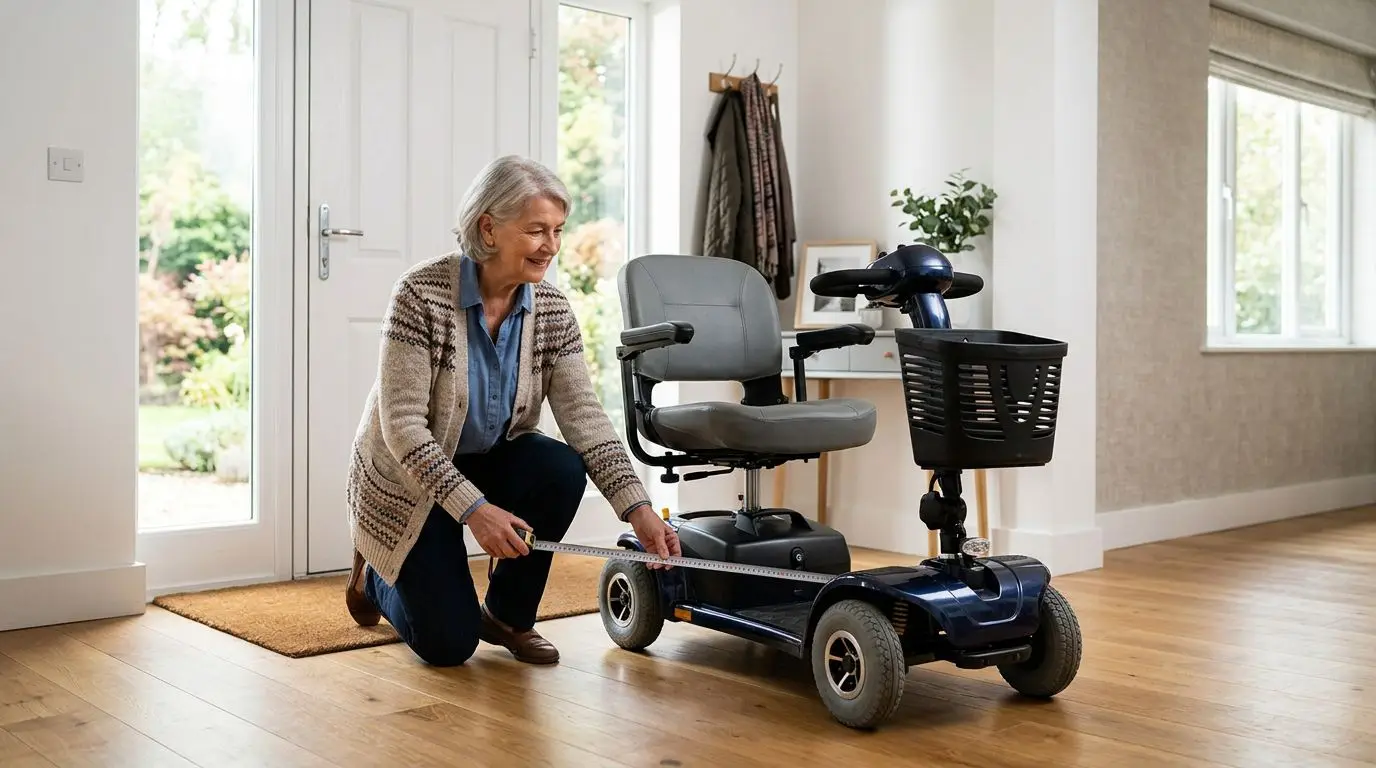
A mobility scooter under $500 is usually used, heavily discounted open-box, or a very basic compact model with limited range, comfort, and support. For occasional indoor use on flat surfaces, a budget scooter may be enough. For daily transportation, hills, heavier riders, or outdoor use, spending more is often the safer long-term value.
The key is not to judge by price alone. At this price point, the battery, brakes, tires, charger, return policy, and weight capacity matter more than styling or advertised speed.
What $500 Usually Buys in the Mobility Scooter Market
A true mobility scooter under $500 is not the same as a full-featured scooter built for all-day errands, uneven sidewalks, and years of daily use. In most cases, the realistic options are pre-owned scooters, local private-party listings, refurbished units with limited coverage, or compact travel scooters with shorter range, often about 5 to 10 miles depending on battery age, rider weight, terrain, and temperature.
New scooters at this price do exist, but shoppers should look closely. Some very low-cost listings are not designed as medical mobility devices at all. They may be seated electric ride-ons, recreational scooters, or imported units with little documentation. A mobility scooter should have clear specifications, a stated weight capacity, a stable seat, a reliable braking system, and available replacement parts.
Expect compromises. Common tradeoffs include smaller seats around 16 to 18 inches wide, modest weight capacities often near 250 pounds, low ground clearance around 1.5 to 3 inches, shorter warranties, and less padding. That does not make every budget scooter bad. It means the scooter needs to match a narrow use case.
| Budget option | What you may get | Main caution |
|---|---|---|
| Used travel scooter | Compact frame, 3 or 4 wheels, often 3 to 5 mph | Battery may be weak or near replacement |
| Open-box scooter | Possibly unused, may have cosmetic wear | Return terms and missing parts vary |
| Older full-size scooter | Larger seat, better outdoor stability | Heavy, harder to transport, parts may be harder to find |
| Very cheap new listing | Low upfront price and simple controls | May lack service support or clear safety information |
Who a Sub-$500 Scooter Is Best For
A scooter in this price range is best for someone who needs light, occasional help rather than all-day mobility. Think short indoor trips, smooth apartment hallways, a senior living community, quick movement around a level garage, or a few blocks on well-maintained sidewalks. If the scooter will be used for 10 minutes at a time instead of 2 hours, its limits are easier to manage.
This budget also makes sense for someone who can inspect a used scooter in person, test it safely, and walk away if anything feels wrong. A local seller who allows a 15-minute test ride and shows the charger, key, manual, and battery compartment is usually a better bet than a vague online listing with only one photo.
It is less suitable for people who rely on a scooter as their main way to leave home. If missing one errand, one appointment, or one social activity would create a serious hardship, reliability is worth paying for.
Best-fit situations
- Indoor or mostly indoor use on level floors
- Short trips of about 1 mile or less at a time
- Riders within the stated weight limit, ideally with a 20 to 25 pound margin
- Homes with doorways around 30 to 32 inches wide
- Users who can charge after each outing
- Shoppers comfortable buying used and checking condition carefully
What to Avoid Under $500: 12 Red Flags
A low price can hide expensive problems. The most common budget-scooter mistake is buying a unit that moves during a short test ride but fails after a week because the batteries, controller, brakes, or charger were already worn out.
Pay close attention to safety. A scooter that cannot stop smoothly, has a loose tiller, or uses undocumented electronics is not a bargain at any price.
- No stated weight capacity. If the listing does not say whether the limit is 220, 250, 300, or another number, skip it.
- Missing charger. The correct charger matters. Guessing can damage batteries or create a safety risk.
- Battery will not hold a charge. A scooter that dies after 5 minutes may need a full battery pack.
- No working brake response. Many scooters use electromagnetic braking; when the throttle is released, the scooter should slow predictably.
- Loose seat or tiller. Wobble can affect balance, steering, and transfers.
- Cracked frame or bent wheel fork. Structural damage is a serious concern.
- No return policy on a shipped scooter. Photos cannot prove battery health or ride quality.
- Only one blurry photo. Ask for photos of the battery compartment, tires, charger label, controls, seat, and underside.
- Unclear parts availability. Tires, armrests, keys, chargers, and batteries should be replaceable.
- Advertised range sounds unrealistic. A small compact scooter claiming very long range at a very low price deserves extra scrutiny.
- No manual or basic documentation. You need charging instructions, freewheel instructions, and weight limits.
- Seller refuses a test ride. A safe test on flat ground should not be a problem for a local sale.
Used vs. New Under $500: Which Is the Better Value?
Under $500, a well-kept used scooter is often a better value than the cheapest new scooter with unknown support. A used scooter from a clean, dry home may provide a sturdier seat, better frame, and more predictable parts access. The tradeoff is that batteries age even when a scooter sits unused.
Most mobility scooters use either sealed lead-acid batteries or lithium batteries. Sealed lead-acid packs are often made from two 12-volt batteries, while lithium packs vary by voltage and watt-hour rating. Either way, age matters. If the scooter has been stored for 6 months without proper charging, range may be far lower than advertised.
| Choice | Pros | Cons | Best for |
|---|---|---|---|
| Used scooter | Better features for the money, can test locally | Battery and wear are unknown | Careful shoppers who can inspect before buying |
| New low-cost scooter | Fresh condition, may include a short warranty | May be lightly built with limited parts support | Occasional indoor use and buyers who need delivery |
| Refurbished scooter | May be inspected and cleaned | Coverage varies widely | Shoppers who get written details on what was replaced |
| Rental first | Lets you test size and comfort | Not a permanent solution | People unsure what type they need |
If buying used, ask three direct questions: How old are the batteries? How long does it run on a full charge? Has anything been repaired or replaced in the last 12 months? Clear answers are a good sign. Vague answers do not prove there is a problem, but they do mean you should inspect more carefully.
How to Choose and Measure Before Buying
Before shopping, measure your home, your body fit, and your transportation plan. A scooter can be affordable and still unusable if it cannot pass through a 30-inch doorway, turn in a hallway, fit in a vehicle, or support the rider comfortably.
Start with rider weight. Choose a scooter with a stated capacity above the rider’s body weight, plus clothing, bags, oxygen equipment if used, or groceries. A 20 to 25 pound cushion is a practical minimum. For example, a 235-pound rider should be cautious with a scooter rated at 250 pounds, especially outdoors or on inclines.
Next, measure doorways and turning areas. Many compact scooters are about 20 to 24 inches wide, but armrests can add width. Hallway turns, bathroom entries, and bedroom corners are often harder than front doors. Use painter’s tape on the floor to mark the scooter’s approximate width and length before you buy.
Measurements to take at home
- Narrowest doorway: measure clear opening, not door frame trim.
- Hallway width: especially at 90-degree turns.
- Threshold height: even a 1-inch lip can be difficult for a low-clearance scooter.
- Ramp slope: the ADA design guideline is 1 inch of rise for 12 inches of ramp run, though home situations vary.
- Storage space: leave room for charging and safe transfers.
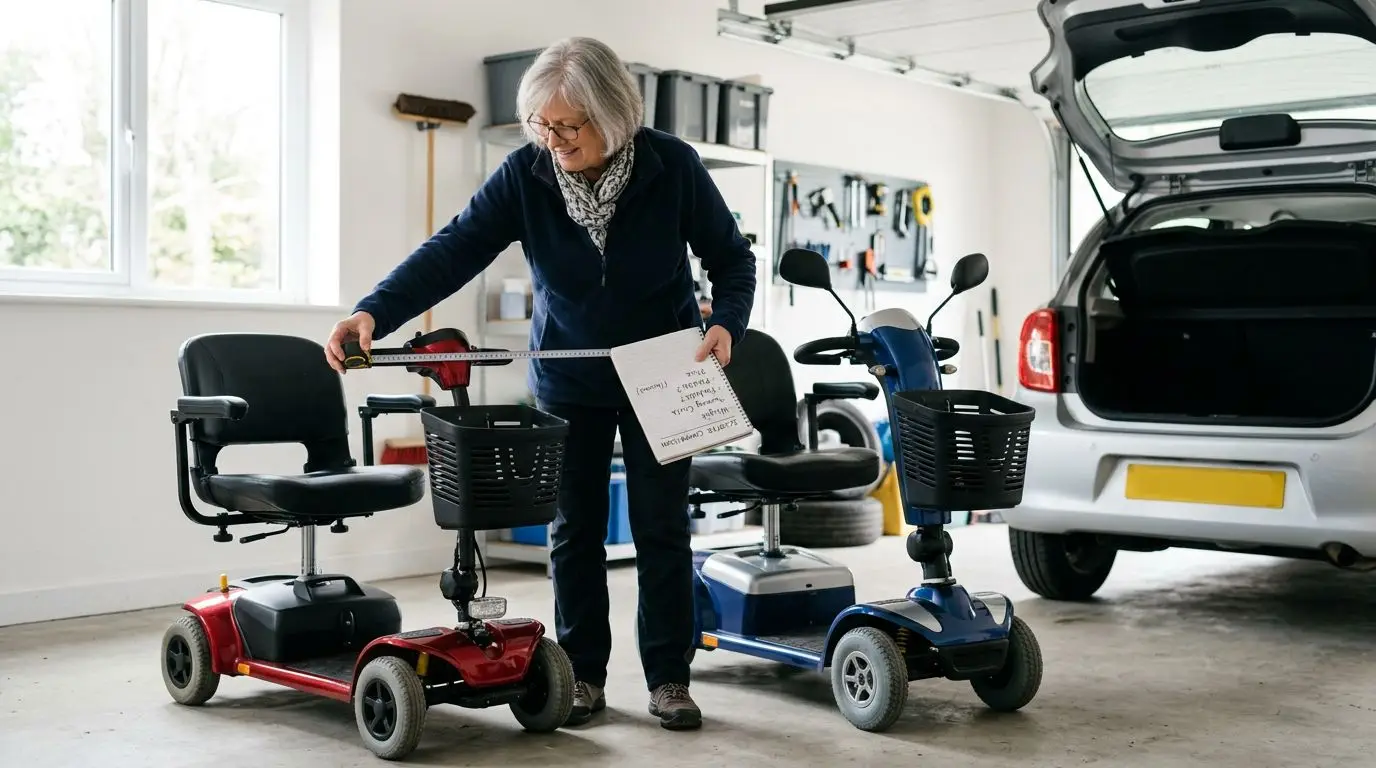
- Vehicle cargo area: measure width, depth, and lift-over height if transporting the scooter.
Also consider seat fit. A seat that is too narrow can cause discomfort, while a seat that is too high may make transfers harder. Many scooter seats are height-adjustable, but not all adjust enough for every user.
Three-Wheel, Four-Wheel, Folding, and Heavy-Duty: Type Comparison
Most scooters under $500 will be compact travel units or older used scooters. The right type depends on turning space, stability needs, transport, and terrain. A 3-wheel scooter may turn in a tighter radius, sometimes around 35 to 45 inches, while a 4-wheel scooter may feel more stable outdoors but need more room to turn.
| Type | Typical strengths | Typical limits | Budget note |
|---|---|---|---|
| 3-wheel travel scooter | Tighter turning, lighter front end, good indoors | Less side-to-side stability than many 4-wheel designs | Common on used market |
| 4-wheel travel scooter | More stable feel, better for sidewalks | Larger turning radius, may be heavier | Good choice if storage space allows |
| Folding scooter | Can be easier to store, sometimes compact for travel | Seat and suspension may be minimal | Check folded weight and battery condition |
| Full-size scooter | Larger seat, better outdoor comfort, higher capacity | Harder to lift, may not fit small vehicles | Possible used, but inspect carefully |
| Heavy-duty scooter | Higher weight capacity and better terrain handling | Often large, heavy, and above $500 | Usually worth a higher budget if needed |
Do not buy a smaller scooter just because it costs less if the rider needs a higher weight capacity, wider seat, or better outdoor performance. Running a scooter at or near its limit can reduce range, slow hill climbing, and increase wear.
Battery, Range, and Charging: The Biggest Budget Risk
The battery is often the make-or-break part of a cheap scooter. A seller may advertise a 10-mile range because that was the original specification, but a 3-year-old battery may deliver much less. Cold weather, hills, rider weight, and stop-and-go driving all reduce range.
Ask to see the scooter start from a full charge. During a test ride, check whether the battery indicator drops quickly under load, especially when turning, starting from a stop, or climbing a gentle slope. A battery gauge is not a lab test, but a sudden drop from full to half in a few minutes is a warning sign.
Charging habits matter. Many scooters are designed to be charged after use and not left deeply discharged. If a scooter sat in a closet for a year, the battery pack may be damaged even if the scooter looks clean.
Battery questions to ask
- How old is the battery pack?
- Was it charged at least once every few weeks while stored?
- Does the charger light change correctly when charging is complete?
- How many miles or minutes does it run in real use?
- Is the battery removable, and are replacements easy to find?
If you must replace the batteries immediately, the real cost of the scooter is no longer under $500. That may still be acceptable, but only if the frame, motor, tires, seat, and electronics are in good condition.
Safety Features Worth Prioritizing at Any Price
Even a low-cost scooter should have basic safety features. A top speed of 3 to 5 mph is common for compact mobility scooters, and that is plenty for indoor use. Predictable stopping, stable steering, and comfortable control matter more.
Look for an easy-to-reach speed dial, a horn, reflectors or lights if used near driveways or dim hallways, anti-tip wheels where appropriate, and a freewheel lever that works correctly. The freewheel lever lets the scooter be pushed manually, but the scooter should not be driven while it is in freewheel mode.
| Feature | Why it matters | Quick check |
|---|---|---|
| Electromagnetic braking | Helps the scooter stop when throttle is released | Release throttle on flat ground and feel for smooth slowdown |
| Speed control | Allows slower indoor driving | Set to low and confirm it limits speed |
| Anti-tip wheels | Can reduce tip risk in certain situations | Check they are present and not cracked |
| Solid or foam-filled tires | Reduce flat-tire concerns | Look for cracks, flat spots, or uneven wear |
| Lights or reflectors | Improve visibility around cars and pedestrians | Test every switch before buying |
| Swivel seat | Can make transfers easier | Confirm it locks firmly in position |
Safety also depends on fit and judgment. Mobility scooters are not designed to replace professional medical advice, balance training, or a home safety evaluation. If transfers, vision, reaction time, or dizziness are concerns, talk with a qualified clinician before choosing a scooter.
When to Spend More Than $500
Spend more if the scooter will be used daily, outdoors, on slopes, across uneven pavement, or as the rider’s main transportation. A higher budget can provide a newer battery, stronger frame, better seat, clearer warranty, and easier access to service. Those are not luxuries when the scooter is essential.
A bigger budget is also wise for riders above 250 to 300 pounds, users who need a wider seat, or anyone who will carry groceries, oxygen equipment, or other items regularly. Weight capacity is not only about whether the scooter moves. It affects braking, stability, battery draw, tire wear, and motor strain.
Consider spending more in these situations:
- You need dependable range beyond 5 to 8 miles.
- You live in an area with hills, curb cuts, gravel, or broken sidewalks.
- You cannot lift or assemble scooter pieces safely.
- You need professional delivery, setup, or instruction.
- You want a warranty that covers parts and labor clearly.
- You need a higher weight capacity or a wider, more supportive seat.
- You plan to use a vehicle lift or public transit regularly.
Spending more is not about buying the fanciest scooter. It is about reducing failure points. If a cheaper scooter leaves you stranded, needs immediate batteries, or cannot handle your doorway and ramp, it was not truly affordable.
A 15-Minute Inspection Checklist Before You Pay
Use a simple checklist before handing over money. A careful 15-minute inspection can prevent many budget-scooter mistakes, especially in private sales where returns are uncommon.
- Check the paperwork: manual, charger information, original specifications, and any repair receipts.
- Inspect the frame: look for cracks, rust, bent metal, or signs of impact.
- Test the seat: swivel, height adjustment, armrests, and locking mechanism.
- Look at the tires: cracks, flat spots, worn tread, and uneven alignment.
- Power it on: confirm the display, horn, lights, and battery gauge work.
- Drive slowly: test forward, reverse, turns, and stopping in a safe open area.
- Try a small incline: only if safe, legal, and appropriate for the scooter type.
- Check freewheel mode: confirm it disengages and re-engages properly.
- Listen: grinding, clicking, or hesitation can point to mechanical or electrical issues.
- Confirm transport fit: measure the heaviest piece if it disassembles.
If possible, bring another person. One person can watch for wheel wobble, brake response, and unusual noises while the other rides. Do not test a scooter in traffic or on a steep driveway.
FAQ: Cheap Mobility Scooters Under $500
Can I buy a reliable new mobility scooter for under $500?
Sometimes, but it is uncommon for a new scooter under $500 to offer strong range, comfort, service support, and long-term durability. Many shoppers find better value in a carefully inspected used scooter or by increasing the budget for a basic new travel scooter with clearer support.
Is a used mobility scooter safe?
A used scooter can be safe if the frame is sound, the brakes work correctly, the batteries hold a charge, and the scooter fits the rider and environment. It should be tested on flat ground before purchase, and any loose steering, damaged tires, or unreliable braking should be treated as a serious red flag.
How long should a cheap mobility scooter battery last per charge?
For budget used scooters, real-world range may be around 5 to 10 miles or less, depending on battery age, rider weight, hills, surface conditions, and temperature. Do not rely only on the original advertised range, especially if the battery is more than a couple of years old.
Are 3-wheel scooters or 4-wheel scooters better for a tight budget?
A 3-wheel scooter can be better indoors because it usually turns tighter, while a 4-wheel scooter often feels more stable outdoors. The better choice depends on your doorway width, turning space, balance needs, and sidewalk conditions, not just price.
What is the biggest mistake when buying a scooter under $500?
The biggest mistake is buying without testing the battery and brakes. A scooter that looks clean but needs batteries, a charger, tires, or electrical repair can quickly cost more than a better scooter purchased upfront.
When should I avoid a budget scooter altogether?
Avoid a sub-$500 scooter if you need daily dependable transportation, have steep hills, need a higher weight capacity, require outdoor comfort, or cannot risk breakdowns. In those cases, a newer scooter with better support is usually the safer value.
Frequently asked questions
Can I buy a reliable new mobility scooter for under $500? +
Sometimes, but it is uncommon for a new scooter under $500 to offer strong range, comfort, service support, and long-term durability. A carefully inspected used scooter or a higher budget for a basic new travel scooter may be a better value.
Is a used mobility scooter safe? +
A used scooter can be safe if the frame is sound, the brakes work correctly, the batteries hold a charge, and the scooter fits the rider and environment. Always test it on flat ground before buying.
How long should a cheap mobility scooter battery last per charge? +
For budget used scooters, real-world range may be around 5 to 10 miles or less, depending on battery age, rider weight, hills, surface conditions, and temperature.
Are 3-wheel or 4-wheel scooters better on a tight budget? +
A 3-wheel scooter usually turns tighter for indoor use, while a 4-wheel scooter often feels more stable outdoors. Choose based on your doorway width, turning space, balance needs, and sidewalk conditions.
What is the biggest mistake when buying a scooter under $500? +
The biggest mistake is buying without testing the battery and brakes. A scooter that needs batteries, a charger, tires, or electrical repair can quickly cost more than a better scooter purchased upfront.
When should I spend more than $500? +
Spend more if you need daily dependable transportation, outdoor range, a higher weight capacity, better seating, service support, or reliable performance on slopes and uneven sidewalks.
Related guides
Cheap Mobility Scooters: How to Save Money Without Buying the Wrong Type
16 min read
New vs. Used Mobility Scooter Costs: Upfront Savings, Battery Risk, Repairs, and Long-Term Value
13 min read
How Much Does a Mobility Scooter Cost? Price Ranges, Features, and Long-Term Value
12 min read