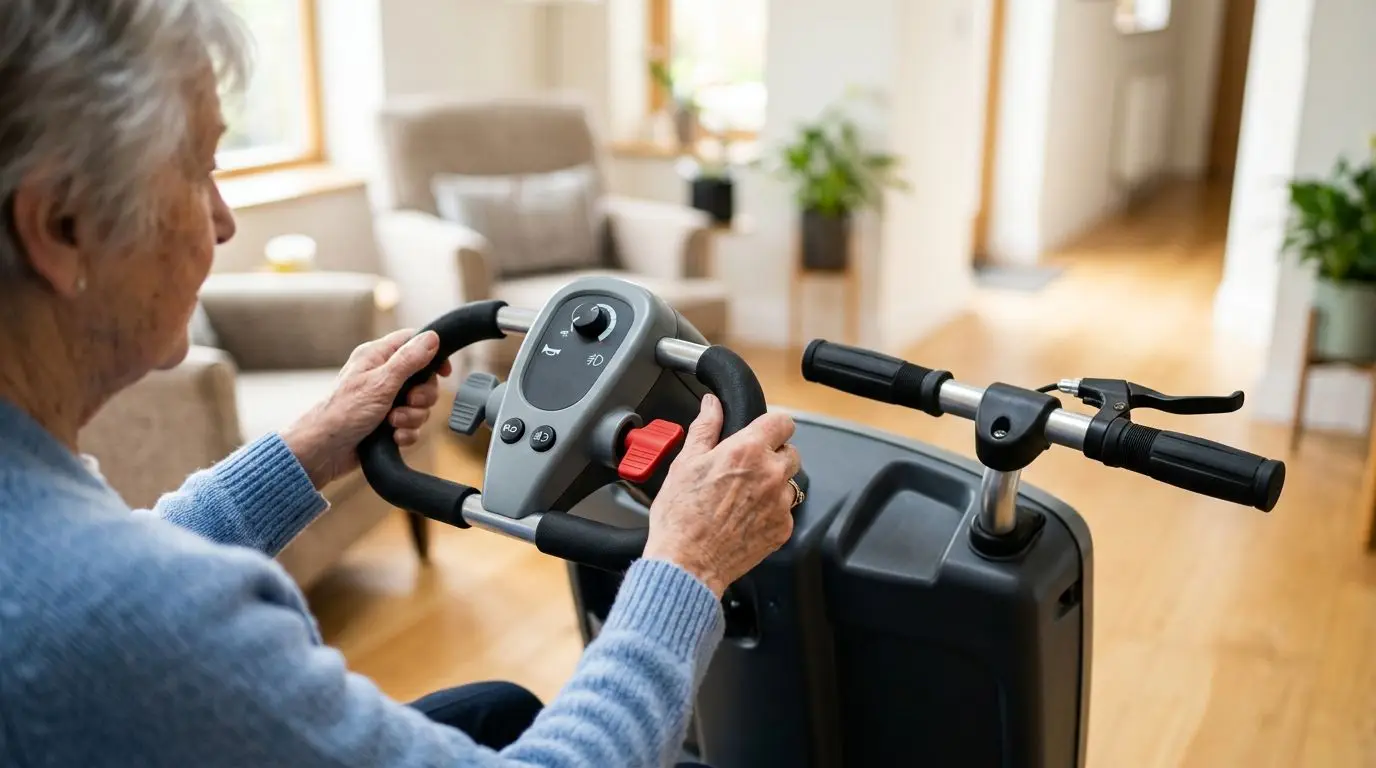
A delta tiller is often the more comfortable choice for riders with hand pain, limited dexterity, weak grip, or fatigue because it allows push-pull steering and can often be used with either hand. Standard scooter handles can feel familiar and precise, but they usually require a steadier two-hand grip and more wrist positioning. The right choice depends on your hand strength, wrist comfort, arm reach, and how easily you can use the throttle and brake controls for at least 15 to 30 minutes.
Delta tiller vs. standard handles: the quick 30-second difference
Most mobility scooters use a front steering column called a tiller. The main difference is the shape of the handle area and how your hands interact with it. A delta tiller is shaped like a loop, oval, or wraparound bar, often with control levers reachable from either side. Standard handles are closer to a straight T-bar or bicycle-style handle setup, with separate left and right grips.
That shape matters. A rider who cannot comfortably close their fingers around a grip for more than 10 minutes may still be able to guide a delta tiller by resting the palm, using the heel of the hand, or lightly pulling one side of the loop. A rider with good grip strength may prefer the traditional feel of standard handles, especially if they like having a defined left-hand and right-hand position.
| Handle type | Typical feel | Common advantage | Common drawback |
|---|---|---|---|
| Delta tiller | Loop or wraparound steering | Easier for one-handed steering and lighter grip | Can feel less familiar at first |
| Standard handles | Two separate grips or T-style bar | Familiar, direct hand placement | May require stronger grip and more wrist control |
Neither design is automatically safer for every rider. Safety depends on fit, control access, predictable steering, speed management, and the rider’s ability to stop confidently.
Who it is best for: 5 rider situations to consider
A delta tiller is often best for riders who need steering flexibility. If your hands get tired after 5 to 15 minutes, or if one hand is stronger than the other, a loop-style tiller can reduce the need to clamp down on two separate grips. It also gives you more places to rest your hands, which can help on longer trips through a store, medical building, apartment complex, or neighborhood sidewalk.
Standard handles may be best for riders who have good two-hand grip, steady wrists, and a preference for a handlebar feel. Some people find separate grips easier to center because each hand has a clear job. On open paths or longer straight routes, that familiar hand placement can feel natural.
- Hand arthritis or joint tenderness: A delta tiller may reduce squeezing and allow more open-hand steering.
- Limited finger movement: A delta tiller may be easier if the controls are reachable without curling all fingers around a grip.
- One stronger hand: A delta tiller may allow more control from the stronger side, depending on the scooter’s control layout.
- Good grip and wrist stability: Standard handles may feel precise and familiar.
- Frequent indoor turns: Either can work, but control access at low speeds around 2 to 4 mph matters more than handle shape alone.
If you have a medical condition affecting your hands, sensation, reaction time, or upper-body control, ask an occupational therapist, physical therapist, or qualified mobility professional to watch you test both layouts. A 10-minute showroom test can reveal problems that a brochure cannot.
Steering comfort and wrist position during 15- to 30-minute rides
Comfort is not only about soft grips. It also depends on wrist angle, elbow bend, shoulder height, and how much pressure your hands must hold. Many riders feel fine during the first 2 minutes and uncomfortable by minute 20, which is why a realistic test ride matters.
With standard handles, the wrist often stays in a more fixed position. If the grips are too far forward, you may reach with straight elbows and raised shoulders. If the grips are too low, the wrists may bend downward. Either position can increase fatigue, especially during repeated turns.
A delta tiller gives you more steering contact points. You may place both hands on the sides, rest one palm on the upper curve, or use a push-pull motion without tightly closing your fingers. For some riders, this keeps the wrists closer to neutral. For others, the wider loop may feel awkward if the seat-to-tiller distance is not adjusted correctly.
Look for a tiller angle that lets your elbows stay slightly bent, often around 20 to 30 degrees, while your shoulders remain relaxed. Your hands should reach the controls without leaning your torso forward. If you need to scoot to the front edge of the seat just to turn, the fit is wrong.
Grip strength and dexterity: 2 hands, 1 hand, or light pressure
Grip strength is one of the biggest differences between delta tillers and standard handles. Standard handles usually expect both hands to hold defined grips. Even when steering is light, the rider may need enough finger strength to stay stable over bumps, turn in tight spaces, and operate the throttle lever smoothly.
Delta tillers can be more forgiving because the loop can be pushed, pulled, or guided with the palm. This helps riders who have difficulty making a full fist, riders with thumb pain, or riders whose fingers fatigue after carrying a shopping bag or walker handle. Some riders can steer a delta tiller one-handed, though that does not mean one-handed operation is always recommended. Uneven pavement, curb cuts, and sudden obstacles still require control.
Dexterity also affects throttle use. Many mobility scooters use a paddle, lever, or wig-wag style control that moves forward and backward. On some layouts, you press with the right thumb to move forward and the left side to reverse; on others, the exact feel differs. The key test is simple: can you start, slow down, reverse, and stop without pain or hesitation 10 times in a row?
| Rider need | Delta tiller advantage | Standard handle advantage |
|---|---|---|
| Weak grip | May allow palm pressure instead of squeezing | Works if grips are soft and steering is light |
| Limited finger curl | More open-hand positions | May be harder if grips require wrapping fingers |
| Thumb pain | May offer alternate hand positions, depending on controls | May be comfortable if controls use fingers instead of thumbs |
| One-sided weakness | Often easier to guide from the stronger side | May feel unbalanced if both grips are needed |
| Good two-hand control | Still comfortable for many riders | Often feels familiar and direct |
Do not assume handle shape solves every hand problem. Control force, lever location, tiller adjustability, seat position, and scooter speed settings can matter just as much.
Control differences from 3 mph indoors to 8 mph outdoors
Handle style affects how control feels, but it does not change the basic physics of the scooter. A 4-wheel scooter with a longer wheelbase will usually need more room to turn than a compact 3-wheel scooter, whether it has a delta tiller or standard handles. Typical indoor scooter speeds may be around 3 to 4 mph, while some outdoor-oriented scooters can travel closer to 6 to 8 mph.
At low speed, fine control matters most. Can you creep through a doorway, turn at the end of a hallway, or line up with a checkout counter without jerky throttle movements? Delta tillers can help some riders because they allow smaller palm movements and relaxed steering. Standard handles can also work well, especially for riders who like symmetrical two-hand input.
At higher speed, stability and predictable steering become more important. Two hands on the tiller are usually better, even with a delta design. A relaxed grip is good; a loose, distracted grip is not. If the scooter has speed adjustment, many riders benefit from lowering the speed indoors and increasing it only when they are outside on a clear, level route.
Turning radius should also factor into your decision. A compact scooter might turn in roughly 32 to 45 inches, while larger outdoor scooters may need 50 inches or more. If your home hallway is narrow, handle style will not make up for a scooter that is simply too large for the space.
How to choose and measure in 6 practical steps
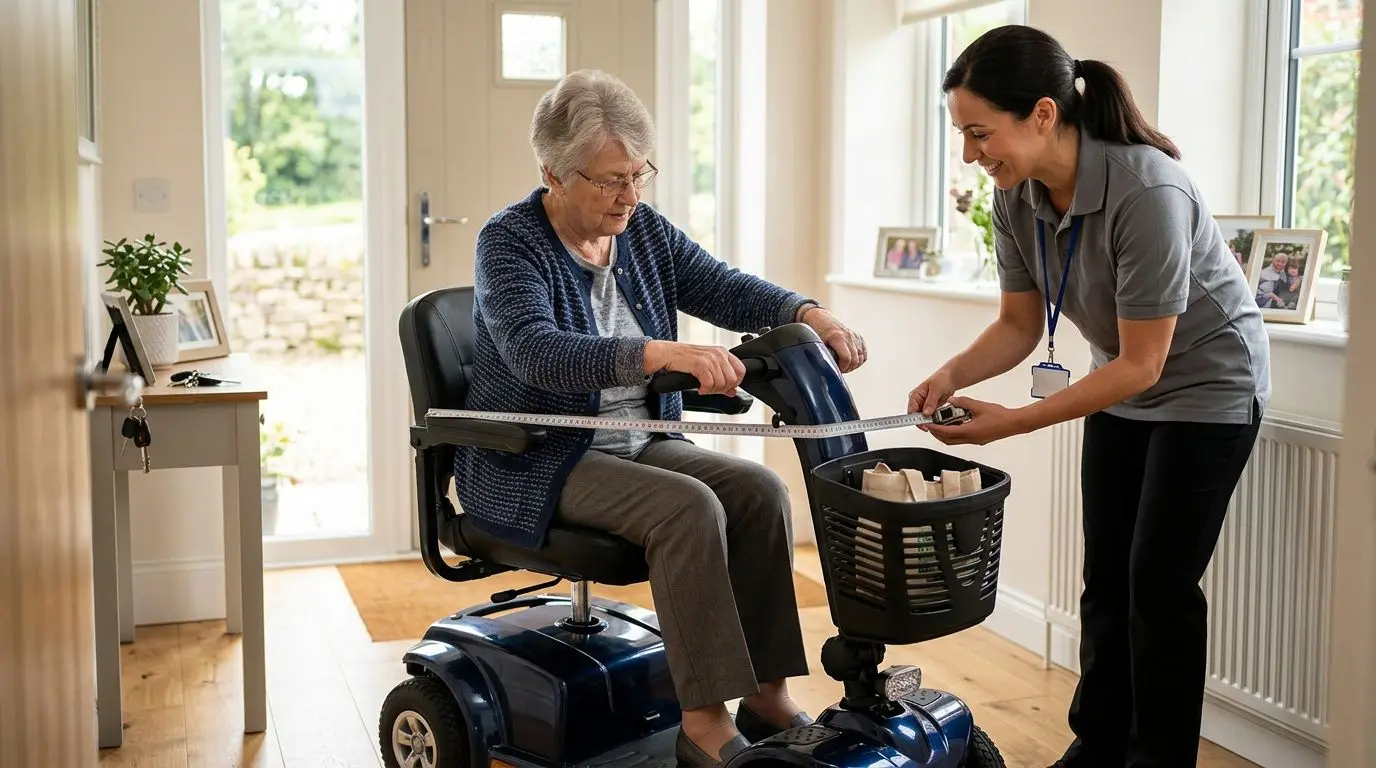
Before choosing between a delta tiller and standard handles, measure the rider and the places where the scooter will be used. A 30-inch doorway, a 36-inch hallway, or a tight elevator can matter as much as hand comfort. Use a tape measure, not a guess.
- Measure seated reach. Sit in a chair similar in height to the scooter seat. With shoulders relaxed, measure from your lower back to your comfortable hand position. You should not need to lean forward to steer.
- Check elbow bend. Aim for a slight bend, often around 20 to 30 degrees. Locked elbows can make steering tiring and reduce shock absorption over bumps.
- Test wrist position. Your wrists should not be sharply bent up, down, or sideways. A neutral wrist is usually more comfortable over 15 minutes or more.
- Test throttle access. Move forward, stop, reverse, and stop again at least 10 times. Watch for pain, delay, or accidental over-pressing.
- Try a tight turn. Practice a slow U-turn in a marked space, such as a 6-foot-wide area, if available. This shows whether steering feels controlled or strained.
- Simulate real use. Wear your usual gloves, wrist brace, or hand support if you use one. Carry the items you normally bring, such as a purse or small bag, and test for at least 10 minutes.
If a tiller adjusts forward and backward, test more than one angle. A delta tiller that feels excellent when properly adjusted may feel poor if it is set too far away. The same is true for standard handles.
Feature comparison: 8 control details that matter
Handle shape is only one part of the control system. When comparing scooters, look at at least 8 control details before deciding. Small differences can affect daily comfort more than the label “delta” or “standard.”
| Feature | Why it matters | What to check |
|---|---|---|
| Tiller angle adjustment | Helps match arm length and posture | Can you reach without leaning? |
| Throttle style | Affects thumb and finger effort | Can you operate it 10 times without discomfort? |
| Grip diameter | Too small or too large can strain hands | Can your hand rest naturally? |
| Control labels | Reduces confusion | Are forward, reverse, horn, and lights easy to identify? |
| Speed dial placement | Helps indoor control | Can you lower speed before entering tight spaces? |
| Horn button | Useful around pedestrians | Can you reach it without looking down? |
| Brake response | Critical for stopping confidence | Does the scooter stop predictably when you release the throttle? |
| Display visibility | Shows battery and status | Can you read it in bright light and indoors? |
Pay attention to start-up behavior, too. A scooter that starts too abruptly can feel difficult for riders with tremor, stiffness, or slow reaction time. A smoother low-speed response may matter more than maximum speed.
Safety checks before buying or renting: a 10-minute test
A short test ride should include more than driving in a straight line. Plan a 10-minute control check that imitates real life: starting, stopping, turning, backing up, and parking. If you are comparing both handle types, test them on the same day if possible so the differences are easier to feel.
- Minute 1: Adjust the seat and tiller. Confirm your feet are stable and your back is supported.
- Minutes 2 to 3: Practice slow starts and stops. Release the throttle fully each time.
- Minutes 4 to 5: Make left and right turns at low speed. Notice wrist strain or shoulder lifting.
- Minutes 6 to 7: Reverse slowly and stop. Check whether the controls feel intuitive.
- Minutes 8 to 9: Drive over a small threshold or surface change if safely available.
- Minute 10: Park beside a table, counter, or chair. Make sure you can approach without bumping.
Stop the test if you feel unsafe, confused, or unable to release the throttle reliably. Hand pain matters, but control is the priority. A comfortable scooter still needs to be predictable when a person, pet, shopping cart, or door appears unexpectedly.
Common trade-offs for riders with hand pain after 20 minutes
Many riders with hand pain focus on the first impression: which handle feels softer when they sit down. A better question is which layout still feels controlled after 20 minutes of steering. Fatigue changes everything. A hand that works well at the beginning of a trip may become slower or less precise on the way back.
A delta tiller may reduce fatigue because it allows hand repositioning. You can vary contact points, use a lighter grip, and sometimes steer with the stronger hand when the weaker hand needs rest. The trade-off is that some riders need practice to avoid oversteering, especially if they are used to bicycle-style grips.
Standard handles may provide a secure, familiar feeling, especially for riders who like equal pressure from both hands. The trade-off is that they can encourage constant gripping. If your knuckles, thumbs, or wrists ache after holding a shopping cart, cane, or walker, standard handles deserve extra scrutiny.
Padding, gloves, and proper adjustment can help either style, but they should not be used to hide a poor fit. If you need to squeeze hard to feel in control, the scooter may not be the right match.
FAQ: 5 common questions about scooter handle comfort
Is a delta tiller always better for arthritis?
No. A delta tiller is often easier for riders with painful or stiff hands because it may require less squeezing, but arthritis affects people differently. Control lever location, tiller angle, and seat position can make one scooter more comfortable than another, even with the same handle type.
Can I drive a mobility scooter with one hand?
Some riders can operate certain scooters one-handed, especially with a delta tiller, but it depends on strength, reaction time, terrain, and control layout. Two-handed control is generally more stable on uneven surfaces, curb cuts, and outdoor routes.
Do standard handles give better control?
They can for riders with good grip and wrist stability because the hand positions are clear and familiar. For riders with weak grip or hand fatigue, a standard handle may feel less controlled over time than a delta tiller.
What should I test if my thumbs hurt?
Test the throttle motion at least 10 times in forward and reverse. Check whether you can use fingers instead of thumbs, alternate hands, or rest your palm without pressing the control accidentally.
Does handle type affect turning radius?
Not directly. Turning radius is mainly affected by scooter size, wheelbase, and 3-wheel versus 4-wheel design. Handle type affects how steering feels, not how tightly the scooter is built to turn.
Frequently asked questions
Is a delta tiller always better for arthritis? +
No. A delta tiller is often easier for riders with painful or stiff hands because it may require less squeezing, but arthritis affects people differently. Control placement, tiller angle, and seat position also matter.
Can I drive a mobility scooter with one hand? +
Some riders can operate certain scooters one-handed, especially with a delta tiller, but it depends on strength, reaction time, terrain, and control layout. Two-handed control is usually more stable outdoors.
Do standard scooter handles give better control? +
They can for riders with good grip and wrist stability because the hand positions are familiar and defined. Riders with weak grip or fatigue may feel more controlled with a delta tiller.
What should I test if my thumbs hurt? +
Test the throttle in forward and reverse at least 10 times. Check whether you can operate it without thumb strain, whether fingers can be used instead, and whether your hand can rest without accidental pressure.
Does handle type affect turning radius? +
Not directly. Turning radius depends mostly on scooter size, wheelbase, and 3-wheel versus 4-wheel design. Handle type affects steering feel and hand comfort, not the scooter’s built-in turning circle.
Related guides
Mobility Scooter Controls and Tiller Fit: What to Check for Arthritis, Weak Grip, or Limited Reach
14 min read
Joystick-Control Mobility Scooters vs. Tiller Steering: Which Control Style Fits Your Needs?
13 min read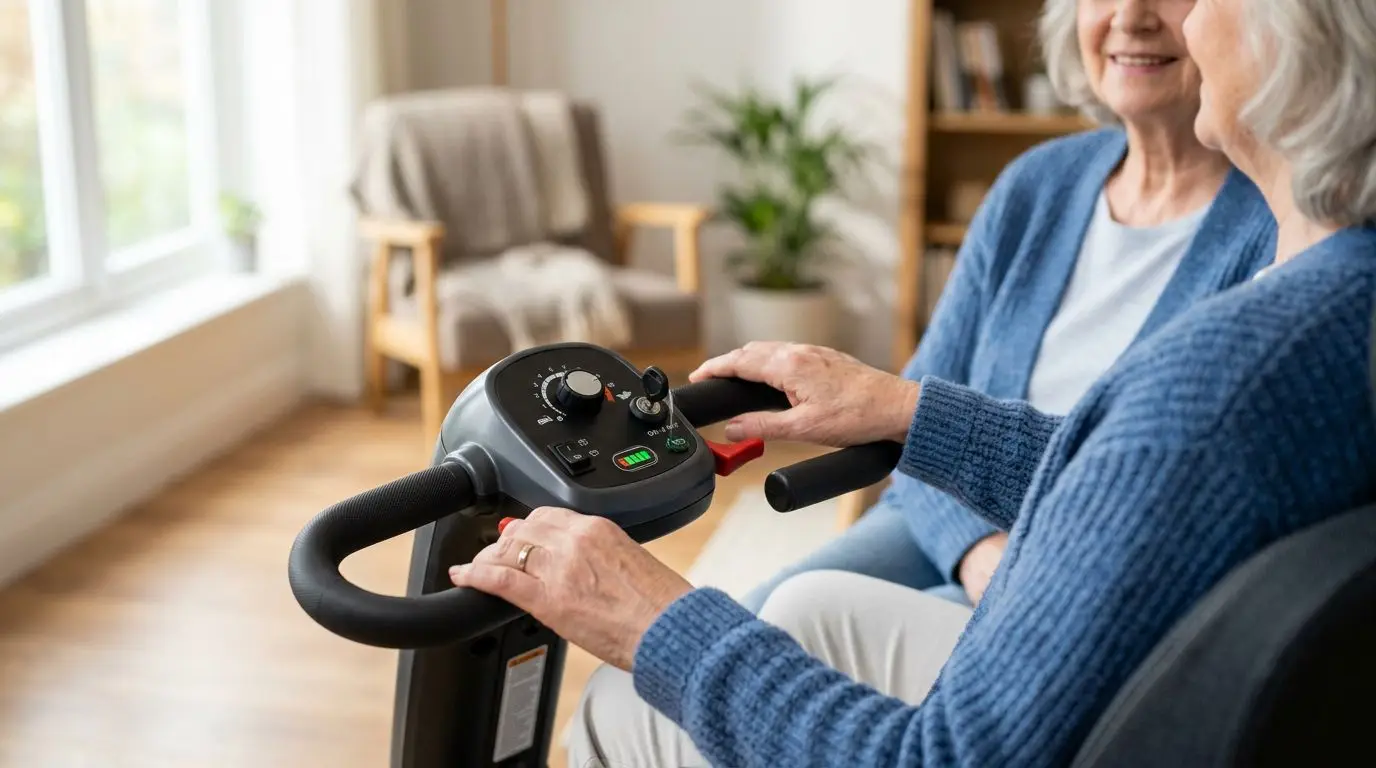
Mobility Scooter Controls Explained: Throttles, Brakes, Speed Settings, and Ease of Use
15 min read