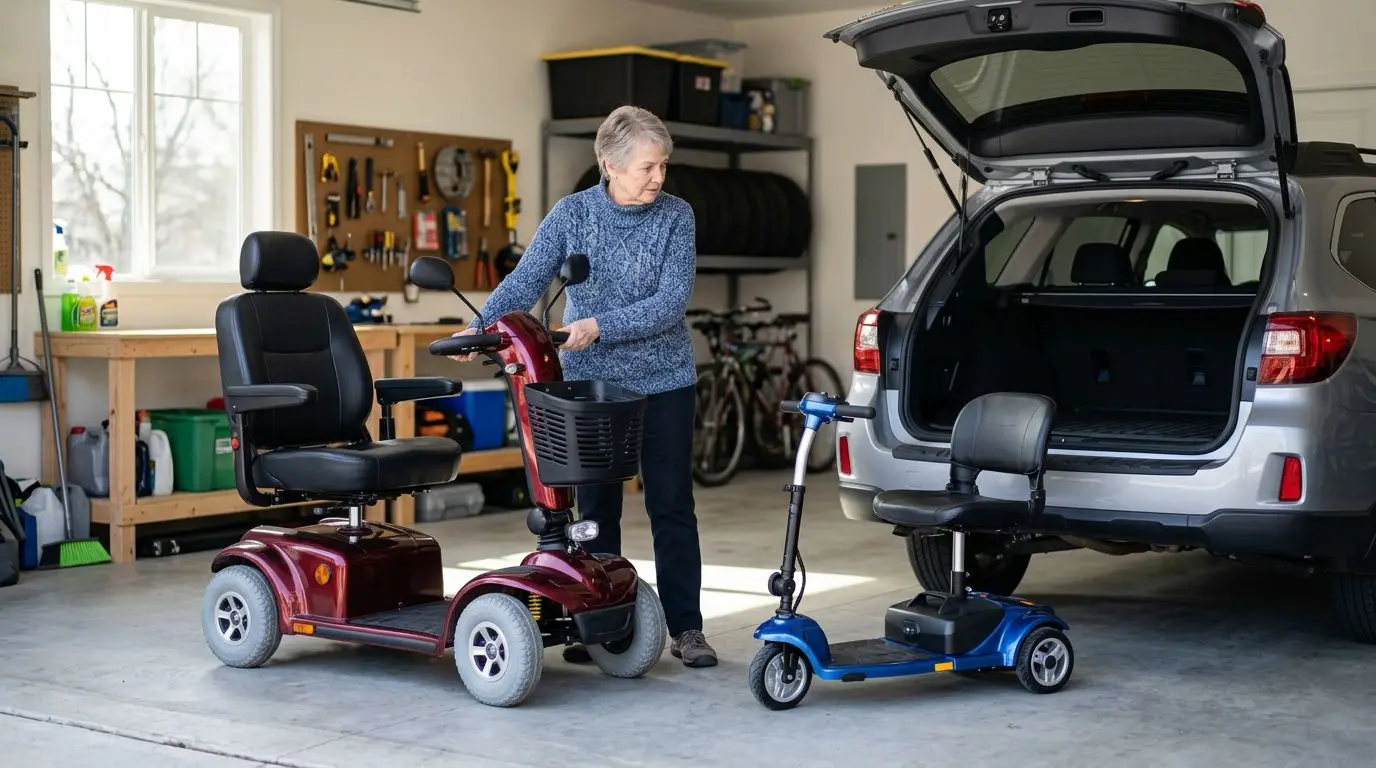
Foldable lightweight mobility scooters are easiest to choose when you start with how they fold, the heaviest weight you will need to lift, and where the scooter must fit. Manual folding is usually simpler and lighter. Auto folding is easier on the hands but can add weight and electronics. Disassembly scooters often provide the best lift weight because the scooter separates into smaller pieces.
If you plan to load the scooter into a car, focus less on total weight and more on the heaviest single piece, folded dimensions, handle locations, and whether you can lift safely from ground level to your trunk lip. Comfort and durability matter as well: the lightest scooters can be convenient, but they often have smaller wheels, shorter seats, and less suspension than heavier travel scooters.
What lightweight folding scooters usually mean: 35 to 70 lb total weight
A lightweight mobility scooter is usually a compact travel scooter made for short errands, indoor use, smooth sidewalks, and easier transport. Many fall roughly between 35 and 70 lb without accessories, though the number that matters most is the heaviest piece you will actually lift.
There is no single legal definition of lightweight. A scooter advertised as light may still be hard to load if it folds into one 55 lb package with no good grab point. Another scooter may weigh more overall but split into a 30 lb front section, a 20 lb rear section, a seat, and a battery pack, making it easier for more users to manage.
Most foldable lightweight scooters use a narrow frame, compact tiller, 3 or 4 wheels, and a smaller battery than a full-size outdoor scooter. Common travel features include a removable battery, adjustable tiller, electromagnetic brake, flat-free tires, and a turning radius that may be under 45 inches on some compact designs.
Portability brings trade-offs. A scooter under 50 lb may have 6- to 8-inch wheels, a smaller seat base, lower ground clearance, and a shorter deck. Those details affect comfort, leg position, and how smoothly the scooter handles driveway lips, sidewalk seams, grass, and uneven parking lots.
3 folding and transport options compared side by side
The three main options are manual folding, auto folding, and disassembly. Each can work well, but they solve different problems. A person with strong balance but limited storage may prefer a manual folding scooter, while someone with hand pain may value push-button folding. A caregiver who loads the scooter into a sedan may prefer disassembly because each piece is lighter.
| Transport style | Typical lift pattern | Best advantage | Main drawback |
|---|---|---|---|
| Manual folding | One folded unit, often about 40 to 60 lb | Simple mechanism with fewer electronics | You usually lift the full scooter at once |
| Auto folding | One folded unit, often about 45 to 65 lb | Folds by button, key fob, or switch | Motorized folding parts can add weight and complexity |
| Disassembly | Several pieces, heaviest often about 25 to 45 lb | Lower single-piece lift weight | Takes more steps and more trunk organization |
Manual folding scooters usually require you to release a latch, fold the tiller down, and collapse the frame or seat area. With practice, the process may take 20 to 60 seconds. This style is appealing because it avoids a powered folding system, but the user or caregiver still has to manage the scooter as one unit.
Auto folding scooters use a small motorized mechanism to fold and unfold the frame. This can help if bending, gripping, or pulling a latch is difficult. The scooter still has to be lifted, though. Auto folding does not make a 55 lb scooter feel like 25 lb; it only reduces the effort needed to change its shape.
Disassembly scooters separate into major parts. A typical setup may include the seat, battery pack, rear drive section, front frame section, and basket. Total weight may be similar to a folding scooter, but each piece can be easier to load. The trade-off is time, repetition, and the need to reconnect parts correctly before each ride.
Who each option is best for: match the scooter to the 1 person lifting it
The best foldable scooter is not always the one with the lowest advertised weight. It is the one that fits the real user, vehicle, storage area, and daily routine. If only one person will lift it, that person’s safe lifting limit should guide the decision.
Manual folding is best for
- Users or caregivers who can safely lift one 40 to 60 lb folded unit.
- People who want a simple folding process without relying on a powered folding motor.
- Apartment residents who need a scooter that stands or stores in a closet, corner, or entryway.
- Drivers with hatchbacks, wagons, or SUVs where the loading height is manageable.
Manual folding can be a good fit when storage is the main problem, not lifting strength. It is also helpful when the scooter must be rolled like luggage for short distances, though not every folding scooter rolls smoothly when folded.
Auto folding is best for
- People who have trouble bending to release frame latches or folding joints.
- Users with reduced hand strength who prefer a button-operated mechanism.
- Travelers who value a consistent fold size for car trunks, closets, or hotel rooms.
- Caregivers who can lift the scooter but want to reduce setup steps.
Auto folding is mainly about convenience. It can make daily use less frustrating, especially when the scooter is folded several times a week. Still, it adds another system to maintain. If the battery is depleted or the folding mechanism is obstructed, you may need to know the manual override process.
Disassembly is best for
- Caregivers who prefer lifting 25 to 45 lb pieces instead of one heavier scooter.
- Drivers with sedans, compact cars, or trunks with a narrow opening.
- Users who want a slightly sturdier travel scooter but still need transportability.
- Households that can tolerate 3 to 5 assembly steps before each outing.
Disassembly is often the most practical choice when lifting weight is the deciding factor. It can also make trunk loading less awkward because each piece can be angled separately. The downside is that assembly requires enough standing balance, hand function, and memory to connect the frame, seat, battery, and tiller safely.
How to measure trunk fit and lifting weight in 10 minutes
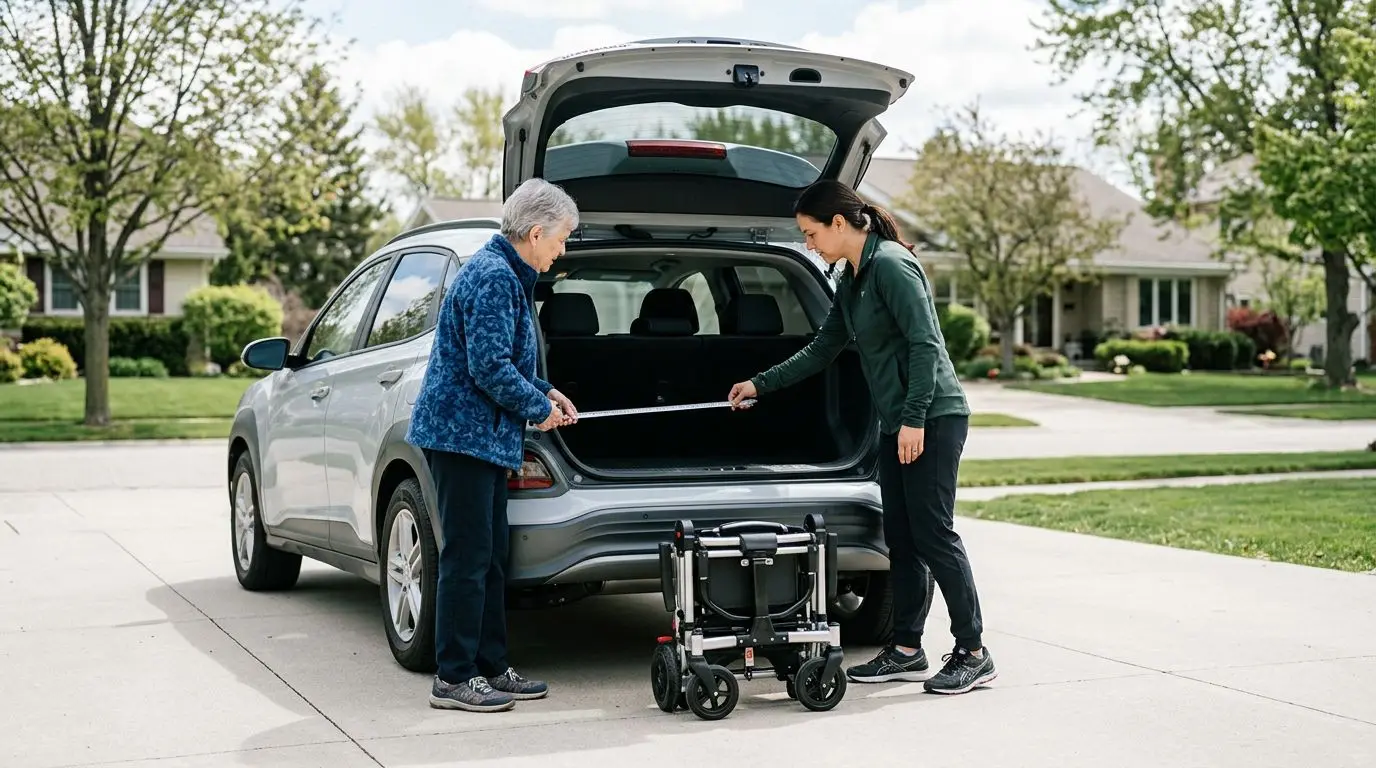
Before choosing any foldable lightweight scooter, measure your vehicle and consider your body mechanics. A tape measure can prevent an expensive mismatch. Write down 4 numbers: trunk opening width, trunk depth, trunk height, and the height from the ground to the trunk lip.
Start with the trunk opening, not just the interior space. A folded scooter may fit inside the cargo area but fail to pass through a 28-inch trunk opening. Measure the narrowest point from side to side, then measure height from the lower lip to the top of the opening. If you drive a sedan, also check the angle of the opening because a rigid folded scooter may need to be tilted.
Next, measure cargo depth from the rear edge to the back seats. Many compact folded scooters fall roughly in the 25- to 40-inch length range, but dimensions vary by frame style. Allow at least 1 to 2 inches of clearance so you are not forcing the tiller, throttle, or plastic trim against the car.
Now measure lift height. A trunk lip of 28 to 32 inches can feel very different from a low hatchback floor, especially with a 50 lb scooter. Practice with a safe object of similar weight before buying. If you cannot lift the object smoothly without twisting, the scooter may require a ramp, lift assist, disassembly style, or a second person.
| Measurement | How to check it | Why it matters |
|---|---|---|
| Heaviest piece | Compare to what the lifter can safely raise | Total scooter weight can be misleading |
| Folded length | Measure trunk depth and diagonal clearance | Long frames may not fit sedans |
| Folded height | Measure the smallest part of the opening | Tillers and seats often create the high point |
| Loading height | Measure ground to trunk lip in inches | Higher lips make lifting harder |
| Home storage | Measure closet, hallway, or entry space | A scooter may fit the car but block the home |
Think about where the scooter will sit overnight too. If it must be charged indoors, make sure the charging spot is near a standard outlet and does not create a trip hazard. A 36-inch hallway can become difficult to navigate if a folded scooter is parked sideways.
Comfort trade-offs under 50 lb: seat, wheels, and ride quality
Lightweight scooters are convenient because they remove bulk, but they also give up some comfort features. The biggest differences are usually seat padding, wheel size, suspension, foot space, and frame length. A 45 lb scooter may be easy to lift yet feel cramped after 30 minutes of riding.
Seat design matters. Many lightweight scooters use compact seats to save weight and folded height. Check seat width, back support, and whether armrests are included, removable, or adjustable. A narrow seat can be fine for quick indoor trips but tiring during a full afternoon at a museum, store, or medical campus.
Wheel size is another important clue. Smaller 6-inch wheels keep the scooter compact, but they do not roll over cracks and thresholds as comfortably as larger wheels. If you expect to cross uneven sidewalks, curb cuts, gravel patches, or thick carpet, look for enough ground clearance and tire size for those surfaces. A difference of 1 or 2 inches in wheel diameter can be noticeable.
Legroom is easy to overlook. Compact decks can force taller riders to bend their knees sharply. If possible, sit on the scooter for at least 10 minutes. Check whether your feet rest flat, whether your knees clear the tiller, and whether you can reach the controls without hunching forward.
Speed and range should be viewed realistically. Travel scooters are often built for moderate speeds and controlled environments, not road use. Published range can be affected by rider weight, hills, temperature, tire condition, battery age, and stop-and-go use. If a trip requires 6 miles of real-world riding, do not choose a scooter that only barely claims that distance under ideal conditions.
Durability and safety details to check before a 12-month ownership period
A lightweight scooter should still feel secure. During the first year of ownership, small durability details can make the difference between a scooter that is easy to live with and one that feels fragile. Look closely at the folding joint, frame lock, battery connection, seat post, tiller hinge, and wheels.
The folding latch should engage firmly with an obvious click or locked position. If the scooter can be moved while partly folded, check whether the frame flexes or rattles. A little movement is common in compact designs, but a loose hinge can become annoying and may reduce confidence on rough surfaces.
Anti-tip wheels are worth checking, especially on compact 3-wheel scooters or scooters with a short wheelbase. They do not replace careful driving, but they can add a margin of stability on small slopes and transitions. Also check braking behavior. Most mobility scooters use an automatic electromagnetic brake that engages when the throttle is released, but stopping distance still depends on speed, slope, surface, and load.
Batteries need attention. Many foldable scooters use lithium-ion battery packs because they are lighter than older sealed lead-acid batteries. For air travel, airlines commonly ask for the battery’s watt-hour rating and may require advance approval. Some travel mobility batteries are designed to stay within airline limits, but rules can vary by airline and destination, so confirm before booking and keep the battery label readable.
Water exposure is another practical issue. Lightweight scooters are electrical devices, not waterproof outdoor machines. Riding through deep puddles, storing the scooter outside, or leaving it in heavy rain can damage electronics and connectors. If you live in a wet climate, ask how the battery compartment, controls, and charging port are protected and plan indoor storage.
Key features that matter most in a 4-week trial mindset
If you could test a scooter for 4 weeks, the winning features would likely be ordinary ones: easy loading, predictable controls, good seating, stable turning, and simple charging. Use that mindset when comparing specifications. The most impressive feature on paper may not matter if the scooter is painful to lift twice a day.
| Feature | Why it matters | What to look for |
|---|---|---|
| Heaviest piece weight | Determines real loading difficulty | A number the lifter can manage without twisting |
| Folded dimensions | Controls trunk, closet, and elevator fit | Length, width, and height listed separately |
| Battery removal | Can reduce lift weight and simplify charging | A pack that releases without tools |
| Tiller adjustment | Affects posture and knee clearance | Multiple positions or easy angle adjustment |
| Seat comfort | Controls how long you can ride comfortably | Adequate width, back support, and stable mount |
| Wheel and tire size | Changes ride quality on thresholds and sidewalks | Larger wheels for more uneven surfaces |
| Controls | Important for hand strength and reaction time | Easy throttle, horn, speed dial, and battery display |
Pay attention to the charger as well. Some scooters charge on-board, some allow the battery to be charged off-board, and some support both. Off-board charging is useful if the scooter stays in the car or garage while the battery charges indoors. Make sure the battery is light enough to carry comfortably; even a small pack can be awkward if the handle is poor.
Turning radius matters indoors. A compact scooter with a turning radius around 35 to 45 inches may handle grocery aisles and apartment hallways better than a longer scooter. Four-wheel designs often feel steadier in a straight line, while 3-wheel designs can turn tighter. Neither is automatically better; the right choice depends on space, balance needs, and surfaces.
How to choose in 5 steps without relying on brand names
A smart buying process starts with your routine, not a product page. List the 3 places you will use the scooter most: for example, a grocery store, a senior community, and a medical office. Then choose the scooter type around those places.
- Set a safe lift limit. Decide the maximum heaviest-piece weight that the user or caregiver can lift from the ground to the vehicle. If that number is under 35 lb, disassembly may be more realistic than one-piece folding.
- Measure the vehicle. Record trunk opening width, height, depth, and lift-over height. Compare those numbers with folded dimensions, leaving at least 1 inch of clearance.
- Match the folding method to your hands. If gripping latches is easy, manual folding may be fine. If hand strength or bending is limited, auto folding may help, as long as the full scooter can still be lifted.
- Sit before you decide. Check seat width, back support, tiller reach, foot position, and knee clearance for at least 10 minutes when possible.
- Check the surfaces. Smooth indoor floors are different from cracked sidewalks, sloped driveways, and thick door thresholds. Choose wheel size, ground clearance, and stability accordingly.
Do not ignore service and parts access just because a scooter is lightweight. Ask how batteries, tires, chargers, armrests, and seats are replaced. A simple scooter can be a better long-term choice if routine parts are easy to obtain and the frame is straightforward to inspect.
If you are choosing for a parent or spouse, involve the person who will ride it. Independence is personal. The scooter should feel manageable, not embarrassing, confusing, or intimidating. A good fit supports mobility while respecting the rider’s comfort and preferences.
FAQ: 5 common questions about foldable lightweight scooters
Is an auto folding scooter always better than a manual folding scooter?
No. Auto folding can reduce bending and hand effort, but it does not reduce the weight you lift into a car. A manual folding scooter may be lighter, simpler, and easier to troubleshoot if you are comfortable operating the latch and folding joint.
What is the most important weight number to compare?
Compare the heaviest piece, not just the total scooter weight. A 65 lb scooter that separates into 30 lb sections may be easier to load than a 50 lb scooter that must be lifted as one awkward unit.
Will a foldable mobility scooter fit in a sedan trunk?
Some will, but you must measure. Check the trunk opening width and height, not only the interior depth. Many trunk openings are under 30 inches high at the tightest point, which can be the limiting factor for folded scooters.
Are lightweight scooters comfortable for all-day use?
They can work for short trips and planned outings, but many lightweight scooters have compact seats, smaller wheels, and limited suspension. If you expect to ride for several hours, test seat comfort, legroom, and ride quality before deciding.
Can I take a foldable scooter on an airplane?
Often, yes, but you need airline approval and battery information before travel. Airlines commonly ask for the lithium battery watt-hour rating, and rules can vary, so contact the airline well before your flight.
Which is more durable: folding or disassembly?
Neither is automatically more durable. Folding scooters rely on hinges and latches, while disassembly scooters rely on connectors and removable sections. In both cases, inspect the frame lock, battery connection, seat mount, and wheels regularly.
Frequently asked questions
Is an auto folding scooter always better than a manual folding scooter? +
No. Auto folding can reduce bending and hand effort, but it does not reduce the weight you lift into a car. A manual folding scooter may be lighter, simpler, and easier to troubleshoot if you are comfortable operating the latch and folding joint.
What is the most important weight number to compare? +
Compare the heaviest piece, not just the total scooter weight. A 65 lb scooter that separates into 30 lb sections may be easier to load than a 50 lb scooter that must be lifted as one awkward unit.
Will a foldable mobility scooter fit in a sedan trunk? +
Some will, but you must measure. Check the trunk opening width and height, not only the interior depth. Many trunk openings are under 30 inches high at the tightest point, which can be the limiting factor for folded scooters.
Are lightweight scooters comfortable for all-day use? +
They can work for short trips and planned outings, but many lightweight scooters have compact seats, smaller wheels, and limited suspension. If you expect to ride for several hours, test seat comfort, legroom, and ride quality before deciding.
Can I take a foldable scooter on an airplane? +
Often, yes, but you need airline approval and battery information before travel. Airlines commonly ask for the lithium battery watt-hour rating, and rules can vary, so contact the airline well before your flight.
Which is more durable: folding or disassembly? +
Neither is automatically more durable. Folding scooters rely on hinges and latches, while disassembly scooters rely on connectors and removable sections. In both cases, inspect the frame lock, battery connection, seat mount, and wheels regularly.
Related guides
Travel, Folding, and Lightweight Mobility Scooters: What to Know Before You Buy
13 min read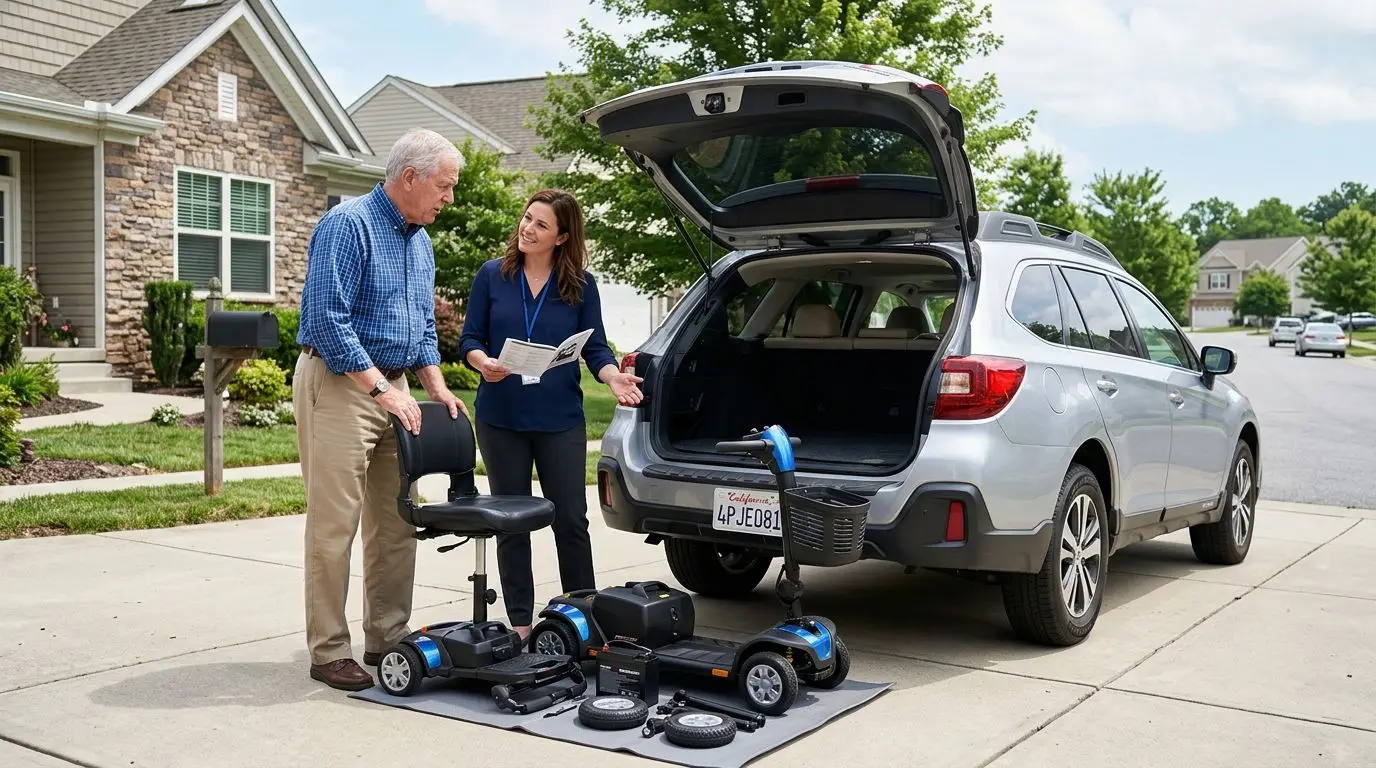
Portable Mobility Scooters for Cars: Folding, Disassembling, and Lift-Compatible Types Compared
12 min read
Lightweight Mobility Scooters: What You Gain and Give Up With a Lighter Scooter
13 min read