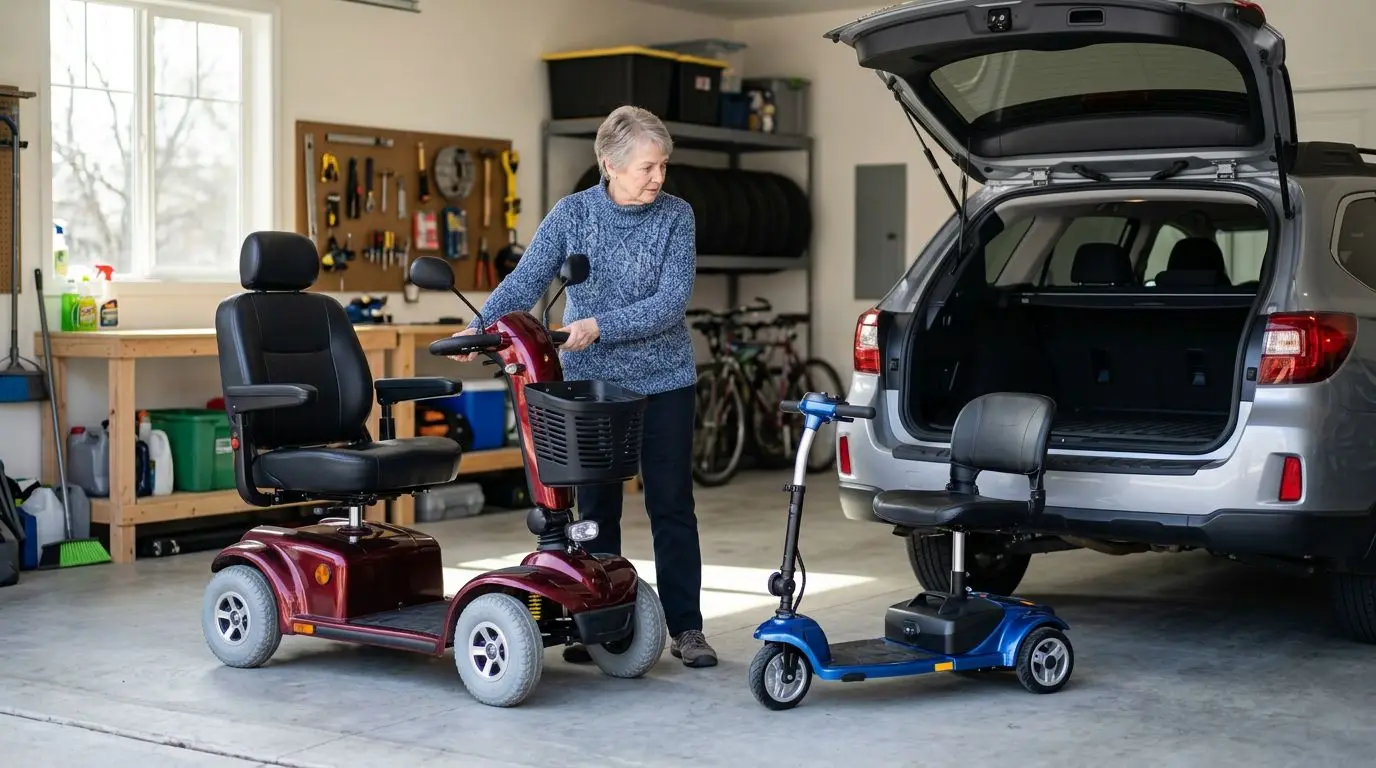
Choose a travel mobility scooter if you need easy car transport, tight indoor maneuvering, and short trips of roughly 6 to 15 miles. Choose a full-size mobility scooter if you want more comfort, higher weight capacity, better outdoor stability, and longer range for errands, appointments, or full afternoons away from home. The right choice depends less on size alone than on where you will ride, how you will transport it, and how long you need to stay comfortable.
Both types can support safer, more independent movement when matched to the user and setting. A compact scooter that fits your trunk may be ideal for doctor visits, while a larger scooter may work better as an everyday vehicle for sidewalks, community centers, and shopping trips. This guide explains the tradeoffs in plain terms so you can choose with fewer surprises.
Quick comparison: 6 key differences between travel and full-size scooters
Travel scooters and full-size scooters are built around different priorities. Most travel scooters are made to break down into 3 to 5 pieces or fold for transport, while full-size scooters are usually designed to stay assembled and provide a steadier ride.
| Category | Travel mobility scooter | Full-size mobility scooter |
|---|---|---|
| Primary strength | Portability and storage | Comfort, range, and stability |
| Typical range | About 6 to 15 miles per charge | About 15 to 30+ miles per charge |
| Transport | Often disassembles into 3 to 5 pieces or folds | Usually needs a vehicle lift, ramp, or accessible van |
| Heaviest piece | Often about 30 to 60 lb, depending on design | Often too heavy for routine lifting by one person |
| Seat comfort | Compact seat, limited padding, often smaller backrest | Larger padded seat, higher back, more adjustment |
| Outdoor ride | Best on smooth pavement and indoor floors | Better for sidewalks, longer routes, and mild unevenness |
| Turning radius | Often tighter, useful in stores and hallways | Wider, especially on larger 4-wheel designs |
A simple way to frame it: travel scooters solve the car problem; full-size scooters solve the long-day comfort problem. If both matter equally, decide which problem creates more difficulty in your weekly routine.
Who travel mobility scooters are best for: short trips, cars, and spaces under 36 inches
A travel scooter is usually best for someone who rides in controlled environments and needs to load the scooter into a car several times a week. Common examples include medical appointments, grocery stores, airports, museums, restaurants, senior centers, and visits to family homes.
This type works especially well when your typical outing is measured in hours, not the whole day. Many compact scooters have enough range for a shopping trip plus a stop for lunch, but they are not usually meant for 8-hour outdoor use on mixed surfaces. Battery range varies by rider weight, speed, terrain, temperature, and battery age, so it is wise to leave a cushion instead of planning to use every mile listed in a specification sheet.
Travel scooters often make sense if you:
- Need to lift or roll the scooter into a trunk, hatchback, or back seat area.
- Ride mostly indoors or on smooth, level sidewalks.
- Have limited storage space at home, such as an apartment entryway or closet.
- Need a tighter turning radius for aisles, elevators, and hallways.
- Use the scooter for 1 to 3 outings at a time rather than continuous all-day riding.
- Can tolerate a smaller seat and a firmer, more compact ride.
Pay close attention to the weight of the heaviest piece, not just the total scooter weight. A scooter advertised as transportable may still have a base section that weighs 45 or 55 lb. For many older adults and caregivers, that difference matters more than the total assembled weight.
Who full-size mobility scooters are best for: longer rides, 300 lb capacities, and daily errands
A full-size mobility scooter is usually better for people who plan to use a scooter as a primary mobility aid outside the home or throughout the day. These scooters typically offer larger batteries, a more supportive seat, higher ground clearance, and a broader wheelbase than compact travel designs.
Many full-size scooters are rated for higher user weights, often in the 300 to 400 lb range depending on the class and construction. Higher capacity is not only about the rider; it can also affect performance when carrying groceries, a cane holder, oxygen equipment, or a front basket with personal items. Always check the stated weight capacity and include anything routinely carried on the scooter.
Full-size scooters often make sense if you:
- Use the scooter daily for errands, appointments, community activities, or longer neighborhood rides.
- Need a wider or more cushioned seat for hip, back, or leg comfort.
- Ride on sidewalks with seams, curb cuts, ramps, or slightly uneven pavement.
- Want longer battery range and less worry about charging during the day.
- Need a higher weight capacity or more legroom.
- Have a garage, covered parking area, lift, ramp, or van for transport.
The main tradeoff is transport. A full-size scooter may feel much better once you are seated, but it can be difficult to take along unless your vehicle setup is ready for it. If the scooter will stay at home and serve your neighborhood, that may not be a problem. If you need to drive to most destinations, it becomes a major deciding factor.
Portability test: measure your vehicle, lift height, and the 3 heaviest parts
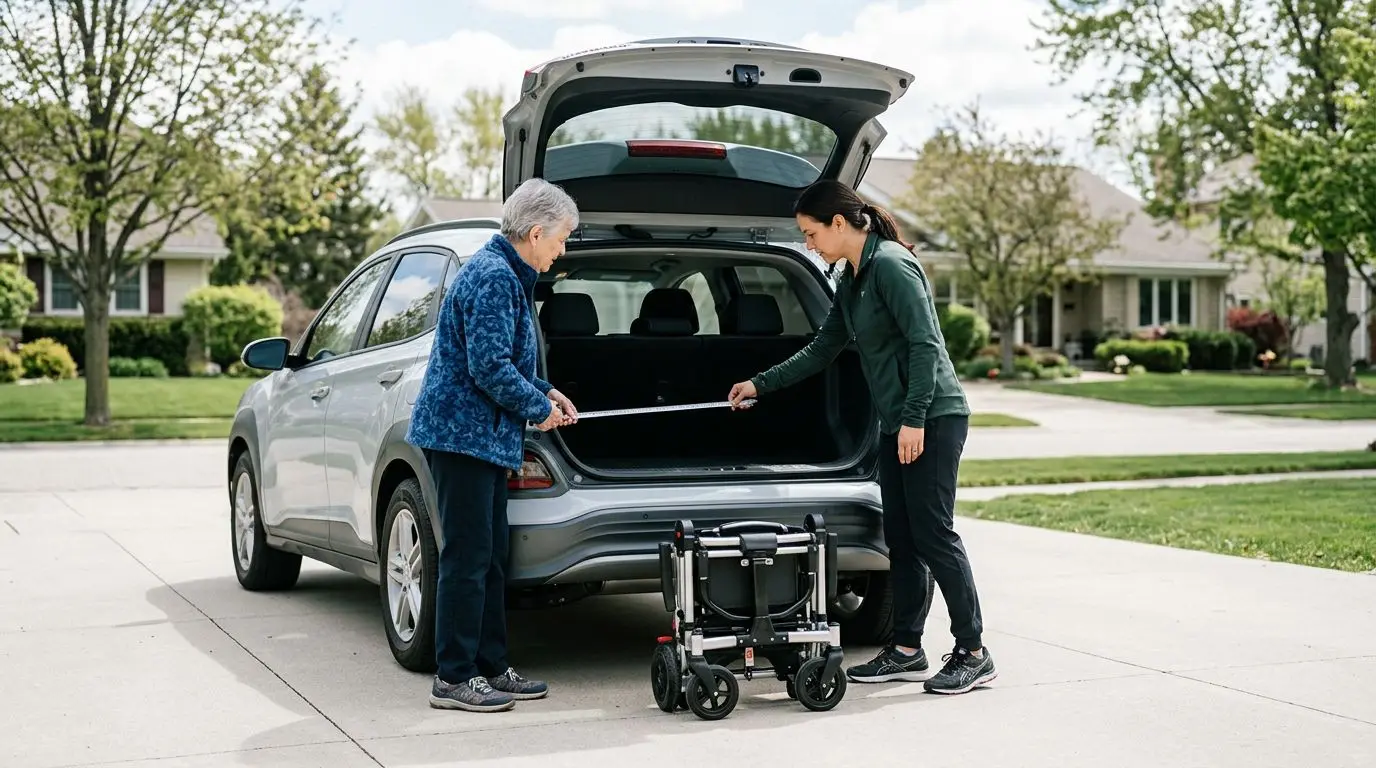
Before buying a travel scooter, measure the vehicle you will actually use. A scooter that technically disassembles can still be frustrating if the battery box is awkward, the steering column is long, or the base catches on the trunk opening. Measure twice.
Start with 3 numbers: the width of the trunk or hatch opening, the depth of the cargo area, and the lift-over height from the ground to the cargo floor. A trunk opening might be only 36 to 42 inches wide, and a high cargo floor can make even a 40 lb scooter section hard to load safely. If a caregiver will do the lifting, that person should test the motion with a similar weight before committing.
How to measure for car transport
- Cargo opening width: Measure the narrowest point, not the widest part inside the trunk.
- Cargo depth: Measure with the rear seats in the position you normally use.
- Opening height: Make sure the folded tiller or largest frame section can pass through.
- Lift-over height: Measure from the ground to the cargo floor; a few inches can change the difficulty.
- Heaviest piece: Confirm the weight of the largest section after disassembly.
- Grip points: Look for places to hold the part securely without pinching fingers.
If the heaviest piece is near your safe lifting limit, consider whether you will still be comfortable on a rainy day, after an appointment, or when parked on a slope. Portability should mean repeatable and safe, not just possible once in a showroom.
Comfort and seating: compare 2 hours of use versus a full afternoon
Comfort is where many buyers underestimate the difference. A travel scooter seat may feel fine for 10 minutes but become tiring after 2 hours. Full-size scooters generally provide more seat width, thicker padding, better back support, and more room to adjust posture.
Seat height, armrest width, tiller angle, and foot platform space all matter. If your knees sit high, your hips feel cramped, or your shoulders reach forward the whole time, fatigue can build quickly. A larger scooter often gives taller riders and people with joint stiffness more room to sit naturally.
Comfort features to compare
| Feature | Why it matters | Typical advantage |
|---|---|---|
| Seat width | Affects hip comfort and pressure points | Full-size |
| Backrest height | Supports longer sitting and posture changes | Full-size |
| Swivel seat | Helps transfers when space is tight | Both, depending on design |
| Adjustable tiller | Helps arm reach and steering comfort | Both, often more range on larger scooters |
| Suspension | Reduces vibration on sidewalks and seams | Full-size |
| Foot platform length | Matters for taller riders and limited knee bend | Full-size |
If possible, sit on the scooter for at least 15 to 20 minutes, not just a quick lap. Practice getting on and off. Turn the tiller. Reach the controls. If your intended rides are long, comfort is not a luxury feature; it is part of whether you will actually use the scooter.
Range and batteries: plan around 70 percent of the stated miles
Battery range is one of the most important differences between travel and full-size scooters, but listed mileage should be treated as an estimate. Real-world range can drop when riding uphill, carrying more weight, using lights, driving on rough surfaces, or operating in cold weather. A practical planning rule is to use about 70 percent of the stated range as your dependable everyday number.
For example, if a scooter is listed for 10 miles, planning around 7 miles gives you a safety margin. If a larger scooter is listed for 25 miles, planning around 17 or 18 miles is more realistic for mixed errands. This is not a defect; it is how battery-powered mobility equipment works under changing conditions.
Questions to ask about range
- How far is a normal round trip from home, including detours?
- Will you ride on hills, ramps, grass edges, gravel paths, or rough sidewalks?
- Do you need enough battery for a full day away from home?
- Can you charge at home every night in a dry, accessible spot?
- Is the battery removable, and if so, how much does it weigh?
Travel scooters may use lighter battery packs that are easier to remove and charge indoors. Full-size scooters usually have larger battery systems that support longer range but are less convenient to lift. For air travel, battery rules can be strict, especially for lithium batteries, so always confirm requirements with the airline well before your trip.
Indoor, sidewalk, and outdoor terrain: wheel size can change the ride by 2 inches or more
Terrain should guide your decision as much as range. Small wheels are easier to package into a compact scooter, but they can feel less forgiving over sidewalk cracks, door thresholds, curb cuts, and uneven pavement. Larger wheels, sometimes 9 to 13 inches depending on scooter type, tend to roll more smoothly over minor surface changes.
A travel scooter is usually happiest on smooth floors, paved paths, level parking lots, and well-maintained sidewalks. It may handle short outdoor routes, but frequent bumps can make the ride jarring. A full-size scooter with larger tires, more ground clearance, and suspension is generally better for mixed outdoor use.
Match scooter size to common surfaces
| Surface or setting | Better fit | Why |
|---|---|---|
| Indoor stores and medical offices | Travel scooter | Tighter turns and smaller footprint |
| Apartment hallways and elevators | Travel scooter | Easier maneuvering in confined spaces |
| Neighborhood sidewalks | Full-size scooter | More stable over seams and curb cuts |
| Long parking lots | Full-size scooter | Better comfort and range |
| Grass, gravel, and uneven paths | Neither compact type is ideal; consider a more rugged class | Small tires and low clearance can limit traction |
| Shopping trips with car transport | Travel scooter | Easier loading and unloading |
Three-wheel scooters often turn more tightly, while four-wheel scooters often feel more stable in a straight line. Still, design varies. A small 4-wheel travel scooter may feel less stable outdoors than a larger 3-wheel scooter with a longer wheelbase. Test on the type of surface you expect to use, if you can.
Storage at home: check doorways, charging space, and a 30-inch path
A scooter that fits your lifestyle also has to fit your home. Many interior doorways are around 28 to 32 inches wide, though older homes can be narrower. Measure the doorway, hallway turns, and the place where the scooter will park and charge.
Travel scooters are easier to store in small spaces because they may fold or disassemble. Full-size scooters need a larger parking spot and a reliable charging outlet nearby. Avoid running extension cords across walkways; they can become a trip hazard. If you must charge in a garage or covered area, make sure the space is dry and easy to access.
Home fit checklist
- Doorway width at the narrowest point, including trim.
- Hallway turning space near bedrooms, bathrooms, and entry doors.
- Parking footprint with enough room to get on and off safely.
- Access to a grounded outlet without crossing a walking path.
- Weather protection if stored outside a main living area.
- Space for accessories, such as a cane holder or basket, without blocking movement.
If you live in senior housing or a condominium, ask about storage and charging rules before buying. Some buildings have policies about hallway parking, elevator use, battery charging, or fire access. A 5-minute conversation with management can prevent a costly mismatch.
How to choose: use a 5-step decision process before you buy
The best scooter is the one that matches your real week, not an ideal day. Use this 5-step process to make the decision more practical.
Step 1: List your top 3 trips
Write down the 3 places you visit most often, such as the grocery store, clinic, pharmacy, church, park, or a relative's home. Note whether each trip starts from home or requires a car ride. If most trips require car transport, a travel scooter moves up the list.
Step 2: Estimate daily distance
Add up your typical distance, including parking lots, store aisles, and the route back to the car or home. If you often need more than 7 to 10 dependable miles, a full-size scooter may be more comfortable and practical.
Step 3: Decide who will lift it
If no one can safely lift the heaviest piece, do not rely on disassembly as your transport plan. In that case, consider a vehicle lift, ramp, accessible van, or a lighter scooter category. Safety comes first.
Step 4: Test the seat and controls
Spend enough time seated to notice pressure points, posture, and reach. Make sure you can operate the speed control, brake release, horn, lights if included, and battery indicator without strain.
Step 5: Leave a margin
Choose more range, comfort, and capacity than your exact minimum when possible. A scooter used at its limits every day may feel less satisfying over time. A reasonable margin also helps if your routine changes.
Safety and fit: keep 1 hand on control and both feet supported
A mobility scooter is not a medical treatment, and it cannot remove every fall or injury risk. It can, however, support safer movement when the scooter is properly fitted, driven at appropriate speeds, and used on suitable surfaces. If you have vision changes, balance concerns, memory problems, or sudden weakness, speak with a qualified health professional before relying on a scooter independently.
Good fit starts with posture. Both feet should be supported on the platform, your knees should not be jammed against the tiller, and your hands should reach the controls without leaning forward. Keep speed low in crowded areas, near doorways, and around corners. Even a compact scooter can surprise pedestrians if driven too fast in a tight aisle.
- Practice starts, stops, turns, and backing up in an open area.
- Use lights and reflectors when visibility is low, if the scooter has them.
- Slow down before curb cuts, ramps, and uneven transitions.
- Do not exceed the stated weight capacity.
- Keep bags secured so they do not swing into the wheels or controls.
- Charge according to the owner's instructions and inspect tires regularly.
For many buyers, the safest choice is not the smallest or the largest scooter. It is the scooter that can be transported, controlled, charged, and used comfortably without rushing or straining.
Final decision: portability or comfort should win by 1 clear priority
If you are still split, choose based on the one problem you cannot work around. If you cannot load a full-size scooter into your vehicle and you drive to most outings, portability should win. If you can store and transport a larger scooter and need comfort for longer days, full-size design should win.
Here is the simplest rule: pick a travel scooter for short, car-based outings on smooth surfaces; pick a full-size scooter for daily outdoor use, longer range, and better seating comfort. If your needs fall between the two, make a written list of must-haves and nice-to-haves before shopping. That list will keep you focused when comparing features.
FAQ: travel vs. full-size mobility scooters
Can a travel mobility scooter be used every day?
Yes, a travel scooter can be used every day if your routes are short, smooth, and not too demanding. If daily use means long sidewalks, rough pavement, or several hours seated, a full-size scooter may be more comfortable and durable for that routine.
Is a full-size scooter too big for indoor use?
Not always, but it depends on the home or building. Measure doorways, hallway turns, elevator depth, and turning space. A scooter that is comfortable outdoors may be awkward in a bathroom doorway or small apartment kitchen.
How much range do I really need?
Estimate your normal round trip and add a buffer. A practical approach is to plan around 70 percent of the listed range, because hills, rider weight, temperature, and surface conditions can reduce real-world distance.
Are 3-wheel scooters less safe than 4-wheel scooters?
Not automatically. Three-wheel scooters usually turn tighter, while four-wheel scooters often feel more stable on straight outdoor paths. Safety depends on design, speed, terrain, user control, and whether the scooter is used within its limits.
Can I lift a travel scooter by myself?
Maybe, but check the heaviest disassembled piece, not the total weight. Many transportable scooters still have a section in the 30 to 60 lb range. If lifting that much is unsafe or painful, look for another transport plan.
Which scooter is better for grocery shopping?
For car-based shopping trips in large stores, a travel scooter often works well because it is easier to transport and maneuver. For shopping from home, longer errands, or carrying heavier items, a full-size scooter may offer better range, comfort, and stability.
Frequently asked questions
Can a travel mobility scooter be used every day? +
Yes, if your daily routes are short, smooth, and not too demanding. For long sidewalks, rough pavement, or several hours seated, a full-size scooter may be more comfortable.
Is a full-size scooter too big for indoor use? +
It depends on your space. Measure doorways, hallway turns, elevator depth, and the area where you need to turn. Larger scooters can be awkward in tight homes.
How much mobility scooter range do I really need? +
Estimate your normal round trip and add a buffer. A practical rule is to plan around 70 percent of the listed range because terrain, weight, and weather can reduce mileage.
Are 3-wheel scooters less safe than 4-wheel scooters? +
Not automatically. Three-wheel scooters usually turn tighter, while four-wheel scooters often feel steadier outdoors. Safe use depends on design, speed, terrain, and user control.
Can I lift a travel scooter by myself? +
Maybe, but check the heaviest disassembled piece. Many transportable scooters still have a section weighing about 30 to 60 lb, which may be too much for some users or caregivers.
Which scooter is better for grocery shopping? +
For car-based trips to large stores, a travel scooter is often easier to transport and maneuver. For longer errands from home or heavier loads, a full-size scooter may be better.
Related guides
Travel, Folding, and Lightweight Mobility Scooters: What to Know Before You Buy
13 min read
Full-Size Mobility Scooters Explained: Comfort, Range, Stability, and Who They’re Best For
14 min read
How to Choose a Mobility Scooter for Everyday Errands, Stores, and Medical Appointments
15 min read