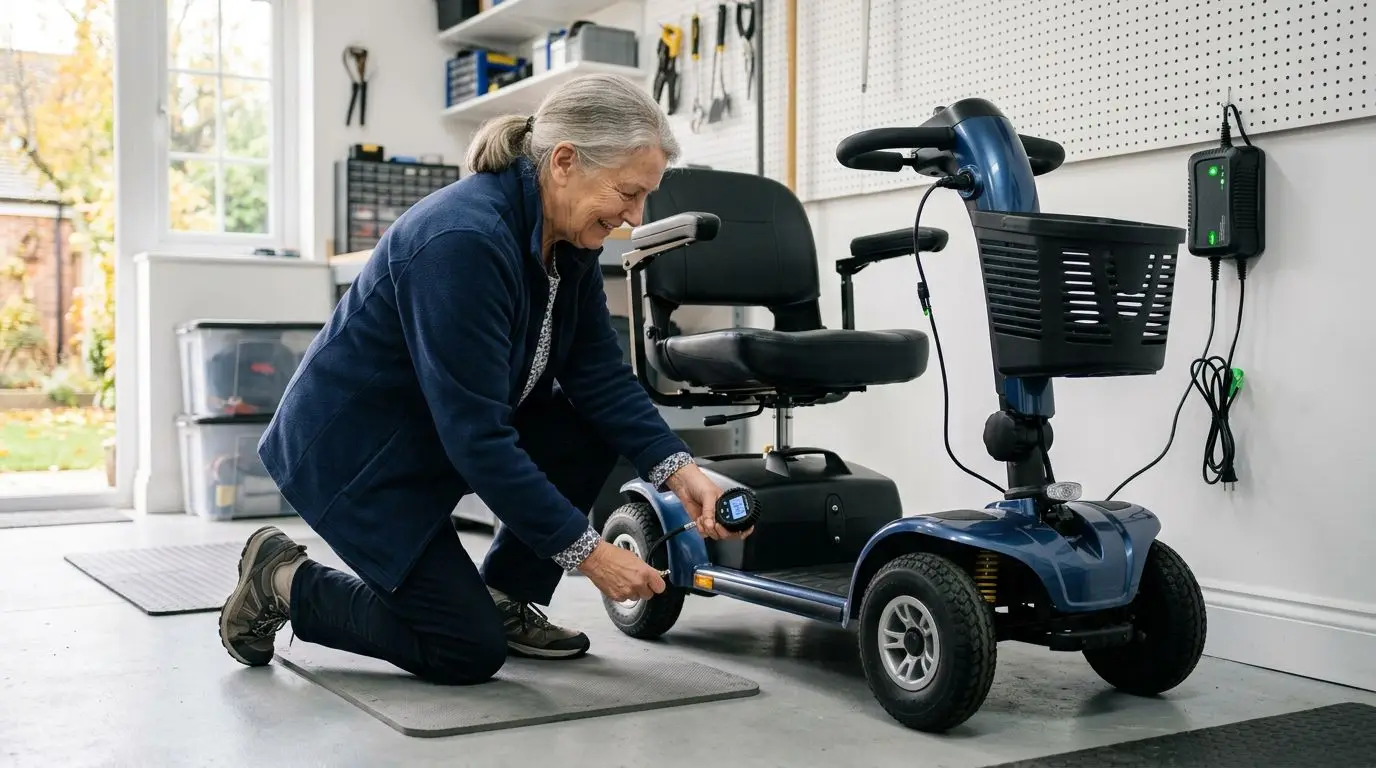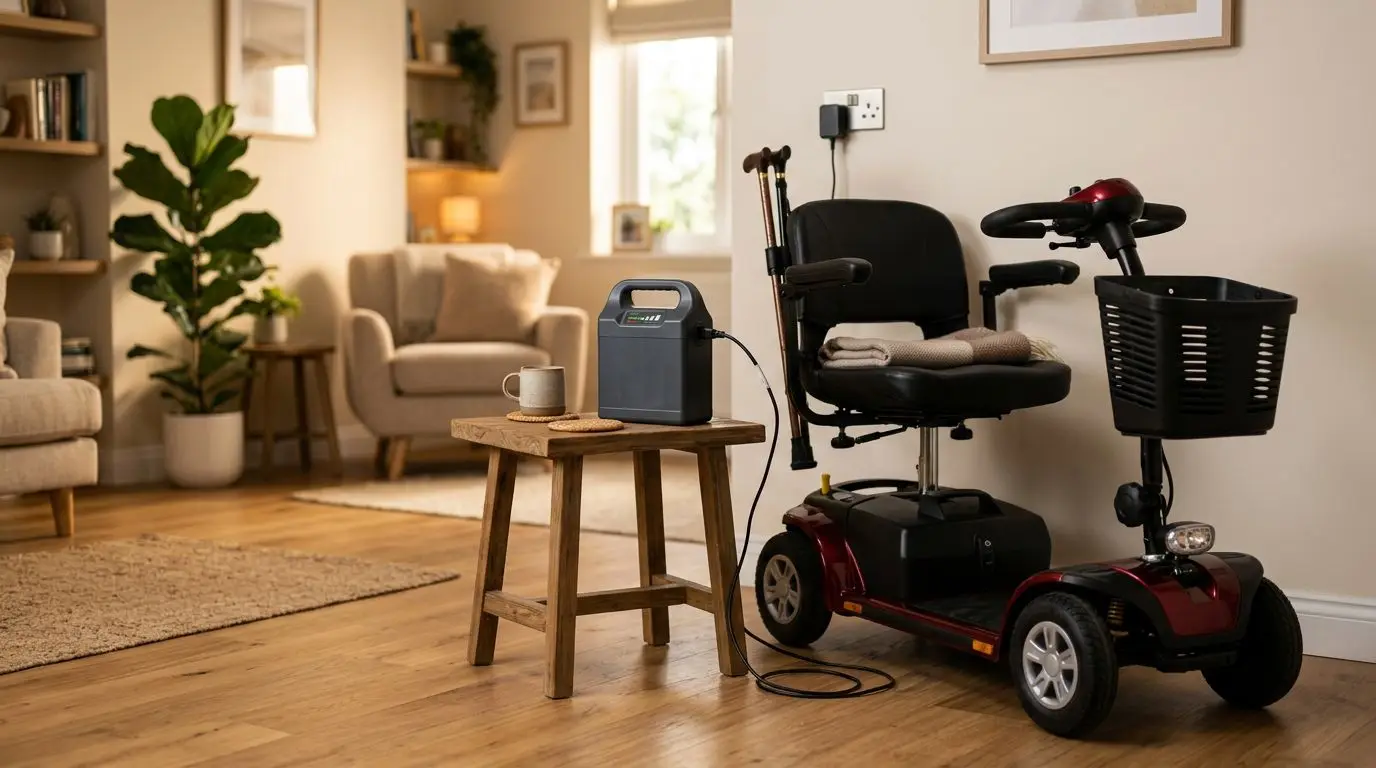
To help mobility scooter batteries last longer, charge them regularly, avoid running them completely flat, and store them in a cool, dry place with a partial to full charge. In cold weather, keep batteries indoors when you can, charge at room temperature, and expect less range below about 40°F. The biggest gains come from steady habits, not special tricks.
Most scooter battery problems begin with small oversights: a charger left unplugged for weeks, a battery drained to empty too often, or a scooter stored in a cold garage all winter. Good battery care helps preserve range, reduce unexpected shutdowns, and delay early replacement, but it cannot reverse normal aging. Batteries are wear items, so the goal is to get their full useful life safely.
Why mobility scooter batteries wear out after 300 to 1,000 charge cycles
Mobility scooter batteries age because every discharge and recharge causes chemical changes inside the battery. A charge cycle does not always mean one full plug-in; using 50 percent of the battery one day and 50 percent the next can add up to roughly one full cycle. Many sealed lead-acid batteries are commonly rated for a few hundred cycles, while many lithium-style scooter batteries may be rated for several hundred to around 1,000 cycles, depending on design, depth of discharge, temperature, and care.
That range is broad because real life varies. A scooter used for 2 short errands a week has an easier battery life than one driven several miles every day on hills. Weight, tire pressure, carpet, ramps, grass, and frequent stop-and-go driving all increase the load on the motor. More load means deeper discharge, more heat, and more stress on the battery.
Two battery systems are common. Many scooters use two 12-volt sealed batteries connected to make a 24-volt system. Some newer or lighter scooters use a removable lithium battery pack. The care principles are similar, but the exact charging rules, storage range, and replacement procedure should always follow the scooter manual and battery label.
- Heat speeds aging. Long exposure above about 80°F can shorten service life.
- Deep discharge is hard on batteries. Repeatedly running to empty can cause permanent capacity loss.
- Time matters. A battery can age even if the scooter is rarely used.
- Charging equipment matters. A mismatched charger can undercharge, overcharge, or fail to stop properly.
Charging habits that help: plug in after use and avoid 0 percent
The simplest rule is also the most useful: charge after each day of use, especially if the scooter was driven more than a few minutes. Do not wait until the battery gauge is on its last bar. For many scooters, keeping the battery from regularly falling below about 20 to 30 percent helps reduce stress and protects usable range.
Use the charger supplied or approved for the scooter’s battery type and voltage. A 24-volt scooter battery system needs a charger designed for that system, and lithium batteries require chargers matched to their battery management system. If the charger light changes from red to green, or from charging to complete, let it finish before unplugging unless the manual says otherwise.
Charging overnight is usually acceptable for many modern scooter chargers because they are designed to taper or stop when full. Even so, do not treat the charger as permanent life support. If the manual says to unplug after a full charge, follow that instruction. If a battery or charger becomes hot to the touch, smells unusual, makes noise, or shows swelling or leakage, stop charging and have it checked before using the scooter again.
| Charging habit | Better choice | Why it helps |
|---|---|---|
| After daily use | Recharge the same day | Prevents sitting at a low state of charge for 12 hours or more |
| Battery gauge low | Recharge before it reaches empty | Reduces deep-discharge damage |
| Charger selection | Use the correct voltage and battery-type charger | Avoids overcharging or undercharging |
| Charging location | Dry indoor area around room temperature | Limits moisture, heat, and cold stress |
Battery gauges on scooters are useful, but they are not laboratory instruments. Some meters drop quickly under load, then recover when the scooter stops. A gauge that shows full right after charging but falls fast during a ride may point to aging batteries, low tire pressure, a brake drag issue, or a route that is harder than expected.
Storage care for 2 weeks, 1 month, or a full winter
If the scooter will sit unused for more than about 2 weeks, storage care becomes important. Batteries self-discharge slowly even when the scooter is off. Some scooters also draw a tiny standby current through electronics, lights, alarms, or control modules.
For short storage of 2 to 4 weeks, fully charge the battery first, turn the scooter off, and store it in a dry location. If the scooter has a removable battery pack, indoor storage is often easier and safer than leaving the whole scooter in a garage or shed. Keep the battery away from heaters, direct sun, damp concrete floors, and freezing temperatures.
For longer storage, check the manual. Many sealed lead-acid scooter batteries do best when stored fully charged and topped up about every 30 to 60 days. Many lithium battery packs prefer partial storage, often somewhere around 40 to 80 percent, though the exact recommendation varies by battery design. The key is not to park any scooter with a nearly empty battery and forget it for months.
- Before storage: charge the battery, clean the charging port, and inspect cables.
- During storage: check charge level every 30 to 60 days if recommended.
- Storage temperature: aim for a stable indoor space, often around 50°F to 77°F.
- Before riding again: fully charge, confirm the charger completes normally, and test the scooter close to home.
A practical winter routine is to put a reminder on the calendar for the first day of each month. Check the battery, plug in if needed, and look for corrosion, damaged wires, cracked cases, or unusual odors. Five minutes a month can prevent an expensive surprise in spring.
Cold-weather care below 40°F: expect less range and charge indoors
Cold weather temporarily reduces battery performance. Below about 40°F, many scooter batteries deliver less usable range because chemical reactions slow down. At or below freezing, the effect becomes more noticeable, especially on older batteries or routes with hills.
This does not always mean the battery is ruined. A scooter that travels 10 miles in mild weather may travel less in the cold, even with a healthy battery. Range can recover when the battery warms up. Plan shorter trips, avoid pushing the battery to the last bar, and leave extra margin for the return trip.
Charging cold batteries requires care. Whenever possible, bring a removable battery indoors and let it warm to room temperature before charging. If the whole scooter must be stored in a cold garage, move it to a warmer indoor area for several hours before charging if practical. Some lithium battery systems restrict charging near or below 32°F to protect the cells; follow the scooter manual closely.
Cold-weather habits that help:
- Start with a full charge before any winter outing.
- Keep the battery indoors when the scooter is not in use, if the design allows removal.
- Avoid leaving the scooter in a vehicle overnight when temperatures drop below freezing.
- Use lights and accessories wisely, since they add electrical load.
- Test winter range on a familiar route before depending on the scooter for a longer trip.
Do not use improvised heaters, heating pads, or direct heat on a battery case. Uneven heat and moisture can create safety risks. A normal indoor room is enough.
How to choose and how to measure battery condition before replacing it
Before buying replacement batteries, measure what is happening. A scooter that slows down or loses range does not always have bad batteries. Low tire pressure, worn tires, dragging brakes, heavy cargo, a loose connection, or a charger fault can mimic battery failure.
Start with a simple range log. Write down the date, temperature, terrain, rider and cargo load, approximate distance, and battery gauge reading at the end of the ride. If a scooter once handled a 3-mile errand easily but now struggles after 1 mile in similar weather and terrain, that pattern is useful evidence.
Check the basics next. Many scooter tires have a pressure rating printed on the sidewall, often in pounds per square inch. Underinflated pneumatic tires increase rolling resistance and drain batteries faster. Make sure the freewheel lever is fully engaged for driving, the brakes release properly, and the charger shows its normal complete signal after charging.
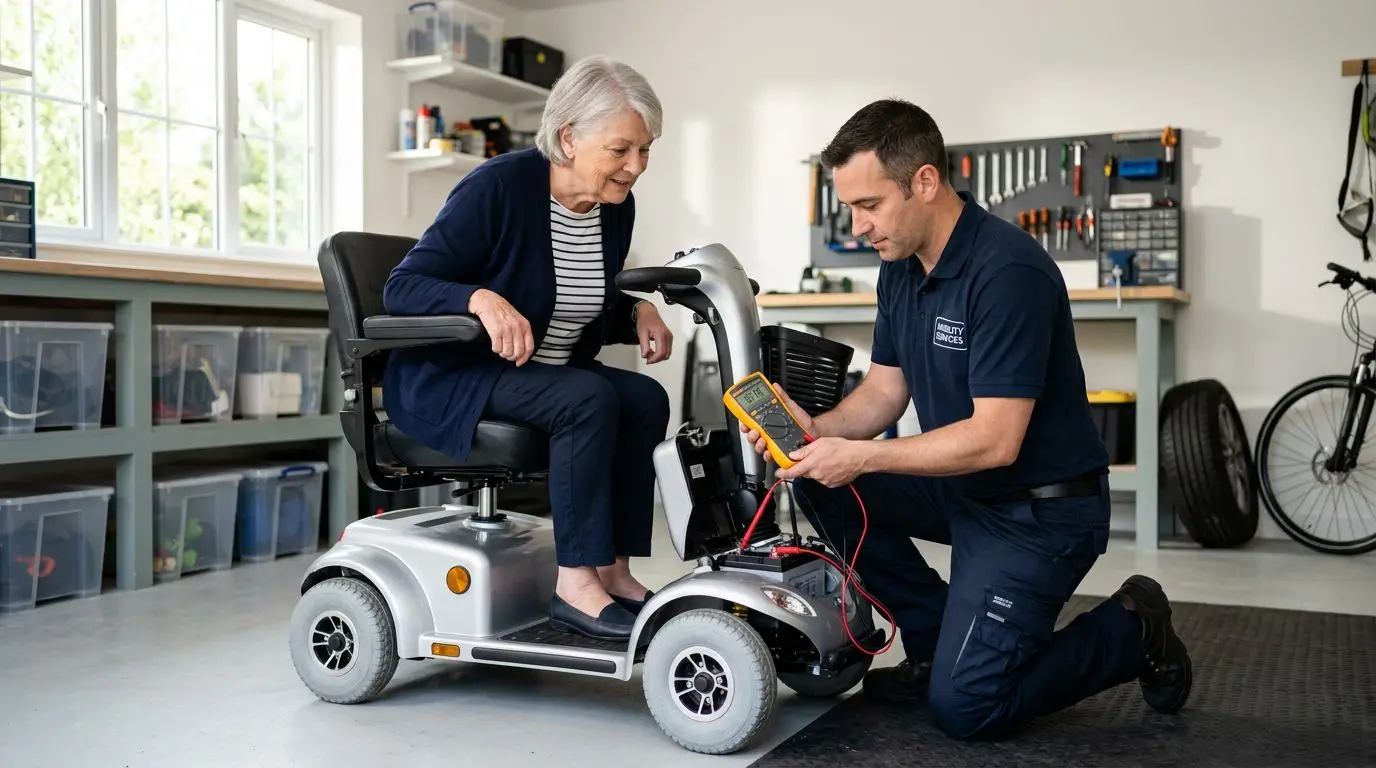
A technician or battery shop can perform a load test, which checks how voltage behaves under demand rather than only at rest. Resting voltage can look acceptable while the battery sags badly when the motor pulls current. For a common 24-volt scooter system, both 12-volt batteries should usually be evaluated together because one weak battery can limit the entire pair.
| Symptom | Possible battery issue | Also check |
|---|---|---|
| Range drops by about 30 percent or more | Capacity loss from age or deep discharge | Tire pressure, hills, rider load, cold weather |
| Charger never reaches complete | Battery not accepting charge | Charger, outlet, charging port, fuse |
| Gauge falls fast under acceleration | Voltage sag under load | Loose terminals, old batteries, steep ramps |
| Scooter stops, then recovers after rest | Battery voltage dipping too low | Controller protection, overheated motor, route demands |
When replacement is needed, match voltage, physical size, terminal style, and battery chemistry to the scooter’s requirements. Do not mix one new sealed battery with one old sealed battery in a 24-volt pair unless a qualified technician approves it. The older battery can pull down the new one, wasting money and reducing reliability.
Battery type comparison: sealed lead-acid vs lithium care in 5 key areas
Battery type affects maintenance habits. Sealed lead-acid batteries, including common absorbent glass mat or gel styles, have been used in mobility scooters for many years. Lithium packs are often lighter and may offer longer cycle life, but they depend heavily on an internal battery management system and correct charging.
| Care area | Sealed lead-acid scooter batteries | Lithium scooter battery packs |
|---|---|---|
| Typical system | Often two 12-volt batteries for 24 volts | Usually one removable pack or integrated pack |
| Storage charge | Commonly stored fully charged | Often stored around 40 to 80 percent if long term |
| Weight | Heavier; individual batteries may weigh 15 to 40 lb each | Lighter for similar usable energy |
| Cold charging | Charge in a moderate indoor area | May block charging near 32°F depending on design |
| Replacement | Pairs should usually be replaced together | Pack replacement should match the scooter’s system |
The better battery is the one that fits the scooter safely and supports the rider’s routine. A person who removes the battery daily may value a lighter pack. Someone with an older full-size scooter may be using a matched pair of sealed batteries. Either type lasts longer with proper charging, moderate temperature, and protection from deep discharge.
Who it is best for: riders who depend on 1 reliable charge per day
Careful battery maintenance matters most for riders who rely on a scooter for daily transportation, such as getting to meals, appointments, mailboxes, community rooms, or nearby stores. If one reliable charge per day is important, battery habits are not optional maintenance. They are part of trip planning.
This guide is especially useful if you:
- Use your scooter more than 3 days a week.
- Store the scooter in a garage, porch, vehicle, or shed.
- Live where winter temperatures fall below 40°F.
- Notice range changing from season to season.
- Have had batteries replaced earlier than expected in the past.
It is also helpful for caregivers and family members. A senior may be using the scooter correctly but not seeing the charger light, not reaching the outlet easily, or not remembering monthly storage charging. A safe charging spot with good lighting, a stable surface, and a simple calendar reminder can remove those barriers.
Battery care should support independence without creating risk. Do not carry loose batteries by their wires, do not open sealed battery cases, and do not ignore tripped breakers or hot plugs. If charging requires bending, lifting, or reaching in an unsafe way, ask a technician about a safer setup.
When replacement is safer than trying for another 6 months
Extending battery life is useful only when the battery remains safe and reliable. If a battery is swollen, cracked, leaking, badly corroded, giving off a rotten-egg odor, or getting unusually hot during charging, stop using it and seek service. Those are not normal aging signs.
Replacement may also be the practical choice when range no longer fits your minimum daily needs. For example, if you need a dependable 2-mile round trip and the scooter now becomes uncertain after 1 mile on level ground, stretching the batteries another 6 months may create avoidable worry. A failed battery away from home can leave the rider stranded.
Before replacing, confirm the charger works and the scooter itself is not the cause. If the batteries are several years old, fail a load test, or no longer hold a charge after normal charging, replacement is reasonable. Dispose of old batteries through an approved recycling program or service provider. Scooter batteries should not go in household trash.
After replacement, start good habits immediately. Fully charge as directed, avoid the first deep discharge, keep a simple range log for the first 2 weeks, and store the scooter correctly. New batteries are not maintenance-free in the practical sense, even when they are sealed.
FAQ: 5 common battery-care questions
Should I charge my mobility scooter after every use?
Usually, yes. If you used the scooter during the day, charging it afterward helps prevent the battery from sitting partially drained for 12 hours or more. Follow the manual if it gives a different routine for your battery type.
Is it bad to leave a scooter plugged in overnight?
Many modern scooter chargers are designed for overnight charging and switch to a maintenance or complete mode. Still, use only the correct charger, charge in a dry indoor area, and unplug if the manual tells you to do so after the charge is complete.
How often should I charge a stored scooter battery?
For many stored scooters, checking every 30 to 60 days is a sensible routine. Sealed lead-acid batteries are commonly stored fully charged, while many lithium packs may prefer partial charge for long storage. The manual is the best guide.
Why does my scooter battery die faster in winter?
Cold slows the battery’s chemical activity, so usable range can drop below about 40°F and more noticeably near freezing. The battery may perform better again when warmed, but older batteries often show winter weakness first.
Can I use any charger with the same plug?
No. A matching plug does not prove the charger has the correct voltage, current, or charging profile. Use a charger approved for the scooter’s battery type and system voltage.
Frequently asked questions
Should I charge my mobility scooter after every use? +
Usually, yes. Charging after daily use helps keep the battery from sitting at a low charge and reduces deep-discharge stress. Always follow the scooter manual for your battery type.
Is it bad to leave a mobility scooter plugged in overnight? +
Many modern scooter chargers are designed for overnight charging, but use only the correct charger and charge in a dry indoor area. Unplug after completion if the manual recommends it.
How often should I charge a scooter battery in storage? +
Check stored batteries about every 30 to 60 days unless the manual says otherwise. Sealed lead-acid batteries are often stored full, while many lithium packs prefer partial charge.
Why does my scooter have less range in cold weather? +
Cold temperatures slow battery chemistry, so usable range often drops below about 40°F and can fall more near freezing. Start with a full charge and plan shorter winter trips.
Can I use any charger if the plug fits? +
No. The charger must match the scooter battery voltage, chemistry, and charging profile. A plug that fits can still be electrically wrong and may damage the battery.
Related guides
How to Tell If Your Mobility Scooter Battery Is Bad
14 min read
How to Charge a Mobility Scooter Battery the Right Way: Daily Use, Overcharging Myths, and Battery-Life Tips
16 min read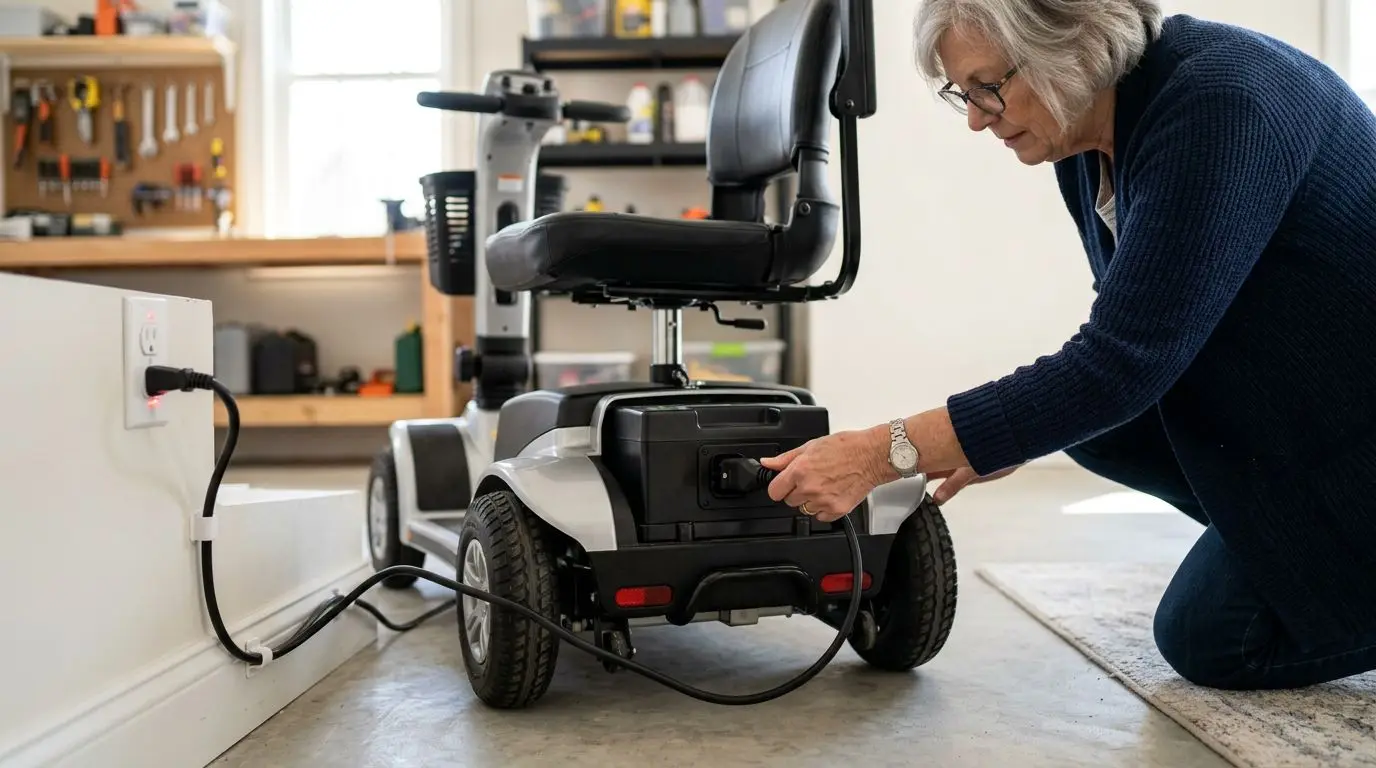
Mobility Scooter Batteries and Chargers: Range, Replacement Cost, and Care Tips
14 min read