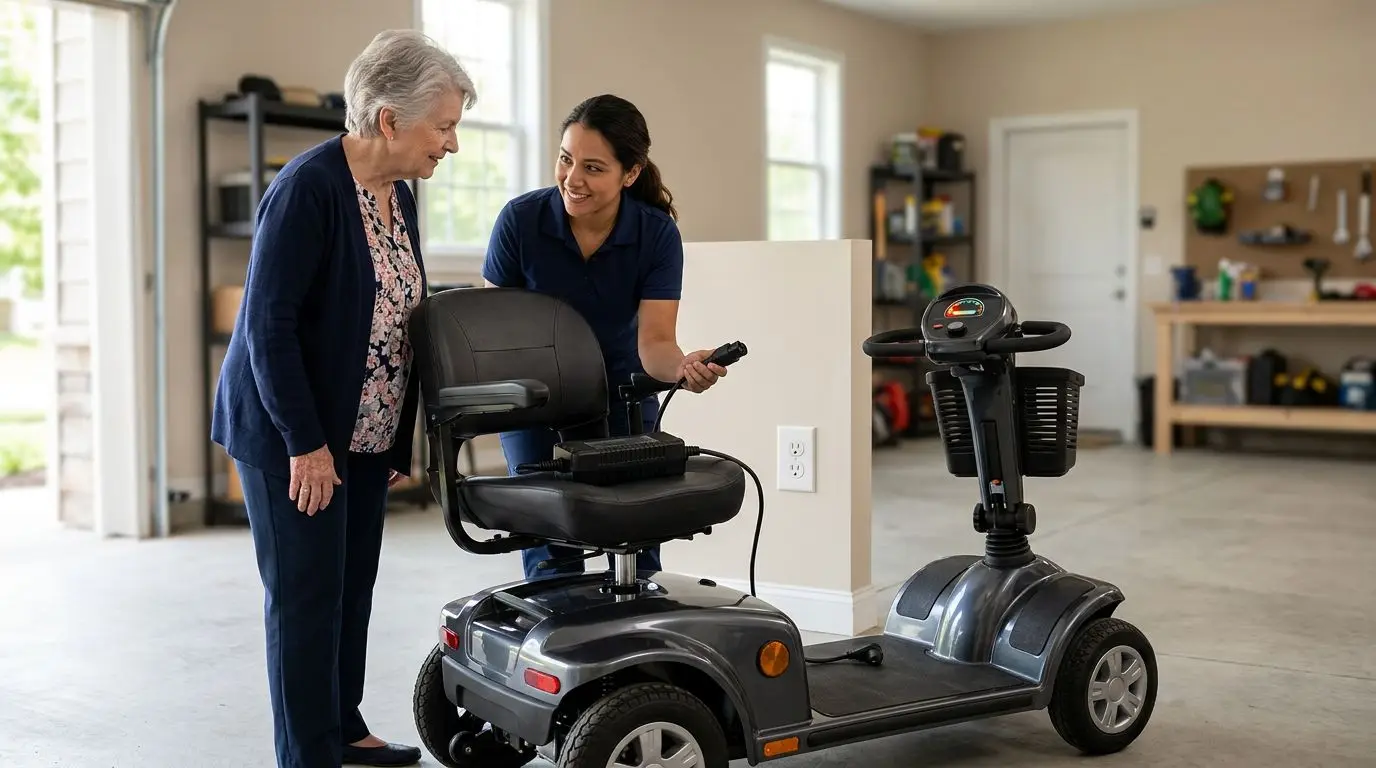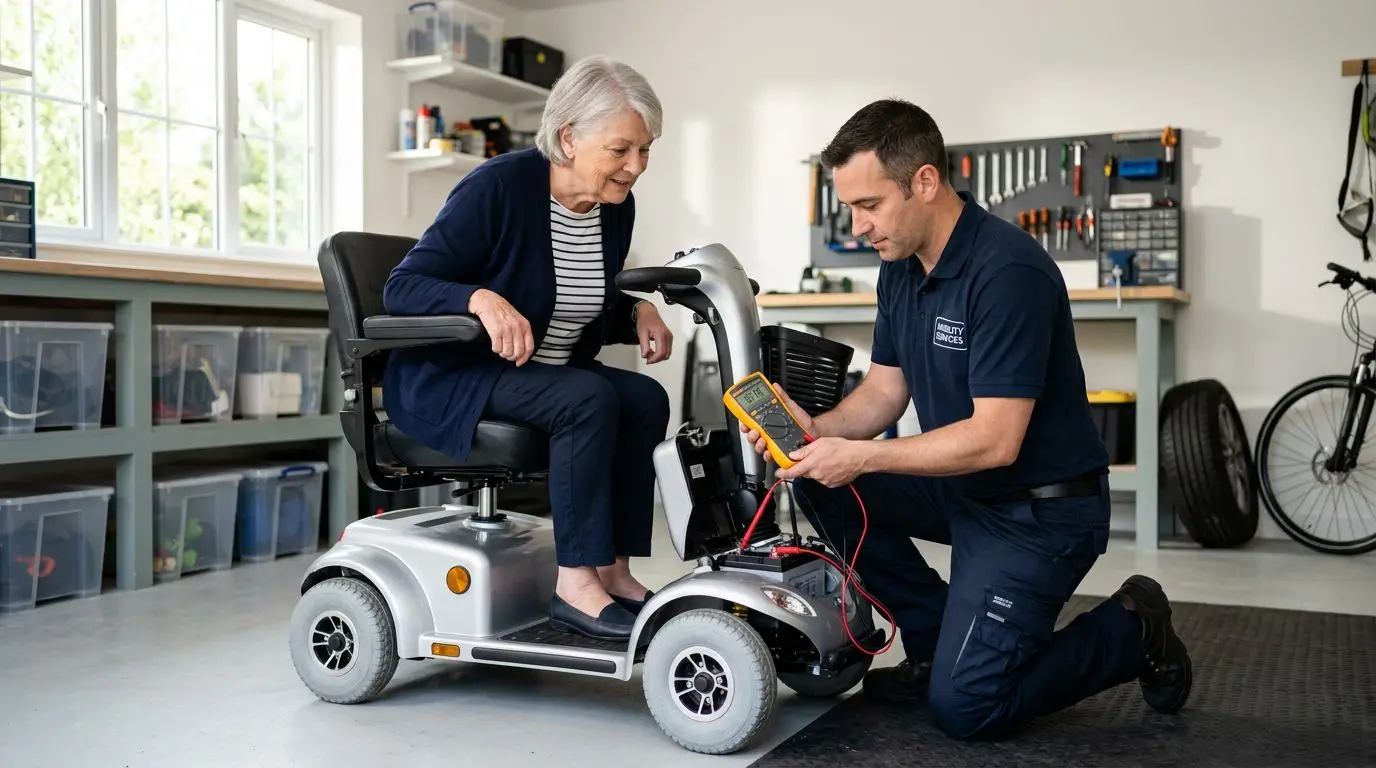
A mobility scooter battery is likely bad if the scooter has lost a lot of range, slows down during normal use, takes much longer than it used to charge, or shows low voltage after a full charge. The quickest way to decide what to do is to fully charge the battery, compare real-world range, and check battery voltage after it rests for at least 30 minutes. If range is still poor and voltage drops quickly during use, replacement is usually the safer choice.
Battery problems can be confusing because scooters also lose range from cold weather, low tire pressure, heavy loads, hills, or dragging brakes. This guide walks through the common battery-failure symptoms and simple checks that can help you decide whether to charge again, test more carefully, or replace the battery pack.
7 signs your mobility scooter battery may be bad
Most mobility scooter battery problems appear as a pattern, not from one unusual day. One short trip or one slow charge does not automatically mean the battery is finished. But if you notice several of the 7 signs below over a few days, the battery needs attention.
- Range has dropped sharply. A scooter that used to handle a 6-mile outing now struggles after 2 or 3 miles.
- The battery gauge falls quickly. It may show full at the start, then drop to half or low after a short ride.
- Speed fades under load. The scooter slows more than usual on a mild ramp, carpet, or a driveway slope.
- The scooter stops suddenly. It may cut out, then work again after sitting for a few minutes.
- Charging takes much longer than normal. A charge that used to take 6 to 8 hours now takes 12 hours or never appears to finish.
- The battery does not hold a charge overnight. It shows full after charging but is low the next morning.
- There are physical warning signs. Bulging, leaking, cracking, burning smells, excessive heat, or corroded terminals require immediate caution.
Stop using the battery if you see swelling, leaking, smoke, melted plastic, or notice a sharp chemical smell. Do not try to charge a damaged battery. Move the scooter away from flammable items if you can do so safely, then contact a qualified mobility scooter technician or battery recycler for next steps.
| Symptom | What it often suggests | What to do next |
|---|---|---|
| Range drops by 30% or more | Battery aging, cold weather, added load, low tire pressure | Fully charge, check tires, repeat a short range test |
| Gauge drops from full to low quickly | Weak battery capacity or voltage sag | Rest battery 30 minutes, then check voltage |
| Charger stays on for 12+ hours | Battery not accepting charge, charger issue, deep discharge | Check charger lights and battery voltage |
| Scooter cuts out on hills | Voltage drop under load or controller protection | Avoid hills until tested; have battery load-tested |
| Battery case is swollen or leaking | Unsafe battery damage | Stop charging and replace safely |
Range loss: compare today’s miles with a 30-day baseline
Range loss is usually the symptom riders notice first. A helpful check is to compare today’s usable distance with what the scooter could reliably do during the last 30 days under similar conditions. If you normally visit a neighbor, ride to the mailbox, and make a short store trip on one charge, but now the scooter struggles before you get home, the battery may be losing capacity.
Keep the comparison fair. Range depends on the route, rider weight, cargo, speed, tire condition, temperature, and stops. A scooter traveling on flat indoor floors uses less energy than one climbing curb ramps and outdoor sidewalks. Cold weather can reduce battery performance, especially for sealed lead-acid batteries. Even a temperature drop from 70°F to 40°F can make a tired battery feel much weaker.
To measure range without guessing, use the same route for 2 or 3 outings. Start with a full charge. Note the time, distance, surface, outdoor temperature, and the battery gauge at the end. You do not need a special device; a phone map, a car odometer for a neighborhood route, or a known distance inside a senior community can work.
A practical rule: if the scooter repeatedly delivers less than about half of its usual real-world range after a proper full charge, the battery is a strong suspect. Still, check the basics before replacing it. Low tire pressure on pneumatic tires, extra weight in a basket, dragging brakes, rough carpet, and steep ramps can all cut range noticeably.
Slow charging: what 6 to 12 hours can tell you
Many mobility scooter batteries are charged overnight, and a common full charge may take around 6 to 12 hours depending on battery size, depth of discharge, charger output, and battery type. If your scooter used to charge overnight and now still shows a charging light well into the next day, the battery may not be accepting energy normally. The charger itself can also be the problem, so check both.
First, confirm the charger is plugged securely into the wall and into the scooter or battery box. A loose charging port can interrupt charging. Look for bent pins, dirt, or corrosion. If the outlet is controlled by a wall switch, make sure it stayed on through the night. Simple issues do happen.
Next, watch the charger lights. Many chargers show one color while charging and another color when the charge is complete. A light that never changes after 12 to 14 hours may point to a weak battery, a deeply discharged pack, or a charger fault. A light that turns to full in only a few minutes can also be suspicious if the scooter then has poor range; the battery voltage may be rising quickly even though the capacity is no longer there.
Heat matters. Batteries and chargers can become slightly warm during normal charging, but they should not be too hot to touch. If a battery becomes unusually hot, smells odd, or the charger gets excessively hot, unplug it and stop using it until it has been checked. Safety comes before squeezing out one more trip.
Voltage checks: 24V, 36V, and 48V scooter battery basics
A voltage check is one of the most useful ways to separate a low battery from a failing battery. Many mobility scooters use a 24-volt battery pack made from two 12-volt batteries connected in series, while some larger or specialized scooters use 36-volt or 48-volt systems. Always check your scooter manual or battery label before testing.
Use a digital multimeter set to DC volts. If you are not comfortable using a meter, ask a technician, repair shop, or experienced helper. Avoid touching both terminals with metal tools, and never let a wrench or probe bridge the positive and negative terminals. That can create a dangerous short circuit.
For a basic resting voltage check, fully charge the scooter, unplug the charger, and let the battery rest for at least 30 minutes. Then measure across the full pack, or across each individual battery if the battery box allows safe access. A healthy fully charged 12-volt sealed lead-acid battery often rests around 12.7 to 12.9 volts, so a 24-volt pack may read roughly 25.4 to 25.8 volts. Readings vary by battery chemistry, age, charger behavior, and temperature, so use these as general guideposts rather than exact pass-fail numbers.
| System type | Common setup | General full resting voltage guide | What a low reading may mean |
|---|---|---|---|
| 24V scooter | Two 12V batteries in series | About 25.4V to 25.8V for many SLA packs | Not fully charged, aging battery, charger issue |
| 36V scooter | Three 12V batteries or lithium pack | Depends strongly on chemistry | Check manual; do not assume SLA numbers |
| 48V scooter | Four 12V batteries or lithium pack | Depends strongly on chemistry | May need technician testing |
One reading does not tell the whole story. A worn battery can show decent voltage after charging but collapse when the motor draws power. That is called voltage sag. If the scooter gauge drops fast while riding, or the scooter cuts out on a small hill, the pack may be failing under load even if the resting voltage looks acceptable.
For sealed lead-acid packs, compare the individual 12-volt batteries too, if possible. If one battery rests at 12.8 volts and the other at 12.1 volts after the same full charge, the lower one may be weak. In many scooters, batteries in a pack should be replaced as a matched set because a new battery paired with an old weak battery can age quickly and perform poorly.
How to choose: test, charge, or replace in 3 steps
You do not need to guess right away. Use this 3-step approach to decide what comes next. It keeps the process simple and helps you avoid replacing a battery when the real problem is a charger, tire, brake, or connection issue.
Step 1: Charge fully and reset the situation
Charge the scooter until the charger indicates complete, or for the normal full-charge window recommended for your battery type. For many scooters, that means an overnight charge. After charging, unplug the charger and let the battery rest for 30 to 60 minutes before judging the gauge or voltage. A reading taken the second you unplug the charger can be misleading.
Step 2: Check the easy range killers
Before blaming the battery, inspect the scooter. If it uses pneumatic tires, confirm the tire pressure matches the number printed on the tire sidewall or in the manual. A tire that is 10 psi low can make a scooter feel sluggish and reduce range. Check that the freewheel lever is fully engaged, the brakes are not dragging, the wheels spin freely, and the battery connectors are seated firmly.
Step 3: Test voltage and real-world performance
Measure resting voltage after a full charge. Then take a short, safe route close to home, ideally 10 to 20 minutes on familiar ground. Watch how quickly the gauge falls and whether speed fades. If the battery starts near full voltage but drops quickly under a light ride, it is likely losing usable capacity.
| Your finding | Most sensible next step |
|---|---|
| Battery was simply not fully charged | Recharge completely and retest range |
| Range improves after tire or brake correction | Monitor for a week before replacing |
| Resting voltage is low after full charge | Check charger output or have battery tested |
| Voltage looks okay but drops fast during use | Request a load test or plan replacement |
| Battery is swollen, leaking, or overheating | Stop using it and replace safely |
Battery type comparison: 2 common technologies
Most mobility scooters use either sealed lead-acid batteries or lithium-based batteries. The two technologies behave differently, so failure symptoms and testing are not exactly the same. The battery label and scooter manual should identify what you have.
| Battery type | Common traits | Bad-battery clues | Testing notes |
|---|---|---|---|
| Sealed lead-acid, often AGM or gel | Common in many scooters; usually heavier; often used as 12V batteries in series | Short range, slow charging, swelling, voltage imbalance between batteries | Resting voltage is useful; load testing can reveal weak capacity |
| Lithium-based battery | Lighter for similar energy; often has a battery management system | Sudden shutoff, no charge acceptance, protection circuit stopping output | Voltage depends on chemistry and cell count; follow manual or technician guidance |
Sealed lead-acid batteries usually dislike sitting discharged. If they are left low for weeks, they can lose capacity permanently. A scooter stored all winter without regular charging may show full on the charger but provide poor range in spring.
Lithium batteries are different. Many include a battery management system that can shut the pack down if voltage is too low, too high, too hot, or if there is another fault. That protection is useful, but it can make troubleshooting less obvious. If a lithium pack will not wake up or accept charge, do not bypass safety circuits or open the battery case. Get professional help.
Who should replace now, and who can test for 1 week
Some riders should replace or professionally test the battery right away. Others can safely monitor performance for 1 week after charging and checking the scooter. The right choice depends on safety, daily needs, and how severe the symptoms are.
Replace or get service now if:
- You depend on the scooter for essential daily mobility and cannot risk being stranded.
- The scooter has cut out in traffic areas, parking lots, ramps, or far from help.
- The battery is swollen, leaking, cracked, unusually hot, or smells burnt.
- Range has dropped to less than half of normal for 2 or more full charges.
- Voltage readings show one battery in a pair is much lower than the other after charging.
Test for a few more days if:
- The range loss appeared only once and followed unusual conditions, such as cold weather or a long hill.
- The scooter sat unused and may not have received a complete charge cycle.
- You found a correctable issue, such as low tire pressure or a loose connector.
- You only use the scooter close to home and have help available if needed.
If you replace batteries, use the correct voltage, size, terminal style, and chemistry specified for the scooter. Battery dimensions matter because the pack must fit securely in the tray or battery box. Even a half-inch difference in height or terminal placement can create a poor fit. Never force a battery cover closed against cables or terminals.
For scooters that use two or more batteries in series, replace the whole set at the same time unless a qualified technician advises otherwise. Mixing one new battery with one old battery can limit performance and shorten the life of the new one.
Safety and maintenance: 5 habits that extend battery life
Good habits cannot repair a worn-out battery, but they can help a healthy battery last longer and perform more predictably. These 5 habits are simple and practical for everyday scooter owners.
- Charge after regular use. Avoid leaving many scooter batteries deeply discharged for days or weeks.
- Store in moderate temperatures. A dry room around normal indoor temperatures is better than a hot garage or freezing shed.
- Use the correct charger. Voltage, connector, and charging profile should match the scooter and battery type.
- Keep terminals clean and tight. Corrosion and loose connections can mimic battery failure.
- Plan a monthly check during storage. If the scooter is parked for a season, follow the manual’s storage-charging guidance.
Charging location matters, too. Charge on a stable surface with ventilation around the charger. Keep bedding, paper, curtains, and other flammable materials away from the charger and battery area. Do not use an extension cord unless the scooter manual allows it and the cord is properly rated.
Battery replacement is also a recycling issue. Mobility scooter batteries should not go into household trash. Many communities have battery recycling sites, hazardous waste collection events, or battery retailers that accept used batteries. Tape exposed terminals if instructed by the recycling location, and transport batteries upright when possible.
5 FAQs about bad mobility scooter batteries
Can a mobility scooter battery show full but still be bad?
Yes. A weak battery can reach a full-looking voltage after charging but have very little usable capacity. The scooter may show a full gauge at first, then drop quickly once the motor draws current.
How long should I charge before testing the battery?
Charge until the charger indicates complete, or for the normal full-charge period recommended for your scooter. Many users charge overnight, often in the 6 to 12 hour range. After unplugging, let the battery rest at least 30 minutes before checking voltage.
Is slow charging always a battery problem?
No. Slow charging can come from a weak battery, but it can also be caused by a faulty charger, loose charging port, poor outlet connection, or a deeply discharged pack. Check the simple items first.
Should I replace only one 12V battery in a 24V scooter?
Usually, the better practice is to replace both batteries as a matched set. If one old battery is paired with one new battery, the weaker battery can limit range and place extra stress on the new one.
What if my scooter battery gets hot while charging?
Slight warmth can be normal, but excessive heat is not. If the battery is too hot to touch, smells unusual, swells, leaks, or the charger becomes extremely hot, unplug it if safe and have the system inspected before using it again.
Frequently asked questions
Can a mobility scooter battery show full but still be bad? +
Yes. A weak battery can show a full gauge or normal resting voltage after charging, then drop quickly once the scooter is used. That usually means the battery no longer has enough usable capacity.
How long should I charge a mobility scooter battery before testing it? +
Charge until the charger indicates complete, or for the normal full-charge period recommended for the scooter. Many scooters charge overnight, often around 6 to 12 hours. Let the battery rest at least 30 minutes before checking voltage.
Is slow charging always a sign of a bad battery? +
No. Slow charging can be caused by a weak battery, faulty charger, loose charging port, poor wall outlet connection, or a deeply discharged battery pack. Check connections and charger behavior before replacing the battery.
What voltage should a 24V mobility scooter battery show when full? +
Many 24V sealed lead-acid scooter packs rest around 25.4 to 25.8 volts after a full charge and a short rest. Exact readings vary by battery chemistry, temperature, age, and charger type, so use the manual when available.
Should I replace both batteries in a 24V mobility scooter? +
In most cases, yes. A 24V scooter commonly uses two 12V batteries in series, and replacing them as a matched set helps prevent poor range and uneven battery wear.
Related guides
How to Make Mobility Scooter Batteries Last Longer: Charging, Storage, and Cold-Weather Care
12 min read
Why Your Mobility Scooter Battery Range Is Dropping: Common Causes and Practical Fixes
12 min read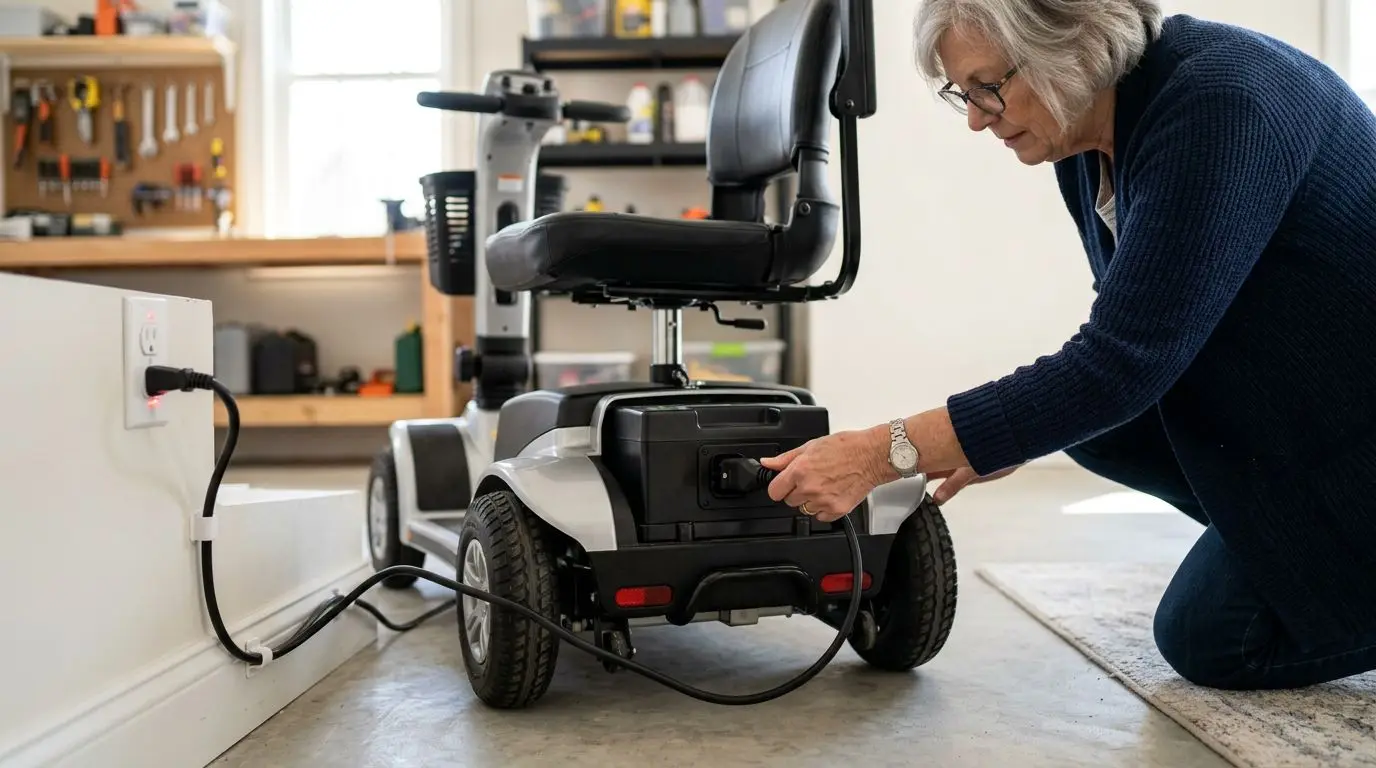
Mobility Scooter Batteries and Chargers: Range, Replacement Cost, and Care Tips
14 min read