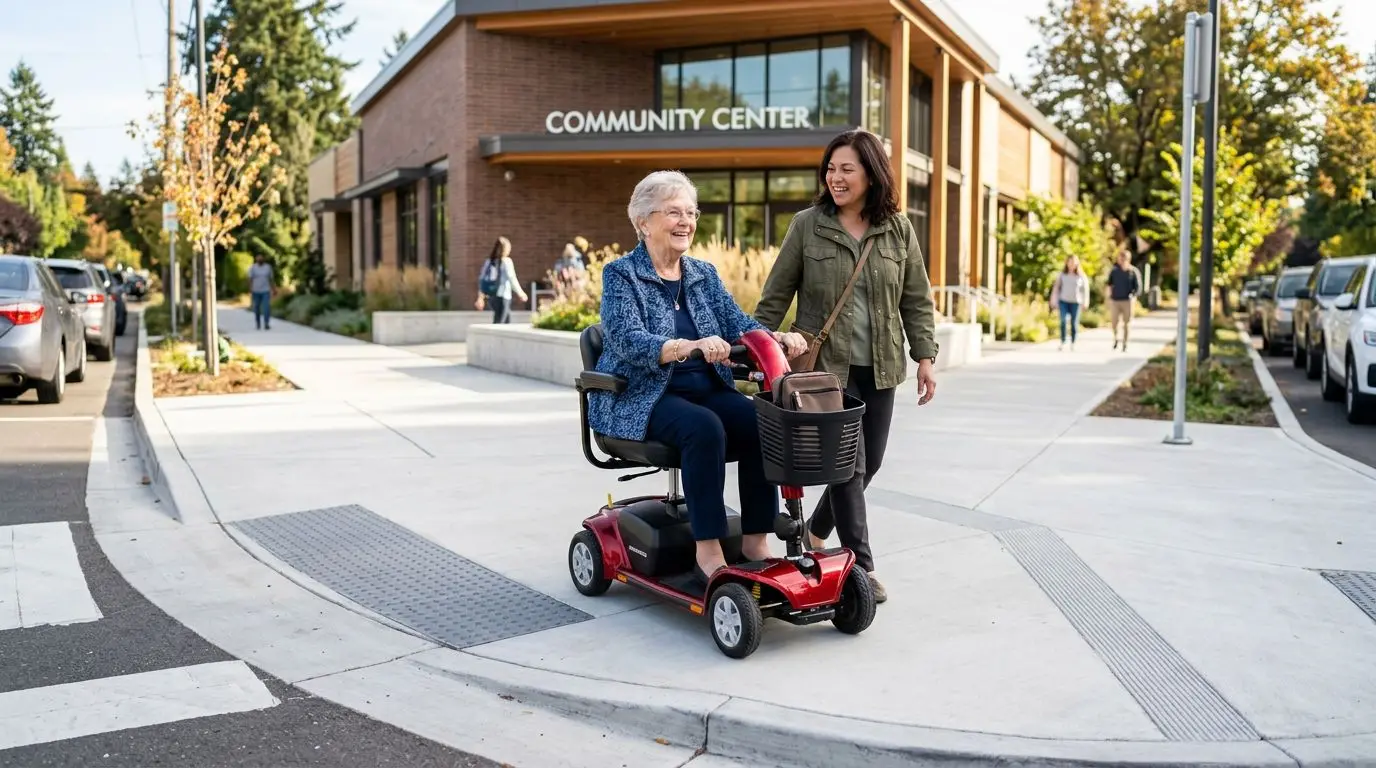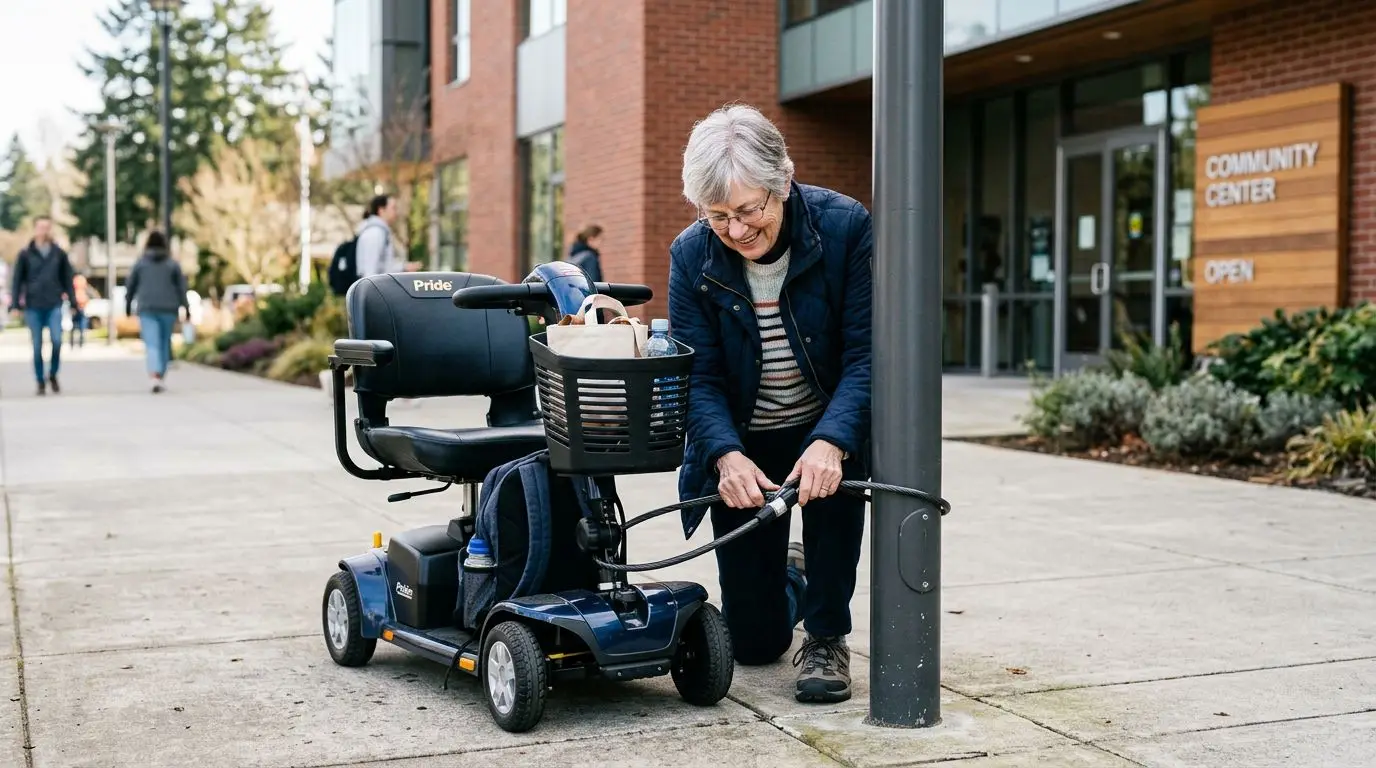
Before you buy a mobility scooter, check the practical security features: a keyed ignition, a reliable way to lock the scooter to a fixed object, and either a built-in or add-on alarm that fits where you park. The best setup usually combines 2 layers of protection, such as a sturdy lock plus a motion alarm, because no single feature can prevent every theft or tampering attempt.
Security is not just about theft. It also means avoiding a lost key, preventing unauthorized use, reducing nuisance ignition problems, and feeling comfortable leaving your scooter outside a store for 10 minutes. This guide explains what to compare before you buy, without pushing any brand or model.
Security features worth checking before you buy
A scooter can weigh anywhere from about 70 lb for a lightweight travel design to more than 250 lb for a heavy-duty full-size unit, and that weight affects how someone might move it, lift it, or roll it away. Before focusing on seat comfort or battery range, take 5 minutes to review the basic security design.
At minimum, check whether the scooter has a keyed ignition, whether the key can be removed in the off position, whether the freewheel lever is easy to reach, and whether the frame has a safe place to pass a lock. Also consider where the scooter will be parked most often: a locked garage, apartment hallway, public sidewalk, senior living lobby, vehicle lift, or store entrance.
- Keyed ignition: Helps prevent casual unauthorized use, but it is not a complete anti-theft system.
- Frame or wheel access for locking: Lets you secure the scooter to a post, rack, railing, or ground anchor when appropriate.
- Alarm readiness: Some scooters have built-in alerts, while others work better with a separate motion alarm.
- Battery access: A removable battery pack is convenient, but it should not be easy for a stranger to lift off in seconds.
- Freewheel control: If the scooter can be disengaged and pushed, it needs extra attention when parked.
Do not attach a lock to a delicate plastic shroud, basket, armrest, or control cable. Those parts are not security anchors. Look for metal frame sections, a wheel opening, or another load-bearing area that will not be damaged by tension.
Built-in security vs add-on gear: a 2-minute comparison
Most buyers are weighing what comes on the scooter against what they can add later. A 2-minute comparison can prevent a poor fit, especially if you park in public several times per week.
| Security option | Typical role | Best use | Limitations |
|---|---|---|---|
| Keyed ignition | Stops simple ride-away use | Daily operation and basic control | Does not physically attach the scooter to anything |
| Built-in alarm or fault alert | May sound when moved or when a system fault occurs | Quick stops and tamper awareness | Not all scooters include a true theft alarm |
| Cable or chain lock | Secures scooter to a fixed object | Stores, clinics, community centers | Must fit through frame or wheel safely |
| Wheel clamp or brake-style lock | Prevents rolling | Short parking periods on level ground | Does not always anchor the scooter to a structure |
| Add-on motion alarm | Creates attention if moved | Shared parking areas or porches | Needs batteries or charging and sensible sensitivity |
Built-in features are convenient because they travel with the scooter and are less likely to be forgotten. Add-on devices offer more flexibility. A person who parks in a private garage may need only a simple lock and spare-key plan, while someone who parks near a busy sidewalk for 30 minutes at a time may want a stronger combination.
Locks: cable, chain, U-lock, and wheel clamp options
For mobility scooters, the lock has to fit the scooter, the user’s hand strength, and the parking location. A heavy chain that weighs 8 lb may be secure, but it may not be practical for a rider with limited grip or shoulder strength. A thin cable is easy to carry, but it should be treated as a light-duty deterrent rather than a high-security solution.
| Lock type | Common size range | Pros | Watch-outs |
|---|---|---|---|
| Cable lock | Often 4 ft to 6 ft long | Flexible, easy to route through wheels or frame openings | Lower resistance to cutting than thicker options |
| Chain lock | Links may be 6 mm to 10 mm thick | More robust and flexible around posts | Can be heavy and awkward to carry |
| U-lock | Shackle openings often around 4 in. to 7 in. | Rigid, compact, difficult to twist if fitted tightly | May not reach around larger scooter frames or posts |
| Wheel clamp | Designed to grip a tire or wheel section | Helps stop rolling | May not secure the scooter to a fixed object |
If you expect to lock the scooter at a grocery store, measure the distance from the scooter’s secure frame point to the rack or post you will use. A 4 ft cable may be enough for a narrow railing, while a 6 ft cable gives more reach around a wider post. More length is not always better; loose cable can rest on the ground, get dirty, or create a trip hazard.
Combination locks remove the need for another key, but the numbers must be easy to see and turn. Keyed locks may be easier for some hands, yet they add one more small item to manage. If you have low vision, look for large dials, a tactile key head, or a lock you can operate by feel after practice.
Alarms and motion sensors: what 110 dB really means
Many add-on scooter alarms and personal security alarms advertise sound levels around 100 to 120 dB, with 110 dB often described as roughly comparable to a very loud siren at close range. That can draw attention, but it can also disturb neighbors if the alarm is too sensitive. Volume matters, but so does the trigger.
Motion alarms usually respond to vibration, tilting, or movement. Some use a remote, some use a keypad, and some are armed with a small fob. For an older adult or caregiver, the main question is not only how loud it is. It is whether you can arm and disarm it reliably without setting it off by accident.
- Short public stops: A loud motion alarm can be useful for a 10- to 20-minute stop outside a pharmacy or clinic.
- Apartment buildings: Adjustable sensitivity may be more important than maximum volume.
- Porches and carports: Weather resistance matters if the alarm will see rain, dust, or summer heat.
- Night parking: A blinking indicator light may deter tampering, but it may also draw attention to the scooter.
Check how the alarm is powered. Some small alarms use replaceable batteries, while others recharge by USB. If charging another device every few weeks is unrealistic, a simpler lock may be better. A dead alarm is just extra plastic on the scooter.
Keys, ignition switches, and spare-key planning
A scooter key is small, and losing it can stop your day immediately. Before you buy, ask how many keys come with the scooter; 2 keys is a practical minimum for most households. One can stay with the rider, and one can be stored in a safe location known to a caregiver or trusted family member.
Keyed ignition is convenient, but it should feel solid. The key should insert smoothly, turn without force, and stay in the correct position while riding. A loose, sticky, or wobbly ignition on a new scooter should not be ignored, because ignition problems can lead to unreliable starts or a key that is difficult to remove.
Good spare-key planning is simple:
- Keep 1 spare key indoors, not in the scooter basket.
- Label the key discreetly, without writing your address on it.
- Ask whether replacement keys require a key code, proof of ownership, or a service visit.
- Take a clear photo of any key code or paperwork and store it securely.
- If a caregiver helps, decide who can access the spare before an emergency happens.
Avoid hiding a spare key on the scooter itself. A magnetic key box under the shroud or a key tucked in the basket may be convenient, but it can defeat the purpose of having a keyed ignition. If multiple people use the scooter, a small wall hook or labeled drawer at home is safer and easier to manage.
Parking security at home, in public, and while traveling
A scooter parked for 8 hours overnight needs a different plan than one parked for 8 minutes outside a coffee shop. The best security setup starts with the parking pattern.
At home
If the scooter is stored in a garage, locked storage room, or inside the home, theft risk is usually lower, but charging safety and access still matter. Keep the charger cord out of walkways, avoid blocking exits, and use a lock if the scooter is stored in a shared hallway or community room. Some buildings have rules about hallway parking because a 30-in. wide scooter can narrow an exit path.
In public
For errands, lock to a fixed object when allowed and when it does not block pedestrian access. A signpost set in concrete is better than a movable chair or lightweight display rack. If you must leave the scooter near an entrance, remove personal items from the basket and take the key with you every time.
While traveling
If you transport the scooter on a vehicle lift or in a cargo area, the travel lock is not the same as the parking lock. Use proper tie-downs for transport according to the lift or vehicle instructions, then use a separate security lock when parked. A scooter on an exterior vehicle lift is visible, so even a short restaurant stop may justify a lock plus alarm.
Weather matters too. If you park outdoors for more than 30 minutes at a time, look for locks and alarms that can tolerate moisture and temperature swings. A plastic bag over the controls is not a real security or weatherproofing plan.
Who it's best for: matching security to your scooter use
The right setup depends on how often the scooter is out of your sight. A person who uses a scooter inside a retirement community 5 days a week has different needs than a rider who parks outside a public library for an hour.
| User situation | Security priority | Practical setup |
|---|---|---|
| Mostly indoor home use | Key control and safe storage | Keyed ignition, 1 spare key, indoor storage spot |
| Shared apartment or senior living area | Prevent tampering and mix-ups | Lock to approved anchor, visible ID tag without home address |
| Errands 2 to 4 times per week | Short-stop theft deterrence | Frame lock plus motion alarm or wheel lock |
| Frequent public parking | Layered protection | Stronger lock, alarm, spare-key plan, remove accessories |
| Vehicle lift transport | Visibility and access | Transport tie-downs plus a separate parking lock |
If you have hand arthritis, limited reach, or low vision, the easiest lock to use consistently is often the safest choice. A highly secure device that stays at home because it is too heavy or confusing will not help. Practice locking and unlocking the scooter 3 times in daylight before relying on a new setup in a parking lot.
How to choose and measure before you buy
Bring a tape measure, or ask for measurements before purchasing online. A difference of 2 in. can determine whether a U-lock fits around a frame tube or whether a cable reaches a post without stretching across a walkway.
- Measure a locking point: Find a metal frame area or wheel opening and note its width, height, and distance from the ground.
- Measure reach: Estimate the distance from that point to a typical post, rack, or railing. Add 12 in. of slack for easier handling.
- Check carrying storage: Confirm whether the lock fits in the basket, under-seat pouch, or rear bag without interfering with the tiller or controls.
- Test hand use: Try the key, combination dials, remote buttons, or clamp release while seated, if possible.
- Review parking rules: Some stores, clinics, transit areas, and apartment buildings restrict where scooters can be locked.
Also check the scooter’s freewheel lever. If a scooter can be put into freewheel and pushed silently, physical locking becomes more important. If the scooter has a brake release or manual push mode, make sure you understand where it is and whether it can be accessed by someone standing beside the scooter.
For add-on alarms, confirm the mounting area. A small alarm may need a flat space of about 2 in. by 3 in., plus clearance for a remote signal or button access. Do not mount anything where it blocks the charging port, battery release, seat swivel lever, or tiller adjustment.
Red flags and ignition issues to investigate
Ignition problems are not always security problems, but they can leave you stranded. If the key fails 1 time in a driveway, it may fail again outside a medical appointment. Treat repeat ignition trouble as a service issue, not as a normal quirk.
Watch for these red flags before buying used or accepting delivery:
- The key turns only if you wiggle it several times.
- The scooter powers on with no key or with the key partly removed.
- The ignition barrel feels loose in the tiller.
- The same key does not work consistently in both positions.
- The scooter shuts off when the tiller is moved.
- Wires near the ignition look pinched, taped, or modified.
Do not try to bypass an ignition or alter wiring to solve a key problem. That can create safety risks and may damage the scooter’s electrical system. A qualified mobility equipment technician can check the switch, wiring, battery connections, and controller codes without guessing.
If you are buying a pre-owned scooter, ask for all keys, charger, battery information, and ownership paperwork. A missing key may have a simple explanation, but it should still affect your decision. At a minimum, confirm that replacement keys or ignition service are available before money changes hands.
FAQ: 5 security questions before you buy
Do mobility scooters usually have keys?
Many mobility scooters use a keyed ignition, but the key is mainly for basic on-off control. It should not be treated as the only theft-prevention feature, especially if the scooter will be parked in public for 15 minutes or longer.
What is the best lock for a mobility scooter?
The best lock is one you can use correctly every time. For many riders, that means a 4 ft to 6 ft cable or chain that can pass through a secure frame area and around a fixed object, without creating a trip hazard.
Are scooter alarms worth it?
An alarm can be worthwhile if you park in shared or public areas, but it works best as a second layer with a physical lock. Look for a volume and sensitivity level you can live with, not just the loudest rating on the package.
What should I do if I lose my scooter key?
Use your spare key if you have one, then arrange a replacement through the seller, service provider, or a qualified locksmith if appropriate. You may need a key code or proof of ownership, so keep purchase paperwork and key information in a safe place.
Can I lock a scooter by the basket or armrest?
No. Baskets, armrests, plastic panels, and accessory brackets are not secure anchor points. Lock through a metal frame section, wheel opening, or other structural area recommended for safe handling.
Frequently asked questions
Do mobility scooters usually have keys? +
Many mobility scooters use a keyed ignition, but the key is mainly for basic on-off control. It should not be treated as the only theft-prevention feature, especially if the scooter will be parked in public for 15 minutes or longer.
What is the best lock for a mobility scooter? +
The best lock is one you can use correctly every time. For many riders, that means a 4 ft to 6 ft cable or chain that can pass through a secure frame area and around a fixed object, without creating a trip hazard.
Are scooter alarms worth it? +
An alarm can be worthwhile if you park in shared or public areas, but it works best as a second layer with a physical lock. Look for a volume and sensitivity level you can live with, not just the loudest rating on the package.
What should I do if I lose my scooter key? +
Use your spare key if you have one, then arrange a replacement through the seller, service provider, or a qualified locksmith if appropriate. You may need a key code or proof of ownership, so keep purchase paperwork and key information in a safe place.
Can I lock a scooter by the basket or armrest? +
No. Baskets, armrests, plastic panels, and accessory brackets are not secure anchor points. Lock through a metal frame section, wheel opening, or other structural area recommended for safe handling.
Related guides
Best Mobility Scooter Accessories for Safety, Storage, and Everyday Comfort
13 min read
What to Do If Your Mobility Scooter Breaks Down Away From Home
14 min read
Mobility Scooter Brakes and Freewheel Mode: Safe Stopping, Parking, and Emergency Checks
16 min read