If your mobility scooter is not going as far as it used to, the cause is usually one of six things: a heavier-than-usual load, soft tires, hills or rough surfaces, cold weather, an incomplete charge, or batteries nearing the end of their useful life. Check the simple items first, because a few pounds of tire pressure or one weak charger connection can noticeably shorten a ride. If the scooter is several years old and the range has dropped suddenly after normal charging, the batteries may need professional testing or replacement.
Range is not a fixed number. A scooter that travels well along a flat indoor hallway can drain much faster on a sloped sidewalk, thick grass, or a chilly morning. The goal is not to guess, but to isolate what changed and fix the most likely issue safely.
Start with a 1-mile baseline test before replacing parts
The best first step is a short, repeatable test. Choose a safe, mostly flat route of about 1 mile, fully charge the scooter, drive at a steady moderate speed, and note the battery gauge at the start and finish. If possible, repeat the same route on another day. This gives you a real comparison instead of relying only on the dashboard gauge, which can drop faster under load and recover slightly when the scooter stops.
Write down four things: outside temperature, surface type, rider and cargo weight, and whether the scooter was charged until the charger indicated full. If your range loss only appears on hills or in cold weather, the batteries may not be failing. If the scooter struggles on the same 1-mile flat route that used to be easy, take a closer look at tires, brakes, charging, and battery age.
| What you notice | Most likely direction to check |
|---|---|
| Gauge drops fast on hills but recovers on flat ground | Terrain, rider load, normal voltage sag |
| Range is poor after an overnight charge | Charger, outlet, battery age, loose connection |
| Scooter feels sluggish or pulls to one side | Tire pressure, brake drag, wheel alignment |
| Range drops mainly below 50°F | Cold-weather battery performance |
Terrain and surfaces can cut range by 20% to 50%
Mobility scooter range ratings are usually based on controlled conditions, often a steady pace on a hard, level surface with a moderate test load. Real sidewalks are different. A long ramp, cracked pavement, curb cuts, gravel, and grass all make the motor work harder. Even a gentle 5-degree slope can use far more energy than level travel because the scooter is lifting weight, not just rolling it forward.
Soft surfaces are especially demanding. Grass, sand, loose dirt, and deep carpet increase rolling resistance, so the motor pulls more current from the battery. The same happens when a route includes frequent stopping and starting, such as shopping areas with crowded aisles or neighborhood sidewalks with many street crossings. Starting from a stop takes more energy than cruising.
Practical fix: plan the flattest route when range matters. Use curb cuts instead of bumping over edges. Avoid grass unless the scooter is specifically designed for that kind of surface, and slow down on rough pavement to reduce motor strain and vibration. If your usual trip includes a steep driveway or a 200-yard stretch of gravel, that route may explain the shorter ride even when the batteries are healthy.
Rider weight, cargo, and accessories: a 25 lb change matters
Every scooter has a stated weight capacity, and staying within it is important for braking, steering, motor load, and battery range. Range can drop when the scooter carries more than usual, even if the total is still under the limit. A basket of groceries, oxygen equipment, a heavy bag, a canopy, or winter clothing can add 10 to 25 lb or more. That extra load matters most on ramps, uneven surfaces, and during frequent starts.
Weight placement matters too. Heavy items on the front tiller basket can affect steering feel, while items hanging from the seat can shift the center of gravity. Keep cargo low and secure. Do not exceed the scooter weight limit, and do not use added weight as a substitute for stability equipment recommended by a qualified professional.
Practical fix: repeat your 1-mile test once with no extra cargo and once with your usual load. If the difference is obvious, the scooter may be working as expected under a heavier real-world load. For regular errands, consider shorter trips, more frequent charging, or a scooter type with battery capacity and motor strength suited to the terrain and load you actually use.
Tire pressure can quietly steal range by 5 to 15 psi
Soft pneumatic tires are one of the easiest range problems to miss. A tire that looks acceptable can still be 5 to 15 psi below its recommended pressure. Underinflated tires flatten against the ground, creating more rolling resistance. The scooter then needs more power to maintain the same speed, and the battery gauge falls faster.
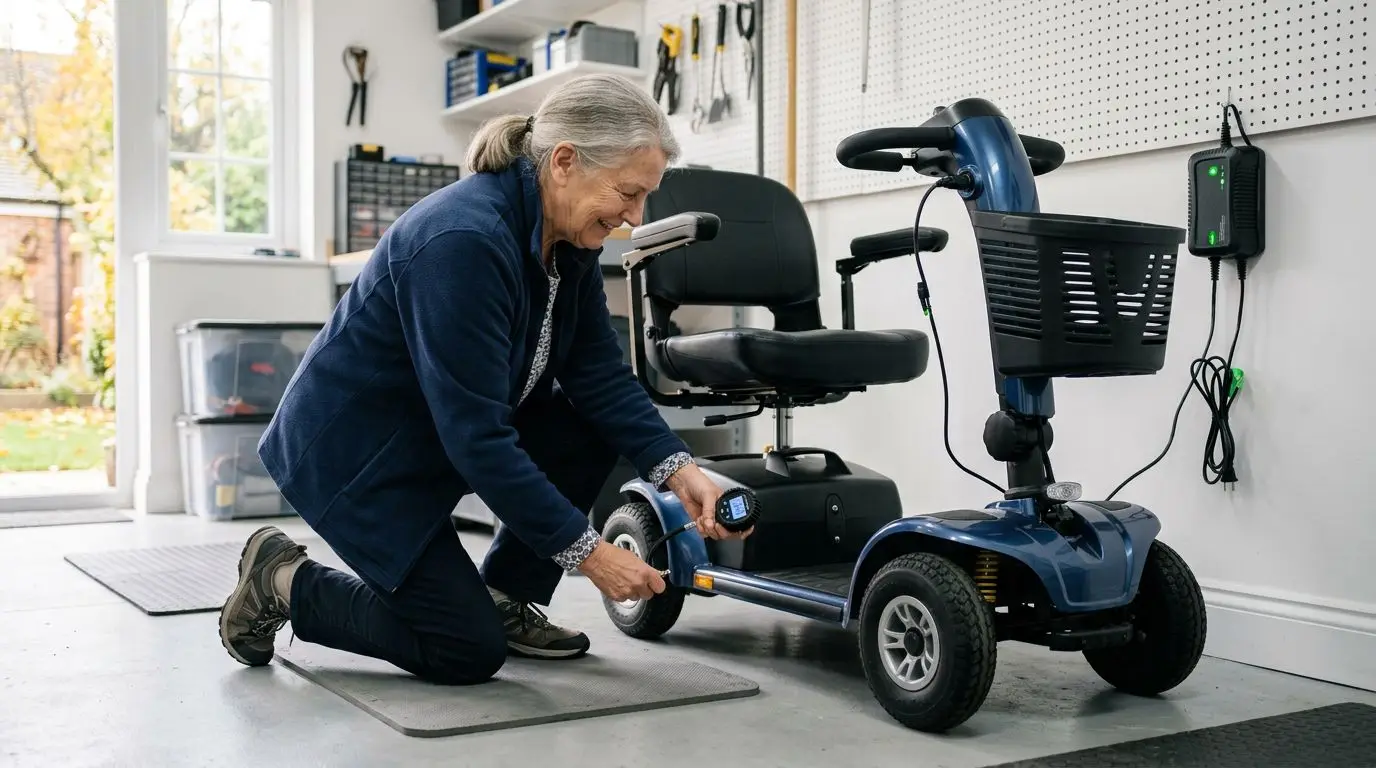
Check the sidewall or owner information for the recommended tire pressure. Many scooter tires are small, so use a gauge that reads low pressures accurately. Check when the tires are cool, not right after a ride. If your scooter uses solid or foam-filled tires, you will not adjust pressure, but you should still inspect for uneven wear, flat spots, cracks, or debris lodged near the wheel.
Practical fix: inspect all tires monthly and before longer trips. Inflate pneumatic tires to the recommended range, never beyond the maximum shown on the tire. If one tire repeatedly loses air within a week, have the valve stem, tube, or tire checked. A slow leak can make a scooter feel weak long before the tire looks flat.
Cold weather below 50°F reduces usable battery power
Batteries deliver less usable energy in cold weather. Many riders notice shorter range when temperatures fall below about 50°F, and the effect becomes more obvious near freezing. This does not always mean the battery is damaged. Cold slows the chemical reactions inside the battery, so voltage may sag sooner under load, especially on hills.
Both sealed lead-acid and lithium-based scooter batteries can show reduced winter range, though they behave differently. Avoid charging a very cold battery immediately after bringing it in from a freezing environment unless the scooter manual says it is safe. Let the battery and scooter reach a moderate indoor temperature first. Also avoid storing the scooter for weeks in an unheated area with a low battery, because deep discharge can shorten battery life.
Practical fix: store and charge the scooter in a dry, moderate-temperature location when possible. If you normally get 8 miles in mild weather, do not plan an 8-mile winter trip with no margin. Build in a cushion of at least 20% on cold days, and be extra cautious with hills or outdoor errands.
Charger and outlet problems often appear after a 6- to 10-hour charge
A scooter can sit plugged in overnight and still not receive a full charge if the charger, outlet, power strip, charging port, or connection is faulty. Many scooters use chargers that take about 6 to 10 hours for a full charge, depending on battery size and level of discharge. If the charger light changes too quickly, never changes, flickers, or feels unusually hot, pay attention.
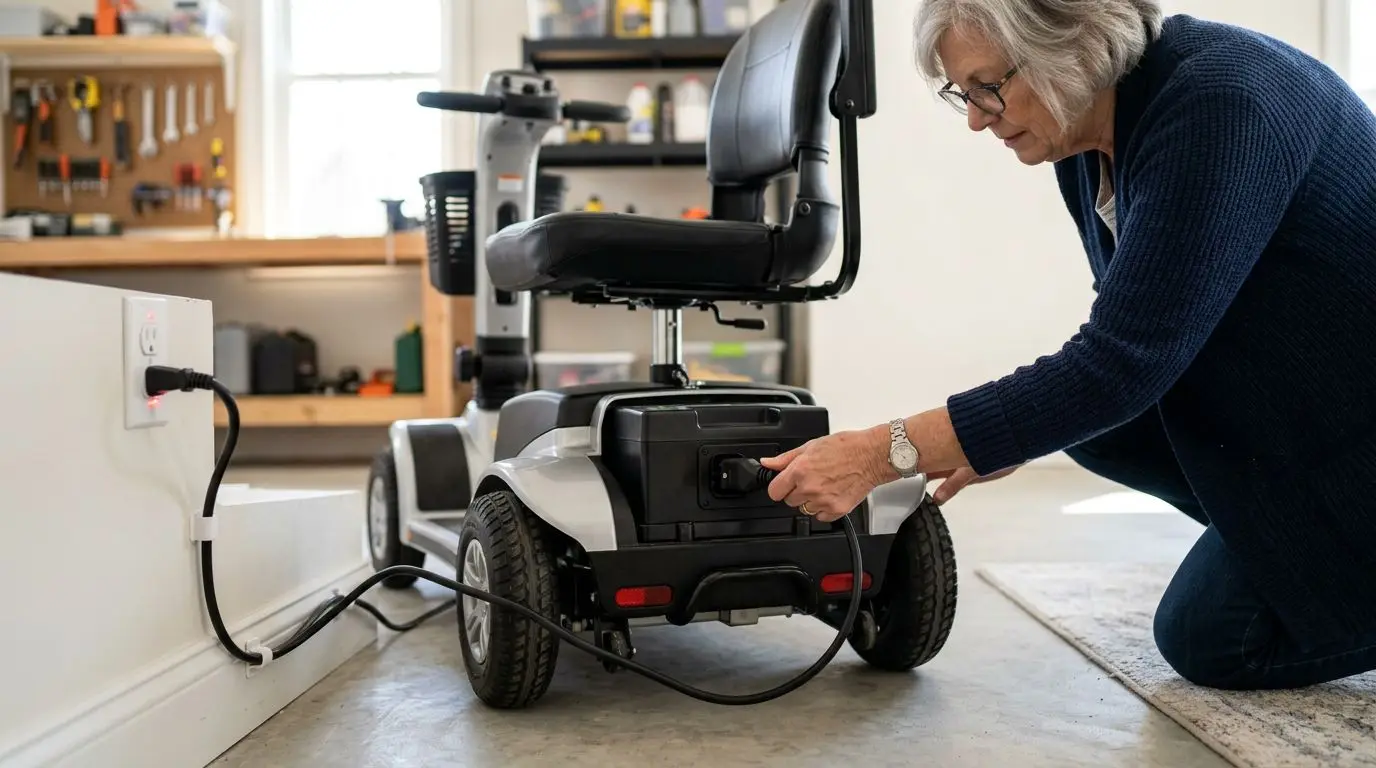
Start with the simple checks. Confirm the wall outlet works by plugging in a lamp or another safe household item. Make sure the charger plug is fully seated at both ends. Look for bent pins, looseness, corrosion, frayed cords, or a charging port that wiggles. Avoid long, thin extension cords because voltage drop and poor connections can interfere with charging and create safety risks.
Practical fix: charge directly from a known-good wall outlet in a dry indoor location. Follow the charging order in your manual if it gives one. If the scooter still shows reduced range, have the charger output and battery condition checked by a qualified technician. Do not open a sealed charger or battery case unless you are trained to do so.
Aging batteries commonly lose capacity after 2 to 5 years
Rechargeable scooter batteries are consumable parts. With normal use, many packs begin to show noticeable capacity loss after 2 to 5 years, though the timeline depends on battery type, depth of discharge, storage temperature, charging habits, and how often the scooter is used. A battery can still show full on the gauge yet hold much less energy than it did when new.
Signs of aging include shorter trips after a full charge, faster voltage drop on small hills, the scooter slowing sooner than usual, or one battery in a pair becoming weaker than the other. Many mobility scooters that use sealed lead-acid batteries require matched batteries replaced as a set, not one at a time, because one weak or mismatched battery can pull the whole pack down. Lithium-based packs may require specific chargers and battery management systems, so compatibility matters.
| Battery type | Common range issue | What to do |
|---|---|---|
| Sealed lead-acid | Gradual capacity loss, worse after deep discharge | Test under load; replace matched set when needed |
| Gel or AGM lead-acid | Sensitive to incorrect charging profile | Use compatible charger and avoid deep storage discharge |
| Lithium-based pack | Protection system may limit output if fault detected | Use approved charging method and seek service for faults |
Practical fix: if the scooter is older and simple checks do not explain the range drop, ask for a load test rather than relying only on a resting voltage reading. Resting voltage can look acceptable even when the battery cannot support real driving load.
Brake drag and wheel resistance can drain a battery in 5 minutes
Mechanical drag makes the motor fight the scooter itself. A brake that does not fully release, a wheel bearing with resistance, debris wrapped around an axle, or a misaligned tire can reduce range and make the scooter feel noisy or sluggish. Sometimes the first clue appears within 5 minutes: the scooter slows, the motor sounds strained, or one wheel area becomes warmer than the others after a short ride.
With the scooter turned off and parked safely, inspect around each wheel. Look for string, hair, plastic, leaves, or small stones. Check whether a parking brake or freewheel lever is fully in the correct drive position. If the scooter has recently been transported, bumped, or stored in a tight space, something may have shifted.
Practical fix: remove only visible debris that can be cleared safely without tools or disassembly. If a wheel does not turn normally, the scooter pulls to one side, or you smell a hot electrical odor, stop using it and arrange service. Continuing to drive with drag can overwork the controller, motor, and batteries.
How to choose the right fix using a 3-step range checklist
A good range diagnosis moves from easy and low-risk to more technical. This helps you avoid replacing batteries when the real issue is a soft tire, bad charger connection, or winter route. Use this 3-step checklist over two or three normal charging cycles.
Step 1: Measure the ride
Track one familiar route, such as a 1-mile loop or a trip to a nearby mailbox and back. Record temperature, surface, hills, cargo, charge time, and ending gauge level. If you can, repeat the route at the same speed and same load.
Step 2: Check the easy losses
Confirm tire pressure, inspect wheels, reduce unnecessary cargo, and charge from a known-good outlet. These checks often take less than 15 minutes and cost nothing unless a tire repair is needed.
Step 3: Test the power system
If range is still poor, move to charger and battery testing. A technician can check charger output, battery voltage under load, battery connections, and signs of controller or motor strain.
| Situation | Who it is best for | Best next step |
|---|---|---|
| Range drops only on hills or grass | Riders with changing outdoor routes | Plan flatter routes and allow a 20% range cushion |
| Range drops every ride, even indoors | Daily users with consistent routes | Check tires, brakes, charger, then battery load test |
| Range dropped after cold weather arrived | Riders storing scooters in garages or sheds | Store and charge at moderate indoor temperature |
| Range dropped after 2 to 5 years | Long-term owners with original batteries | Have batteries tested for capacity and matching |
Safe habits that protect range over the next 12 months
Once you fix the immediate problem, a few habits can help keep range predictable. They will not make an old battery new again, but they can reduce unnecessary strain and make your scooter more reliable for daily mobility.
- Charge after use, especially after longer trips, unless your manual gives different instructions.
- Avoid repeatedly running the scooter until it nearly stops.
- Keep pneumatic tires at the recommended pressure and check them at least monthly.
- Store the scooter in a dry area away from extreme heat and freezing temperatures.
- Do not carry extra cargo you do not need for the trip.
- Use the correct charger type for the battery system.
- Schedule service if range drops suddenly, the scooter smells hot, or the charger behaves strangely.
Range supports independence, but safety comes first. If you are unsure whether the scooter can complete a trip, choose a shorter route, bring a phone, let someone know your plan, or arrange a backup ride. A mobility scooter should help you move with confidence, not leave you worrying about the last block home.
FAQ: 5 common mobility scooter range questions
Why does my battery gauge drop on hills and then rise again?
That is often voltage sag. When the motor works hard, such as on a ramp or hill, the battery voltage dips under load. When you stop or return to flat ground, the gauge may recover slightly. Frequent or severe sag on mild slopes can also point to aging batteries or excessive load.
Can low tire pressure really reduce range?
Yes. A pneumatic tire that is 5 to 15 psi low can add enough rolling resistance to shorten rides and make the scooter feel sluggish. Check pressure with a gauge rather than by appearance.
How do I know if the charger is the problem?
Warning signs include a charger light that never reaches full, changes too quickly, flickers, or the scooter losing range after a normal 6- to 10-hour charge. Test the wall outlet and connections first, then have the charger output checked if the problem continues.
Should I replace just one weak battery?
For many scooters that use batteries in pairs, replacing only one can cause poor performance because the older battery may limit the newer one. Follow the scooter manual and ask a technician whether matched replacement is required.
Is shorter winter range normal?
Some winter range loss is normal, especially below about 50°F. Plan shorter trips, store and charge in a moderate-temperature location when possible, and avoid assuming the battery has failed unless range remains poor in mild conditions too.
Frequently asked questions
Why does my mobility scooter range drop so fast on hills? +
Hills make the motor draw more power because it must lift the combined weight of the rider, scooter, and cargo. A gauge drop on hills can be normal, but severe range loss may also point to soft tires, heavy load, brake drag, or aging batteries.
Can low tire pressure reduce mobility scooter battery range? +
Yes. Pneumatic tires that are 5 to 15 psi below the recommended pressure can increase rolling resistance and shorten the ride. Check pressure with a gauge when the tires are cool.
How long should a mobility scooter charge take? +
Many mobility scooter chargers take about 6 to 10 hours for a full charge, depending on battery size and how discharged the batteries are. If the charger light never shows full, changes too quickly, or flickers, check the outlet and connections and consider service.
Do mobility scooter batteries lose range in cold weather? +
Yes. Many batteries deliver less usable power below about 50°F, with more noticeable loss near freezing. Store and charge the scooter in a dry, moderate-temperature area when possible and plan a range cushion for winter trips.
When should mobility scooter batteries be replaced? +
Many scooter batteries show noticeable capacity loss after 2 to 5 years, depending on use, storage, charging habits, and battery type. If simple fixes do not restore range, have the batteries load-tested before replacing them.
Related guides

Mobility Scooter Range Explained: How Far You Can Really Go on a Charge
14 min read
How to Make Mobility Scooter Batteries Last Longer: Charging, Storage, and Cold-Weather Care
12 min read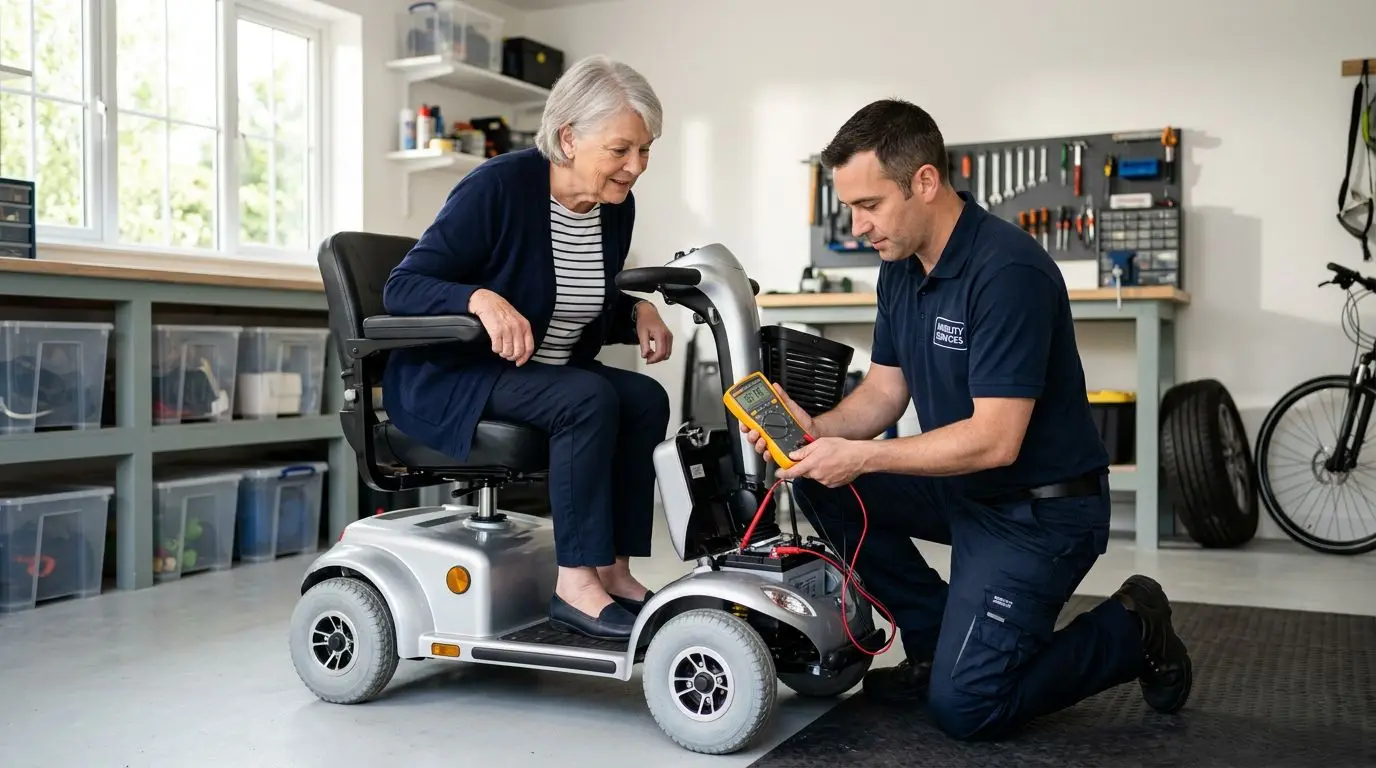
How to Tell If Your Mobility Scooter Battery Is Bad
14 min read