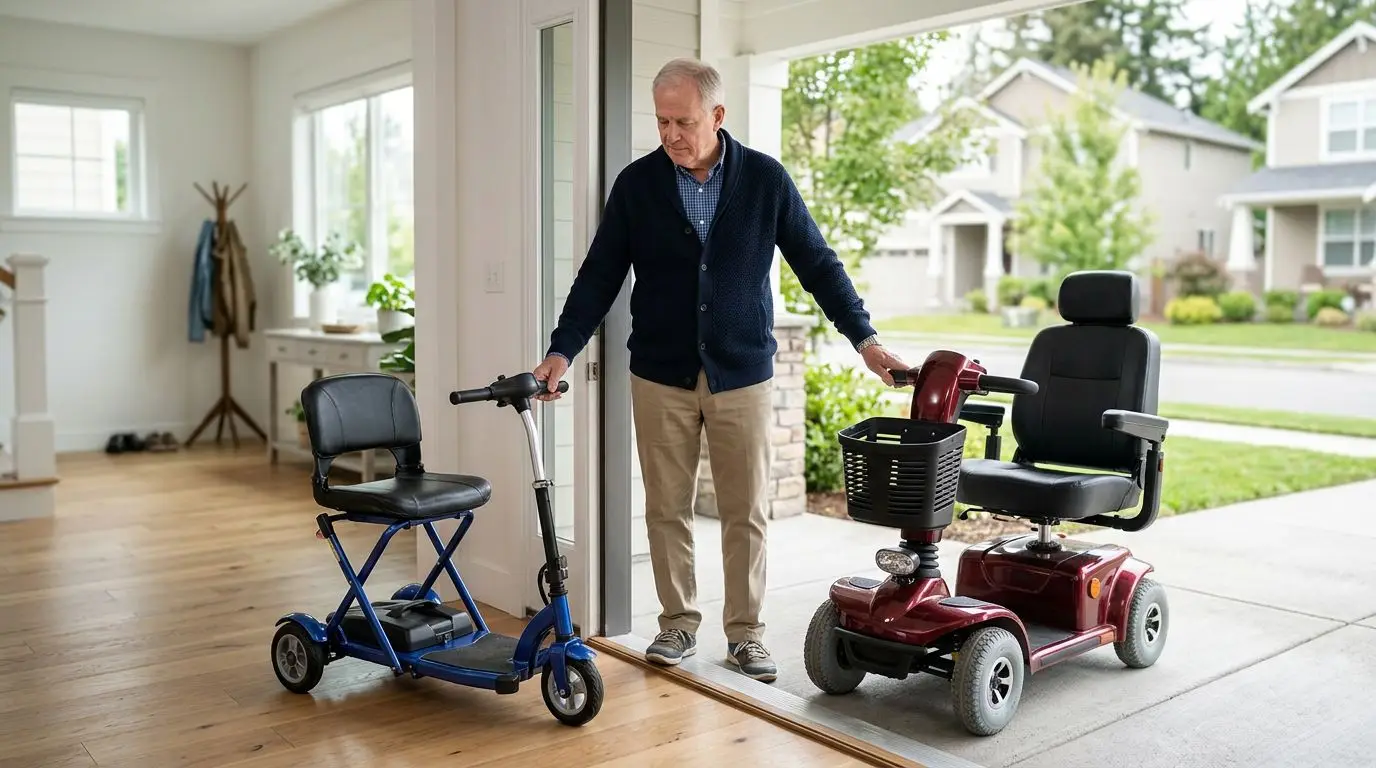
The right mobility scooter for a senior is the one that fits the places they actually go: inside the home, around the neighborhood, into stores, or in and out of a vehicle. Start by matching scooter size, turning radius, seat comfort, battery range, and weight capacity to daily routines instead of choosing the biggest or fastest option.
For many seniors, a compact 3-wheel scooter works well indoors and on short errands, while a 4-wheel scooter provides more stability outdoors. Travel scooters are easier to lift and transport, and heavy-duty scooters are better suited to longer rides, higher weight capacities, or rougher surfaces.
Start With the 3 Places the Scooter Will Be Used Most
Before comparing features, list the top three places the scooter needs to handle. A scooter used mostly in a 900-square-foot apartment has very different requirements from one used on sidewalks, in parking lots, and for weekly grocery trips.
Think in real routes. Bedroom to kitchen. Front door to mailbox. Apartment to elevator. Car trunk to medical office. House to neighborhood pharmacy. These details matter because a scooter that feels comfortable in a showroom can become frustrating if it cannot turn in a hallway or fit through a tight doorway.
- At home: Look for a narrow base, tight turning radius, easy speed control, and a seat height that works with tables and counters.
- For errands: Prioritize battery range, stable tires, a comfortable seat, a basket or storage option, and enough ground clearance for curb cuts and uneven pavement.
- For travel: Focus on total scooter weight, the heaviest piece after disassembly, battery type, and whether it fits in the vehicle used most often.
Many interior doorways in older homes are about 28 to 30 inches wide, while newer accessible doorways are often closer to 32 to 36 inches. Scooter width can range from about 20 inches on compact travel designs to more than 27 inches on larger outdoor scooters. Measure first. It is easier than returning a scooter that is too wide.
Who a Mobility Scooter Is Best For: From 50 Feet to 1 Mile
A mobility scooter is typically best for someone who can sit upright, steer with both hands or with an adapted control setup, transfer on and off the seat safely, and stay alert while operating a motorized device. It is not the same as a powered wheelchair. Scooters usually require more upper-body control, a larger turning area, and the ability to manage a tiller-style steering column.
A good candidate may be able to walk short distances, such as 50 to 200 feet, but becomes tired, short of breath, unsteady, or uncomfortable with longer distances. The scooter can help with predictable trips, such as going from a parking lot to a store entrance, moving around a senior community, or visiting a park with paved paths.
It may not be the right tool if the person cannot consistently judge speed and distance, has frequent unsafe transfers, or needs pressure relief and positioning support for many hours per day. In those situations, an occupational therapist, physical therapist, or physician can help decide whether a different mobility device is safer.
Best fit
- Seniors who can walk a little but cannot comfortably complete errands or longer outings.
- People who need seated mobility for paved areas, stores, medical buildings, or senior living campuses.
- Caregivers who want to reduce pushing strain from a manual wheelchair during long outings.
Use extra caution
- Anyone with new dizziness, vision changes, confusion, or uncontrolled balance problems.
- Homes with several steps and no ramp or safe storage area.
- Users who need all-day posture support beyond a standard scooter seat.
Compare the 4 Common Mobility Scooter Types
Most senior mobility scooters fall into four broad categories: compact travel, 3-wheel standard, 4-wheel standard, and heavy-duty outdoor. The names are generic, but the differences are practical. Weight, turning radius, stability, and transport needs should guide the decision.
| Type | Typical strengths | Trade-offs | Best for |
|---|---|---|---|
| Compact travel scooter | Often disassembles into 4 or 5 pieces; lighter components; easier vehicle transport | Smaller seat, lower ground clearance, shorter range than larger scooters | Medical visits, shopping trips, car travel, occasional use |
| 3-wheel standard scooter | Tighter turning radius, easier indoor maneuvering, more legroom in some designs | Less side-to-side stability than many 4-wheel designs on uneven surfaces | Apartments, hallways, stores, smooth sidewalks |
| 4-wheel standard scooter | More stable feel outdoors, better tracking in a straight line | Wider turning circle; may be harder in tight rooms | Neighborhood sidewalks, senior communities, errands |
| Heavy-duty outdoor scooter | Higher weight capacity, larger tires, more powerful motor, better comfort on longer rides | Heavier, harder to transport, needs more storage space | Longer outdoor trips, larger users, uneven paved areas |
Weight capacity is not just a safety number. A scooter rated for 300 pounds may perform very differently near its limit than it does with a 180-pound rider. Add the user’s body weight, winter clothing, oxygen equipment if used, bags, and anything commonly carried. Choose a scooter with a comfortable margin instead of operating at the maximum rating every day.
Speed also varies by type. Many scooters designed for seniors operate around walking to jogging pace, often about 3 to 8 mph depending on design and setting. For indoor use, smooth low-speed control matters more than top speed.
How to Measure Your Home, Vehicle, and Daily Route in 30 Minutes
A tape measure can prevent most scooter-fit problems. Set aside about 30 minutes and measure the spaces that are hardest to navigate, not only the largest open areas.
Measure indoor spaces
- Doorway width: Measure the narrowest point with the door open. Include trim, hinges, and door swing.
- Hallway width: Measure the tightest hallway, especially near turns into bedrooms and bathrooms.
- Turning spots: Check whether there is enough open floor to turn around near the bed, kitchen, and front door.
- Table and counter height: Compare seat height and armrest height if the scooter will be used at a dining table or desk.
A scooter with a 35-inch turning radius needs a much smaller area to turn than one with a 55-inch turning radius. If the scooter will be used in a small kitchen or apartment hallway, that difference is noticeable every day.
Measure vehicle fit
If the scooter must travel in a car, measure the trunk opening, cargo floor width, cargo depth, and lift-over height. Do not rely only on cargo volume listed by the vehicle maker. A scooter piece that is 38 inches long may not fit through a narrow trunk opening even if the trunk has enough space inside.
Also check the heaviest piece after disassembly. Some travel scooters break down into pieces where the heaviest section is roughly 30 to 60 pounds, depending on design. That can still be too heavy for many older caregivers. If lifting is painful or unsafe, consider a vehicle lift, ramp, or a scooter that stays assembled in an accessible storage area.
Walk the route
Look at the actual path from door to destination. Count thresholds, curb cuts, cracked sidewalk sections, gravel patches, slopes, and places where the scooter must turn. A 1-inch threshold at a doorway can feel small when walking but become a daily obstacle for a low-clearance scooter.
Match Features to Real Needs: 7 Decisions That Matter
Features should solve a specific problem. A larger battery helps if the user regularly travels several miles between charges. A captain-style seat matters more when rides last 30 minutes or longer. A very tight turning radius matters if the scooter is used inside a small home every day.
| Feature | What to look for | Why it matters |
|---|---|---|
| Turning radius | Lower numbers, often around 32 to 45 inches for compact designs | Helps in hallways, elevators, kitchens, and store aisles |
| Weight capacity | User weight plus carried items, with a safety margin | Protects performance, braking, frame durability, and comfort |
| Seat | Width, padding, swivel function, adjustable height, armrests | Improves comfort and makes transfers easier |
| Battery range | Enough for the longest normal day, not just the average day | Reduces worry about losing power away from home |
| Ground clearance | More clearance for thresholds and uneven pavement | Helps prevent scraping or getting stuck |
| Tires | Solid tires for low maintenance; air-filled tires for more cushioning | Affects ride comfort, upkeep, and outdoor performance |
| Controls | Easy throttle, readable battery gauge, simple speed dial | Supports safer operation, especially for new users |
Battery range deserves special attention. Published range is usually measured under controlled conditions. Real-world range can be reduced by hills, rider weight, cold weather, frequent stopping, rough pavement, and battery age. If a normal outing is 4 miles round trip, choosing a scooter with only a small range margin may create stress.
Seat comfort is another daily factor. A narrow, lightly padded seat may be fine for a 10-minute ride through a clinic, but not for a 45-minute trip around a senior living campus or outdoor market. If possible, sit in the scooter long enough to notice pressure points, arm position, and whether the feet rest naturally on the platform.
Home Scooters vs Errand Scooters: A 28-Inch Doorway Changes the Choice
Indoor use is about control and fit. Outdoor errand use is about stability, comfort, and range. Many buyers want one scooter to do both, which is possible, but the compromise needs to be clear.
For a small home, apartment, or assisted living room, a compact scooter with a narrow width and tight turning radius is often easier to live with. It can move through doorways, turn near furniture, and park without blocking the room. The trade-off may be a smaller seat, less outdoor comfort, and lower ground clearance.
For errands, a 4-wheel scooter or a more stable standard scooter can feel more secure on sidewalks, parking lots, curb cuts, and long store aisles. Look for a comfortable seat, front and rear lighting if used near dusk, a basket or secure storage, and a battery range that exceeds the normal route. If a typical shopping trip lasts 90 minutes, comfort and battery confidence matter more than a tiny turning radius.
- Mostly indoors: Favor 3-wheel maneuverability, compact width, low-speed control, and easy transfers.
- Mostly errands: Favor 4-wheel stability, range, storage, lights, and a seat that supports longer rides.
- Mixed use: Choose the smallest scooter that safely handles the outdoor surfaces used most often.
Do not overlook storage. A scooter parked in a hallway can become a fall hazard. Plan for a charging spot near an outlet with at least a few inches of clearance around the scooter and no cord stretched across a walking path.
Transport and Lifting: Check the Heaviest Piece Before Buying
Many families focus on total scooter weight, but the more important number is the heaviest piece someone must lift. A scooter that weighs 95 pounds total may sound manageable if it separates into parts, but a 45-pound base can still be difficult to lift into a trunk.
Ask who will load it, how often, and into what vehicle. A healthy adult may lift a scooter base once in a showroom and feel fine, then struggle after a doctor visit, in the rain, or in a tight parking lot. Repeated lifting is different from a one-time test.
If transport is central to the plan, compare these details:
- Number of pieces after disassembly, commonly 4 or 5 on travel-style scooters.
- Heaviest piece weight, ideally low enough for the actual caregiver to lift safely.
- Whether the seat, battery, and basket remove without tools.
- Whether the tiller folds and locks for lifting.
- Vehicle cargo opening, not just cargo capacity.
Some scooters are better treated as home-based mobility devices rather than car-transport devices. That is not a flaw. It simply means they serve a different job. If the senior needs both indoor mobility and frequent car travel, two different mobility tools may sometimes be safer than forcing one scooter to do everything.
Safety, Training, and Daily Use at 3 to 5 MPH
Safe scooter use starts slowly. Even if a scooter can travel faster, new users should practice at low speed, often around 3 mph or less, until steering, stopping, reversing, and turning feel natural.
Practice in a quiet, open area before going into a busy store or onto a sidewalk. Work on starting smoothly, stopping without jerking, backing up, turning around, and approaching doorways. Caregivers should watch for leaning, overcorrecting, delayed braking, or confusion with the controls.
- Keep both feet on the platform while moving.
- Reduce speed before turns, ramps, curb cuts, and doorways.
- Use lights and reflective clothing when visibility is low.
- Avoid loose gravel, wet grass, steep slopes, and broken pavement when possible.
- Do not carry heavy bags on the tiller if they affect steering.
- Charge batteries according to the manufacturer’s instructions.
Most scooters are designed for paved or firm surfaces, not road traffic. Local rules vary, so check community policies, transit rules, and building guidelines. In senior living communities, there may be speed limits, parking areas, elevator rules, or required training.
Transfers are part of safety too. A swivel seat can make it easier to get on and off, especially when parked beside a bed, chair, or vehicle. The scooter should be turned off before transferring, and the user should avoid pulling hard on a movable tiller for support unless the manufacturer says it is designed for that purpose.
Caregiver Checklist: 10 Questions Before You Decide
Caregivers often see practical issues the rider may miss. Use these 10 questions to make the decision more realistic and less emotional.
- Can the senior get on and off the scooter safely without rushing?
- Can they operate the throttle, brake, speed control, and horn consistently?
- Does the scooter fit through the narrowest doorway used every day?
- Can it turn in the tightest indoor space without repeated bumping?
- Is the seat comfortable for the longest expected ride, such as 30 to 60 minutes?
- Is the battery range enough for a normal outing plus a margin?
- Who will charge it, and where will the cord be placed?
- Who will lift or transport it, and what is the heaviest piece?
- Where will it be stored so it does not block walking paths?
- Has a clinician weighed in if there are balance, vision, cognition, or transfer concerns?
A scooter can support independence, but it should not create new hazards. If the user has fallen recently, has trouble judging traffic, or cannot remember how to stop the scooter, pause the purchase and get professional guidance.
Try Before You Buy: Use a 15-Minute Test Ride
A short test ride can reveal more than a long feature list. If possible, spend at least 15 minutes with the scooter type under consideration. Test it at low speed, around tight turns, near a doorway, and on a surface similar to the one used at home.
During the test, check comfort from head to toe. Are the shoulders relaxed? Are the elbows bent comfortably? Can the user reach the controls without stretching? Do the knees have enough room? Can the feet rest flat? Can the user see the battery gauge clearly?
Ask about service, replacement batteries, return rules, and written warranty terms before committing. Avoid any seller who pressures the family to buy before measurements are done. A responsible purchase should account for the home, the user’s abilities, the caregiver’s lifting limits, and the routes the scooter will travel.
If buying used, inspect the battery age, charger, tires, seat condition, frame, controls, and signs of water damage. Batteries are wear items. A used scooter with weak batteries may operate during a quick demonstration but lose range during a real outing.
5 FAQs About Mobility Scooters for Seniors
Is a 3-wheel or 4-wheel scooter better for seniors?
A 3-wheel scooter is often better for tight indoor spaces because it usually turns more sharply. A 4-wheel scooter is often preferred for outdoor errands because it tends to feel more stable on sidewalks and parking lots. The better choice depends on where the scooter will be used most.
Can a mobility scooter be used inside the house?
Yes, but only if it fits the home. Measure doorways, halls, turning spaces, and storage areas. In smaller homes, scooter width and turning radius can matter more than battery range or outdoor speed.
How much battery range does a senior need?
Choose enough range for the longest normal outing, plus extra margin for hills, cold weather, rider weight, and battery aging. If the usual round trip is 3 to 4 miles, do not choose a scooter that barely covers that distance under ideal conditions.
Are mobility scooters safe for older adults?
They can be safe when matched to the user’s abilities and environment. The rider should be able to steer, stop, transfer safely, judge obstacles, and follow basic operating rules. Medical or therapy input is wise if there are concerns about vision, balance, cognition, or recent falls.
What is the easiest scooter to transport?
The easiest scooter to transport is usually a compact travel design that separates into manageable pieces. Check the heaviest piece, not just total weight. A 40- to 50-pound section may still be too heavy for some caregivers.
Do seniors need a prescription for a mobility scooter?
For private purchase, a prescription is usually not required. If someone hopes to use insurance or a health benefit, documentation and medical necessity rules may apply. Requirements vary, so check with the insurer and clinician before buying.
Frequently asked questions
Is a 3-wheel or 4-wheel mobility scooter better for seniors? +
A 3-wheel scooter is often better for tight indoor spaces because it usually has a smaller turning radius. A 4-wheel scooter usually feels more stable outdoors on sidewalks, parking lots, and longer errand routes.
Can a mobility scooter be used inside the home? +
Yes, if the scooter fits the home’s doorways, hallways, turning areas, and storage space. Measure the narrowest doorway and tightest turn before choosing an indoor scooter.
How much battery range should a senior mobility scooter have? +
Choose enough battery range for the longest normal outing, plus extra margin for hills, rider weight, cold weather, and battery aging. Real-world range is often lower than ideal test conditions.
What should caregivers check before buying a mobility scooter? +
Caregivers should check transfers, steering control, braking, doorway fit, turning space, comfort, charging location, storage, and the heaviest piece if the scooter must be lifted into a vehicle.
Are mobility scooters safe for seniors? +
They can be safe when the scooter matches the user’s abilities and environment. Seniors should be able to steer, stop, judge obstacles, transfer safely, and operate the controls consistently.
Do you need a prescription to buy a mobility scooter? +
A prescription is usually not needed for a private purchase. If insurance coverage is involved, medical documentation and specific eligibility rules may apply.
Related guides

How to Choose a Mobility Scooter for Everyday Errands, Stores, and Medical Appointments
15 min read
Travel vs. Full-Size Mobility Scooters: How to Choose Between Portability, Comfort, and Range
15 min read
Mobility Scooters for Adults Under 65: Work, Errands, Fatigue, and Long-Term Mobility Needs
13 min read