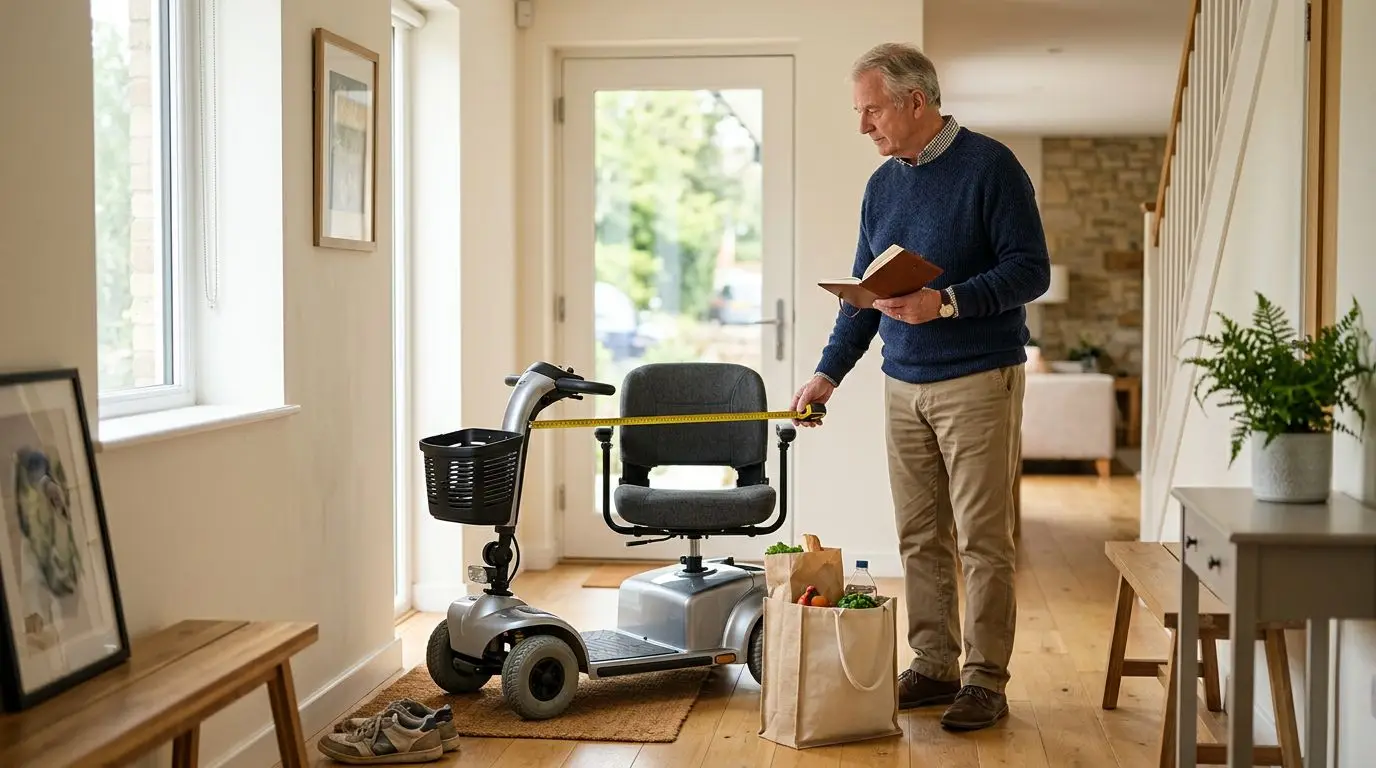
A mobility scooter is worth the cost when it helps you safely do activities you have already started skipping, such as grocery shopping, appointments, neighborhood visits, or longer outings. The value is strongest when you expect to use it several times a week, have a safe place to store and charge it, and can operate it comfortably. If you would use it only once or twice a month, renting, borrowing, using delivery services, or choosing another mobility aid may be the better value.
The real question is not only, How much does a scooter cost? A better question is, What would it give back over the next 12 months? For many people, the answer is more than transportation. It may mean fewer cancelled plans, less fatigue after errands, less reliance on family for every trip, and more confidence leaving home. Those benefits are real, but they should be weighed against storage space, maintenance, transport needs, and whether a scooter fits your daily environment.
A quick answer: when a scooter is worth it after 3 months of real use
A useful test is to picture your first 90 days with a scooter. If you can name at least 3 regular uses per week, such as going to the mailbox, visiting a neighbor, shopping, attending services, or moving around a retirement community, the purchase has a stronger value case. If you struggle to name even 3 realistic uses in a month, the cost may be hard to justify.
Mobility scooters are designed for people who can sit upright, steer with both hands or an adapted control setup, see well enough to navigate, and transfer on and off the seat with reasonable safety. They are not a treatment for a medical condition, and they do not replace medical advice. They are practical mobility tools. Their value comes from matching the tool to your body, your home, and your routine.
Think in terms of access. If walking 200 feet from a parking lot to a store entrance leaves you exhausted, a scooter may make trips possible that you currently avoid. If your main challenge is balance inside a small apartment, a scooter may not help and could even feel awkward. A compact walker, rollator, cane, home modification, or physical therapy plan recommended by a clinician may be more appropriate.
One simple way to judge value is cost per meaningful outing. Write down the total cost you would actually pay, including accessories, delivery, batteries when needed, and any carrier or ramp if transport matters. Then divide that by the number of outings you expect in 1 year. A scooter used 5 days a week for errands and community activities creates a very different value picture than one used only for an annual fair or occasional vacation.
What you are really paying for: 5 cost buckets
The sticker price is only 1 part of the decision. Before buying any scooter, list 5 cost buckets: the scooter itself, batteries and charging, accessories, transport or storage equipment, and service or repairs. This keeps you from underestimating the real cost of ownership.
The scooter itself varies by type, size, battery capacity, seating, suspension, and weight rating. Travel scooters tend to be lighter and easier to disassemble, while full-size and heavy-duty scooters usually offer more stability, larger seats, higher weight capacities, and better comfort over longer distances. Those improvements may matter a great deal if you plan to ride for 30 to 60 minutes at a time.
Batteries are another major factor. Most scooters use rechargeable batteries, and battery life depends on rider weight, hills, surface type, temperature, and charging habits. A scooter that performs well on smooth indoor floors may use power faster on rough sidewalks or slopes. Ask how long a typical charge lasts under real conditions, not just ideal test conditions.
Accessories can be modest or essential. A basket, rear bag, cup holder, cane holder, weather cover, safety flag, or extra lighting can make a scooter more practical. Some accessories are convenience items. Others affect safety, especially visibility in parking lots, apartment complexes, or low-light areas.
Transport and storage can surprise buyers. If you want to take the scooter in a car, you may need a model that disassembles into manageable pieces or a vehicle lift or carrier. If you live in an apartment, confirm elevator size, hallway width, charging rules, and where the scooter can be parked without blocking an exit.
| Cost bucket | What to check | Why it affects value |
|---|---|---|
| Scooter | Size, weight rating, seat, turning radius, intended terrain | Determines whether it fits your body and routine |
| Battery and charging | Range, charging time, replacement process | Affects daily reliability and long-term ownership cost |
| Accessories | Basket, lights, cane holder, weather cover | Can turn an occasional tool into a daily helper |
| Transport | Disassembly weight, vehicle space, ramp or carrier needs | Matters if you plan to use it away from home |
| Service | Tires, brakes, controls, battery terminals, local repair access | Reduces downtime and surprise expenses |
Who it is best for: 4 use patterns that support the cost
A scooter is usually most worthwhile for 4 types of users: people who leave home several times a week, people in large senior communities, people who fatigue quickly during errands, and people who need outdoor mobility over distances greater than a short walk. If one of these sounds familiar, the value may be strong.
1. The errand keeper
This person still wants to handle groceries, pharmacy trips, appointments, and social visits but cannot comfortably walk across large stores or parking lots. A scooter can make these trips possible with less strain. The key is whether the scooter can be transported or whether the destination provides enough accessible space.
2. The community traveler
In a retirement community, assisted living campus, large apartment complex, or neighborhood with sidewalks, a scooter may be used daily. Even a 10-minute trip to the dining room, clubhouse, mailbox, or neighbor's home can become easier. In this setting, storage and charging are often more important than vehicle transport.
3. The energy conserver
Some people can walk short distances but pay for it later with pain, weakness, or fatigue. A scooter can help conserve energy for the activity itself, such as attending a grandchild's event, shopping with a spouse, or enjoying a museum. It should still be matched with safe walking, transfer ability, and advice from a health professional when needed.
4. The outdoor distance user
For people who need to travel several blocks, move around a large property, or navigate smooth outdoor paths, a scooter may be more comfortable than a manual wheelchair or walker. Outdoor use requires attention to ground clearance, tire type, lighting, brakes, and stability on slopes.
A scooter may not be best for someone who has severe vision limitations, cannot safely judge traffic or obstacles, has frequent uncontrolled dizziness, or cannot operate controls reliably. In those cases, it is wise to speak with a clinician, occupational therapist, or mobility specialist before spending money.
How to measure your real need in 7 days
Before you buy, track your mobility for 7 days. Keep a simple notebook or phone note and write down every trip you skipped, shortened, delayed, or needed help with because walking was too difficult. This 1-week record is often more honest than memory.
Use 4 columns: activity, distance or time on your feet, what stopped you, and what a scooter would have changed. For example, Activity: grocery store. Time: 25 minutes on feet. Barrier: tired after first 2 aisles. Scooter effect: could shop without leaning on cart. Another example: mailbox. Distance: 300 feet round trip. Barrier: uneven sidewalk. Scooter effect: maybe helpful, but only if wheels and ground clearance handle cracks.
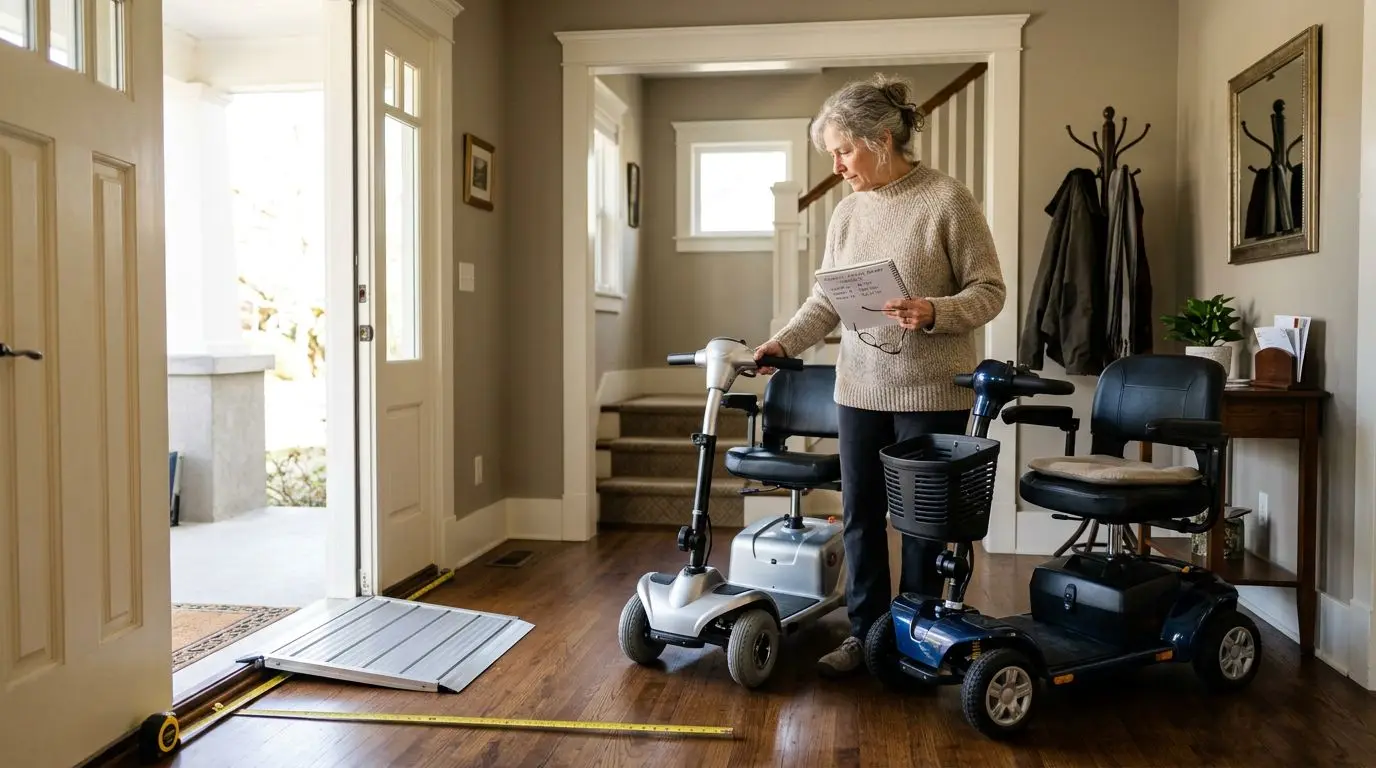
Measure your home and storage area too. Many scooters need more room than people expect. Measure doorways, hallways, turning spots, elevator openings, and the place where you would charge it. A doorway around 30 to 32 inches wide may work for many scooters, but tight turns immediately after the doorway can still be a problem. Do not rely on width alone.
If you plan to transport the scooter, measure your trunk or cargo area. Also ask yourself who will lift or assemble it. Some travel scooters break into several pieces, but the heaviest piece can still be too much for one person. A scooter that technically fits in a vehicle but takes 15 minutes and painful lifting to load may not be used often.
- Count how many trips you avoid in 7 days.
- Measure your longest common walking distance.
- Measure doorways, hallway turns, and storage space.
- Check whether charging is available near the storage spot.
- Note who would lift, load, clean, and maintain it.
At the end of the week, circle the trips that would genuinely improve your life. If there are 10 or more in a month, a scooter deserves serious consideration. If there are only 1 or 2, look closely at lower-cost alternatives first.
Scooter types compared: 3 common choices and where value changes
Most buyers compare 3 broad categories: travel scooters, mid-size everyday scooters, and full-size or heavy-duty scooters. The right type depends on where you will ride, how often you will transport it, and how much comfort you need over 20 to 60 minutes of use.
Travel scooters are built for portability. They may fold or disassemble, and they often have smaller wheels and lighter frames. Their value is highest for people who need occasional help at stores, appointments, airports, or family outings. The tradeoff is that they may feel less comfortable on rough outdoor surfaces and may have less legroom or suspension.
Mid-size scooters are the practical middle ground for many users. They are often comfortable enough for daily errands and stable enough for smooth outdoor paths, while still being easier to store than larger units. They may not be easy to lift into a vehicle without help or equipment.
Full-size and heavy-duty scooters are built for comfort, stability, larger riders, longer rides, and more demanding outdoor use. They may have larger seats, higher ground clearance, stronger motors, and larger batteries. The tradeoff is size. They can be difficult to store in small homes, maneuver in tight shops, or transport without a lift.
| Scooter type | Best fit | Common strengths | Common tradeoffs |
|---|---|---|---|
| Travel or folding | Occasional outings and vehicle transport | Portable, lighter, easier to store | Less comfort, smaller wheels, limited rough-surface use |
| Mid-size everyday | Frequent errands and community use | Balanced comfort, range, and maneuverability | May still be heavy to lift or load |
| Full-size or heavy-duty | Longer rides, larger users, outdoor routes | Comfort, stability, stronger performance | Large footprint, harder transport, more storage space |
Do not buy more scooter than your environment can handle. A large scooter may feel wonderful in a showroom, then become frustrating in a narrow hallway or crowded apartment. On the other hand, buying the smallest option just because it is easier to store may leave you with a scooter that is uncomfortable or underpowered for your actual routes.
Features that change value: 6 items worth comparing
Six features have an outsized effect on whether a scooter feels worth owning: seat comfort, turning radius, battery range, ground clearance, tires, and controls. A difference of 2 inches in seat width or ground clearance can matter more than a long list of extras.
Seat comfort is not cosmetic. If you plan to sit for 30 minutes or more, look at seat width, back support, armrests, swivel ability, and whether your feet rest naturally. A cramped seat can make a scooter unpleasant even if the motor performs well.
Turning radius matters indoors. Small apartments, elevators, medical offices, and store aisles require tighter maneuvering. A scooter used mainly inside needs a different turning profile than one used on sidewalks and community paths.
Battery range should be judged conservatively. Real-world range can drop when the rider is near the weight limit, the route includes hills, the surface is rough, or the weather is cold. If your typical outing is 4 miles round trip, do not choose a scooter that barely covers that distance under ideal conditions.
Ground clearance and tires affect outdoor confidence. Small solid tires can be fine on smooth floors but harsh on cracked sidewalks. Pneumatic or larger tires may improve ride comfort, though they can require more maintenance. No mobility scooter is made for unsafe terrain, steep slopes beyond its rating, or traffic lanes.
Controls should feel natural within the first few minutes. Test forward and reverse, speed adjustment, horn, braking, key location, and tiller angle. If your hands are weak or painful, ask about control options and whether the scooter can be operated safely without strain.
| Feature | Ask this | Why it matters |
|---|---|---|
| Seat | Can I sit comfortably for 30 minutes? | Comfort affects how often you use it |
| Turning radius | Can it turn in my hallway or elevator? | Prevents daily frustration |
| Battery range | Does it exceed my usual trip distance with margin? | Reduces range anxiety |
| Ground clearance | Can it handle my driveway, curb cuts, and sidewalk cracks? | Improves outdoor practicality |
| Tires | Are they suited to indoor floors, sidewalks, or both? | Affects ride feel and upkeep |
| Controls | Can I steer, stop, and reverse comfortably? | Directly tied to safety |
Scooter vs alternatives: compare by trips per week
The fairest comparison starts with your expected trips per week. A scooter used 4 to 7 days weekly competes differently against alternatives than a scooter used only for 2 special events a year. Frequency often determines value more than any single feature.
A cane is simple, portable, and low maintenance, but it provides limited support and does not reduce walking distance. A walker or rollator can improve stability and provide a seat for breaks, but it still requires the user to walk and push the device. A manual wheelchair may be useful for caregiver-assisted outings, yet it can be tiring to self-propel and may require someone else to push. A power wheelchair may be better for people who need indoor maneuverability and more supportive seating, but it is a different category and should be considered carefully with professional guidance when medical or seating needs are involved.
Renting can be a smart test. If you only need powered mobility for a vacation, theme park, fair, cruise, or recovery period, rental may provide the benefit without long-term storage and maintenance. Delivery services can also replace some errands, though they do not replace the social and independence value of leaving home.
| Option | Best for | Limitations |
|---|---|---|
| Cane | Short distances and mild support | Does not help much with fatigue over distance |
| Walker or rollator | Balance support and seated rest breaks | Still requires walking the full route |
| Manual wheelchair | Caregiver-assisted outings or short self-propulsion | May require upper-body strength or help |
| Mobility scooter | Frequent longer trips by someone who can steer and transfer | Needs storage, charging, and safe operating space |
| Rental | Occasional trips, travel, or trial use | May not fit perfectly and is not always available |
| Delivery or rides | Errands when leaving home is not important | Does not provide community access or activity outside the home |
The best value may be a combination. Some people use a scooter for long outings, a rollator inside the home, and delivery during bad weather. Value is not about owning the most equipment. It is about having the right help for the right situations.
Safety, storage, and upkeep: 10 checks before you spend
Before buying, run through 10 practical checks: vision, reaction time, transfers, seating, route surfaces, slopes, storage, charging, transport, and service access. Any 1 of these can change whether a scooter is a smart purchase.
Safety starts with the rider. You should be able to start, stop, turn, reverse, and control speed without panic. Practice in an open area before using sidewalks, stores, or crowded community spaces. Keep speeds low indoors. Watch for children, pets, uneven pavement, wet leaves, loose gravel, and curb cuts that are steeper than they look.
Storage should be safe and legal. A scooter should not block a doorway, hallway, fire exit, or shared walkway. If you live in a building with rules, ask management about scooter parking and battery charging before you buy. Some buildings have designated charging areas or restrictions.
Charging is usually simple, but habits matter. Charge in a dry, ventilated location according to the manufacturer's instructions. Do not use damaged cords. If the battery or charger becomes unusually hot, smells odd, or shows visible damage, stop using it and seek service.
Upkeep is part of ownership. Check tires, lights, horn, brakes, seat hardware, battery connections, and the tiller area on a regular schedule. A 5-minute check once a week can catch loose parts or low tire pressure before they become problems. Keep the scooter clean, especially around wheels and moving parts.
- Can you transfer on and off the seat safely?
- Can you see obstacles and judge distance?
- Can you operate the controls without hand pain or confusion?
- Is there a dry charging spot near an outlet?
- Will it block any exit or hallway?
- Can it handle your steepest routine slope?
- Can it turn where you need it to turn?
- Do you have a plan for rain and cold weather?
- Who will service it if something stops working?
- How will you transport it when needed?
Insurance, warranties, and service policies vary. Read them before purchase. Pay close attention to what is covered, how repairs are handled, whether labor is included, and what happens if the scooter must be shipped or picked up for service.
How to make the final decision with a 12-month lens
Look at the decision over 12 months, not just the day you buy. A scooter is worth serious consideration if it will restore or protect access to activities you value at least weekly, fits your environment, and can be used safely without creating a burden for storage or maintenance.
Start with your must-do trips. These are not fantasy outings. They are the real places you already need or want to go: appointments, groceries, worship services, dining room, mailbox, recreation room, local park, family visits, or volunteer work. Then list the barriers. Distance, pain, fatigue, balance, parking, and standing time are common examples.
Next, match the scooter to those routes. If your life is mostly indoors with tight turns, prioritize compact size and turning radius. If you travel by car every week, prioritize portability and loading weight. If you ride outdoors for 45 minutes at a time, prioritize comfort, tires, range, lights, and stability.
Then compare the total cost against the value of recovered activity. Some benefits are hard to put into dollars. Being able to attend a weekly family meal, shop without rushing, or visit a neighbor without arranging a ride may be deeply meaningful. That does not mean every scooter is a good buy. It means the value calculation should include independence, routine, confidence, and social connection, not just hardware.
A good final test is the 3-question rule. Will I use it at least weekly? Can I store, charge, and maintain it safely? Does it solve a real problem better than a cane, walker, wheelchair, rental, delivery, or rides from others? If the answer is yes to all 3, a mobility scooter may be well worth the cost. If any answer is no, pause and keep comparing.
FAQ: 5 cost and value questions
Is a mobility scooter worth it if I can still walk?
Yes, it can be worth it if walking is possible but limited enough that you avoid errands, social events, or longer outings. Many scooter users still walk short distances and use the scooter to conserve energy for trips that would otherwise be too demanding.
How often should I use a scooter to justify buying one?
There is no single rule, but several uses per week usually makes a stronger value case than occasional use. If you expect to use it only a few times a year, renting or borrowing may be more practical.
Should I buy the smallest scooter to save space?
Not automatically. A small scooter may be easier to store and transport, but it still needs to fit your body, route, comfort needs, and outdoor surfaces. Measure first, then choose the smallest scooter that safely meets your real use.
Can a scooter reduce fall risk?
A scooter may reduce the amount of walking or standing you do during certain outings, but it is not a guaranteed fall-prevention device. Safe transfers, clear vision, appropriate speed, good judgment, and the right mobility aid all matter.
What should I try before buying?
Try sitting, turning, reversing, stopping, and getting on and off the scooter. If possible, test it in conditions similar to your daily life, such as a hallway, elevator, sidewalk, store aisle, or vehicle-loading situation.
Frequently asked questions
Is a mobility scooter worth it if I can still walk? +
Yes, it can be worth it if walking is possible but limited enough that you avoid errands, social events, or longer outings. Many scooter users still walk short distances and use the scooter to conserve energy for trips that would otherwise be too demanding.
How often should I use a scooter to justify buying one? +
There is no single rule, but several uses per week usually makes a stronger value case than occasional use. If you expect to use it only a few times a year, renting or borrowing may be more practical.
Should I buy the smallest scooter to save space? +
Not automatically. A small scooter may be easier to store and transport, but it still needs to fit your body, route, comfort needs, and outdoor surfaces. Measure first, then choose the smallest scooter that safely meets your real use.
Can a scooter reduce fall risk? +
A scooter may reduce the amount of walking or standing you do during certain outings, but it is not a guaranteed fall-prevention device. Safe transfers, clear vision, appropriate speed, good judgment, and the right mobility aid all matter.
What should I try before buying? +
Try sitting, turning, reversing, stopping, and getting on and off the scooter. If possible, test it in conditions similar to your daily life, such as a hallway, elevator, sidewalk, store aisle, or vehicle-loading situation.
Related guides
How Much Does a Mobility Scooter Cost? Price Ranges, Features, and Long-Term Value
12 min read
Used vs. New Mobility Scooters: Cost Savings, Risks, and What to Check Before You Buy
13 min read
How to Choose a Mobility Scooter for Everyday Errands, Stores, and Medical Appointments
15 min read