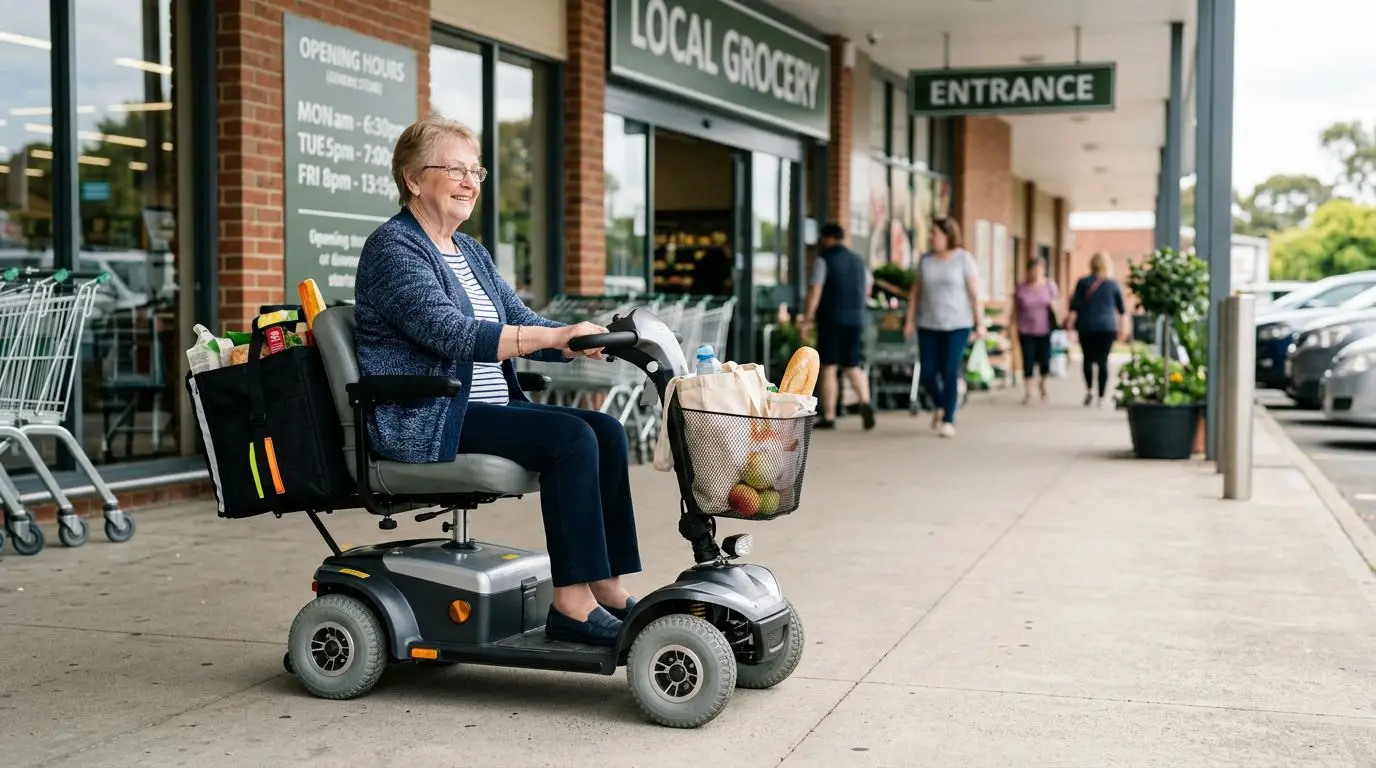
The safest way to add storage to a mobility scooter is to keep cargo light, secure, and as close to the scooter’s center as possible. Front baskets, rear bags, under-seat compartments, and specialty holders can all work well, but each one affects handling differently, especially when you add 5, 10, or 20 pounds of items.
For most riders, a good setup is a small front basket for quick-reach items, under-seat storage for compact valuables, and a rear bag or carrier only when extra space is really needed. Always count cargo as part of the scooter’s total weight capacity, and avoid hanging loose bags from the tiller or armrests.
Why storage and weight balance matter on a 3- or 4-wheel scooter
Mobility scooters are built around balance. The battery pack, seat, frame, and rider position all work together to keep the scooter stable during turns, stops, ramps, and uneven sidewalk transitions. When you add cargo, you change that balance.
That does not mean storage accessories are unsafe. It means they should be used with care. A 6-pound purse in a front basket may feel fine, while a 25-pound grocery load hanging behind the seat can make the rear of the scooter feel heavier during a turn or when backing up.
Three-wheel scooters usually have a tighter turning radius, sometimes around 30 to 40 inches, but they can feel more sensitive to side-to-side weight shifts. Four-wheel scooters often feel more planted, yet they still have limits on slopes, curbs, and sudden steering. Storage affects both types.
The most important number is the scooter’s total weight capacity. If a scooter is rated for 300 pounds, that typically includes the rider, cargo, oxygen equipment, bags, and any accessories attached to the scooter. A rider who weighs 270 pounds has much less remaining capacity for storage than a rider who weighs 190 pounds on the same scooter.
Also check the accessory’s own rating. Many front baskets are intended for light items, often in the 5- to 15-pound range depending on their mounting style. Rear carriers may hold more, but extra capacity does not automatically mean better handling. A load can be within the stated limit and still feel awkward if it is high, loose, or uneven.
Front baskets: best for 5 to 15 pounds of easy-reach items
A front basket is the most common scooter storage accessory because it keeps essentials visible and within reach. It is a practical place for a water bottle, small purse, phone pouch, mail, light groceries, or a folded jacket.
Front baskets work best when the load is compact and shallow. Heavy items in the front can affect steering feel, especially on scooters with lighter tillers. If the basket is mounted to the tiller rather than the frame, every pound may be felt through the steering column.
A common mistake is treating a front basket like a shopping cart. A half-gallon of milk weighs about 4 pounds, and a few canned goods can add another 5 to 8 pounds quickly. That may put a small basket near its practical comfort limit before you add a purse or medical supplies.
Who a front basket is best for
- Riders who need quick access to keys, glasses, a phone, wallet, or tissues.
- Short errands with 1 small shopping bag rather than a full grocery run.
- People who prefer to see their belongings while riding.
- Riders who can keep items below the top edge of the basket so nothing bounces out.
Front basket safety tips
- Keep the load low and evenly spread across the bottom of the basket.
- Do not block the headlight, controls, horn, or your view of the front wheel area.
- Use a small zip pouch or drawstring bag for loose items.
- Avoid glass containers when possible; bumps can cause breakage.
- Do not place medications that are heat-sensitive in an uncovered basket for long periods.
If you ride on rough sidewalks, choose a basket style that holds items snugly. A soft liner or small organizer can reduce rattling and keep small belongings from slipping through wire openings.
Rear bags and rear baskets: better volume, but 10 to 25 pounds can change handling
Rear storage helps when a front basket is not enough. A rear bag, rear basket, or carrier behind the seat can hold bulkier items such as a raincoat, groceries, incontinence supplies, a small cooler bag, or a folded walking aid if the carrier is designed for it.
The tradeoff is weight placement. Rear storage usually sits behind the rider and may sit higher than the deck. Ten pounds behind the seat is often manageable, but 20 to 25 pounds can make some scooters feel tail-heavy, especially on ramps or when turning on a slope.
Rear bags are usually softer and better for clothing, personal items, and lightweight medical supplies. Rear baskets and platforms may suit boxy items better, but they need secure tie-down points. Any open rear carrier should use straps, bungee cords designed for the task, or a fitted cover so items cannot fall into the wheels or onto the ground.
Who rear storage is best for
- Riders who carry more than a front basket can safely hold.
- Grocery trips with several light bags instead of one heavy bag.
- Carrying supplies that do not need to be reached while driving.
- Riders using 4-wheel scooters or larger scooters with a more stable platform.
Rear storage is usually not the best place for items you need immediately, such as emergency contact information, a rescue inhaler, or a phone. Keep those on your person, in a front pouch, or in a pocket you can reach without twisting hard in the seat.
Check the scooter’s overall length after installing rear storage. Adding 8 to 14 inches behind the seat can affect elevators, vehicle lifts, apartment hallways, and turns into a bathroom or small kitchen. That extra length matters indoors.
Under-seat storage: secure space for small items under about 3 to 6 inches tall
Under-seat storage is useful because it keeps weight near the center of the scooter. Depending on the scooter design, it may be a small compartment, a removable tray, or simply open space beneath the seat post area. Capacity is usually limited, but the position is excellent for balance.
This type of storage works best for compact items: a wallet, folded shopping tote, gloves, small first-aid pouch, charging cord, or paperwork in a sealed bag. It is not usually the place for bulky groceries or tall medical equipment. Many under-seat areas only fit items a few inches high, so measure before assuming something will fit.
Advantages of under-seat storage
- Weight stays close to the rider and scooter frame.
- Items are less visible than in an open basket.
- Small belongings are less likely to bounce out.
- It does not add length to the scooter.
Limits to keep in mind
- Access may require stopping and rotating or lifting the seat, depending on the design.
- Space may be shallow, narrow, or interrupted by the seat post.
- Some compartments are not sealed against rain.
- Heat can build up in enclosed spaces during warm weather.
Do not store anything under the seat that interferes with seat locking, battery access, wiring, or seat swivel movement. If an item causes the seat to wobble or prevents it from latching, remove it.
Carrying medical items, oxygen, and personal supplies safely
Many riders use scooter storage for health-related items: medication organizers, wound-care supplies, incontinence products, glucose tablets, a blood pressure cuff, or portable oxygen equipment. These items need more care than ordinary cargo because damage, heat, moisture, or loss can create a serious problem.
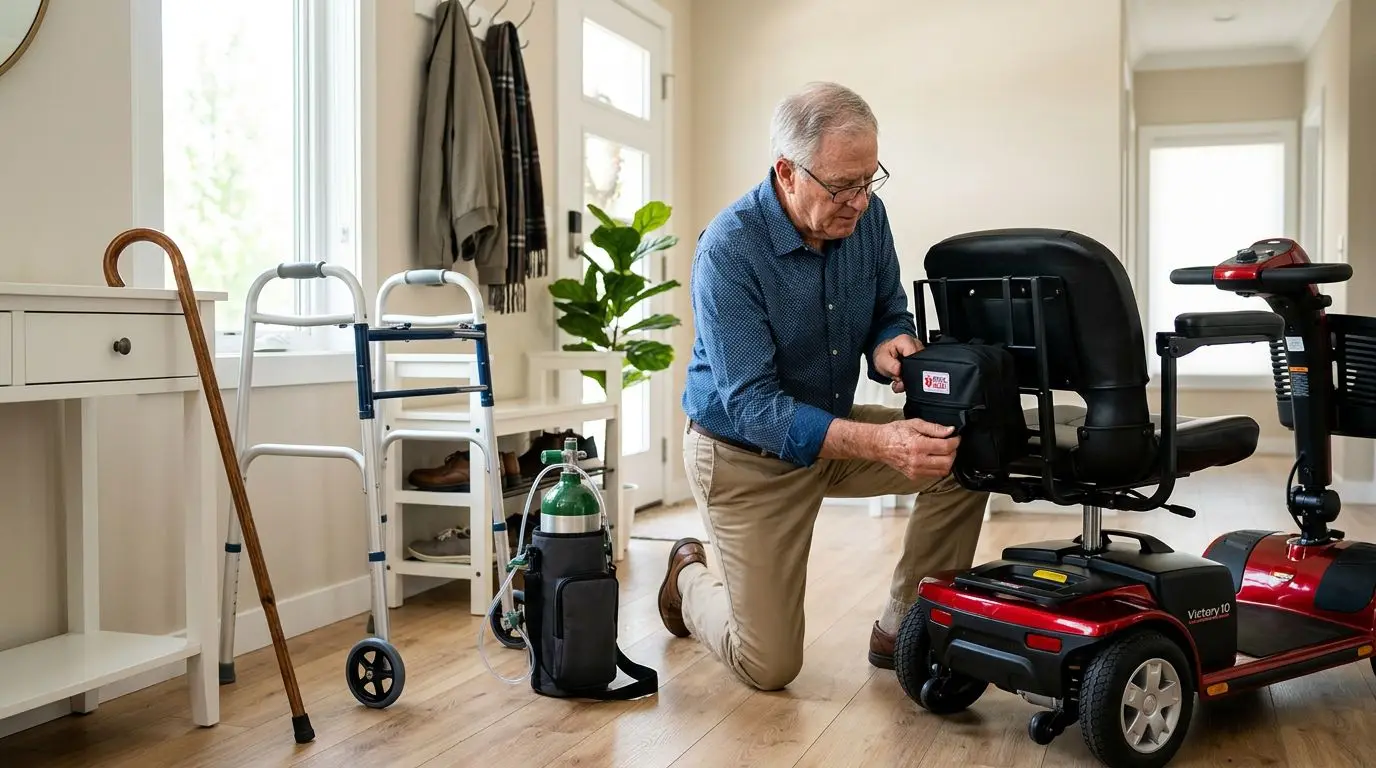
Portable oxygen equipment should be carried only in a holder or bag appropriate for the equipment’s size and orientation. Many portable oxygen concentrators weigh roughly 5 to 10 pounds, while some oxygen cylinders can weigh more depending on size and material. The equipment supplier or clinician can tell you whether the unit should remain upright, whether ventilation is required, and how to avoid blocking vents or tubing.
Never let oxygen tubing trail near wheels, the ground, or moving scooter parts. Tubing should have enough slack for comfortable head movement but not so much that it catches on armrests, doorways, baskets, or a lift. If you use oxygen while riding, practice mounting, turning, and dismounting in a safe open area before taking the setup into a store or medical office.
Medication is another special case. Some medicines should not sit in a hot front basket or cold rear bag for long. A small insulated pouch may help for short errands, but it is not a substitute for proper storage instructions. Follow the medication label or ask a pharmacist if temperature matters.
Practical setup ideas
- Keep emergency identification and a phone within arm’s reach, not buried in a rear bag.
- Use separate pouches for medical items and groceries to prevent spills or contamination.
- Choose water-resistant storage for paperwork, dressings, and electronics.
- Label medical bags clearly if someone may need to help you.
- Do not overload a holder just because the item fits inside it.
A scooter can support independence, errands, and community access, but it should not be treated as a medical device platform without checking compatibility. When oxygen, powered medical equipment, or other critical items are involved, ask the equipment provider what mounting and ventilation rules apply.
How to choose and measure scooter storage in 7 steps
The right accessory is the one that fits your scooter, your body, and your usual errands. A storage bag that looks roomy may still be a poor choice if it blocks the seat swivel, rubs the tires, or makes the scooter too long for your vehicle lift.
- Check total weight capacity. Start with the scooter’s stated limit, such as 250, 300, or 350 pounds, then subtract the rider’s weight and any accessories already installed.
- Find the accessory weight rating. Look for the basket, bag, or carrier limit. If no rating is available, be conservative and use it only for light items.
- Measure mounting space. For a front basket, measure width at the tiller or bracket area. For rear storage, measure clearance behind the seat and above the rear shroud.
- Check turning and seat movement. Turn the tiller fully left and right, and swivel the seat if it has that feature. Nothing should pinch, scrape, or block movement.
- Measure your doorway or lift. A scooter that is 42 inches long may become 52 inches long with a rear carrier. That can matter in elevators, vans, and tight hallways.
- Test with real weight. Put 5 pounds, then 10 pounds, then your usual load in the storage area and try slow turns in a safe place.
- Confirm access. Make sure you can reach the items you need without leaning far forward, twisting sharply, or standing on an unstable surface.
Use a tape measure, not a guess. Measure the height, width, and depth of the items you carry most often. A standard reusable grocery bag may be about 13 inches wide and 15 inches tall, but the contents can bulge beyond that. Soft bags need room to flex.
If you use a vehicle lift or transport the scooter in a car, measure with the accessory installed and loaded. Some storage accessories must be removed before transport to prevent damage or wind movement.
Comparison table: front baskets, rear bags, under-seat storage, and specialty holders
The table below compares common storage locations using practical everyday loads. Exact limits vary, so use these as decision points rather than fixed ratings.
| Storage type | Best use | Typical practical load | Balance effect | Main caution |
|---|---|---|---|---|
| Front basket | Phone, wallet, small purse, light groceries | About 5 to 15 lb when rated for it | Can affect steering | Do not block lights or controls |
| Rear soft bag | Clothing, supplies, lightweight bulk | Often 5 to 20 lb depending on mounting | Adds weight behind the rider | May be hard to reach while seated |
| Rear basket or platform | Boxy items, multiple small bags | May support heavier loads if rated | Can make scooter feel tail-heavy | Must secure items so they cannot fall |
| Under-seat compartment | Keys, gloves, documents, small pouches | Usually light, compact items only | Good center balance | Limited height and access |
| Oxygen or medical holder | Specific oxygen or medical equipment | Based on equipment and holder rating | Depends on position and weight | Follow supplier guidance for orientation and ventilation |
Feature comparison: 6 storage details that affect daily use
Small design details can matter more than size. A 12-inch-wide bag with good zippers and a stable mount may be more useful than a larger bag that swings, sags, or blocks the seat.
| Feature | Why it matters | What to look for |
|---|---|---|
| Mounting style | Determines stability and compatibility | Secure brackets, straps, or frame attachment points |
| Weather resistance | Protects papers, electronics, and medical supplies | Water-resistant fabric, covered zippers, or a removable liner |
| Closure | Keeps items from bouncing out | Zipper, flap, buckle, drawstring, or fitted cover |
| Reflective material | Improves visibility in low light | Reflective strips on rear or side-facing surfaces |
| Compartments | Separates medication, groceries, and valuables | At least 2 sections or removable pouches |
| Quick removal | Helps with charging, transport, and security | Handles, clips, or straps that can be removed without tools |
If you ride at dusk, reflective trim is simple and useful. It does not replace scooter lights, but it can make the storage bag more visible from the rear or side.
Weight balance rules for groceries, purses, oxygen, and daily items
A good storage setup should feel predictable at walking speed, during a tight turn, and on a gentle ramp. If the scooter leans, tips, drags, or feels harder to steer after loading, the storage arrangement needs to change.
Use the 3-point balance idea: keep heavy items low, centered, and secured. Low means close to the scooter deck or seat base. Centered means not hanging off one side. Secured means the item cannot swing, bounce, slide, or contact the wheels.
Safer loading habits
- Split groceries into 2 lighter bags instead of one heavy bag.
- Put canned goods, bottled drinks, and other dense items as low as possible.
- Do not hang a purse from one armrest; it can swing and affect balance.
- Keep bags away from the throttle, brake lever, tiller adjustment knob, and charging port.
- Recheck straps after the first 5 minutes of riding, especially with a new setup.
Side loads need special attention. A 7-pound bag on one armrest may not sound heavy, but because it sits away from the centerline, it can make the scooter feel uneven. This is more noticeable when turning toward the loaded side or crossing a driveway apron.
Ramps are another test. Many scooters list a maximum climbing angle, often described in degrees or as a grade, but real-world safety also depends on rider weight, cargo, tire condition, surface, and speed. If a scooter already feels close to its limit on a ramp, adding rear cargo can make it less steady.
Stop and adjust if you notice new rattles, rubbing, steering wobble, or reduced braking confidence. Storage should make errands easier, not create a new hazard.
Who each storage accessory is best for: 5 common carrying needs
Different riders carry different things. A person going to the mailbox needs a different setup than someone who shops weekly or rides to medical appointments with equipment.
| Carrying need | Best storage approach | Why it works |
|---|---|---|
| Purse, wallet, keys, phone | Small front basket or under-seat compartment | Keeps valuables close and easy to manage |
| Light grocery trip | Front basket plus rear soft bag | Splits weight instead of overloading one spot |
| Medical supplies | Water-resistant pouch in front or under-seat area | Protects items and keeps essentials reachable |
| Portable oxygen equipment | Purpose-appropriate holder in the recommended position | Supports the equipment while respecting orientation and ventilation needs |
| Jacket, rain gear, spare tote | Rear bag or under-seat space | Bulky but light items are less likely to affect handling |
If you frequently carry more than 20 pounds of cargo, consider whether a scooter is the right tool for that errand as currently configured. Delivery, a companion’s cart, smaller trips, or store-provided assistance may be safer than pushing the scooter’s practical limits.
FAQ: 5 common questions about mobility scooter storage accessories
Can I hang grocery bags from the scooter handlebars or tiller?
It is not a good idea. Bags hanging from the tiller can interfere with steering, throttle controls, horn buttons, or brake levers. They can also swing during turns. Use a basket, bag, or carrier that is mounted securely and rated for the load.
How much weight can I put in a mobility scooter basket?
Use the basket’s stated weight rating if available. Many front baskets are meant for light loads, often around 5 to 15 pounds, but designs vary. If you cannot confirm the limit, keep the load light and test handling slowly in a safe area.
Is rear storage safer than front storage?
Not always. Rear storage can hold bulkier items and may leave steering lighter, but too much weight behind the seat can affect ramps, backing up, and turning. Front storage is easier to reach, yet heavy front loads can affect steering. The safest choice depends on weight, mounting, and scooter design.
Where should I carry medication on a scooter?
Keep medication secure, dry, and within a safe temperature range. For short trips, a small pouch in a front basket, under-seat compartment, or personal pocket may work. Follow the medication label or ask a pharmacist if heat, cold, or sunlight are concerns.
Can I carry oxygen on a mobility scooter?
Often, yes, but it should be carried in a holder appropriate for the oxygen equipment and used according to supplier or clinician guidance. Do not block vents, kink tubing, or let tubing trail near wheels. Confirm whether the equipment must stay upright.
Frequently asked questions
Can I hang grocery bags from the scooter handlebars or tiller? +
It is not recommended. Hanging bags can interfere with steering and controls and may swing during turns. Use a securely mounted basket, bag, or carrier instead.
How much weight can I put in a mobility scooter basket? +
Follow the basket’s stated rating. Many front baskets are intended for light loads, often around 5 to 15 pounds, but limits vary by design and mounting style.
Is rear storage safer than front storage? +
Neither is automatically safer. Rear storage can hold bulkier items but may make the scooter feel tail-heavy, while heavy front storage can affect steering. Keep weight low, centered, and secured.
Where should I carry medication on a scooter? +
Carry medication in a secure, dry pouch that stays within the required temperature range. Keep essential medication reachable and ask a pharmacist if heat, cold, or sunlight are concerns.
Can I carry oxygen on a mobility scooter? +
Often, yes, if the oxygen equipment is carried in an appropriate holder and used according to supplier or clinician guidance. Keep vents clear, tubing controlled, and confirm whether the equipment must remain upright.
Related guides
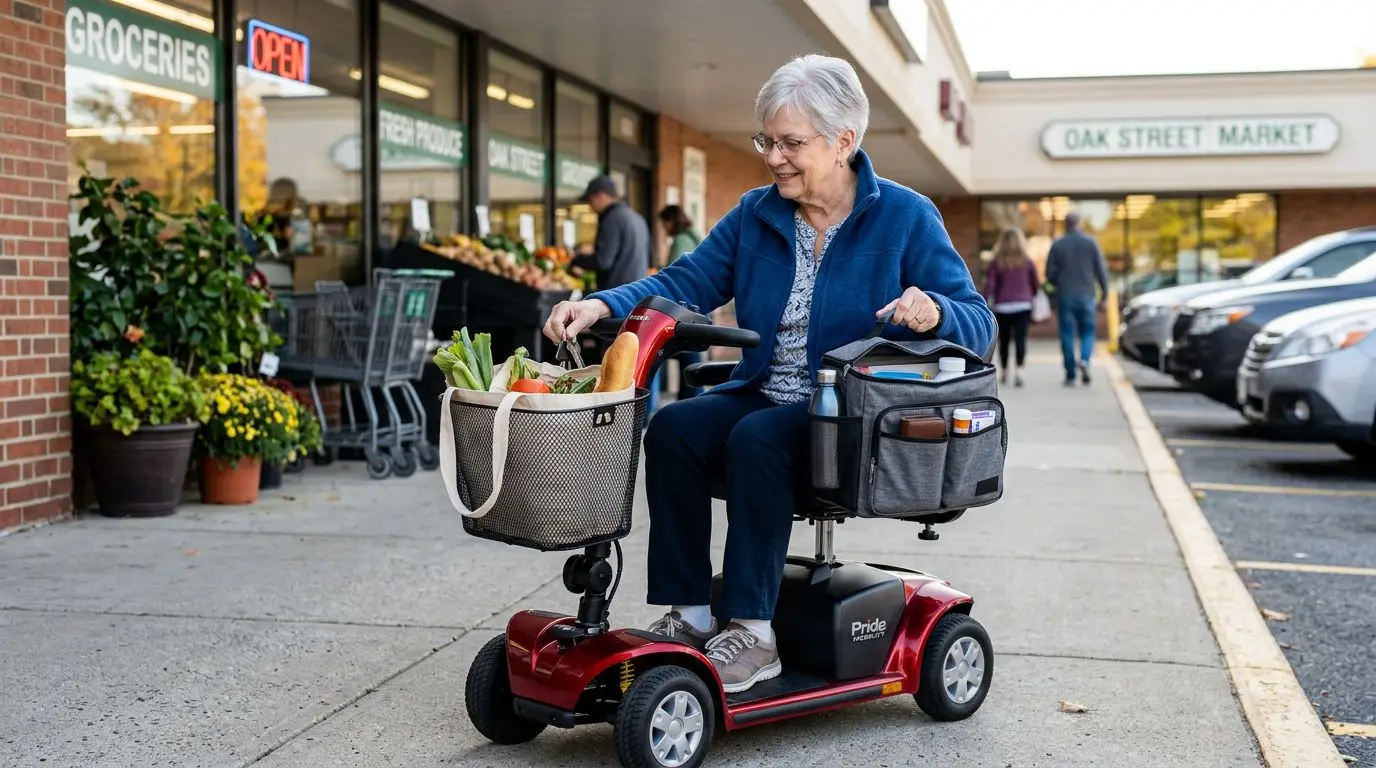
Mobility Scooter Bags vs. Baskets: How to Choose the Right Storage Accessory
13 min read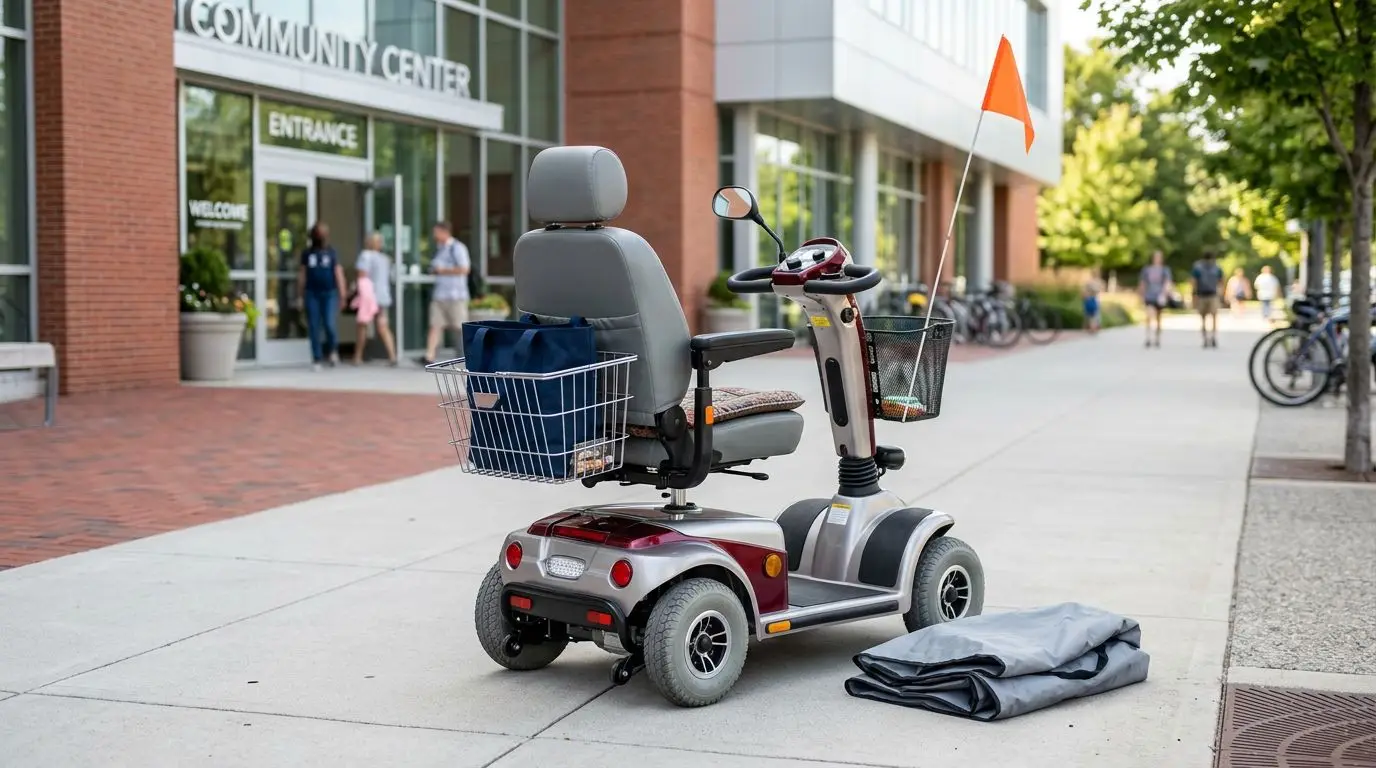
Best Mobility Scooter Accessories for Daily Use: Storage, Safety, Comfort, and Weather Protection
14 min read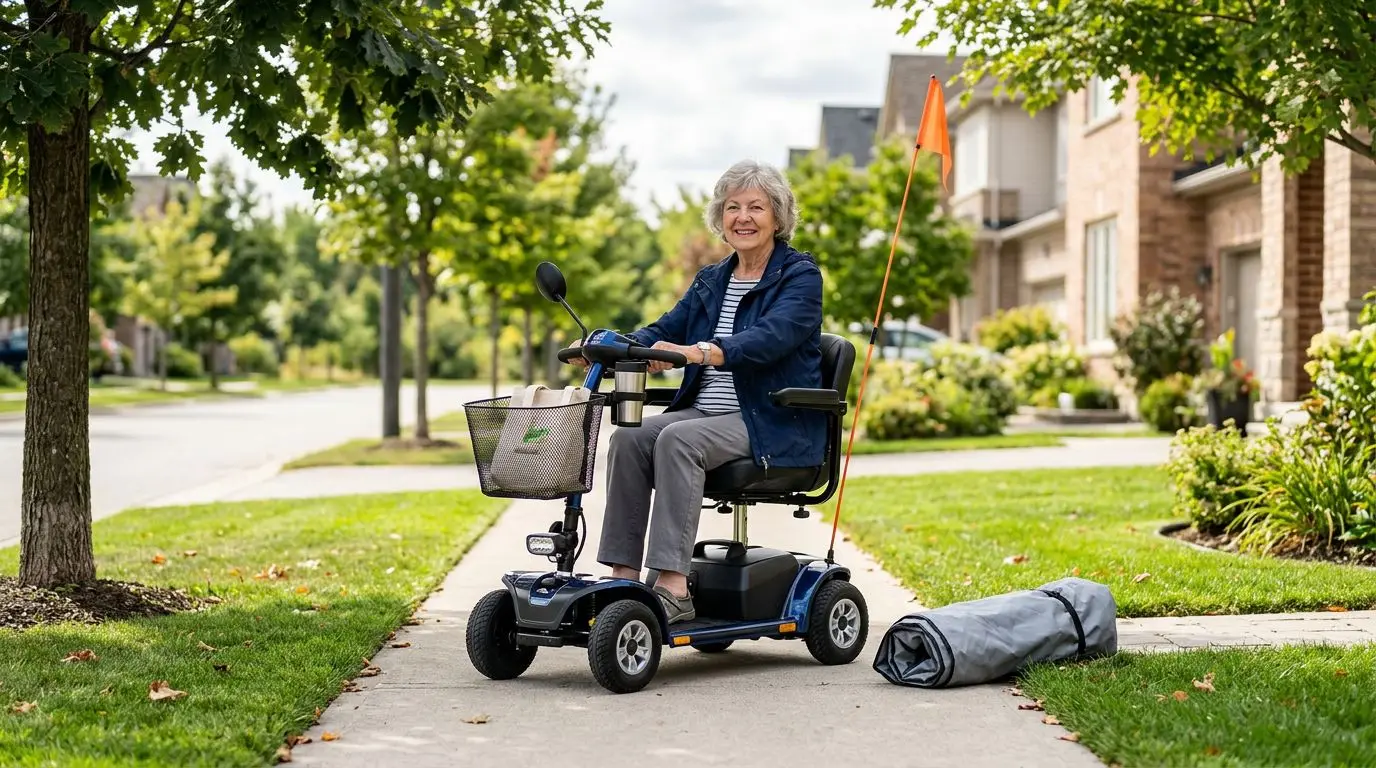
Best Mobility Scooter Accessories for Safety, Storage, and Everyday Comfort
13 min read