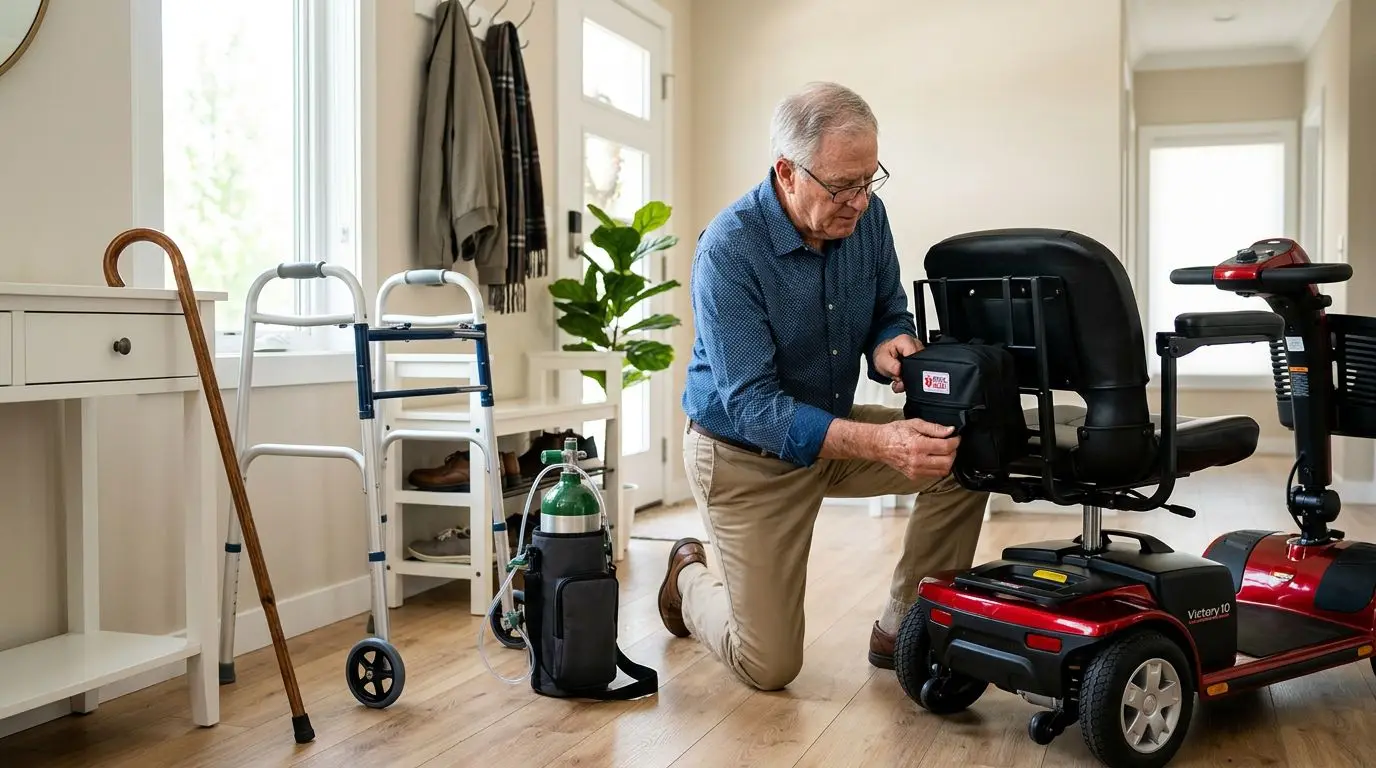
A mobility scooter holder can safely carry a cane, crutch, walker, or oxygen tank only when it fits the scooter frame, stays within the scooter’s accessory weight limits, and does not block steering, braking, lights, or your path on and off the seat. Before using one, measure the scooter, confirm the loaded weight, and take a slow test ride for at least 10 minutes in an open area.
These accessories are practical for many seniors and adults who use more than one mobility or medical aid during the day. The key is to treat the holder as part of the scooter’s safety system, not just as a storage add-on.
Why holders matter when you carry 1 to 3 extra items
Many scooter users rely on a second aid after they park: a cane for short indoor walks, a forearm crutch for transfers, a folding walker for longer distances, or a portable oxygen cylinder for prescribed oxygen use. Even 1 loose item carried across your lap can interfere with the tiller, the speed control, or your ability to make a clean turn.
A properly fitted holder keeps equipment upright, restrained, and predictable. That matters because a cane sliding off the foot deck or a walker shifting behind the seat can become a trip hazard, damage nearby property, or change how the scooter feels when turning.
Most holders attach in one of 3 common areas: behind the seat, on the rear accessory bracket, or along the seat post or armrest area. Rear mounting is common because it keeps long items away from your knees and the tiller, but it also places weight behind the rear wheels. That rear weight must be accounted for, especially on compact scooters with short wheelbases.
The goal is simple: carry what you need without creating a new problem. A holder should make daily travel easier, not make the scooter wider, heavier, or harder to control than it was designed to be.
Holder types compared: canes, crutches, walkers, and oxygen tanks
The right holder depends on the shape, length, and weight of the equipment. A standard single-point cane may weigh around 1 lb, while a folding walker can weigh 6 to 10 lb or more before accessories. A portable oxygen cylinder and carrier can add several pounds, and the cylinder must remain secure and upright unless your oxygen supplier has told you otherwise for your specific equipment.
| Holder type | Best for | Common mounting location | Key fit concern | Safety note |
|---|---|---|---|---|
| Cane holder | 1 or 2 canes, often straight or folding styles | Rear bracket, seat post, or side frame | Cane tip diameter and total cane length | Tip should not drag or swing into wheels |
| Crutch holder | Underarm or forearm crutches, usually 1 pair | Rear of seat or rear accessory mount | Crutch height, cuff shape, and lower tip spacing | Secure both top and bottom to prevent bouncing |
| Walker holder | Folding walkers and some compact rollators | Rear accessory bracket | Folded width and frame tube shape | Check that added width clears doorways and ramps |
| Oxygen tank holder | Portable cylinders or prescribed oxygen equipment | Rear basket area, rear bracket, or dedicated carrier position | Cylinder diameter, height, valve clearance, and tubing route | Follow oxygen supplier guidance; keep away from heat and flames |
Cane and crutch holders usually use cups, clips, straps, or a tube-style sleeve. Walker holders typically use a bracket, hook, or frame cradle to hold the folded walker against the rear of the scooter. Oxygen tank holders must do more than support weight; they need to prevent tipping, protect the regulator or valve area, and allow tubing to route without pinching.
One caution: a holder that fits the item does not automatically fit the scooter. Always check both sides of the pairing.
How to choose and measure before buying: 6 fit checks
Use a tape measure, a bathroom scale if needed, and your scooter owner information before choosing a holder. Write the numbers down. A 1-inch mismatch at the bracket or tube can be enough to make an accessory unstable or unusable.
- Measure the scooter’s mounting point. Check the rear accessory receiver, seat post, armrest tube, or frame tube where the holder would attach. Note the shape, width, and available clearance.
- Measure equipment length. For a cane or crutch, measure from the hand grip to the rubber tip. For a walker, measure its folded height and folded width.
- Measure diameter and shape. Cane tips, crutch shafts, walker tubing, and oxygen cylinders vary. A round tube and an oval tube may need different support styles.
- Check ground clearance. With the item in the holder, the lowest point should stay above the ground, curb edges, and ramp transitions. Even 2 inches of dragging can catch on thresholds.
- Confirm seat movement. Swivel the seat, fold the armrests, and slide the seat if your scooter allows adjustment. The holder should not trap you in place.
- Check transport position. If your scooter disassembles or folds, see whether the holder must be removed first. A part that adds 5 minutes every trip may become frustrating.
For walkers, pay close attention to folded width. Some walkers fold narrow front-to-back, while others fold side-to-side. A holder designed for a flat-folding frame may not control a bulkier frame with wheels, a seat, or hand brakes.
For oxygen tanks, measure the cylinder diameter and height with the regulator attached if that is how you travel. The top of the tank should not be squeezed against the seat back, and the tubing should not run across the foot deck where shoes can catch it.
Weight and balance limits: know the loaded pounds
Every mobility scooter has a stated user weight capacity, and many also have separate limits for baskets, rear accessories, or hitch-style attachments. Do not assume a rear holder can carry the same weight as the scooter seat. A rear basket may be limited to 10 lb, 15 lb, or another value set by the scooter maker.
Add up the full load. That means the holder, the cane or walker, any oxygen cylinder, small bag, pouch, rain cover, and anything else attached at the same point. If the holder weighs 3 lb and the equipment weighs 8 lb, that is 11 lb before you add personal items.
| Check | Why it matters | Practical example |
|---|---|---|
| Total accessory weight | Prevents overloading the bracket or scooter frame | Holder plus walker plus pouch may exceed 10 lb |
| Rear balance | Too much weight behind the seat can affect steering feel | A heavy folded walker may make tight turns feel different |
| Side-to-side balance | Uneven loads can lean or swing during turns | One crutch on one side may need a second restraint point |
| Clearance while turning | Long items can sweep into walls, shelves, or door frames | A 36-inch cane mounted at an angle needs room behind you |
Weight also affects stopping distance and turning comfort. Most users will not notice much change from a single lightweight cane, but a walker or oxygen cylinder can make the scooter feel different on ramps, sidewalk seams, or tight indoor turns.
If your scooter already operates near its maximum user weight capacity, be especially careful. Accessories count. When in doubt, ask the scooter manufacturer, dealer, repair technician, or clinician familiar with your mobility needs before adding a loaded rear holder.
Safety checks after installation: a 10-minute test ride
After installing any holder, test it before using it in a store, clinic, apartment hallway, or parking lot. A safe test can take 10 minutes and may reveal problems that are hard to see while the scooter is parked.
- Start with a parked check. Shake the holder gently by hand. It should not wobble, twist, or slide on the mounting point.
- Load the equipment. Place the cane, crutch, walker, or tank exactly as you plan to use it. Fasten every strap or clip.
- Check controls and visibility. Turn the tiller fully left and right. Confirm the throttle, brake release, horn, lights, mirrors, and basket still work normally.
- Mount and dismount twice. Sit down and get up as you normally would. The holder should not block your foot placement or hand support points.
- Drive slowly in a straight line. Listen for rattling or dragging. Stop and inspect if anything shifts.
- Practice 3 turns each way. Include a wide turn and a tight turn. Watch how far the equipment swings behind or beside you.
- Try a small ramp if appropriate. Use a gentle, familiar ramp only if you normally travel that route. Keep speed low.
Do not use the holder if the equipment blocks the anti-tip wheels, rear lights, reflectors, charging port, freewheel lever, or seat release. Those parts may be needed quickly, and an accessory should not cover them.
Noise is another clue. Some rattling is annoying but harmless; metal-on-metal shifting, repeated thumping, or a strap that loosens after a few minutes needs attention before regular use.
Who it is best for—and who should reconsider after 1 test ride
Cane, crutch, walker, and oxygen tank holders are best for scooter users who need their equipment after they park, can load and unload it safely, and have a scooter with a compatible mounting point. They are especially useful for adults who drive the scooter to a dining room, clinic lobby, mailbox area, or store entrance and then walk a short distance with another aid.
A holder may be a poor fit if you cannot reach the equipment without twisting too far, if the loaded accessory makes the scooter feel unstable, or if the item blocks your safest transfer routine. For some users, a front basket, a caregiver-carried aid, a lighter folding device, or a different scooter setup may be safer.
Oxygen users should be especially deliberate. A tank holder can be very helpful, but oxygen equipment has its own safety rules. Follow instructions from your oxygen supplier and healthcare team, including guidance on positioning, tubing length, cylinder storage, and travel near heat sources.
If you feel less steady after just 1 test ride, pause. The accessory may need adjustment, a different mounting position, or professional installation. Independence is the goal, but not at the expense of control, visibility, or safe transfers.
Oxygen tank holder considerations: secure 1 cylinder and protect the tubing
Oxygen tank holders deserve separate attention because they carry medical equipment, not just walking aids. The holder should keep 1 cylinder secure in the size range recommended for that holder, prevent bouncing, and protect the regulator area from bumps.
Never hang an oxygen cylinder loosely from an armrest, tiller, or shopping bag hook. A loose cylinder can swing, strike the scooter, or fall. Keep the cylinder away from open flames, smoking materials, high heat, and anything that could damage the valve or regulator. Oxygen itself is not a flame, but it can make fire burn more intensely.
Tubing is often the overlooked hazard. Route tubing so it does not cross the foot deck, wrap around the tiller, or drag near the wheels. Many users need enough slack to turn their head and mount the scooter, but too much loose tubing can snag. If you are unsure about tubing length or routing, ask your oxygen supplier for specific guidance.
Check whether the holder allows you to read the gauge and adjust equipment as instructed. You should not need to remove the tank every time you check it unless your care instructions require that. Keep emergency access in mind, too; a caregiver should be able to remove the cylinder quickly if needed.
Maintenance and daily use: a 30-second checklist
A holder that was safe last month can loosen with daily vibration. Build a 30-second check into your routine, especially before leaving home or loading the scooter into a vehicle.
- Confirm the holder is tight at the mounting point.
- Check straps, buckles, clips, cups, and rubber tips for wear.
- Make sure the carried item is fully seated and cannot bounce out.
- Look for cracked plastic, bent metal, rust, or missing hardware.
- Check that lights, reflectors, and the charging port are not blocked.
- Remove extra bags or items that were not included in your weight check.
Clean dirt from cups and cradles because grit can wear straps and finishes. If the holder uses hook-and-loop material, press it flat and replace it when it no longer grips firmly. If it uses bolts, check them periodically with the correct tool, but avoid overtightening parts attached to plastic shrouds or seat components.
Weather matters. Rain can make straps stretch, metal parts slippery, and rubber tips easier to dislodge. After wet travel, dry the holder and inspect it before the next trip.
FAQ: 5 common questions about scooter holders
Can I carry a cane across my lap instead of using a holder?
It may seem convenient, but it is not ideal. A cane across your lap can slide into the tiller, fall onto the foot deck, or interfere with your hands. A properly fitted holder is usually safer for routine travel.
Will a walker holder fit any folding walker?
No. Folding walkers vary in folded width, tube shape, wheel size, and handle style. Measure the walker when folded and compare it with the holder’s supported dimensions before using it.
Can I install a holder myself?
Some holders are simple clamp-on or bracket-mounted accessories, while others require a compatible rear receiver or careful alignment. If installation affects the seat, rear frame, wiring, lights, or oxygen equipment, get help from a qualified scooter technician or equipment provider.
How much weight can a scooter holder carry?
There is no universal limit. The safe load depends on the holder, mounting point, scooter design, and any rear accessory rating. Always include the weight of the holder plus the carried item, not just the cane, walker, crutch, or tank.
Can an oxygen tank go in a regular rear basket?
Only if your oxygen supplier and scooter documentation allow that setup and the tank is secured against tipping and impact. A dedicated holder is often safer because it supports the cylinder shape and helps control movement.
What should I do if the scooter feels different after adding a holder?
Stop using the loaded holder until you identify the cause. Check weight, balance, loose hardware, dragging parts, and turning clearance. If the scooter still feels unstable, ask a technician or mobility professional to review the setup.
Frequently asked questions
Can I carry a cane across my lap instead of using a holder? +
It may seem convenient, but it is not ideal. A cane across your lap can slide into the tiller, fall onto the foot deck, or interfere with your hands. A properly fitted holder is usually safer for routine travel.
Will a walker holder fit any folding walker? +
No. Folding walkers vary in folded width, tube shape, wheel size, and handle style. Measure the walker when folded and compare it with the holder’s supported dimensions before using it.
Can I install a holder myself? +
Some holders are simple clamp-on or bracket-mounted accessories, while others require a compatible rear receiver or careful alignment. If installation affects the seat, rear frame, wiring, lights, or oxygen equipment, get help from a qualified scooter technician or equipment provider.
How much weight can a scooter holder carry? +
There is no universal limit. The safe load depends on the holder, mounting point, scooter design, and any rear accessory rating. Always include the weight of the holder plus the carried item, not just the cane, walker, crutch, or tank.
Can an oxygen tank go in a regular rear basket? +
Only if your oxygen supplier and scooter documentation allow that setup and the tank is secured against tipping and impact. A dedicated holder is often safer because it supports the cylinder shape and helps control movement.
What should I do if the scooter feels different after adding a holder? +
Stop using the loaded holder until you identify the cause. Check weight, balance, loose hardware, dragging parts, and turning clearance. If the scooter still feels unstable, ask a technician or mobility professional to review the setup.
Related guides

Mobility Scooter Storage Accessories: Baskets, Bags, Under-Seat Space, and Weight Balance
15 min read
Mobility Scooter Cup Holders, Trays, and Phone Mounts: Safe Convenience Add-Ons
15 min read
How to Choose Mobility Scooter Accessories That Actually Fit: Universal vs. Scooter-Specific Add-Ons
13 min read