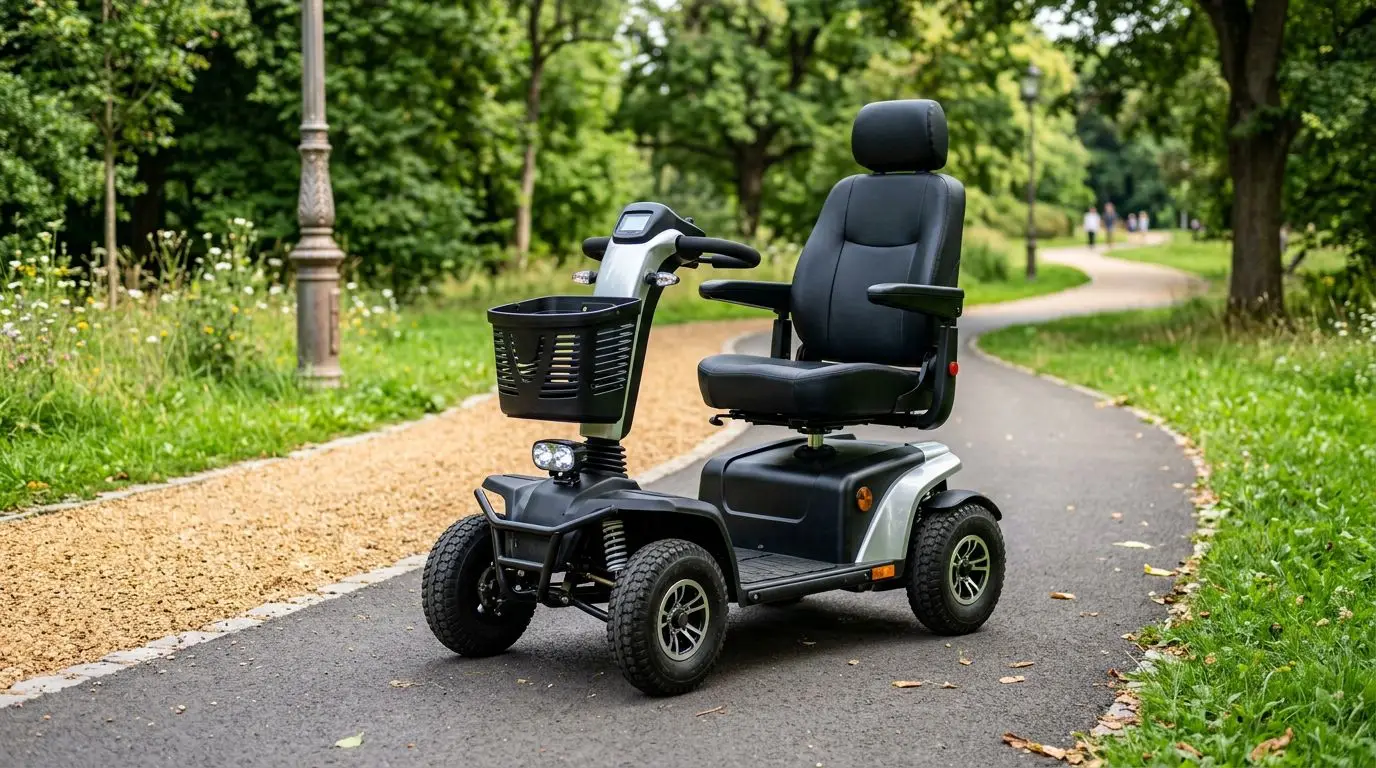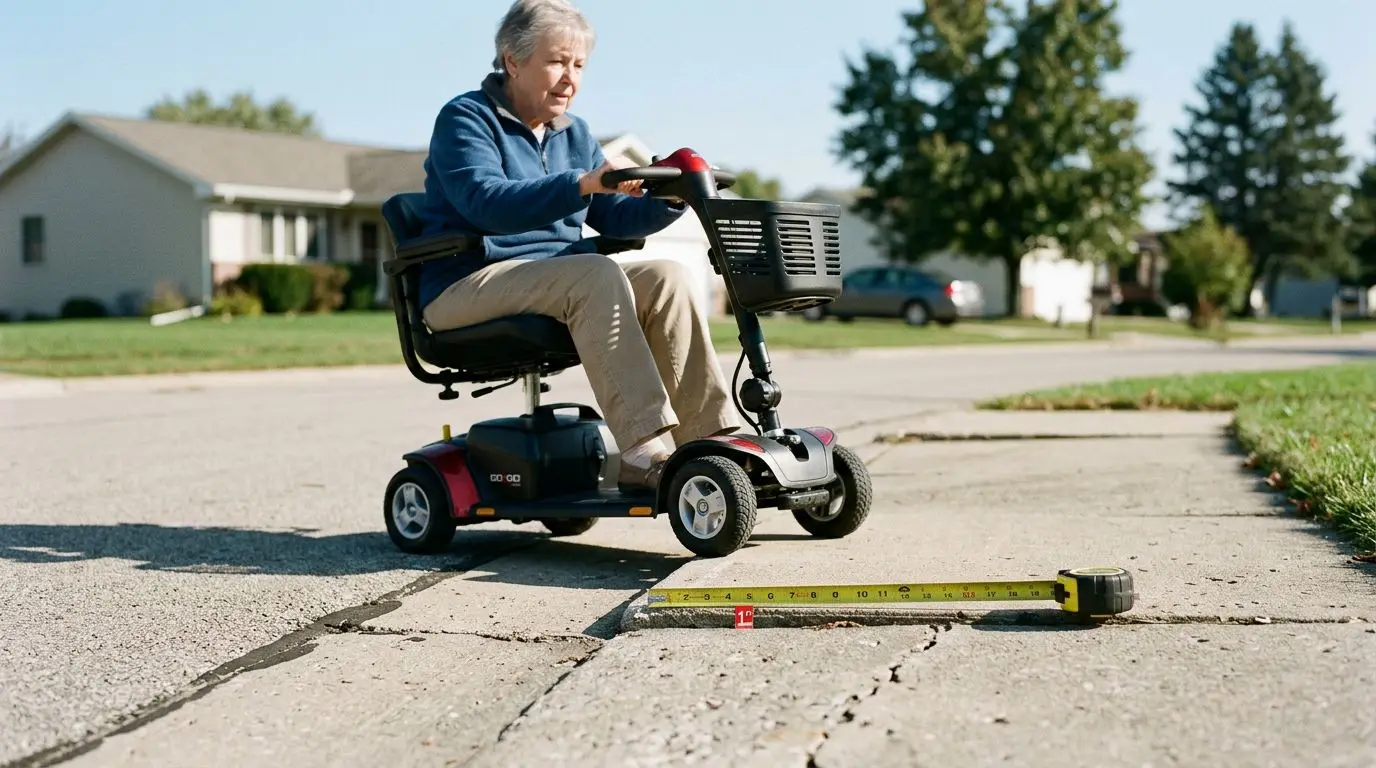
Small mobility scooter tires and low ground clearance may be enough if you mostly ride indoors, on smooth store floors, and on well-maintained sidewalks with shallow thresholds. If your daily route includes cracked pavement, curb-cut lips, gravel patches, brick paths, or raised door thresholds near 1 inch or more, larger tires, better suspension, and higher clearance are usually the more comfortable and safer choice.
The right setup is not about buying the biggest scooter. It is about matching tire size, tire material, suspension, and clearance to the surfaces you actually use each week.
Start with the surfaces you use 80% of the week
Before comparing tire types, think about where the scooter will spend most of its time. Someone who rides 80% indoors and only crosses a short, flat parking lot has different needs than someone who travels several blocks on uneven sidewalks every day.
Small travel-style scooters often feel nimble in tight spaces, elevators, apartment hallways, and store aisles. Their lower profile can also make transfers easier for some users. The trade-off is that short tires and limited underbody clearance have less room to absorb bumps or roll over raised edges.
Outdoor-oriented scooters usually use larger tires, stronger frames, and sometimes suspension. They can feel steadier on imperfect pavement, but they may also be heavier, longer, harder to lift, and less convenient in compact homes.
Who small tires and low clearance are best for
- Riders who primarily use the scooter indoors or in smooth commercial spaces.
- People whose outdoor trips are short, such as from a car to a medical office entrance.
- Homes with smooth flooring and thresholds under about 1/2 inch.
- Users who need a scooter that breaks down into lighter pieces for transport.
- Riders who value tight turning in kitchens, elevators, and narrow hallways.
Who should consider more tire, suspension, and clearance
- Riders who use sidewalks for 10 to 30 minutes at a time.
- Neighborhoods with cracked slabs, tree-root lift, or uneven curb cuts.
- Apartment or home entries with raised thresholds around 3/4 inch to 1 inch.
- Areas with brick, pavers, hard-packed dirt, gravel patches, or rough asphalt.
- Users who feel every jolt through the seat, back, wrists, or shoulders.
A practical rule: if your route has repeated bumps you can see from 10 feet away, comfort features matter. If the scooter only crosses one small seam at a doorway, they may not.
Tire size and material: 6-inch to 13-inch tires make a real difference
Mobility scooter tire size is commonly described by outside diameter, such as 6 inches, 8 inches, 10 inches, or 13 inches. Larger tires generally roll over surface changes more easily because they meet an obstacle at a gentler angle. A 10-inch tire will usually handle a shallow sidewalk crack more smoothly than a 6-inch tire, all else being equal.
Tire material matters too. Solid tires are low-maintenance and cannot go flat, but they send more vibration through the scooter. Air-filled pneumatic tires usually feel softer on rough surfaces, though they require pressure checks and can puncture. Foam-filled or flat-free tires sit between the two: less risk of flats than pneumatic tires, often more forgiving than hard solid rubber, but still not as plush as properly inflated air tires.
| Feature | Typical range | Best use | Trade-off |
|---|---|---|---|
| Small solid tires | About 6 to 8 inches | Indoor floors, smooth sidewalks, tight spaces | More vibration over cracks and seams |
| Medium tires | About 8 to 10 inches | Mixed indoor and outdoor use | May add length, weight, and turning radius |
| Larger tires | About 10 to 13 inches | Rough sidewalks, grass edges, pavers, uneven asphalt | Usually found on heavier scooters |
| Pneumatic tires | Often 8 inches and up | Comfort on rough pavement | Need air pressure checks and flat prevention |
| Foam-filled or flat-free tires | Often 8 inches and up | Lower maintenance with some cushioning | Can feel firmer than air tires |
For a smooth senior center, grocery store, or clinic, 6- to 8-inch solid tires may be completely reasonable. For several blocks of older sidewalks, larger tires can reduce the harsh tap-tap-tap feeling that comes from every expansion joint.
Look at tire width as well. Wider tires can feel more planted on uneven pavement, but they may increase rolling resistance and make steering feel heavier. A scooter with narrow tires may be easier in a hallway but feel less settled on a rough curb ramp.
Suspension: helpful when rides last 20 minutes or bumps repeat
Suspension is designed to reduce the shock transferred from the wheels to the seat and frame. On a scooter, suspension may be placed at the front wheels, rear wheels, or all four wheels. Some systems use springs, some use shock absorbers, and some use simpler flexible frame or seat-post designs.
Suspension is easiest to notice when the ride is long enough for bumps to add up. A single 1/4-inch seam at a doorway may not justify a heavier scooter. A 20-minute ride over patched asphalt, driveway aprons, and uneven sidewalk panels can feel very different with suspension.
Suspension does not make a scooter an all-terrain vehicle. It does not remove the need to slow down, avoid steep slopes, or approach thresholds correctly. What it can do is improve comfort and help the tires stay in better contact with the ground over small irregularities.
| Suspension setup | What it can improve | Best fit | Limits |
|---|---|---|---|
| No suspension | Simplicity, lighter weight, lower maintenance | Indoor use and smooth pavement | Can feel harsh on cracks and pavers |
| Front suspension | Reduces impact through steering column and hands | Sidewalk seams, curb cuts, light outdoor use | Rear bumps may still be felt through the seat |
| Rear suspension | Improves seat comfort over repeated bumps | Riders sensitive to jolts through the back or hips | Front wheels still take the first impact |
| Full suspension | Most balanced ride comfort | Longer outdoor trips on uneven surfaces | Usually adds weight, cost, and size |
If comfort is the deciding factor, ask to test a scooter over a real seam, not just a polished showroom floor. Even a 30-foot test path with a doorway threshold, parking-lot crack, or sidewalk joint can tell you more than a spec sheet.
Ground clearance: match 1/2-inch thresholds to 2-inch obstacles carefully
Ground clearance is the distance between the lowest part of the scooter and the ground. On many compact scooters, usable clearance may be around 1.5 to 2.5 inches. More outdoor-focused scooters may offer around 3 to 5 inches, though exact figures vary by design and load.
Clearance is not the same as obstacle-climbing ability. A scooter may have 3 inches of clearance under the frame but still struggle if the front anti-tip wheels, deck, battery case, or motor housing contacts a raised edge. The shape of the underside matters.
Door thresholds are a common issue. A 1/4-inch transition strip is usually manageable for many scooters when approached slowly and straight. A 1/2-inch threshold can be more noticeable. A 1-inch lip, especially if it is sharp-edged, may require a small ramp or a scooter with larger tires and more clearance.
- Under 1/4 inch: usually a minor seam on smooth flooring.
- Around 1/2 inch: may be felt clearly and should be approached straight.
- Around 3/4 inch to 1 inch: can stop small tires or scrape low components.
- Over 1 inch: often better handled with a beveled threshold ramp or route change.
Sidewalk problems are similar. A raised slab edge that is 1 inch high can be a serious obstacle for a low scooter, especially if the approach is angled. Even if the scooter can climb it, the jolt may be uncomfortable and may increase tip risk if taken too fast.
When in doubt, choose the smoother route. A 30-second detour around a broken panel is better than forcing a scooter over an edge it was not designed to handle.
How to measure your route in 15 minutes
You do not need special equipment to make a better buying decision. A tape measure, a phone camera, and 15 minutes on your usual route can prevent an expensive mismatch.
Step 1: Measure thresholds
Measure the height of entry thresholds at home, apartment lobbies, medical offices, and any place you visit weekly. Place the tape measure vertically from the floor to the top of the raised lip. Note anything 1/2 inch or higher.
Step 2: Check sidewalk slab edges
Look for raised panels near tree roots, driveway crossings, and curb ramps. Take photos from the side so you can see the height difference. If you can safely measure, record the biggest edge in inches.
Step 3: Count rough sections
On a normal trip, count how many rough areas you cross in 5 minutes. One driveway seam is very different from 15 repeated cracks. Repetition is what makes ride comfort important.
Step 4: Note slopes and curb ramps
A scooter that handles a flat threshold may behave differently on a slope. Many scooters list a maximum incline rating, but real-world traction, rider weight, surface condition, and battery charge all affect performance. Treat wet curb ramps and loose gravel as higher risk.
Step 5: Compare measurements to features
If your largest regular obstacle is a smooth 1/4-inch doorway strip, small tires may be enough. If your route includes repeated 3/4-inch edges, rough asphalt, and 20-minute outdoor rides, prioritize larger tires, suspension, and higher clearance.
Bring your measurements when speaking with a dealer, therapist, or mobility specialist. Specific numbers are more useful than saying the sidewalk is bumpy.
Feature combinations for 3 common riding environments
Most buyers do not choose one feature in isolation. Tires, suspension, clearance, wheelbase, seat comfort, and speed control all work together. The table below shows common combinations for three real-world environments.
| Riding environment | Typical surfaces | Reasonable feature match | Watch for |
|---|---|---|---|
| Mostly indoor | Tile, carpet, elevators, smooth entryways | 6- to 8-inch solid tires, low to moderate clearance, no suspension or basic comfort seating | Thresholds above 1/2 inch and thick door mats |
| Mixed daily use | Stores, parking lots, good sidewalks, curb cuts | 8- to 10-inch tires, flat-free or pneumatic options, moderate clearance, front or rear suspension helpful | Raised sidewalk slabs, driveway aprons, wet curb ramps |
| Rough neighborhood pavement | Cracked sidewalks, brick paths, pavers, patched asphalt | 10- to 13-inch tires, more clearance, stronger suspension, supportive seat | Heavier frame, wider turning radius, transport limits |
There is no single best setup. A compact scooter that is perfect for a 600-square-foot apartment may feel punishing outdoors. A more rugged scooter that feels comfortable on rough pavement may be frustrating inside a narrow bathroom doorway.
Try to protect your most important activity. If the scooter is mainly for indoor shopping, turning radius and portability may matter more than outdoor comfort. If the scooter is your daily link to neighbors, mail, transit, or a nearby park, obstacle handling deserves more weight in the decision.
Portability trade-offs: 35-pound parts and 100-pound frames matter
Larger tires, suspension, and higher clearance often come with added weight. Some travel scooters separate into pieces, with the heaviest piece commonly in the 35- to 60-pound range. Larger scooters may not disassemble easily and can weigh well over 100 pounds as a complete unit.
This matters if you plan to load the scooter into a trunk, use a vehicle lift, store it in a small apartment, or turn around in tight spaces. A scooter that handles rough pavement beautifully is not helpful if you cannot transport it to the places you need to go.
Turning radius is another practical number. Compact scooters may turn in a smaller circle, while longer wheelbases need more room. In a kitchen, bedroom, or elevator, a few inches can decide whether the scooter feels manageable.
- Ask for the total scooter weight and the weight of the heaviest removable piece.
- Check overall length and width, not just tire size.
- Measure your doorway width; many interior doors are around 28 to 32 inches wide.
- Measure vehicle cargo height if you plan to lift the scooter into a trunk or hatch.
- Confirm whether armrests, baskets, or accessories add width.
Battery range can also be affected by terrain. Rough pavement, hills, higher rider weight, cold weather, and frequent stops can reduce real-world range compared with ideal test conditions. If a regular trip is 4 miles round trip, do not buy based only on perfect-condition range claims.
Safety checks before crossing a 1-inch lip or rough curb cut
Even the right scooter needs careful riding technique. A 1-inch lip, wet curb ramp, or broken sidewalk edge can be enough to upset a small scooter if approached too fast or at an angle.
- Slow down before the obstacle, not while the front wheels are already on it.
- Approach thresholds and slab edges as straight as possible.
- Avoid hitting raised edges with only one front wheel first.
- Keep both hands on the tiller when crossing rough pavement.
- Do not carry loose bags where they can swing into the controls or wheels.
- Use a small threshold ramp for repeated doorway lips instead of forcing the scooter over them daily.
Speed settings matter. Many scooters are more controllable at a lower speed when crossing doorways, curb cuts, and crowded sidewalks. If the scooter has a speed dial, practice in an open area before using it in public.
Maintenance is part of safety too. Check pneumatic tire pressure as recommended in the owner manual, because underinflated tires can feel sluggish and reduce stability. Inspect solid or foam-filled tires for cracks, flat spots, or embedded debris. Listen for scraping under the frame after crossing a threshold; it may indicate that clearance is too low for that route.
If you have balance concerns, pain with jolts, reduced reaction time, or a condition that affects posture, consider getting advice from a qualified clinician or mobility professional. A scooter can support independence, but it should fit your body, environment, and daily habits.
Buyer checklist: choose after a 10-minute test ride, not only specs
Specifications are useful, but they do not tell the whole story. A 10-minute test ride over surfaces similar to your real route can reveal comfort, steering effort, braking feel, and whether the deck scrapes.
Use this checklist when comparing generic scooter types:
- Tires: Are they large enough for your biggest regular crack or threshold?
- Tire material: Do you prefer low maintenance or a softer ride?
- Suspension: Does it reduce jolts on a surface you actually use?
- Clearance: Is the lowest point high enough for your thresholds and curb cuts?
- Seat comfort: Does the seat support you for your usual ride length, such as 15 or 30 minutes?
- Turning radius: Can you use it in your home, elevator, or favorite store aisle?
- Transport: Can you lift the heaviest piece or do you need a ramp or lift?
- Controls: Can you operate the throttle, brake, horn, and speed dial comfortably?
If two scooters both fit your basic needs, choose the one that feels calmer and more predictable over your real-world surfaces. Confidence matters, but it should come from fit and control, not from pushing a scooter beyond its limits.
FAQ: 5 common questions about tires, suspension, and clearance
Are solid tires bad for outdoor use?
No. Solid tires can work well outdoors on smooth pavement, parking lots, and short sidewalk trips. They are popular because they do not go flat. The downside is comfort: on repeated cracks, pavers, or rough asphalt, solid tires usually transmit more vibration than pneumatic tires.
How much ground clearance do I need for a doorway threshold?
For a smooth threshold under about 1/2 inch, many scooters can manage if approached slowly and straight. Around 3/4 inch to 1 inch, be more cautious and consider larger tires, more clearance, or a small threshold ramp. Always check the scooter manual and avoid forcing the frame over a sharp edge.
Do larger tires make a scooter safer?
Larger tires can improve obstacle handling and comfort on uneven surfaces, but they do not automatically make a scooter safer. Stability also depends on speed, wheelbase, rider position, slope, surface traction, turning behavior, and correct use. Larger scooters may also be heavier and less maneuverable indoors.
Is suspension worth it for short trips?
If your trips are mostly under 5 minutes on smooth surfaces, suspension may not matter much. If you ride 15 to 30 minutes on sidewalks with repeated seams, driveway aprons, or rough pavement, suspension can make the ride noticeably more comfortable.
Can I use a mobility scooter on gravel or grass?
Some scooters can handle short stretches of firm grass or packed gravel, especially with larger tires and higher clearance. Loose gravel, wet grass, mud, and slopes increase the risk of slipping, getting stuck, or tipping. If those surfaces are part of your routine, test carefully and consider whether a different route is safer.
Frequently asked questions
Are solid tires bad for outdoor use? +
No. Solid tires can work well on smooth outdoor pavement and short sidewalk trips, and they do not go flat. They usually feel firmer than pneumatic tires on repeated cracks, pavers, or rough asphalt.
How much ground clearance do I need for a doorway threshold? +
Many scooters can manage a smooth threshold under about 1/2 inch when approached slowly and straight. Around 3/4 inch to 1 inch, larger tires, more clearance, or a small threshold ramp may be needed.
Do larger tires make a mobility scooter safer? +
Larger tires can help with comfort and obstacle handling, but safety also depends on speed, slope, traction, wheelbase, rider position, and proper technique. Bigger is not always better indoors.
Is suspension worth it for short trips? +
For trips under about 5 minutes on smooth floors or pavement, suspension may not add much. For 15- to 30-minute rides on cracked sidewalks or rough asphalt, it can improve comfort.
Can I use a mobility scooter on gravel or grass? +
Some scooters can cross short areas of firm grass or packed gravel, especially with larger tires and higher clearance. Loose gravel, wet grass, mud, and slopes are higher risk and may require a different route.
Related guides
Do You Need Suspension on a Mobility Scooter? A Practical Comfort Guide
11 min read
Indoor vs. Outdoor Mobility Scooters: How to Match the Scooter Type to Where You’ll Use It
14 min read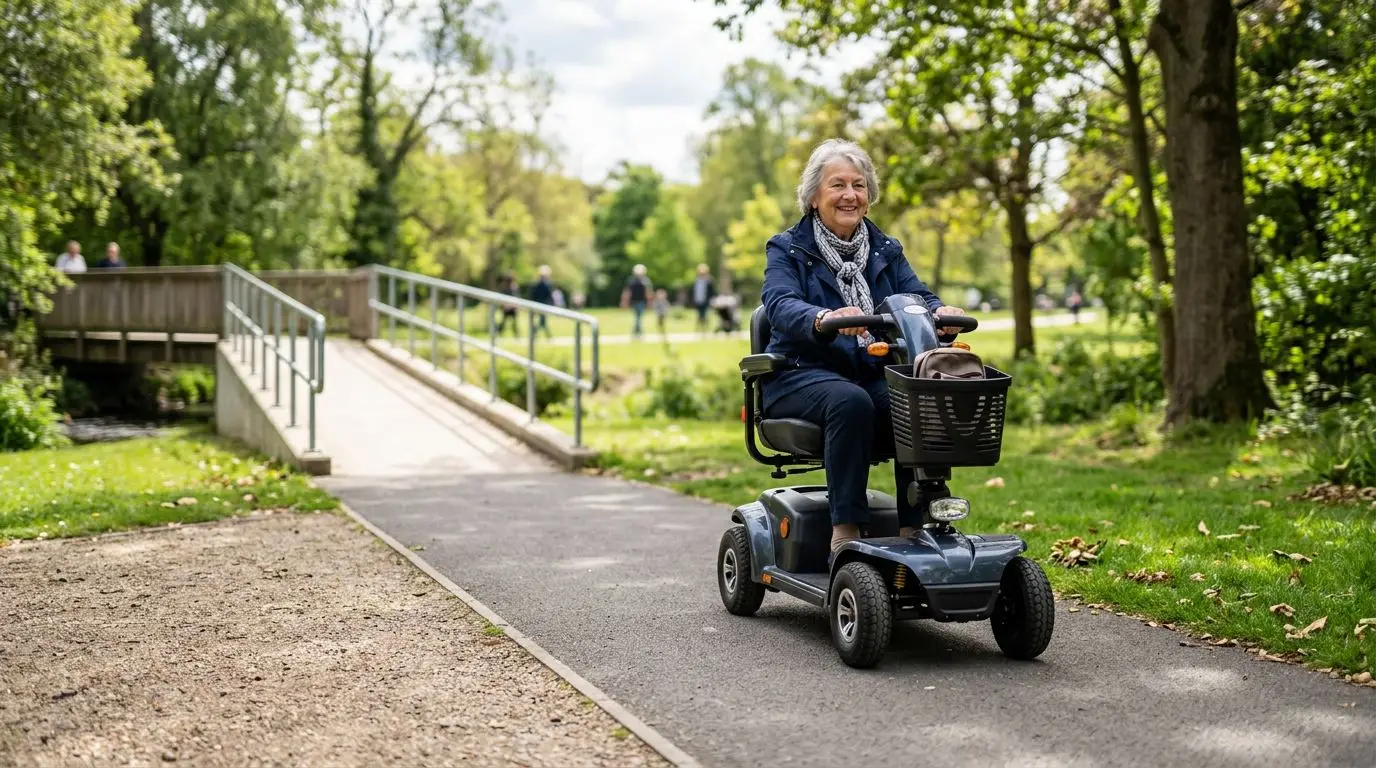
Using a Mobility Scooter on Ramps, Grass, Gravel, and Uneven Ground: What’s Safe and What to Avoid
13 min read