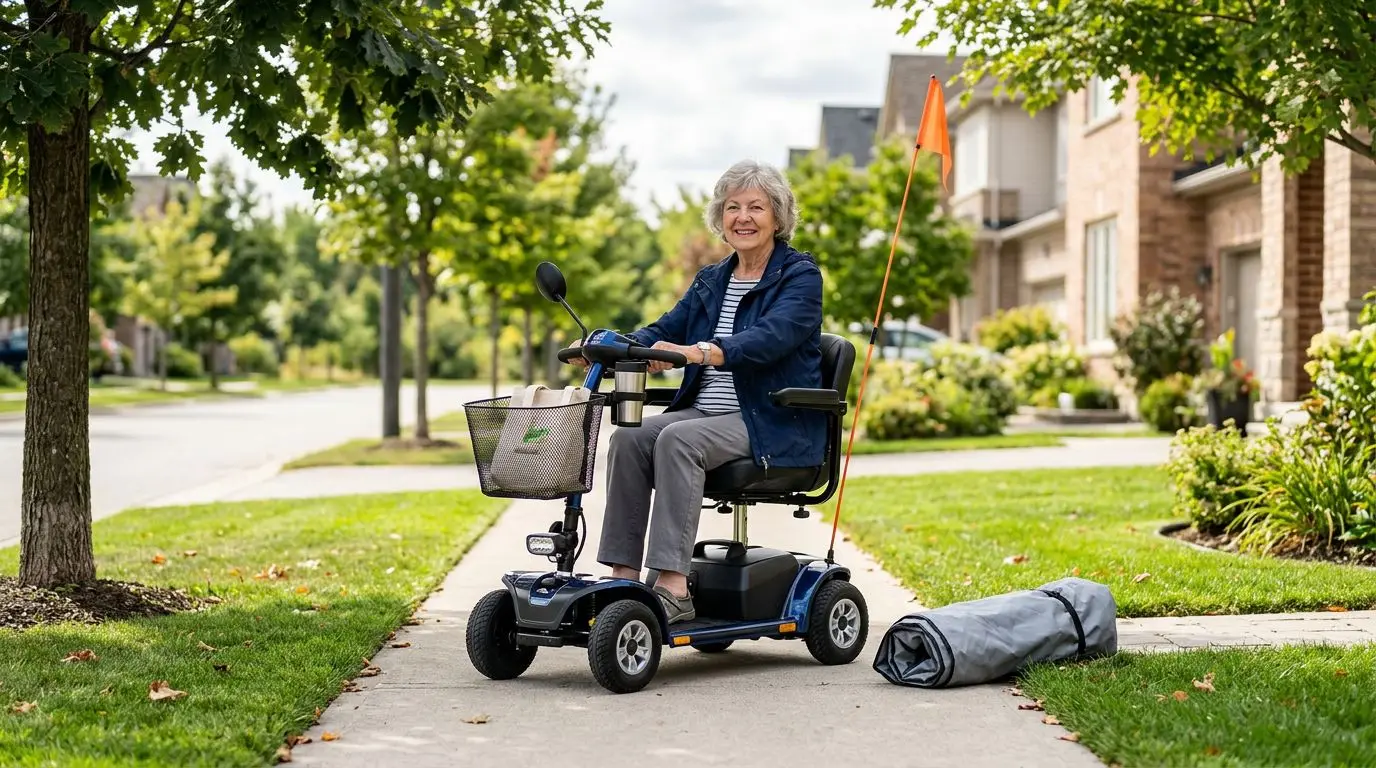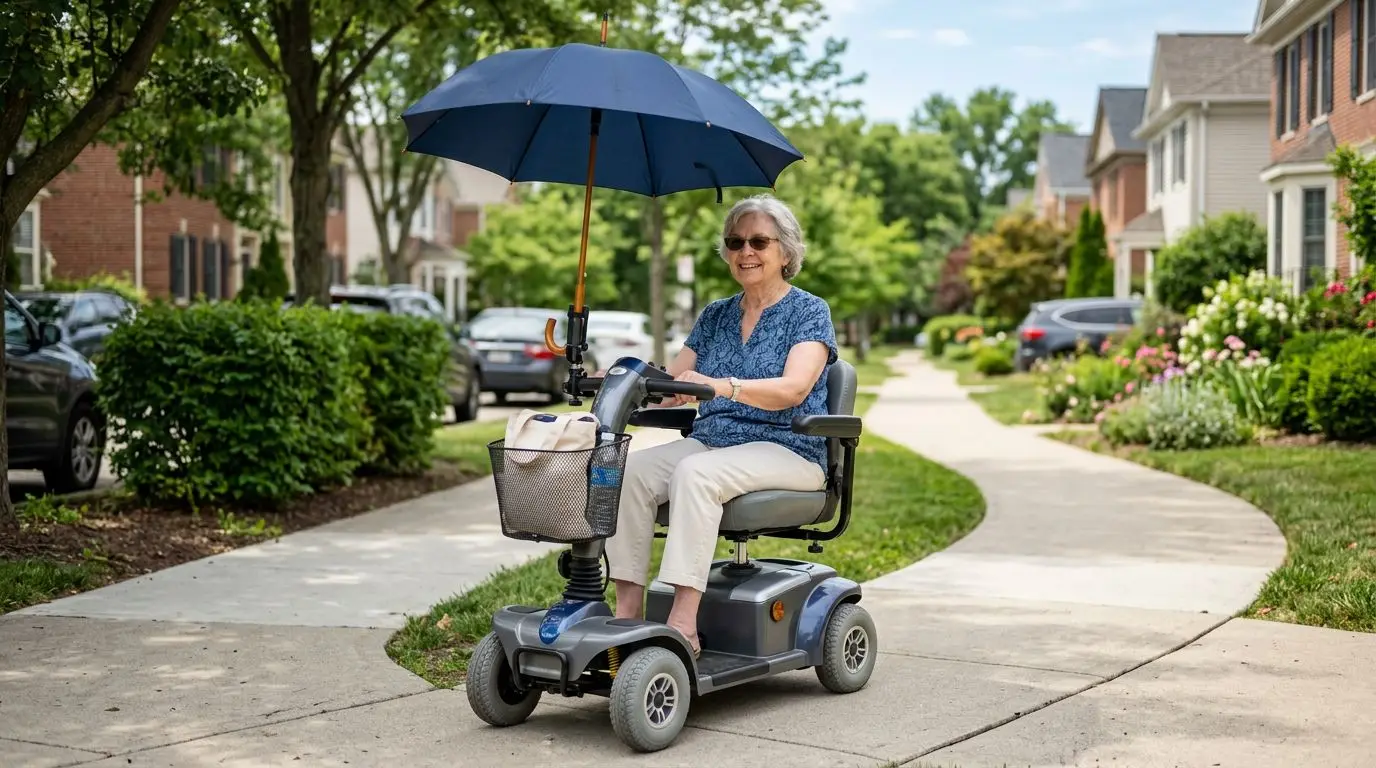
A mobility scooter umbrella holder can be useful for shade and light rain when it is firmly mounted, correctly positioned, and used in calm conditions. It is not a substitute for a full weather canopy, and it can become risky in wind because the umbrella adds height, drag, and visual obstruction. The best choice depends on your scooter’s tubing size, seating position, typical weather, and whether you can safely control the scooter with the umbrella installed.
For many riders, the appeal is simple. Sun on the face, glare in the eyes, or a surprise shower can make a short trip uncomfortable. A holder keeps both hands available for steering instead of forcing you to grip an umbrella while driving. That is the benefit. The trade-off is that a scooter is a small vehicle, often traveling at about 2 to 8 mph, and anything tall mounted above it can affect stability and awareness.
What an Umbrella Holder Can—and Cannot—Do at 2–8 mph
A scooter umbrella holder is a mounted bracket designed to hold an umbrella upright or at an angle while the scooter is in use. Most attach to the seat post, armrest support, rear accessory receiver, or a round section of frame tubing. The goal is to place the umbrella above the rider without interfering with steering, brakes, mirrors, baskets, or entry and exit.
Used properly, an umbrella holder can create a small zone of shade and help keep light rain off your head, shoulders, and lap. It can also reduce direct sun exposure during a slow ride to the mailbox, around a retirement community, across a parking lot, or along a flat paved path. A typical personal umbrella canopy may measure about 36 to 48 inches across, so the coverage is helpful but limited.
It cannot make a scooter weatherproof. Rain can still blow sideways onto your legs, controls, seat, and battery compartment. It also should not be treated as protection from lightning, high winds, hail, or storm conditions. If the forecast includes thunder or strong gusts, the safer decision is usually to delay the trip or use a vehicle or indoor route.
Think of it as a comfort accessory, not a safety device. It may make mild weather more comfortable, but it also adds another object you have to manage.
Who It’s Best For—and Who Should Skip It on a 3- or 4-Wheel Scooter
An umbrella holder is best for riders who use their mobility scooter on smooth, familiar surfaces at low speeds and need short-duration shade or light rain protection. It tends to make the most sense for predictable trips: a 5-minute ride to a clubhouse, a slow roll through a neighborhood, or waiting outdoors at a pickup area.
Best for
- Calm-weather riders who avoid windy days and rough pavement.
- Users who need both hands free for throttle, tiller, brake lever, or control buttons.
- Riders with sun sensitivity who already use sunscreen, sunglasses, and a hat but want extra shade.
- People who make short outdoor trips where a full canopy feels unnecessary.
- Scooters with solid mounting points such as a round seat post or sturdy accessory bar.
May not be a good fit
- Riders in windy coastal, desert, or open-field areas where gusts can arrive suddenly.
- Users who travel near traffic and need maximum visibility in every direction.
- Anyone whose scooter already feels top-heavy, especially on ramps or side slopes.
- Riders who frequently use doorways, elevators, or narrow aisles where an umbrella could catch.
- People who cannot easily remove or fold the umbrella without pain, balance difficulty, or hand weakness.
Three-wheel scooters often turn tightly, which is convenient indoors and on sidewalks, but they may feel less planted on uneven ground than many four-wheel scooters. Four-wheel scooters may offer a wider stance, yet they are still not designed to carry a sail overhead in gusty weather. Stability depends on the whole setup: scooter width, rider weight distribution, tire type, surface, speed, and how high the umbrella is mounted.
Types of Scooter Umbrella Holders Compared: 3 Common Mounting Styles
Most scooter umbrella holders fall into a few practical categories. The right one depends less on the umbrella and more on where it attaches. A clamp that does not match the scooter tubing can loosen in less than a mile, while a well-fitted mount can stay put during normal low-speed use.
| Holder type | Typical attachment point | Best use | Main trade-off |
|---|---|---|---|
| Adjustable clamp holder | Round tubing, seat post, armrest support | Scooters with exposed tubing about 7/8 to 1 1/4 inches in diameter | Can slip if the clamp is too large, too small, or mounted on a tapered surface |
| Socket-style holder | Rear accessory receiver or fixed bracket | Riders who want a more upright, repeatable position | May place the umbrella behind the rider instead of centered overhead |
| Flexible-arm holder | Clamp base with bendable or jointed arm | Fine-tuning shade angle during low-speed trips | Long arms can bounce, vibrate, or drift out of position |
| Dual-clamp support | Two contact points on frame or post | Reducing twist and wobble on longer umbrellas | Needs more open space on the scooter and more careful setup |
Clamp holders are the most common because they are adaptable. They also cause the most fit problems. Scooter tubing may be round, oval, square, padded, painted, or partly hidden by plastic shrouds. A clamp designed for round metal tubing should not be forced onto a soft armrest pad or a thin plastic body panel.
Socket-style holders can feel tidier, but only if your scooter has a suitable rear receiver or bracket. They may place the umbrella behind your head, which helps with sun from the rear but may not cover your lap or controls. A flexible arm can solve angle problems, but the more joints it has, the more chances there are for movement.
How to Measure Clamp Fit in 5 Minutes
Before buying any generic umbrella holder, measure the scooter rather than guessing. A 5-minute check with a tape measure can prevent a loose clamp, scratched tubing, or a holder that blocks the seat swivel.
Step 1: Find a solid mounting location
Look for a rigid metal tube or accessory bar that does not move when you press it with your hand. Common candidates include the vertical seat post, a rear cane-holder area, or an armrest support. Avoid the tiller unless the scooter documentation clearly allows accessories there; adding weight to the steering column can affect control.
Step 2: Measure the diameter
Wrap a flexible tape measure around the tube to get the circumference, then divide by 3.14 to estimate diameter. For example, a tube with a circumference of about 3.5 inches is roughly 1.1 inches in diameter. Many adjustable clamps are intended for tubing around 7/8 inch to 1 1/4 inches, but you must match the holder’s stated range to your scooter’s actual tube.
Step 3: Check straight length
The clamp needs enough straight surface to grip. As a practical rule, look for at least 1 to 2 inches of clear, straight tubing with no weld bead, knob, seam, quick-release lever, or plastic curve in the way. If the tube tapers, the clamp may creep downward over time.
Step 4: Sit on the scooter and test the umbrella path
Sit in your normal posture. Imagine the umbrella shaft rising from the mounting spot. It should not touch your shoulder, block your view of the controls, hit the back of your head, or interfere with turning the seat. If your scooter seat swivels 90 degrees for transfers, confirm that the holder does not block that movement.
Step 5: Measure height and clearance
With the umbrella open, there should be enough headroom to avoid bumping the canopy while still keeping it low enough to reduce wind leverage. Check doorways and elevators you use often. Many residential doorways are about 30 to 36 inches wide, and an open umbrella can easily be wider than that.
Safety Trade-Offs: Wind, Visibility, and Tipping Risk in 10 mph Gusts
The biggest safety issue is wind. An open umbrella can behave like a small sail. Even a modest 10 mph gust can tug on the umbrella, twist the holder, or pull the rider’s attention away from steering. Stronger gusts can bend the shaft, loosen the clamp, or create a sudden sideways force.
The second issue is visibility. An umbrella that is too low may block overhead signs, traffic signals, pedestrians stepping off a curb, or a caregiver walking beside you. A dark canopy can also make it harder for others to see you, especially in rain or at dusk. Bright outer colors and reflective trim can help, but they do not remove the need for caution.
Tipping risk depends on the scooter and the setting. A tall umbrella raises the profile of the scooter-rider combination, and a side gust can matter more when you are turning, crossing a sloped driveway, or riding along a curb cut. Slopes are especially important. Many scooters list maximum incline limits in their documentation, often expressed in degrees, but accessories and weather can make a familiar ramp feel different.
There is also a distraction factor. If you adjust the umbrella angle while moving, one hand may leave the controls or your eyes may leave the path. Make all adjustments while stopped. If the umbrella starts rattling, drifting, or pulling, stop in a safe place and close it.
- Do not use an umbrella holder during thunderstorms.
- Do not use it in strong or unpredictable wind.
- Do not let the canopy block mirrors, lights, reflectors, or your forward view.
- Do not mount it to plastic trim, loose baskets, or moving steering parts.
- Do not assume a stable setup on flat pavement will feel the same on a ramp.
Features Worth Looking For: 6 Practical Details
Since there is no single universal scooter frame, the best umbrella holder is usually the one that fits securely and stays out of the way. Look at the hardware first and the convenience features second.
| Feature | Why it matters | What to check |
|---|---|---|
| Clamp size range | Determines whether the holder can grip the scooter tubing | Match it to your measured tube diameter, such as 1 inch |
| Non-slip liner | Helps reduce twisting and protects painted metal | Look for rubber or textured padding inside the clamp |
| Tool-free knobs | Makes removal easier for storage or transport | Confirm you can tighten it with your hand strength |
| Angle adjustment | Lets you aim shade without remounting the whole holder | Check that joints lock firmly and do not droop |
| Quick umbrella release | Useful when entering buildings or loading the scooter | Practice closing or removing it while parked |
| Corrosion-resistant hardware | Rain can affect screws, springs, and clamp parts | Dry it after wet trips and inspect for rust monthly |
The umbrella itself matters, too. A vented canopy can allow some air to pass through, reducing the tug compared with a solid canopy, though it is still not safe in high wind. A compact umbrella may be easier to manage, while a very wide golf-style umbrella can create too much leverage for a small scooter mount.
Weight is another detail. A heavier umbrella may feel sturdier in the hand, but mounted weight above shoulder height can increase bouncing. If the holder arm is long, even a few extra ounces can make the setup wobble over sidewalk seams.
Installation and Use Checklist: 10 Checks Before You Roll
Use this 10-point checklist after installation and before each outdoor trip. It is short enough to run through at the front door or garage.
- 1. Clamp grip: Try to twist the mount by hand. It should not rotate on the tube.
- 2. Clear steering: Turn the tiller fully left and right while parked.
- 3. Clear controls: Confirm you can see and reach the throttle, horn, speed dial, lights, and battery indicator.
- 4. Seat movement: If your seat swivels, test the full transfer movement before riding.
- 5. Head clearance: Sit normally and make sure the umbrella does not brush your head or glasses.
- 6. Side clearance: Check that the open umbrella will not hit door frames, gate posts, parked cars, or people walking beside you.
- 7. Rear visibility: If you use mirrors, make sure the canopy and shaft do not block them.
- 8. Weather check: Do not start if gusty wind, thunder, or heavy rain is likely.
- 9. Test roll: Ride 20 to 30 feet in a safe area and listen for rattling or movement.
- 10. Removal plan: Know how you will close or detach the umbrella before entering a building or loading the scooter.
After the first ride, inspect the mount again. Small shifts are easier to correct early. If the clamp has marked the tubing, loosened, or slid down, the location may not be suitable.
Umbrella Holder vs. Canopy vs. Poncho: 3 Weather Options
An umbrella holder is only one way to manage sun and rain. Depending on how often you ride outdoors, another option may be safer or more practical. Compare the coverage, effort, and limitations before deciding.
| Option | Best for | Coverage | Key caution |
|---|---|---|---|
| Umbrella holder | Short trips in sun or light rain | Head, shoulders, partial lap coverage | Wind can pull or twist the umbrella |
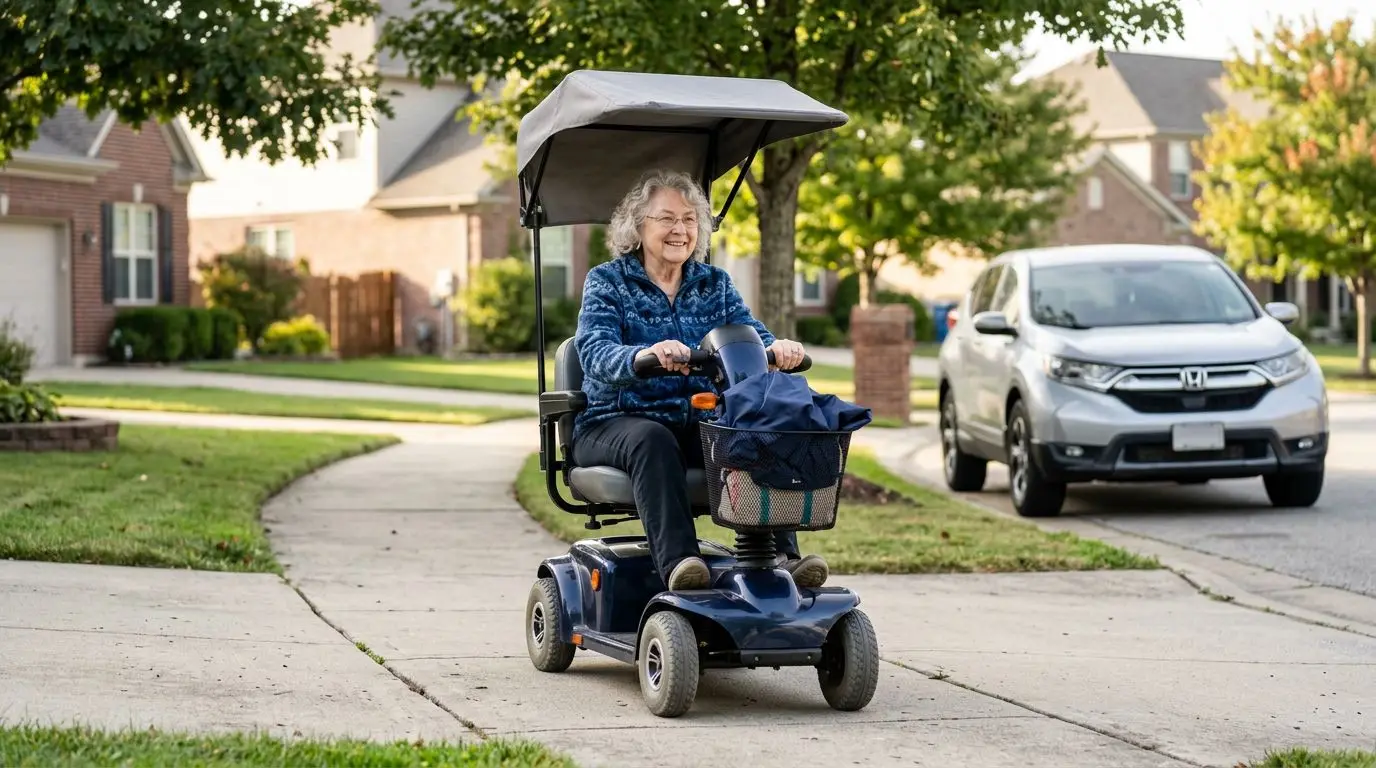
| Scooter canopy | More frequent outdoor riding | Larger shade area, often more consistent overhead cover | Adds size and may affect transport, storage, and clearance |
| Rain poncho or jacket | Wet conditions where wind is mild to moderate | Body coverage without a tall overhead sail | Loose fabric must stay clear of wheels and controls |
A canopy may be better for someone who spends 30 minutes or more outdoors on many days, but it can make the scooter taller and harder to store. A poncho or rain jacket avoids a high umbrella, yet it can trap heat and may reduce hand access if poorly fitted. For sun, a wide-brim hat, UV-rated clothing, sunglasses, and sunscreen can work with or without an umbrella holder.
If your main concern is keeping scooter electronics dry, an umbrella is not enough. Check the scooter manual for guidance on rain exposure, storage, and drying. Many scooters can handle brief damp conditions better than heavy rain, but water and electrical components are never a good mix.
FAQ: 5 Common Questions About Scooter Umbrella Holders
Can I put an umbrella holder on any mobility scooter?
No. It depends on whether your scooter has a strong, compatible mounting point. Measure the tube diameter, check for at least 1 to 2 inches of straight gripping surface, and avoid plastic body panels or moving steering parts.
Is it safe to use a scooter umbrella holder in the wind?
Use caution even in light wind, and avoid it in gusty conditions. An open umbrella can catch wind and pull on the mount, especially when turning, riding near buildings, or crossing sloped pavement.
Where is the best place to mount the holder?
A sturdy seat post, rear accessory area, or fixed metal frame tube is usually safer than the tiller or plastic trim. The holder should not block controls, mirrors, seat swivel, or your path on and off the scooter.
Will an umbrella holder keep me dry in rain?
It can help in light, mostly vertical rain, but it will not keep the scooter or rider fully dry. Wind-blown rain can still reach your legs, controls, seat, and battery area.
What size umbrella works best?
A moderate-size umbrella is usually easier to control than an extra-wide canopy. Many riders find a canopy around 36 to 42 inches more manageable than a very large umbrella, but fit and wind conditions matter more than size alone.
Frequently asked questions
Can I put an umbrella holder on any mobility scooter? +
No. It depends on whether your scooter has a strong, compatible mounting point. Measure the tube diameter, check for at least 1 to 2 inches of straight gripping surface, and avoid plastic panels or moving steering parts.
Is it safe to use a scooter umbrella holder in the wind? +
Use caution even in light wind, and avoid it in gusty conditions. An open umbrella can catch wind, twist the mount, and affect stability or steering attention.
Where is the best place to mount a scooter umbrella holder? +
A sturdy seat post, rear accessory area, or fixed metal frame tube is usually preferable. The holder should not block the controls, mirrors, seat swivel, or your transfer path.
Will an umbrella holder keep me dry in rain? +
It can help in light, mostly vertical rain, but it will not keep you or the scooter fully dry. Wind-blown rain can still reach your legs, controls, seat, and battery area.
What size umbrella works best on a mobility scooter? +
A moderate umbrella is usually easier to manage than an extra-wide one. Around 36 to 42 inches of canopy width is often more practical, but secure fit and calm weather are more important than size.
Related guides
Weather Accessories for Mobility Scooters: Sun, Rain, and Cold Protection
13 min read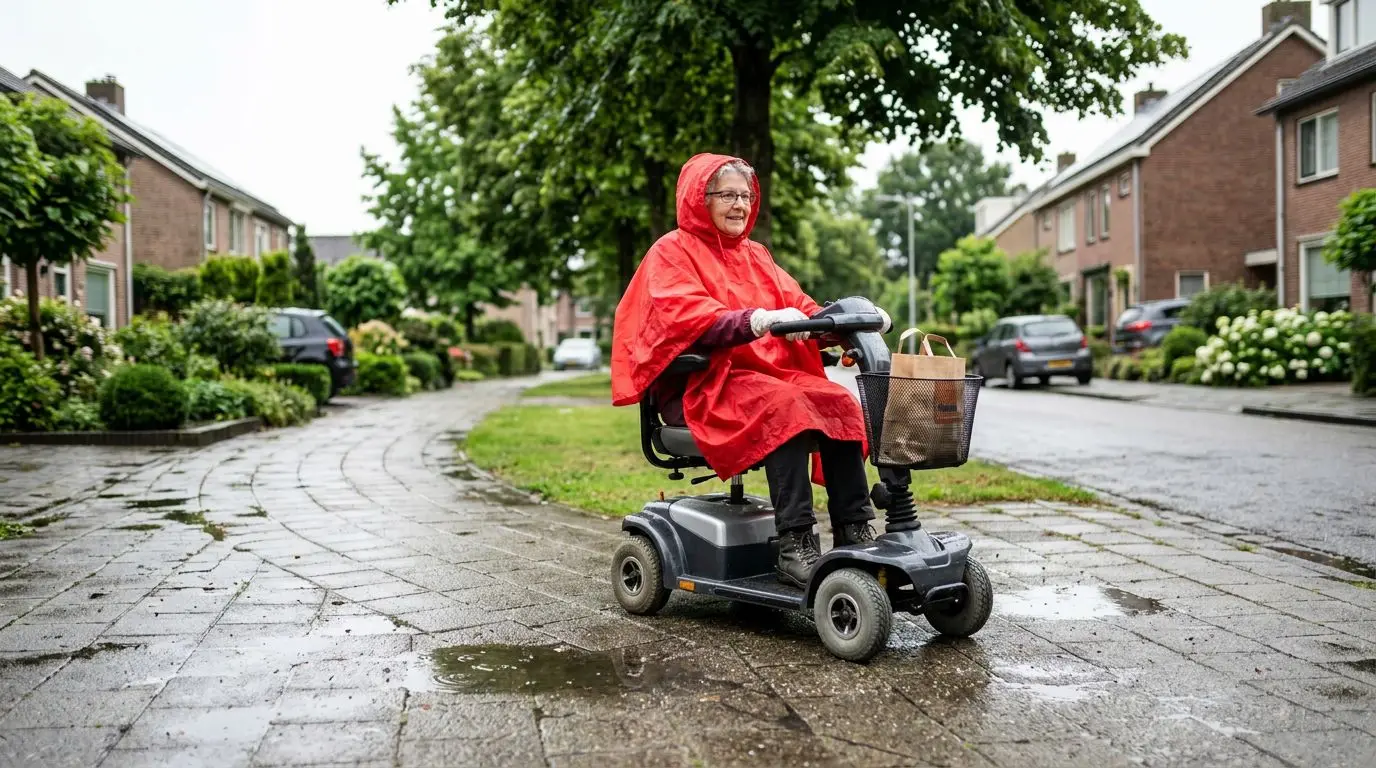
Can You Use a Mobility Scooter in Rain? Wet-Weather Riding Risks and Safety Tips
13 min read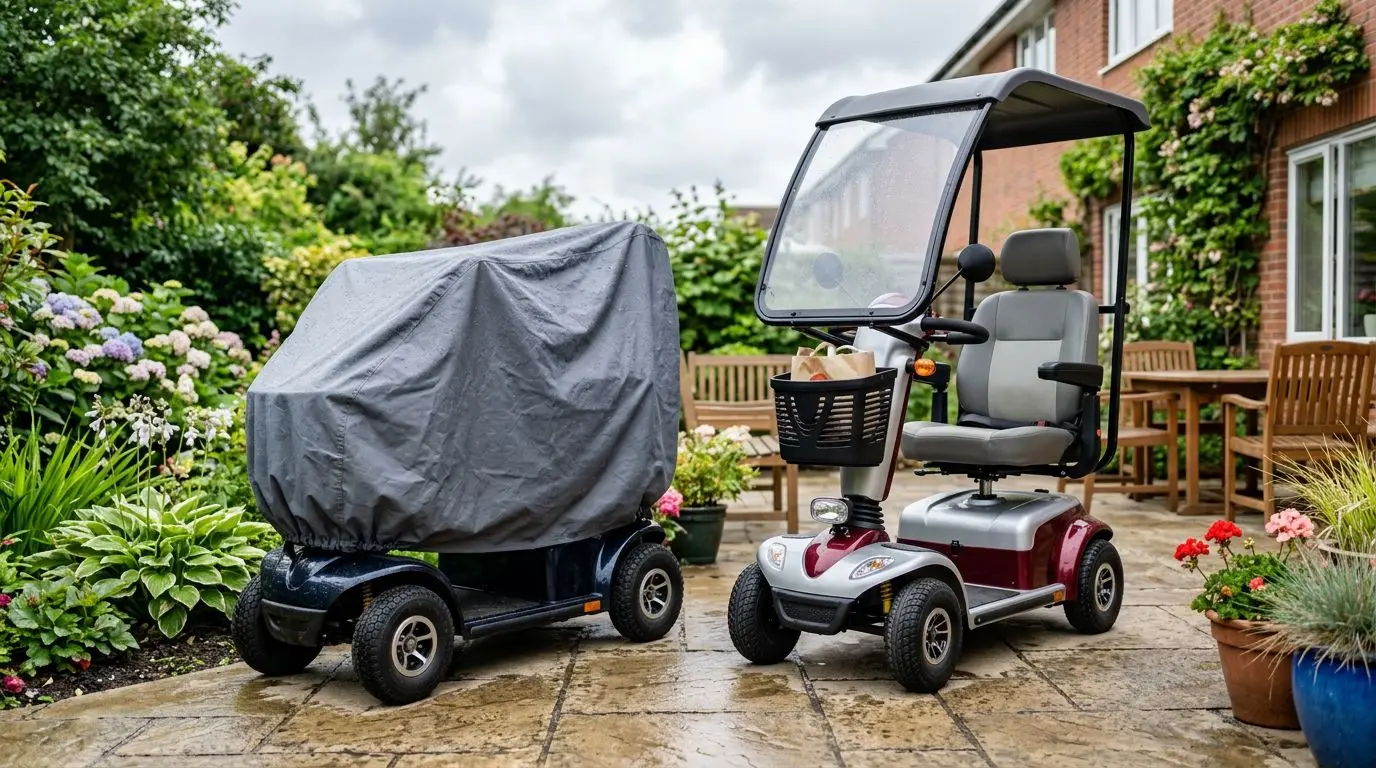
Mobility Scooter Covers, Canopies, and Weather Enclosures: What Protects the Scooter vs. the Rider?
13 min read