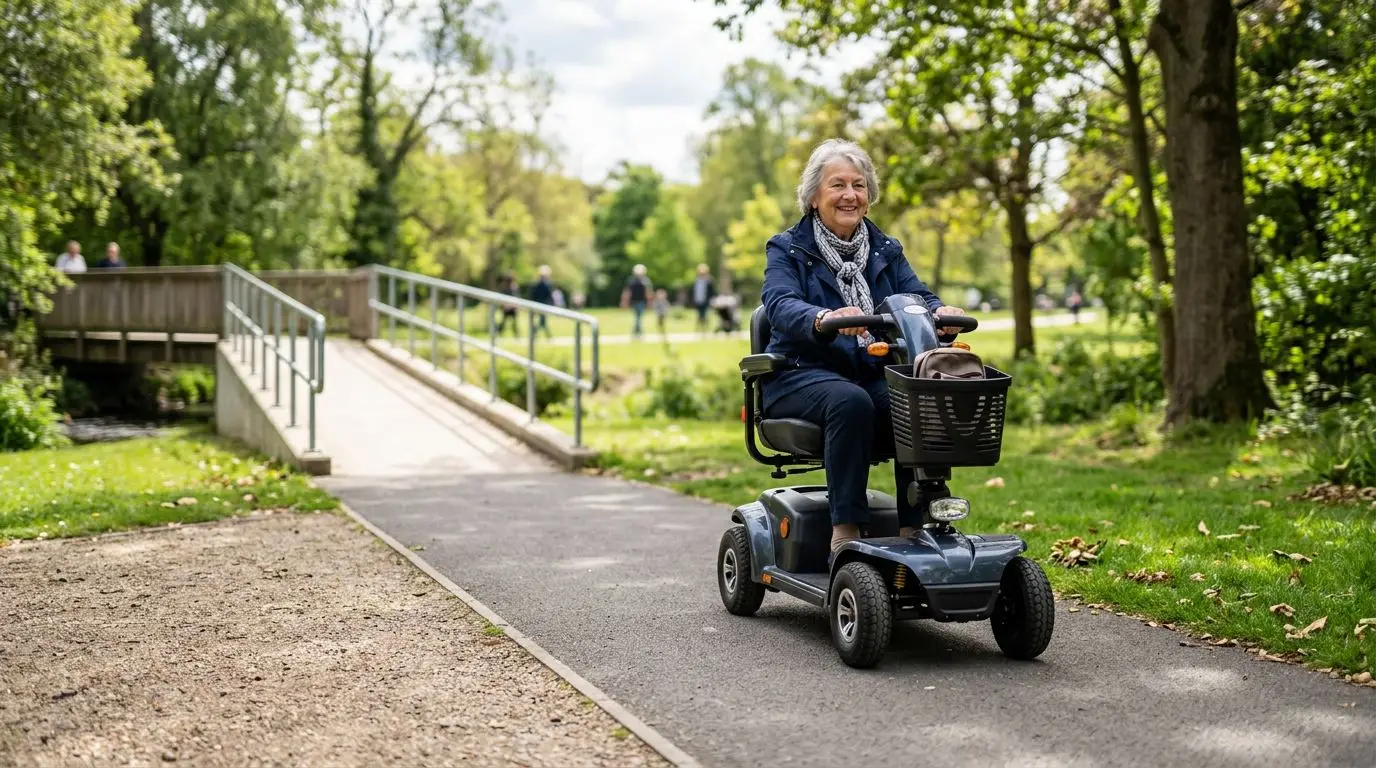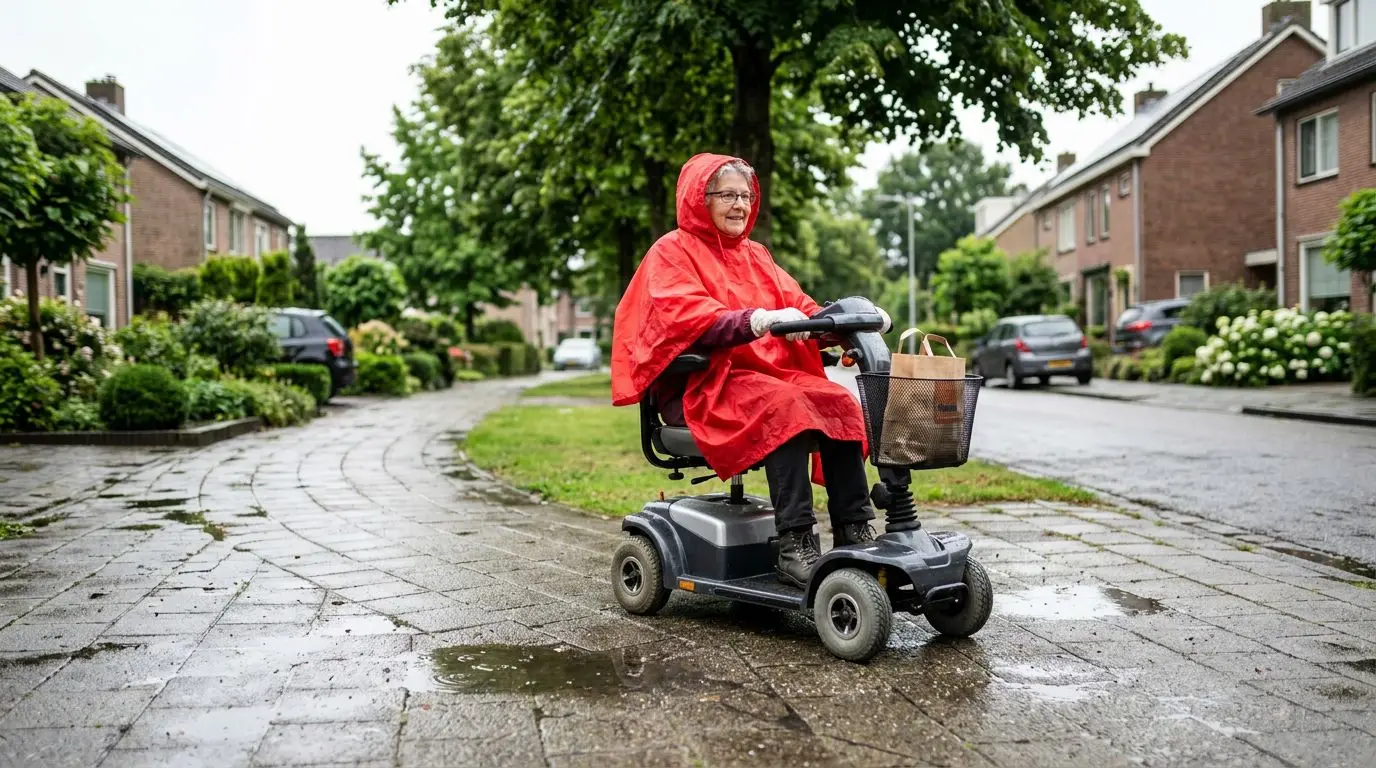
Yes, many mobility scooters can be used in light rain, but only with caution and never through standing water. The main wet-weather risks are reduced traction, longer braking distance, hidden potholes, poor visibility, and water reaching electronics or the battery area. If rain is heavy, water is pooling, or your route includes steep ramps or busy roads, it is usually safer to wait or arrange another ride.
What light rain does to a mobility scooter in the first 10 minutes
A mobility scooter is not a car, and most are not built like outdoor power equipment. Even a brief 10-minute shower can change how the scooter handles because the tires, brake system, deck, controls, and seat surfaces all get wet at once.
Light rain is the least risky wet condition, but it can still cause trouble on smooth concrete, painted crosswalks, metal plates, curb ramps, wood decking, and tile near store entrances. These surfaces may seem harmless when dry yet become slick very quickly.
The important difference is rain from above versus water from below. Rain landing on the seat and tiller is one thing. Water splashing up into the motor, controller, wiring, battery compartment, or charging port is more serious. That is why damp pavement may be acceptable, while a 2-inch puddle can be a no-go.
If you choose to ride in light rain, slow down immediately. A scooter that feels stable at 5 mph on dry pavement may need to be ridden closer to walking speed, around 2 to 3 mph, when surfaces are wet or crowded.
Traction and braking: expect more stopping distance, sometimes 2 times as much
Wet pavement reduces tire grip, affecting steering, stopping, and stability. Mobility scooters usually have small wheels compared with bicycles or cars, commonly in the 8- to 13-inch range depending on scooter type. Smaller tires can be more sensitive to cracks, shallow ruts, wet leaves, and slick curb cuts.
Braking distance can increase noticeably in rain. There is no single number that applies to every scooter and rider, but a practical safety rule is to allow at least twice your normal stopping distance on wet surfaces. If you normally stop comfortably within 3 feet at a slow indoor pace, plan for 6 feet or more outdoors in the rain.
Traction also depends on tire type. Pneumatic tires can conform to small surface irregularities and may feel more forgiving outdoors. Solid tires are puncture-resistant, but they can feel harder on slick surfaces. Tread pattern matters too, since smooth or worn tires have less ability to channel water away from the contact patch.
| Wet-weather factor | Why it matters | Practical safety move |
|---|---|---|
| Small wheels, often 8 to 13 inches | More affected by cracks, puddle edges, and uneven pavement | Approach rough areas straight on and slowly |
| Wet painted lines | Can be slicker than bare pavement | Avoid sudden turns or braking on crosswalk paint |
| Wet leaves or grass clippings | Can act like a sliding layer under the tires | Steer around them when possible |
| Downhill ramps | Gravity increases stopping distance | Descend at the lowest practical speed |
Test braking before committing to a longer route. In an open, flat area, move slowly and stop gently. If the scooter skids, pulls, or feels delayed, turn back before conditions get worse.
Puddles, curbs, and slopes: avoid water deeper than 1 to 2 inches
Puddles are one of the biggest mistakes riders make in rain. A puddle hides the surface underneath. It may cover a pothole, broken pavement, a raised utility cover, gravel, or a curb edge. Even a puddle that looks shallow can splash water upward into areas that should stay dry.
As a conservative rule, avoid standing water deeper than about 1 inch, and do not ride through anything approaching 2 inches unless your manual specifically says the scooter is built for that exposure. Many mobility scooters have low deck clearance, and the lowest components may be closer to the ground than they appear from the seat.
Slopes add another layer of risk. A ramp that is manageable when dry can become difficult when wet, especially if it has algae, leaves, or a painted surface. Many public accessibility ramps are designed around a 1:12 slope, meaning 1 inch of rise for every 12 inches of run, but private driveways and temporary ramps can be steeper.
Curbs and curb cuts need extra caution. Rain often collects at the bottom of a curb ramp, exactly where a scooter needs traction to climb. Approach straight, avoid sharp steering, and do not accelerate hard while the front wheels are in water.
- Do not drive into puddles when you cannot see the bottom.
- Avoid gutter water along the edge of roads.
- Cross curb ramps at 90 degrees when possible.
- Skip steep shortcuts in rain, even if they save 5 minutes.
- Turn around if the scooter begins to fishtail, slide, or lose steering response.
Electronics and batteries: water-resistant is not the same as waterproof
Mobility scooters use electrical systems that may include a controller, wiring harnesses, throttle controls, brake sensors, lights, charging ports, and a battery pack. Common scooter batteries are often 12-volt units used in pairs for a 24-volt system, though configurations vary. None of this means the scooter should be treated as waterproof.
Some scooters may list an ingress protection rating, often called an IP rating. If a manufacturer provides one, it can help you understand protection against dust and water. If no rating is listed, do not assume the scooter can handle heavy rain, hose spray, or puddle splash.
Battery exposure is a special concern. Sealed batteries can tolerate normal use better than open wet-cell designs, but battery terminals, connectors, chargers, and charging ports still need to stay dry. Never charge a scooter when the charging port, plug, battery compartment, or surrounding floor is wet. Water and charging equipment are a dangerous combination.
| Part of scooter | Rain concern | What to do |
|---|---|---|
| Tiller controls | Water can reach switches or throttle areas | Use a clear control cover if appropriate and keep controls dry |
| Charging port | Moisture can cause corrosion or unsafe charging | Keep capped and wait until fully dry before charging |
| Battery compartment | Splashing can reach connectors | Avoid puddles and inspect after wet rides |
| Motor area | Low-mounted components may be exposed to road spray | Stay out of standing water and mud |
If the scooter gets wetter than expected, park it in a dry, ventilated place. Wipe visible water from the seat, deck, tiller, and charging area. If water may have entered the battery or electronics area, do not charge or restart it until it has been inspected or has dried thoroughly according to the owner’s manual. Waiting 24 hours is often safer than rushing, but follow the specific guidance for your scooter.
Visibility: in rain, drivers may not see a scooter until 100 feet away
Rain reduces visibility for everyone. Drivers may be dealing with windshield glare, fogged glass, headlight reflections, and reduced braking performance. A mobility scooter is lower and smaller than a person standing upright, so it can be harder to notice in traffic or parking lots.
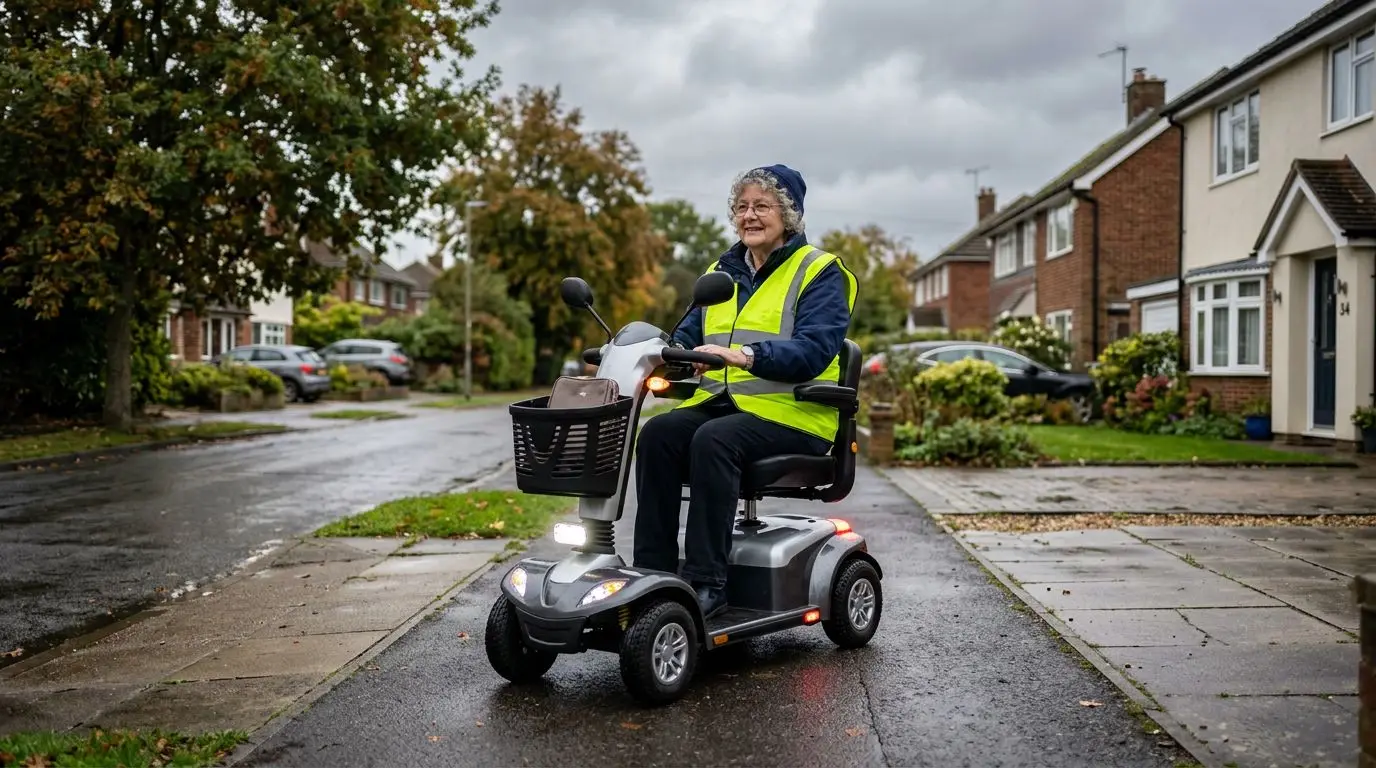
Do not rely on being seen. Use lights if your scooter has them, even during the day. Reflective strips, a bright rain poncho, and a small safety flag can help increase contrast. At dusk, in heavy cloud cover, or under trees, visibility can drop faster than many riders expect.
Think in terms of sight distance. If a driver turning into a parking lot cannot see you until 100 feet away, that may be too little time when the pavement is wet and the driver is distracted. Make eye contact when possible, pause before crossing driveways, and avoid assuming a vehicle has yielded just because it slowed down.
- Use front and rear lights in any rain.
- Wear a high-contrast outer layer, such as yellow, orange, or bright blue.
- Avoid black umbrellas or dark coats that blend into wet pavement.
- Keep both hands available for steering; a handheld umbrella can be unsafe.
- Cross parking lot lanes slowly and predictably.
Comfort matters too. Wet clothing can distract you, reduce hand control, and make it harder to turn your head. A poncho or scooter cover should not hang low enough to touch the wheels, controls, or ground.
Who it is best for: short, flat trips under about 15 minutes
Riding in light rain is most reasonable for short, familiar routes on flat pavement where you can turn back easily. A 5- to 15-minute trip to a nearby mailbox area, community room, or covered entrance may be manageable if the pavement is only damp and visibility is good.
It is less suitable for long errands, road-edge travel, steep driveways, gravel paths, poorly lit sidewalks, or routes with several curb ramps that collect water. If the trip requires crossing busy intersections, riding near fast traffic, or navigating broken pavement, rain changes the risk calculation.
Best fit for wet-weather scooter use
- Experienced riders who know how their scooter brakes and turns.
- Routes with smooth, flat sidewalks and few curb cuts.
- Light rain with no thunder, flooding, or strong wind.
- Trips where shelter is available every few hundred feet.
- Riders who can slow down without feeling rushed by traffic or companions.
Better to wait, reschedule, or get help
- Heavy rain that overwhelms drains or creates standing water.
- Thunderstorms, lightning, or wind gusts strong enough to move branches.
- Temperatures near freezing, since wet surfaces can turn icy.
- New or unfamiliar scooters, especially during the first few rides.
- Any route that includes steep slopes, grass, mud, or road shoulders.
Independence is important, but so is a backup plan. For some trips, the safer choice is a covered ride, delivery, a companion, or simply waiting 30 to 60 minutes for a storm to pass.
How to choose and measure wet-weather readiness in 7 checks
You do not need a product catalog to evaluate wet-weather readiness. You need to inspect the scooter you already use or are considering, then match it to your real routes. Take 10 minutes with a tape measure, flashlight, and the owner’s manual if you have it.
| Check | What to measure or inspect | Why it matters in rain |
|---|---|---|
| 1. Tire tread | Look for visible grooves across the tire | Worn or smooth tires shed less water |
| 2. Ground clearance | Measure from ground to the lowest exposed part | Low clearance increases puddle splash risk |
| 3. Braking feel | Test stops at 2 to 3 mph on flat ground | Delayed stops are more dangerous when wet |
| 4. Charging port location | See whether it faces upward, sideways, or low | Ports exposed to rain need extra protection |
| 5. Control protection | Check if the tiller and switches are shielded | Wet controls can become unreliable |
| 6. Lighting | Confirm front and rear lights work | Visibility drops quickly in rain |
| 7. Route drainage | Walk or observe the route after rain | The same puddle may form every storm |
Ground clearance is especially useful. If the lowest exposed area is only 2 inches above the ground, even shallow water can become a concern once the scooter moves and splashes. Also check where the battery compartment sits. A high-mounted, well-covered compartment is generally less exposed than a low, open area, but designs vary.
Do not forget the route. Measure the narrowest sidewalk pinch point, the steepest ramp you use, and the deepest puddle that regularly forms. A scooter that is fine on a dry, wide sidewalk may be a poor match for a route with a 3-inch-deep gutter crossing.
Wet-weather riding checklist: before, during, and after a 20-minute trip
A simple checklist can prevent most avoidable rain problems. Use it before any wet ride, even a familiar one. The goal is not to make bad weather safe; it is to recognize when conditions are acceptable and when they are not.
Before you ride
- Check the weather radar and avoid thunderstorms or heavy downpours.
- Confirm the battery has enough charge for the round trip plus a margin.
- Make sure lights, horn, and brakes work.
- Wipe condensation or water from the tiller and seat.
- Secure loose clothing so it cannot touch the wheels.
- Plan a route with shelter, curb cuts, and smooth pavement.
While riding
- Use the slowest practical speed, often 2 to 3 mph in wet areas.
- Start, stop, and turn gently.
- Keep extra distance from pedestrians, doors, cars, and curb edges.
- Avoid puddles, mud, wet grass, metal grates, and painted markings.
- Do not ride with one hand holding an umbrella.
- Turn back if rain becomes heavy or visibility drops.
After the ride
- Park under cover or indoors if allowed.
- Dry the seat, tiller, deck, and visible wiring areas.
- Inspect the charging port before plugging in.
- Do not charge until the scooter and charging area are dry.
- Listen for unusual sounds on the next ride.
If the scooter stalls, behaves erratically, smells hot, shows warning lights, or has been exposed to deep water, stop using it and seek qualified service. Do not try to dry electrical parts with high heat, and do not open sealed components unless the manual instructs you to do so.
When it is safer not to ride: 6 red flags
Some conditions are not worth negotiating. A mobility scooter can support daily independence, but it is still a small electric vehicle with limited traction and weather protection. If one of these red flags is present, choose another option.
- Standing water over 1 to 2 inches: It can hide hazards and splash electronics.
- Fast-moving runoff: Water moving along gutters or driveways can push small wheels sideways.
- Lightning within the area: Wait indoors until the storm has passed.
- Wind gusts around 25 mph or higher: Wind can affect steering, ponchos, and balance on exposed paths.
- Near-freezing temperatures: Bridges, ramps, and shaded sidewalks can ice before the rest of the route.
- Poor visibility: If you cannot clearly see vehicles, curb edges, and potholes ahead, others may not see you either.
There is no shame in postponing a ride. A 30-minute delay may give drains time to clear, rain time to lighten, and drivers a better chance to see. If the trip is essential, call ahead, ask for assistance, use a covered transportation option, or have items delivered when possible.
FAQ: 5 common rain questions from scooter riders
Can a mobility scooter get wet?
It can usually handle small amounts of incidental moisture, such as light rain or damp pavement, but that does not make it waterproof. Keep the controls, charging port, battery area, and motor area as dry as possible.
Can I drive through puddles on a mobility scooter?
It is best to avoid puddles, especially if you cannot see the bottom. As a conservative rule, avoid standing water deeper than about 1 inch and never ride through water that may reach the deck, motor, or battery compartment.
Will rain damage the battery?
Rain can cause problems if water reaches battery terminals, connectors, the charging port, or the charger. Do not charge the scooter while any part of the charging area is wet, and have it inspected if water entered the battery compartment.
Are 3-wheel or 4-wheel scooters better in rain?
Four-wheel scooters often feel more stable on uneven outdoor surfaces, while three-wheel scooters may turn more tightly. In rain, tire condition, speed, slope, ground clearance, and rider judgment matter more than wheel count alone.
What should I do if my scooter stops working after rain?
Move to a safe, dry location if you can do so without risk. Turn the scooter off, do not charge it, wipe visible moisture, and contact a qualified technician or the scooter provider for guidance.
Frequently asked questions
Can a mobility scooter get wet? +
A mobility scooter can usually tolerate small amounts of incidental moisture, such as light rain, but it should not be treated as waterproof. Keep the controls, charging port, battery area, and motor area dry whenever possible.
Can I drive through puddles on a mobility scooter? +
It is best to avoid puddles because they can hide potholes, curb edges, and debris. Avoid standing water deeper than about 1 inch, and never ride through water that may reach the deck, motor, or battery compartment.
Will rain damage a mobility scooter battery? +
Rain can cause trouble if water reaches terminals, connectors, the charging port, or the charger. Do not charge the scooter until the port, plug, battery area, and floor are completely dry.
Are 3-wheel or 4-wheel mobility scooters safer in rain? +
Four-wheel scooters may feel more stable outdoors, while three-wheel scooters often turn more tightly. In rain, tire tread, speed, braking distance, slope, ground clearance, and rider judgment are more important than wheel count alone.
When should I avoid riding a mobility scooter in rain? +
Avoid riding during heavy rain, thunderstorms, poor visibility, strong wind, near-freezing temperatures, or when standing water is more than 1 to 2 inches deep. If the route has steep ramps, busy crossings, or hidden puddles, wait or use another option.
Related guides
Mobility Scooter Weather Safety: Riding in Rain, Heat, Cold, and Low Visibility
13 min read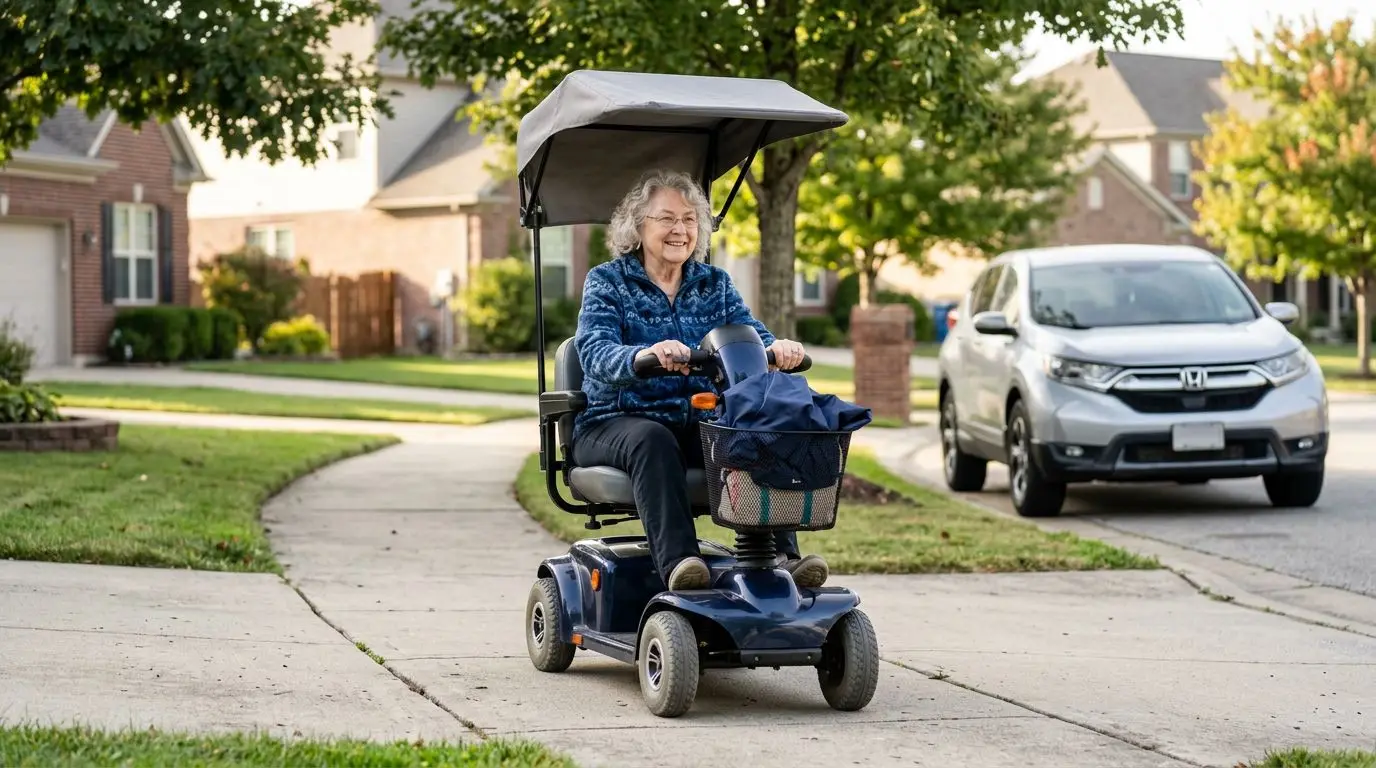
Weather Accessories for Mobility Scooters: Sun, Rain, and Cold Protection
13 min read
Using a Mobility Scooter on Ramps, Slopes, Curbs, and Uneven Pavement Safely
13 min read