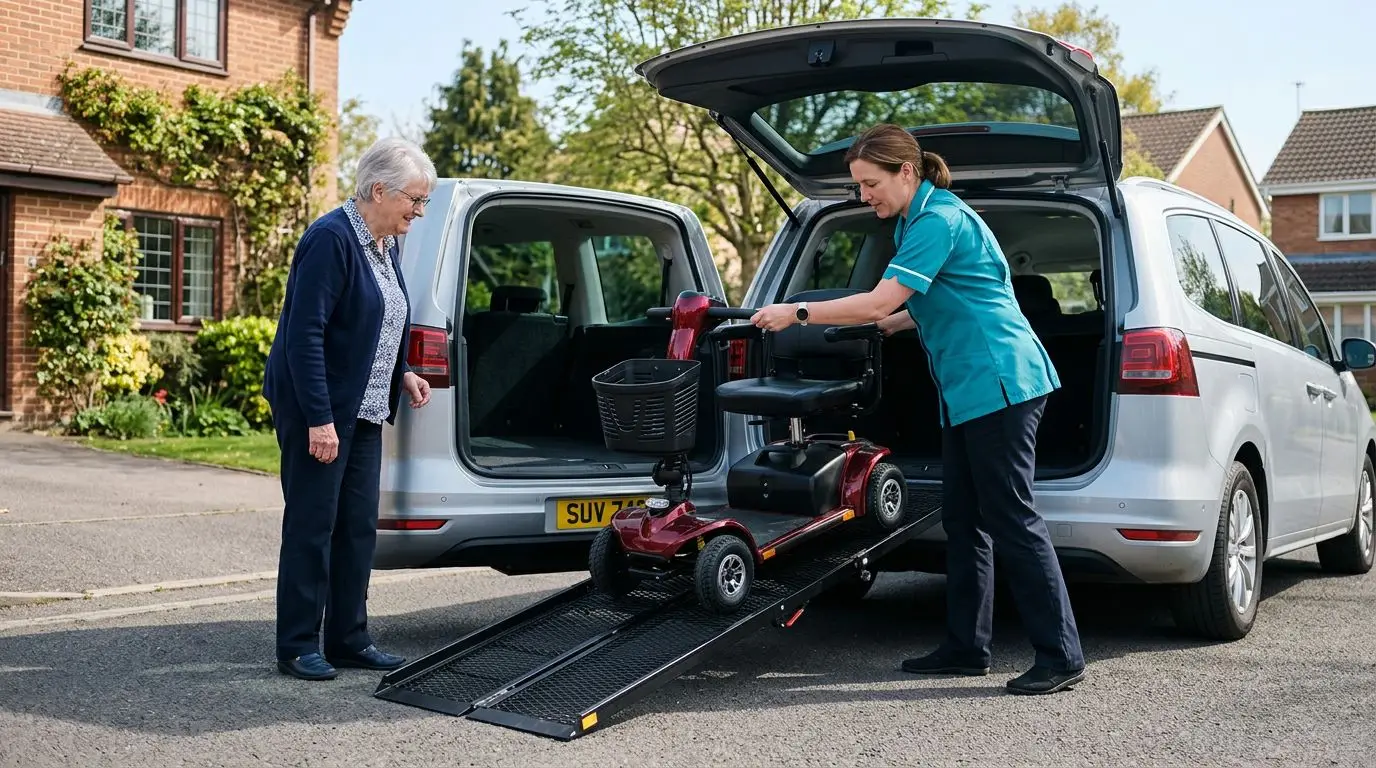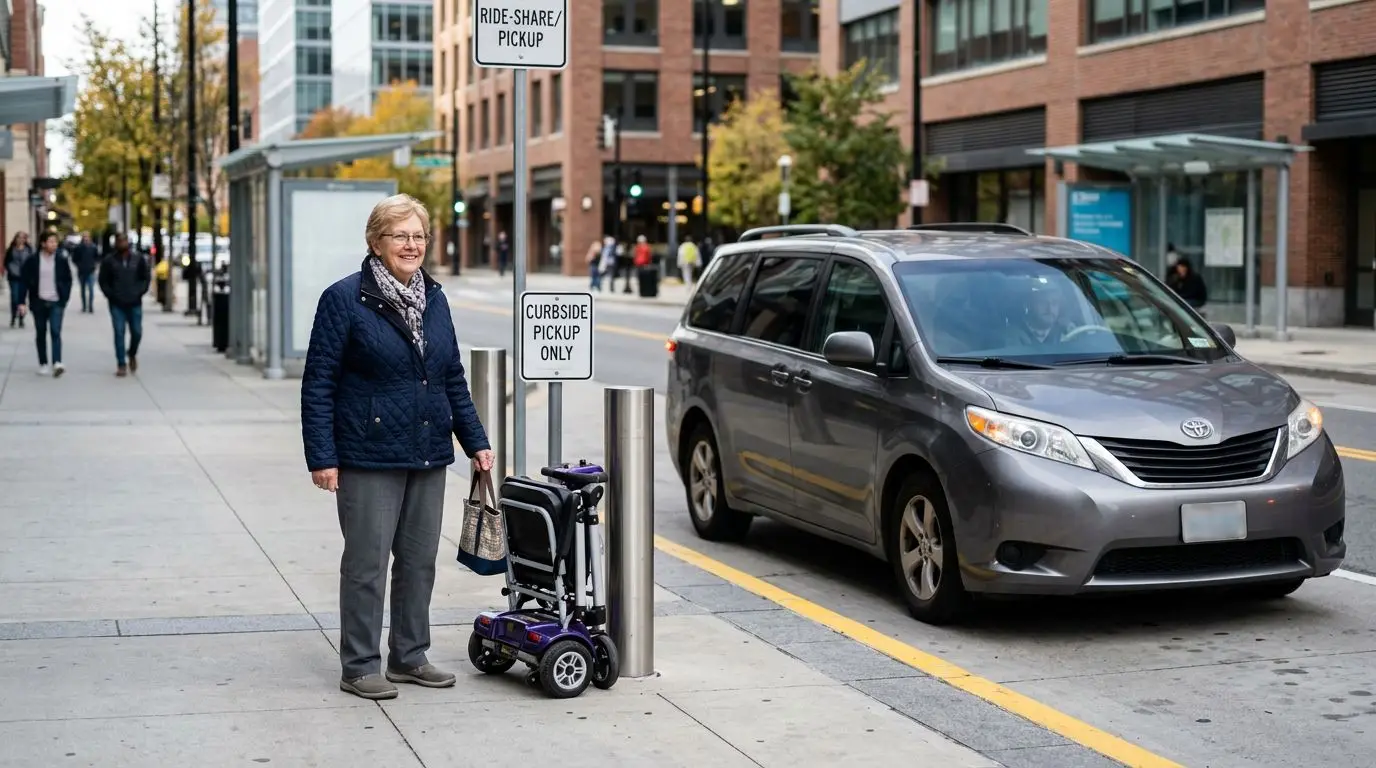
Before you book a taxi or rideshare with a mobility scooter, confirm 3 things: whether the scooter folds or disassembles, whether its heaviest piece can be lifted into the vehicle, and whether the vehicle has enough cargo space or accessible equipment. Do not assume a standard car can carry a scooter, even a travel-size one, because trunk openings, driver policies, and local accessible-vehicle supply vary widely.
The safest plan is to measure your scooter, call or message the transportation provider before pickup, and keep a backup option ready in case the first vehicle cannot load it. A 5-minute check can prevent missed appointments, awkward curbside delays, or damage to the scooter.
Why the 5-minute confirmation matters before a paid ride
Mobility scooters are not all handled the same way. A compact folding scooter may fit in a sedan trunk, while a full-size scooter may need a ramp-equipped van or wheelchair-accessible taxi. The difference often comes down to inches and pounds, not just whether the vehicle looks roomy.
Many standard sedan trunks offer roughly 14 to 16 cubic feet of cargo space, but the opening may be too narrow for a scooter base even when the total volume sounds adequate. A hatchback or small SUV may have a wider opening, yet a high rear cargo lip can make lifting difficult. If the scooter has a long deck, high tiller, or non-removable seat post, those details matter.
Rideshare and taxi drivers also may not be trained or physically able to lift heavy equipment. Some will help if the scooter is light and you can guide the process. Others may be unable to assist, especially if the scooter weighs 70 pounds or more in one piece. Confirming ahead respects everyone’s limits and gives you time to request the right vehicle.
| What to confirm | Why it matters | Example detail to provide |
|---|---|---|
| Folded or disassembled size | Determines cargo fit | Folded length 38 inches, width 19 inches |
| Heaviest piece weight | Determines whether lifting is realistic | Base section weighs 48 pounds |
| Battery type | May affect handling and airline-style caution | Removable lithium battery or sealed battery |
| Passenger transfer ability | Determines whether you ride in the car seat or remain seated in an accessible vehicle | I can transfer with 1 handhold, or I cannot transfer |
| Vehicle type | Standard, larger, or accessible vehicles differ | Sedan trunk, hatchback, minivan, ramp van |
Know your scooter type: 3 common travel situations
The type of scooter you use affects which ride options are realistic. Even within the same category, dimensions vary, so treat the descriptions below as a planning guide rather than a guarantee.
| Scooter type | Typical transport situation | Best paid ride match | Main concern |
|---|---|---|---|
| Folding scooter | Folds into one compact unit | Hatchback, larger sedan, small SUV | One-piece lifting weight |
| Disassembling travel scooter | Breaks into 3 to 5 sections | Sedan, hatchback, SUV, taxi trunk | Time and driver willingness to load parts |
| Full-size 3- or 4-wheel scooter | Usually does not fit standard trunks | Wheelchair-accessible taxi or ramp van | Ramp capacity, tie-downs, transfer needs |
| Heavy-duty scooter | Larger frame, higher weight rating | Accessible van only, sometimes specialty transport | Combined scooter and rider weight, length, turning space |
Folding scooters are convenient, but the word folding can be misleading. Some fold into a suitcase-like shape and still weigh 50 to 70 pounds as one piece. If no one can safely lift that weight, a trunk ride may not be practical.
Disassembling travel scooters can be easier because the seat, battery, basket, and base come apart. A common setup separates into 4 pieces, with the base usually the heaviest. This can work well for taxis when you can stand nearby and explain the loading order.
Full-size scooters are different. They may be 45 to 55 inches long and too tall for many cargo areas. For those, book an accessible vehicle or a local non-emergency transportation provider rather than hoping a standard rideshare will work.
How to measure your scooter in 10 minutes
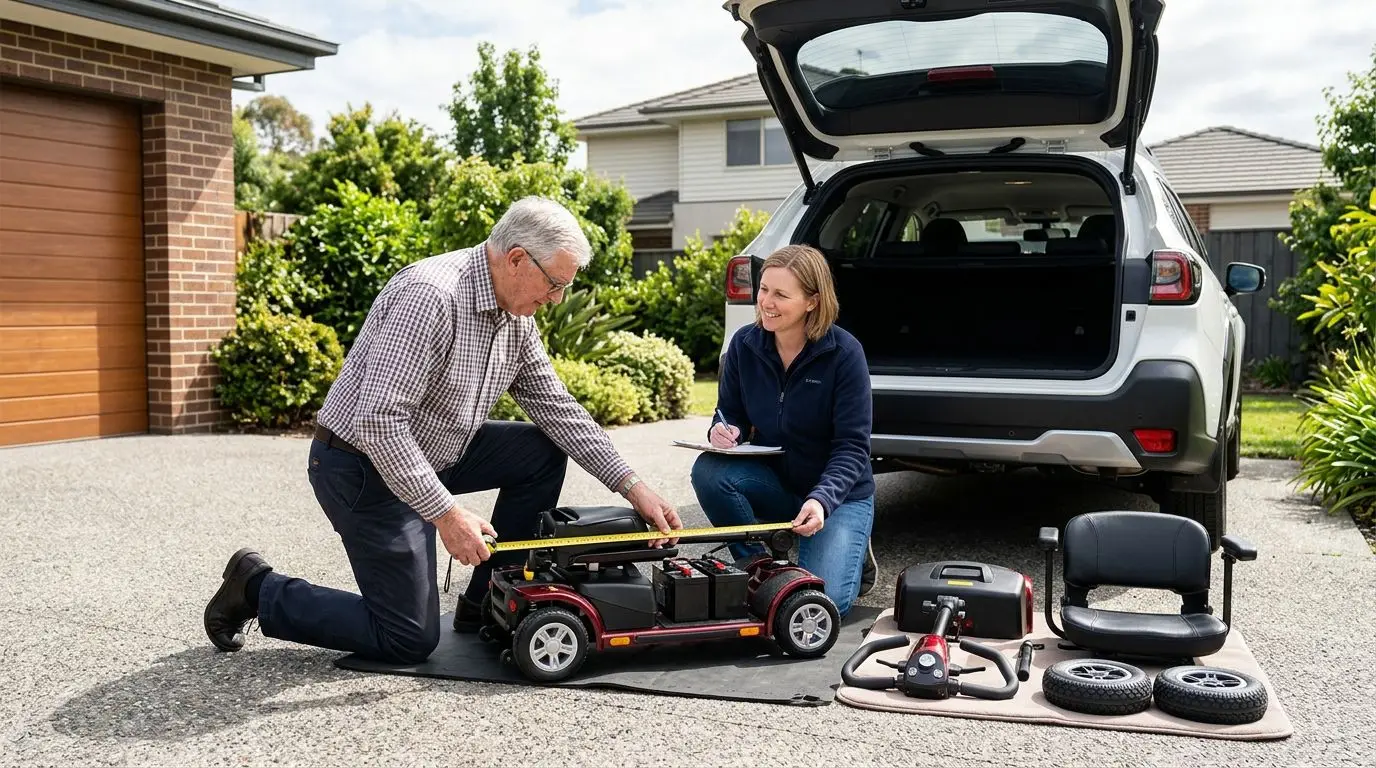
Keep a simple scooter travel card in your wallet or phone. It should list the measurements a dispatcher, driver, or accessible-ride coordinator needs. You can gather most of them with a tape measure and a bathroom scale, though heavier pieces may require the manufacturer’s documentation or help from another adult.
Measure the scooter as you actually travel with it
- Overall length: Measure from the front wheel or bumper to the back edge of the rear wheels or anti-tip wheels.
- Overall width: Measure the widest point, often the rear wheels or armrests.
- Height: Measure folded height or height with the seat and basket removed.
- Heaviest piece: Weigh or look up the largest part after disassembly, usually the base.
- Number of pieces: Note whether it breaks into 3, 4, or 5 parts.
- Battery: Note whether the battery is removable and whether it locks into the scooter.
A useful example sounds like this: My scooter comes apart into 4 pieces. The longest piece is 36 inches, the widest is 21 inches, and the heaviest piece is about 45 pounds. I can transfer into a car seat, but I need the scooter loaded in the trunk.
Take 2 photos as well: one of the scooter assembled and one folded or disassembled beside a chair or doorway. A photo helps when a dispatcher is deciding whether to send a sedan, SUV, or accessible vehicle.
What to ask a taxi dispatcher: 6 specific questions
When calling a taxi company, avoid a broad question like Can you take a scooter? It is too easy to get a yes that really means maybe. Ask specific, practical questions and share your scooter measurements.
- Do you have vehicles with a trunk or cargo area large enough for a scooter measuring ___ by ___ by ___ inches?
- Can I request a hatchback, van, or larger vehicle instead of a sedan?
- Do you have wheelchair-accessible taxis with a ramp or lift?
- If I transfer to a seat, can the scooter be loaded as cargo?
- Are drivers permitted to help lift mobility equipment, and is there a weight limit for lifting?
- How far ahead should I reserve an accessible vehicle: 30 minutes, 2 hours, or the day before?
Accessible taxis can be limited, especially outside major downtown areas. In some cities, only a small number of ramp-equipped vehicles may be working at one time. If you have a medical appointment, airport trip, or time-sensitive event, book early and confirm again before the pickup window.
Ask about the loading location too. A scooter may be easy to load at a curb cut but difficult on a steep driveway or narrow apartment entrance. If the driver must stop in traffic, they may not have enough time or safe space to disassemble and load the scooter.
What to check in a rideshare app before pickup: 4 details
App-based rideshares are convenient, but the vehicle is usually assigned after you request the ride. That means you may not know the trunk shape, driver’s physical ability, or cargo space until the car arrives. Planning lowers the risk.
Look for these 4 details before depending on a rideshare with a scooter:
- Vehicle category: If larger vehicles are available, they may offer more cargo space than a standard car, though they still are not guaranteed to fit every scooter.
- Accessible option: Some areas offer wheelchair-accessible vehicle requests, but availability may be limited by city and time of day.
- Messaging ability: After a driver is assigned, send a short note with the scooter size and whether you can transfer.
- Cancellation timing: Know how quickly fees apply if the assigned vehicle cannot accommodate the scooter.
A clear driver message can prevent confusion: I have a folding mobility scooter that is about 38 inches long and 20 inches wide when folded. It weighs about 55 pounds. I can transfer into the car, but the scooter needs to go in the cargo area. Please let me know if that will not work for your vehicle.
If the driver says the vehicle will not fit your scooter, do not pressure them to try. Forced loading can damage the scooter, scratch the vehicle, or cause an injury. Cancel according to the app’s process and request a different vehicle type if available.
Who taxis and rideshares are best for: trips under 15 miles
Taxis and rideshares can work very well for certain scooter users. They are less reliable for others. The right fit depends on the scooter, your transfer ability, and how flexible your schedule is.
| Best fit | Use caution | Consider another option |
|---|---|---|
| You use a folding or disassembling travel scooter | Your scooter has a 60-pound heaviest piece | Your scooter does not fold or disassemble |
| You can transfer into a vehicle seat | You need steadying help but not lifting | You must remain seated on the scooter during transport |
| Your trip is flexible by 15 to 30 minutes | You are catching a train or flight | You cannot risk a failed pickup |
| You can explain loading steps clearly | You travel alone with heavy pieces | You need trained securement assistance |
For short local trips, paid car rides may be an excellent bridge between home and a clinic, restaurant, community center, or family visit. For higher-stakes trips, such as surgery check-in or airport travel, a prearranged accessible vehicle is often safer.
If you cannot transfer out of the scooter, ask specifically whether the vehicle is designed for occupied mobility-device transport. Riding seated on a scooter in a standard cargo area is not safe. A proper accessible vehicle should have a ramp or lift and securement equipment, and the passenger should use approved seating and restraints according to the provider’s process.
Loading, batteries, and driver help: limits around 50 pounds
The most common curbside problem is not total scooter size. It is lifting. A driver may be willing to help with a 25-pound seat or battery pack but not a 55-pound base. That is reasonable; lifting bulky equipment from ground level into a trunk can strain the back or shoulders.
Before the vehicle arrives, remove loose items from the basket, turn off the scooter, and take the key with you. Fold the tiller if possible. If the scooter disassembles, remove the seat first, then the battery if it is designed to be removable, then separate the base or rear section according to the scooter’s instructions.
Battery handling deserves care. Many mobility scooters use sealed lead-acid or lithium batteries. Do not disconnect wiring that is not meant for routine removal. If the battery case has a handle, lift from the handle and keep it upright unless the scooter instructions say otherwise. If a driver asks what kind of battery it is, answer plainly; you do not need technical detail, but removable versus non-removable is useful.
Bring a small strap or bungee only if it is safe and appropriate for holding parts together, not for securing an occupied rider. A towel or small blanket can protect the car bumper and the scooter finish. Keep the scooter key, charger, and any release knobs in a pouch so they do not disappear in a dark trunk.
Accessible vehicles and securement: allow 24 hours when possible
If you use a larger scooter or cannot transfer, ask for an accessible vehicle rather than a standard taxi or rideshare. Availability varies by city, county, and provider. Same-day accessible rides may be possible in dense urban areas, while smaller communities may need advance scheduling.
When arranging an accessible ride, ask whether the vehicle can accommodate your scooter’s length, width, and combined occupied weight. Many mobility scooters are longer than manual wheelchairs, and some have a wide turning radius. A ramp van may have enough ramp capacity but still limited interior maneuvering room.
Ask these questions before you rely on the booking:
- Is the vehicle ramp-equipped or lift-equipped?
- Can the passenger remain seated on a mobility scooter, or must they transfer to a vehicle seat?
- What is the maximum device width and length the vehicle can accept?
- Does the driver provide securement using tie-downs or restraints?
- Where should I wait so the ramp can deploy safely?
Many accessible vehicles need a flat area beside the curb for the ramp. Snowbanks, steep curb cuts, gravel driveways, and tight parking lanes can interfere. If your pickup location is difficult, describe it when you book and consider meeting at a safer entrance.
Leave extra time. A standard car pickup may take 10 minutes in a busy area, while an accessible vehicle may take much longer depending on supply. For appointments, a 24-hour reservation is often wiser than a last-minute request.
Before the driver arrives: a 7-point curbside checklist
A smooth ride starts before the car turns the corner. Use this checklist each time, especially if you are traveling alone.
- 1. Confirm the vehicle type. If you requested a larger or accessible vehicle, verify the details before walking outside.
- 2. Prepare the scooter. Power off, remove the key, fold the tiller, and remove loose bags.
- 3. Have measurements ready. Keep your scooter card in your phone notes or wallet.
- 4. Choose a safe loading spot. Look for a curb cut, wide sidewalk, or driveway away from moving traffic.
- 5. Explain the lifting order. Seat first, battery next if removable, base last is common for travel scooters.
- 6. Protect small parts. Put knobs, keys, and chargers in one bag.
- 7. Plan the arrival. Make sure you can reassemble the scooter at the destination or have help waiting.
Do not let anyone lift the scooter by the tiller, armrests, basket, or plastic shrouds. Those parts may bend or break. Lift only from solid frame areas or built-in handles designed for transport.
If the situation feels unsafe, stop. It is better to rebook than to rush a heavy lift in traffic or rain.
Backup plans for airports, appointments, and late-night rides within 30 minutes
Have a backup plan whenever being stranded would create a serious problem. This is especially important late at night, during bad weather, or when traveling to places with strict check-in times.
For airports, ask whether the ride provider can handle both luggage and scooter pieces. A compact scooter plus 2 suitcases may exceed a sedan’s practical cargo space. Consider reserving a larger vehicle or accessible van in advance, and allow additional loading time at curbside drop-off.
For medical appointments, call the office and ask what happens if transportation is delayed. Some clinics have strict late-arrival rules; others can note your chart if accessible transportation is unreliable. This is not medical advice, but it is practical scheduling.
For late-night trips, do not assume accessible vehicles will be available quickly. Save phone numbers for local taxi dispatchers, accessible taxi programs, community transportation, and non-emergency medical transportation providers if appropriate. If a friend or family member is your backup, confirm whether their vehicle can actually fit the scooter before you need it.
A good rule: if you must arrive within a 30-minute window, confirm the ride twice and have a second provider ready. If you have flexibility, a standard taxi or rideshare may be perfectly workable with the right scooter and clear communication.
FAQ: 5 common questions about scooters in taxis and rideshares
Can a taxi refuse my mobility scooter?
A taxi may be unable to take a scooter if it will not safely fit, if the vehicle lacks accessible equipment, or if lifting would be unsafe. Disability access laws and local taxi rules vary, so contact the company or local transportation authority if you believe you were denied service unfairly.
Will a rideshare driver load my scooter for me?
Some drivers may help, but you should not assume it. Drivers may have physical limitations, vehicle restrictions, or safety concerns. If the heaviest piece is more than about 50 pounds, plan for your own loading help or book an accessible service.
Can I stay seated on my scooter during the ride?
Not in a standard car. Remaining seated during transport should only be considered in a properly equipped accessible vehicle with a ramp or lift and securement system, and only if the provider allows it.
What scooter size fits in a car trunk?
There is no universal trunk size. Many travel scooters fit only after disassembly, and some folding scooters still need a hatchback or SUV-style cargo opening. Measure length, width, height, and heaviest piece before booking.
Should I remove the battery before loading?
Remove it only if the scooter is designed for routine battery removal. A removable battery can make the scooter lighter, but forcing cables or connectors can damage the scooter.
Frequently asked questions
Can a taxi refuse my mobility scooter? +
A taxi may be unable to take a scooter if it cannot safely fit, if the vehicle lacks accessible equipment, or if lifting would be unsafe. Rules vary by location, so contact the company or local transportation authority if you believe you were denied service unfairly.
Will a rideshare driver load my scooter for me? +
Some drivers may help, but it is not guaranteed. Confirm the scooter size and heaviest piece after the driver is assigned, and arrange your own help if the scooter is heavy or difficult to lift.
Can I stay seated on my scooter during the ride? +
Not in a standard car. Staying seated should only be considered in a properly equipped accessible vehicle with a ramp or lift and securement system, and only if the provider allows it.
What measurements should I know before booking? +
Know the scooter’s folded or disassembled length, width, height, heaviest piece weight, number of pieces, and whether you can transfer into a vehicle seat.
Is a folding scooter always easier for taxis and rideshares? +
Not always. Some folding scooters still weigh 50 to 70 pounds as one piece, which can be harder to lift than a disassembling scooter with lighter separate sections.
Related guides
How to Transport a Mobility Scooter in a Car, SUV, or Van
14 min read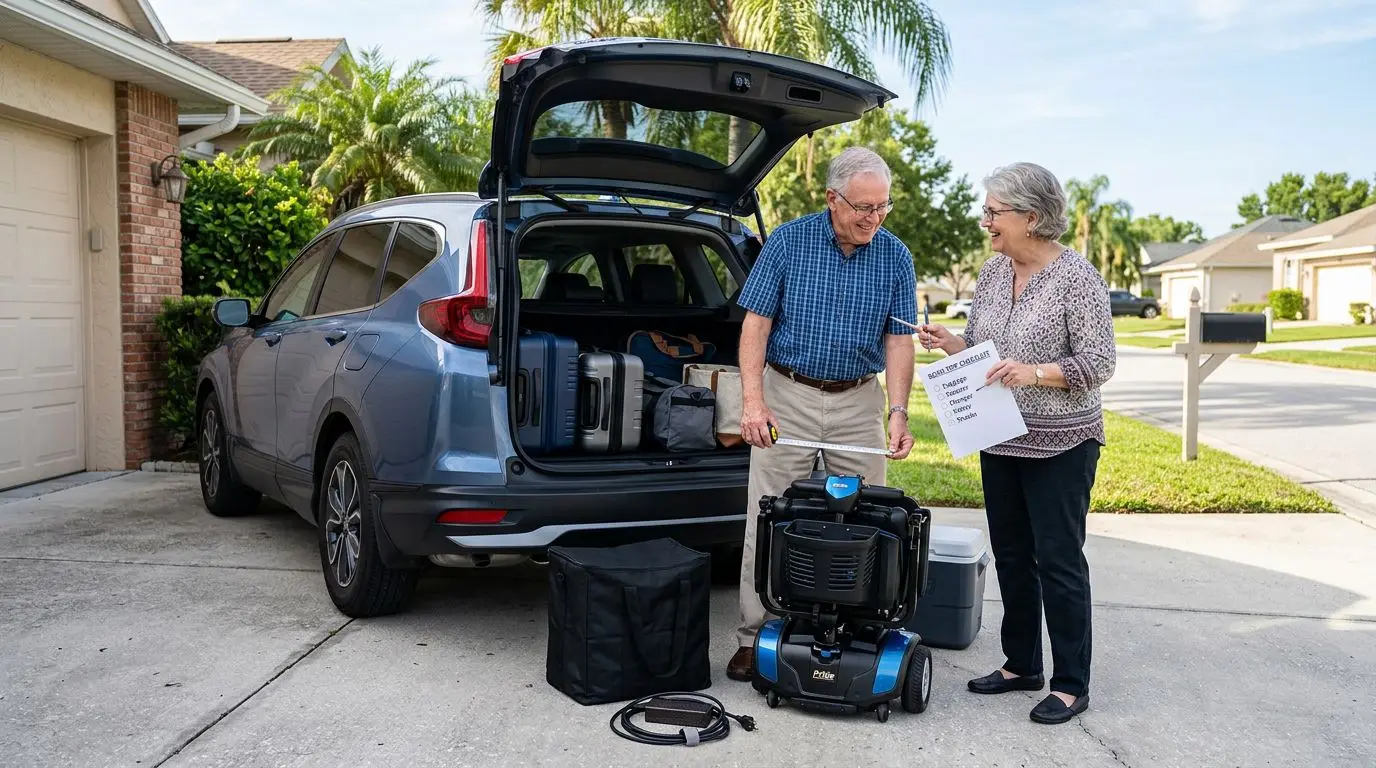
Planning a Road Trip With a Mobility Scooter: Space, Charging, Hotels, and Backup Plans
14 min read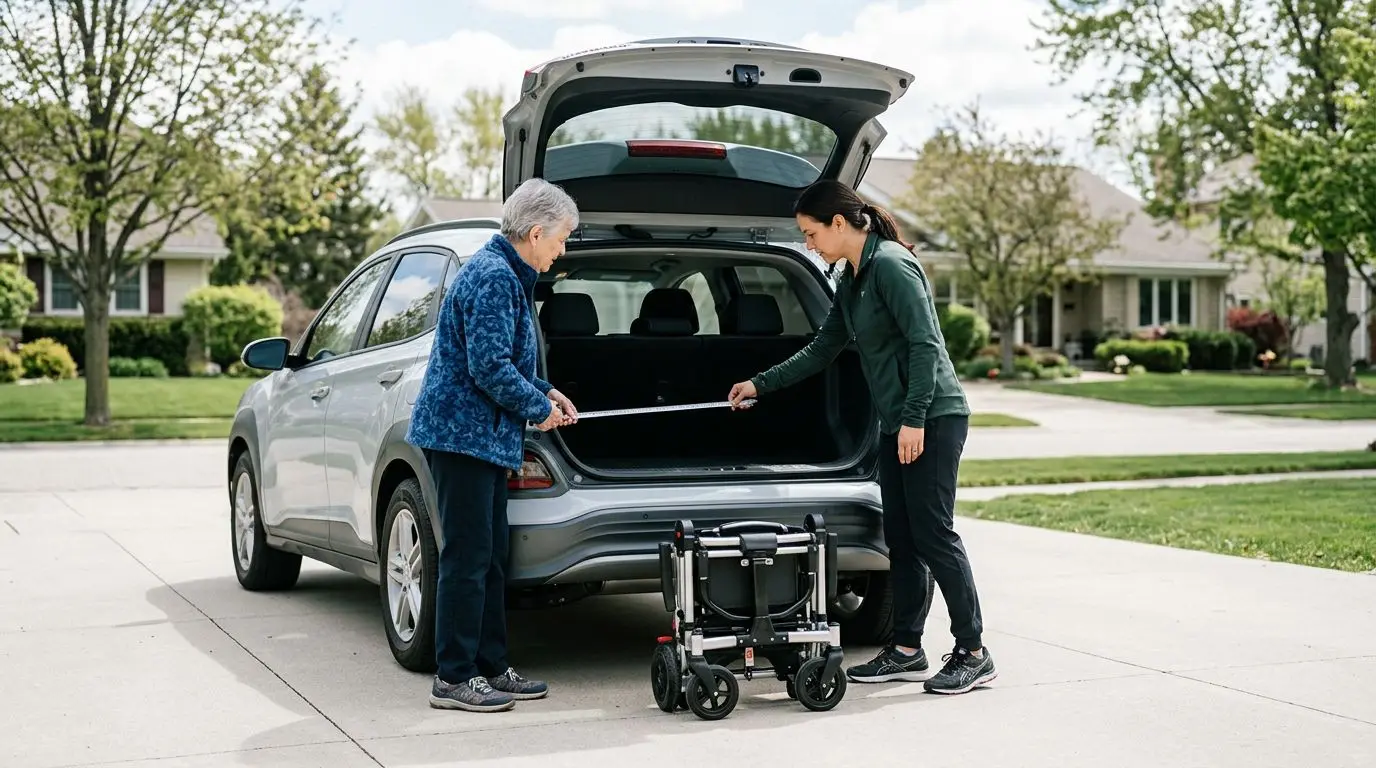
Travel, Folding, and Lightweight Mobility Scooters: What to Know Before You Buy
13 min read