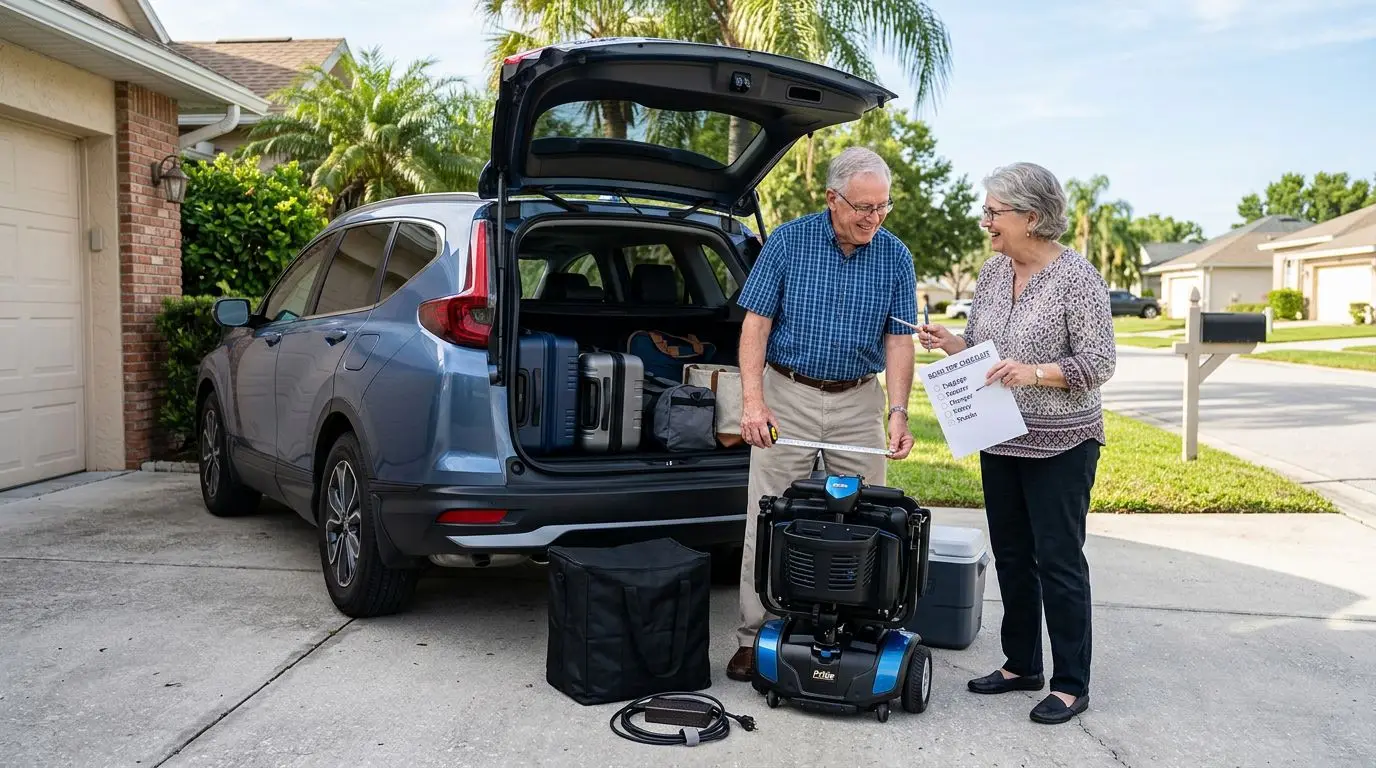
Planning a road trip with a mobility scooter starts with four basics: make sure the scooter fits in or on your vehicle, know how and where you will charge it, confirm hotel accessibility before you arrive, and have a backup plan if something breaks or the battery runs low. The best trip plan is practical, written down, and tested at home before you drive the first mile.
A mobility scooter can make a road trip much easier, but it also brings logistics that are easy to miss. Vehicle cargo height, battery charging time, hotel doorway width, weather exposure, rest stop surfaces, and emergency transportation options can all affect the trip. This guide walks through the real-world details so you can travel with fewer surprises.
1. Start With a 30-Minute Scooter and Vehicle Measurement Check
Before you book hotels or map restaurants, spend about 30 minutes measuring the scooter, the vehicle, and the lifting or loading method you plan to use. A tape measure and a bathroom scale will not answer every question, but they can prevent the most common travel-day problem: finding out the scooter does not fit the way you expected.
Write the numbers down. Do not rely on memory. Measure the scooter in its travel position, since folded tillers, removed seats, and lowered armrests can change the final size by several inches.
How to measure your scooter for a road trip
- Overall length: Measure from the front-most point to the rear-most point. Many travel-size scooters are roughly 37 to 45 inches long, while larger scooters may be closer to 50 inches or more.
- Overall width: Measure the widest part, often the rear wheels or armrests. Common scooter widths range from about 19 to 27 inches.
- Overall height: Measure with the seat attached, then again with the seat removed if you plan to disassemble it.
- Heaviest piece weight: If the scooter comes apart, find the weight of the heaviest section. A manageable total scooter weight is not helpful if one section is still too heavy for the person loading it.
- Ground clearance: Note the clearance under the scooter, often around 2 to 5 inches. This matters on ramps, gravel, steep driveways, and hotel thresholds.
Then measure your vehicle cargo area or hitch setup. For an SUV, hatchback, or van, measure the opening height, cargo floor width, cargo depth with seats folded, and the height from the ground to the cargo floor. For a hitch-mounted platform carrier, confirm the tongue weight rating, hitch class, carrier weight, and the scooter weight together. Do not guess here; exceeding vehicle or hitch ratings can create a serious safety risk.
| Measurement | Why it matters | Practical tip |
|---|---|---|
| Cargo opening height | Determines whether the scooter can enter the vehicle upright | Measure the narrowest part of the hatch, not just the inside space |
| Cargo floor depth | Shows whether the scooter fits without blocking the door | Measure with second-row seats folded if you plan to travel that way |
| Heaviest scooter piece | Controls who can safely lift or load it | Practice lifting it 2 or 3 times before the trip |
| Ramp angle | Affects loading safety and scooter stability | A longer ramp usually creates a gentler angle |
If you use a ramp, practice loading on flat pavement in daylight. A loading method that feels fine in your driveway may feel very different in rain, at night, or in a crowded hotel parking lot.
2. Vehicle Space and Securement Before You Drive 50 Miles
Once the scooter fits, the next question is whether it can ride securely for the whole trip. A scooter that shifts during a sudden stop can damage the vehicle, the scooter, or other luggage. Before taking a 300-mile drive, do a shorter 20- to 50-mile test run with the scooter loaded exactly as it will be on travel day.
Inside a vehicle, use tie-down points if available and keep the scooter from rolling or tipping. Turn the scooter off, remove the key, and engage the freewheel or drive mode according to the manufacturer’s instructions for transport. If the seat removes, take it off or secure it so it cannot slide.
On an outside carrier, pay close attention to weather, road debris, rear visibility, license plate visibility, and exhaust heat. A scooter on the back of a vehicle may sit in the rain for hours. A cover can help, but it must be secured so it does not flap into traffic or block lights. After the first 10 miles, pull over safely and check straps, ramps, and locking pins.
Choosing the right transport approach
The best setup depends on your scooter size, the vehicle, your lifting ability, and whether you will need the scooter at every stop. There is no single best method for every traveler.
| Transport type | Best fit | Watch for |
|---|---|---|
| Disassembled scooter in trunk or cargo area | Travel scooters with removable seat, basket, and battery | Repeated lifting; keeping pieces organized |
| Folded scooter inside vehicle | Compact scooters and larger hatch areas | Folded height, handlebar position, and cargo door clearance |
| Ramp into van or SUV | Users who can guide the scooter safely up a ramp | Ramp angle, traction, and the need for a helper |
| Hitch-mounted carrier | Vehicles with proper hitch capacity and rear clearance | Total weight, rain exposure, lights, and rear departure angle |
| Vehicle lift | Heavier scooters or users who should not lift | Electrical operation, installation requirements, and backup release |
Plan where luggage will go, too. A scooter may fit perfectly only until you add a cooler, walker, oxygen equipment, suitcases, pet supplies, or a folding ramp. Pack the vehicle once at home, then open and close every door. Make sure the driver still has full visibility and that emergency items are reachable without unloading everything.
3. Build a Charging Plan Around 6 to 10 Hours Overnight
Most mobility scooter users should plan around overnight charging, often in the 6- to 10-hour range depending on the battery, charger, age of the battery, and how much charge remains. Your exact charging instructions should come from the scooter’s manual, but the travel rule is simple: do not assume you can fully recharge during a quick lunch stop.
Before the trip, test your real-world range in a safe, familiar area. A scooter’s advertised range can be affected by rider weight, hills, tire condition, temperature, speed, stops and starts, and surface type. If you usually get 8 miles of comfortable use at home, do not plan a 7.5-mile sightseeing day with no charging option. Build in a margin.
Charging questions to answer before departure
- Can the battery be charged on or off the scooter?
- Does the charger need a standard 3-prong outlet?
- How long is the charger cord?
- Will the battery be stored indoors overnight?
- Is the charger packed where you can reach it without unloading the whole vehicle?
- Do you have access to a grounded outlet near the scooter at the hotel?
Ask hotels about outlets before arrival, especially if the scooter cannot be brought into the room easily. Some travelers charge inside the room, while others may need a safe outlet near a lobby, storage area, or accessible entrance. The safest and simplest option is usually charging in your room if the scooter can enter without blocking exits.
Avoid risky charging shortcuts. Do not run long extension cords across public walkways, through puddles, or under doors where the cord can be pinched. If you use a power strip or extension cord, it should be appropriate for the charger and used according to safety guidelines. Never cover a charger with clothing or luggage while it is operating, because chargers can generate heat.
Cold and heat matter too. Batteries often perform worse in cold temperatures, and extreme heat inside a parked vehicle can be hard on electronics and batteries. If you are traveling in summer or winter, store the scooter and battery in a moderate environment whenever possible.
4. Confirm Hotels and Stops Within 48 Hours of Arrival
Online hotel filters are useful, but they are not enough. At least 48 hours before arrival, call the property directly and confirm the details that matter for your scooter. Use plain questions and ask the person to check the actual room notes if possible.
The word “accessible” can mean different things. A hotel may have an accessible parking space and lobby but still have a room layout that is tight for a scooter. A doorway that is about 32 inches clear may work for many mobility devices, but turning space, bed placement, bathroom entry, and thresholds can still be a problem.
What to ask the hotel
- Is the room on the ground floor or near an elevator?
- What is the clear width of the room door and bathroom door?
- Is there a step, raised threshold, or steep ramp at any entrance?
- Can a scooter be parked and charged in the room without blocking the exit?
- Is there an accessible parking space close to the entrance?
- If the elevator stops working, what is the plan for guests who cannot use stairs?
- Is there a covered unloading area during rain?
Think about the full day, not just the hotel. Rest stops, restaurants, scenic overlooks, visitor centers, and gas stations can vary widely. A location may technically have a ramp but still be difficult because of gravel, steep slopes, narrow aisles, or crowded seating. If a stop is important to your trip, call ahead or look for recent photos of the entrance and parking area.
For longer trips, plan accessible stops every 2 to 3 hours even if the driver can go longer. These breaks allow time to check straps, inspect the scooter, charge a phone, use accessible restrooms, and adjust the plan before fatigue builds. Short breaks can prevent rushed decisions later.
5. Make a 3-Part Backup Plan for Battery, Weather, and Breakdowns
A good backup plan does not mean expecting trouble. It means deciding in advance what you will do if the scooter battery runs low, the weather turns bad, or the loading equipment fails. Put the plan in writing and share it with anyone traveling with you.
Backup 1: Low battery
Plan your day so you can turn back while you still have charge remaining. For example, if your comfortable real-world range is 8 miles, avoid using the first 7 miles before thinking about the return trip. Keep the charger with you when practical, and identify places where you could safely wait while someone retrieves the vehicle.
Backup 2: Weather
Rain can affect traction, visibility, controls, and comfort. A scooter that is fine on dry pavement may feel less stable on wet ramps or brick sidewalks. Pack rain protection for the rider and scooter, but do not treat a cover as permission to drive through standing water. If lightning, heavy rain, ice, or high winds are present, the safer choice may be to delay the outing.
Backup 3: Equipment failure
Know how to move the scooter if it will not power on. Many scooters have a freewheel setting, but the procedure varies. Practice at home and make sure a travel companion knows it too. Keep a small kit with the key, charger, basic manual pages, tire information if applicable, and contact numbers for roadside assistance, the hotel, and a local mobility equipment repair service near your destination.
Consider transportation backup as well. If the scooter cannot be used for a day, can the traveler safely use a walker, manual wheelchair, or shorter itinerary? If not, identify accessible taxi, rideshare, shuttle, or rental options in advance. Availability can be limited in rural areas, at night, and during large events.
6. Who This Road Trip Setup Is Best For: 3 Traveler Profiles
Mobility scooter road trips work especially well when the traveler can match the route and equipment to their energy, balance, and support needs. The right setup for a 2-night family visit may be very different from a 14-day sightseeing trip across multiple states.
| Traveler profile | Best road trip approach | Key planning priority |
|---|---|---|
| Independent traveler with a compact scooter | Use a vehicle cargo area if lifting is safe and manageable | Keep the heaviest scooter piece within safe lifting ability |
| Couple or family traveling with a mid-size scooter | Use a ramp, carrier, or lift depending on vehicle capacity | Practice loading and unloading before the trip |
| Traveler needing the scooter at nearly every stop | Choose stops with easy parking and minimal unloading barriers | Reduce repeated disassembly and plan breaks every 2 to 3 hours |
This kind of planning is not only for long vacations. It also helps for medical appointments in another city, holiday visits, weddings, reunions, and snowbird travel. If the trip includes health-related needs, ask a qualified medical professional about travel timing, endurance, medication storage, and safe activity limits. A scooter can support mobility and independence, but it should not be used as a substitute for medical advice.
7. Pack a 2-Day or 2-Week Scooter Travel Kit
A simple travel kit can solve small problems before they change the trip. The list below works for a weekend trip and can be expanded for a 2-week vacation.
Essential scooter items
- Battery charger and any required charging adapter
- Scooter key plus a spare key stored separately
- Owner’s manual pages for charging, freewheel mode, and troubleshooting
- Phone number for service or repair near your destination
- Basic cleaning cloth for dust, rain, or spilled drinks
- Small flashlight or headlamp for nighttime loading
- Bright tape or tag to identify charger and scooter parts
Comfort and access items
- Rain poncho or weather-appropriate outer layer
- Seat cushion if normally used
- Reusable water bottle
- Sun protection for outdoor stops
- Gloves for handling ramps, straps, or cold scooter controls
- Small bag that does not interfere with steering or controls
Vehicle and loading items
- Approved tie-down straps or securement equipment
- Wheel chock or non-slip mat if appropriate
- Towel or mat to protect cargo flooring
- Ramp pins, carrier pins, locks, or keys
- Reflective vest for roadside visibility
- Printed measurements and weight notes
Keep critical items in the same place every day. The charger is the one item you do not want to leave behind at a hotel. Before checkout, do a 60-second room sweep: outlet, bedside table, bathroom, closet, and luggage area.
8. Use a 10-Point Departure Checklist Before Every Drive
A checklist may feel unnecessary on day one, but it becomes valuable when everyone is tired on day five. Use the same 10-point routine before each drive, especially after hotel checkout or a long sightseeing stop.
- 1. Scooter is powered off and key is removed.
- 2. Battery is secured according to the scooter instructions.
- 3. Seat, basket, armrests, and loose parts are secured or removed.
- 4. Charger is packed and easy to reach.
- 5. Tie-downs, straps, ramp pins, or lift locks are checked.
- 6. Vehicle lights, license plate, and rear camera or mirrors are not blocked unsafely.
- 7. Luggage is secured and not pressing on scooter controls.
- 8. Accessible parking placard, if used, is available and valid.
- 9. Next stop has a realistic accessible restroom or unloading option.
- 10. Phone is charged and emergency contacts are available offline.
For longer driving days, repeat a shorter check after the first 10 miles and again at each fuel or rest stop. Small shifts in straps or cargo are easier to fix early.
9. Frequently Asked Questions: 5 Road Trip Details
Can I charge a mobility scooter in a hotel room?
Often, yes, if the scooter can safely enter the room and charge without blocking doors, exits, or walkways. Call the hotel before arrival and ask about outlet access, room layout, and any property rules.
How far can I drive my scooter during sightseeing?
Use your real-world tested range, not the best-case range. Hills, rider weight, temperature, rough surfaces, and frequent stops can reduce battery performance, so keep a safety margin for returning to the vehicle or hotel.
Should I transport the scooter inside the vehicle or on an outside carrier?
Inside transport protects the scooter from weather and road debris, but it requires enough cargo space and safe lifting. Outside carriers can preserve interior space, but they require proper vehicle capacity, secure tie-downs, and weather planning.
What should I do if the hotel room is not accessible when I arrive?
Ask for a manager immediately, explain the specific barrier, and request a room that meets the confirmed needs. If no safe room is available, contact the booking service if used and nearby hotels while documenting names, times, and photos when appropriate.
Is it safe to leave a scooter in the car overnight?
It depends on temperature, theft risk, charging needs, and whether the scooter or battery can tolerate the conditions. In many cases, bringing the battery or scooter indoors is safer and more practical, especially when overnight charging is needed.
Frequently asked questions
Can I charge a mobility scooter in a hotel room? +
Often, yes, if the scooter can safely enter the room and charge without blocking doors, exits, or walkways. Call the hotel before arrival and ask about outlet access, room layout, and any property rules.
How far can I drive my scooter during sightseeing? +
Use your real-world tested range, not the best-case range. Hills, rider weight, temperature, rough surfaces, and frequent stops can reduce battery performance, so keep a safety margin for returning to the vehicle or hotel.
Should I transport the scooter inside the vehicle or on an outside carrier? +
Inside transport protects the scooter from weather and road debris, but it requires enough cargo space and safe lifting. Outside carriers can preserve interior space, but they require proper vehicle capacity, secure tie-downs, and weather planning.
What should I do if the hotel room is not accessible when I arrive? +
Ask for a manager immediately, explain the specific barrier, and request a room that meets the confirmed needs. If no safe room is available, contact the booking service if used and nearby hotels while documenting names, times, and photos when appropriate.
Is it safe to leave a scooter in the car overnight? +
It depends on temperature, theft risk, charging needs, and whether the scooter or battery can tolerate the conditions. In many cases, bringing the battery or scooter indoors is safer and more practical, especially when overnight charging is needed.
Related guides
Can You Take a Mobility Scooter on an Airplane? TSA, Airline, and Battery Rules for US Travelers
15 min read
Mobility Scooters, Taxis, and Rideshares: What to Confirm Before You Book a Ride
14 min read
Renting a Mobility Scooter for Travel: When It Beats Bringing Your Own
13 min read